
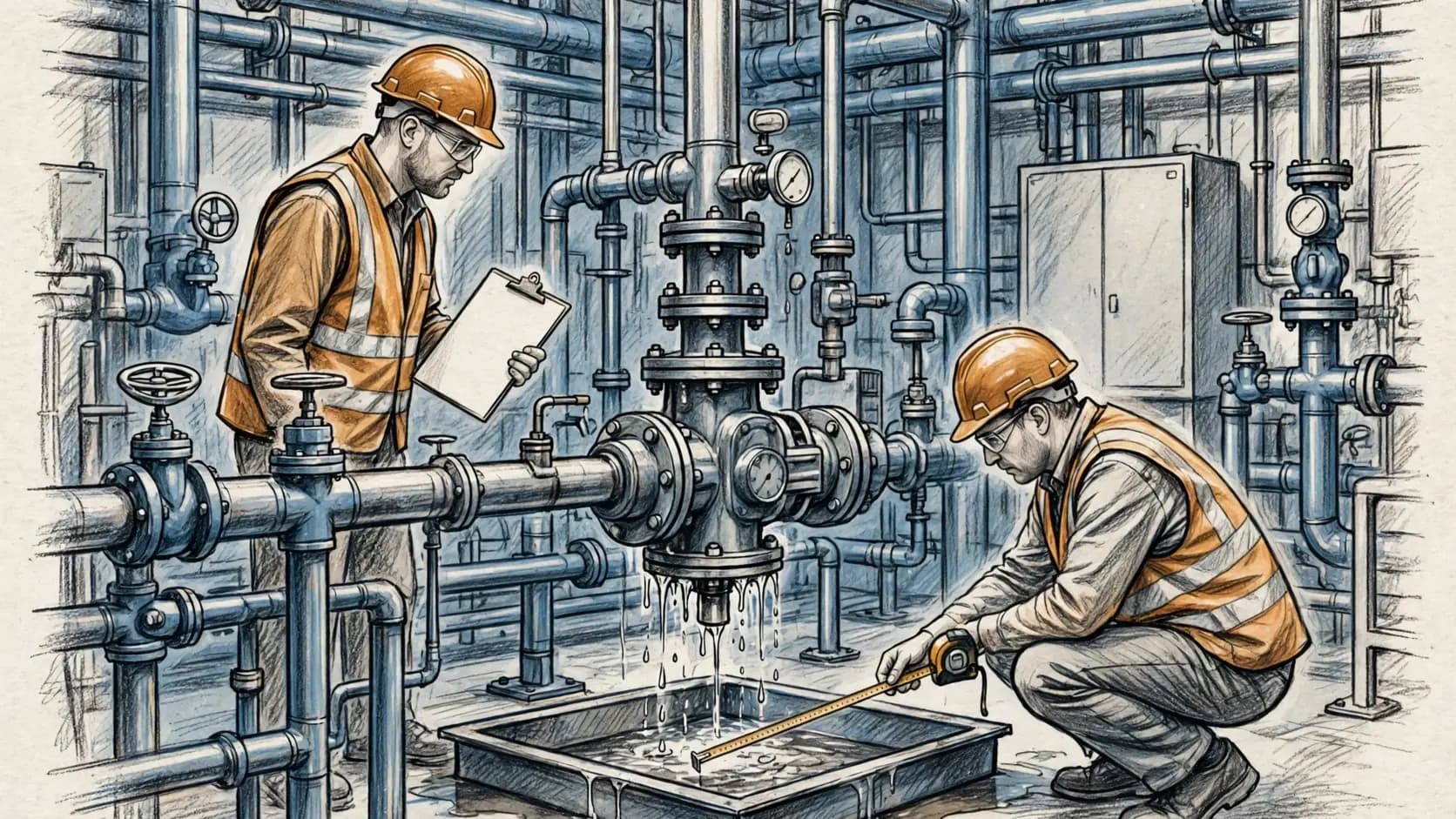
Root cause analysis is a structured investigation that finds the system failure behind a problem, instead of stopping at the symptom. When a worker slips on spilled oil, the symptom is the oil on the floor. The root cause may be a maintenance programme that never inspected the leaking seal. Fix the programme and the spill stops happening; mop the floor and it comes back.
The method applies to injuries, near misses, equipment failures and repeat defects. It works the same way in each case: define the problem, gather evidence, trace the causes back to a system failure, then fix that failure and check the fix worked.
What is root cause analysis?
Root cause analysis (RCA) is a structured way of investigating a problem to find the underlying reason it happened, so the same problem does not happen again. The US Occupational Safety and Health Administration (OSHA) and the Environmental Protection Agency (EPA) define a root cause as "a fundamental, underlying, system-related reason why an incident occurred that identifies one or more correctable system failures". OSHA and EPA fact sheet on root cause analysis
That definition carries two tests. First, the cause must sit in the system: a missing inspection, an out-of-date procedure, a design that invites error. Second, fixing it must be possible. A cause nobody can change is not a root cause worth naming; it is a condition to design around. The American Society for Quality (ASQ) adds that a root cause should be permanently eliminated through process improvement. ASQ on root cause analysis
Three kinds of cause: immediate, underlying and root
The UK Health and Safety Executive (HSE) separates the causes of an adverse event into three layers. The immediate cause is the most obvious reason the event happened. The underlying cause is the less obvious system or organisational reason. The root cause is the initiating failing from which all the other causes spring, and it is usually a management, planning or organisational failing. HSE workbook HSG245
Keeping the three layers apart matters because each level needs a different fix. A missing guard needs refitting today. A supervisor who never checks guards needs a checking routine. Nobody being responsible for guard checks needs a named duty in the management system. Fixing only the first level prevents one repeat; fixing all three prevents a series.
- Immediate cause: the agent or event closest to the harm, such as a missing guard or a slip on a wet floor.
- Underlying cause: the unsafe act or condition that let the immediate cause exist, such as checks not being carried out.
- Root cause: the management or planning failure behind the rest, such as no one being made responsible for the checks.
Root cause analysis is not troubleshooting
Troubleshooting gets things working again as fast as possible. Root cause analysis finds out why normal operation failed in the first place. Both matter, and they usually happen in sequence: restore safe operation first, then investigate. Skipping the second step guarantees the same failure will return, often at a worse moment.
Investigation is also different from blame. HSE guidance states that investigations which conclude operator error was the sole cause are rarely acceptable. Behind most human errors sit conditions that made the error likely: poor training, unclear procedures, awkward equipment or pressure to keep production moving. A good investigation asks what made the mistake easy to make.
Why root cause analysis matters
The strongest reason is prevention. OSHA and the EPA state that addressing root causes may substantially or completely prevent the same or a similar incident from recurring. Each repeat incident carries its own cost: injury, damage, disruption, emergency response and clean-up. Preventing the repeat removes all of them at once.
There is also a legal dimension. In the United States, employers covered by OSHA's Process Safety Management standard must investigate incidents that resulted in, or could reasonably have resulted in, a catastrophic release of highly hazardous chemicals. Facilities under the EPA's Risk Management Program must conduct incident investigations too. Both agencies urge employers to go beyond the minimum investigation and conduct a root cause analysis, as set out in the OSHA and EPA fact sheet on root cause analysis.
- Fewer repeat incidents, because the fix removes the mechanism that produced the failure.
- Lower costs from rework, downtime, emergency response and claims, which stop recurring once the cause is gone.
- Better risk assessments, because findings show where existing controls were missing or weak.
- Stronger trust with workers, who see problems fixed rather than filed away.
- Evidence for insurers and regulators that the organisation investigated thoroughly and acted.
OSHA and the EPA add a financial warning: litigation costs can often substantially exceed fines. A thorough investigation that finds and fixes root causes is cheaper than defending the next incident. It also builds a record that the organisation takes prevention seriously.
Root cause analysis methods
No single method fits every problem. The right choice depends on how complex the problem is, how much data exists, and how many people need to be involved. The table compares the six methods covered in the sections that follow. For most day-to-day problems, a fishbone diagram followed by the 5 Whys covers the ground well.
| Method | Best for | How it works | Effort |
|---|---|---|---|
| 5 Whys | Simple to moderate problems | Ask "why" repeatedly until the chain reaches a correctable system cause | Low |
| Fishbone diagram (Ishikawa) | Problems with several possible causes | Map causes under categories such as people, process, equipment and environment | Medium |
| Pareto analysis | Choosing which problem to tackle first | Rank causes by frequency or impact and fix the few that drive most of the harm | Medium |
| Fault tree analysis | Safety-critical failures | Build a logic tree from the top event down through combinations of failures | High |
| Failure mode and effects analysis (FMEA) | Preventing failures before they happen | Score each failure mode by severity, occurrence and detectability | High |
| 8D problem solving | Complex cross-functional problems | Eight-discipline team process with containment, root cause and prevention | High |
Quality practice adds three more approaches, described by ASQ. Events and causal factor analysis builds a timeline for a major single event. Change analysis looks at what changed when performance shifted. Barrier analysis checks which controls should have prevented or detected the problem, and which ones failed.
The 5 Whys
The 5 Whys is the simplest root cause analysis method. Write down the problem, ask why it happened, take that answer and ask why again. Repeat until the chain reaches a cause the organisation can correct. Five is a guideline, not a rule: some chains end after three whys, others need seven.
The method only works with evidence. Every answer needs a record, a measurement or a witness account behind it. An answer nobody can support is speculation, not analysis. If the chain ends at "operator error", keep asking: why was the error possible, and what system failed to prevent it?
TipWrite each answer down before asking the next why. A spoken chain drifts; a written chain can be checked against the evidence.
Fishbone diagram
A fishbone diagram, also called an Ishikawa or cause-and-effect diagram, maps possible causes under headings that branch off a central spine. The problem sits at the head of the fish. Common headings are the 6Ms: man (people), machine (equipment), method, material, measurement and mother nature (environment). The headings force the team to look beyond the first explanation.
The team lists every plausible cause under each heading, then tests each one against the evidence and crosses out the ones with no support. What survives becomes the shortlist for deeper work, often with the 5 Whys. The diagram suits problems where several departments are involved or where the cause is not obvious.
NoteBrainstorm first, judge second. Crossing out a cause too early hides the one that matters.
Pareto analysis
Pareto analysis applies the 80/20 rule: a small number of causes usually drive most of the impact. List the problems or causes observed, count how often each one occurs, and rank them. The few causes at the top deserve the investigation effort; the long tail can wait.
The method needs data, so it suits repeat problems with a history: recurring defects, repeat near misses, frequent breakdowns. It offers little for a single incident in isolation, where there is nothing to count. Use it to decide which problem to investigate first, not to find the cause itself.
Fault tree analysis
Fault tree analysis starts with the unwanted event at the top of a diagram and works backwards. Each branch shows how smaller failures combine to produce the event, using AND gates (all conditions must be present) and OR gates (any single condition is enough). The tree shows every path to the failure, not just the one that happened.
The method suits safety-critical and engineering failures, where understanding every combination matters more than speed. It takes time and needs people who understand the system. For a simple workplace incident, it is usually more than the problem needs.
Failure mode and effects analysis
Failure mode and effects analysis (FMEA) is the proactive member of the set: it looks for failures before they happen. The team walks through each step of a process, asks what could fail at that step, and scores each failure mode on severity, likelihood and detectability. The scores combine into a risk priority number that ranks the failures.
FMEA fits new processes, new equipment and high-risk tasks, where preventing a failure is worth more than investigating one. It is thorough and resource-intensive, so reserve it for work where the consequences of failure justify the effort. Use it alongside a risk assessment when a new task or process is being planned.
WarningDo not use FMEA scores as a substitute for fixing a known hazard. A high score demands action, and a low score never excuses inaction.
How to do a root cause analysis
The steps follow the structure used by HSE guidance and by OSHA and the EPA: gather the facts, analyse them, choose controls, then act and check. Match the depth of the investigation to the risk. HSE guidance sets the level by the potential consequences and the likelihood of recurrence, not only by the harm suffered on the day. A near miss with serious potential can deserve more attention than a minor injury.
Start the investigation quickly, while memories are fresh and before the scene is disturbed. Keep the focus on systems, not on blame. Involve the people who do the work: they know where the cracks are, and they will be the ones living with the fix.
Step 1: Respond and make the scene safe
Care for injured people first and stop further harm. Give first aid, check the first aid kit is stocked and accessible, and call emergency services where needed. Make the area safe: stop the work, isolate energy or shut down equipment, and keep people away from the hazard.
Crews that practice emergency procedures regularly respond faster and calmer when a real incident happens. Preserve the scene for the investigation. Do not move equipment, clean up or restart work until the facts are recorded, unless leaving things as they are creates a danger. Photograph positions, damage and conditions before anything changes. Evidence lost in the first hour rarely comes back.
Step 2: Define the problem
Write a specific, measurable problem statement. "Accidents are up" is too vague to investigate. "Three hand injuries on the press brake in six weeks, all during jam clearance" can be investigated. A tight statement keeps the analysis on one problem and shows when it is solved.
Record what happened, when, where, who was involved and what was being done at the time. Note what did not happen too: which guards were in place, which alarms sounded, which checks were done. The gaps in the picture often point at the cause. Agree the scope with the team before gathering evidence, so the investigation does not drift.
Step 3: Gather evidence
Collect facts before forming theories. Interview the people involved separately, ask open questions and listen without leading. Memory fades fast, so talk to witnesses on the day where possible. Record what each person saw and did, in their own words, and note where accounts disagree.
Gather the documents that describe how the work was supposed to happen: risk assessments, procedures, training records, maintenance logs, inspection reports and permits. Compare them with what actually happened. The difference between the written procedure and the real work is often where the cause hides.
- Photographs, sketches and measurements of the scene and the equipment.
- Maintenance and inspection logs, including overdue checks and past defects.
- Training and competence records for everyone involved in the task.
- The current risk assessment and the procedure in force on the day.
- Records of earlier incidents, near misses and corrective actions.
Step 4: Build the timeline and find the causes
Put the events in order, from the start of the task to the outcome. A timeline shows the sequence and exposes the gaps: a missing check, a delayed warning, a change nobody recorded. Use a fishbone diagram to map possible causes across categories, then test each one against the evidence gathered in step 3.
Drill down with the 5 Whys on the causes that survive. Keep asking until the chain reaches a management, planning or organisational failing that can be corrected. Expect more than one root cause: most serious problems have several, and each one needs its own fix. Check the chain by asking the reverse question: if this cause were removed, would the incident still have happened?
Step 5: Agree corrective actions
Choose controls that address each root cause, starting at the top of the hierarchy: eliminate the hazard, substitute something safer, engineer it out, change the way the work is done, and only then rely on protective equipment. Check PPE requirements before treating protective equipment as the fix; it is the last line of defence, not the first.
Write each action so it can be checked: a named owner, a deadline, and a clear description of what "done" looks like. Vague actions such as "remind staff to be careful" fix nothing. A specific action such as "fit interlocked guards to all three press brakes by the end of next month, owned by the engineering manager" can be verified. Review the risk assessment alongside the actions, so the controls are written into the way the work is done.
Step 6: Verify the fix and standardise it
An investigation is not finished when the report is written. Check that each action was done, on time, and that it works. Measure whether the problem has stopped: no repeat incidents, no repeat near misses, no return of the same defect. A corrective action that is never verified is only a hypothesis.
Once the fix is verified, write it into the system: update the procedure, the training material and the risk assessment so the change survives staff turnover. Share the lessons with other teams doing similar work, so they do not have to learn them the hard way. File the investigation record where the next investigator can find it.
AlertShare the findings with the workers involved. People who see their evidence lead to a real change will report the next near miss; people who never hear back will stop reporting.
Worked examples
Two examples show the same discipline at work. The first is the example OSHA and the EPA use in their fact sheet. The second is an illustrative example built on HSE's cause layers, showing how a familiar workshop injury traces back to a management failing.
Example 1: The oil spill on the plant floor
A worker slips on a puddle of oil on the plant floor and falls. A traditional investigation finds the cause to be "oil spilled on the floor" and the remedy is to clean up the spill and tell the worker to be more careful. The spill returns, because nothing has changed. Spilled oil is also a chemical hazard: it can injure workers, damage the environment and create a fire risk.
A root cause analysis keeps asking why. Why was the oil on the floor? A seal on a pump had been leaking for weeks. Why was the leak not found? No inspection covered that pump. Why not? The mechanical integrity programme, which covers inspection and repair, did not include it. The root cause was the gap in the programme, not the puddle.
- Why did the worker fall? The floor was covered in oil.
- Why was oil on the floor? A pump seal had been leaking for weeks.
- Why was the leak not found? No inspection covered that pump.
- Why did no inspection cover it? The mechanical integrity programme did not list it.
- Why was it not listed? The pump was added after the programme was last updated, and nobody updated the programme.
The fix follows the root cause: add the pump to the inspection programme, inspect every pump added since the last update, and set a rule that new equipment cannot enter service until it is on the programme. Cleaning the floor is still needed, but it is containment, not a cure.
Example 2: The missing machine guard
A worker cuts a hand on a press brake while clearing a jam. The guard had been removed to reach the jam and was never refitted. That is the immediate cause, and refitting the guard is the first action. But the investigation must ask why the guard was off, and why nobody noticed.
The answers form three layers. The guard was removed because it slowed jam clearance and the task had no safe alternative. Supervisors had stopped carrying out pre-start checks, so the missing guard went unnoticed for a week. Nobody had been made responsible for checking that guards were refitted after maintenance. The root cause sits in that last answer: a missing duty in the management system.
- Immediate cause: the guard was missing when the worker cleared the jam.
- Underlying cause: pre-start checks were not being carried out, so the missing guard went unnoticed.
- Root cause: no one was made responsible for checking that guards were refitted after maintenance.
The corrective actions match the layers: refit the guard, reinstate pre-start checks with a signed checklist, and name a person responsible for guard checks after every maintenance job. Each action has an owner and a deadline, and the checks are audited for the first month to confirm they happen.
WarningNever record "operator error" as the root cause. HSE guidance is clear that investigations ending there are rarely acceptable, because the conditions that made the error likely stay in place.
Common mistakes
Root cause analysis is easy to do badly. These are the failure modes that appear most often, and each one leaves the real cause in place.
- Stopping too early: naming the first plausible cause instead of tracing the chain to a system failure.
- Ending at "human error": blaming the worker instead of asking what made the error possible.
- Confusing contributing factors with root causes: treating every factor as equal, so actions scatter and nothing is fixed properly.
- Guessing instead of evidencing: accepting an answer with no record, measurement or witness behind it.
- Analysis without action: writing a report with no owner, no deadline and no check that the fix worked.
- Scope creep: trying to explain every bad outcome at once, which produces vague findings instead of a sharp fix.
When to run a root cause analysis
Not every problem needs a full investigation, but some always do. The depth should match the risk: a fatality or a major release needs a team investigation led by senior management, while a minor injury may need only a short look by the supervisor. HSE guidance sets the level by what could have happened and how likely it is to happen again.
- Any injury or case of ill health at work, including a cluster of illness such as Legionnaires' disease cases linked to one building.
- Any near miss with serious potential, including a load falling where someone had just been standing.
- A repeat problem: the same defect, breakdown or incident happening again after a fix.
- An audit finding or a regulator's notice that points at a system weakness.
- Exposure to a hazardous substance, such as asbestos, where the controls may have failed.
Investigating near misses is often easier than investigating accidents, and it prevents the accident that has not happened yet. HSE guidance notes that earlier warnings were ignored before several major disasters. A near miss reported and investigated is a warning acted on, not a warning missed.
AlertReportable incidents still need reporting. An internal investigation does not replace a report to the enforcing authority where the law requires one.
Frequently Asked Questions
What is the difference between root cause analysis and the 5 Whys?
Root cause analysis is the broad discipline of finding the underlying cause of a problem. The 5 Whys is one method used inside it. An investigation can use many tools; the 5 Whys is the most accessible, but it is not always the right one for a complex problem.
Which root cause analysis method should I use?
Start with the 5 Whys for a straightforward problem. Use a fishbone diagram when several departments are involved or the cause is not obvious. Use Pareto analysis to choose between several problems. Use fault tree analysis or FMEA for safety-critical work.
How many root causes can a problem have?
More than one. Most serious problems have several root causes, and each one needs its own corrective action. A single investigation often finds a primary cause plus two or three contributing factors.
How long does a root cause analysis take?
It depends on the problem. A simple 5 Whys session can take an hour. A team investigation of a serious incident can take weeks, with evidence gathering, interviews and verification. Match the effort to the risk, not to the calendar.
Should root cause analysis blame anyone?
No. The purpose is to find system failures and fix them, not to assign fault. Stopping at a person's mistake leaves the conditions that caused it in place.
Can root cause analysis be used outside safety?
Yes. The same methods apply to quality defects, repeat breakdowns, customer complaints and process failures. Root cause analysis grew out of total quality management, and the discipline is the same wherever a recurring problem needs a permanent fix.
What happens after the root cause is found?
Agree corrective actions with an owner and a deadline, check that each action was done, and measure whether the problem has stopped. Then write the fix into procedures, training and the risk assessment so it lasts.
Sources
Each link was checked before publication. HSE's workbook HSG245 was published in 2004 and remains current guidance, but its RIDDOR details refer to the 1995 regulations; check current reporting rules against the 2013 regulations.
Leave a Reply