
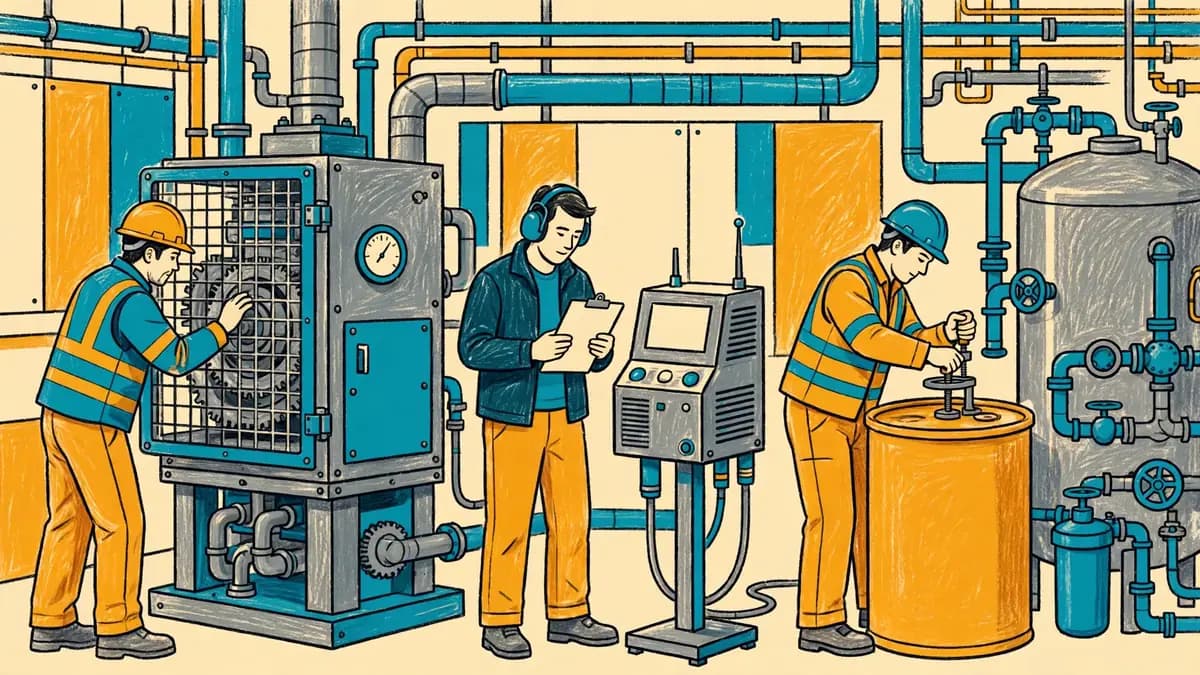
EHS stands for environment, health and safety. It is the name for the work of protecting people from injury and illness at work. It also covers limiting the harm a workplace causes to the air, water and land around it.
The three letters describe one discipline, not three separate jobs. A chemical spill can injure a worker, expose others to harmful vapour and contaminate nearby water at the same time. Managing the three kinds of harm together is the whole point of EHS.
What does EHS stand for?
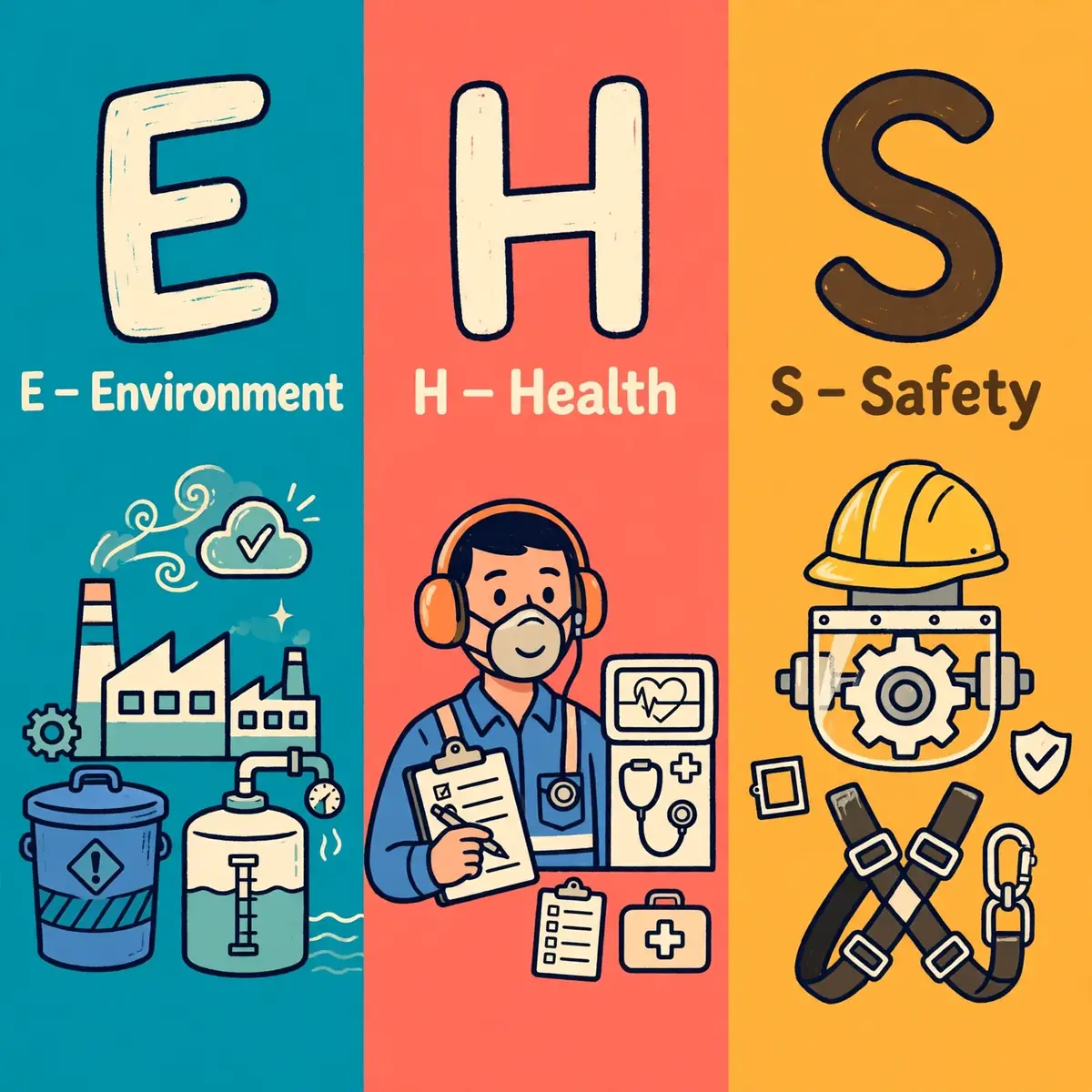
EHS stands for environment, health and safety. The letters spell out the three kinds of harm that work can cause. Each letter names a different part of the job, and each part needs different experts, different controls and different records.
The EHS meaning is easiest to remember letter by letter: E for the environment outside the site, H for health inside the body, S for safety in the moment. Some organisations write the letters as EH&S, with an ampersand. The meaning is the same. In the United States and in many US-headquartered multinationals, EHS is the usual term. Other regions use different letter orders for the same discipline.
Environment
Environment covers how operations affect the air, water, land and wildlife around a site. Typical work includes tracking emissions and waste, holding environmental permits, managing spills and meeting the conditions a regulator sets. Many teams also report on energy use and carbon as part of wider sustainability goals.
The duty does not stop at the front gate. Waste that leaves a site still has to be tracked to its final destination, with transfer records and disposal documents to prove it followed the rules at every step. Permits, monitoring results and waste records together tell the story of where materials ended up.
Health
Health covers harm that builds up over time rather than in a single event. Common examples are noise, dust, chemical exposure, vibration, manual handling and stress. A worker who breathes in dust or fumes for years and develops a lung illness has a health problem, and the damage often shows up long after the exposure.
Typical work includes exposure monitoring, health surveillance, occupational hygiene assessments and return-to-work support. Health risks are harder to spot than safety hazards because there is often no single event to investigate. The clues show up slowly: a measurement, a group of workers with similar symptoms, or an illness that appears years later.
Safety
Safety covers the prevention of injuries and accidents. Typical work includes risk assessment, incident reporting and investigation, permits to work, equipment inspections, contractor controls and safety training. Common hazards are falls, moving machinery, electricity, fire, pressure and vehicles sharing the floor with people.
An incident has a time, a place and an immediate result, which makes safety problems easier to report than health risks. Being easy to report is not the same as being prevented. A workplace can be excellent at writing up accidents after they happen and still do a poor job of stopping the next one.
TipWhen you see EHS in a job advertisement, read the three letters as three kinds of harm. Then ask which of them the role spends most of its time on.
How the three parts overlap
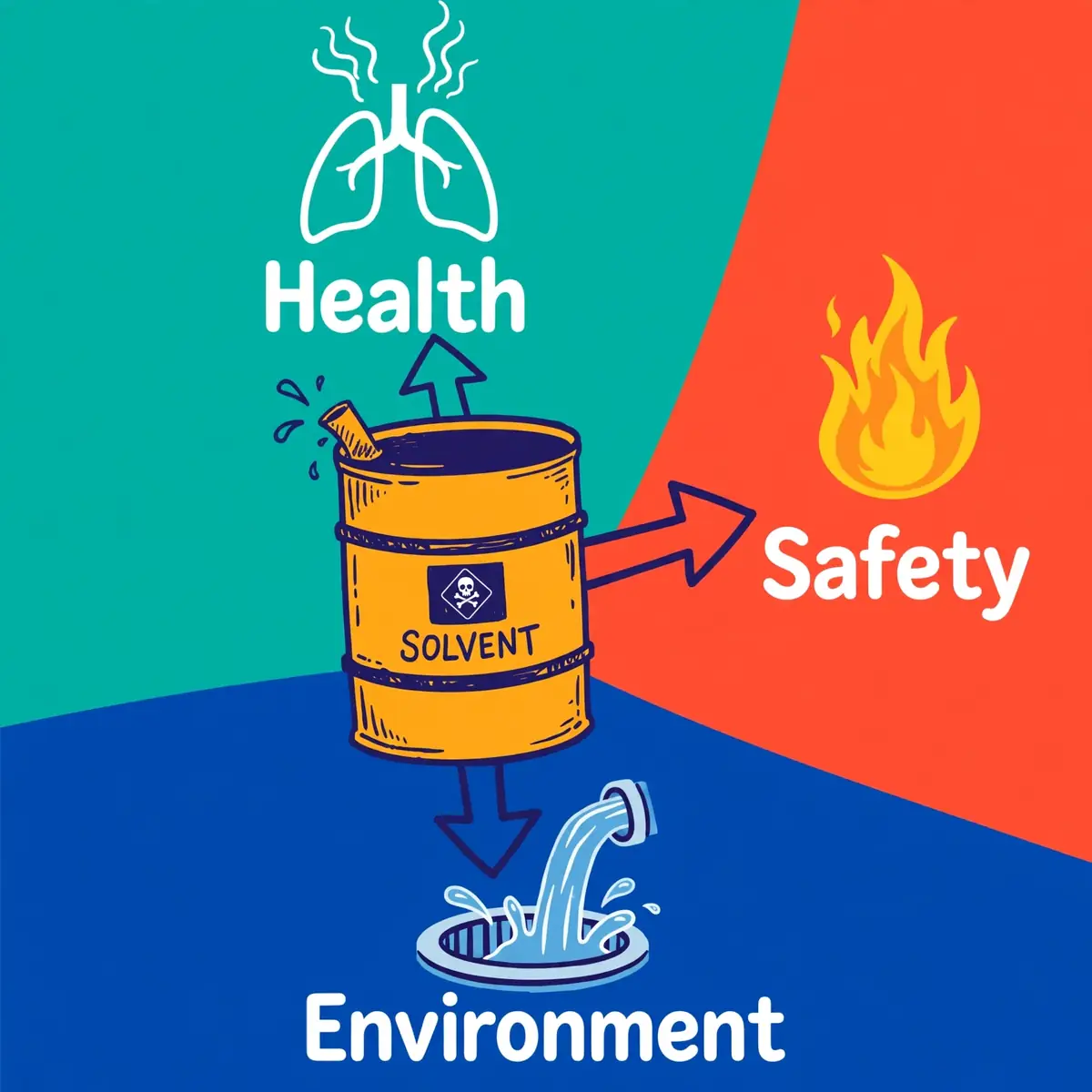
The three pillars are a helpful way to think, not a set of walls between separate problems. Real hazards rarely fit neatly into one box. A drum of solvent shows the overlap clearly. Breathing the vapour harms health, ignition causes a fire and an immediate injury, and a spill that reaches a drain damages the environment.
Managing that drum through three unconnected processes would duplicate work and leave gaps between teams. One assessment can identify all three forms of harm, so storage controls, worker protection, spill response and disposal get chosen together. Skip the assessment and the harm still arrives, which is the practical case for taking EHS as one discipline.
WarningNever treat a chemical hazard as a safety problem alone. Check the health exposure and the environmental release in the same assessment, or the fix will cover only one third of the risk.
EHS vs HSE, OHS and WHS: what is the difference?
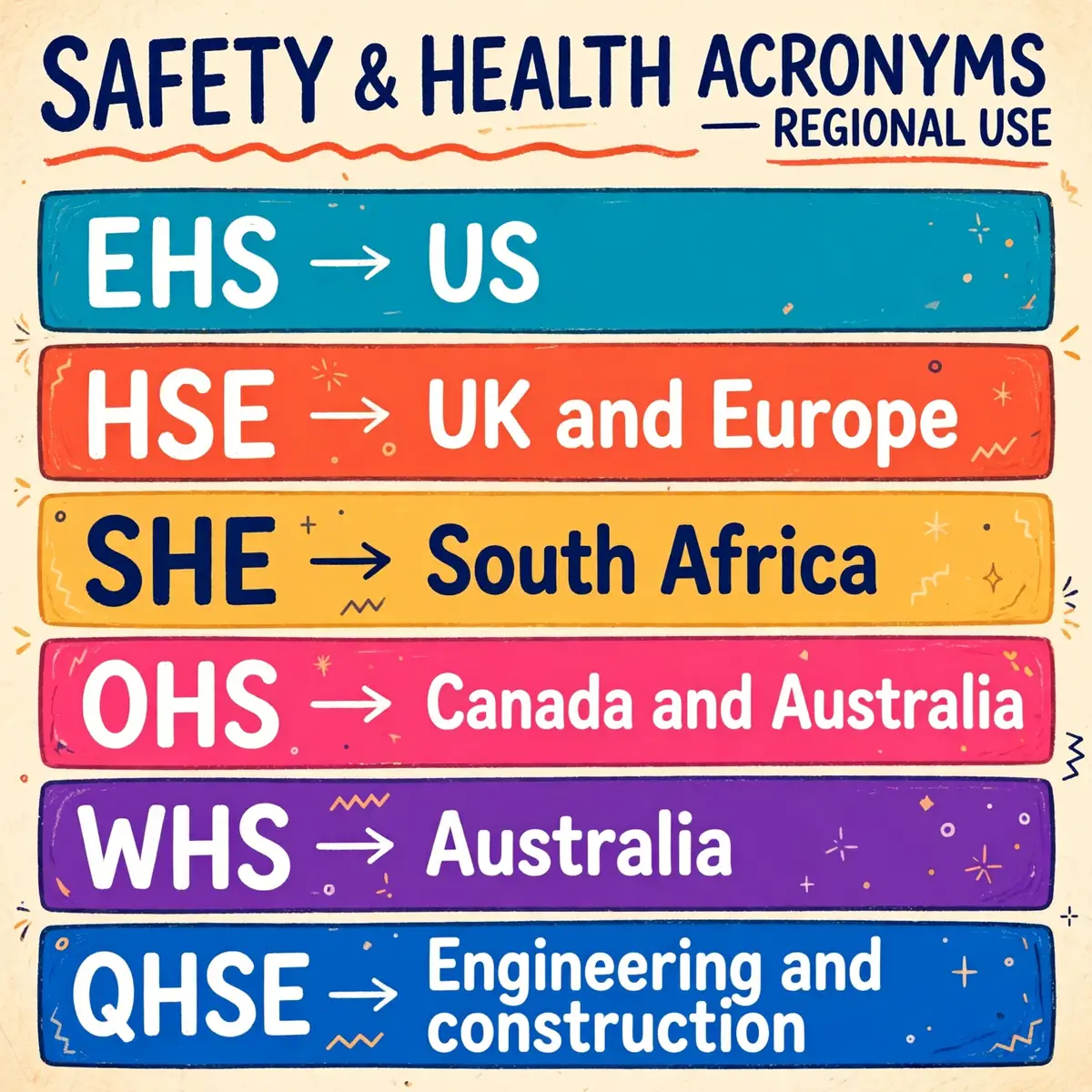
The acronyms describe the same core idea with a different emphasis. Which one an organisation uses usually depends on its country, its industry and its regulator. The order of the letters mostly echoes the name of the local regulator: OSHA in the US, the Health and Safety Executive (HSE) in the UK.
| Term | Stands for | Where it is common | What it signals |
|---|---|---|---|
| EHS | Environment, health and safety | US and global enterprises | Environment, health and safety managed together |
| HSE | Health, safety and environment | UK, Europe, and oil and gas | Same scope as EHS, with safety listed first |
| SHE | Safety, health and environment | South Africa, mining and utilities | Same scope, safety listed first |
| OHS | Occupational health and safety | Canada, Australia and international standards | Worker health and safety, environment often handled separately |
| WHS | Work health and safety | Australia | Legal term under the model WHS laws |
| QHSE | Quality, health, safety and environment | Engineering, construction and manufacturing | EHS plus quality management in one system |
The practical difference is scope. EHS, HSE and SHE cover environmental management as well as worker safety. OHS and WHS focus on people at work. QHSE adds quality. When you search for tools or standards, check what a vendor or document means by the term rather than relying on the acronym alone.
One confusion is worth naming directly. HSE is both the name of the discipline in the UK and the name of the UK regulator, the Health and Safety Executive. A document that says "the HSE requires" usually means the regulator, not the discipline.
Why EHS matters at work
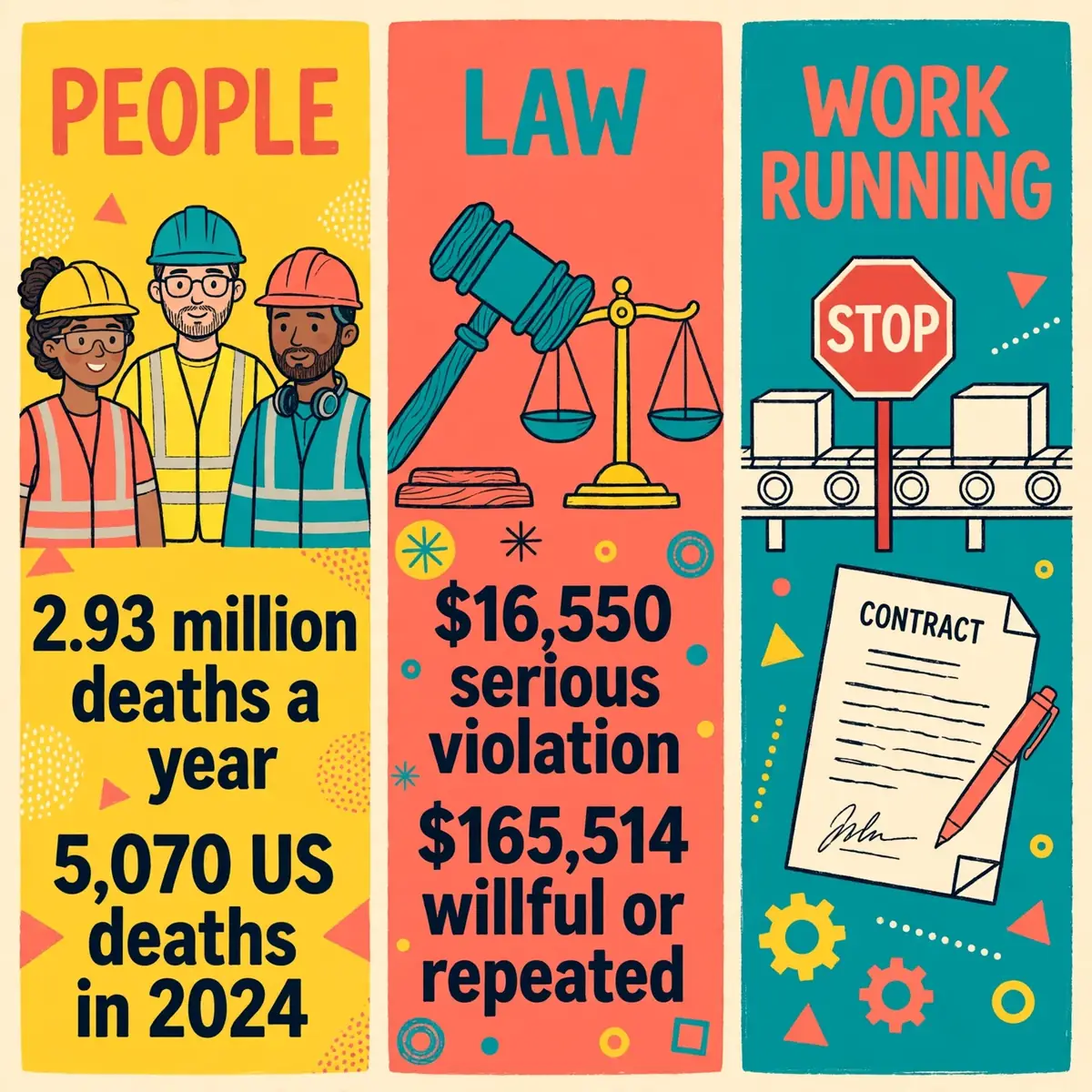
EHS failures hurt people, the environment and the business at the same time. That is why EHS has moved from a site-level function to a board-level risk. The reasons fall into three groups: people, the law, and keeping work running.
It protects people
The International Labour Organization reports that 2.93 million workers die each year as a result of work-related factors. A further 395 million sustain a non-fatal work injury each year. Most of those deaths come from occupational disease, not from single accidents. A safe and healthy working environment has been recognised by the ILO since 2022 as a fundamental principle and right at work.
In the United States, 5,070 workers died from work-related injuries in 2024, according to the Bureau of Labor Statistics. That is down from 5,283 in 2023, a rate of 3.3 deaths per 100,000 full-time workers — a worker dying every 104 minutes. Behind each number is a real person, and usually a family and co-workers who feel it too.
It keeps the business on the right side of the law
Regulators can inspect, fine and prosecute. In the US, OSHA's maximum civil penalties stand at $16,550 per serious violation and $165,514 per willful or repeated violation. The amounts apply per violation, so an inspection that turns up several problems at once adds up fast.
Elsewhere, sanctions can include site closure, market restrictions and imprisonment of responsible managers. In one 2026 benchmark of senior compliance leaders, 19% had taken a regulatory fine or penalty linked to regulatory complexity in the past 12 months. In the same benchmark, 53% saw legal or consulting costs rise.
AlertEHS as a department is not a legal requirement, but the duties it covers are. Laws require employers to manage safety, health and environmental impacts whether or not anyone on site carries the EHS title.
It keeps work running and markets open
A serious incident or a permit breach can stop operations. Production stops. The company reports the injury to a regulator, and an investigation follows. If the same dangerous setup exists at other locations, the fixes have to be rolled out everywhere. One injury in one building can end up reshaping how the whole company operates.
Customers, insurers and lenders increasingly ask suppliers for evidence of EHS performance before they sign. Many tenders ask for safety records, and standards such as ISO 45001 and ISO 14001 give organisations a recognised framework to show. A weak record can cost a contract as surely as a fine can cost money. A business continuity plan depends on the same controls holding.
Who is responsible for EHS?
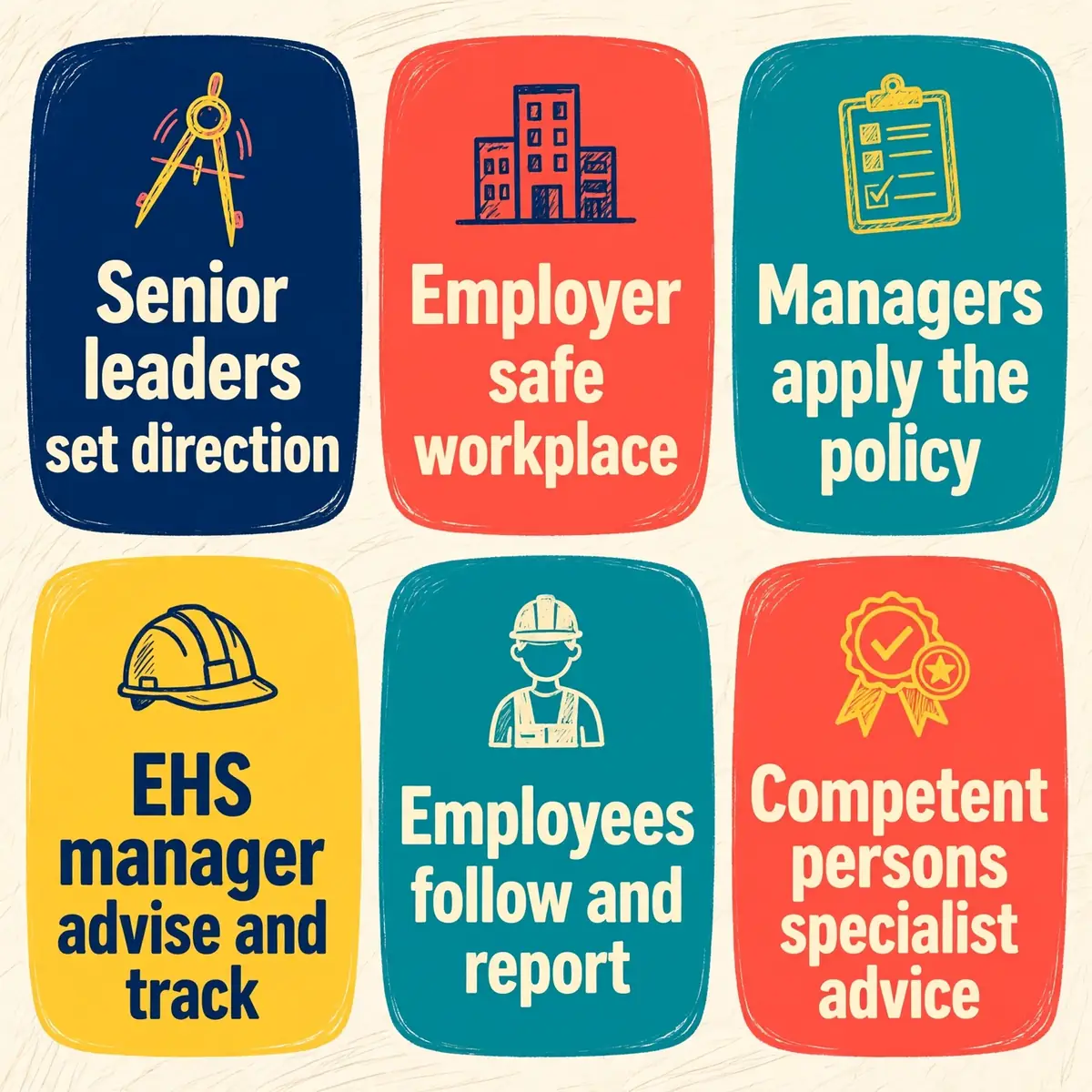
Everyone has a part to play, but the legal duty sits with the organisation and its leaders. The exact wording differs by country, though the pattern is similar: the employer owes the duty, managers apply it, specialists advise on it, and workers follow it and report problems.
| Role | Main responsibilities |
|---|---|
| Senior leaders and directors | Set direction, provide resources and stay informed about risk |
| Employer or business owner | Provide a safe workplace, safe systems of work, training and equipment |
| Managers and supervisors | Apply the policy in their area, run inspections, act on hazards, make sure people are trained |
| EHS manager or team | Advise leaders, build and maintain the programme, track compliance, lead investigations |
| Employees and contractors | Follow procedures, use equipment correctly, report hazards and incidents, raise concerns |
| Competent persons and safety representatives | Provide specialist advice, represent workers, support consultation |
Assign each EHS duty to a named role. Unowned duties are the ones that get missed. A policy that sits in a folder protects no one. The test is simple: ask a frontline worker where the policy is and what it says about their job.
What does an EHS manager do?
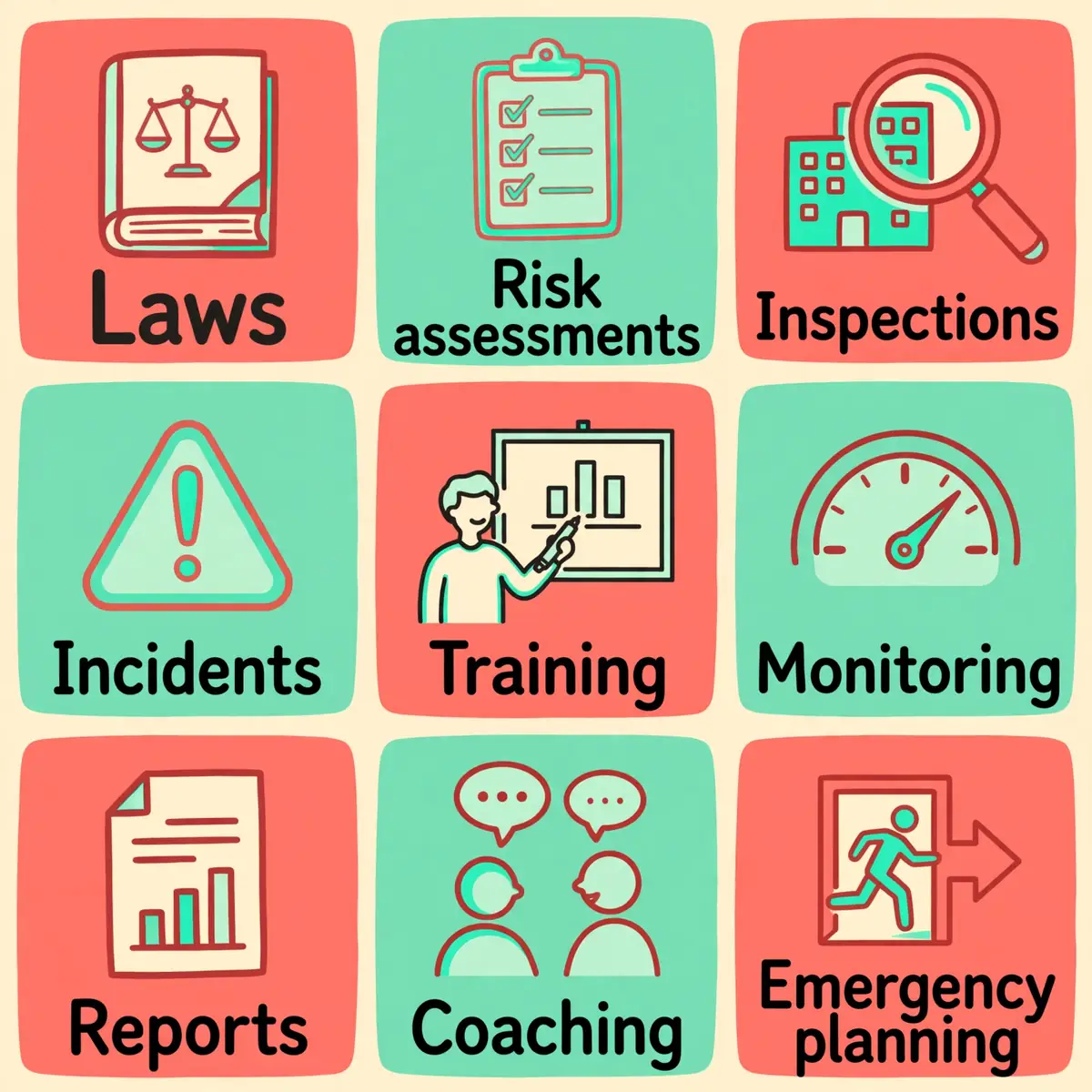
An EHS manager leads the day-to-day work of keeping a site or organisation safe and compliant. The title varies, and some companies use HSE manager or safety manager, but the core tasks are consistent. The role typically covers permits, risk assessments, incident investigations, training, audits, emergency planning and tracking regulatory change.
- Identify the laws, permits and standards that apply and track changes to them
- Carry out and review risk assessments
- Run workplace inspections and audits and follow up on actions
- Manage incident reporting, investigation and root cause analysis
- Plan and deliver training, and keep training records current
- Monitor environmental and health indicators such as emissions, waste and exposure
- Prepare reports for leadership and regulators
- Coach managers and supervisors on their EHS duties
- Lead emergency planning and drills
Much of this work is repeat tasks with due dates, so EHS managers spend a lot of time chasing actions and collecting evidence. Digital tools can reduce the paperwork and give leaders a clearer view of open actions. The EHS manager still makes the judgment calls.
Skills and background
EHS managers usually combine technical knowledge with influence skills. Many hold a degree or a professional qualification in health and safety or environmental science. Common examples are NEBOSH in the UK and the Certified Safety Professional (CSP) credential in the US. Clear communication matters as much as technical knowledge because the role depends on persuading others to act.
Training is part of the job on both sides. The manager plans training for the workforce and keeps the records current, and also keeps their own knowledge current as laws and standards change. OSHA training rules set the topics and the refresher intervals for many US workplaces.
What an EHS programme includes
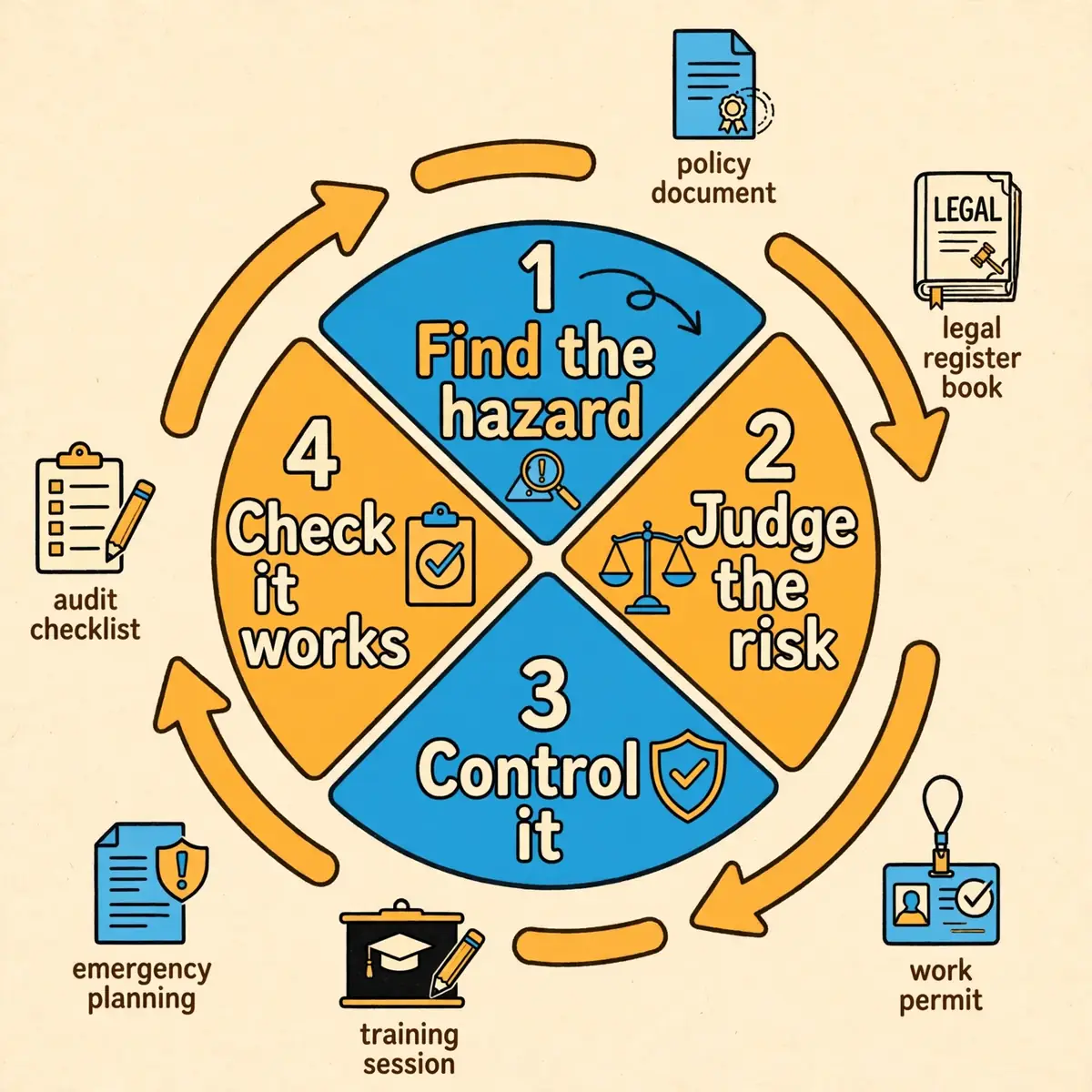
An effective EHS programme connects leadership commitments to what happens on the shop floor. It runs as a simple, repeating cycle: find a problem, figure out how risky it is, put something in place to control it, then check whether that control actually worked.
- Find the hazard through inspections, worker reports, near misses and reviews of how tasks are actually done
- Judge the risk by asking who could be harmed, how badly, and how likely it is
- Control it with the most effective measure available, from removing the hazard to protective equipment
- Check that the control still works, and fix it when it does not
Most programmes include the same elements: an EHS policy and measurable objectives set by leadership; a legal register of the regulations that apply to each facility; hazard identification and risk assessment; permits, monitoring and reporting for emissions, waste, water and chemicals; incident reporting, investigation and corrective action; training and competence records; emergency preparedness; management of change; and internal audits with management review.
A programme is what an organisation does. A management system is how it directs that work, through named owners, dated objectives, written processes and regular management review. The two most widely used systems are ISO 14001 for environmental management and ISO 45001 for occupational health and safety management.
TipIf a hazard report goes in and nobody looks into it, the report helps no one. The cycle only protects people when every step connects to the next, including the fix and the check afterwards.
EHS and the law in the United States and the United Kingdom
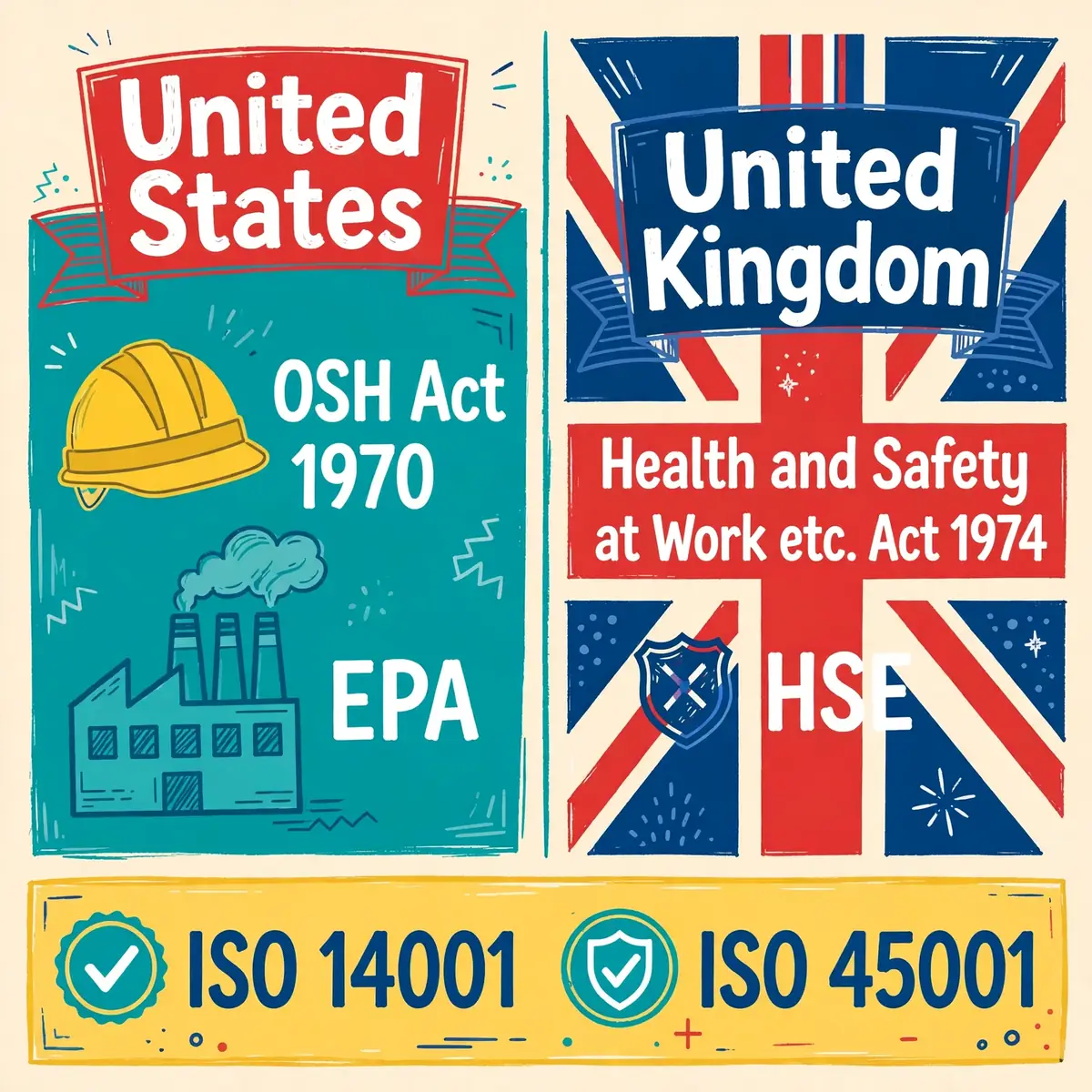
There is no single EHS law. The duties come from separate laws, and the standards and regulations that sit under them differ by country. In the US, workplace safety and environmental protection sit with different agencies. In the UK, one regulator covers workplace safety and health while environmental duties sit elsewhere.
The United States
The Occupational Safety and Health Administration (OSHA) regulates workplace safety and health under the Occupational Safety and Health Act of 1970. The Act's general duty clause requires each employer to furnish employment free from recognized hazards that are causing or are likely to cause death or serious physical harm. OSHA sets specific standards on top of that duty, from machine guarding to hazard communication.
The US Environmental Protection Agency (EPA) regulates environmental protection, administering laws such as the Clean Air Act, the Clean Water Act and the Resource Conservation and Recovery Act. Some states run their own OSHA-approved safety plans, and some states set their own environmental rules, so requirements differ site by site.
The United Kingdom
The Health and Safety at Work etc. Act 1974 is the main law. Section 2 requires every employer to ensure, so far as is reasonably practicable, the health, safety and welfare at work of all employees. Section 2(3) requires employers with five or more employees to prepare a written health and safety policy.
Regulations sit underneath the Act, including the Management of Health and Safety at Work Regulations 1999 and the Control of Substances Hazardous to Health Regulations 2002. The Health and Safety Executive (HSE) enforces the law, and environmental safety duties sit with the Environment Agency and its equivalents in Scotland, Wales and Northern Ireland.
The standards that tie it together
ISO 14001 sets out the criteria for an environmental management system. It is the only standard in the ISO 14000 family that an organisation can be certified to, and more than 670,000 certifications exist worldwide. ISO published the 2026 edition of ISO 14001 in April 2026, with a three-year transition for certified organisations.
ISO 45001:2018 specifies the requirements for an occupational health and safety management system, built on the Plan-Do-Check-Act cycle. A revision is planned for publication as ISO 45001:2027, with a stronger focus on psychosocial risk, climate-related risk and contractor controls. Certification is voluntary. The standards give organisations a recognised framework, and auditors and customers accept them as evidence that a system exists.
EHS is not ESG
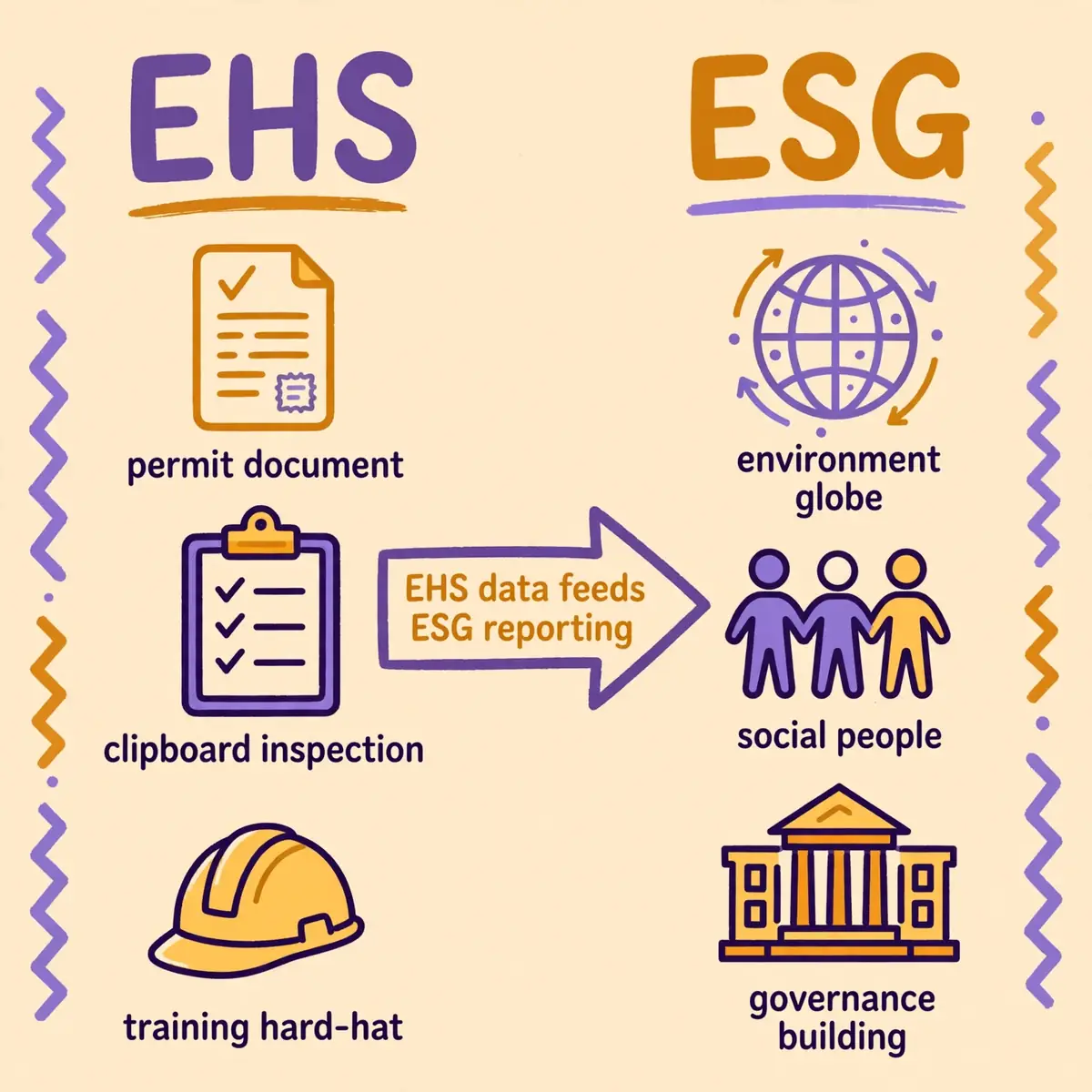
EHS and ESG (environmental, social and governance) are often confused because both deal with the environment. They are different things. EHS is about compliance with environmental, health and safety laws at an operational level: permits, exposure limits, inspections, training and incident records.
ESG is a wider framework for environmental, social and governance performance, used by investors and in sustainability reporting. EHS data, such as emissions and injury rates, feeds ESG reporting. The practical point is that a good ESG report does not prove a safe workplace, and a safe workplace does not by itself produce an ESG report.
How to start EHS in a small workplace
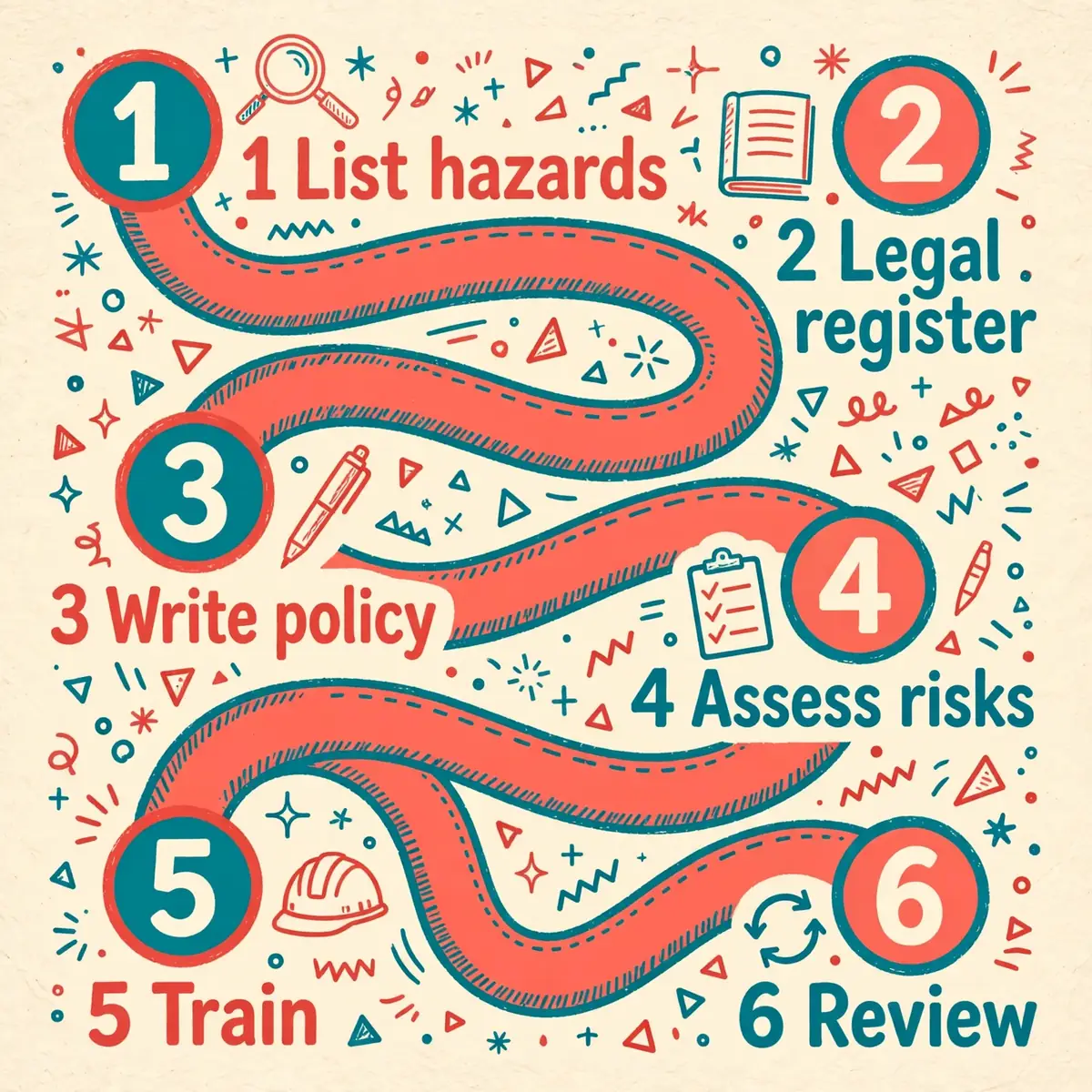
Needing EHS work is not the same as needing an EHS department. A small office may hand risk assessment, emergency planning and incident reporting to an owner or an operations manager. A manufacturer handling chemicals, machinery, waste and emissions usually needs specialists. Either way, the starting steps are the same.
- Walk the workplace and list every hazard you can see, from trailing cables to stored chemicals
- Check which laws apply to your site and write them down as a legal register
- Write a short policy that names who is responsible for what
- Assess the risks you listed and record the controls for each one
- Train everyone on the controls that affect their job, and keep the records
- Review the whole thing at least once a year and after any incident or change
Start with the hazards that can kill or seriously injure someone, and with the duties the law states plainly. An office will not pollute a river, but someone can still trip on a loose cable or strain their back lifting a box. The scale of the programme should match the hazards, not the size of the company.
WarningDo not copy another company's policy and file it away. A policy that does not describe what actually happens on your site will fail the first time an inspector or an injured worker tests it.
Checklist: is your workplace covered?
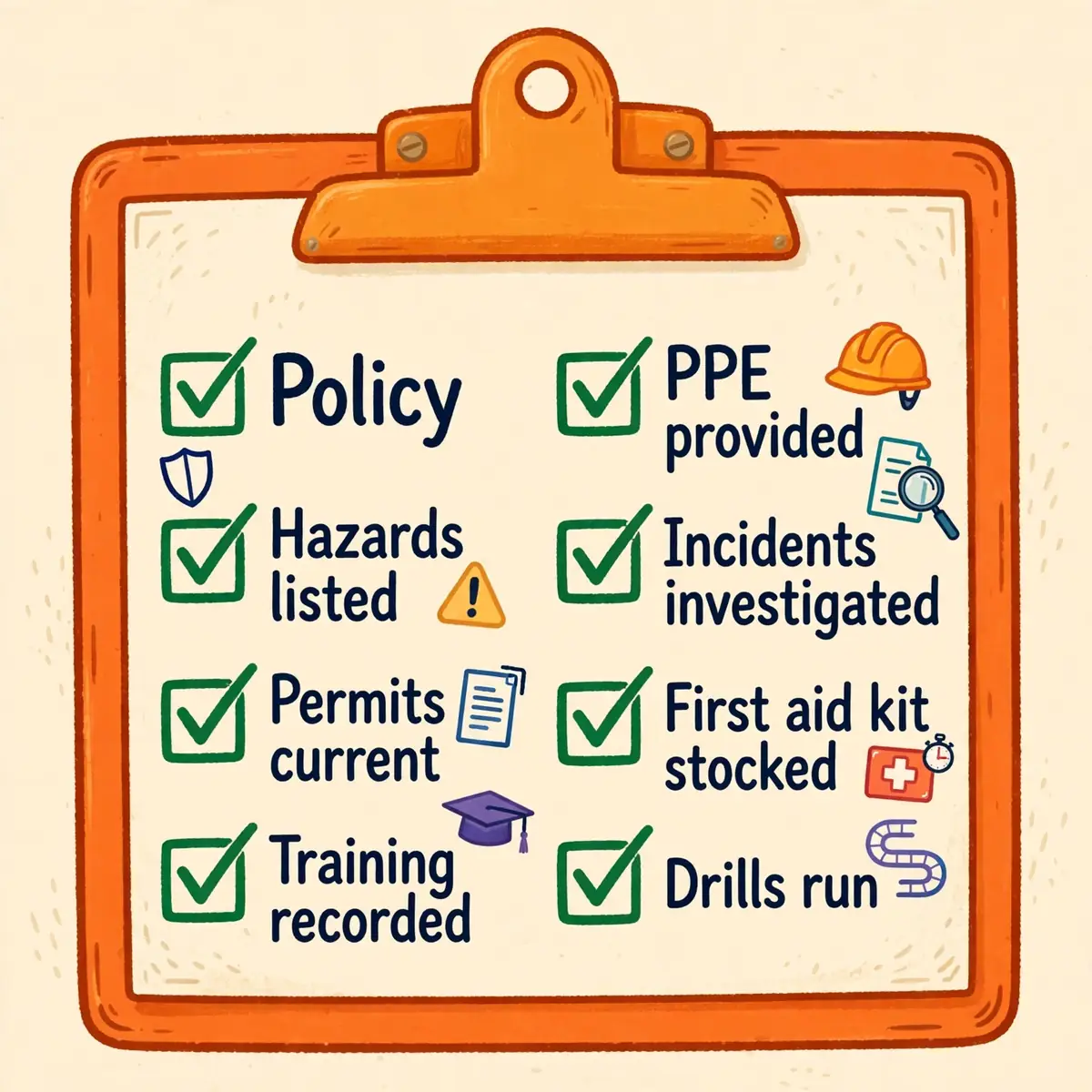
Work through the list and tick each item off only when you can point to the record that proves it. A missing tick is a gap to close, not a box to ignore.
- A written health and safety policy exists, signed by the most senior person, and workers know where to find it
- Every hazard on site is listed, with a risk assessment and a named control for each one
- Environmental permits are current, and emissions, waste and water records are kept
- Workers have the training their job requires, with dates and refresher intervals recorded
- PPE requirements are set for each task, and the equipment is provided free of charge
- Incidents and near misses are reported, investigated and followed up to a completed fix
- A first aid kit is stocked, checked and within reach, with a trained first aider available
- Practice emergency procedures are written down, and drills run on a schedule workers actually follow
Frequently Asked Questions
What does EHS stand for?
EHS stands for environment, health and safety. It is the discipline that protects people and the environment from harm caused by work, and keeps an organisation within the law while it does so.
Is EHS the same as HSE?
In most cases, yes. Both cover environment, health and safety. HSE lists health and safety first and is common in the UK, Europe and the energy sector. HSE is also the name of the UK regulator, the Health and Safety Executive.
Is OHS the same as EHS?
Not quite. OHS focuses on worker health and safety. EHS adds environmental management, so it also covers emissions, waste, water and the land around a site.
Is EHS a legal requirement?
EHS as a department is not a legal requirement, but the duties it covers are. Laws require employers to manage safety, health and environmental impacts, whether or not anyone on site carries the EHS title.
What does an EHS manager do?
An EHS manager keeps a site or business compliant with environmental, health and safety laws. The role typically covers permits, risk assessments, incident investigations, training, audits, emergency planning and tracking regulatory change.
What is the difference between EHS and ESG?
EHS is operational compliance with environmental, health and safety laws. ESG is a wider framework for environmental, social and governance performance used by investors and in sustainability reporting. EHS data feeds ESG reporting, but a good ESG report does not prove a safe workplace.
Do small businesses need EHS?
Yes. Every workplace carries health and safety risks, even where its environmental duties are limited. A small business may not need a department, but it still needs a policy, risk assessments, training and incident reporting, scaled to its hazards.
Sources
- International Labour Organization — Safety and health at work
- US Bureau of Labor Statistics — Census of Fatal Occupational Injuries Summary, 2024
- Occupational Safety and Health Administration — Penalties
- Occupational Safety and Health Administration — Occupational Safety and Health Act of 1970, full text
- US Environmental Protection Agency — Laws and Regulations
- Health and Safety Executive — Health and Safety at Work etc. Act 1974
- International Organization for Standardization — ISO 14001: Environmental management
- International Organization for Standardization — ISO 45001:2018, Occupational health and safety management systems
- Enhesa — What is EHS? A practical guide for 2026 and 2027
- IBM — What is Environment, Health and Safety (EHS)
- Ideagen — What Is EHS? Meaning, Roles and How It Differs From HSE and OHS