
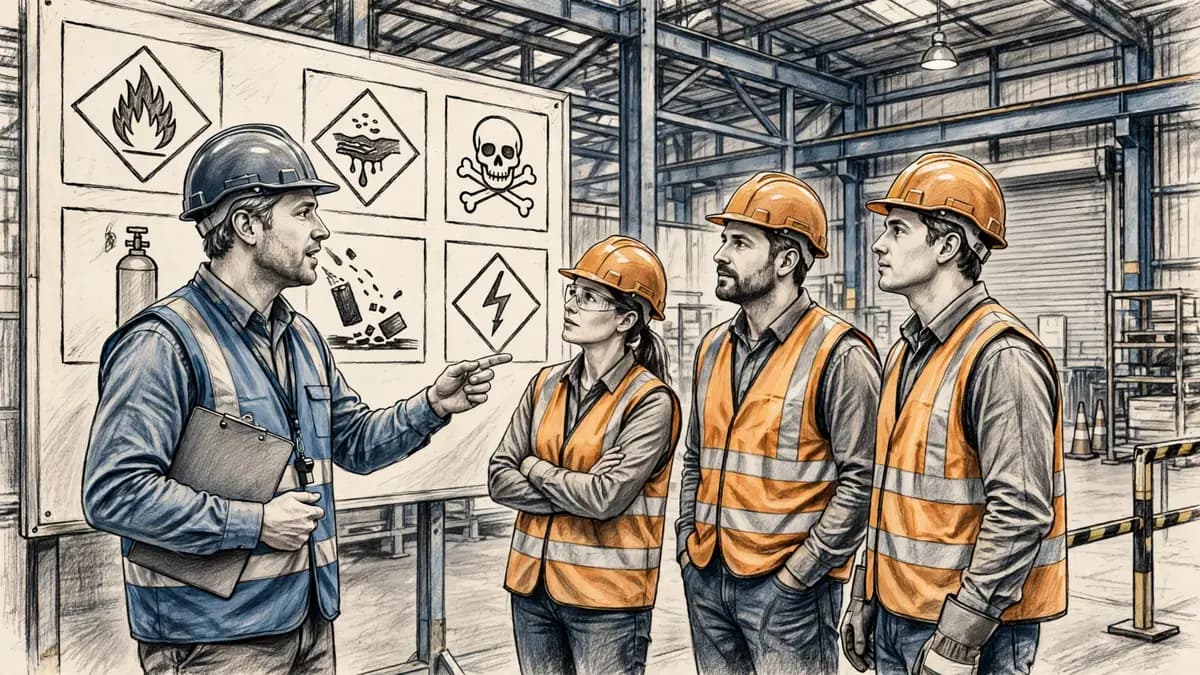
OSHA training is hazard-specific. No single rule covers every worker, and no single annual course satisfies every standard. Each standard names the workers it covers, the topics they must be taught, and when the training must be repeated. Employers who train to the hazard — and track each requirement on its own clock — stay compliant. Employers who rely on one generic course do not.
What OSHA training actually means
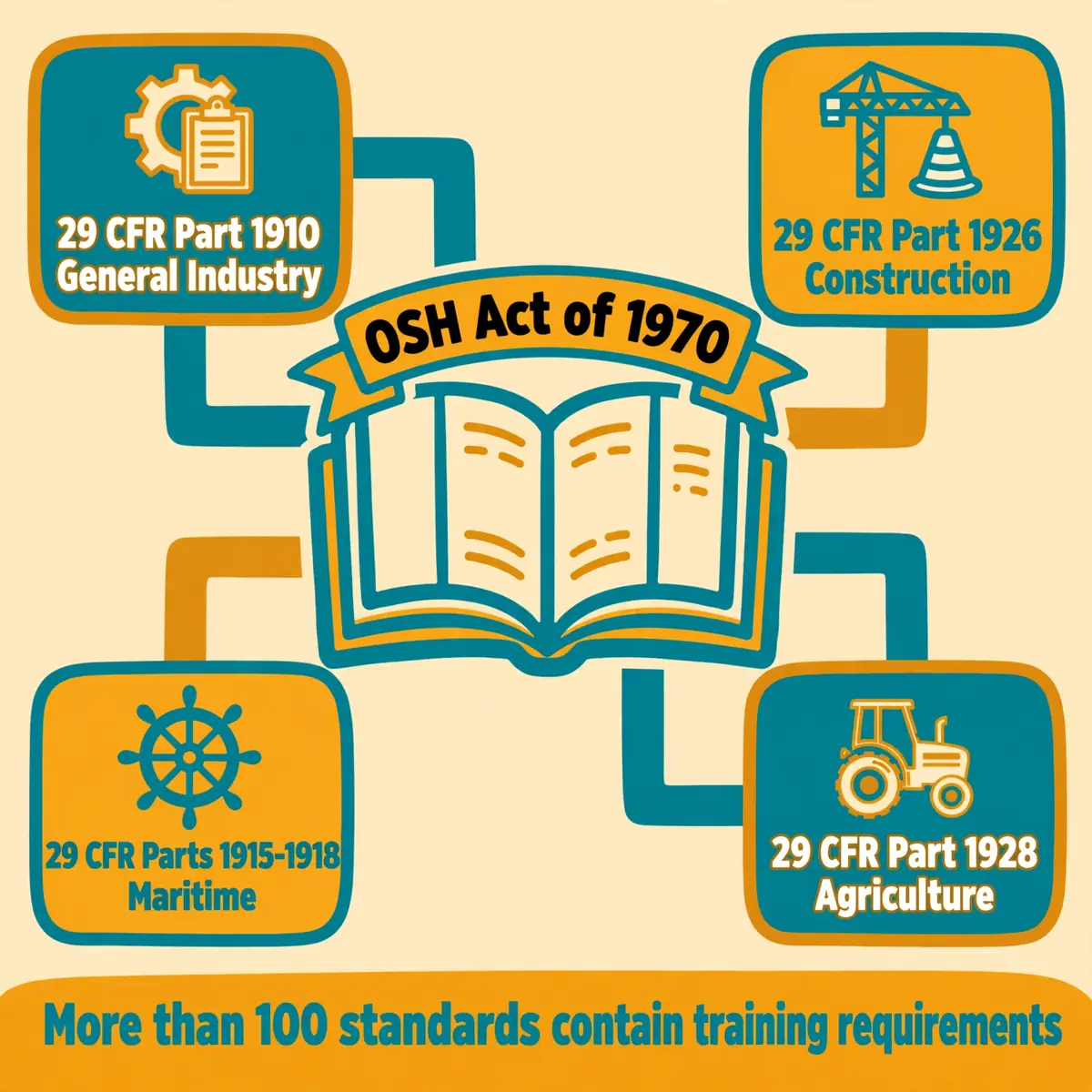
OSHA is the Occupational Safety and Health Administration, the US federal agency that sets and enforces workplace safety standards. Its training duties do not sit in one general rule. They are written into the individual standards, in Title 29 of the Code of Federal Regulations (CFR), and each one sets its own rules on who trains, on what, by when and how often.
The standards are grouped by sector. Part 1910 covers general industry, Part 1926 covers construction, Parts 1915 to 1918 cover maritime work, and Part 1928 covers agriculture. A citation such as 29 CFR 1910.1200(h) means Title 29, section 1910.1200, paragraph (h). The legal authority behind all of them is the Occupational Safety and Health Act of 1970 (OSH Act), including the General Duty Clause in section 5(a)(1), which requires employers to keep the workplace free from recognised hazards likely to cause death or serious physical harm.
OSHA collects the training clauses in its booklet Training Requirements in OSHA Standards (OSHA 2254), which organises them by sector. The booklet is guidance, not a standard: it creates no new legal obligations, and the standards themselves are the binding text. Use it as a map, then read the standard it points to.
TipStart any training plan with OSHA 2254. It lists the standards with training clauses by sector, so a hazard assessment can be matched to the exact rules that apply.
Who must be trained
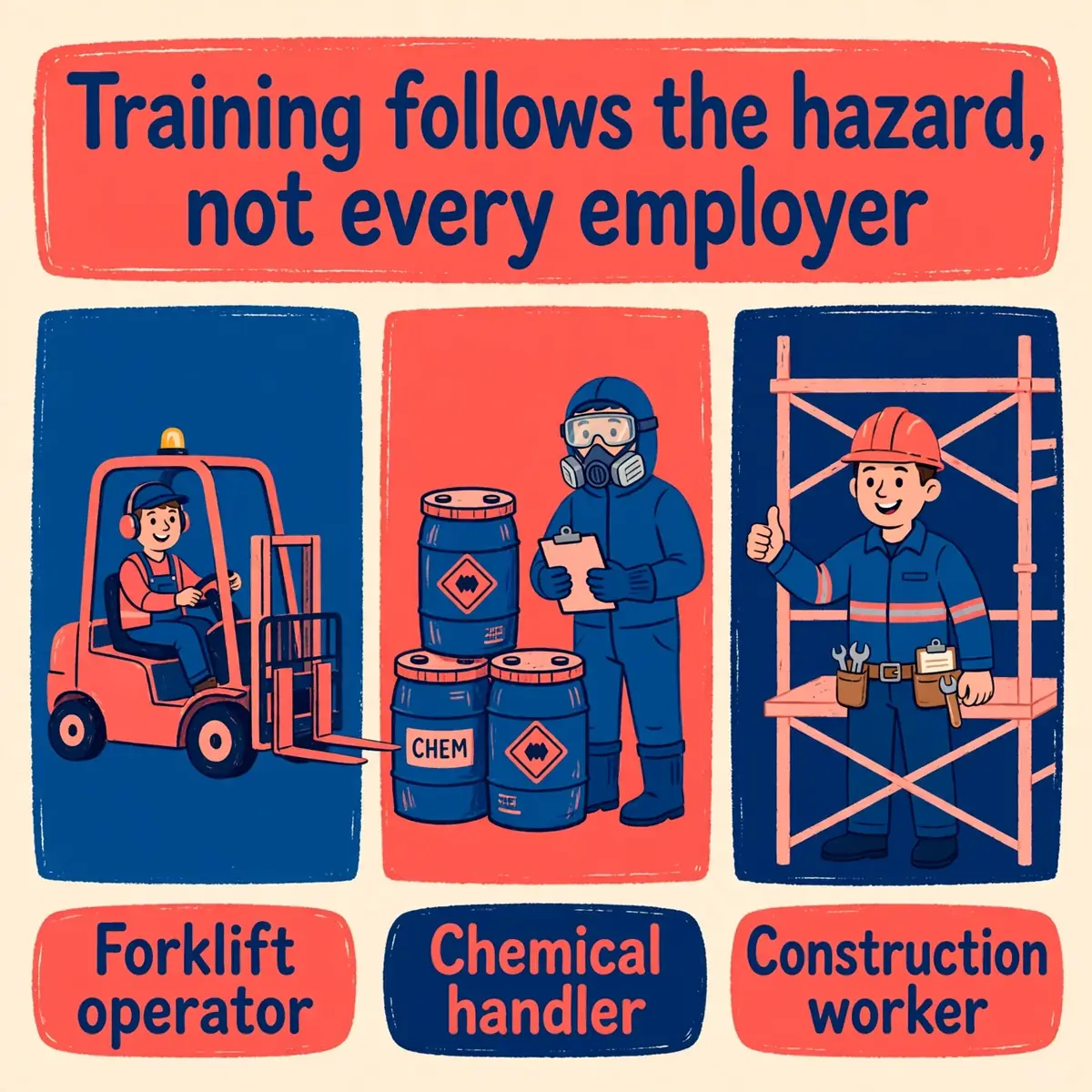
Training applies when a workplace has the hazard or activity a standard covers, not to every employer by default. A worker must be trained before exposure to the hazard, and only on the standards that cover their work. A warehouse with no chemicals needs no hazard communication training. A warehouse with forklifts needs powered industrial truck training for every operator.
Construction has the closest thing to a general training duty. Under 29 CFR 1926.21(b)(2), the employer must instruct each construction employee in the recognition and avoidance of unsafe conditions and the regulations that apply to their work environment. Other construction rules then add specific duties, such as fall protection training under 1926.503 before any worker is exposed to a fall hazard.
Enforcement depends on where the workplace sits. Federal OSHA enforces the standards in most states, but 29 states and territories run their own OSHA-approved State Plans. Twenty-two of those plans cover private-sector and state and local government workers; seven cover only state and local government workers. State Plans must be at least as effective as federal OSHA and may set stricter or additional requirements, including extra training rules. Multi-state employers should treat the federal standards as a floor and check each State Plan state where they operate.
What OSHA training must cover
Each standard states the topics its training must cover. The topics always follow the hazard: what it is, how to recognise it, how to control it, and what to do when something goes wrong. A worker who can name the hazard but cannot use the control has not been trained. Training must also be practical — it must explain the procedures, equipment and emergency steps for the worker's own job, not general safety theory.
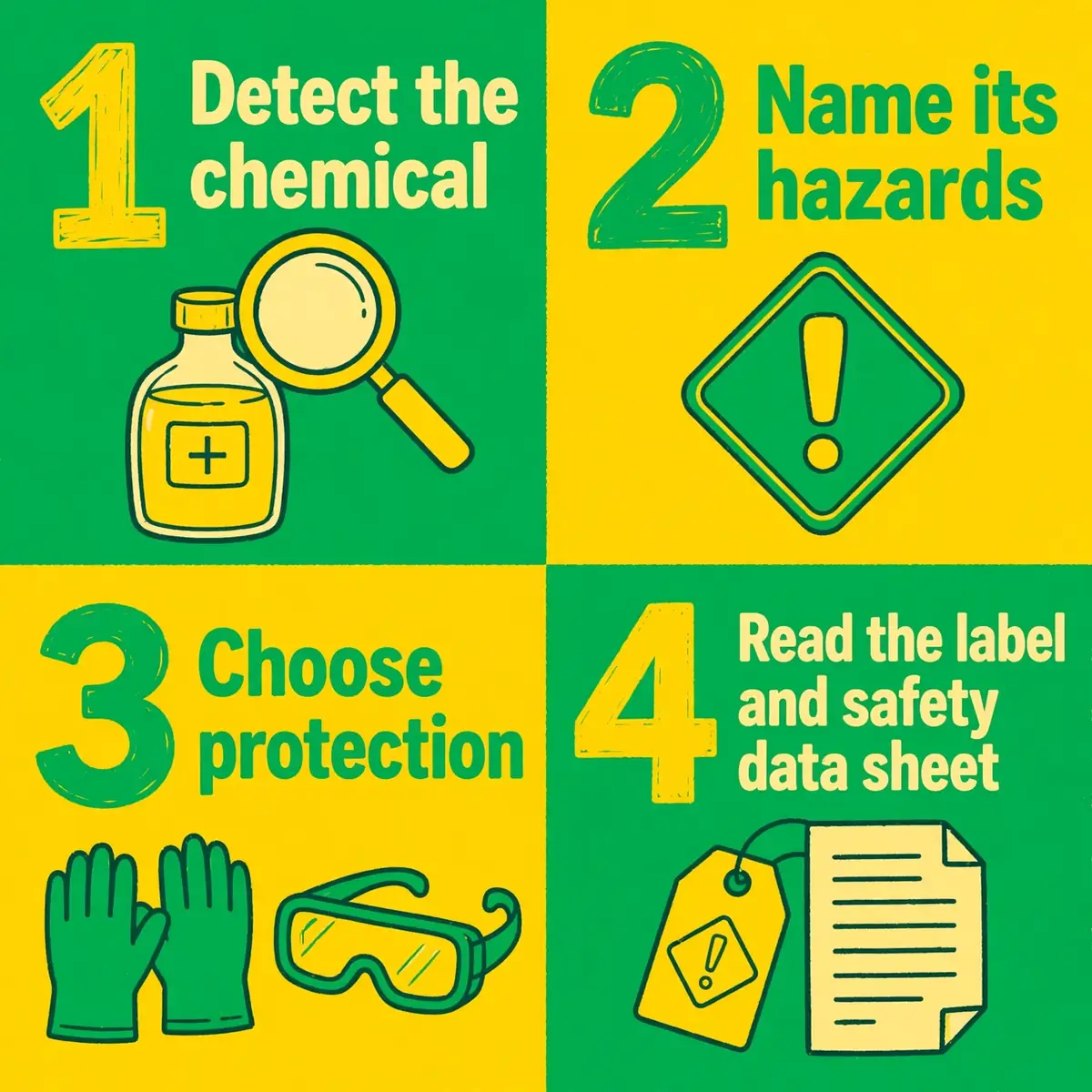
Hazard communication shows the pattern clearly. Under 29 CFR 1910.1200(h), training must explain how to detect hazardous chemicals, what their hazards are, how to protect against them, and how the employer's programme works.
That means methods and observations used to detect a chemical, such as monitoring, visual appearance or odour; the physical, health, simple asphyxiation, combustible dust and pyrophoric gas hazards of chemicals in the work area; protective measures, including work practices, emergency procedures and personal protective equipment; and details of the written programme, including labels and safety data sheets and how to use them. Training may cover categories of hazards, such as flammability or carcinogenicity, rather than each chemical, provided chemical-specific information stays available on labels and safety data sheets.
Other standards follow the same shape with their own content. Respiratory protection training covers how to use, inspect and maintain the respirator. Lockout/tagout training covers the energy control procedure for each machine a worker services.
Electrical safety training under 29 CFR 1910.332 covers the practices that keep qualified workers safe around live parts, and the NFPA 70E standard gives the detail behind those practices. NFPA 70E sets out arc flash boundaries and PPE categories that electrical training must reflect.
Hazard communication: the worked example
Hazard communication is the most common training duty in general industry, because almost every workplace stores or uses a chemical. The standard applies to every employee exposed to hazardous chemicals in their work area, at the time of initial assignment and whenever a new chemical hazard is introduced. It is also the standard most often cited when training is missing, because the gap is easy for an inspector to find: no labels explained, no safety data sheets shown, no record of the session.
The content is fixed by the standard, so a training session can be checked against it. Workers must be able to detect a chemical's presence or release, name its hazards, choose the protective measures that apply, and find the label and safety data sheet for it. A session that only shows a video about chemicals in general does not meet that test. The test is whether workers can apply the answers to the chemicals in their own work area.
Language, literacy and cost
Training must be understood, not merely delivered. OSHA's Training Standards Policy Statement of 28 April 2010 directs inspectors to treat "train" and "instruct" as meaning to present information in a manner that employees receiving it are capable of understanding. If an employee does not speak or understand English, instruction must be given in a language the employee can understand. Written materials alone do not satisfy the duty for employees who cannot read them.
Several standards build this into their text. The bloodborne pathogens standard requires material appropriate in content and vocabulary to the educational level, literacy and language of employees, and a trainer knowledgeable in the subject as it relates to the workplace. Training under that standard must also be provided at no cost to the employee and during working hours. More broadly, the OSH Act requires all required training to be provided by and paid for by employers.
WarningNever hand a worker a training handout in a language they cannot read and record the session as complete. OSHA treats training as the understanding it produces, not the paper it generates.
How often must OSHA training be repeated
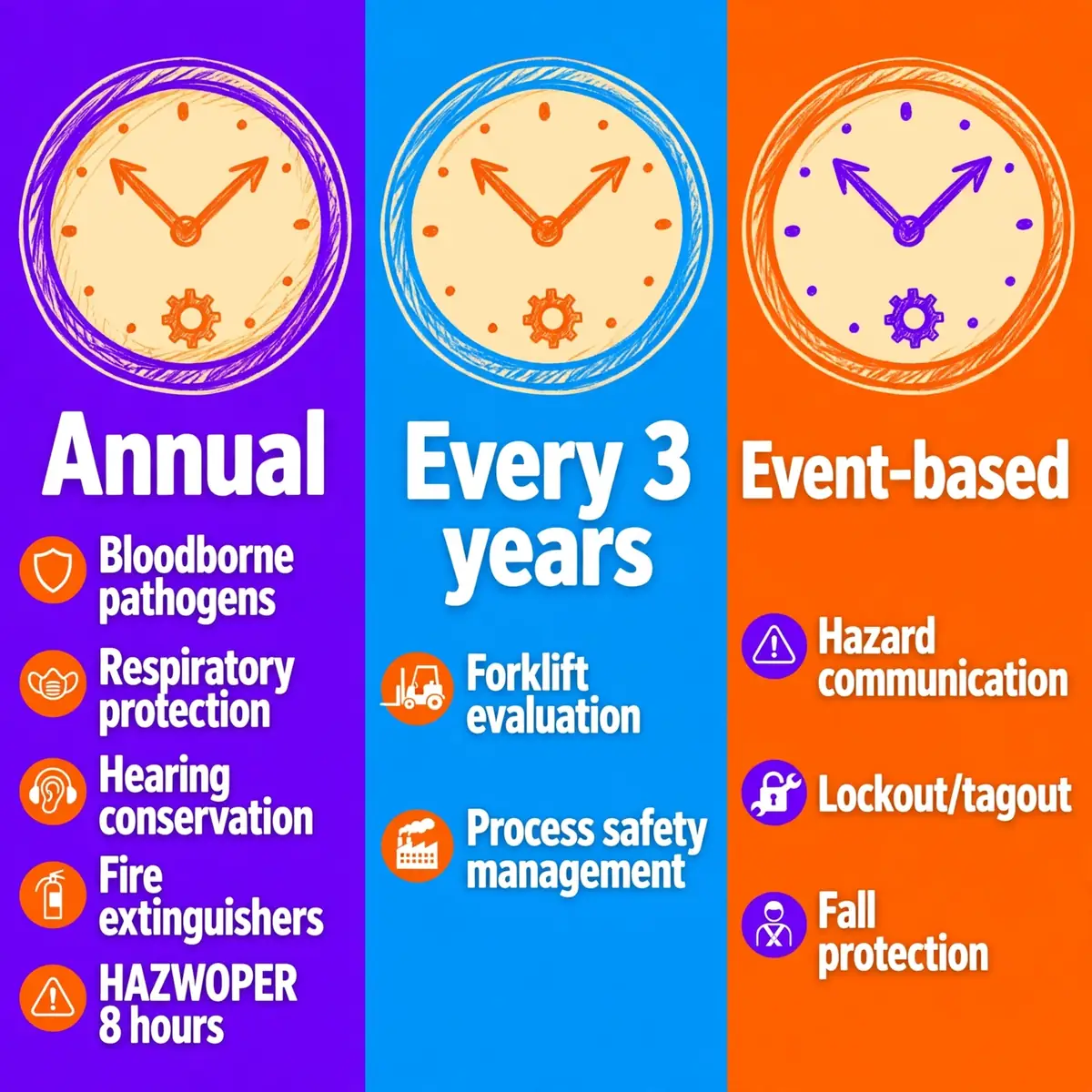
There is no OSHA standard that requires annual training for all workers. The obligations run on three different clocks, and a single annual course cannot satisfy all of them. Calendar-based duties repeat on a fixed interval. Trigger-based duties repeat when something changes. Evaluation-based duties repeat when a worker is assessed, at least every three years.
| Clock | Standards | Interval |
|---|---|---|
| Calendar-based | Bloodborne pathogens 1910.1030; respiratory protection 1910.134; hearing conservation 1910.95; portable fire extinguishers 1910.157; HAZWOPER 1910.120(e)(8) | Annually |
| Evaluation-based | Powered industrial trucks 1910.178(l); process safety management 1910.119(g)(2) | At least every three years |
| Trigger-based | Hazard communication 1910.1200(h); lockout/tagout 1910.147(c)(7); fall protection 1926.503; emergency action plans 1910.38; PPE 1910.132 | When the hazard, job, equipment or procedure changes |
Annual training
Five common standards set a fixed annual cycle. Bloodborne pathogens training must be provided at initial assignment, at least annually — within one year of the previous training — and when tasks change. Respiratory protection retraining must be administered annually and when workplace or respirator changes make earlier training obsolete, or when a worker shows inadequate knowledge or skill. Hearing conservation training repeats annually for employees in the hearing conservation programme.
Portable fire extinguisher training is provided at initial employment or assignment, then at least annually, for all employees under 1910.157(g)(2) and for the designated firefighting group under (g)(4). HAZWOPER refresher training is eight hours annually for site workers and their managers and supervisors under 1910.120(e)(8), and its content includes critiques of incidents from the past year. Workers at treatment, storage and disposal facilities receive eight hours of refresher training annually under 1910.120(p)(7), and emergency responders under paragraph (q) receive annual refresher training or demonstrate competency at least yearly.
One detail is easy to miss. The annual bloodborne pathogens cycle runs from each employee's previous training date, within one year of that date, so a single calendar date for everyone can put late joiners out of compliance. Track each worker's own date, not a company-wide training day.
Every three years
Two common duties run on a three-year clock. Forklift and powered industrial truck operators must be evaluated at least once every three years under 1910.178(l)(4)(iii), and refresher training is required sooner after unsafe operation, an accident or near miss, a failed evaluation, assignment to a different type of truck, or a workplace change affecting safe operation. The evaluation is a performance check in the actual workplace, not a classroom test.
Process safety management refresher training must be provided at least every three years, and more often if necessary, with the frequency set in consultation with the operating employees under 1910.119(g)(2). Employees whose job tasks are affected by a process change must be informed of, and trained in, the change before start-up. The three-year interval is a maximum, not a target: the standard says refresher training must be provided at least every three years, and more often if necessary.
Event-based retraining
Some standards set no fixed interval at all. Hazard communication training repeats whenever a new chemical hazard the employees have not previously been trained about is introduced into their work area. Lockout/tagout retraining is required when job assignments, machines, equipment or processes change, or when a periodic inspection reveals deviations or inadequacies in the energy control procedure.
Fall protection training in construction repeats when new hazards arise, and emergency action plan training repeats when the plan is developed, when an employee is first assigned, and when duties or the plan change. PPE training repeats before initial use and when conditions change. A trigger-based requirement cannot be satisfied by a schedule, only by a detection mechanism: someone must notice the change and start the retraining.
NoteRoughly half of the training obligations in 29 CFR are conditional. They fire when a job assignment changes, when a new hazard enters the work area, when a process is modified, or when a trained worker can no longer perform the procedure.
Do OSHA 10-hour and 30-hour cards count?
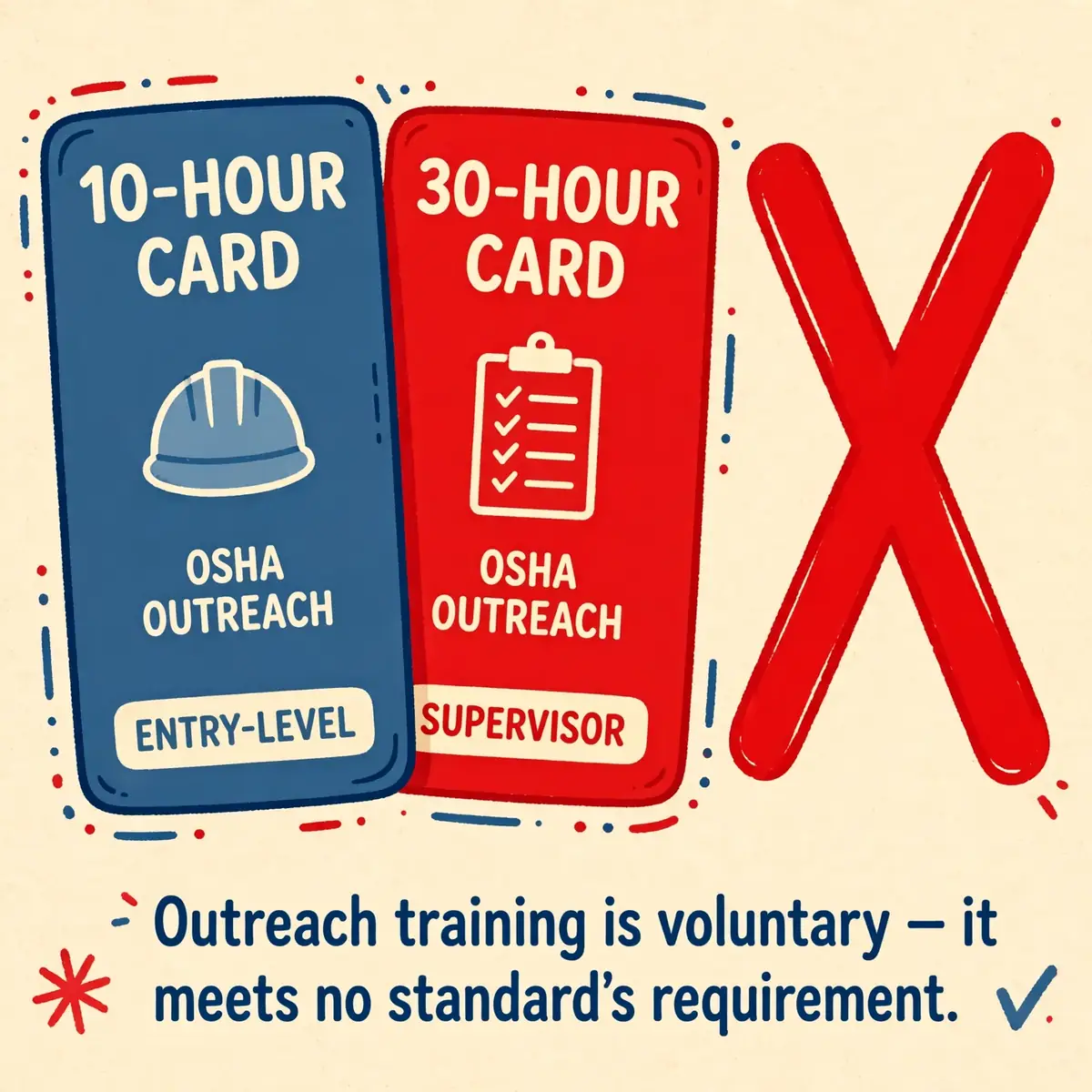
No. The OSHA Outreach Training Program is voluntary, and OSHA states plainly that its courses do not meet the training requirements for any OSHA standard. The 10-hour course gives general hazard awareness for entry-level workers, and the 30-hour course gives a broader overview for supervisors. Both end with a student course completion card, but the card is not a certification or a licence, and it is not required by OSHA.
Some states, municipalities and organisations do require Outreach cards as a condition of work, and some unions require them on job sites. Those are state or local requirements, and they do not replace the site-specific and hazard-specific training each OSHA standard demands. Training conducted to comply with OSHA standards also cannot be counted toward Outreach Training Program requirements — the two run in opposite directions.
Outreach trainers are OSHA-authorised, not OSHA personnel, and the courses teach hazard recognition, avoidance, control and prevention rather than the standards themselves. A worker with a 10-hour card still needs the training each applicable standard requires, delivered for their own hazards, before exposure. First aid kit contents and safety goggles selection, for example, are covered by their own standards and their own training, not by an Outreach course.
AlertA 10-hour card does not prove a worker was trained on the hazards of their own job. An inspector will ask for the training each applicable standard requires, and the card will not answer that question.
Training records: what to keep and for how long
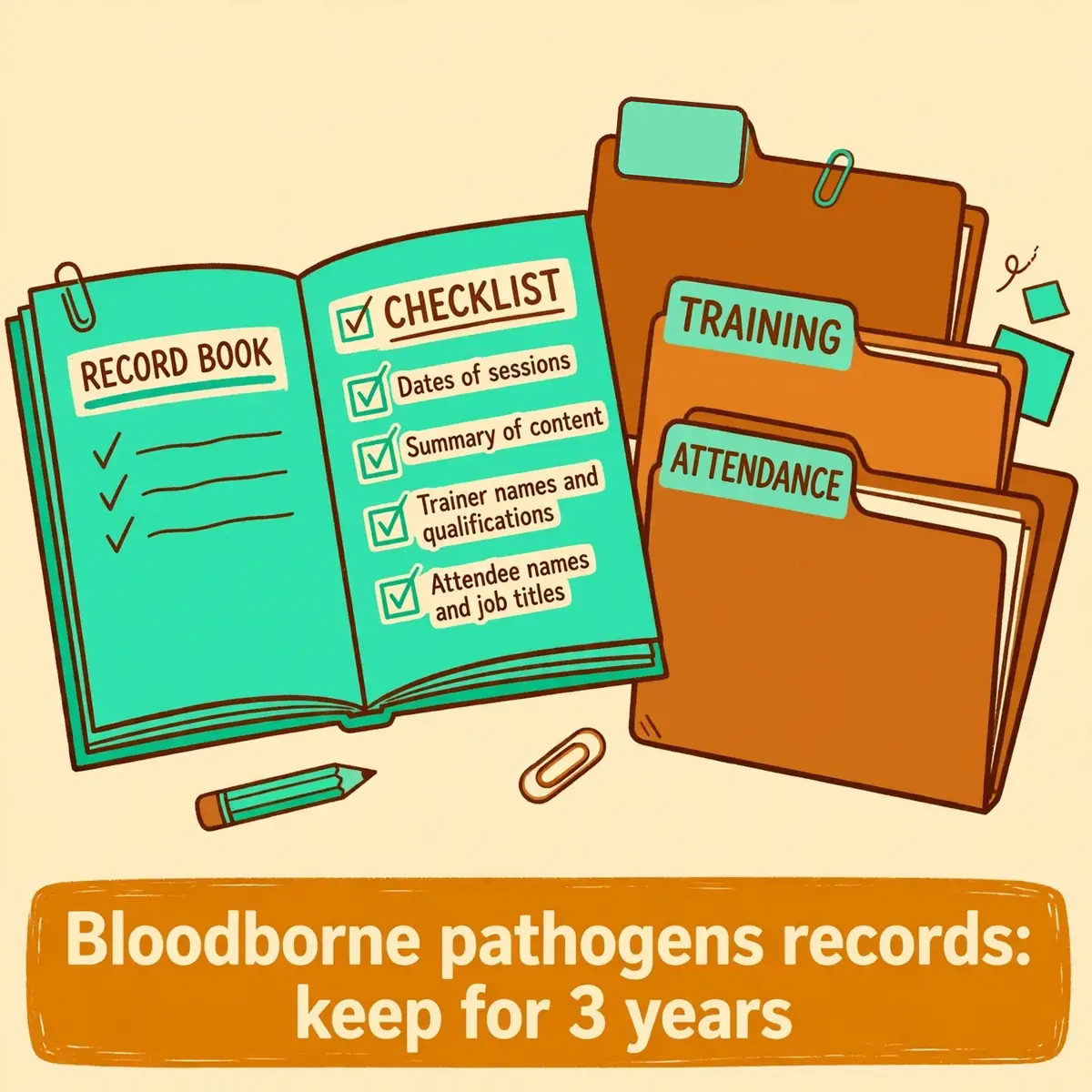
Records are the proof that training happened, and missing records are often the first gap an inspector finds. What must be recorded depends on the standard, so the record should match the rule it proves. A sign-in sheet with a date is rarely enough on its own.
Bloodborne pathogens records are the most specific. They must show the dates of the training sessions, a summary of the training content, the names and qualifications of the trainers, and the names and job titles of the attendees, and they must be kept for three years. Lockout/tagout training must be certified with each employee's name and the dates of training. Forklift training must be certified with the operator's name, the training date, the evaluation date, and the trainer or evaluator.
Process safety management goes further: the employer must document the employee's identity, the training date, and how the employee's understanding was verified. That last point matters for every standard. A record that shows attendance but not understanding leaves the employer unable to show the training worked. Keep the record with the standard it belongs to, the date each worker was trained, and the trainer's name, so any single requirement can be proved on its own.
What happens when training is missing
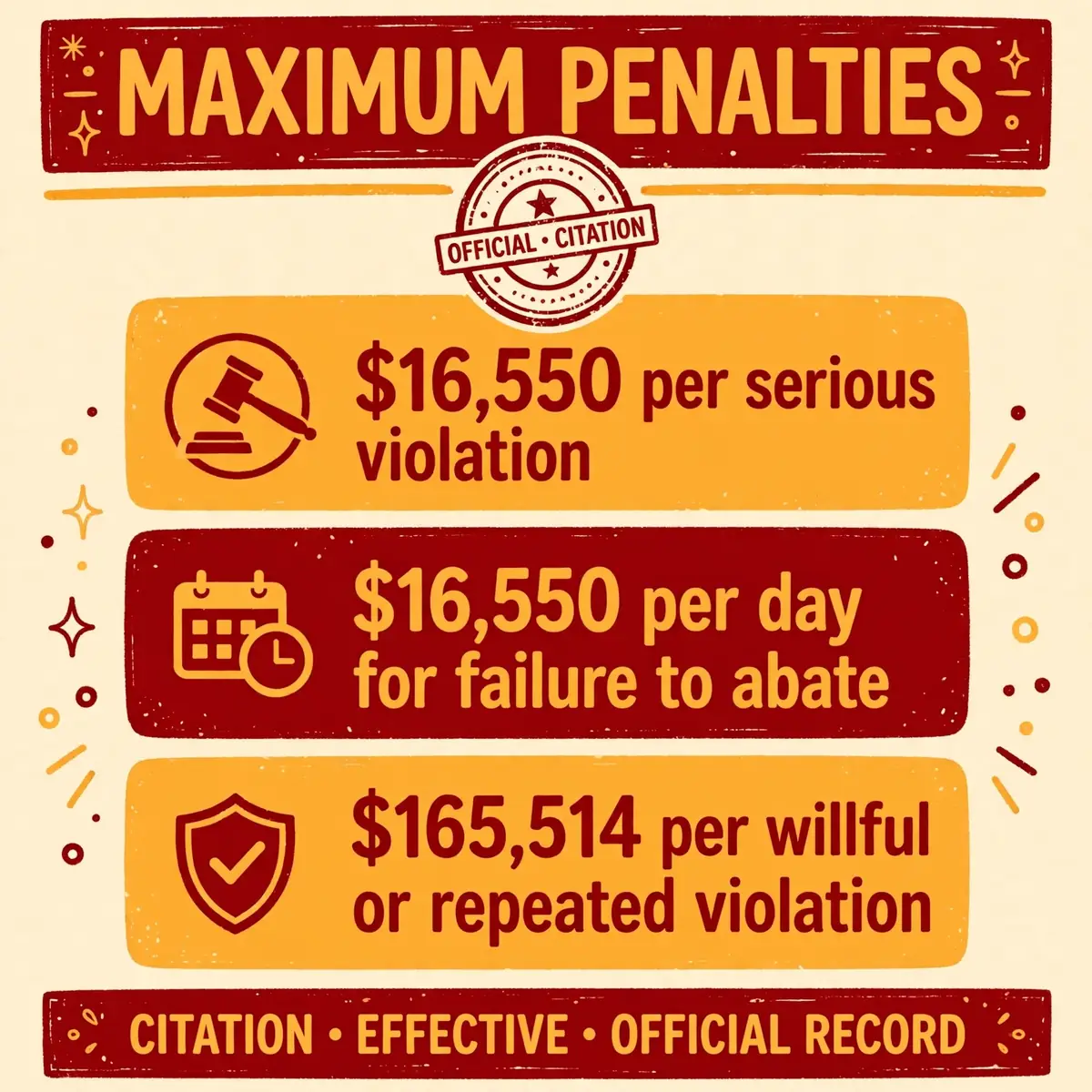
Training failures are cited as violations of the relevant standard, and they carry OSHA's standard civil penalties. For penalties assessed after 15 January 2026, the maximum is $16,550 per serious or other-than-serious violation, $16,550 per day for failure to abate, and $165,514 per willful or repeated violation. State Plans must adopt maximum penalties at least as effective as the federal amounts.
The citation is only part of the cost. Training deficiencies turn up inside almost every one of OSHA's most-cited standards — lockout/tagout, respiratory protection, PPE and powered industrial trucks among them — and an inspector who finds untrained workers will look harder at the rest of the programme. An incident involving an untrained worker also makes the employer's position worse in every later step, from the investigation to the settlement. Root cause analysis of an incident often traces the cause back to training that was missing, out of date, or never understood.
WarningDo not wait for an inspection to find the gap. Missing training records are usually the first thing an inspector notices, because the employer cannot show that training happened at all.
How to build a training plan that stays compliant
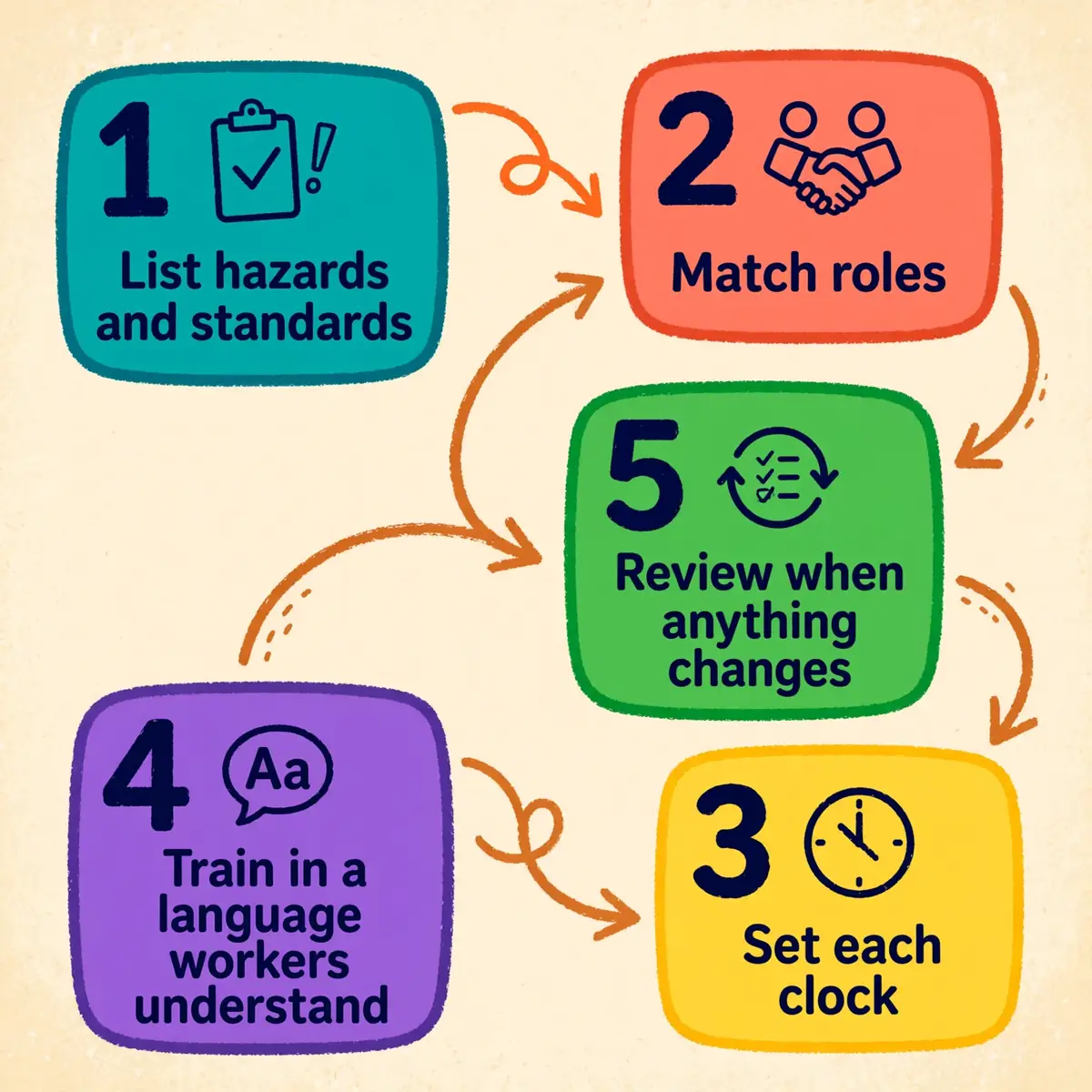
A compliant plan is built from the hazards, not from a calendar. Start with the workplace itself, list what is actually there, and let each hazard point to the standard that covers it. The plan then writes itself: each standard names the workers, the topics, the interval and the record.
- List the hazards and the standards that cover them, using OSHA 2254 as the map and reading each standard it points to.
- Match each standard to the roles it covers, so every worker's training list comes from their own hazards.
- Set each requirement's own clock — annual, three-year or event-based — and track each worker's own dates, not a company-wide training day.
- Deliver the training in a language workers understand, at no cost to them and during working hours, and record the date, content, trainer and attendees.
- Review the plan when anything changes: a new chemical, a new machine, a new process, an incident, or a failed evaluation.
Asbestos work shows why the hazard list comes first. Asbestos removal has its own training, licensing and notification rules, and no general safety course covers them. Asbestos removal must be planned around the licensed, notifiable non-licensed and non-licensed categories, and the workers involved need the training that matches their category. The same logic applies to every hazard: the standard that covers it names the training it requires.
Frequently Asked Questions
Is OSHA training required every year?
Not for every worker. Some standards set an annual cycle — bloodborne pathogens, respiratory protection, hearing conservation, fire extinguishers and HAZWOPER — while others repeat every three years or only when something changes. The standard covering each hazard sets the interval.
Does the OSHA 10-hour course meet OSHA training requirements?
No. The Outreach Training Program is voluntary, and OSHA states that its 10-hour and 30-hour courses do not meet the training requirements for any OSHA standard. Some states and cities require the card, but it does not replace hazard-specific training.
Who pays for OSHA training?
The employer. All training required by OSHA standards must be provided by and paid for by the employer, at no cost to the employee and during working hours. The bloodborne pathogens standard states this explicitly.
How long must training records be kept?
It depends on the standard. Bloodborne pathogens training records must be kept for three years, with the dates, a content summary, trainer names and qualifications, and attendees. Other standards require certification with the employee's name and dates, without setting a retention period.
Does OSHA training have to be in Spanish or another language?
It must be in a language the worker understands. OSHA's 2010 Training Standards Policy Statement requires training to be presented in a manner, language and vocabulary employees can understand, and written materials alone do not satisfy the duty for employees who cannot read them.
What is the difference between OSHA 10-hour and 30-hour training?
Both are voluntary Outreach courses. The 10-hour course covers hazard awareness for entry-level workers, and the 30-hour course covers a broader overview for supervisors. Neither is a certification, and neither meets any OSHA standard's training requirement.
Sources
- OSHA, Training Requirements in OSHA Standards (OSHA 2254, 2015)
- OSHA, OSHA Penalties
- OSHA, Outreach Training Program overview
- Knowledge Foundry, OSHA training requirements
- SafetyFolio, OSHA mandatory training: what every employer must provide
- The Prime VR, OSHA Training Requirements: Annual vs Trigger-Based