Safety goggles are sealed eye protection. Unlike safety glasses, which leave gaps at the sides, goggles press a soft seal against the face, so liquid, dust and vapour cannot slip around the lens. That seal is the whole point of a goggle. The right pair depends on the hazard: the vent type decides what the seal keeps out, the marks stamped on the frame say what the pair was tested for, and the fit decides whether the seal holds. Get those three right and the eyes are protected.
What safety goggles are
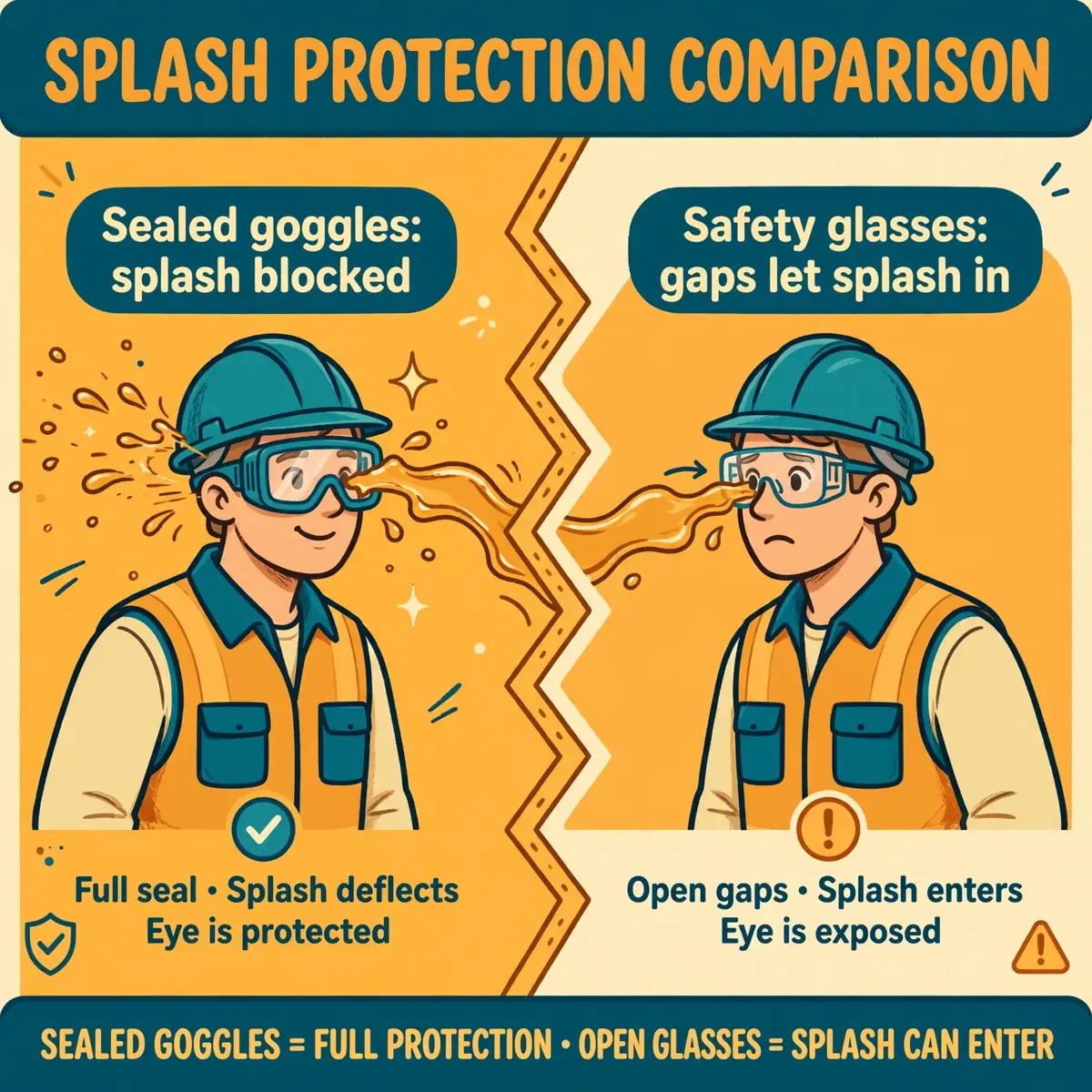
A safety goggle is a tight-fitting eye protector that seals to the face. The frame carries a soft gasket or foam seal, the lens sits in front of both eyes, and an adjustable strap holds the whole unit in place. Most lenses are polycarbonate, the same tough plastic used in safety glasses, because it resists impact and blocks ultraviolet light. The seal, not the lens, is what makes a goggle different from a pair of glasses.
That seal matters because most eye hazards do not travel in a straight line. A splash runs down from the brow or up from a surface. A dust cloud drifts around the edge of a lens. Vapour fills the air and reaches the eye from any direction. Safety glasses stop a particle flying straight at the face, but they leave gaps above, below and at the sides. A goggle closes those gaps, so the hazard has no path to the eye.
Goggles are the right choice wherever the hazard can get around a lens: liquid chemicals, acids and caustics, chemical gases and vapours, fine dust, and molten metal splash. They are also the right choice for dusty work such as grinding, cutting and demolition, and for laboratory work with splashing liquids. Where the only hazard is a flying particle, glasses with side protection may be enough — the next section explains how to tell.
TipPress a goggle to the face without the strap and let go. A good seal holds briefly by suction before it drops. If it falls at once, the seal does not fit that face.
Safety goggles vs safety glasses
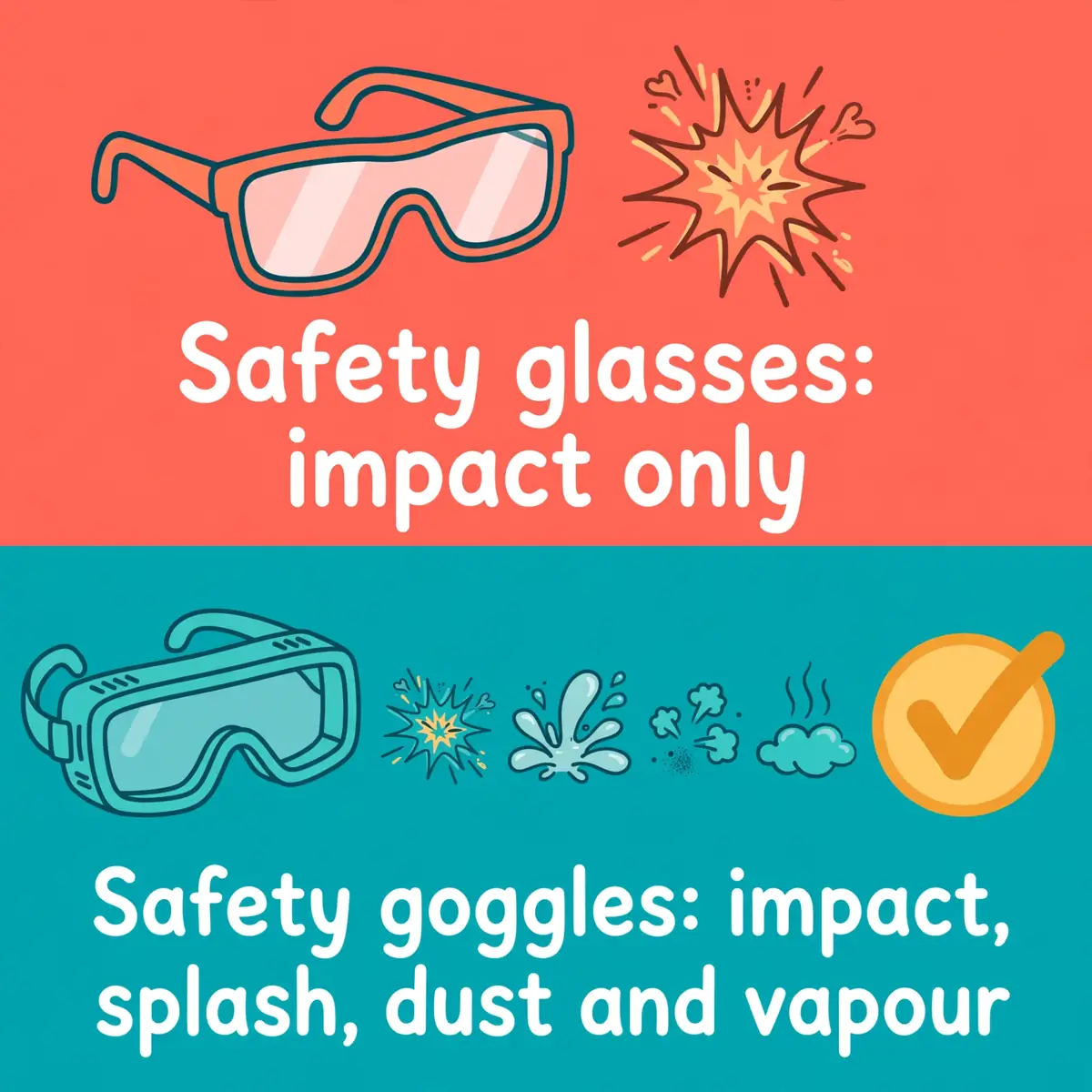
Safety glasses and safety goggles both protect against impact, but they are built for different hazards. Glasses sit on the nose and ears like ordinary spectacles, with side shields to block particles from the side. Goggles strap around the head and seal to the face. The table below shows where each one stands.
| Safety glasses | Safety goggles | |
|---|---|---|
| Seal to the face | No — open at the sides, top and bottom | Yes — soft gasket seals all round |
| Flying particles | Yes, with side protection | Yes |
| Liquid splash | No | Yes (indirect vent or unvented) |
| Dust | No | Yes (D4) |
| Fine dust and vapour | No | Yes, unvented only (D5) |
| Light radiation | Yes, with filter lenses | Yes, with shade-rated lenses |
| Fogging | Less — air flows freely | More — the seal traps warm air |
| Comfort over a long shift | Higher | Lower, unless the fit is right |
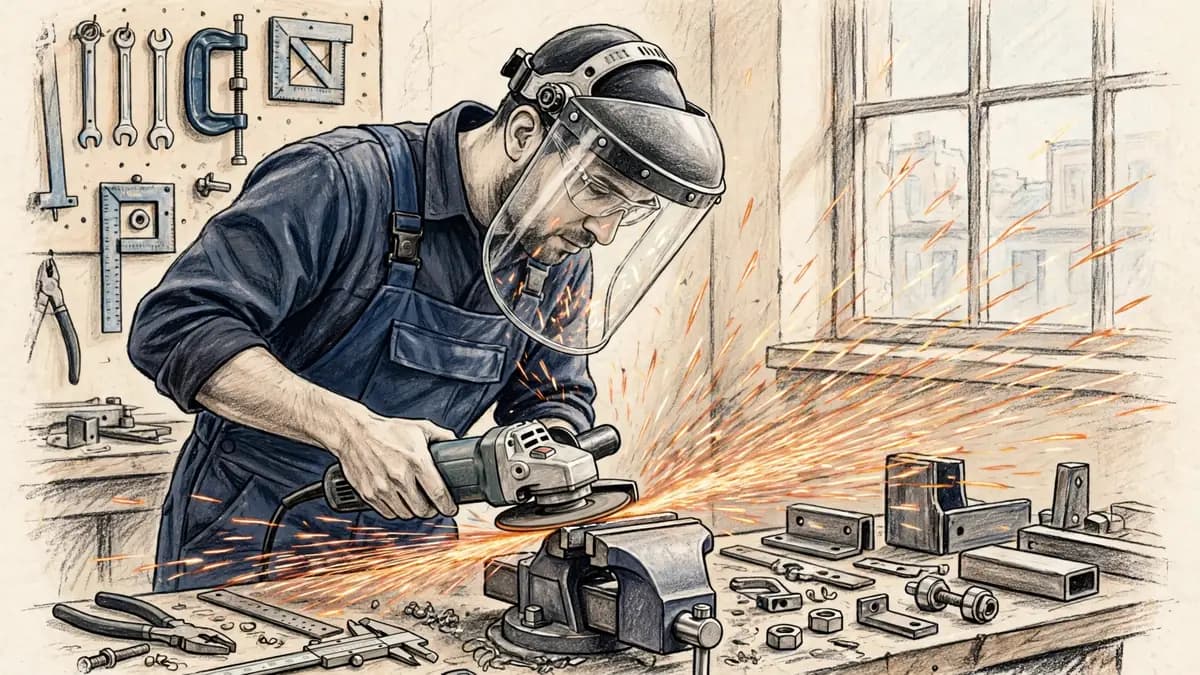
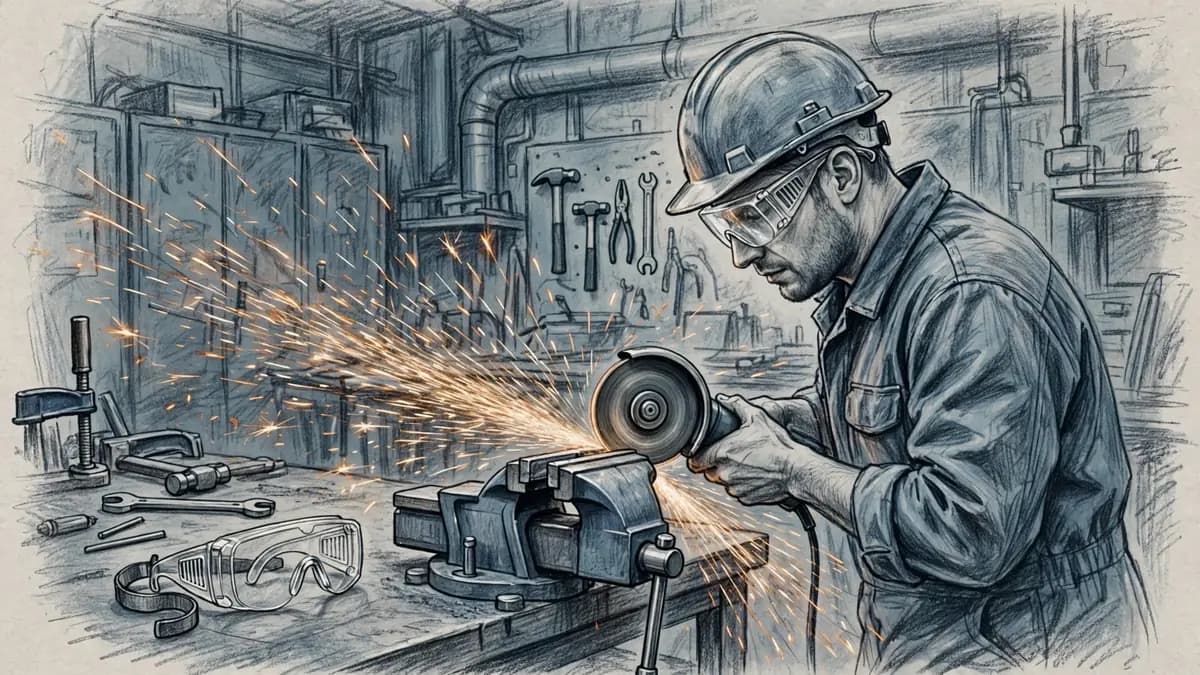
Glasses are the right tool when the hazard is impact alone: grinding, chipping, drilling and nailing, where particles fly in straight lines. Goggles are the right tool when the hazard is a liquid, a vapour or a dust — anything that can go around a lens. The employer's hazard assessment makes the call, task by task, under OSHA 1910.133 in the US and the PPE at Work Regulations 1992 in the UK. A worker who is unsure should ask for the goggle: the cost of over-protecting is comfort, while the cost of under-protecting is an eye injury.
AlertA face shield is not a substitute for glasses or goggles. It is open at the bottom and sides, so a particle that bounces under it reaches an unprotected eye. Wear the shield over the glasses or goggles.
The main types of safety goggles
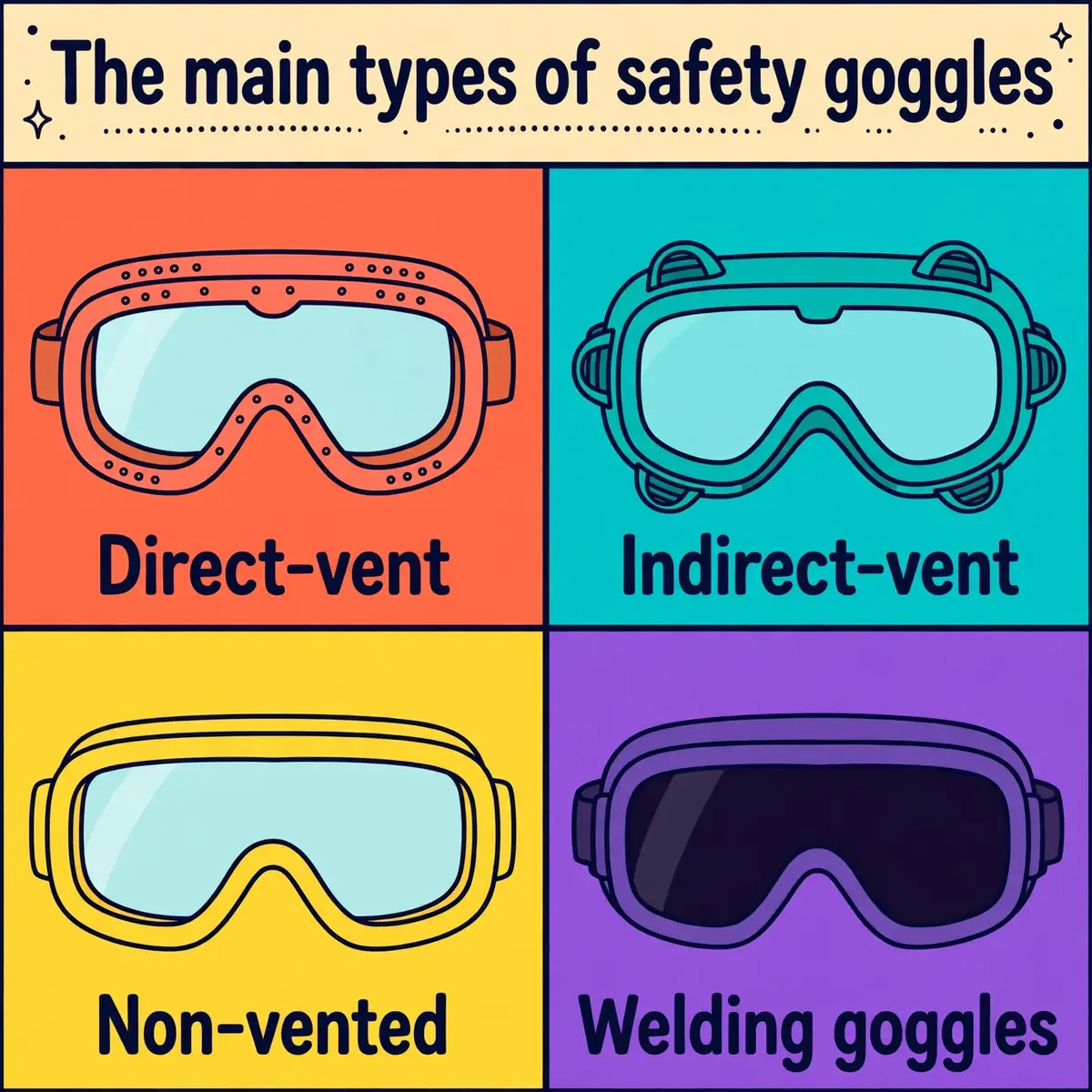
There are four vent types, and the vent is the single feature that decides what a goggle keeps out. Two further designs cover welding and prescription wearers. Every type below is a goggle, and every one seals to the face — the difference is what the vents let through.
Direct-vent goggles
Direct-vent goggles have holes straight through the frame. Air flows directly in and out, so these goggles ventilate best and fog least. They are comfortable in hot work and easy to wear for a full shift.
The same open holes are their limit. Liquid and fine dust pass straight through the vents, so direct-vent goggles stop impact only. Use them for grinding, cutting and other work where flying particles are the hazard and nothing liquid or dusty is in the air.
Indirect-vent goggles
Indirect-vent goggles have covered or baffled vents. Air gets in around a corner, but liquid cannot follow the same path. The vent lets the goggle breathe while the seal keeps splash out, which makes this the most versatile type.
Almost every chemical splash goggle is an indirect-vent goggle, and the splash mark D3 belongs to this design. Indirect vents also handle ordinary dust well. For general chemical and industrial work, this is the default choice when the hazard is not yet fully known.
Non-vented (sealed) goggles
Non-vented goggles have no openings at all. The seal is complete, so they are the only choice for fine dust, gases and vapours. Laboratory work with volatile chemicals and dusty work with very fine particles both call for this type.
Sealed goggles fog fastest, because warm air has nowhere to go. That is why their lenses carry anti-fog coatings, and why some models add a small fan. If a sealed goggle is needed, budget for the anti-fog coating as part of the purchase, not as an extra.
Welding goggles
Welding goggles carry tinted, shade-rated lenses that filter intense light, ultraviolet and infrared radiation, and sparks. The shade number must match the operation: too light a shade leaves the eye exposed, too dark a shade hides the work.
OSHA's shade table in 1910.133(a)(5) gives the minimum shade for each operation — shade 7 for shielded metal arc welding under 60 amps, shade 4 for light gas welding, shade 5 for medium and shade 6 for heavy gas welding. Check the table for the operation before choosing a lens. Electrical work brings a different light hazard — an arc flash — which needs arc-rated face protection over the goggles.
Over-the-glasses and prescription goggles
Workers who wear prescription lenses have two options. Over-the-glasses (OTG) goggles are sized to fit over everyday frames without disturbing either pair. Prescription safety goggles carry a corrective insert behind the protective lens, or the prescription is built into a certified safety frame.
Ordinary prescription glasses are not eye protection. They are not impact-rated, they have no side protection and they do not seal. OSHA 1910.133(a)(3) requires either prescription safety eyewear or protection worn over the prescription lenses. The same rule applies in the UK, where eye protection must meet BS EN 166.
How to read the ratings: ANSI Z87.1 and EN 166
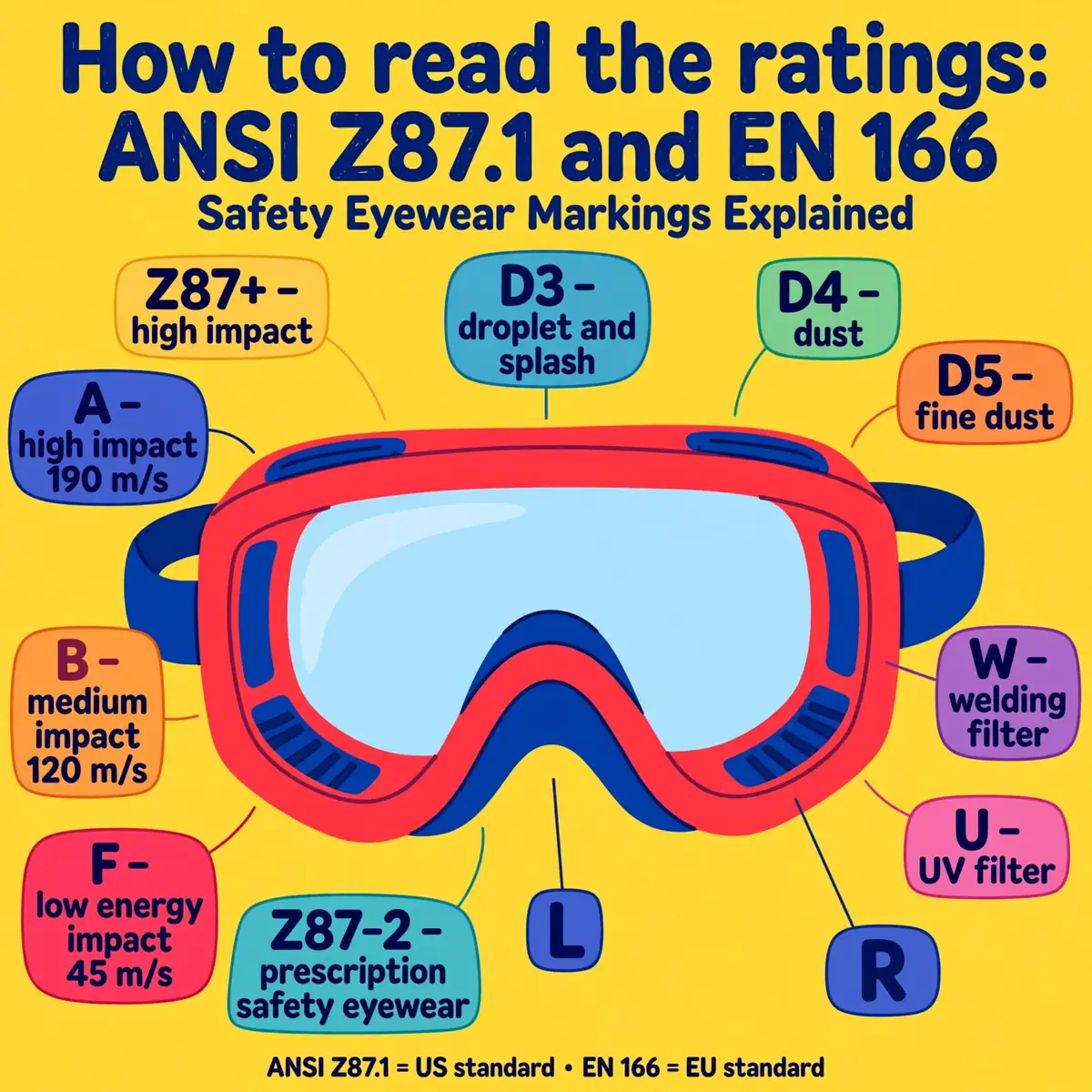
The marks stamped on the frame and lens are the proof that a goggle was tested. An unmarked lens is not a Z87.1 protector, whatever the packaging says. The manufacturer's mark must be on it too, so the maker can be identified. In the US the marks come from ANSI/ISEA Z87.1; in the UK and Europe they come from EN 166 (BS EN 166). The two systems use different letters, so a buyer who works in both markets needs both tables.
| ANSI Z87.1 mark | What it means |
|---|---|
| Z87 | Basic impact: a 1-inch steel ball dropped from 50 inches onto the lens |
| Z87+ | High impact: a quarter-inch steel ball at 150 feet per second, plus a high-mass test; the plus must be on both lens and frame |
| D3 | Droplet and splash protection |
| D4 | Dust protection |
| D5 | Fine dust protection |
| W + number | Welding filter, shade number |
| U + number | Ultraviolet filter, scale number (U6 is common) |
| R | Infrared filter |
| L | Visible light filter |
| V | Variable tint |
| S | Special purpose tint |
| H | Fits smaller head sizes |
| Z87-2 | Prescription frame or carrier |
The D3, D4 and D5 marks belong to goggles only. A protector without a seal cannot carry them, because the test checks what gets past the seal, not just what the lens stops. That is why a splash goggle is always an indirect-vent or unvented goggle, and why a dust goggle is always sealed or baffled. When a catalogue lists D3 on a pair of glasses, the listing is wrong.
| EN 166 mark | What it means |
|---|---|
| F | Low-energy impact: 6 mm steel ball at 45 metres per second |
| B | Medium-energy impact: 6 mm steel ball at 120 metres per second |
| A | High-energy impact: 6 mm steel ball at 190 metres per second |
| S | Increased robustness |
| 3 | Protection against liquid droplets and splashes |
| 4 | Protection against large dust particles |
| 5 | Protection against gas and fine dust particles |
| 1 | Optical class 1 — suitable for continuous wear |
Check the marking before buying, and check it again when the pair arrives. The impact mark and the splash or dust mark must both be present for the hazard in question. A goggle marked only Z87 has passed the basic impact test and nothing else; it is not a splash goggle. A goggle marked Z87+ D3 has passed high impact and splash testing, and it is the pair to reach for in chemical work.
WarningNever buy unmarked eye protection. If the lens and frame carry no standard mark and no maker, there is no evidence the pair was tested at all. A cheap unmarked goggle can fail on the first impact.
Matching the goggle to the hazard
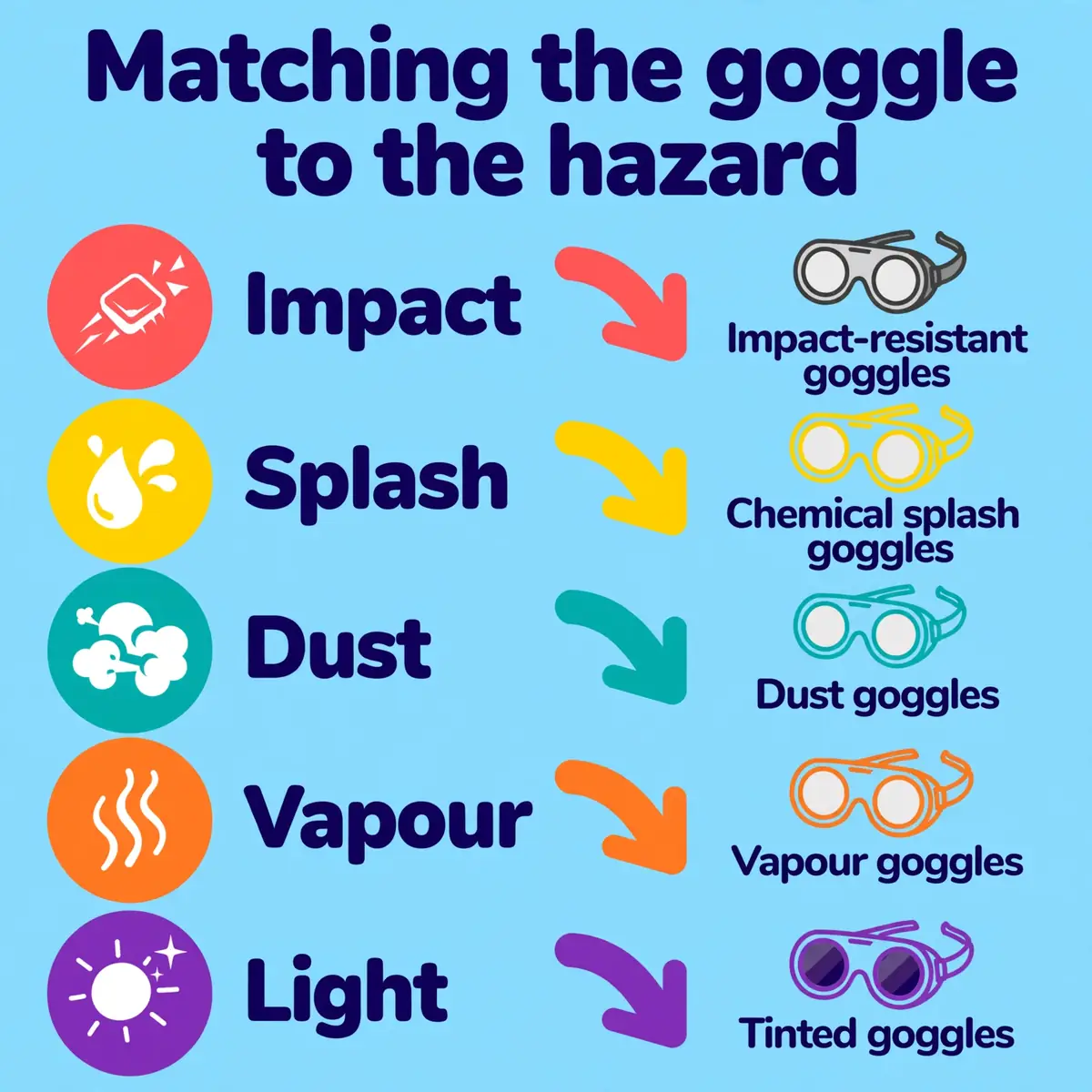
The hazard decides the goggle, not the other way round. Start from what is in the air or on the bench, then read across to the vent type and the marks. The table below covers the hazards OSHA names in 1910.133(a)(1).
| Hazard | Goggle to use | Marks to look for |
|---|---|---|
| Flying particles (grinding, chipping, drilling) | Direct-vent goggles, or safety glasses with side protection | Z87+ for high impact |
| Liquid chemicals, acids, caustics | Indirect-vent goggles | D3 splash |
| Chemical gases or vapours | Unvented goggles | D5 (closest mark; vapour itself is not a Z87.1 test) |
| Dust | Indirect-vent goggles | D4 dust |
| Fine dust | Unvented goggles | D5 fine dust |
| Molten metal | Goggles with the right filter, under a face shield | Z87+ and the filter mark for the operation |
| Light radiation (welding, cutting) | Welding goggles, shade-rated | W plus the shade number for the operation |
Where the splash can reach the whole face, add a face shield over the goggles. The shield is secondary protection: it stops the bulk of a splash from a bath or a line, while the goggles protect the eyes from what runs around it. For severe chemical exposure, OSHA's selection guidance pairs D3 goggles with a shield. The shield alone never meets the rule. Keep eyewash in the first aid kit so a splash can be flushed at once.
One hazard can call for two protectors at once. Asbestos work is a good example: the dust is fine enough to need sealed goggles, and the respirator that goes with them must fit alongside the goggle strap without breaking the seal. Try the combination on before the job starts, not on site. The same applies to helmets, ear defenders and respirators in any dusty trade.
How to choose the right pair
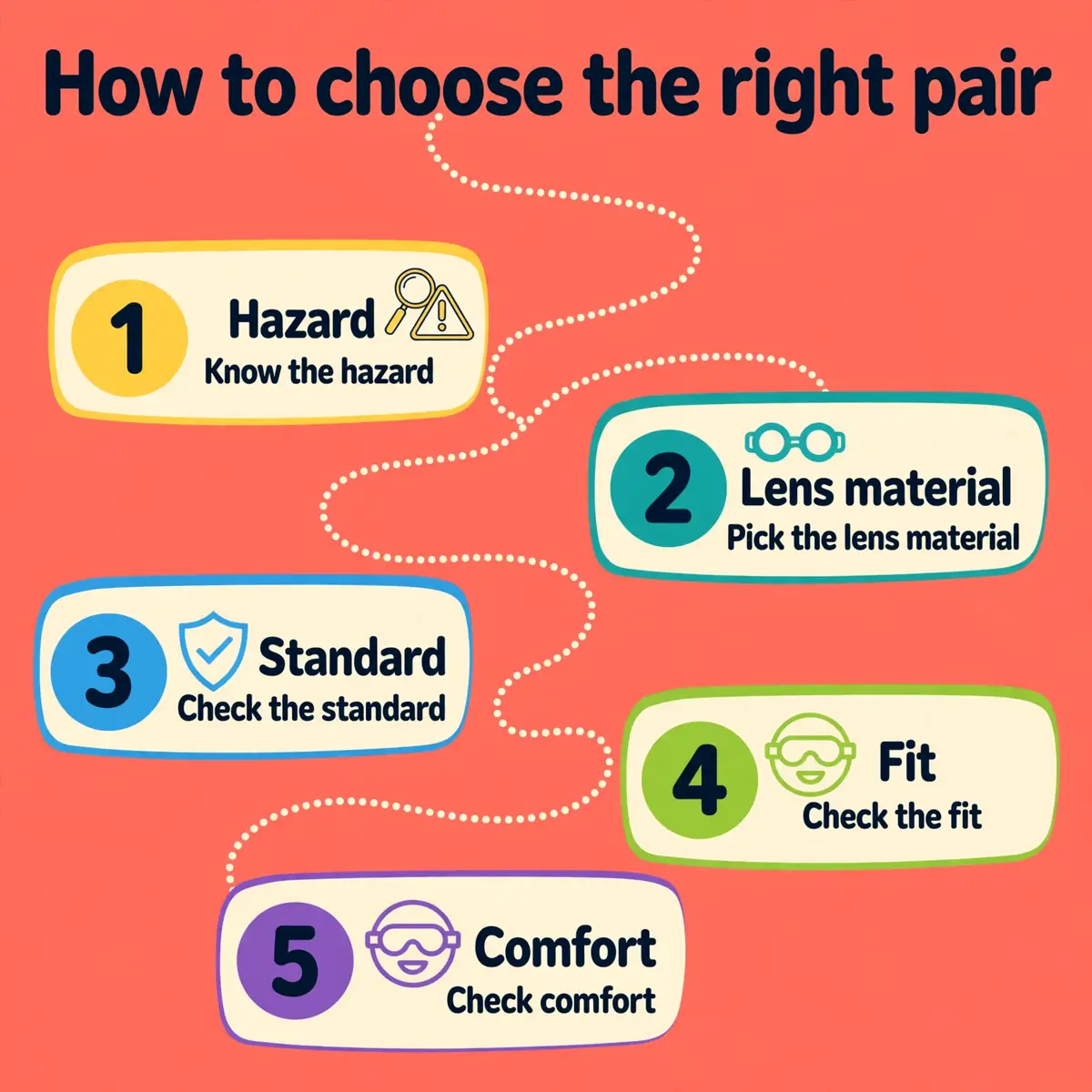
Choosing goggles is a five-step job. Each step narrows the choice, and skipping one is how the wrong pair ends up on the job. Work through them in order.
Step 1: Identify the hazard type
Name what the eyes are exposed to, task by task. Is it impact from grinding or machining? Liquid splash from a chemical bath? Fine dust from cutting or demolition? Vapour from a solvent? Light radiation from welding?
Write the hazard down before shopping. A hazard list turns a vague "we need goggles" into a specification: indirect-vent D3 for the acid line, unvented D5 for the solvent room, direct-vent Z87+ for the grinding bay. Without the list, the buyer guesses — and guessing buys the wrong vent type.
Step 2: Match the lens material to the risk
The lens material decides the level and type of protection. Three materials cover almost every goggle on the market.
- Polycarbonate: the standard choice. High impact resistance, lightweight, and it filters ultraviolet light on its own. Most safety goggles use it.
- Trivex: impact protection comparable to polycarbonate, with better optical clarity. A good choice where the wearer reads instruments or works to fine detail.
- Glass: the best scratch and chemical resistance, but heavier and less impact-resistant than the plastics. Useful where the lens faces chemical attack rather than impact.
Polycarbonate is the default unless a specific reason points elsewhere. Its ultraviolet filtering is a genuine advantage outdoors: a clear polycarbonate lens blocks 99.9% of ultraviolet, and carries the U scale number when the maker has tested it.
Step 3: Verify the relevant standard
Confirm the marks on the lens and the frame before paying. In the US, look for ANSI Z87.1 with the marks the hazard needs: Z87+ for high impact, D3 for splash, D4 for dust, D5 for fine dust. In the UK, look for BS EN 166 with the matching letters and numbers.
Do not trust a claim on the box alone. The marks must be stamped on the protector itself, and the maker's name must be there too. A supplier who cannot show the marks is selling an untested product, and an untested product is not personal protective equipment. The same check applies to other protective equipment: steel toe boots carry their own rating marks, read the same way.
Step 4: Check the fit
Try the goggles on with the other kit the job needs: respirator, helmet, ear defenders. The seal must sit evenly all round the eyes, with no gaps at the brow or cheeks. The strap should be snug without pinching, and the goggles should stay in place when the wearer looks down.
Check the fit with prescription glasses underneath, if the wearer uses them. Over-the-glasses models are sized for this; a standard goggle squeezed over frames will press on the temples and break the seal. If the combination does not sit right, change the model — not the wearer's glasses.
Step 5: Think about comfort for a long shift
Goggles worn across a long shift must be comfortable, or they will be taken off. That is not a minor point: fogging is the most common reason workers remove eye protection, and a removed goggle protects nothing. Adjustable straps, a cushioned nose bridge and a light frame all help.
Anti-fog coating matters most on unvented goggles and in hot, humid work. Vented goggles fog less, so a worker who moves between indoor and outdoor jobs may accept a vented pair with a standard coating. Comfort is a safety feature, not a luxury — budget for it the same way as for the rating.
Fit, fogging and wearing them all day
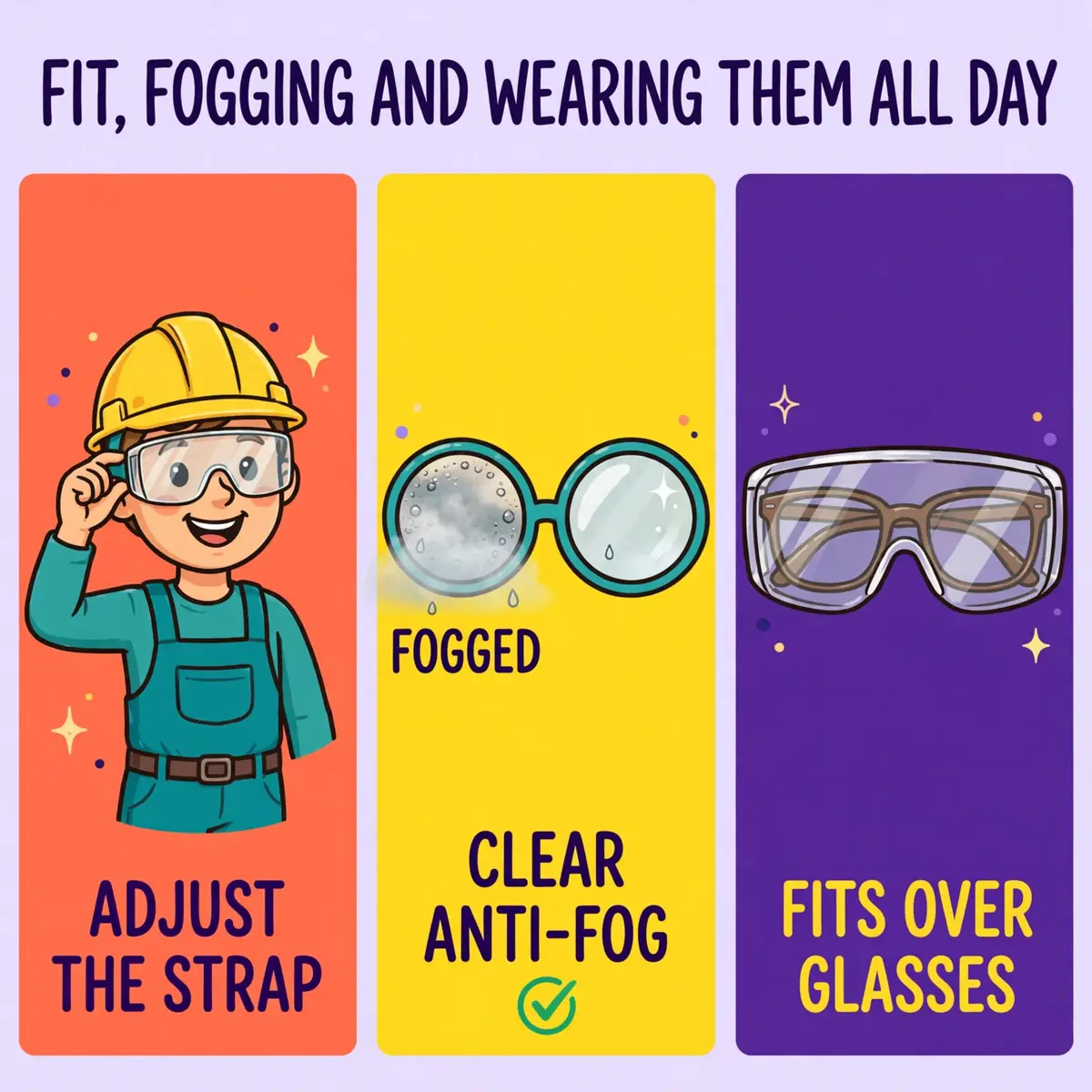
A goggle that does not fit is a goggle that does not protect. The seal must press evenly against the face, with no gap at the brow, the cheeks or the bridge of the nose. Adjust the strap until the goggle sits snug without pinching, then check the seal again with the respirator or helmet on. Other kit can lift the frame and open a gap the wearer never notices.
Fogging is the practical enemy of the seal. Warm, moist air from the face hits a cooler lens and condenses, and the wearer who cannot see will lift the goggles to clear them. That is why fogging is the most common reason workers take eye protection off. Anti-fog coatings, indirect vents and a good seal all help, and the coating works best when the lens is cleaned as the maker instructs — a dry wipe on an anti-fog lens can strip the coating off.
Prescription wearers need the same care. Over-the-glasses goggles fit over everyday frames, while prescription safety eyewear builds the correction into a certified frame. Either way, the protection must not disturb the position of the prescription lenses or the protective lenses. A goggle that presses the wearer's glasses out of line is the wrong goggle, however good its marks are.
TipClean an anti-fog lens with lukewarm water and a soft cloth, as the maker instructs. Never wipe the inside of the lens dry with a paper towel — it scratches the coating and the lens fogs worse after.
Care, inspection and replacement
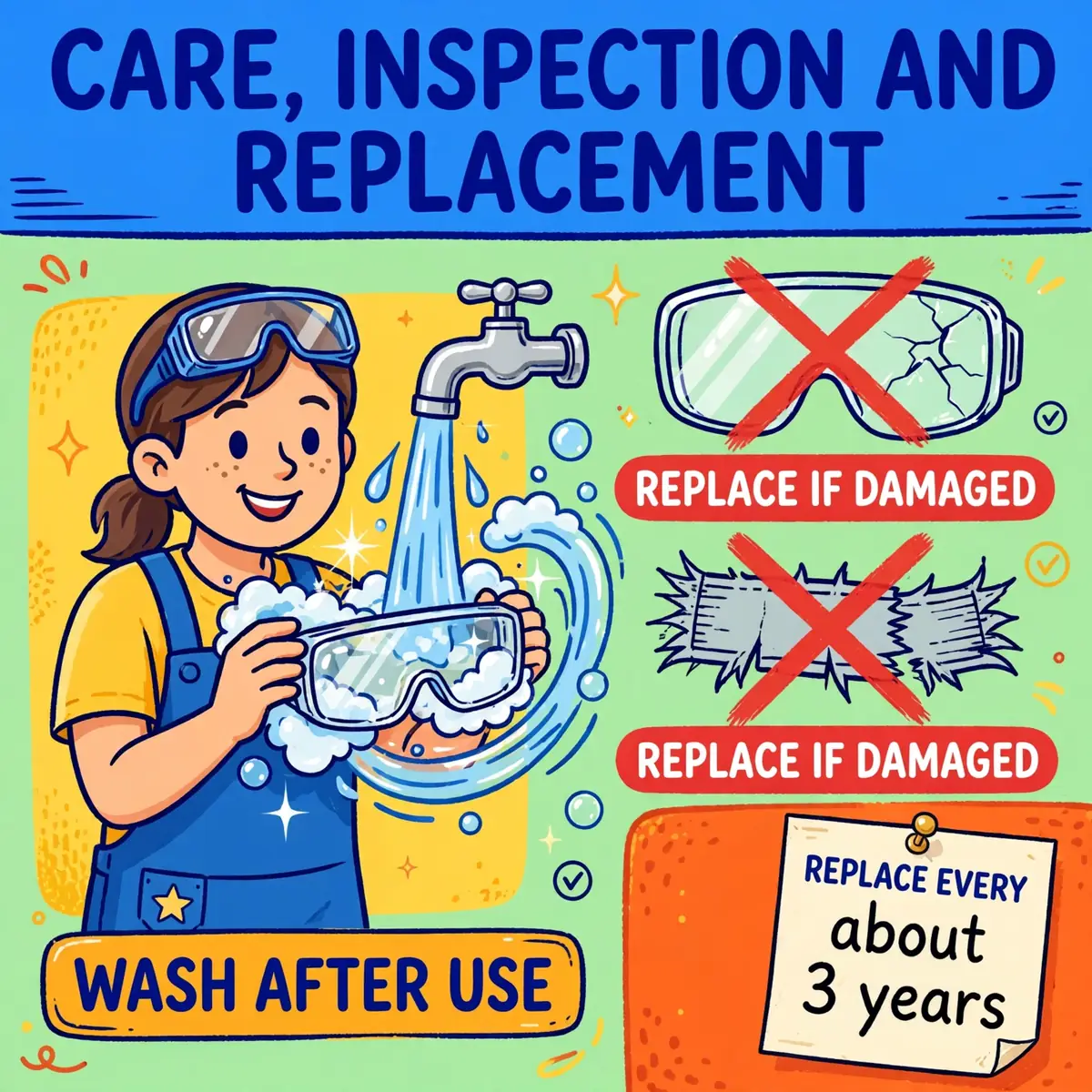
Clean goggles after each use. Rinse off dust and chemicals with lukewarm water, wash with mild soap, and dry with a soft cloth. Store them in a case or a clean locker, away from heat and direct sunlight, and never loose in a toolbox where the lens can be scratched by tools. A scratched lens scatters light and weakens the impact resistance, so the case is part of the protection.
Inspect the pair before each use. Look for scratches and cracks in the lens, a perished or torn seal, a stretched strap, and vents blocked with dust or dried chemical. Check that the markings are still legible: a lens whose marks have worn away cannot be shown to meet the standard. Any of these faults means the pair comes out of service.
Replace goggles after any impact, even if the lens looks undamaged — the impact may have weakened it. Replace them at once if there is visible damage: a crack, a deep scratch, a loose lens or a failed strap. Many manufacturers suggest replacing eye protection after about three years, because the materials degrade with use and cleaning. The date of issue, written on the strap or the case, makes that decision easy.
WarningDo not keep using a scratched or cracked goggle. A damaged lens can fail on the next impact, and a scratch in the line of sight hides hazards. Take the pair out of service and replace it.
The law in the US and the UK
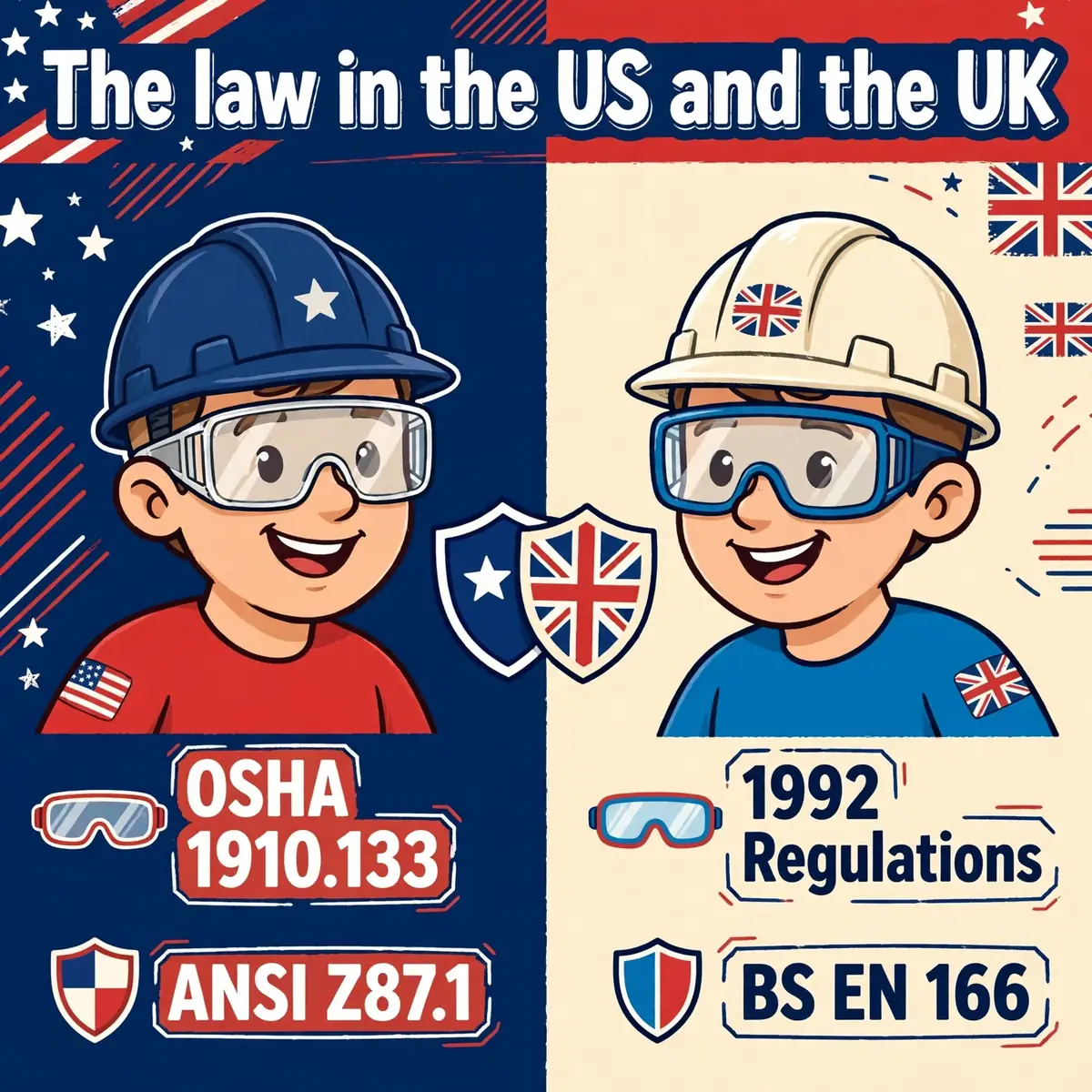
In the United States, OSHA standard 1910.133 requires the employer to make sure each affected employee uses appropriate eye or face protection when exposed to flying particles, molten metal, liquid chemicals, acids or caustic liquids, chemical gases or vapours, or potentially injurious light radiation.
Where flying objects are the hazard, the protection must provide side protection. Prescription wearers must have protection that incorporates the prescription or fits over it without disturbing either pair. Every protector must be distinctly marked with its maker, and filter lenses must carry the shade number for the work. Construction work follows the same duties under 1926.102.
The same rule sets the standard the protector must meet. Devices must comply with ANSI/ISEA Z87.1-2010, Z87.1-2003 or Z87.1-1989, or the employer must show they are at least as effective. Newer editions, including Z87.1-2015 and Z87.1-2020, are accepted on that basis, so a current Z87.1-2020 mark is what a buyer will find on new stock. The employer's hazard assessment under 1910.132(d) is what matches each task to its protector.
In the United Kingdom, the Personal Protective Equipment at Work Regulations 1992 (as amended in 2022) require the employer to provide suitable personal protective equipment free of charge where risks cannot be controlled by other means. Eye protection must meet BS EN 166, and the employer must maintain it, replace it when worn or damaged, and train workers in its use. Regulation 4 makes eye protection a legal requirement wherever the work exposes the eyes to harm. Employees must use the equipment provided and report damage or loss.
Checklist: buying safety goggles
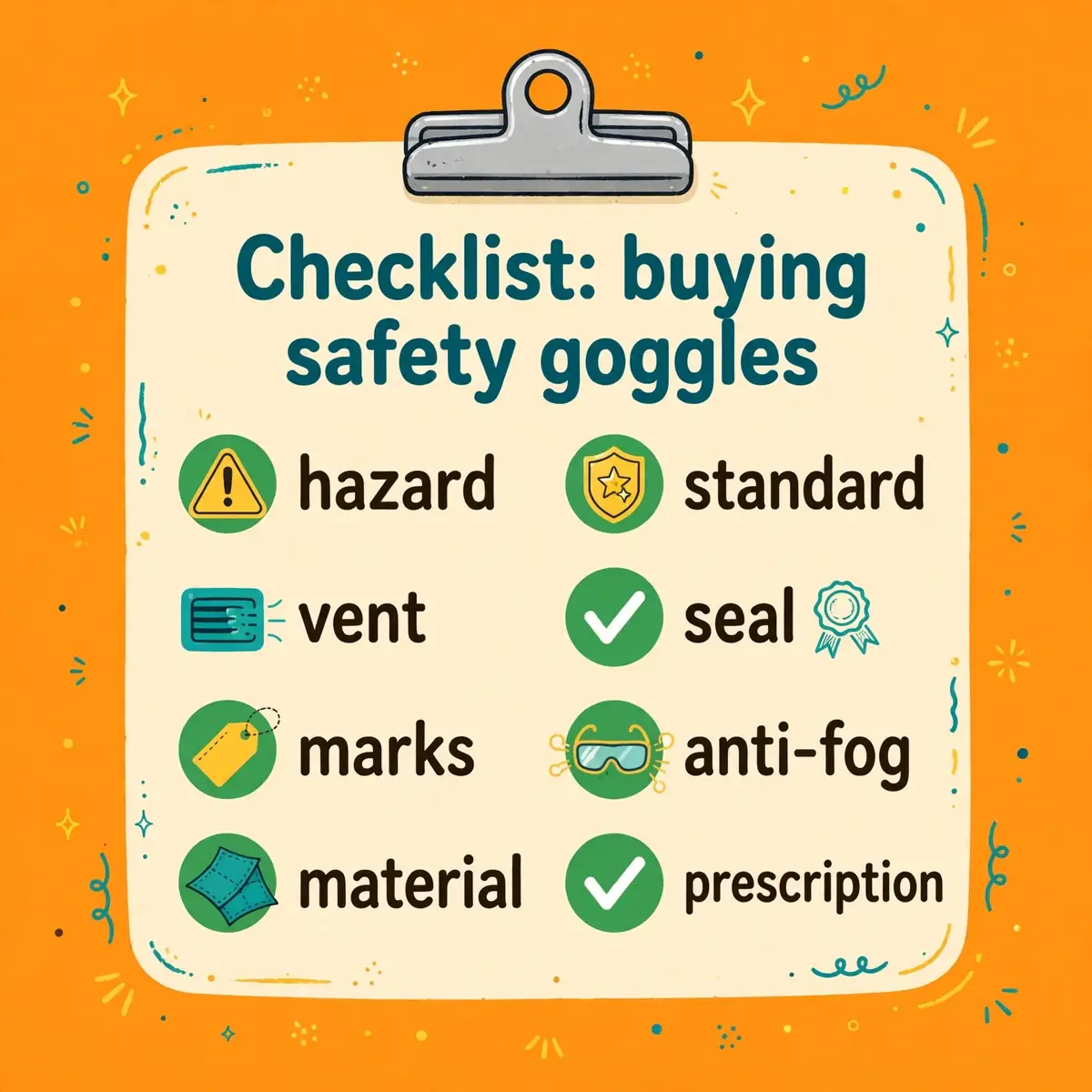
Work through this list before ordering. Every item should be answered yes before the purchase is made.
- Hazard named for the job: impact, splash, dust, vapour or light radiation.
- Vent type matches the hazard: direct for impact, indirect for splash, unvented for fine dust and vapour.
- Marks checked: Z87+ for high impact, D3 for splash, D4 for dust, D5 for fine dust.
- Lens material suits the work: polycarbonate as standard, Trivex for clarity, glass for scratch and chemical resistance.
- Standard verified on the protector itself: ANSI Z87.1 in the US, BS EN 166 in the UK.
- Seal checked: no gaps, strap snug, fits with the respirator or helmet the job needs.
- Anti-fog coating included where the work is hot, humid or unvented.
- Prescription wearers covered: over-the-glasses model or prescription safety eyewear.
Frequently Asked Questions
What is the difference between safety goggles and safety glasses?
Glasses protect against impact with side shields and no seal. Goggles seal to the face and, depending on the vents, keep out splash, dust and vapour as well as impact.
What does Z87+ mean?
High-impact rated under ANSI Z87.1. The lens and frame passed the high-velocity and high-mass tests. Plain Z87 is basic impact only, and the plus must appear on both the lens and the frame.
What does D3 mean on goggles?
Tested for droplet and splash protection. D4 is dust and D5 is fine dust. These are goggle marks: a protector without a seal cannot carry them.
Can I wear safety goggles over prescription glasses?
Yes, if the goggles are made as over-the-glasses models and fit over the frames without disturbing either pair. Prescription safety eyewear, with the correction built into a certified frame, is the other option.
Do I need goggles for chemical work?
Yes, wherever liquid chemicals, acids or caustics can splash. Indirect-vent goggles marked D3 are the standard choice, with a face shield over them where the splash can reach the face.
How often should safety goggles be replaced?
After any impact or visible damage, at once. Otherwise, many manufacturers suggest about three years, because the lens and seal materials degrade with use and cleaning.
Sources
- OSHA, 29 CFR 1910.133 — Eye and face protection
- Electronic Code of Federal Regulations, 29 CFR 1910.133 (Cornell LII)
- CDC/NIOSH, The Manufacture and Selection of Eye Protection at Work
- Bayshore Safety, Safety glasses vs safety goggles: when each one is required
- RS Online, Safety Goggles Guide: Types, Functions & How to Choose
- HETAS, Personal Protective Equipment for installers and chimney sweeps (PPE at Work Regulations 1992, Regulation 4; EN 166)