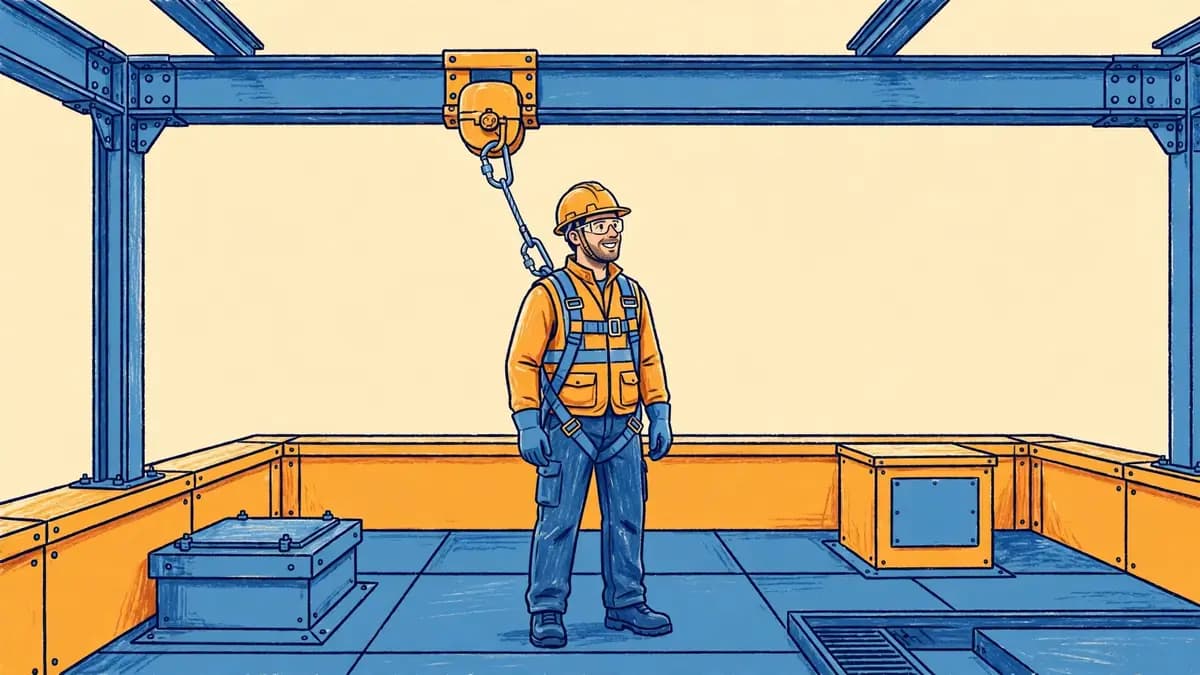
A self-retracting lifeline keeps its line short and taut while you move, then locks within inches when you fall. That short lock is the whole point of the device: it takes the free fall out of the fall. The force on your body stays low and the clearance you need below stays small.
OSHA defines it as a deceleration device with a drum-wound line that pays out and retracts under slight tension during normal movement, and locks the drum automatically at the onset of a fall. Inside the housing, a spring keeps light tension on the line so it never goes slack. A speed-sensing pawl engages when the drum spins faster than walking speed. A brake or energy absorber then slips a controlled distance to keep the arresting force within the legal limit.
What is a self-retracting lifeline?
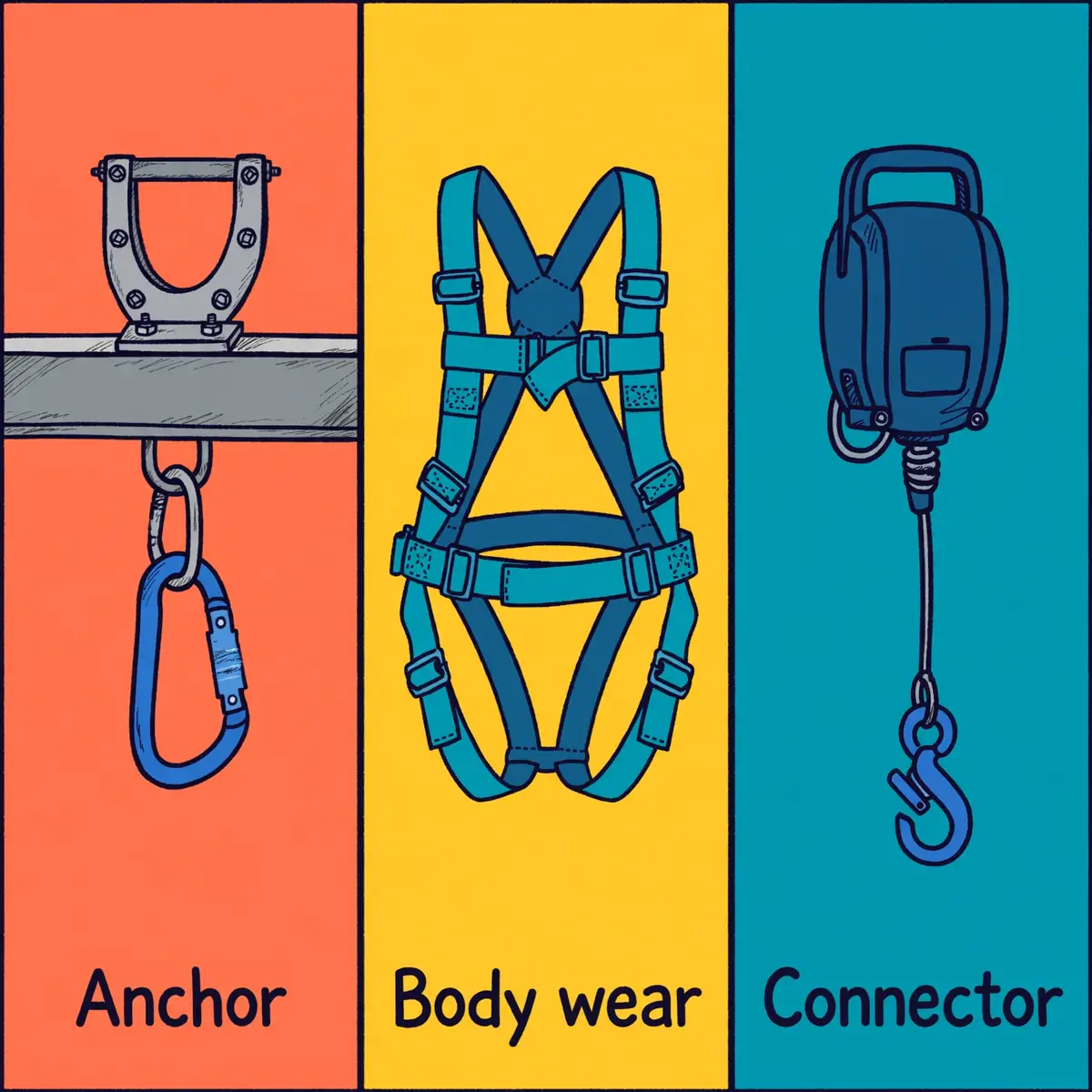
A self-retracting lifeline, or SRL, is a fall arrest connector. It links a worker's full body harness to an anchor point, and it is one part of a personal fall arrest system. That system has three parts, often called the ABCs of fall protection: the anchor, the body wear (the harness) and the connector. The SRL fills the connector role. Remove any one of the three and the system cannot protect the worker.
The device has three main parts of its own. The housing holds the drum, the spring and the brake. The lifeline — steel cable or synthetic webbing — winds onto the drum inside that housing. The connectors at each end link the housing to the anchor and the line to the harness. Carabiners and snap hooks are the common connectors.
Other names for the same device turn up on sites and in catalogues. Workers call it a retractable, a yo-yo, a block or a backpack. A personal fall limiter (PFL) is the small harness-mounted version. In the UK and in European wording, the same device is a retractable-type fall arrester, often called a fall arrest block or an inertia reel. All of these names describe the same drum, spring and brake.
The three parts of the system
The anchor is the fixed point that holds the fall forces. OSHA requires an anchorage to support at least 5,000 pounds per attached worker, or to be designed by a qualified person with a safety factor of at least two. An anchor that cannot hold that load is not an anchor, whatever it looks like.
The body wear is a full body harness, attached at the dorsal D-ring between the shoulder blades. The harness and the lifeline are both personal protective equipment, covered by the site's PPE requirements. Body belts are not acceptable for fall arrest in the United States — OSHA banned them for that use in 1998. The harness spreads the arrest force across the body instead of concentrating it at the waist.
The connector is the SRL itself. It must be strong enough to hold the fall and short enough to stop the worker before a lower level is reached. That is why the SRL's locking speed and its arrest distance matter more than its length.
How a self-retracting lifeline works
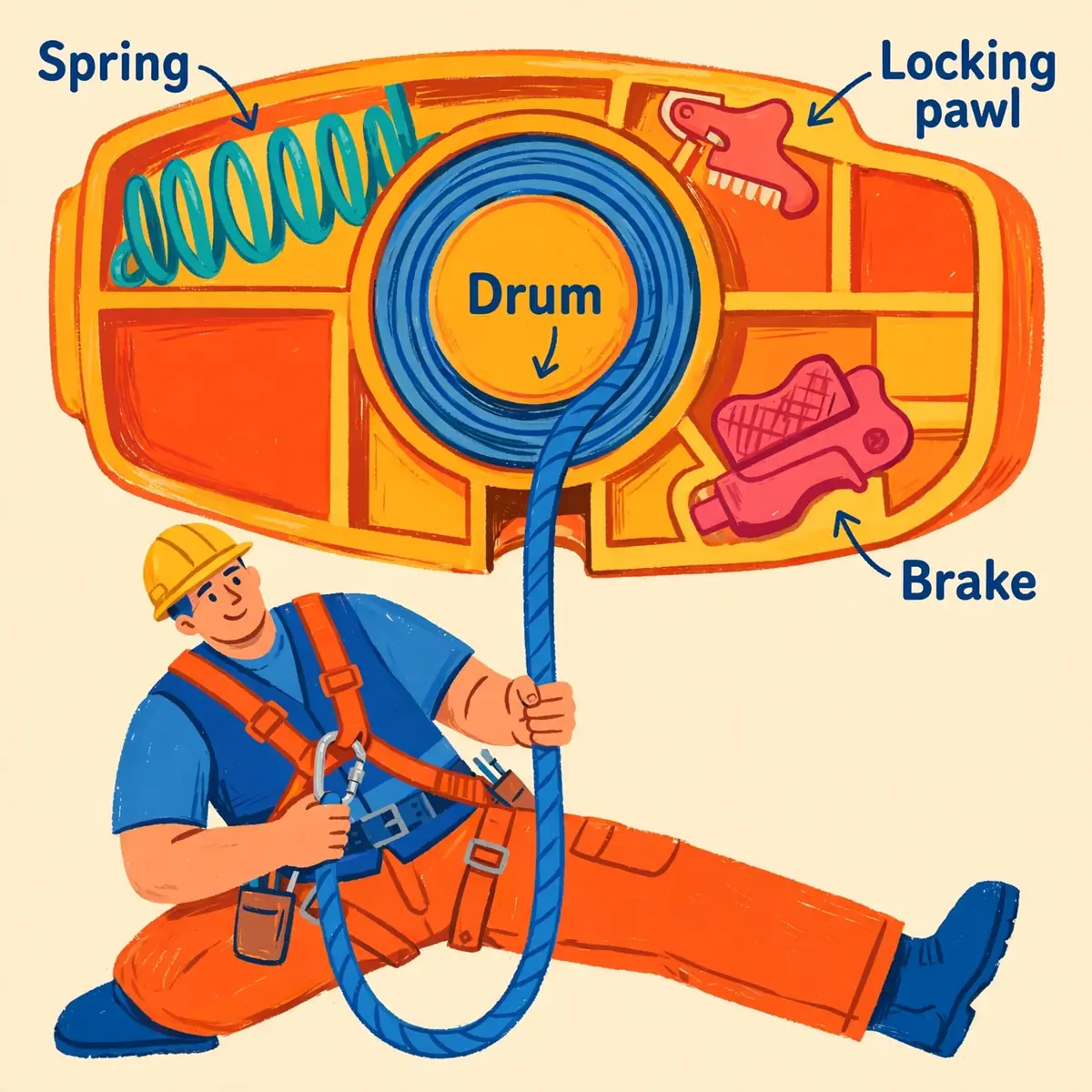
The mechanism is simple to picture and hard to improve on. A spring inside the housing keeps light tension on the line at all times. As the worker moves toward or away from the anchor, the line pays out and reels back in. It never goes slack and never trails on the ground. Normal movement is slow, so the drum turns slowly and the line moves freely.
A fall changes the speed. The line runs out fast, the drum spins past a set speed, and a centrifugal or inertial pawl snaps into place. The drum locks in a fraction of a second, within inches of the fall starting. The brake then slips a controlled amount, so the force on the body stays under the legal limit instead of hitting all at once.
TipThink of a car seatbelt. It lets you lean forward slowly, then locks the moment you move fast. An SRL does the same thing, in the vertical plane.
The drum and the spring
The drum is the heart of the device. It stores the lifeline in a tight coil and turns as the line pays out or retracts. The spring drives the retraction. It must be strong enough to pull the line back in fully, even when the line is long and heavy. It must be gentle enough not to yank the worker.
A weak or damaged spring shows up in the pre-use check. If the line hesitates, sticks, or will not retract fully, the device fails inspection. The fault is not a field repair — the SRL goes to the manufacturer or an authorised service centre.
The lock
The lock is speed-sensing, not weight-sensing. It reacts to how fast the line runs out, not to how heavy the worker is. That is why the lock can catch a fall within inches: the drum reaches its lock-on speed almost as soon as the fall starts.
Test the lock before every use. Pull the line out sharply and it should lock firmly, with no slip while you hold tension on it. Ease the tension and the line should retract smoothly. Repeat the test at different lengths of line, since a fault can hide at one point in the drum's travel.
The brake and the energy absorber
Locking the drum is only half the job. Stopping a falling body in zero distance would put a huge force on the body and the anchor. The brake, or an energy absorber, spends the fall's energy over a short, controlled distance.
Some SRLs put the absorber inside the housing. Some put it in a pack at the harness end of the line. Leading-edge models often use an external absorber on the line, sized for the longer free fall that a low anchor allows. Wherever it sits, the absorber's job is the same: keep the arresting force under 1,800 pounds on a harnessed worker.
The types of self-retracting lifeline
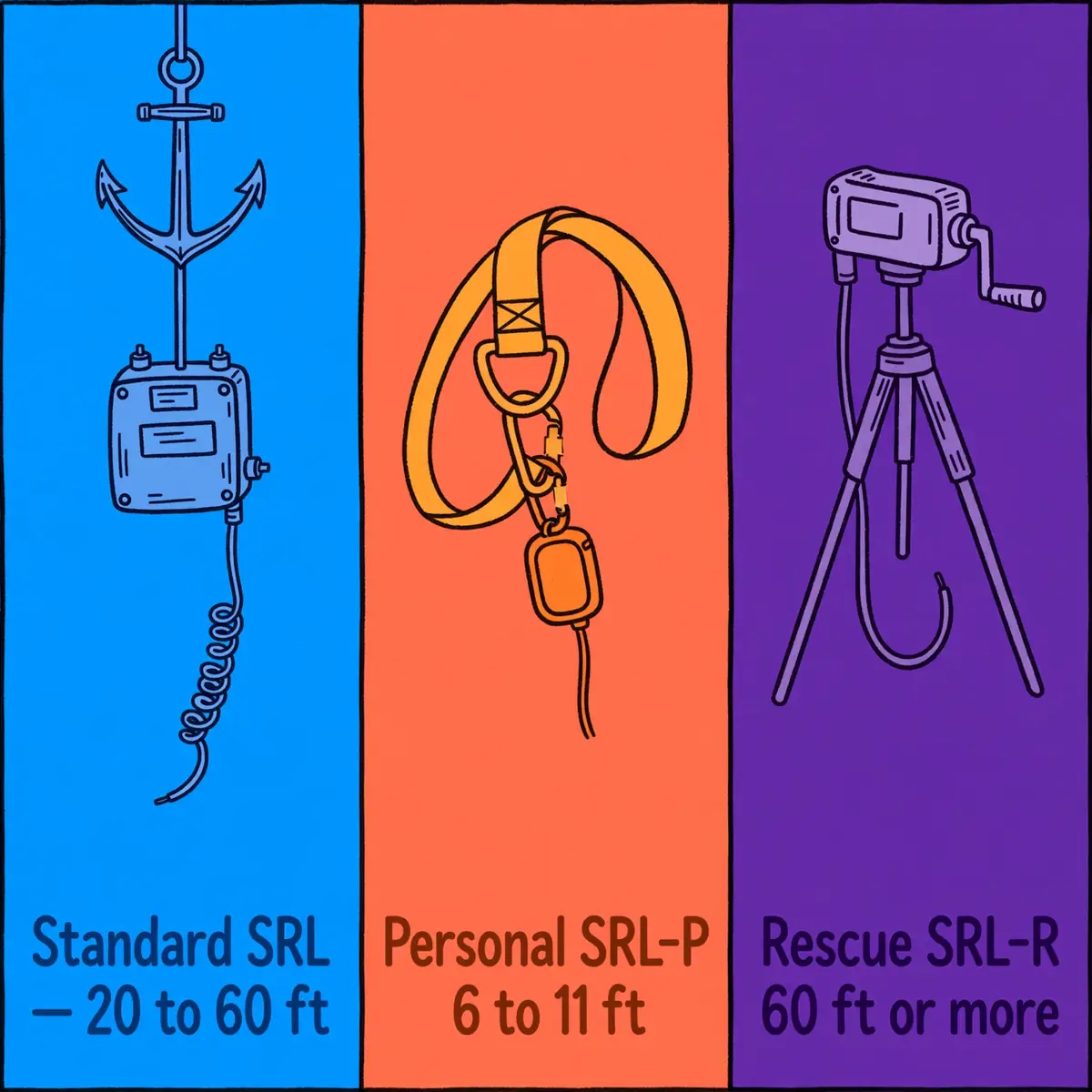
ANSI/ASSP Z359.14-2021, the current US standard for self-retracting devices, names three types. They differ by where they mount and what they do, not by how the lock works. The right type follows from the job: where the anchor is, how far the worker must move, and whether anyone may need to be retrieved after a fall.
All three types share the same lock and the same performance limits. What changes is the mounting, the line length and the extra function. It may be a short line that rides on the harness, a long line that hangs from an anchor, or a crank that can raise a fallen worker back to safety.
Standard block SRLs
A standard SRL, often called a block, is the classic anchor-mounted device. The housing hangs from the anchor above, and the lifeline runs down to the worker's harness. Most block SRLs carry lines between 20 and 60 feet long, though some run to 100 feet or more.
Early blocks had heavy metal housings. Newer models use impact-resistant polymer bodies to cut the weight while keeping the strength. The energy absorber on a block SRL usually sits on the lifeline, just behind the harness connector.
Blocks suit larger work areas where range matters: roofs, decks, loading stations and drill rigs. Their drawback is weight, especially with long steel cable lifelines. A long cable block is a load to carry up a ladder, so the housing and line length should be matched to the work, not oversized.
Personal SRLs (SRL-P)
A personal SRL mounts directly on the worker's harness, at the dorsal D-ring or in a sleeve or tunnel on the harness. The housing rides on the worker's back, and the hook at the end of the line goes to the anchor. The line is short — typically 6 to 11 feet.
Twin-leg versions give 100 percent tie-off. The worker clips one leg to the next anchor before unclipping the other, so there is never a moment with no connection. That matters when moving between anchors on a roof or a scaffold.
Personal SRLs work well on rooftops, in aerial lifts and anywhere the worker must move freely without extra bulk. Their small size limits the line length, but they can still meet Class 1 or Class 2 standards. All Class 2 models are also rated for leading-edge use.
Rescue and retrieval SRLs (SRL-R)
An SRL-R is a standard SRL with a retrieval function added. It stops the fall like any SRL, then lets a rescuer raise or lower the worker to safety. The rescuer switches the device to retrieval mode and uses a handle or crank to wind the worker up or down.
These devices are typically Class 1 only, and their lines are long — usually 60 feet or more — to reach deep into a vertical space. They are used with tripods or davits over confined space entries, towers and other places where self-rescue is impossible. A rescuer entering a confined space may also need self-contained breathing apparatus. A worker suspended after a fall faces suspension trauma, which can set in within minutes, so prompt rescue is part of any complete fall protection plan. Crews should practice emergency procedures for a suspended worker before the job starts.
Cable or webbing lifelines
The lifeline itself is either steel cable or synthetic webbing, and the choice follows the environment. Galvanised or stainless steel cable suits rugged, abrasive work and leading-edge use, where the line may drag across a sharp edge. Webbing is lighter and easier to handle, and suits shorter personal units.
Some premium models use Kevlar-reinforced webbing, which is stronger and lighter than standard cable of the same size. Arc-flash-rated SRLs use Kevlar lifelines too, because the heat of an arc flash can destroy standard polyester webbing in seconds.
| Type | Where it mounts | Typical line length | Best for |
|---|---|---|---|
| Standard SRL (block) | Anchor above the worker | 20 to 60 feet, up to 100 feet | Roofs, decks, loading stations, large areas |
| Personal SRL (SRL-P) | Harness dorsal D-ring | 6 to 11 feet | Rooftops, aerial lifts, moving between anchors |
| Rescue SRL (SRL-R) | Tripod or davit above the entry | 60 feet or more | Confined space entry, towers, retrieval after a fall |
Class 1 vs Class 2: the anchorage rule
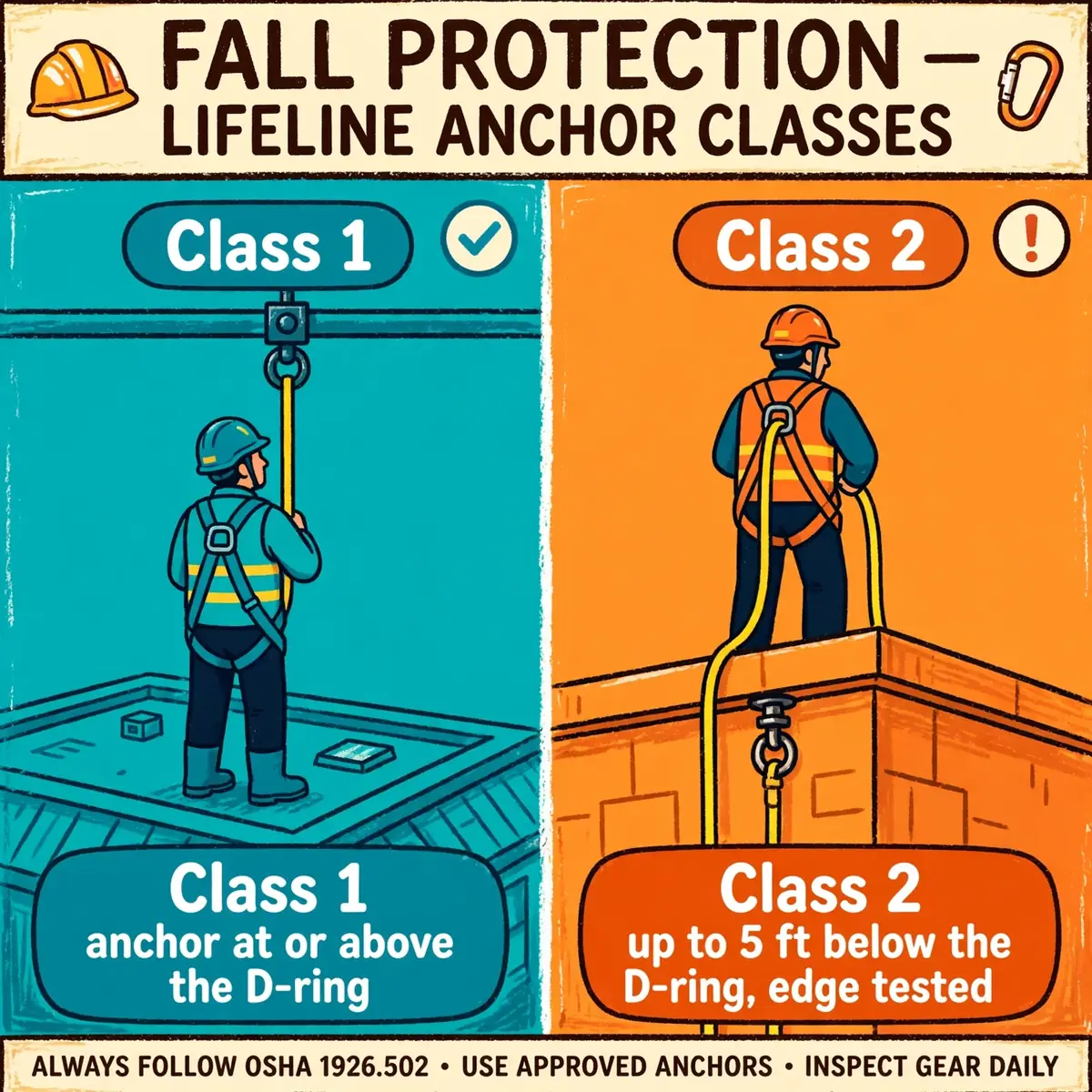
ANSI/ASSP Z359.14-2021 sorts SRLs into two classes, and the class describes where the device may be anchored — not how good it is. A Class 2 device is not better than a Class 1 device. It is built and tested for different conditions. Choosing the wrong class is the most common SRL mistake, and it is the one that turns a survivable fall into a long one.
Class 1 devices anchor at or above the dorsal D-ring. The line runs up from the worker's back to an anchor overhead. They are not tested for the line bearing on an edge, and they must not be used where it might.
Class 2 devices anchor above, at, or up to 5 feet below the dorsal D-ring. They are tested with the line going over a steel edge, so they are rated for leading-edge use. A Class 2 device carries a label and a fall clearance table or diagram on the device and in its manual. Read that chart — it gives the clearance for the anchor height and setback the worker is actually using.
WarningNever anchor a Class 1 SRL below the dorsal D-ring or run its line over an edge. It was not tested for that fall, and the line can be cut or the arrest distance can grow beyond what the clearance allows.
What changed in the 2021 standard
The 2021 edition replaced the 2014 classes. The old Class A and Class B described arrest distance — 24 inches for Class A and 54 inches for Class B. The old SRL-LE was a separate leading-edge type. The 2021 classes describe anchorage location instead, which is the question that decides whether the device works in a real fall.
Both new classes share the same performance limits: a maximum arresting force of 1,800 pounds, an average arresting force of 1,350 pounds or less, and a maximum arrest distance of 42 inches. The dynamic test uses a 310-pound weight, including a foot-level test for Class 2.
Devices made to the 2014 edition are still in service and are marked A, B or LE. Their manufacturer's instructions say what anchorage each allows. A 2014 Class B SRL-LE does not meet the 2021 Class 2 criteria, so it cannot be relabelled or converted. When buying new, look for the Z359.14-2021 marking and the class on the label.
| Feature | Class 1 | Class 2 |
|---|---|---|
| Anchorage location | At or above the dorsal D-ring | Above, at, or up to 5 feet below the dorsal D-ring |
| Edge contact | Not tested for the line bearing on an edge | Tested with the line over a steel edge |
| Maximum arrest distance | 42 inches | 42 inches |
| Average arresting force | 1,350 pounds or less | 1,350 pounds or less |
| Maximum arresting force | 1,800 pounds | 1,800 pounds |
| Dynamic test weight | 310 pounds | 310 pounds, including a foot-level test |
| Label | Class 1 | Class 2, plus a fall clearance table or diagram |
Self-retracting lifeline vs shock-absorbing lanyard
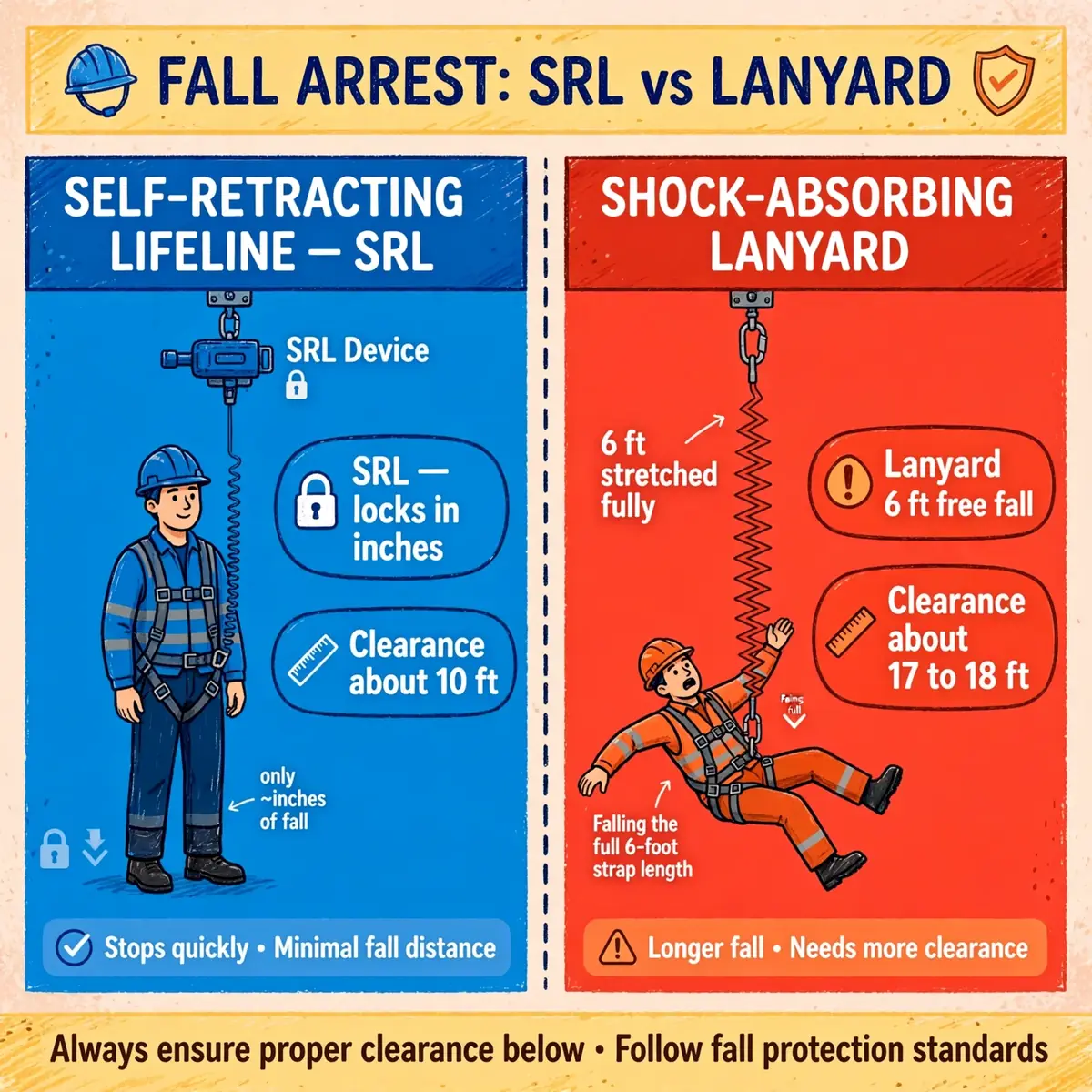
Both devices link a harness to an anchor, but they behave very differently in a fall — and that difference decides which one to use. A shock-absorbing lanyard is a fixed-length strap, usually 6 feet, with a tear-away absorber. In a fall the worker drops the full length of the lanyard before the absorber begins to work.
An SRL keeps the line short and taut the whole time. The drum locks within inches of the fall starting, so the free fall is a few inches instead of six feet. Less free fall means less force on the body and, critically, less clearance needed underneath the worker.
The lanyard's absorber deploys up to 48 inches under ANSI Z359.13, or 3.5 feet of deceleration under OSHA. The SRL's maximum arrest distance under ANSI Z359.14-2021 is 42 inches, and from an overhead anchor it is often much less in practice. The SRL buys roughly 8 feet of clearance on a typical job — the difference between a 12-foot scaffold being survivable or not.
| Feature | Self-retracting lifeline | Shock-absorbing lanyard |
|---|---|---|
| Line length | Retracts as you move; 6 to 100 feet | Fixed, usually 6 feet |
| Free fall from an overhead anchor | Inches — the drum locks at once | Up to 6 feet |
| Maximum arrest distance | 42 inches under ANSI Z359.14-2021 | 48 inches of absorber deployment under ANSI Z359.13 |
| Clearance below (overhead anchor) | About 10 feet | About 17 to 18 feet |
| Range of movement | The line length, without re-clipping | 6 feet from the anchor |
| Moving parts | Drum, spring, brake — needs a function check | None — simpler to inspect |
| Weight and cost | Heavier and more expensive | Lighter and cheaper |
When the lanyard is the better tool
A lanyard still wins in a few situations. Where the anchor is at or above the D-ring and there is plenty of clearance below, a lanyard's simplicity and low cost are hard to beat. Hot work, arc flash and welding favour lanyards too. Kevlar or arc-rated web lanyards exist for those jobs, and an SRL housing would sit in the way or be exposed to slag.
Tie-back use is another lanyard job: a lanyard built for wrapping its own line around a beam removes the need for a separate anchor connector. And where the work is positioning or restraint rather than arrest, those systems use their own lanyard types without an energy absorber.
Everything else, especially anything under 18 feet of clearance or with an anchor below the D-ring, is SRL territory. Where a lanyard cannot meet the free-fall and clearance limits, an SRL usually can.
When to use one — and when not to
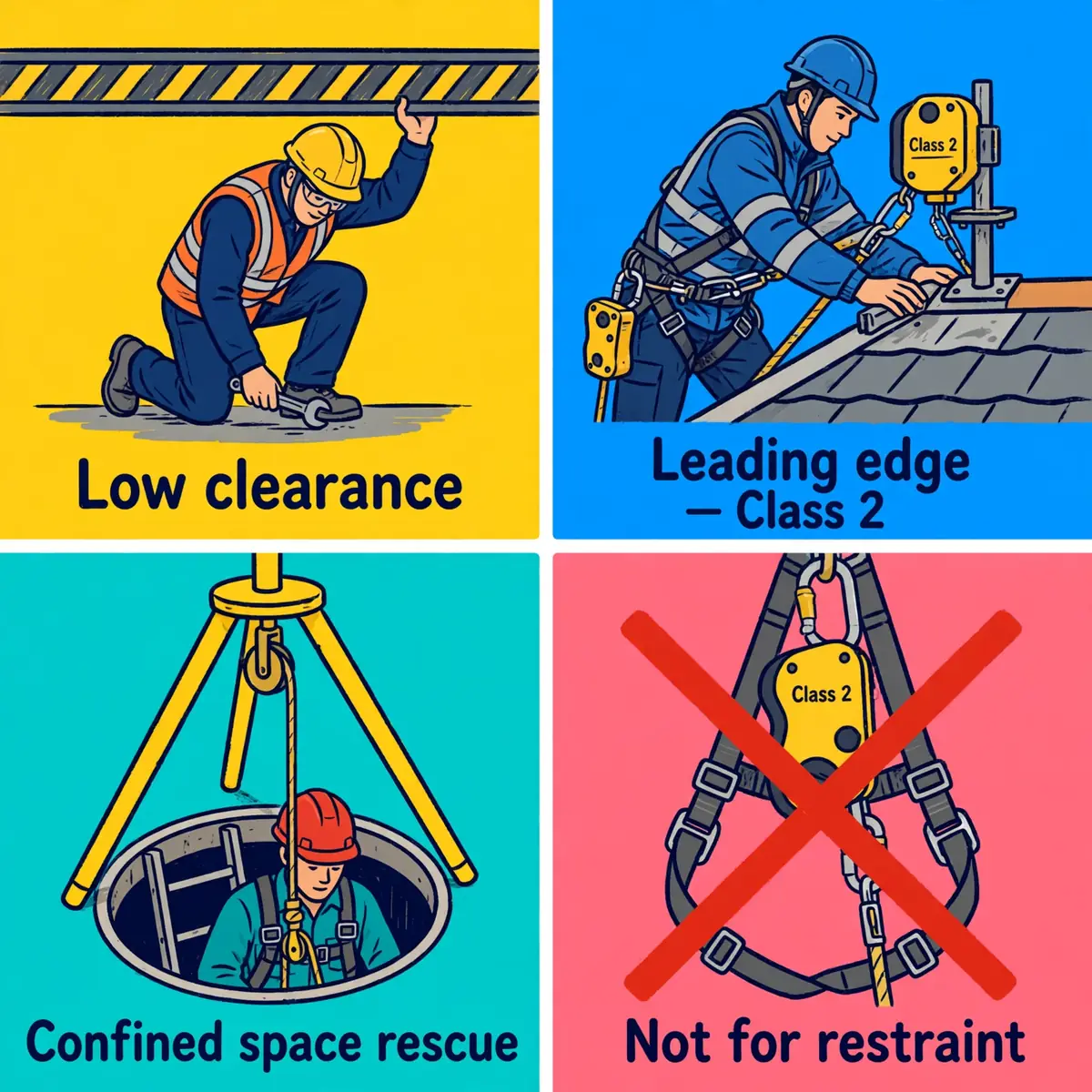
Use an SRL when a worker needs fall protection at height and must stay tied off while moving through the work area. The device suits jobs where the task needs mobility and rapid fall arrest: roofing, steel erection, deck work, loading stations, aerial lifts and maintenance on platforms.
The case is strongest where clearance is tight. Most falls in construction happen from low heights, where a 6-foot lanyard needs most of the available distance just to stop the worker. An SRL anchored overhead stops the fall within inches, so it protects workers on low scaffolds and short roofs where a lanyard cannot.
Leading-edge work calls for a Class 2 SRL. Roof construction, bridge work and steel erection put the anchor at foot level and the line over an edge. Only a Class 2 device is built and tested for that fall. Confined space entry calls for an SRL-R, so the worker can be retrieved after a fall instead of waiting for a separate rescue.
AlertAn SRL is a fall arrest device, not a restraint device. It cannot keep a worker from reaching an edge. Never use one as the only control where the plan is to stop the worker getting to the edge at all.
When not to use an SRL
An SRL protects a worker only inside the conditions it was designed and tested for. Outside them, the device can fail silently. The line can be cut on an edge, the brake can see a fall it was not sized for, or the clearance can run out before the arrest is complete. Each of these situations is a reason to choose a different device or a different plan.
- Anchored below the dorsal D-ring with a Class 1 device, or run over an edge without a Class 2 rating.
- Used horizontally, where the line would drag across a surface or an edge during the fall.
- With an added energy absorber the manufacturer has not allowed — the device's own absorber is sized for its class.
- On a lift or platform where the lift manual or the SRL manufacturer prohibits it.
- After it has arrested a fall, or after it has failed any part of the pre-use inspection.
- As a restraint system, unless the manufacturer expressly allows that use.
Fall clearance: how much space you need
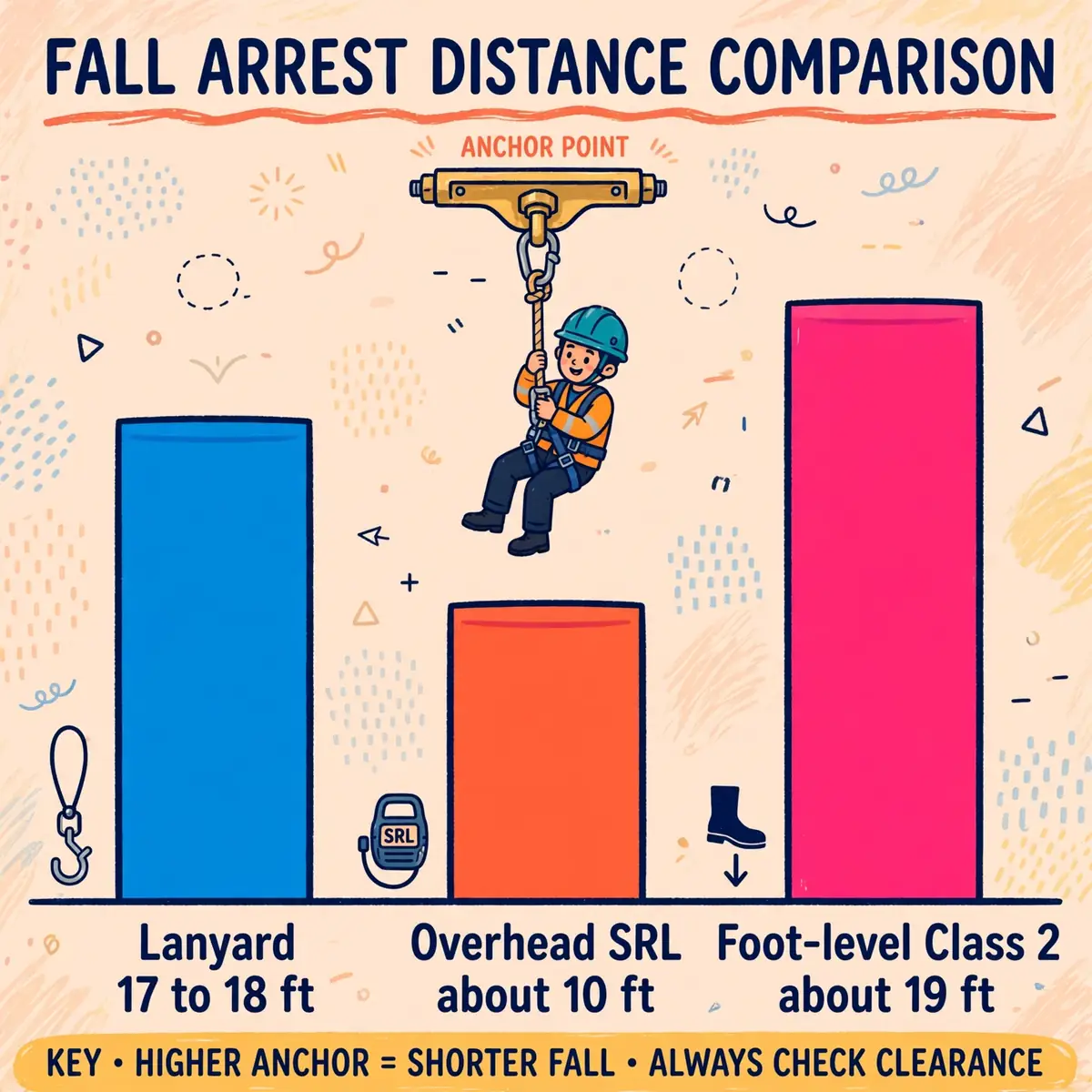
Clearance is the distance below the worker that must be empty for the fall to be arrested before the worker hits a lower level. It is the number that decides whether a system protects the worker at all, and it is where the SRL earns its place.
The clearance for a 6-foot lanyard anchored at D-ring level adds up like this: 6 feet of free fall, up to 4 feet of absorber deployment, 1 foot of harness stretch, 5 feet from the D-ring to the worker's feet, and a 2-foot safety margin. That is about 17 to 18 feet below the anchor. An overhead SRL needs about 10 feet: roughly 3.5 feet of arrest, 1 foot of stretch, and a margin and swing allowance.
The advantage disappears when the SRL is anchored at the feet. Then the worker falls the height of the D-ring plus any setback before the line goes over the edge and the brake sees a fall. The clearance climbs to close to 19 feet, and only a Class 2 device is built for it. Read the clearance chart on the device — a Class 2 SRL ships with one for setback and anchor height.
| System | Anchor position | Clearance needed below the anchor |
|---|---|---|
| 6-foot shock-absorbing lanyard | At D-ring level | About 17 to 18 feet |
| Overhead SRL | Above the dorsal D-ring | About 10 feet |
| Foot-level Class 2 SRL | At foot level, over an edge | Close to 19 feet |
Swing falls
Anchoring directly above the worker is not just about clearance. A worker who falls away from the anchor swings like a pendulum, and the swing can slam them into a wall, a beam or the structure itself. The further the worker moves from the anchor point, the worse the swing.
Keep the work zone as close to directly below the anchor as the job allows. Where the work forces the worker away from the anchor, plan the anchor points so the swing arc stays clear of obstacles. Use a twin-leg personal SRL to keep the tie-off point close.
How to use a self-retracting lifeline
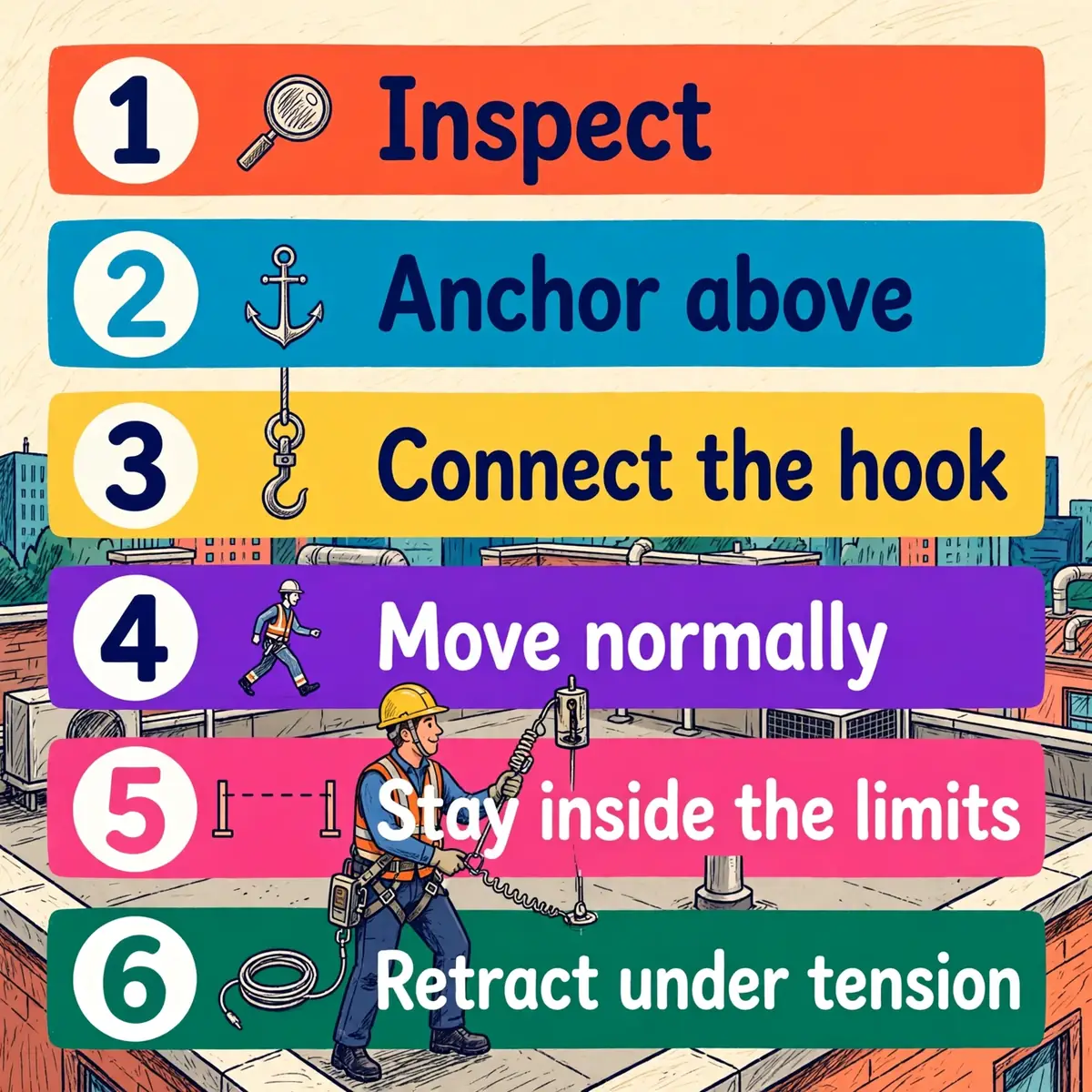
Using an SRL correctly is a short routine, and every step of it matters. The device only protects a worker who is connected the way the manufacturer intended, inside the anchorage location and clearance on its label. Read the manual for the exact device — the steps below are the common pattern, not a substitute for it.
- Inspect the device before use, following the steps in the next section. Do not use an SRL that has not passed.
- Anchor the device above the work area where possible. The housing goes to the anchor for a block SRL; the housing goes on the dorsal D-ring for a personal SRL.
- Connect the hook to the harness dorsal D-ring, or to the anchor for a personal unit. Check that the gate closes and locks on its own.
- Move normally. Let the line pay out and retract as you walk, keeping light tension on it. Never let the line go slack or drag across a sharp edge.
- Stay inside the anchorage location on the label. Do not work beyond the clearance the chart allows, and do not let the line run over an edge unless the device is Class 2.
- After the work, retract the line under light tension. Never let it snap back on its own.
WarningNever let the lifeline freewheel back into the housing. A line that snaps back can damage the spring, jam the cable, or slam the hook into the housing hard enough to break internal parts.
Connecting to the anchor
The anchor end of a block SRL is usually a carabiner or a swivel eye at the top of the housing. It connects to a rated anchor point — a beam strap, a roof anchor, a horizontal lifeline, or a tripod leg. The connection must be a locking type, sized to fit the member it connects to, so the keeper cannot be depressed by the member itself.
For a personal SRL, the connection is reversed: the housing sits on the harness, and the hook at the end of the line goes to the anchor. Twin-leg units clip one leg to each anchor in turn, so the worker stays tied off while moving between them.
What the line must never do
The lifeline must never run over a sharp edge unless the device is rated for it. It must never be used horizontally, where the line would drag across the work surface. It must never be tied off to a guardrail or a hoist, and it must never be used to hoist materials. An SRL is employee protection only.
The line must also never be allowed to go slack and then snatch tight. Slack lets the drum spin up before the brake engages, which lengthens the fall and the force. That is why the spring tension matters: it keeps the line taut through every movement, not just at the start of the shift.
Inspection before every use
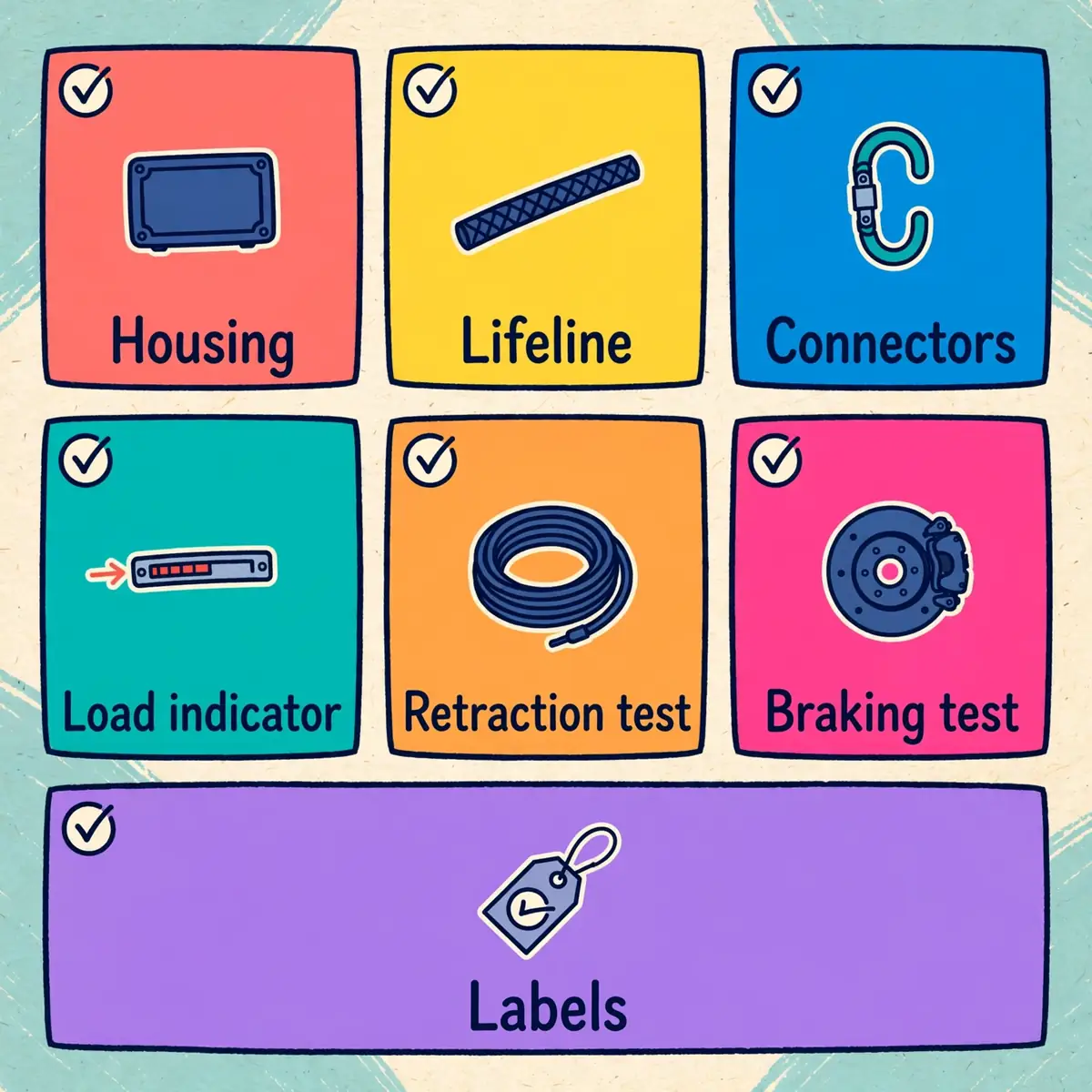
OSHA requires personal fall arrest systems to be inspected prior to each use for wear, damage and other deterioration, and defective components must be removed from service. An SRL has moving parts a lanyard does not, so the check covers the line and the mechanism as well as the connectors. Wear gloves for the inspection — a damaged cable can cut bare hands.
Work through the check in the same order every time. A routine is harder to skip than a list you read once. If any part fails, take the device out of service at once. Do not try to fix it in the field.
- Housing. Look for cracks, dents, loose fasteners and signs of impact. Check that the labels, serial number and date of manufacture are present and legible. Never open the casing unless you are authorised to do so.
- Lifeline, full length. Pull the whole line out slowly and run it through your hands, looking for cuts, corrosion, broken strands, bulges and heat damage.
- Connectors and hooks. Check for cracks, bends and discoloration. The gate must close and lock on its own, and the swivel must turn freely.
- Load indicator. Many SRLs carry a fall indicator — a red or orange strip that appears when the device has arrested a fall. If it shows, the device has caught a fall and comes out of service.
- Retraction test. Pull out half the line while keeping tension on it, then let it retract. Repeat with the full line. It must retract fully and smoothly, without hesitation or sticking.
- Braking test. Give the line a sharp tug to engage the brake and hold tension — there must be no slippage. Then let it retract under slight tension.
- Labels and tags. Confirm the labels are present and readable, and that the inspection date is valid. A device with missing or unreadable labels comes out of service.
On a cable lifeline, look closely for rust, frayed or broken strands, crushed or flattened strands, bulges, and heat damage from torch burns or electrical arcs. On a webbing lifeline, check both sides for holes, tears, abrasion, discoloration and fraying. Repeat the braking test with the line pulled out at different lengths, since a fault can hide at one point in the drum's travel.
TipTest the brake at several line lengths, not just at full extension. A fault in the drum can hide at one point in its travel and pass a single test.
Formal inspection and factory service
The pre-use check is the user's job, done every shift. On top of it, a competent person should inspect the device on the schedule in its manual, with the results documented. Most manufacturers also require periodic factory or authorised-centre inspection and recertification at set intervals.
There is no single OSHA expiry date for an SRL. The manufacturer's stated service life and recertification schedule govern, and they must be followed. A device that has arrested a fall, shows a tripped load indicator, or has a damaged line or mechanism must be retired or returned to the manufacturer at once, whatever its age.
The law in the US and the UK
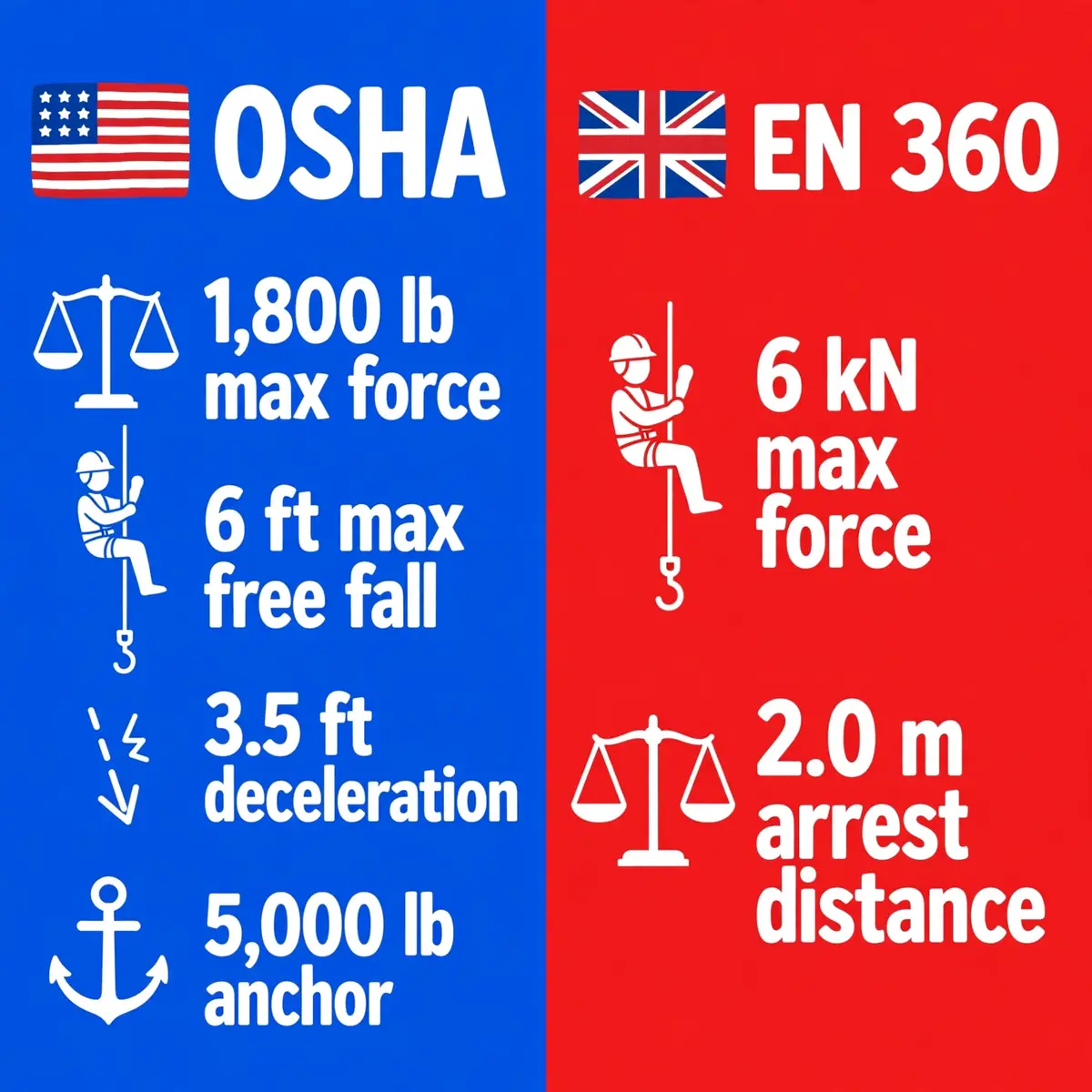
An SRL is not a product a worker chooses on taste. It is a regulated part of a fall arrest system. The rules that govern it are written as performance limits: how much force it may put on the body, how far it may let a worker fall, how strong it must be, and how often it must be inspected.
Three kinds of rule apply, and they are not the same thing. The law sets the duty and the performance limits. A standard such as ANSI Z359.14 or EN 360 sets the tests a device must pass. Guidance from bodies such as the Work at Height Safety Association explains how to meet the duty in practice. Keep the three apart when reading a claim about what an SRL must do.
United States — OSHA
For construction, 29 CFR 1926.502 sets the rules for personal fall arrest systems. OSHA requires fall protection at 6 feet or more in construction and 4 feet or more in general industry. For general industry, 29 CFR 1910.140 carries the same system rules.
The figures that apply to SRLs, from 1926.502(d), are:
| Rule | Figure | Paragraph |
|---|---|---|
| Maximum arresting force on a harness | 1,800 pounds | (d)(16)(ii) |
| Maximum free fall | 6 feet, and the worker must not contact a lower level | (d)(16)(iii) |
| Maximum deceleration distance | 3.5 feet | (d)(16)(iv) |
| SRL that limits free fall to 2 feet or less | Must hold a 3,000-pound tensile load, line fully extended | (d)(12) |
| SRL that does not limit free fall to 2 feet | Treated as a lanyard: 5,000 pounds | (d)(13) |
| Anchorage for arrest | 5,000 pounds per attached worker, or designed under a qualified person at a safety factor of two | (d)(15) |
| Snap hooks and carabiners | Locking type; 5,000-pound minimum tensile strength; 3,600-pound proof load | (d)(3), (d)(4), (d)(6) |
| Inspection | Before each use, for wear, damage and deterioration; defective parts removed | (d)(21) |
| After a fall | Removed from service until a competent person finds it undamaged and suitable | (d)(19) |
| Rescue | The employer provides for prompt rescue, or for self-rescue | (d)(20) |
OSHA does not adopt ANSI/ASSP Z359.14 by reference, so the standard is not itself the law. It is the standard manufacturers certify to, and it is the benchmark a buyer uses to judge whether a device is fit for the job. The employer's duty is to provide a system that meets the OSHA performance limits above.
United States — ANSI/ASSP Z359.14-2021
The current ANSI/ASSP standard for self-retracting devices sets the design, performance and testing requirements manufacturers must meet. It defines the Class 1 and Class 2 anchorage rules, the 42-inch maximum arrest distance, the 1,350-pound average arresting force limit, and the 310-pound dynamic test weight.
Class 2 devices must pass drop tests over a sharp steel edge to earn their rating. The standard also sets the labelling rules: a Class 2 device must carry its class on the label and a fall clearance table or diagram on the device and in its manual. Buyers should check for the Z359.14-2021 marking before purchase.
United Kingdom — EN 360 and the Work at Height Regulations
In the UK the same device is a retractable-type fall arrester, covered by EN 360. The standard requires a minimum static strength of 12 kN for wire rope lifelines and 15 kN for synthetic lifelines. The dynamic test drops a 100 kg mass through 600 mm. The arrest distance must stay within 2.0 metres in total, with a maximum arrest force of 6 kN on the user.
The Work at Height Regulations 2005 govern the use. Regulation 7 requires work equipment to be selected so that it prevents falls where possible. Regulation 12 requires equipment exposed to conditions that cause deterioration to be inspected at suitable intervals, and after exceptional circumstances that could jeopardise safety. Records of those inspections must be kept.
British Standard BS 8437:2005 gives the code of practice for the selection, use and maintenance of personal fall protection systems at work, including retractable-type fall arresters. The Work at Height Safety Association's technical guidance note 2 covers the same ground for fall arrest blocks: selection, use, maintenance and inspection.
Care, storage and retirement
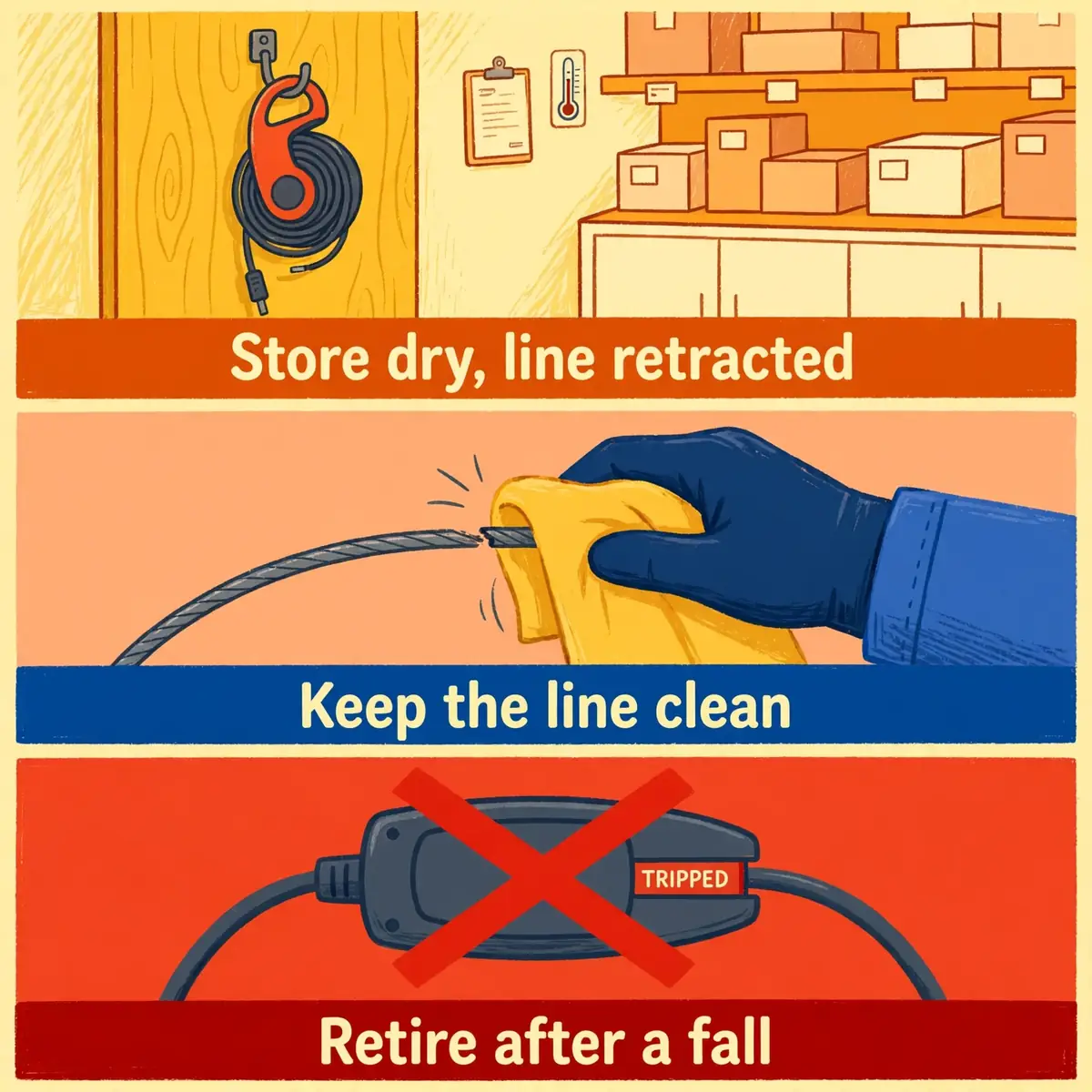
An SRL is a mechanism, and mechanisms fail quietly. Care is mostly about not damaging the spring, the drum and the line between uses. Store the device the way the manufacturer directs — usually in a dry place, out of direct sunlight, with the line fully retracted and the hook secured so it cannot swing and strike the housing.
Keep the line clean. Dirt and grit work into the drum and wear the brake. Wipe a cable line down after use in a dirty environment, and let a wet webbing line dry before it is stored. Never store an SRL with the line partly extended, and never hang a load from the hook.
Heat, chemicals, moisture and ultraviolet light all shorten the life of a lifeline. Webbing is the more vulnerable of the two: sunlight and chemicals degrade it faster than they degrade steel cable. A device used near welding, cutting or chemical splash needs the lifeline material matched to that exposure, and the inspection should look for it.
AlertRetire an SRL at once if it has arrested a fall, shows a tripped load indicator, has a damaged or corroded line, fails to lock or retract properly, or carries labels that are missing or unreadable. When in doubt, take it out of service.
When to retire a device
- It has arrested a fall, or its load indicator has tripped.
- The line is damaged or corroded, or the housing is cracked.
- It fails the lock test or the retraction test.
- Its labels are missing or unreadable, so its class and inspection date cannot be checked.
- It has reached the manufacturer's stated service life or recertification date.
Beyond visible damage, follow the manufacturer's recertification schedule. Many SRLs must go back to the manufacturer or an authorised centre for factory inspection at set intervals. An SRL costs far less than a life, so a device that is doubtful is a device that is retired.
Checklist: choosing a self-retracting lifeline
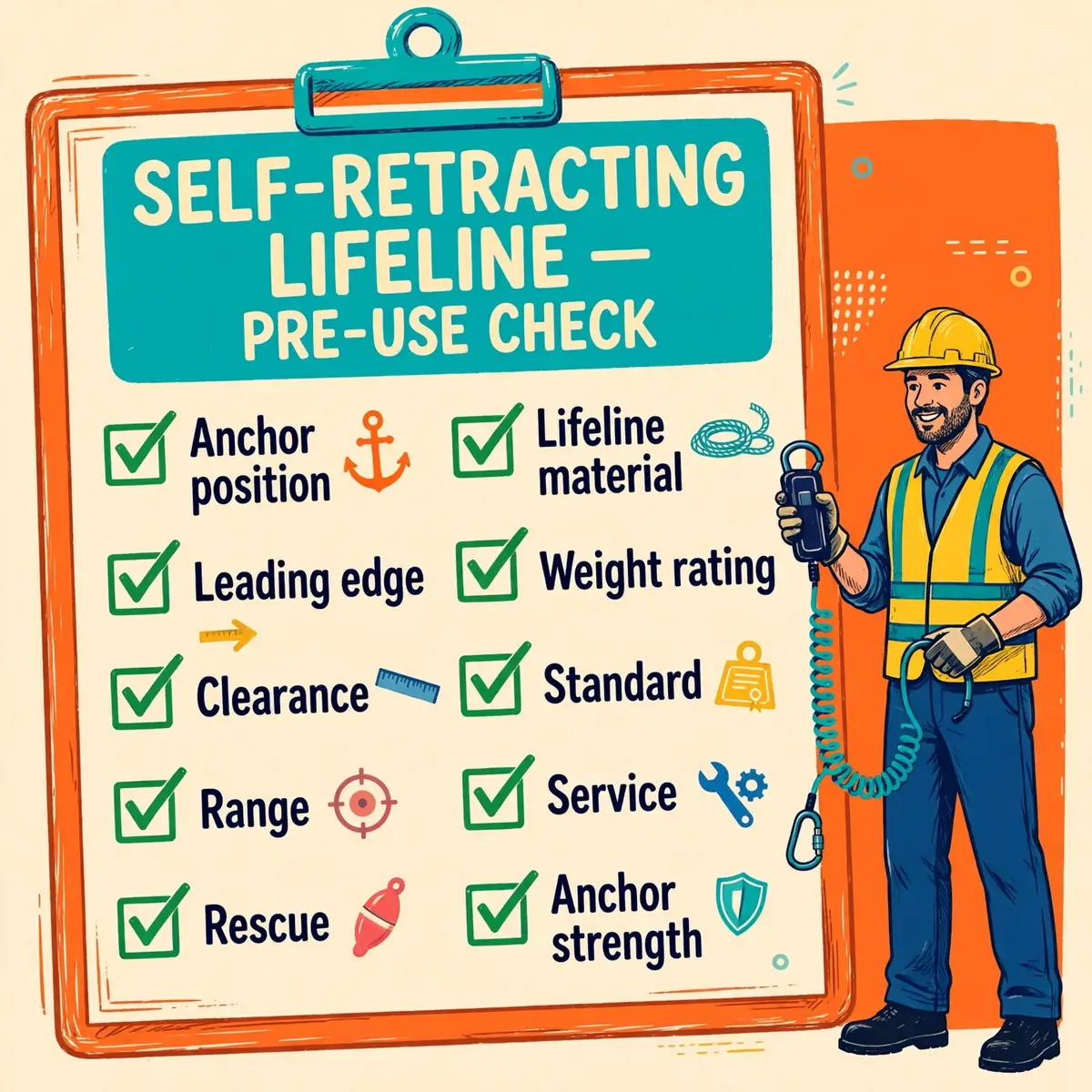
Choosing an SRL starts with the job, not the catalogue. Work through the questions in order, and let the answers pick the device. A risk assessment of the task will already hold most of the answers: the work height, the anchor positions, the edge exposure and the clearance below.
- Where is the anchor? Overhead, at the D-ring, or below it. Overhead or at the D-ring takes a Class 1; below the D-ring takes a Class 2.
- Is there a leading edge? If the line may run over an edge during a fall, only a Class 2 device is rated for it.
- How much clearance is below? Check the device's clearance chart against the real drop. An overhead SRL needs about 10 feet; a foot-level Class 2 needs close to 19 feet.
- How far must the worker move? A personal SRL covers 6 to 11 feet; a block SRL covers 20 to 100 feet. Twin-leg personal units give 100 percent tie-off while moving between anchors.
- Is rescue needed? Confined space entry and towers need an SRL-R with a retrieval crank and a tripod or davit.
- What is the lifeline exposed to? Abrasion and edges favour steel cable; weight and handling favour webbing; arc flash needs a Kevlar lifeline.
- What does the worker weigh, with tools? Most SRLs are rated to 310 pounds including tools and gear; some models support up to 420 pounds.
- Does it meet the current standard? Look for the ANSI/ASSP Z359.14-2021 marking and the class on the label — or EN 360 in the UK.
- Can it be inspected and serviced? Check the inspection schedule in the manual and the factory recertification interval before buying.
- Is the anchor rated? The anchorage must hold 5,000 pounds per worker, or be designed by a qualified person with a safety factor of two.
Frequently Asked Questions
What is a self-retracting lifeline?
A fall arrest device with a drum-wound line that pays out and retracts as you move and locks the drum automatically when a fall starts. OSHA defines it in 29 CFR 1926.500(b) as a deceleration device containing a drum-wound line that can be slowly extracted from, or retracted onto, the drum under slight tension during normal movement, and that automatically locks the drum and arrests the fall.
How does a self-retracting lifeline work?
A spring-tensioned drum pays the line out and reels it in as you move, keeping the line taut. A speed-sensing pawl locks the drum when the line runs out fast at the start of a fall. A brake or energy absorber then slips a controlled distance to keep the arresting force under 1,800 pounds on a harnessed worker.
What is the difference between an SRL and a lanyard?
A lanyard is a fixed 6-foot strap that allows a 6-foot free fall before its absorber works. An SRL keeps the line tight and locks within inches. The free fall and the clearance are much smaller when it is anchored overhead — about 10 feet of clearance against about 17 to 18 feet for a lanyard.
Can I use an SRL at foot level?
Only a Class 2 SRL, and only within the setback and anchor height on its clearance chart. A Class 1 SRL is overhead-only: it anchors at or above the dorsal D-ring and is not tested for the line going over an edge.
How often does a self-retracting lifeline need inspection?
Before each use by the user, with a lock-and-retract function check, and periodically by a competent person on the schedule in the manual. After it arrests a fall it is removed from service until a competent person inspects it and finds it undamaged and suitable.
Do self-retracting lifelines expire?
There is no single OSHA expiry date. Manufacturers set service lives and recertification schedules that must be followed. Any SRL that has arrested a fall, shows a tripped load indicator, or has a damaged line or mechanism must be retired or returned to the manufacturer at once, whatever its age.
What do Class 1 and Class 2 mean?
They are the ANSI/ASSP Z359.14-2021 anchorage classes. Class 1 anchors at or above the dorsal D-ring. Class 2 may anchor up to 5 feet below it and is tested for the line going over an edge. Both classes share the same limits: 42-inch maximum arrest distance and 1,350-pound average arresting force.
Sources
- OSHA — 29 CFR 1926.502, Fall protection systems criteria and practices
- OSHA — 29 CFR 1926.500, Scope, application, and definitions for Subpart M
- OSHA — 29 CFR 1910.140, Personal fall protection systems
- Work at Height Safety Association — Technical Guidance Note 2: Guidance on the selection, use, maintenance and inspection of retractable type fall arresters
- Aresta Safety — EN 360 Retractable type fall arrester
- The Work at Height Regulations 2005 (SI 2005/735)
- FallTech — The Essential Guide to Self-Retracting Lifelines
- Must Be Safety — Self-Retracting Lifelines: How SRLs Stop Falls Fast
- Grain Journal — Understanding Self-Retracting Lifelines
- Bayshore Safety — What is a self-retracting lifeline (SRL), and how does it differ from a lanyard?