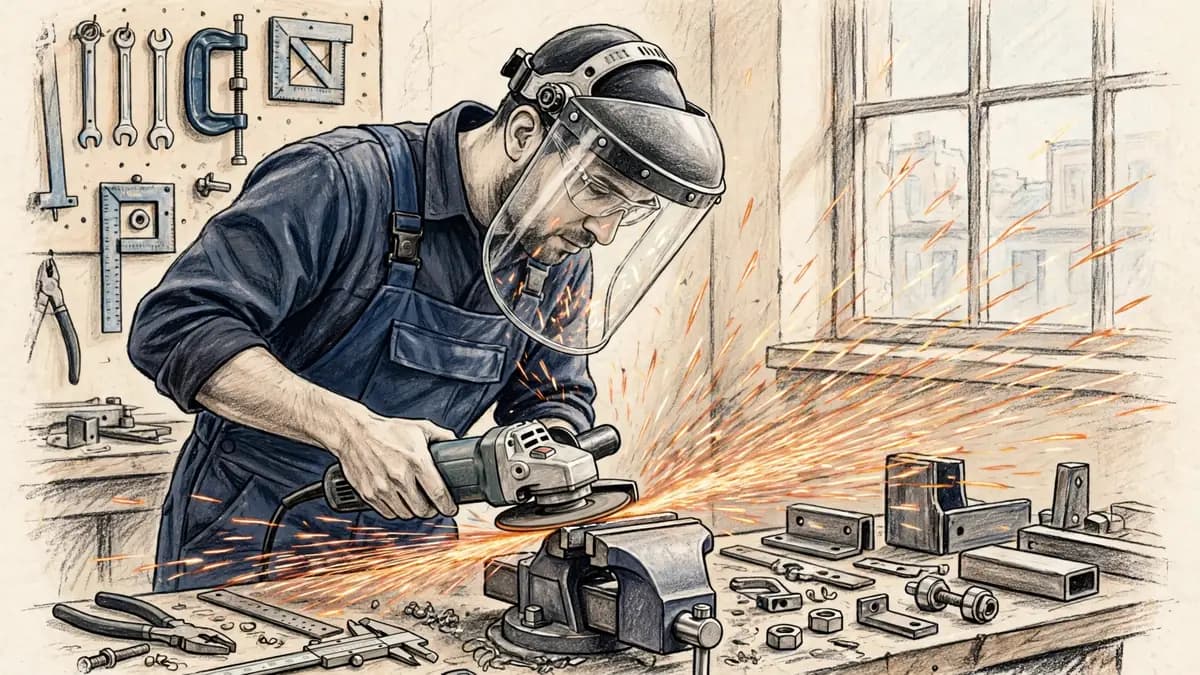
A face shield is a clear window that covers the whole face, from the brow to below the chin. It guards the eyes, nose, mouth, cheeks and throat against flying particles, liquid splash, sparks and radiant heat. It is secondary protection, so it must always be worn over safety glasses or goggles.
About 2,000 workers in the United States suffer a job-related eye injury needing medical treatment every day, according to an estimate from NIOSH. Many of those injuries happen when workers wear the wrong protector, or wear a shield with nothing underneath it. A shield cannot seal the eyes, so a particle or a splash can still reach them from below.
What a face shield is and what it does not protect
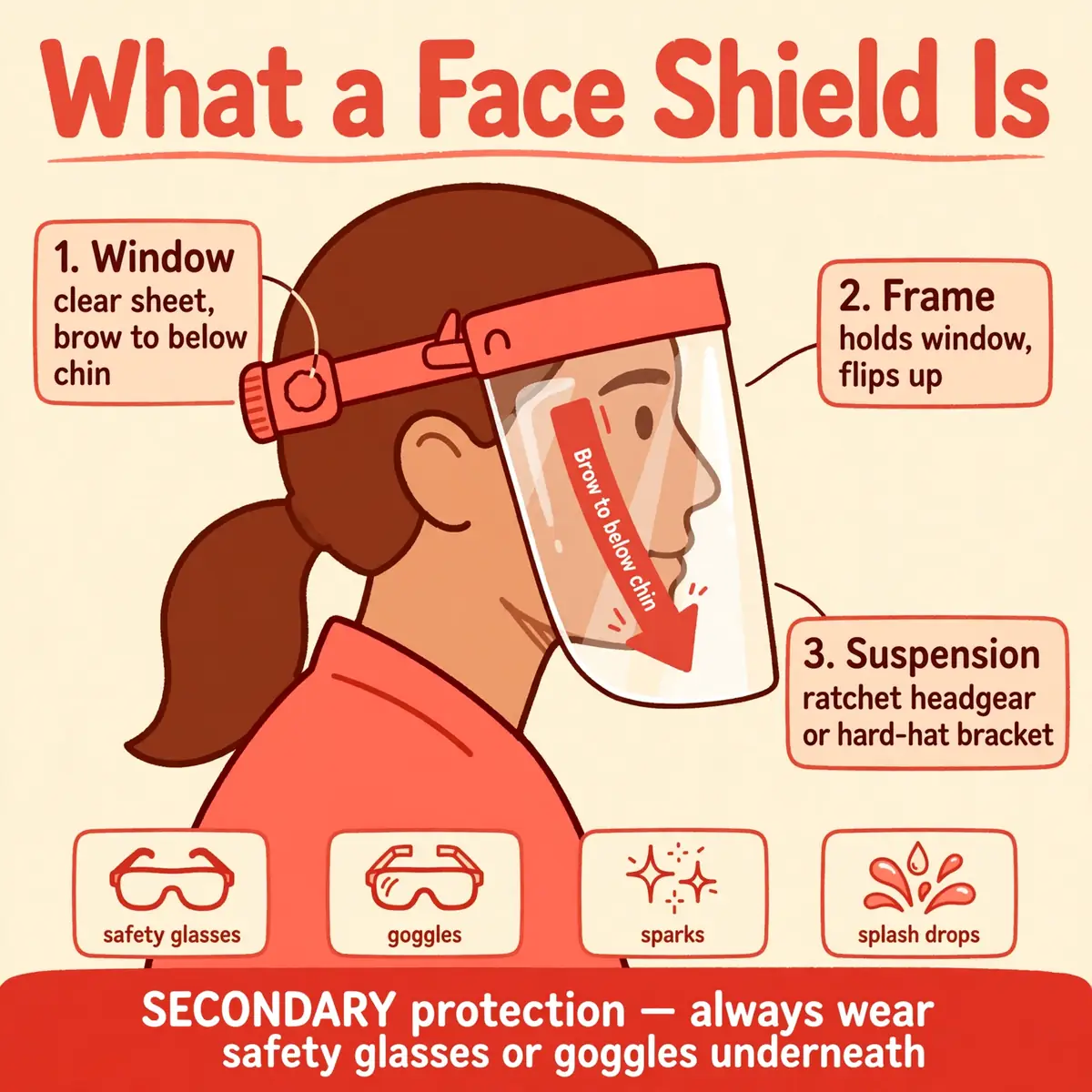
A face shield is a curved transparent window held in front of the face by a frame and a suspension. The window runs from above the brow to below the chin. It wraps at the sides to deflect debris and liquid arriving from an angle. Safety glasses and goggles guard only the eye region, while a shield guards the skin of the face as well.
The three parts of a face shield
Every shield has three parts, and each part carries its own rating. The window is the clear sheet in front of the face. The frame and pivot hold the window, set its angle and let it flip up clear of the face. The suspension is a ratchet headgear, or a bracket that clips into the slots of a hard hat.
The rating applies to the assembled shield, not to each part on its own. A window from one maker fitted to a bracket from another maker may carry no rating at all, even if both parts look the same. Buy the window and the carrier as the system the manufacturer lists together.
What a shield does not protect
A shield does not seal against the face, so it cannot stop fine dust, mist, gas or vapour. Those hazards travel under the bottom edge and around the sides, straight past the window. A shield also cannot act as a respirator, and it cannot protect against a laser, which needs eyewear matched to its wavelength.
A shield on its own is not eye protection, however strong its window is. OSHA's selection guidance for eye and face protection says face shields should only be worn over primary eye protection, meaning spectacles or goggles. A grinding spark can bounce off the chest and up under the window, and a splash can run down inside it.
AlertNever treat a face shield as a substitute for safety glasses or goggles. Put the primary eye protection on first, then lower the shield over it.
Face shield vs safety goggles vs safety glasses
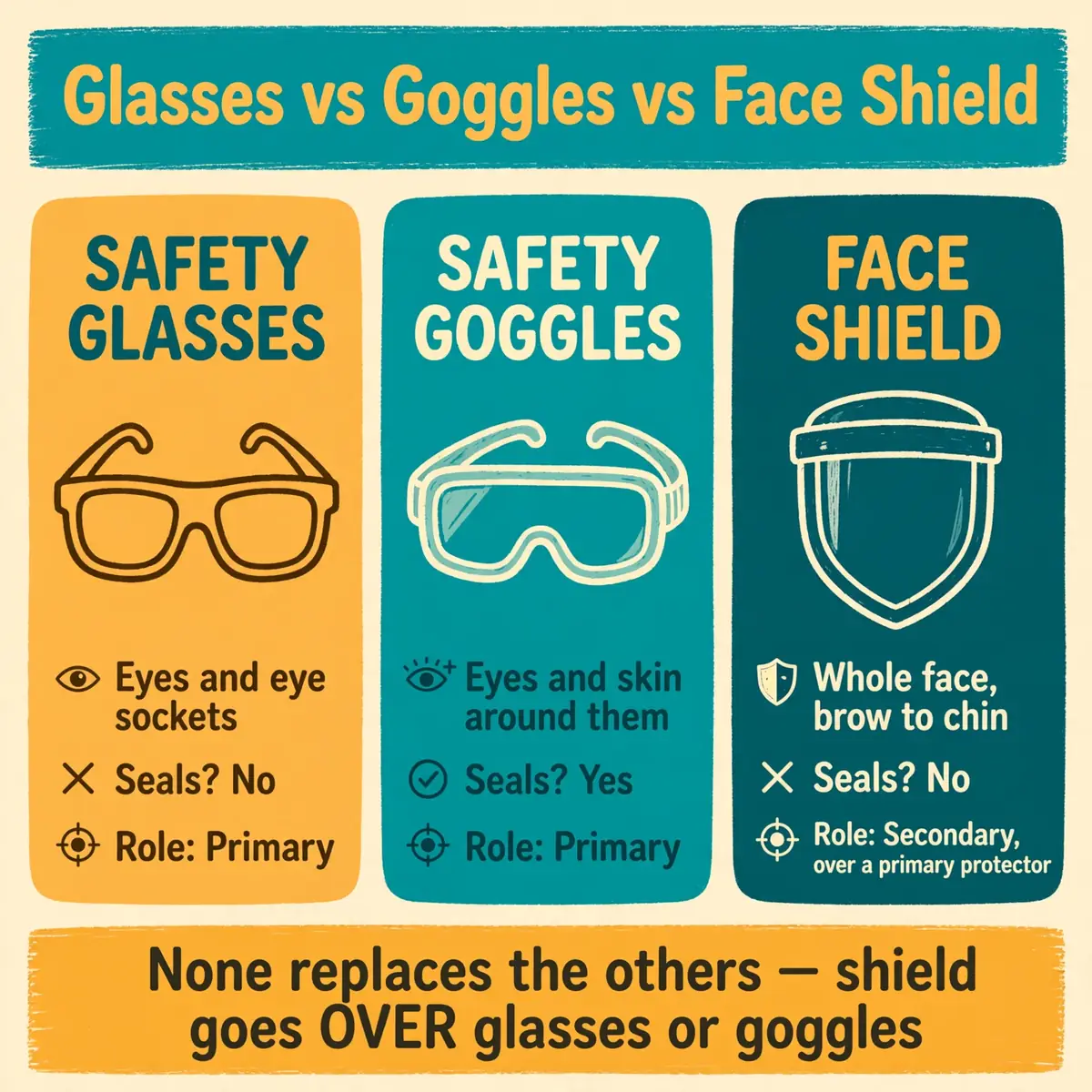
Safety glasses, safety goggles and face shields protect different areas, and none of them replaces the others. Glasses are the everyday primary protector for impact. Goggles seal to the face and are the primary protector for splash and dust. A shield adds full-face coverage over either of them.
| Feature | Safety glasses | Safety goggles | Face shield |
|---|---|---|---|
| Area covered | Eyes and eye sockets | Eyes and skin around them | Whole face, brow to chin |
| Seals around the eyes | No | Yes | No |
| Impact protection | Yes, if rated Z87 or Z87+ | Yes, if rated Z87 or Z87+ | Yes, if rated Z87 or Z87+ |
| Chemical splash | No | Yes, if marked D3 | Face only, if marked D3 |
| Dust and fine dust | No | Yes, if marked D4 or D5 | No |
| Role | Primary | Primary | Secondary, over a primary protector |
When glasses or goggles are the right base
Safety glasses are enough when the only hazard is flying particles arriving from the front, and the face itself is not at risk. Machining, drilling and light assembly often fall in this group. The glasses must have side protection whenever flying objects are the hazard, and they must carry the Z87 or Z87+ mark for the task.
Goggles are the right base when liquid, fine dust or vapour can reach the eyes. Their seal is the feature that matters, and no pair of glasses can copy it. For chemical splash, choose indirect-vent or non-vented goggles marked D3. Add a shield over them when a splash could reach the whole face, as in drum transfers or pouring at face level.
TipCheck the Safety Data Sheet, Section 8, before chemical work. It names the eye and face protection the chemical calls for, and it settles the goggles-or-shield question for that task.
The main types of face shield
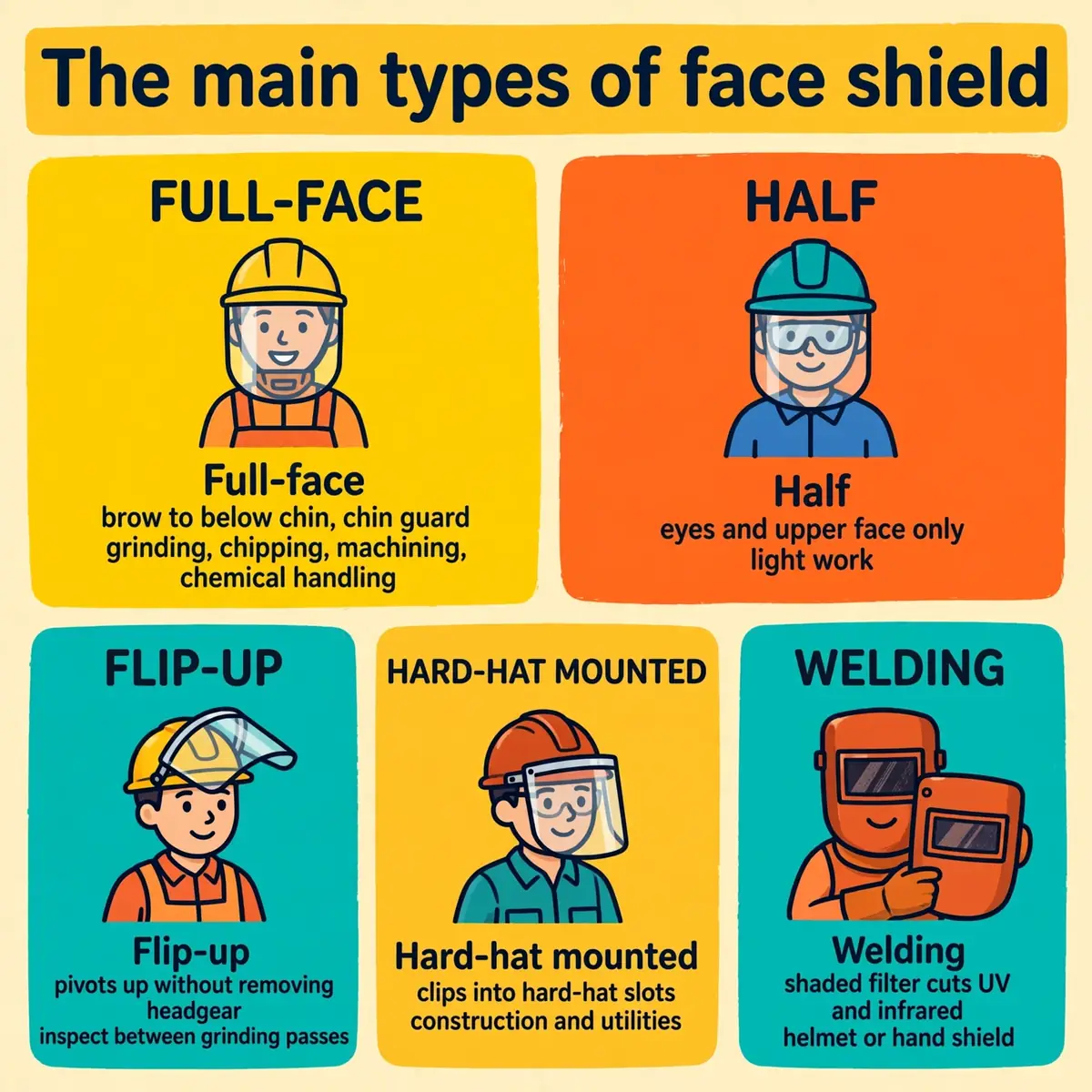
Face shields divide first by the hazard they address, and second by how they mount on the head. Choosing the wrong type is the most common buying error. A clear splash visor gives no protection against an electrical arc. A tinted arc shield is wrong for fine colour inspection.
Full-face, half and flip-up shields
A full-face shield covers the face from the brow to below the chin, often with a chin guard that wraps under the jaw. It is the standard shield for grinding, chipping, machining and chemical handling. The window is usually clear polycarbonate, marked Z87+ for high impact, and may also carry a D3 splash mark.
A half shield is a short window that covers the eyes and the upper face only. It suits light work where the lower face is not at risk. A flip-up shield pivots on its frame. The wearer can raise the window without removing the headgear, as when inspecting a part between grinding passes. The pivot should hold the window firmly in both positions.
Cap and hard-hat mounted shields
A hard-hat mounted shield clips into the accessory slots of a hard hat through a bracket or carrier. It is the standard choice on construction sites and in utilities, where a hard hat is already required. The shield flips up clear of the face when it is not needed, and it comes down without removing the helmet.
Fit is specific to the helmet. A bracket made for one helmet model may not fit another, and the manufacturer certifies the window and bracket as a system. On an electrically rated Class E helmet, the bracket must be dielectric, with no metal passing through the shell.
Welding shields, helmets and mesh shields
A welding shield carries a shaded filter window that cuts ultraviolet and infrared radiation from the arc. A clear window gives no radiation protection at all, however dark its tint looks. For arc welding, the protector is a welding helmet or hand shield with a filter plate. Resistance welding and brazing are different: OSHA calls for a transparent face shield or goggles for that work.
A mesh shield is a fine steel or nylon screen instead of a solid window. It stops wood chips, brush and coarse debris, and the open weave lets air and sound through, so it does not fog. Forestry and chainsaw crews use it for that reason. Mesh stops no liquid and no dust, so safety glasses or goggles still go underneath it.
WarningNever look at a welding arc through a clear face shield. Use a helmet or shield with the filter shade the process calls for, and wear safety glasses underneath it.
Visor materials compared
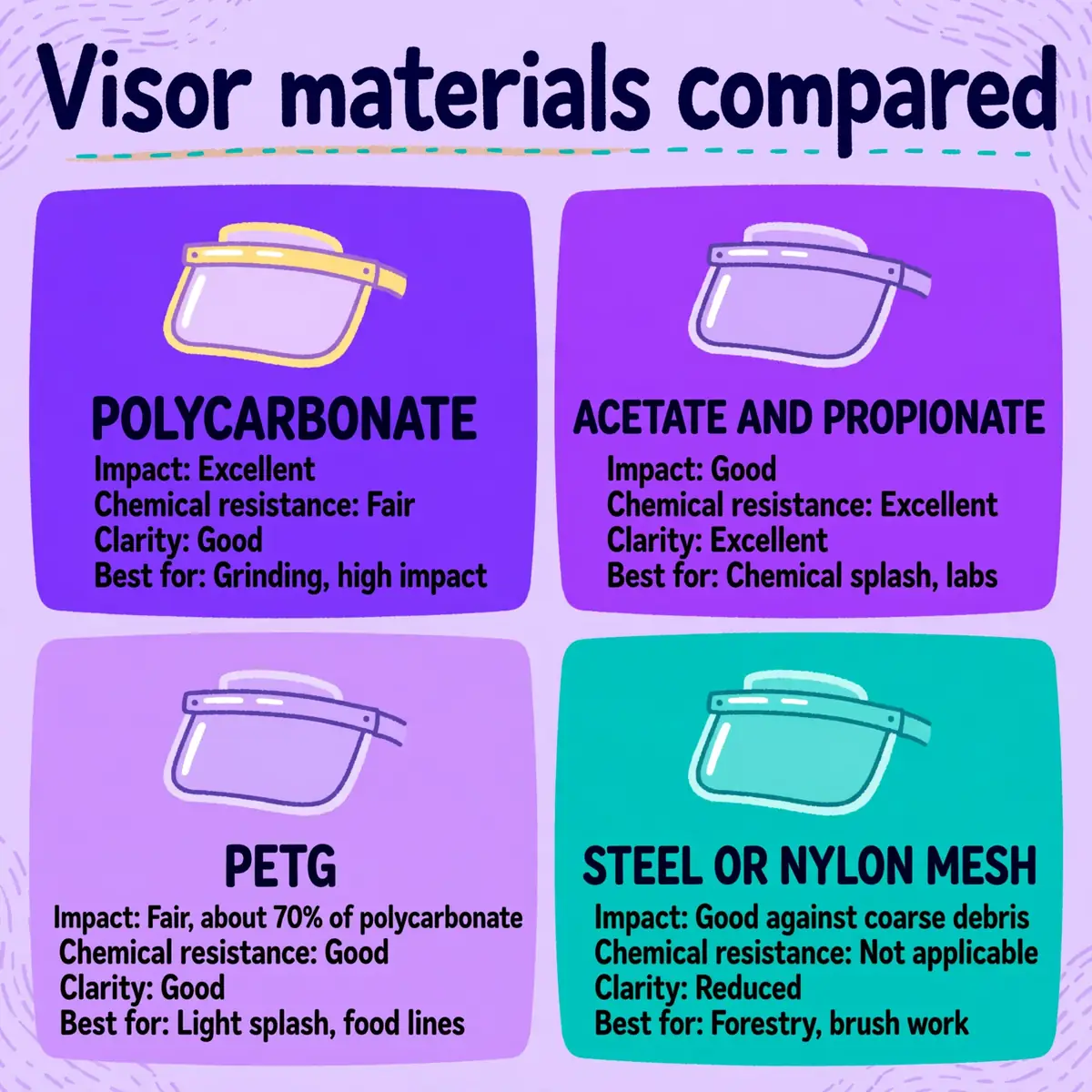
The window material sets the ceiling on impact, chemical, optical and thermal performance. Four materials dominate the market, each trading one strength for another. The choice follows the hazard, and the mark on the window proves what the material was tested for.
| Material | Impact | Chemical resistance | Clarity | Best for |
|---|---|---|---|---|
| Polycarbonate | Excellent | Fair | Good | Grinding, high impact |
| Acetate and propionate | Good | Excellent | Excellent | Chemical splash, labs |
| PETG | Fair, about 70% of polycarbonate | Good | Good | Light splash, food lines |
| Steel or nylon mesh | Good against coarse debris | Not applicable | Reduced | Forestry, brush work |
Solid window materials
Polycarbonate is the default window for impact work. Its toughness is many times that of glass or acrylic, and it is the only common window material that reliably passes the Z87+ high-velocity test. Typical industrial windows run about 1.0 to 2.0 mm thick, with thicker windows used for higher impact and arc duty.
Cellulose acetate propionate gives the best optical clarity of the solid windows and the best resistance to chemical splash. That makes it the laboratory standard. Its impact resistance sits below polycarbonate, so check the mark on the window, not the material name, to see what the shield was tested for.
How to read the ratings: ANSI Z87.1 and EN 166
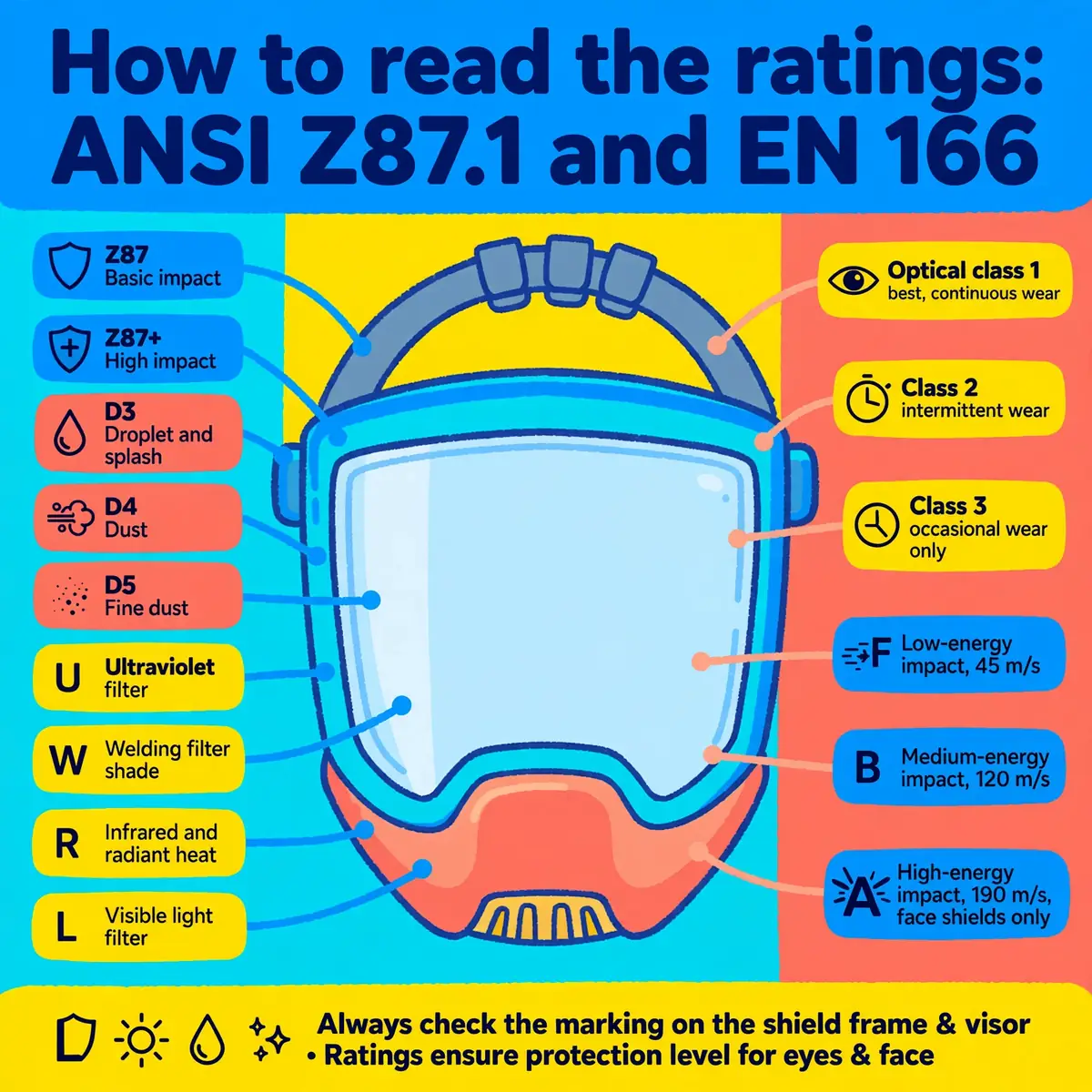
The marks stamped on the window and the frame are the only proof that a shield was tested. A shield with no mark carries no rating, whatever the box claims. Read the marks on the window and on the headgear separately, since the standard marks each part on its own.
ANSI Z87.1 marks
ANSI/ISEA Z87.1 is the United States standard for occupational eye and face protection, and its current edition is Z87.1-2020. OSHA's rule incorporates the 1989, 2003 and 2010 editions. It accepts devices the employer can show are at least as effective as those editions. That is how the 2015 and 2020 editions are used in practice.
Z87 means the window passed the basic impact test, a 1-inch steel ball dropped from 50 inches. Z87+ means high impact. A 6.35 mm steel ball struck the window at 300 feet per second. A 500 g pointed weight dropped from 50 inches, and the window passed a penetration test. The plus must appear on the lens and on the frame for the protector to count as high impact.
| Mark | Meaning |
|---|---|
| Z87 | Basic impact |
| Z87+ | High impact; plus on window and frame |
| D3 | Droplet and splash |
| D4 / D5 | Dust / fine dust; sealed protectors only |
| U + number | Ultraviolet filter |
| W + number | Welding filter shade |
| R | Infrared and radiant heat |
| L + number | Visible light filter |
| Z87-2 | Prescription protector |
| V / S / X | Photochromic / special purpose / anti-fog |
EN 166 marks
EN 166:2001 was the European general specification for personal eye protection, covering spectacles, goggles and face shields. Its marks sit in a fixed order on the frame and on the lens, and the two orders differ. On a lens the order runs scale number for filters, maker, optical class, mechanical strength and fields of use.
Optical class grades distortion, and class 1 is the best.
- Class 1 suits continuous wear.
- Class 2 suits intermittent wear.
- Class 3 suits occasional wear only.
A T after the strength letter means the impact test was passed at temperature extremes, from minus 5 to plus 55 degrees Celsius. K marks anti-scratch and N marks anti-fog.
| Mark | Meaning |
|---|---|
| 1, 2 or 3 | Optical class; 1 is best |
| S | Increased robustness |
| F | Low-energy impact, 45 m/s |
| B | Medium-energy impact, 120 m/s |
| A | High-energy impact, 190 m/s; face shields only |
| 3 / 4 / 5 | Liquids / coarse dust / gas and fine dust |
| 8 | Short-circuit electric arc |
| 9 | Molten metals and hot solids |
The EN ISO 16321-1 change
EN 166 is no longer the standard for new certifications. EN ISO 16321-1:2022, with amendment A1:2025, replaced it for new certifications in the UK and EU from 11 November 2025. It also replaces the filter standards EN 170, EN 171, EN 172 and EN 379. Products already certified to EN 166 may still be sold until their certificate expires, for up to five years.
The new impact classes are C at 45 metres per second, D at 80 and E at 120. Each class is tied to a defined protection zone on the face. The A grade at 190 metres per second has no direct successor. When buying new stock, ask the supplier for the declaration of conformity and check which standard the shield was certified to.
Matching the shield to the hazard
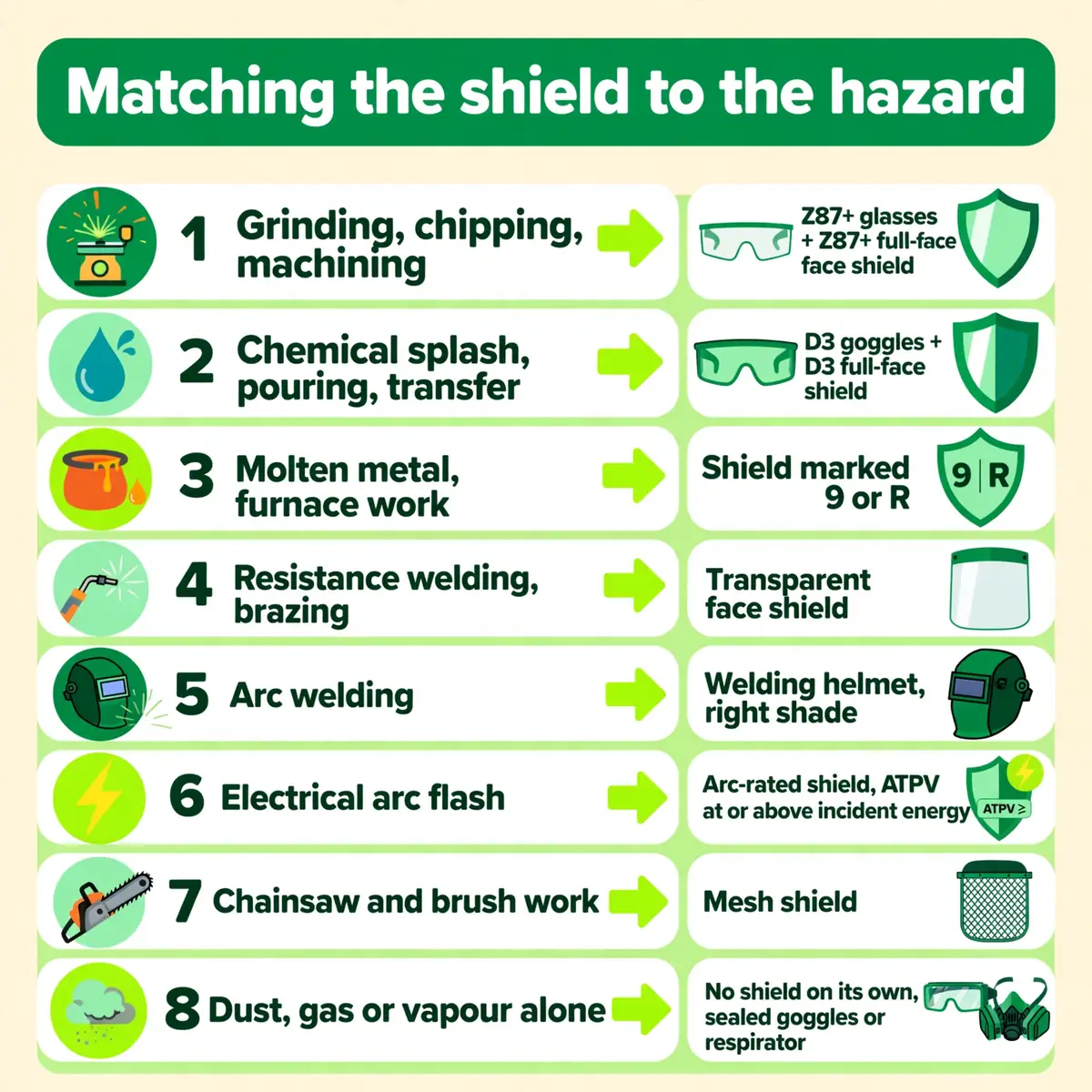
Start from the hazard, not from the catalogue. Name what can strike, splash or burn the face, how it moves, and where the face sits in relation to it. A splash from a drum transfer moves differently from a mist in the air. A grinding spark from below behaves differently from a chip flying straight at the eyes.
| Hazard and task | Primary protection | Face shield |
|---|---|---|
| Grinding, chipping, machining | Z87+ glasses with side protection | Z87+ full-face shield |
| Chemical splash, pouring, transfer | D3 indirect-vent or non-vented goggles | D3 full-face shield over goggles |
| Molten metal, furnace work | Glasses or goggles with filter | Shield marked 9 or R |
| Resistance welding, brazing | Glasses or goggles | Transparent face shield |
| Arc welding | Glasses under the helmet | Welding helmet, right shade |
| Electrical arc flash | Glasses under the shield | Arc-rated shield, ATPV at or above incident energy |
| Chainsaw and brush work | Safety glasses | Mesh shield |
| Dust, gas or vapour alone | Sealed goggles or respirator | No shield on its own |
Severe exposure and three questions
OSHA's selection guidance uses the phrase "severe exposure" to mark the point where a shield joins the primary protector. Grinding, chipping and machining call for spectacles with side protection, goggles or a shield. Severe exposure calls for a shield over the glasses or goggles. Acid handling, degreasing and plating call for goggles, and severe exposure adds a shield over them.
Three questions settle most choices. What is the hazard: impact, splash, heat, radiation or a mix? How does it move: in a straight line, as a splash that runs down, or as a mist that drifts? Where is the face: below the work, level with it, or overhead? Treat the exposure as severe when the work is close, the volume is large or the task runs long.
WarningGrinding is severe exposure. Put Z87+ safety glasses on first, then lower a Z87+ face shield over them before the wheel touches the work.
How to choose the right one
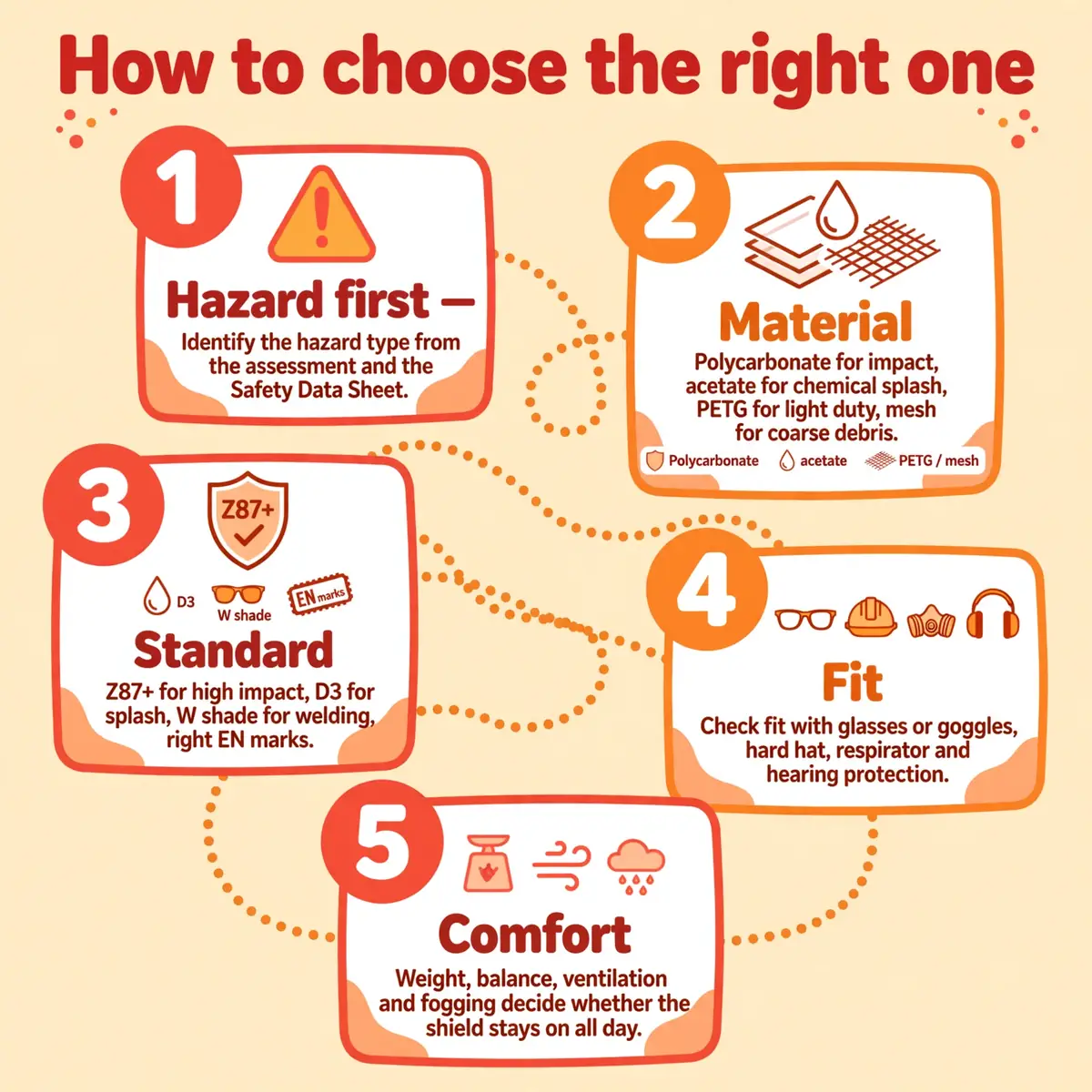
Choosing a face shield works best in order: hazard first, then material, then standard, then fit, then comfort. Choose comfort first and hazard last, and a light splash visor ends up on a grinding job. Work the steps in order and write the result into the task procedure.
- Identify the hazard type from the assessment and the Safety Data Sheet, including every hazard the task can put in front of the face.
- Match the window material to the risk: polycarbonate for impact, acetate for chemical splash, PETG for light duty, mesh for coarse debris.
- Verify the standard on the window and the frame: Z87+ for high impact, D3 for splash, a W shade for welding, or the right EN marks.
- Check the fit with the glasses or goggles, hard hat, respirator and hearing protection the task also needs, using the maker's listed bracket.
- Think about comfort for a long shift: weight, balance, ventilation and fogging decide whether the shield stays on all day.
Offer more than one size and style where the workforce varies, since faces differ in size and shape. A short trial with the crew finds fit problems before a bulk order locks them in. Steel toe boots show the same lesson: a protector that hurts does not get worn.
Fit and wearing it all day
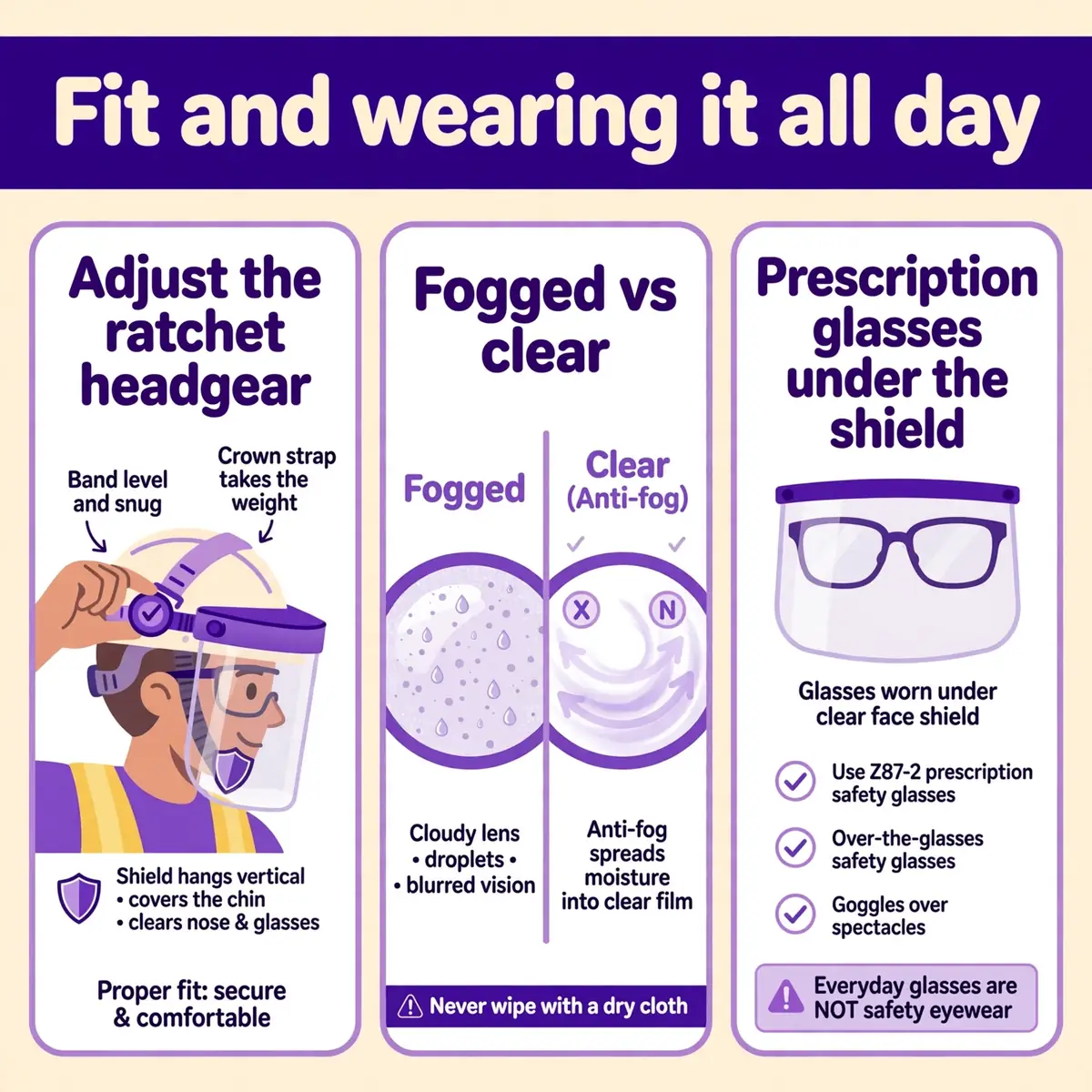
A face shield protects only while it is down, in position and comfortable enough to leave alone. Fit is therefore a safety issue, not a comfort extra. A shield that slips, pinches or fogs will be flipped up or taken off, and the face is unprotected from that moment.
Adjusting the headgear
Set the ratchet headgear so the band sits level and snug, with the crown strap taking the weight. The window should hang vertically in front of the face. It should cover the chin without touching the nose or the glasses. Tilt it a little forward if it fogs, and a little back if it catches on the chest.
Check the coverage from the side as well as the front. The window should wrap far enough to block debris arriving at an angle, and the crown guard should close the gap above the brow. If the window stops at the chin and leaves the throat open, choose a longer window or add a chin guard.
Prescription glasses, fogging and heat
Everyday prescription glasses are not safety eyewear, and a face shield does not change that. Workers who wear prescription lenses need eye protection that incorporates the prescription, or protection that fits over their glasses without disturbing either pair. Practical options are prescription safety glasses marked Z87-2, over-the-glasses safety glasses, or goggles made to fit over spectacles. Safety goggles made for prescription wearers cover the over-glasses designs in detail.
Fogging is the most common reason workers lift a shield. Anti-fog coatings, marked X under ANSI Z87.1 and N under EN 166, spread condensation into a clear film instead of droplets. A gap at the brow lets warm air out, and tilting the shield up during breaks clears the moisture. Never wipe a fogged window with a dry cloth, since that scratches the coating off.
TipKeep a spare window on the shelf. A worker with a scratched or fogged window and no spare will keep working with the damaged one.
Care, inspection and replacement
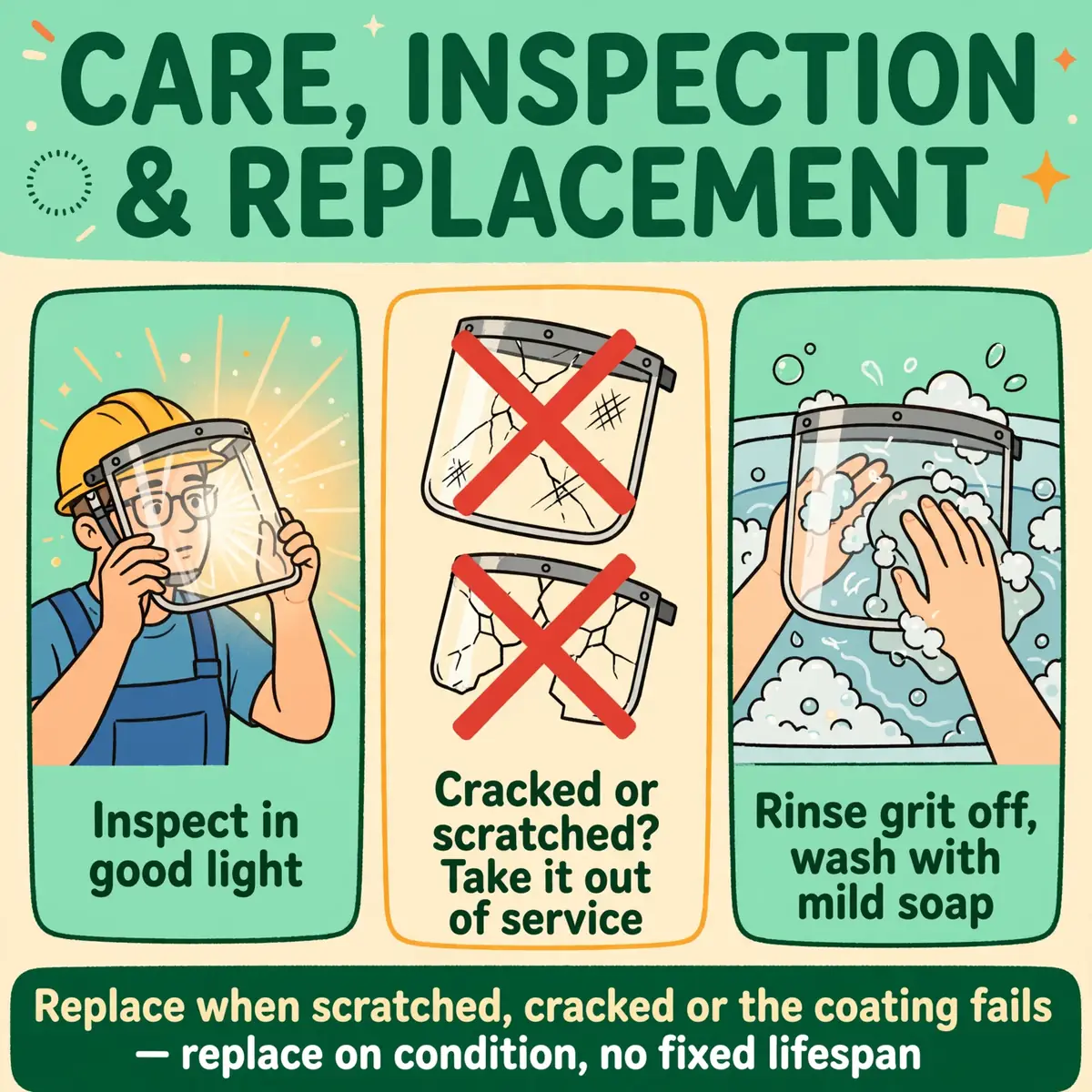
A face shield is a consumable, not a permanent fixture. Windows scratch, coatings wear out, headgear stretches and brackets crack. A shield that is not inspected will be worn past the point where it protects. The wearer will not notice, because a scratched window still looks like a window.
Inspect, clean and replace
Look at the window in good light before putting the shield on. Check for cracks, crazing, deep scratches, melted spots and clouding, then check the frame, pivot, straps and bracket for cracks and wear. Any of those faults means the shield comes out of service. Tag it so nobody picks it up by mistake, and report the defect to the supervisor.
Rinse grit off the window with clean water first, then wash it with mild soap and a soft cloth. Wiping a dry, dusty window drags grit across the surface and scratches it.
Replace a window after any impact that marks it, when scratches or clouding reduce visibility, or when a coating wears off. There is no fixed lifespan, so replace on condition, follow the maker's guidance, and keep spares in stock. If a shield fails in use, a root cause analysis stops the same fault from hurting the next wearer.
WarningDo not keep using a shield that took a hit. A window that stopped one impact may not stop the next one, so take it out of service and replace it.
The law in the US and the UK
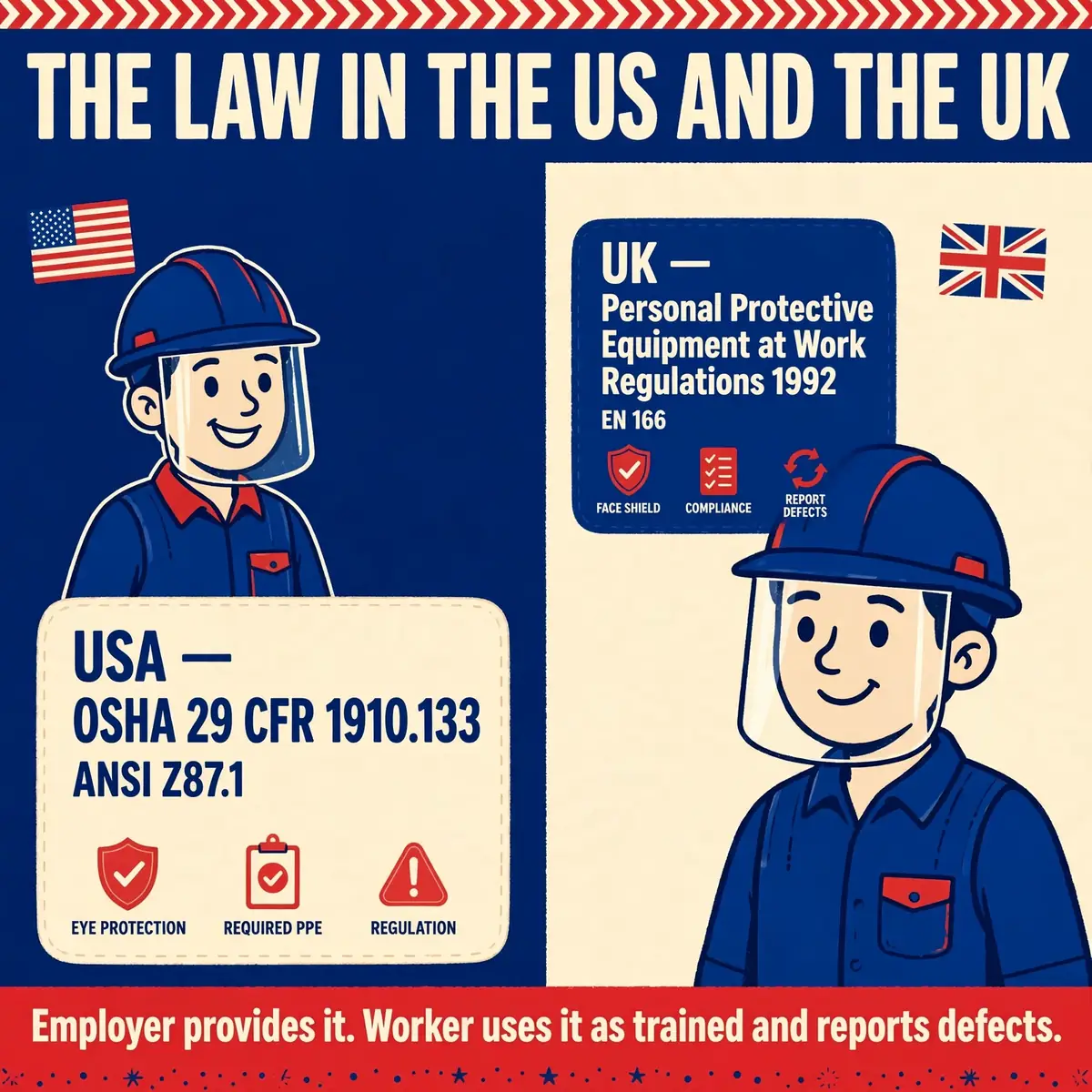
Occupational health law does not name a face shield for every task. It names the hazards, puts the duty on the employer to assess them, and points to the standards that define a compliant protector. The employer provides it, trains the worker and maintains it. The worker uses it as trained and reports defects.
United States
OSHA's eye and face protection rule, 29 CFR 1910.133, requires the employer to ensure that each affected employee uses appropriate eye or face protection. The hazards named are flying particles, molten metal, liquid chemicals, acids or caustic liquids, chemical gases or vapours, and injurious light radiation. The rule also requires side protection where flying objects are the hazard.
The rule points to ANSI/ISEA Z87.1 for the design of the protector. The hazard assessment that picks the protector comes from 29 CFR 1910.132(d), and the training duty comes from 1910.132(f). OSHA's non-mandatory selection guidance, Appendix B to Subpart I, adds the practical detail. Its chart puts a shield over glasses or goggles for severe exposure. Note 3 states that face shields should only be worn over primary eye protection. Electrical work follows NFPA 70E for arc-flash protection.
- 1910.133(a)(1) names the hazards that call for eye or face protection.
- 1910.133(a)(3) covers workers who wear prescription lenses.
- 1910.133(a)(5) requires a filter shade appropriate for the work.
- 1910.252(b)(2) covers helmets, hand shields and face shields for welding.
- 1926.102 is the parallel rule for construction work.
United Kingdom
In Great Britain, the Personal Protective Equipment at Work Regulations 1992 require the employer to provide suitable personal protective equipment. That duty applies where risks cannot be controlled adequately by other means. The equipment must be appropriate for the risk, the conditions and the period of wear, and it must fit the wearer correctly. That is regulation 4, and it is the foundation of the UK duty.
Before choosing the equipment, the employer must assess whether it is suitable, under regulation 6. Where more than one item is worn at once, regulation 5 requires them to be compatible. Regulation 7 requires maintenance in efficient working order, and regulation 9 requires information, instruction and training. Asbestos removal shows the same UK pattern in a different trade.
- Regulation 4: suitable PPE provided to employees exposed to risk.
- Regulation 5: PPE worn together must be compatible.
- Regulation 6: suitability assessed before choosing.
- Regulation 7: PPE maintained, cleaned and replaced as needed.
- Regulation 9: workers given information, instruction and training.
- Regulation 11: workers must report any loss or obvious defect at once.
Checklist: buying a face shield
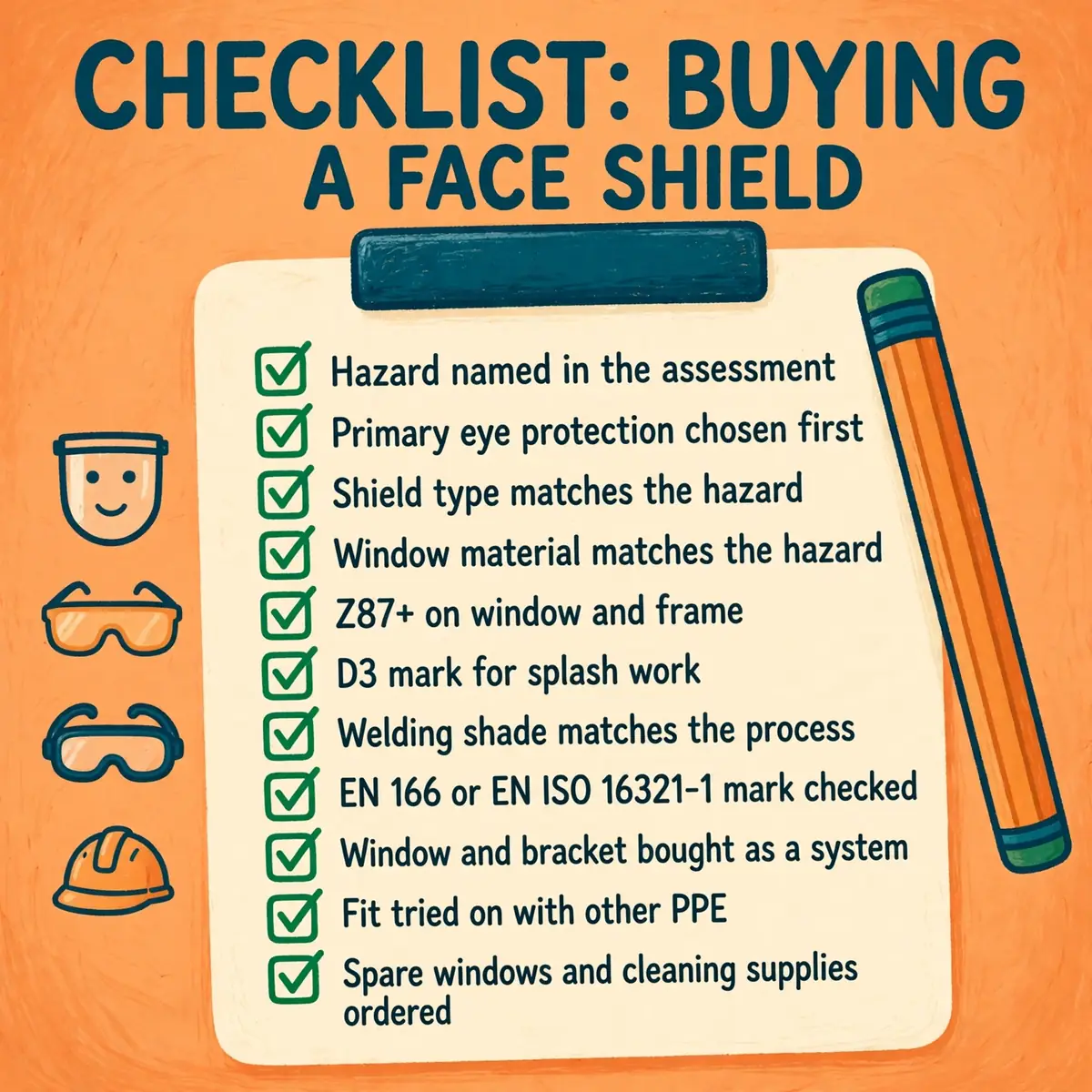
Use this checklist when ordering, and keep a copy with the purchase order. Tick every line before the order goes out.
- Hazard named in the assessment, with the exposure level written down.
- Primary eye protection chosen first: glasses for impact, goggles for splash and dust.
- Shield type matches the hazard: full-face, half, flip-up, hard-hat mounted or welding.
- Window material matches the hazard: polycarbonate, acetate, PETG or mesh.
- Z87+ on the window and the frame for high-impact work in the US.
- D3 mark on the window for splash work, with D3 goggles underneath.
- Welding shade number matches the process and the current, not a tint.
- EN 166 or EN ISO 16321-1 mark with the right strength letter and field numbers.
- Window and bracket bought as the system the maker lists together.
- Fit tried on with the glasses, hard hat, respirator and hearing protection in use.
- Spare windows, spare headgear and cleaning supplies ordered with the shields.
Frequently Asked Questions
Can a face shield replace safety glasses?
No. A face shield is secondary protection and must be worn over safety glasses or goggles. It is open at the bottom and sides, so particles and splash can reach the eyes from below. OSHA's selection guidance states that face shields should only be worn over primary eye protection.
What does Z87+ mean on a face shield?
Z87+ means the window passed the high-impact tests in ANSI/ISEA Z87.1. A 6.35 mm steel ball struck the window at 300 feet per second. A 500 g pointed weight dropped from 50 inches, and the window passed a penetration test. The plus must appear on the window and the frame.
What does D3 mean on a face shield?
D3 means the window passed the droplet and splash test in ANSI/ISEA Z87.1. It protects the face against splash, but it does not seal the eyes. For chemical splash, wear D3 goggles underneath the shield, since the goggles seal around the eyes.
Can I wear a face shield over prescription glasses?
Yes, if the combination fits without disturbing either pair. Use prescription safety glasses marked Z87-2, over-the-glasses safety glasses, or goggles made to fit over spectacles. Everyday prescription glasses on their own are not safety eyewear, even under a shield.
Do I need a face shield for grinding?
Yes, for most grinding work. OSHA's selection guidance treats grinding as an impact hazard and calls for a shield over glasses or goggles where the exposure is severe. A bench grinder or an angle grinder counts as severe exposure, so wear Z87+ glasses and a Z87+ shield together.
How often should a face shield be replaced?
Replace it on condition, not on a calendar date. Replace the window after any impact, when scratches or clouding reduce visibility, or when a coating wears off. Replace headgear when the ratchet slips or the straps stretch. Follow the maker's guidance for the model, and keep spares in stock.
Sources
- OSHA 29 CFR 1910.133 — Eye and face protection
- NIOSH — Eye Safety (archived CDC copy)
- OSHA 29 CFR 1910.252 — Welding, cutting and brazing, general requirements
- The Personal Protective Equipment at Work Regulations 1992 (SI 1992/2966)
- CASRAI — EN 166 eye protection markings explained
- BSI — A new era in eye protection: understanding EN ISO 16321
- HSE — A short guide to the Personal Protective Equipment at Work Regulations 1992 (INDG174, archived copy)