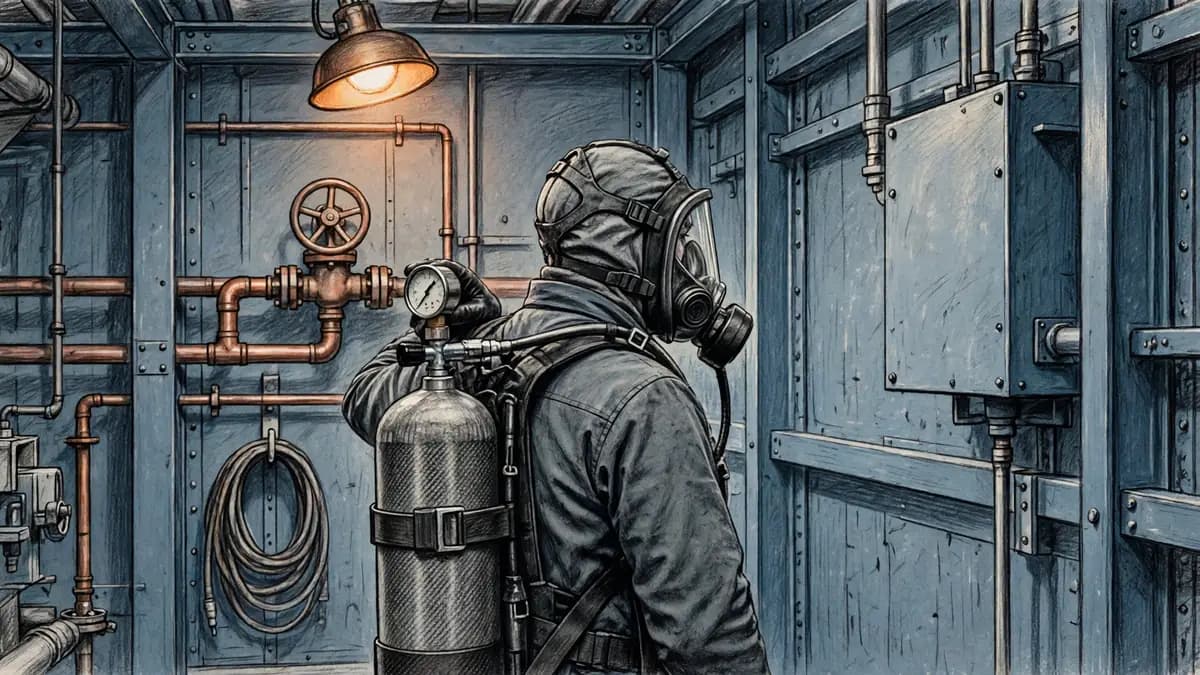
SCBA stands for self-contained breathing apparatus. It is a respirator that carries its own supply of compressed breathing air in a cylinder on the wearer's back, so the wearer can breathe safely in air that would kill or disable them in a few breaths.
OSHA requires it, or a supplied-air respirator with an escape cylinder, in any atmosphere that is immediately dangerous to life or health. A filter mask is never a substitute there, because a filter needs breathable air around it and an SCBA does not.
What is an SCBA?
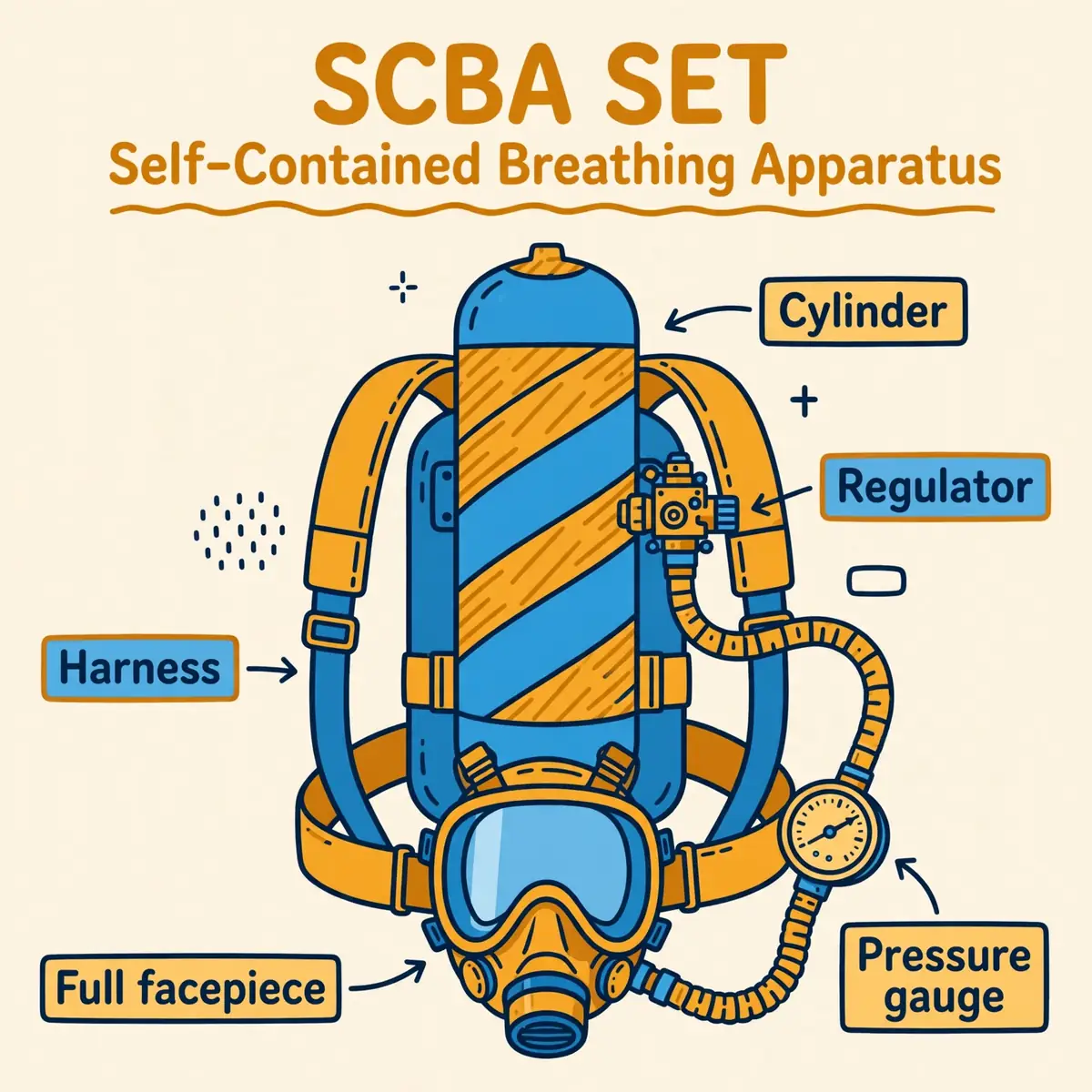
A self-contained breathing apparatus is an atmosphere-supplying respirator whose breathing air source is designed to be carried by the user. That definition comes from OSHA's respiratory protection standard, 29 CFR 1910.134, and it is the whole point of the equipment: the air comes with the wearer, not from the room.
The set has five main parts. A cylinder holds compressed breathing air. A first-stage regulator on the cylinder drops the pressure for the hose. A second-stage regulator on the facepiece delivers air on demand. A full facepiece seals against the face and protects the eyes. A harness and backplate carry the weight on the hips and shoulders.
Most sets also carry a pressure gauge, a low-air alarm and a personal alert safety system, known as a PASS device. Fire-service sets add a heads-up display inside the mask, so the wearer can see the remaining air without looking down at the gauge.
Firefighters are the best-known users, but they are far from the only ones. Industrial rescue teams, confined-space entrants, hazardous-materials responders, miners and chemical plant operators all wear SCBA where the air cannot be trusted. The choice follows the same logic as the PPE requirements for other respiratory hazards: assess the atmosphere first, then select the equipment.
How an SCBA works
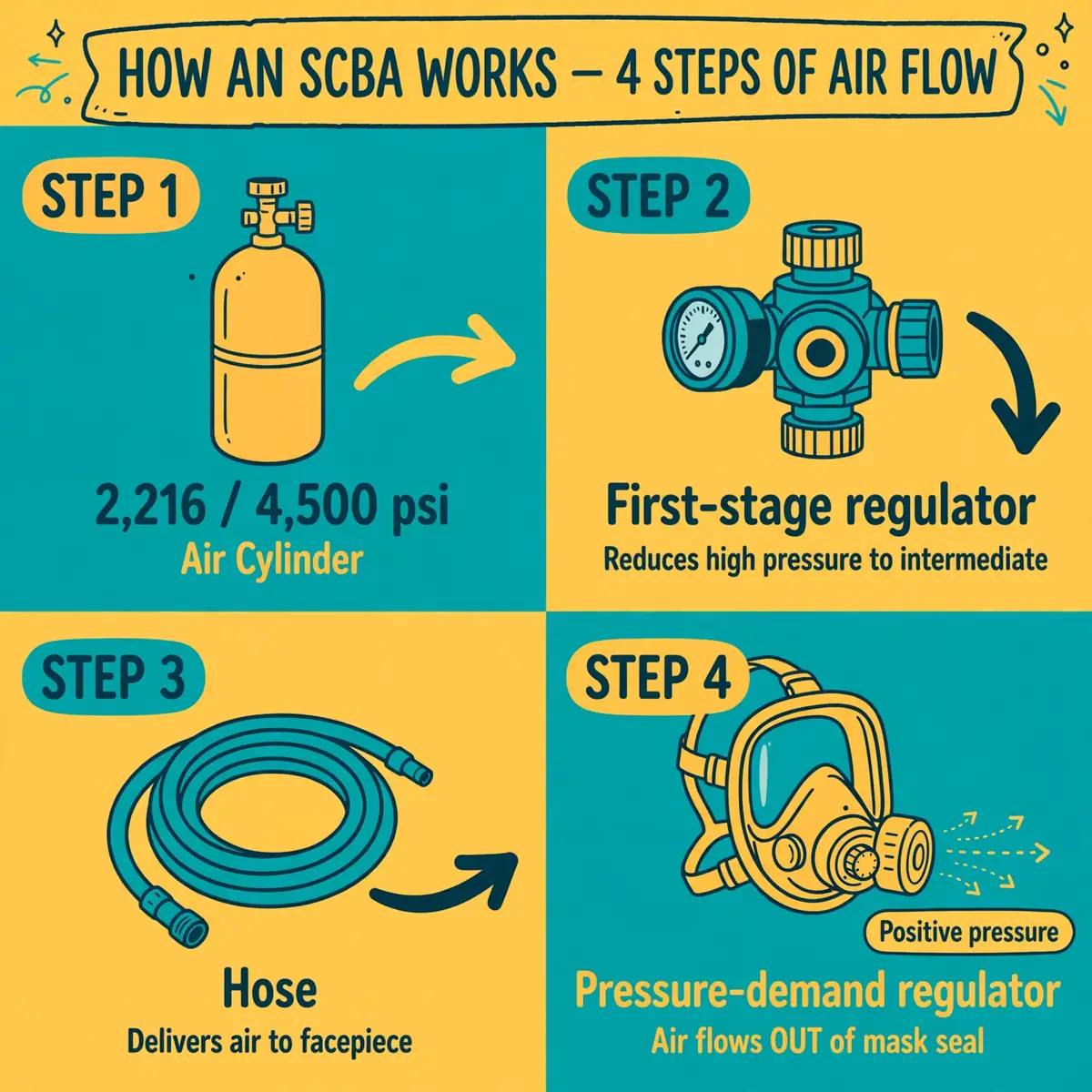
The cylinder holds breathing air at 2,216, 3,500 or 4,500 psi, with some fire-service units at 5,500 psi. The first-stage regulator drops that pressure to a few hundred psi and sends air down a hose. The second-stage regulator, mounted on the facepiece, delivers air as the wearer breathes.
Modern sets are pressure-demand sets. The regulator keeps a slight positive pressure inside the facepiece at all times and opens wider on inhalation. If the seal leaks, air flows out rather than in, so contaminated air cannot be drawn inside. That positive pressure is what makes the set safe in a lethal atmosphere.
The older demand SCBA worked the other way: it delivered air only when inhalation created negative pressure inside the mask. A leak then pulled contaminated air in. The United States has prohibited demand SCBA for any atmosphere that is, or could become, immediately dangerous to life or health since 1 July 1983.
A gauge and an audible low-air alarm tell the wearer when to leave. The alarm sounds with roughly a third of the air left, and the exact point depends on the standard and the cylinder pressure. The harness carries 20 to 35 pounds, depending on the cylinder, and the weight is the main practical limit alongside heat and limited air.
Open-circuit and closed-circuit: the two types
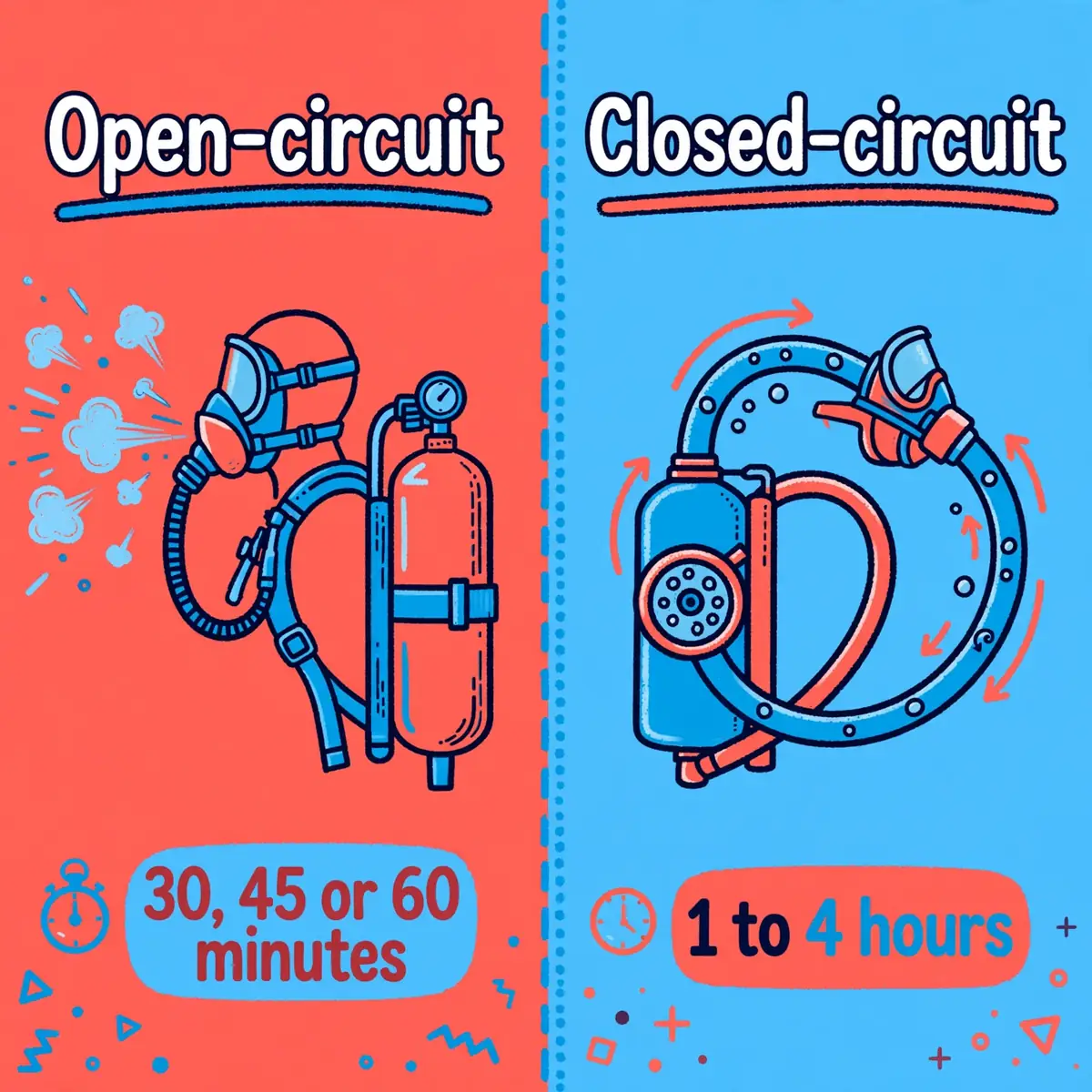
Open-circuit SCBA is the standard type. The wearer breathes compressed air from the cylinder, and exhaled breath is vented to the atmosphere. It is simpler, lighter and easier to service, and it is the type used by fire services and most industrial teams.
Closed-circuit SCBA, also called a rebreather, recycles exhaled air. The gas passes through a carbon dioxide absorber, fresh oxygen is added from a small cylinder, and the wearer breathes the mixture again. Rated service life runs from 1 to 4 hours, far longer than an open-circuit set.
That duration comes with trade-offs. A rebreather is heavier, more complex, harder to maintain and demands more training. It is used mainly in mine rescue and long-duration entry, where an open-circuit cylinder would run out before the job is done. For most workplaces, the open-circuit set is the right choice.
| Type | How it works | Rated time | Where it is used |
|---|---|---|---|
| Open-circuit SCBA | Compressed air cylinder; exhaled air vented | 30, 45 or 60 minutes | Firefighting, IDLH entry, confined-space rescue, emergency response |
| Closed-circuit SCBA (rebreather) | Oxygen cylinder plus carbon dioxide scrubber; exhaled air recycled | 1 to 4 hours | Mine rescue, long-duration entry; specialised work |
When is an SCBA required?
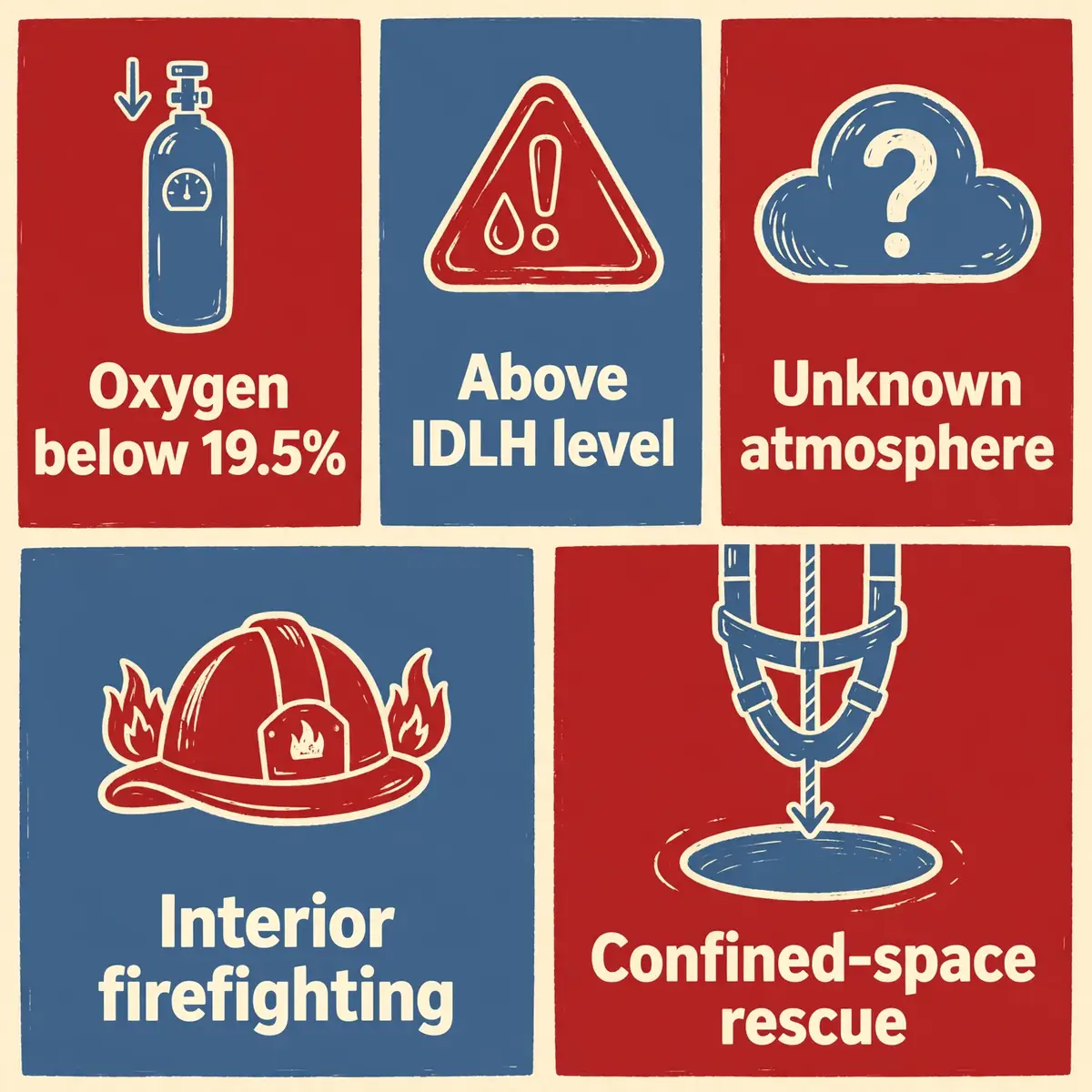
The requirement is written around one idea: IDLH, immediately dangerous to life or health. OSHA defines an IDLH atmosphere as one that poses an immediate threat to life, would cause irreversible adverse health effects, or would impair the wearer's ability to escape. Five situations produce it.
Oxygen below 19.5%
OSHA treats any oxygen-deficient atmosphere as IDLH. Normal air holds about 20.9% oxygen, and the standard draws the line at 19.5% by volume. Below that level, no air-purifying respirator may be used, because a filter cannot add oxygen that is not there.
Oxygen can fall without any warning smell or colour. It is displaced by gases such as nitrogen, argon or carbon dioxide, and it is consumed by rust, fermentation and combustion. A space that looks safe can hold too little oxygen to support consciousness.
A contaminant above its IDLH level
NIOSH publishes an IDLH concentration for many substances. Hydrogen sulphide is 100 ppm, carbon monoxide is 1,200 ppm and ammonia is 300 ppm. Above those levels, only SCBA or a supplied-air respirator with an escape cylinder is allowed.
The number matters because it is the point where escape itself becomes doubtful. Below it, a correctly selected filter or supplied-air set may be enough. Above it, the atmosphere can disable the wearer before they can get out, so the air supply must travel with them.
An unknown atmosphere
If the contaminant or its concentration cannot be identified or reasonably estimated, the atmosphere is treated as IDLH. That is the rule in 1910.134(d)(1)(iii), and it is the reason SCBA is the default for emergency response.
A spill, a leak or a fire produces a mixture nobody can name from the doorway. Until monitoring or sampling characterises the atmosphere, the only safe assumption is the worst one. Hazardous-materials responders wear pressure-demand SCBA until the atmosphere is known.
Interior structural firefighting
Firefighters inside a burning structure must wear pressure-demand SCBA with a full facepiece. Fire smoke holds toxic products of unknown type and quantity, so no filter can be matched to the exposure in advance. The requirement stands after the fire is out, too, because overhaul releases smoke and smouldering material from concealed spaces.
For a fire still at the incipient stage, the fire extinguisher classes decide the right extinguisher. Once the fire is beyond that stage, SCBA entry is the rule, and OSHA's rule for interior structural firefighting, 1910.134(g)(4), also sets the two-in, two-out rule. At least two firefighters enter together, and at least two stay outside, in contact with the team inside and ready to rescue them. Industrial fire brigades that fight fires beyond the incipient stage follow the same rule.
Confined-space rescue and emergency response
Entry rescue into a permit space whose atmosphere has not been made safe is IDLH entry. The rescuer wears SCBA or a supplied-air respirator with an escape cylinder, and works on a retrieval line. A standby person stays outside, trained and equipped to rescue, and the employer is notified before the standby enters. Hazardous-substance emergency response follows the same logic under OSHA's HAZWOPER standard, 29 CFR 1910.120: responders exposed to an inhalation hazard wear positive-pressure SCBA until the incident commander confirms, through air monitoring, that a lower level of protection is safe.
That standby rule exists because rescuers die in the same atmosphere that trapped the first victim. More than one worker has entered a tank or a silo to help a colleague and been overcome by the same gas. The standby, the retrieval line and the SCBA are what break that pattern.
SCBA, supplied-air respirator or gas mask: how to choose
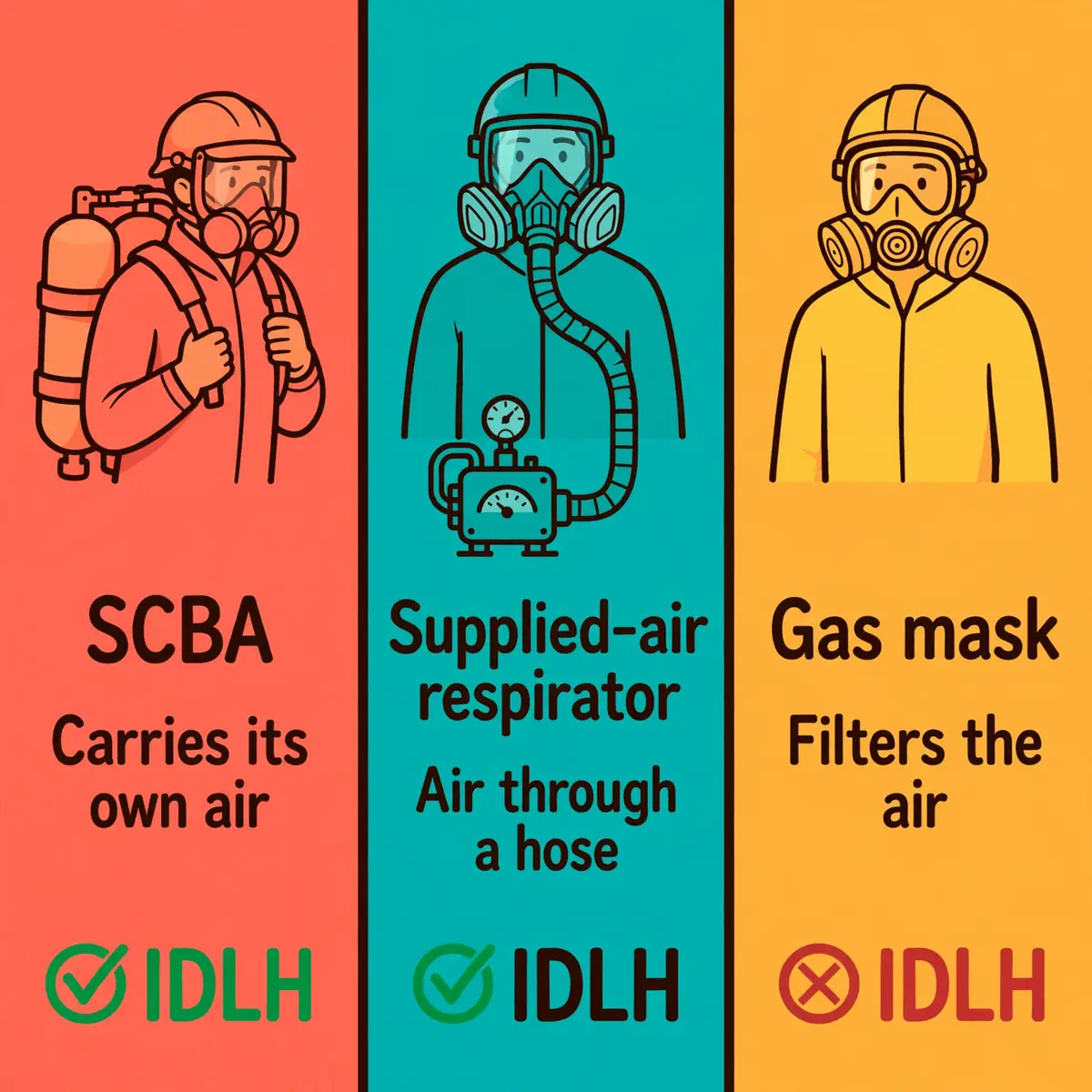
Three kinds of equipment are often confused, and the difference is where the air comes from. An SCBA carries its air on the wearer's back. A supplied-air respirator, or SAR, brings air through a hose from a compressor or a cylinder bank. A gas mask filters the air the wearer is already breathing.
A gas mask, an air-purifying respirator, can only remove contaminants it is designed to hold, and it needs normal oxygen in the air. It cannot protect against carbon monoxide, which binds to haemoglobin about 250 times more strongly than oxygen does. A filter makes breathing feel easier while carbon monoxide is still doing its damage.
Supplied air is lighter than an SCBA and unlimited on the hose, which suits long jobs such as tank cleaning, abrasive blasting and painting. But a hose can be cut, kinked or fed by a compressor that fails, so for IDLH work a supplied-air set needs an escape cylinder on the belt, rated 5 to 15 minutes, to get the wearer out.
OSHA gives SCBA an assigned protection factor of 10,000, the highest of any respirator in Table 1 of 1910.134. That number is not a promise on its own. It applies only when the set is NIOSH-certified, correctly fitted and used inside a written respiratory protection programme.
| Equipment | Air source | Duration | Where it is used |
|---|---|---|---|
| Open-circuit pressure-demand SCBA | Cylinder on the back; exhaled air vented | 30, 45 or 60 minutes rated; less under hard work | IDLH entry, firefighting, confined-space rescue, emergency response |
| Closed-circuit SCBA (rebreather) | Oxygen cylinder plus carbon dioxide scrubber | 1 to 4 hours | Mine rescue, long-duration entry; specialised work |
| Supplied-air respirator with escape cylinder | Hose from a compressor or cylinder bank; 5- to 15-minute escape bottle | Unlimited on the hose | IDLH work where a hose is practical: tank cleaning, blasting, some confined spaces |
| Supplied-air respirator, no escape bottle | Hose only | Unlimited | Non-IDLH work: painting, blasting, pharmaceutical work |
| Escape-only SCBA | Small cylinder, hood | 5 to 15 minutes | Escape from a sudden release; never for entry |
| Emergency escape breathing device (EEBD) | Small cylinder or oxygen generator, hood | 10 to 15 minutes | Ships, refineries, ammonia plants; escape only |
AlertAn escape-only unit is approved for leaving a hazardous area and must never be used to enter or work in one.
How to use an SCBA
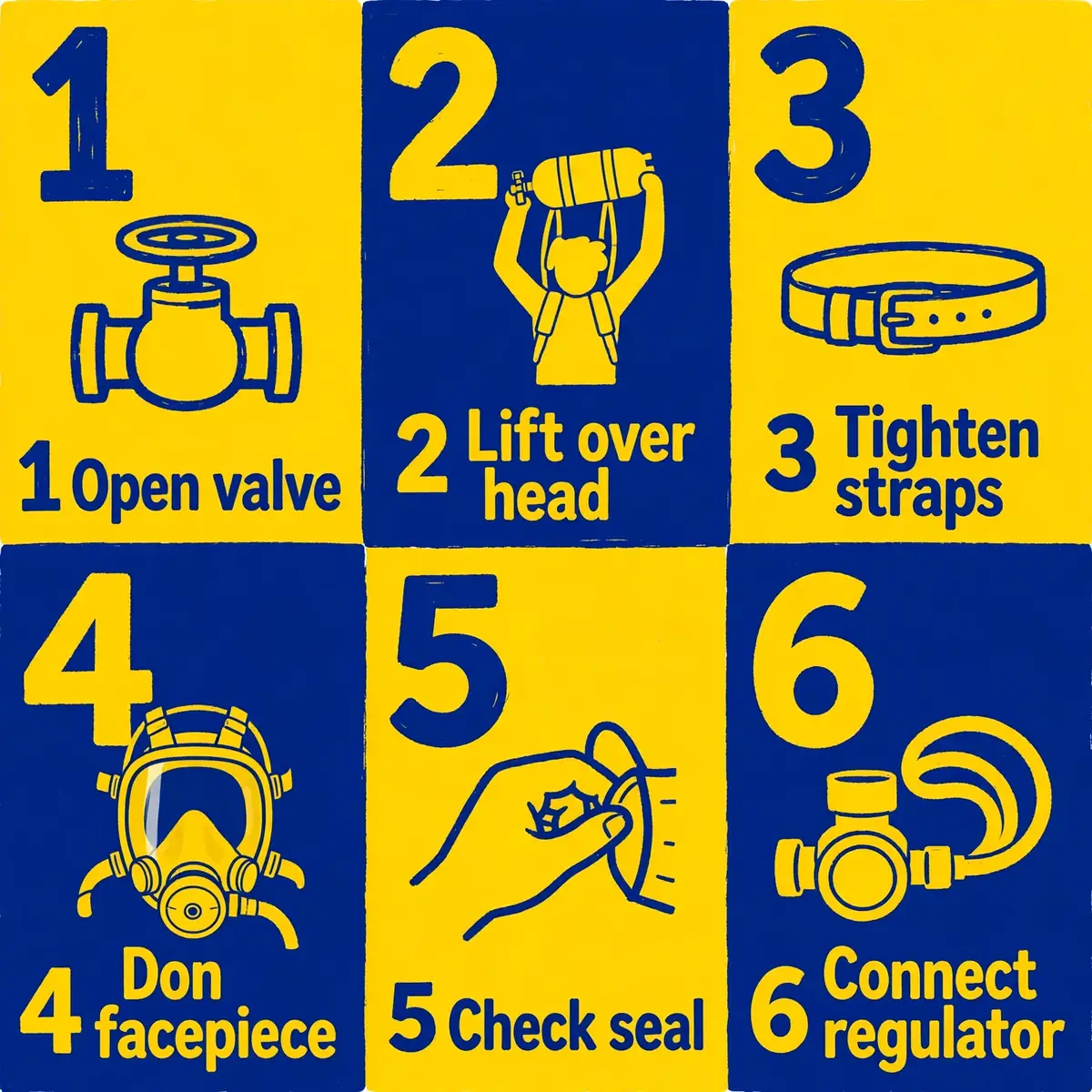
An SCBA is not a mask to pull on and hope for the best. It is a system with a fixed sequence, and the sequence must be practised until it is automatic. Training has to include hands-on donning, seal checks and inspection, watched by someone competent, not just a video or a classroom talk.
WarningNever enter an IDLH atmosphere alone, without a standby person outside, and never enter with a set that has not been inspected and checked that day.
Putting it on
The over-the-head method is the standard way to don a set on the ground. Work through the steps in order.
- Place the SCBA directly in front of you and lay the shoulder straps beside it.
- Open the main cylinder valve and listen for the PASS alarm and the low-air alarm as the set pressurises.
- Grab the backplate with both hands and lift the set over your head, letting it slide down your back.
- Tighten the shoulder straps and the waist belt so the weight sits on the hips.
- Don the facepiece and hood, making sure no skin is exposed.
- Connect the regulator to the facepiece and breathe normally to confirm airflow.
Checking the seal
Every wearer must perform a user seal check each time they put on a tight-fitting respirator. Cover the regulator inlet, inhale gently and hold for a few seconds: the facepiece should pull slightly inward and hold. Then exhale gently: the facepiece should push slightly outward with no air leaking at the edges.
Facial hair breaks the seal. OSHA prohibits a tight-fitting facepiece where facial hair comes between the sealing surface and the face. A beard, stubble or sideburns across the seal line means the wearer cannot use the set, and no adjustment of the straps will fix that.
Taking it off
Disconnect the regulator from the facepiece and press the air-saver switch. Remove the helmet and hood, then loosen the facepiece straps and take the facepiece off. Keep the facepiece somewhere safe, where the lens cannot be scratched or the seal damaged.
Loosen the belt and shoulder straps, remove the set and place it on the ground. Turn off the main cylinder valve and purge the remaining air from the regulator using the bypass valve. Turn off the PASS device last, so it is not left sounding on the floor.
If the set fails while you are inside
A regulator fault, a torn hose or a low-air alarm all mean the same thing: leave now. Do not try to repair the set inside the atmosphere, and do not wait to see whether the alarm stops. Tell the standby person, follow the retrieval line or the planned exit route, and follow your site's practice emergency procedures for an IDLH alarm. Keep breathing normally.
If the facepiece seal fails, the positive pressure inside the mask pushes air outward, which buys a short margin. That margin is measured in seconds, not minutes. The standby team keeps a first aid kit at the entry point, ready for a casualty who has inhaled a toxic gas. The exit plan, the standby person and the spare air are what turn a failure into a story instead of a casualty.
How long does an SCBA cylinder last?
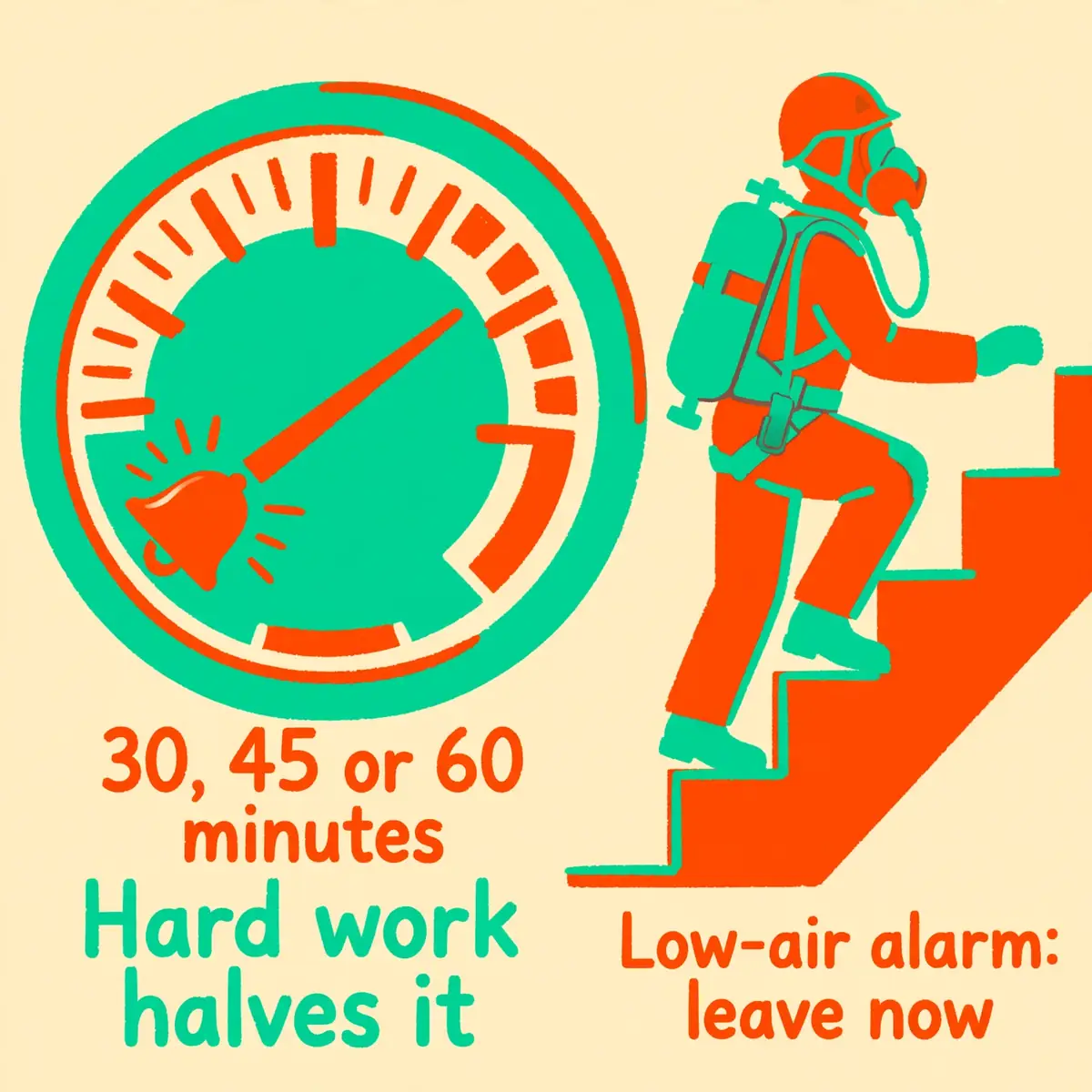
A cylinder is rated at 30, 45 or 60 minutes, but that rating is measured at a standard breathing rate, not at the rate of a worker climbing stairs in full gear under stress. Under hard work, a 30-minute cylinder can last 15 to 20 minutes. Planning on the rated time is planning to run out of air.
The low-air alarm is the signal to leave. NIOSH requires the warning at 25% of rated service pressure, and the NFPA 1981 standard set its end-of-service-time indicator at 33%. The 2025 edition moved the SCBA requirements into NFPA 1970 and adjusted the set point by cylinder pressure: 34% at 2,216 psi, 31% at 4,500 psi and 29% at 5,500 psi. The alarm now sounds when about 35% of the cylinder's air volume remains.
Good air management starts before entry. Check the gauge and confirm the cylinder is full. Know how much air the job needs, including the exit, and keep a margin for the unexpected. Work in pairs, keep the standby person informed, and treat the alarm as an order, not a suggestion.
TipCheck the cylinder gauge before every entry and write the reading down. A set that starts at 90% has already lost a tenth of its working time.
Inspection, maintenance and storage
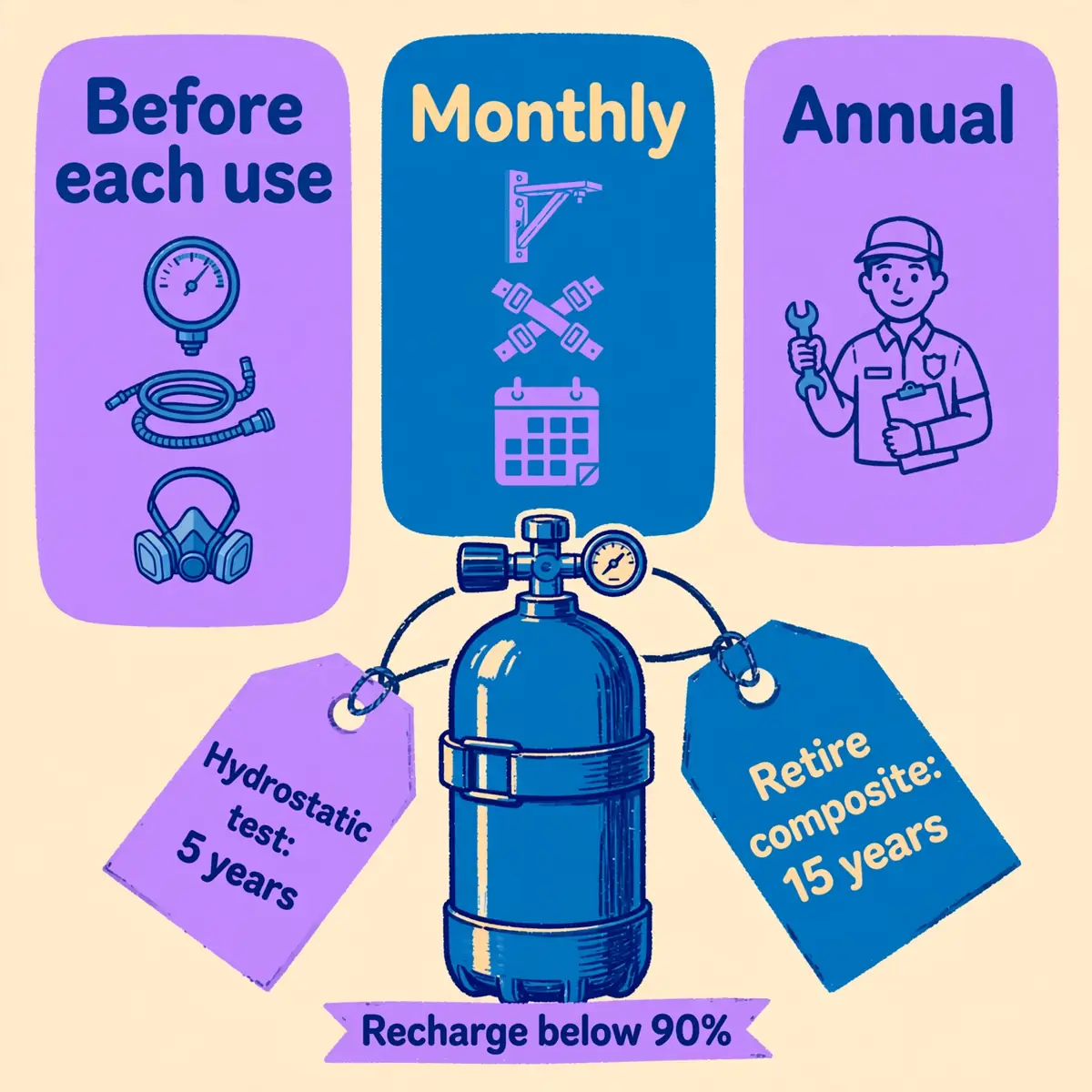
An SCBA that is not inspected is a guess, not protection. OSHA requires emergency-use respirators to be inspected at least monthly and before and after each use, and cylinders to be recharged when the pressure falls below 90% of full. Fire departments go further: NFPA 1500 sets a daily, monthly and annual inspection rhythm.
Before each use
Check the cylinder for damage and confirm it is at least 90% full. Inspect the hoses and the regulator, and compare the cylinder gauge with the remote pressure gauge; the two should agree. Open the bypass to check airflow, connect the facepiece, don it and take one or two normal breaths.
Close the cylinder valve and open the bypass to bleed the air, and confirm the low-pressure alarm sounds at the right pressure. Close the bypass again. Any fault found at this stage means the set stays out of service until it is repaired by a competent person.
Monthly and annual checks
Once a month, inspect the mounting bracket for damage, check the hydrostatic test date on the cylinder, and examine the straps for wear, burns and cuts. Check every buckle and fastener, the backplate for cracks or rust, all connection points and all hoses. Record the inspection on the unit.
Once a year, a certified manufacturer's representative should inspect and service the set. Annual servicing covers the parts a user cannot test: regulator calibration, valve function and the internal condition of the cylinder. Keep the service record with the set.
Cylinders and breathing air
Aluminium cylinders and most composite cylinders are hydrostatically tested every 5 years, and composite cylinders are retired after 15 years of service. The test date is stamped or labelled on the cylinder, and an out-of-date cylinder must not be filled. That rule comes from the transport regulations, 49 CFR 180.205.
Breathing air must meet at least Grade D, the standard in ANSI/CGA G-7.1: oxygen 19.5% to 23.5%, hydrocarbons 5 mg/m³ or less, carbon monoxide 10 ppm or less, carbon dioxide 1,000 ppm or less, and no noticeable odour. Air is tested when cylinders are filled, and compressor-fed fill stations need filtration and a carbon monoxide monitor.
Clean and disinfect the facepiece after each use, and store the set where it is protected from damage, sunlight and contamination, ready for immediate use. A set buried in a locker under other equipment is not ready, however good its last inspection was.
The SCBA programme: medical checks, fit testing and training
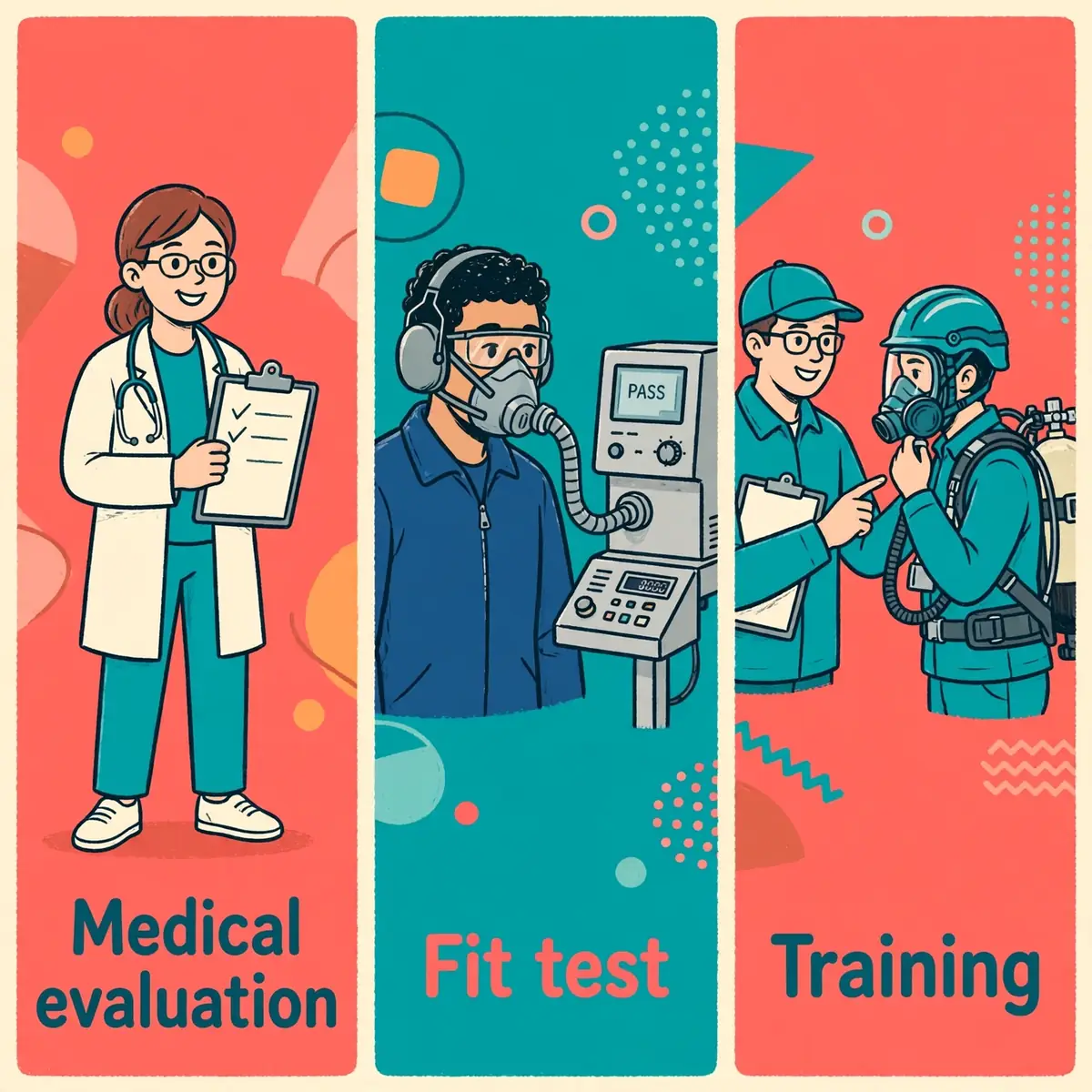
Buying an SCBA does not make a workplace safe. OSHA requires a written respiratory protection programme wherever respirators are required, run by a suitably trained programme administrator. The programme covers selection, medical evaluation, fit testing, use, maintenance, breathing air, training and regular evaluation of its own effectiveness.
Medical evaluation
SCBA is the most physically demanding respirator to wear. The weight, the heat and the extra breathing effort strain the heart and lungs, so the employer must provide a medical evaluation before the employee is fit tested or required to use the set. A physician or other licensed health care professional reviews a questionnaire or an examination and gives a written recommendation.
That evaluation is not a one-off formality. If the employee's health changes in a way that could affect respirator use, the evaluation is repeated. An employee who cannot safely wear an SCBA must not be assigned work that needs one.
Fit testing
Employees using a tight-fitting facepiece must be fit tested before first use, whenever a different facepiece is used, and at least annually after that. The test uses the same make, model, style and size the employee will actually wear, and it follows one of the accepted qualitative or quantitative protocols.
For SCBA facepieces the fit test is normally quantitative, because a number is needed to prove the seal holds under the conditions the set will be used in. A fit test passed on one facepiece says nothing about another. Change the model, and the test starts again.
Training
Training is required before use and annually after that. It must cover why the respirator is necessary, its limitations, how to inspect, don and doff it, how to check the seal, how to use it in an emergency, and how to recognise medical signs that limit its use. The annual refresher sits alongside the site's other OSHA training for respirator users. The employer must provide the respirators, the training and the medical evaluations at no cost to the employee.
Training that stays in a classroom is not enough. Each wearer must be able to demonstrate the skills: donning the set, checking the seal, reading the gauge, responding to the low-air alarm and getting out. Practise in realistic conditions, with the full ensemble on, so the first real entry is not the first time the set is worn.
The law in the US and the UK
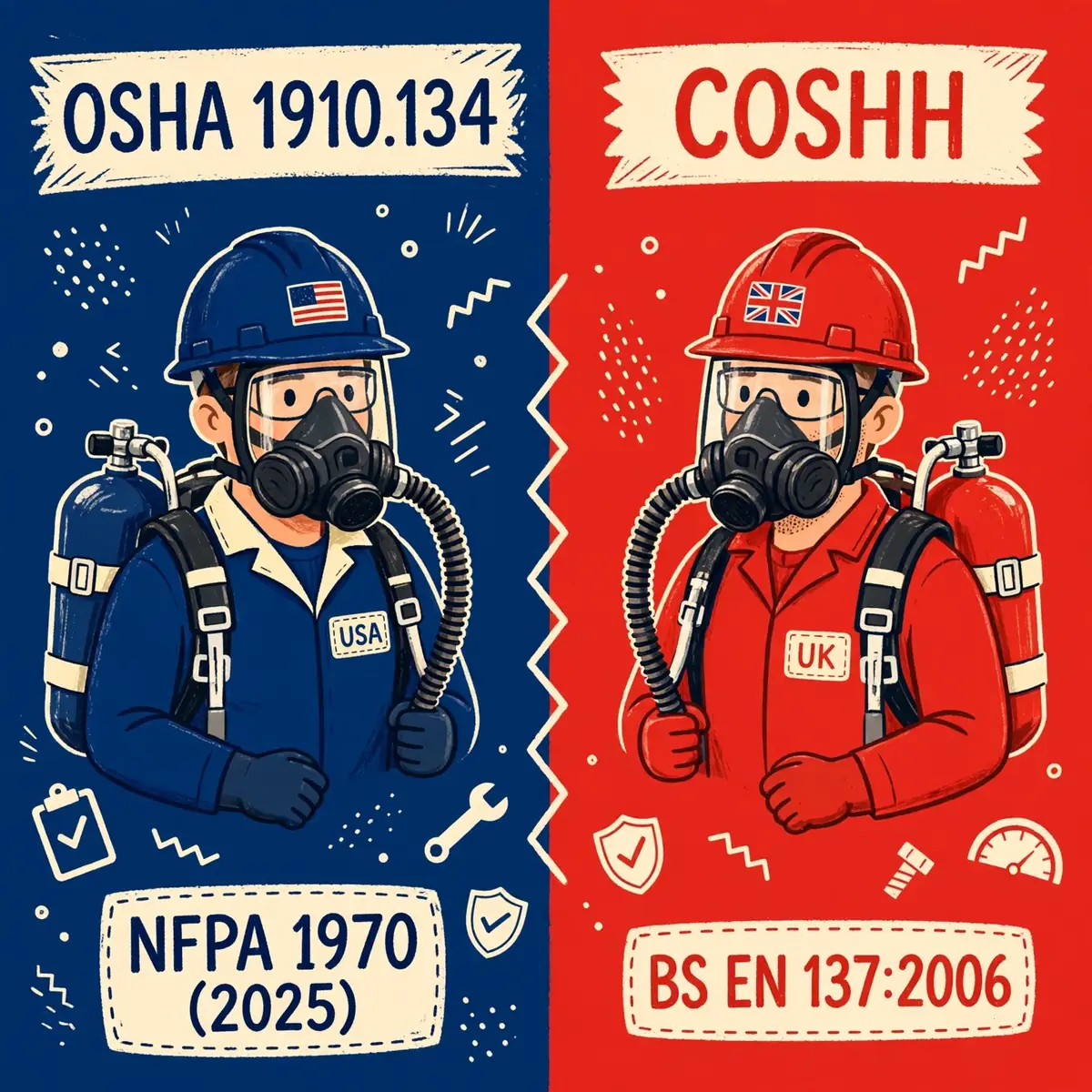
The rules differ by country, but the logic is the same: the atmosphere is assessed, the right equipment is selected, and the wearer is medically fit, fit tested and trained. A US search market does not establish US jurisdiction, and the duties below are stated for the country they belong to.
United States
OSHA's respiratory protection standard, 29 CFR 1910.134, governs general industry, construction and shipyards. It requires the written programme, NIOSH-certified respirators, medical evaluation, fit testing and specific equipment for IDLH atmospheres: a full-facepiece pressure-demand SCBA certified for at least 30 minutes, or a combination supplied-air respirator with an auxiliary self-contained supply.
The product standard for fire-service SCBA was NFPA 1981. Its requirements now sit in NFPA 1970, Standard on Protective Ensembles for Structural and Proximity Firefighting, Work Apparel and Open-Circuit SCBA for Emergency Services, 2025 edition, effective 18 September 2024. The 2025 edition adjusted the low-air alarm set point and added requirements for removable backframe soft goods and for cleaning and disinfecting instructions. The last ship date for SCBA certified to the 2018 edition is 18 March 2026.
United Kingdom
In the UK, the Control of Substances Hazardous to Health Regulations 2002 require exposure to be adequately controlled, and where respiratory protective equipment is the control it must be adequate and suitable. The PPE at Work Regulations 1992, as amended in 2022, require the employer to provide suitable protective equipment free of charge. HSE's practical guide, HSG53, Respiratory protective equipment at work, sets out selection, use, fit testing and maintenance, and selection follows the COSHH risk assessment.
The product standard for open-circuit SCBA in the UK is BS EN 137:2006, which sets minimum performance requirements, testing and marking for self-contained open-circuit compressed air breathing apparatus with a full face mask. It does not cover escape apparatus or diving equipment. Escape sets fall under separate standards, such as EN 402 and EN 1146.
Checklist: choosing an SCBA
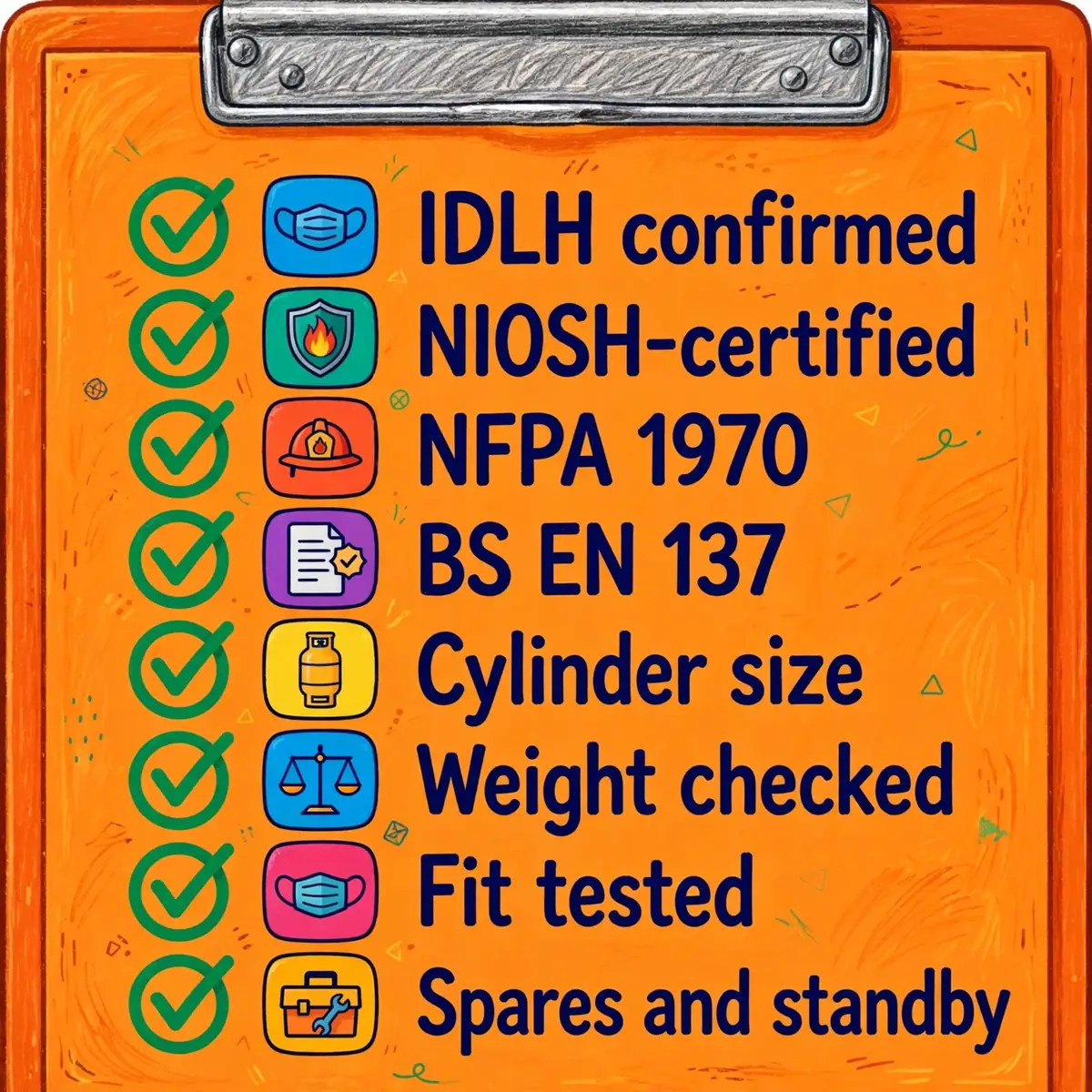
Choosing a set starts with the risk assessment, not with a catalogue. The atmosphere, the task, the duration and the wearer decide the specification, and the certificate decides whether the set may be used at all.
- Confirm the atmosphere is IDLH, or could become IDLH, before choosing SCBA over a filter or supplied-air set.
- Choose a NIOSH-certified pressure-demand set with a full facepiece, rated for at least 30 minutes.
- For interior structural firefighting, choose a set certified to NFPA 1970, the current home of the NFPA 1981 requirements.
- In the UK, choose a set meeting BS EN 137:2006 for open-circuit SCBA with a full face mask.
- Match the cylinder size to the job plus the exit, with a margin: 30, 45 or 60 minutes rated, and less under hard work.
- Check the weight the wearer must carry, 20 to 35 pounds, against their medical clearance.
- Confirm the set fits the wearer's face: fit test the exact make, model, style and size before first use.
- Plan the support: spare cylinders, a fill station with Grade D air, a standby person and a retrieval line.
Frequently Asked Questions
What does SCBA stand for?
Self-contained breathing apparatus: a respirator that carries its own air supply in a cylinder, independent of the surrounding atmosphere.
How long does an SCBA cylinder last?
Rated 30, 45 or 60 minutes at a standard breathing rate. Under hard work it can last half that long, so a 30-minute cylinder may give 15 to 20 minutes. The low-air alarm sounds with roughly a third of the air left, and that is the signal to leave.
What is the difference between an SCBA and a gas mask?
A gas mask is an air-purifying respirator: it filters the air the wearer is breathing and needs normal oxygen in that air. An SCBA supplies its own air and works in any atmosphere. A gas mask is never allowed in IDLH conditions.
Do I need a fit test for SCBA?
Yes. A fit test on the full facepiece is required before first use, whenever the facepiece changes, and at least annually. For SCBA the test is normally quantitative. A medical evaluation comes first, before the fit test.
How often are SCBA cylinders tested?
Hydrostatically every 5 years for aluminium and most composite cylinders, with composite cylinders retired at 15 years. The test date is stamped or labelled on the cylinder, and an out-of-date cylinder must not be filled.
Can an escape SCBA be used for entry?
No. Escape-only units, rated 5 to 15 minutes and usually hood style, are NIOSH-approved for leaving a hazardous area only. They must never be used to enter or work in one.
Sources
- OSHA, 29 CFR 1910.134 — Respiratory protection (full text, Cornell Law Institute)
- OSHA, 29 CFR 1910.120 — Hazardous waste operations and emergency response, HAZWOPER (full text, Cornell Law Institute)
- Bayshore Safety, "What is SCBA, and when does OSHA require it?"
- Fire Safety Academy, "Self-contained breathing apparatus"
- HSE, "Respiratory protective equipment at work" (HSG53, fourth edition, 2013)
- Sir Safety System, "EN 137 standard"
- FireRescue1, "Your go-to guide for back-to-basics SCBA training"
- 3M, "Standards Update: NFPA 1970, 2025 Edition (1981 and 1982 Chapters)"