
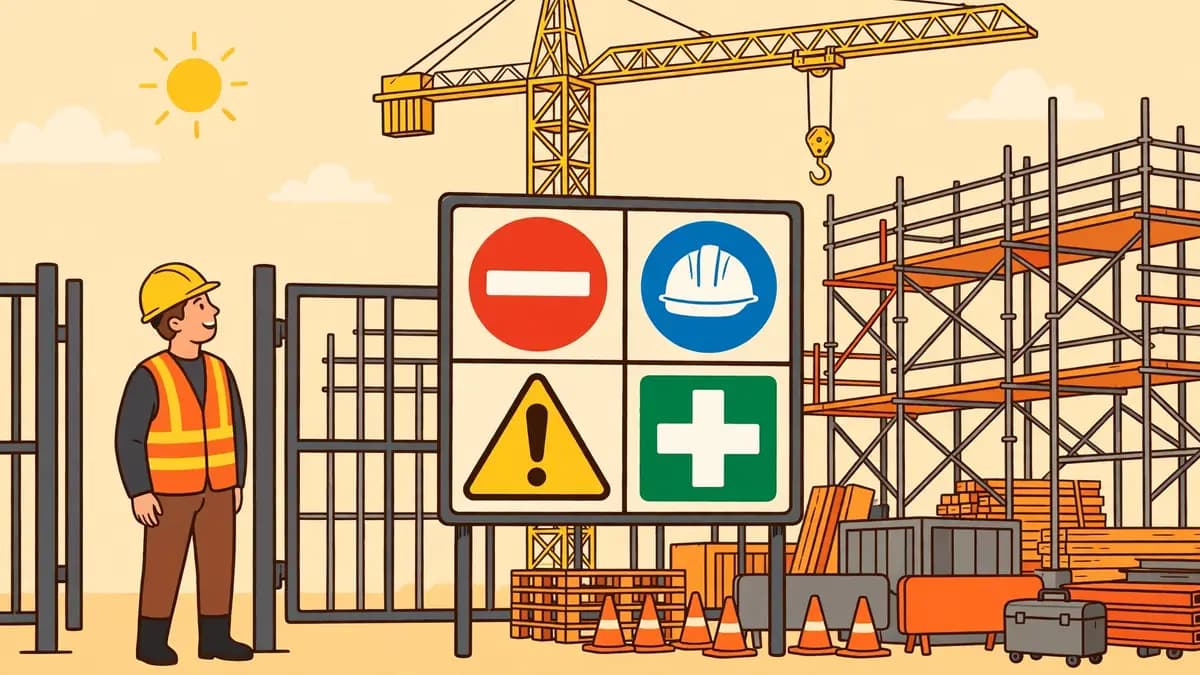
A construction sign tells anyone on site what to do, what not to do, or what danger lies ahead — before they reach it. The shape and colour carry the message, so a worker who cannot read the words, or who speaks another language, can still understand it.
On a construction site the system has two layers. The pictogram families — prohibition, mandatory, warning, safe condition and fire equipment — come from the international standard ISO 7010. In the United States, OSHA adds signal words — DANGER, WARNING and CAUTION — under 29 CFR 1926.200. In Great Britain, the Health and Safety (Safety Signs and Signals) Regulations 1996 require the ISO 7010 signs wherever a risk remains after other controls.
What construction signs are
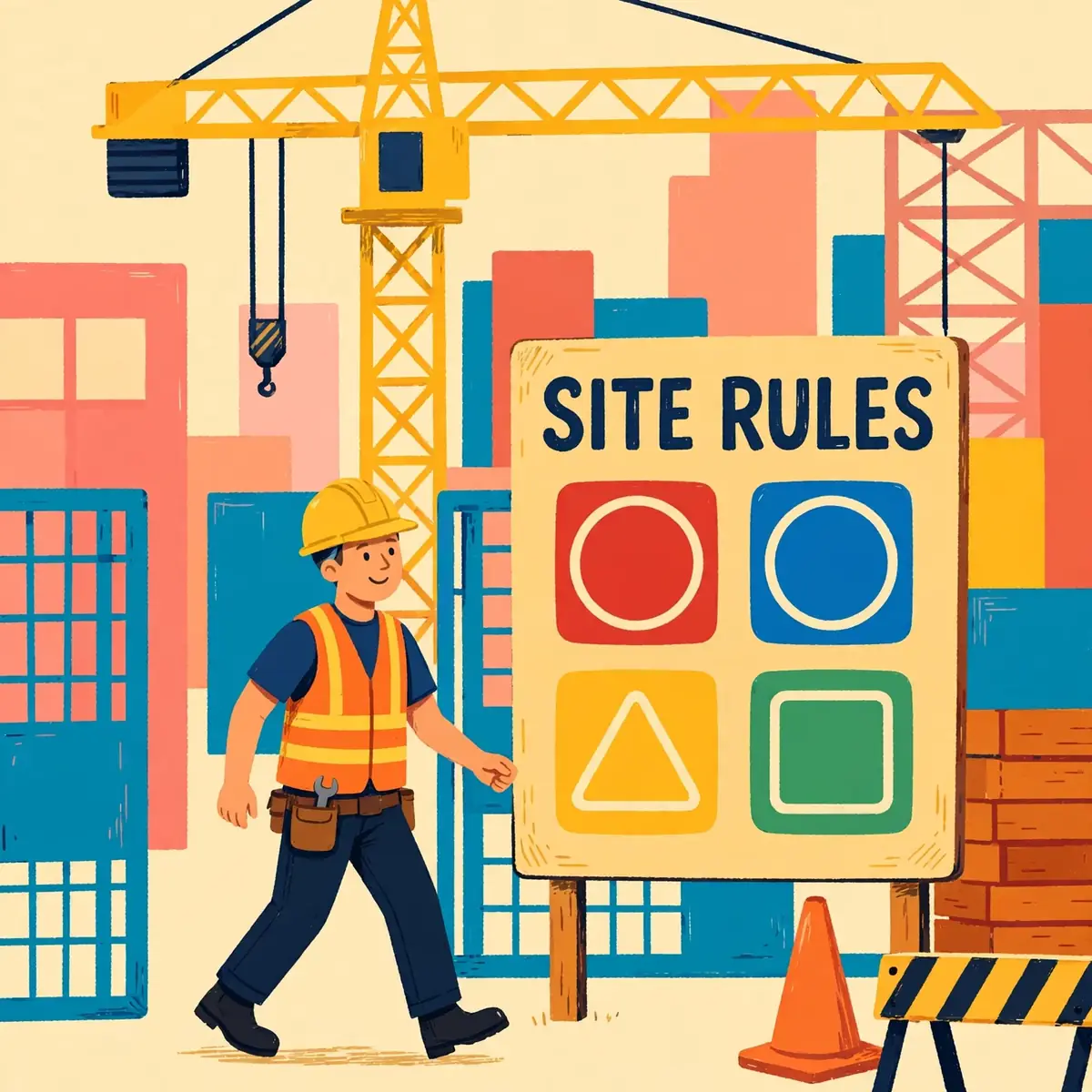
Construction site safety signs are the signs posted on a building site to control what people do and to warn them about hazards. They cover the site gate, the work areas, the plant routes and the welfare block. Every sign on site belongs to one of two jobs: it either tells people what they must do, or it warns them about a danger they cannot see yet.
Site signs are not road signs. Public road signs, such as speed limits and direction signs, follow the rules for traffic on public roads. A construction sign governs behaviour inside the site boundary, where the hazards change as the work moves on. The two systems meet at the gate, where site traffic signs take over from the public road.
Signs sit at the bottom of the hierarchy of controls. Guarding, isolation, ventilation and safe systems of work remove or reduce a risk first. A sign is used for the risk that is left. That is why a sign is never a substitute for a guardrail, a locked-out machine or a trained worker — it is the warning about what remains. A risk assessment decides which signs a site needs, and it is reviewed as the site changes.
TipLearn the five shapes and colours before the first day on site. The shape tells you the family before you read a single word.
How to read a sign in three seconds
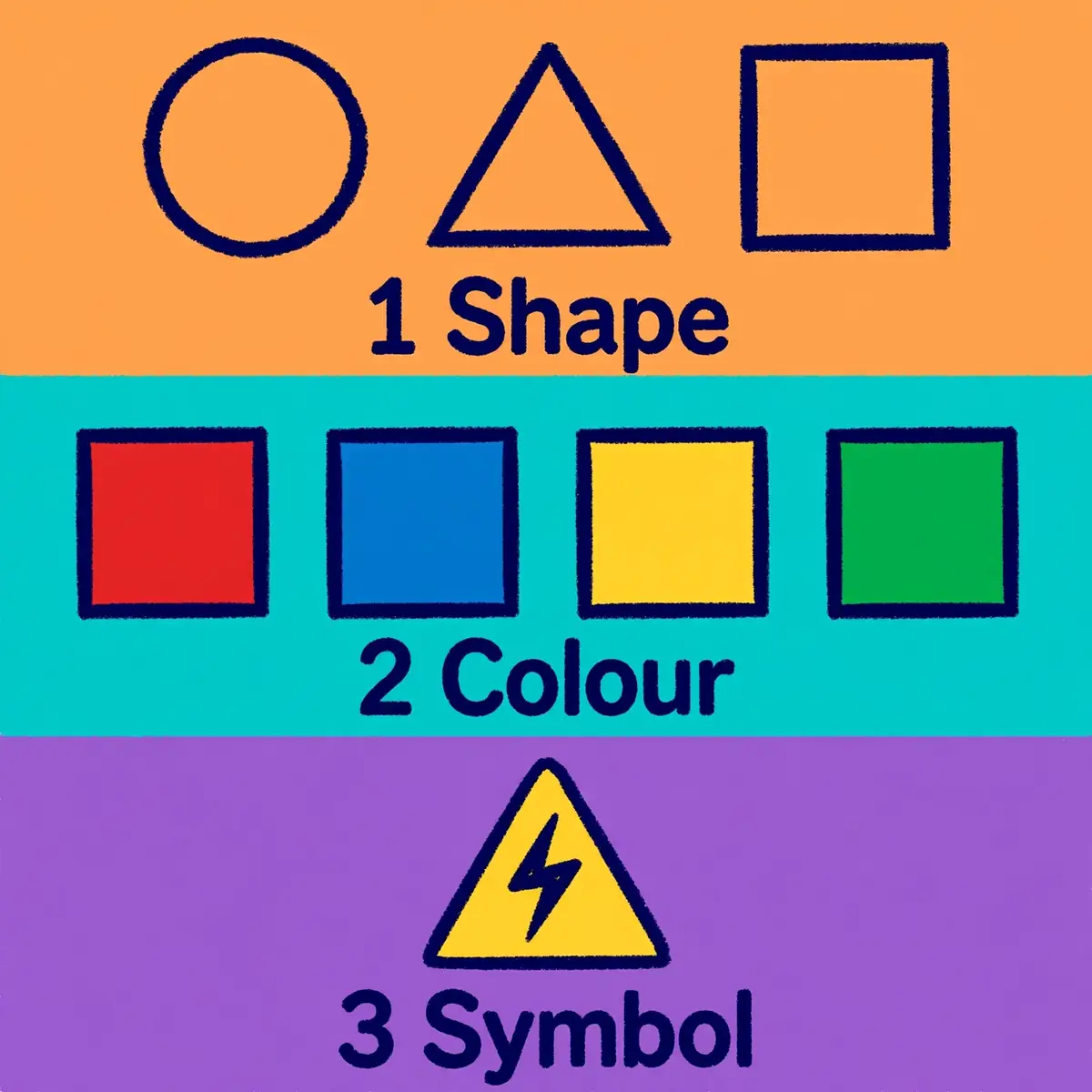
Read a sign in three steps, in this order. First the shape: a circle, a triangle or a square tells you the family. Then the colour: red, blue, yellow or green tells you how urgent the message is. Then the pictogram or the words, which name the exact hazard or action. Construction sign colours and meanings follow a single code, so the same sign means the same thing on every site that uses it.
| Family | Shape | Colour | Meaning | Example |
|---|---|---|---|---|
| Prohibition | Circle with a diagonal bar | Red, black pictogram on white | Do not do this | No entry |
| Mandatory | Circle | Blue, white pictogram | You must do this | Wear a hard hat |
| Warning | Triangle | Yellow, black pictogram | A hazard lies ahead | High voltage |
| Safe condition | Square or rectangle | Green, white pictogram | Safety equipment or escape route | First aid point |
| Fire equipment | Square | Red, white pictogram | Fire-fighting equipment here | Fire extinguisher |
The five families come from ISO 7010, the international standard for registered safety signs. Each registered pictogram carries a code letter: P for prohibition, M for mandatory, W for warning, E for safe condition and F for fire equipment. The code is a quick check that a sign is the right type before you check whether it is the right message. Australia and New Zealand use their own standard, AS 1319. It keeps the same colour-and-shape conventions for prohibition, mandatory, warning, emergency and fire signs.
Pictograms do the heavy lifting on a site with workers from many countries. A yellow triangle with a lightning flash means high voltage in any language. Words still matter: they add the detail a pictogram cannot carry, such as which type of gloves, which voltage, or which way to the assembly point. The best signs carry both.
The five sign families
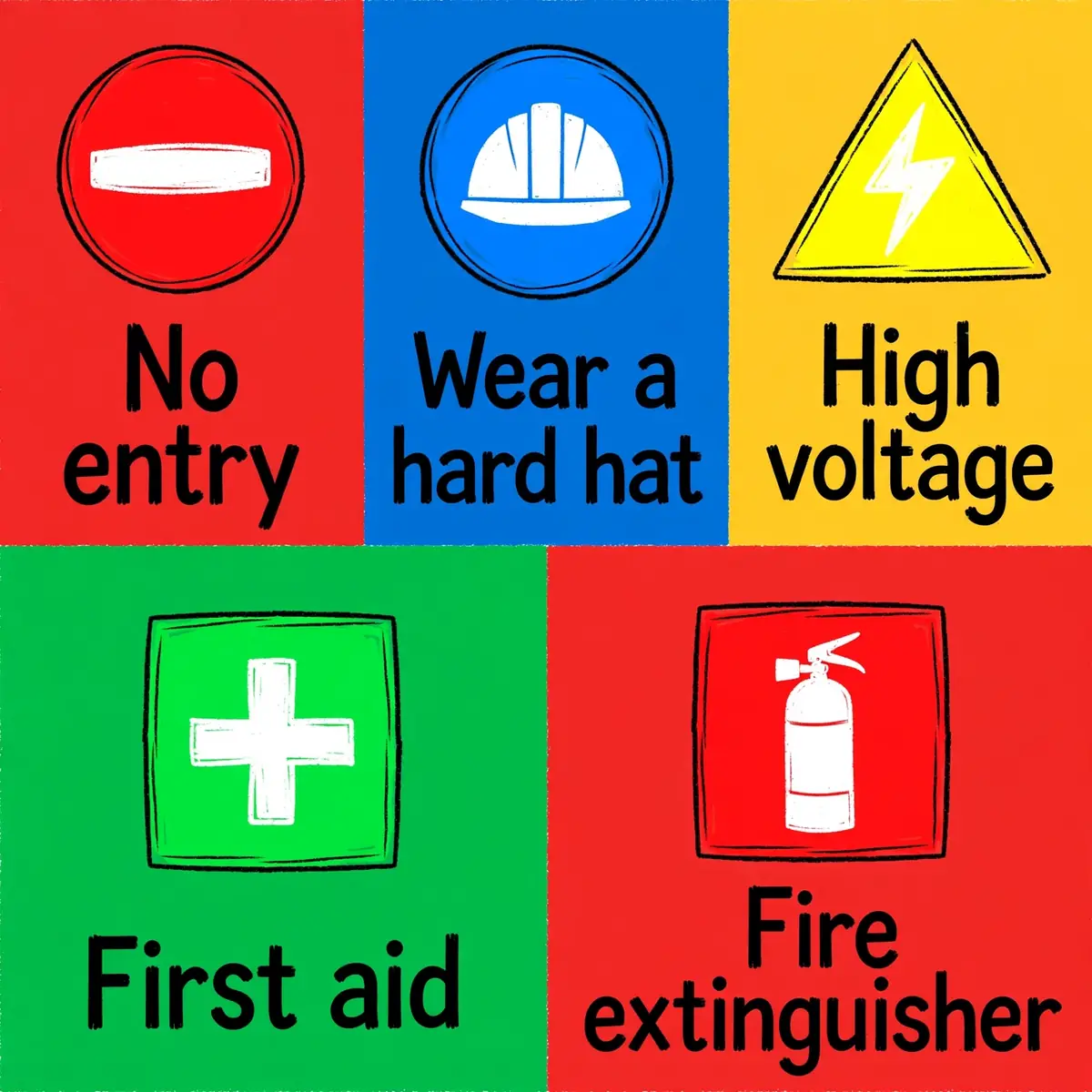
Every construction sign belongs to one of five families, and each family has its own shape and colour. Learn the family first and the individual sign becomes easy to read. The families below follow ISO 7010, the standard used across Great Britain and most of the world.
Prohibition signs: red circle, do not do this
A prohibition sign is a red circle with a diagonal bar over a black pictogram on a white background. Red must cover at least 35% of the sign. It forbids an action outright: no entry, no smoking, no unauthorised access, no mobile phones near blasting, no pedestrians on a plant route.
Prohibition signs sit at the point where the forbidden action would start — at the gate to a restricted area, at the door of a fuel store, at the edge of a vehicle route. When you see one, stop and find another route or another way to do the job. Do not step past it to save time. The rule behind it is there because the risk on the other side cannot be controlled any other way.
Mandatory signs: blue circle, you must do this
A mandatory sign is a blue circle with a white pictogram. It orders an action or a piece of equipment: wear a hard hat, wear high-visibility clothing, wear safety footwear, wear eye protection, wear hearing protection, wear a harness. Mandatory PPE signs are the most widely used signs on a construction site, and the gate board carries a row of them, so everyone entering knows the minimum kit.
A mandatory sign is an instruction, not a suggestion. Site rules make the equipment compulsory, and a worker who refuses it can be removed from the site. The signs also tell visitors what to put on before they are allowed past the gate. For the rules behind each item of kit, see the PPE requirements employers must meet.
Warning signs: yellow triangle, a hazard lies ahead
A warning sign is a yellow triangle with a black border and a black pictogram. Yellow must cover at least 50% of the sign. It warns of a hazard that needs care: high voltage, falling objects, overhead loads, a fragile roof, a deep excavation, a slippery surface, or a forklift operating nearby.
A warning sign does not forbid an action and does not order one. It tells you a hazard lies ahead so you can take precautions before you reach it. That is the difference from the other families: prohibition stops you, mandatory equips you, warning alerts you. Construction warning signs are covered in depth in the guide to warning signs and where they are used.
Safe condition signs: green square, help and escape routes
A safe condition sign is a green square or rectangle with a white pictogram. It points to safety equipment and escape routes: first aid point, eyewash station, emergency exit, assembly point, safety shower, emergency telephone. These signs must stay visible at all times and must never be blocked by stored materials.
Know where the green signs are before you need them. A worker with a chemical splash in the eyes cannot spend a minute searching for the eyewash station. The site induction should walk new starters past the first aid point and the assembly point on day one. Keep a first aid kit at the point the sign marks, and check the kit is stocked.
Fire equipment signs: red square, fire-fighting equipment here
A fire equipment sign is a red square with a white pictogram. It marks the location of fire-fighting equipment: fire extinguisher, hose reel, fire alarm call point, fire blanket. The square shape is what separates it from a prohibition sign — both are red, but only the circle with a bar forbids something.
Fire signs matter most in the first minute of a fire. A worker who can see the extinguisher sign from the work area can reach the right extinguisher before a small fire grows. Learn which extinguisher each sign points to, because the wrong type can make a fire worse. The fire extinguisher classes decide which type suits which fire.
The US system: OSHA signal words
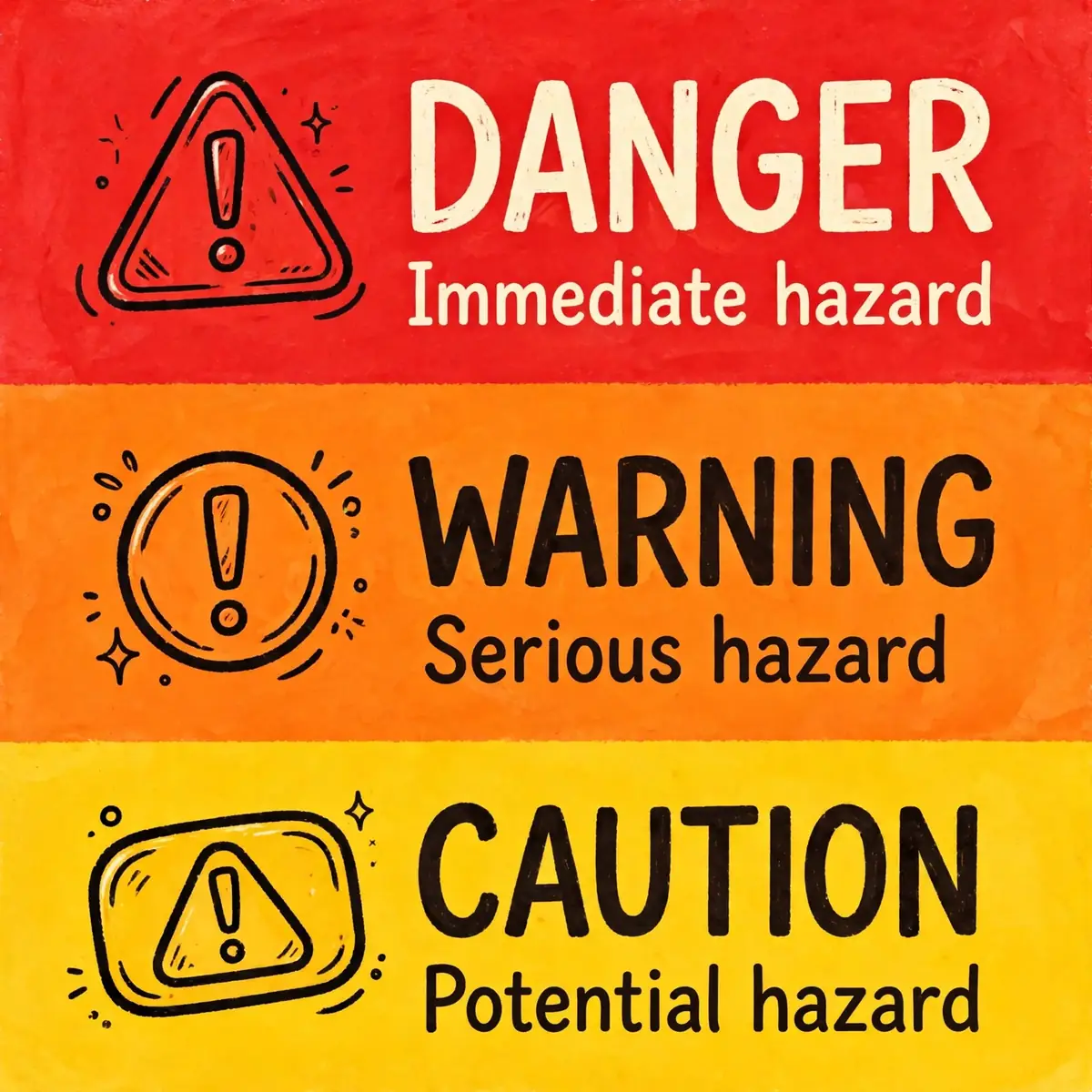
In the United States, OSHA construction signs are governed by the standard 29 CFR 1926.200, "Accident prevention signs and tags", in Subpart G of the construction standards. It sets out the sign types, their colours and their wording, and it incorporates the ANSI Z535.2 standard for the details. The rule covers danger signs, caution signs, exit signs, safety instruction signs, directional signs, traffic control signs and accident prevention tags.
| Signal word | Header colour | When it is used | Example |
|---|---|---|---|
| DANGER | Red upper panel, white lower panel | Only where an immediate hazard exists | High voltage, confined space |
| WARNING | Orange header, black text | A serious hazard that could cause death or serious injury | Overhead load, crane swing radius |
| CAUTION | Yellow, black upper panel | Only for potential hazards or unsafe practices | Slippery surface, low clearance |
The wording matters. A Danger sign may be used only where an immediate hazard exists, and its upper panel must be predominantly red with a black outline and a white lower panel for the extra wording. A Caution sign is used only to warn against potential hazards or unsafe practices, with yellow as the predominating colour and the word "caution" in yellow lettering on a black panel. The orange WARNING header comes from ANSI Z535.2, which OSHA incorporates by reference — it sits between DANGER and CAUTION in severity.
Other formats in the same rule are just as specific. Exit signs must use red letters at least 6 inches high on a white field, with the principal stroke at least three-quarters of an inch wide. Safety instruction signs are white with a green upper panel carrying white letters. Directional signs, other than automotive traffic signs, are white with a black panel and a white directional symbol.
The general rule behind all of them is simple: signs required by the subpart must be visible at all times when work is being performed, and removed or covered promptly when the hazards no longer exist.
AlertA Danger sign means the hazard is immediate. Do not enter the area or start the work until the hazard is controlled.
The UK system: the 1996 Regulations and ISO 7010
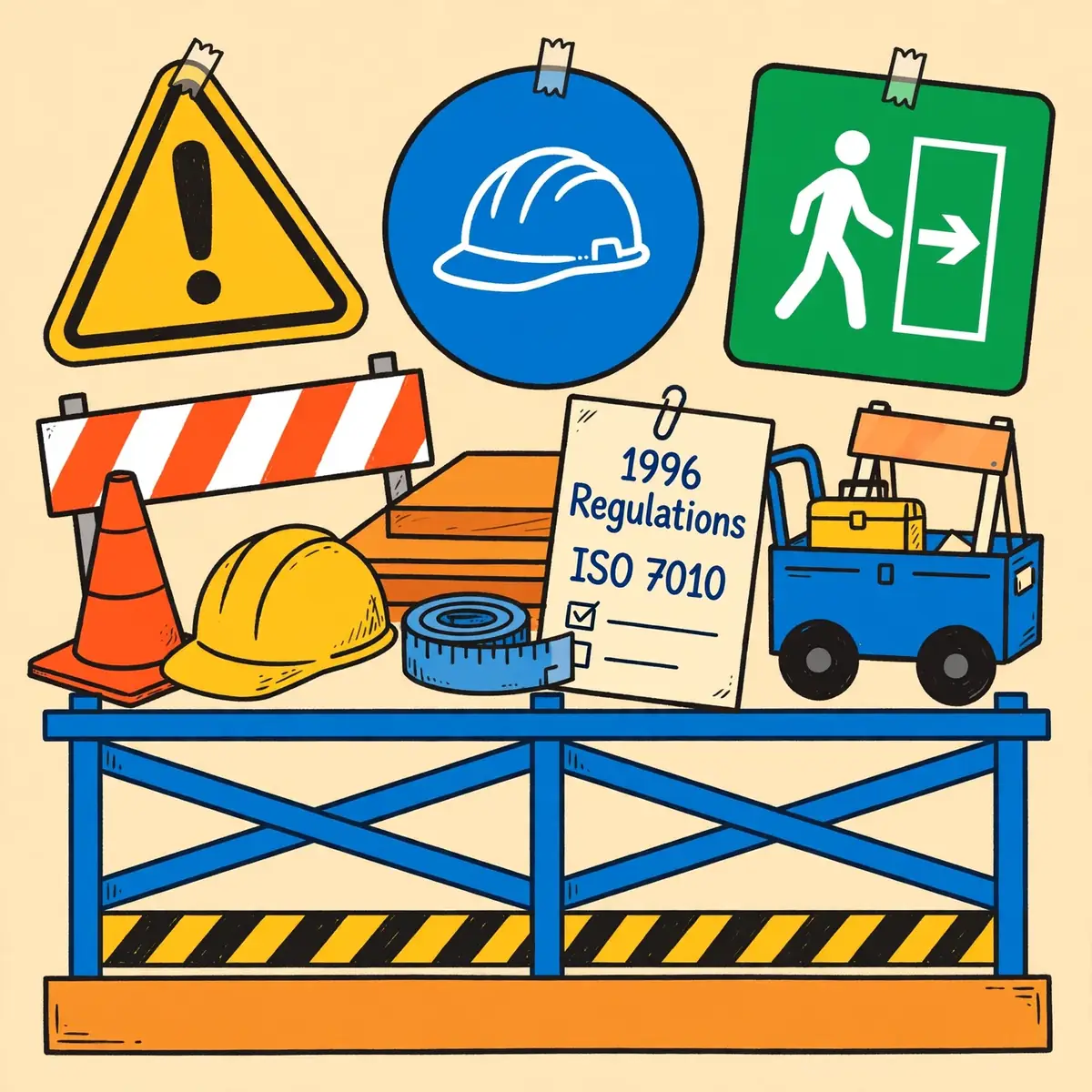
In Great Britain, the Health and Safety (Safety Signs and Signals) Regulations 1996 require employers to provide safety signs where a risk assessment shows a significant risk that cannot be avoided or adequately controlled by other means. The signs must follow the standard designs in BS EN ISO 7010 — the British adoption of ISO 7010. HSE guidance L64 explains how the Regulations apply in practice.
The British system is pictogram-first and uses no signal words. The same five families do the work: red circles forbid, blue circles order, yellow triangles warn, green squares guide to safety, and red squares mark fire equipment. A sign is only required where the risk remains after other controls, so a site with good guarding and isolation needs fewer signs than a site that relies on warnings alone.
On a construction project, the principal contractor sets the site rules and the induction under the Construction (Design and Management) Regulations 2015 (CDM 2015), and the signage plan is part of those rules.
The two systems describe the same hazards with different tools. A British site shows a yellow triangle with a lightning flash for high voltage; an American site shows a red DANGER header with the same words. A worker who moves between the two systems should learn both: the pictogram families for the UK and Europe, and the signal words for the United States. The shape and colour code is the same on both sides of the Atlantic for the five families — only the American headers add a layer of words.
Common construction signs and what each tells you to do
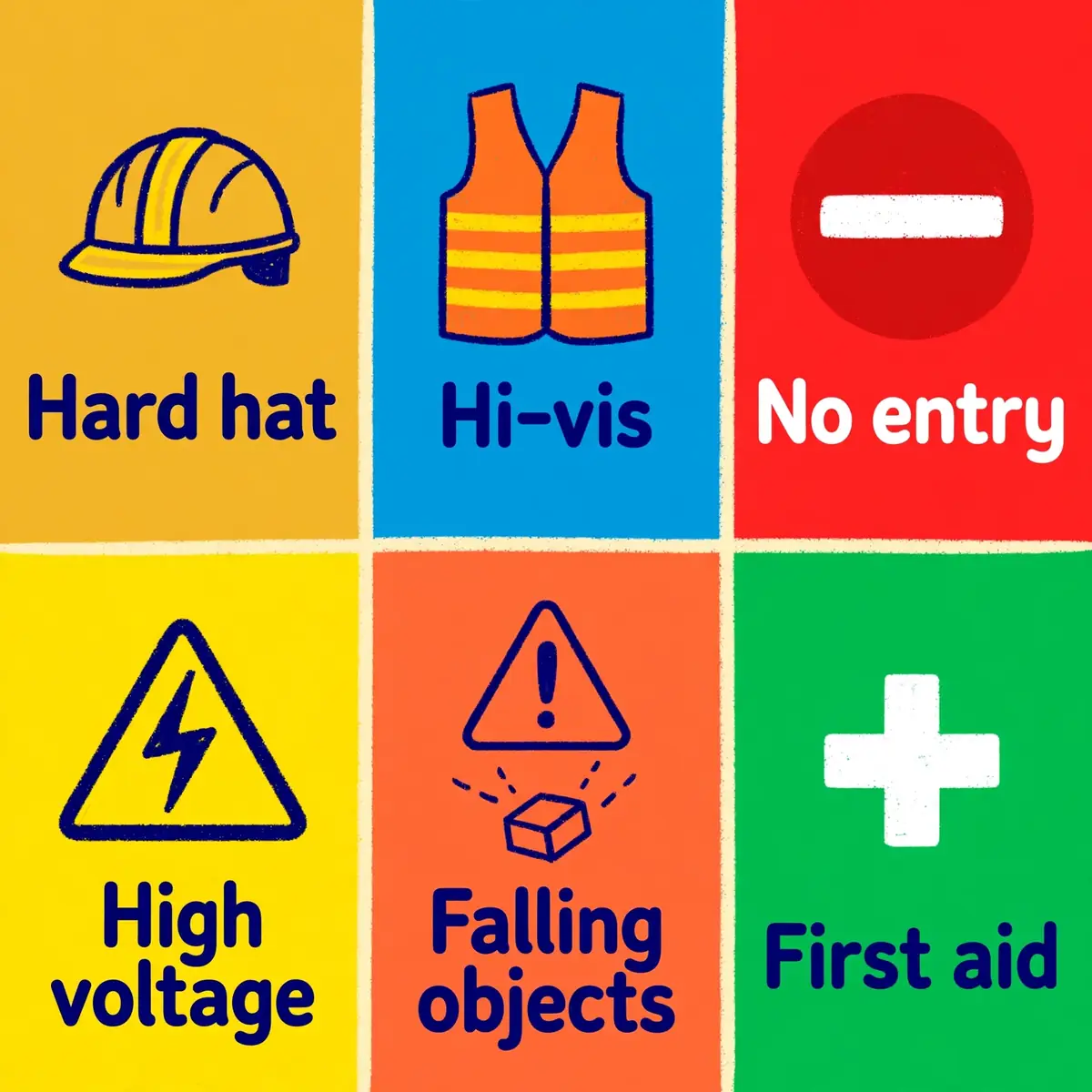
The signs below are the ones a worker meets most often on a building site. Each one names the action it expects. If a sign asks for equipment, put it on before entering the area. If it warns of a hazard, slow down and look for it before stepping forward.
| Sign | What it looks like | What to do |
|---|---|---|
| Hard hat required | Blue circle, white helmet | Put the helmet on before entering the area |
| High-visibility clothing required | Blue circle, white vest | Wear the vest so plant operators can see you |
| No entry | Red circle with a bar, walking figure | Do not pass; use the signed route instead |
| High voltage | Yellow triangle, lightning flash | Keep out; only authorised electricians enter |
| Falling objects | Yellow triangle, object dropping on a head | Wear a hard hat and stay out from under loads |
| Overhead load | Yellow triangle, suspended load | Keep clear of the crane swing radius |
| Fragile roof | Yellow triangle, person falling through a roof | Do not step on the roof; use crawl boards |
| Deep excavation | Yellow triangle, person falling into a trench | Keep back from the edge and use the barriers |
| First aid | Green square, white cross | Know where the kit is before you need it |
| Fire extinguisher | Red square, white extinguisher | Know the location and the class it suits |
| Scaffold incomplete — do not use | Red tag at the access point | Do not climb the scaffold until it is signed off |
Two signs deserve extra attention because they are easy to misread. A "scaffold incomplete" tag is not a suggestion: it means the scaffold has not been inspected and signed off, and climbing it puts you on an unproven structure. The signs for scaffolding signs explain the tag colours and what each one allows. And a "no entry" sign at a plant route is not about paperwork — it marks a route where a reversing dumper or a slewing excavator cannot see a person on foot.
Where signs go on a construction site
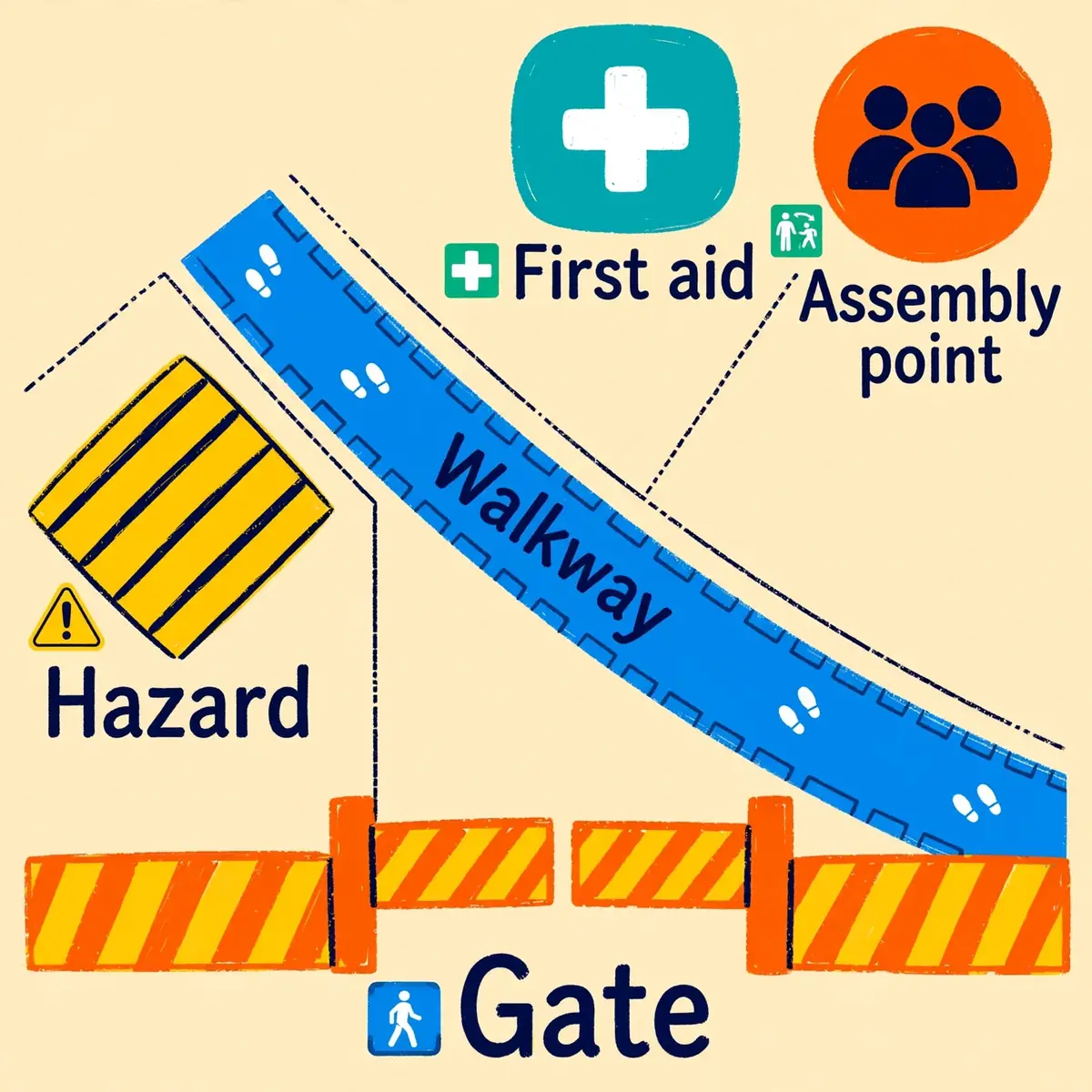
A sign works only if the reader can see it in time to act on it. That means placing it where the decision is made, not where it is convenient to hang it. The gate board goes at the entrance, where everyone entering reads the site rules and the minimum PPE. Hazard signs go immediately before the hazard, so the reader meets the warning before the risk. Route signs go where a route changes or crosses a plant route.
- At the gate: site rules, minimum PPE, induction requirement, and who to report to.
- At each hazard: the warning sign for that hazard, placed before the reader reaches it.
- On pedestrian and vehicle routes: walkway signs, speed limits, one-way routes and crossings.
- At welfare and emergency points: first aid, eyewash, fire points and the assembly point.
- At temporary hazards: a sign or a tag for the duration of the work, then removed.
Visibility is part of the rule, not a nice extra. Signs must be lit where work goes on after dark, kept clean, and never hidden behind stored materials, skips or parked plant. A sign must be large enough to read from the distance at which the reader needs to act — a hazard sign read from two metres away is no use if the hazard starts at ten. On a site with workers who speak different languages, pictograms carry the message and words add the detail; a sign that relies on words alone fails half the workforce.
TipStand where a new worker would stand and check that each sign can be read before the hazard is reached. If you have to step past the hazard to read it, the sign is in the wrong place.
Traffic control signs and flaggers
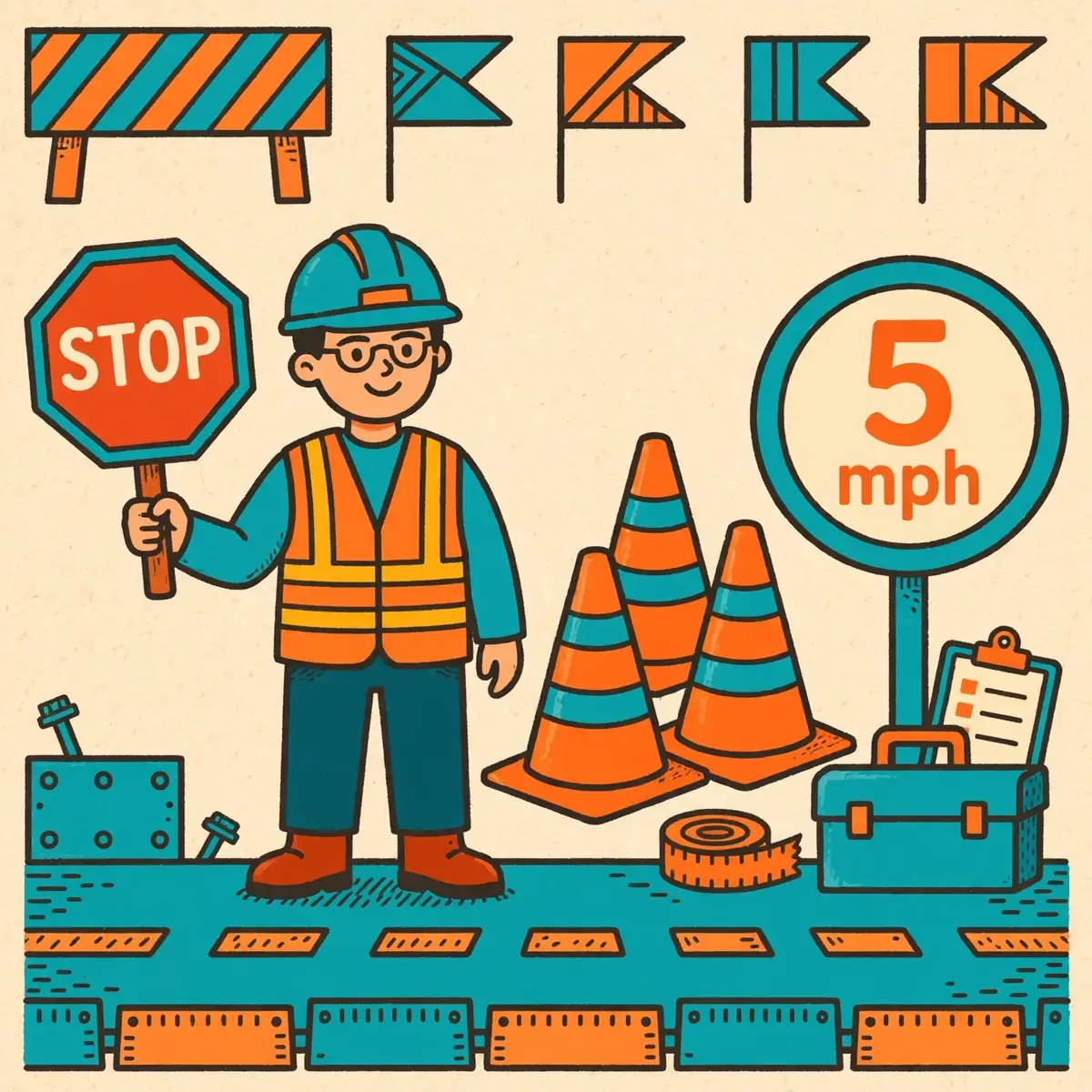
Where a site meets the public road, or where vehicles and pedestrians share the site, traffic control signs take over. Under OSHA 1926.200(g), construction areas must be posted with legible traffic control signs at points of hazard and protected by traffic control devices, and the design and use of those devices must conform to Part 6 of the Manual on Uniform Traffic Control Devices (MUTCD). The MUTCD sets the rules for work-zone signs, cones, barricades and channelizing devices.
Flaggers work under the same manual. OSHA 1926.201(a) requires that signalling by flaggers, and the use of flaggers including their warning garments, conform to Part 6 of the MUTCD. A flagger's hand signals, stop paddle and high-visibility clothing are part of the traffic control system, not an informal arrangement. Drivers and pedestrians must obey a flagger's signals in the same way they obey a fixed sign. Crane and hoist signals are different. Under 1926.201(b), they follow the applicable ANSI standards, not the MUTCD.
Inside the site, the traffic management plan sets the signs. Common ones are a site speed limit — many sites set 5, 10 or 15 miles per hour — one-way routes, stop or give-way points at internal junctions, marked pedestrian walkways separated from plant routes, and "no through road" where a route ends in a work area.
The plan also covers reversing. Large vehicles such as dump trucks and concrete mixers need a banksman where they reverse, and a "vehicles reversing" warning tells pedestrians to keep clear. Signs on the public road outside the site follow the national road-works signing rules, not the site plan.
Tags are not signs
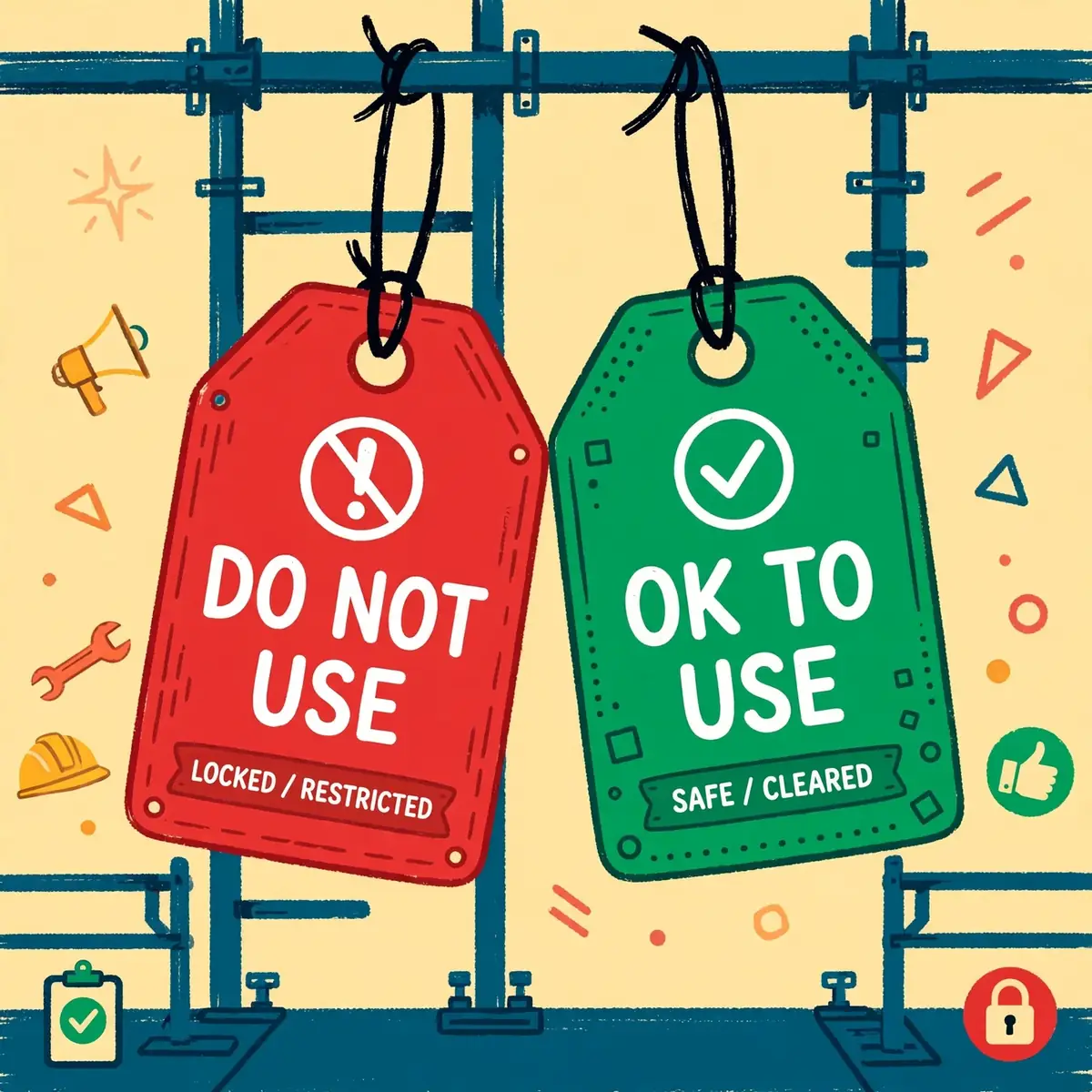
Accident prevention tags are a separate device from signs, and the distinction matters. Under OSHA 1926.200(h), tags are a temporary means of warning employees of an existing hazard, such as defective tools or equipment, and they must not be used in place of, or as a substitute for, accident prevention signs. A tag warns about a temporary condition. A sign warns about a hazard that is part of the site.
Scaffold tags are the most common example on a construction site. A tag at the access point states whether the scaffold is safe to use, incomplete, or out of service. The tag system is covered in the guide to scaffolding signs. The rule for any tag is the same: read it before you use the equipment, never remove someone else's tag, and report a tag that is missing or unreadable. A missing tag on a scaffold or a defective tool removes the only warning the next worker gets.
WarningNever remove a tag from defective equipment or a scaffold. The tag is the only warning between the next worker and the fault.
What to do when a sign is missing, damaged or wrong
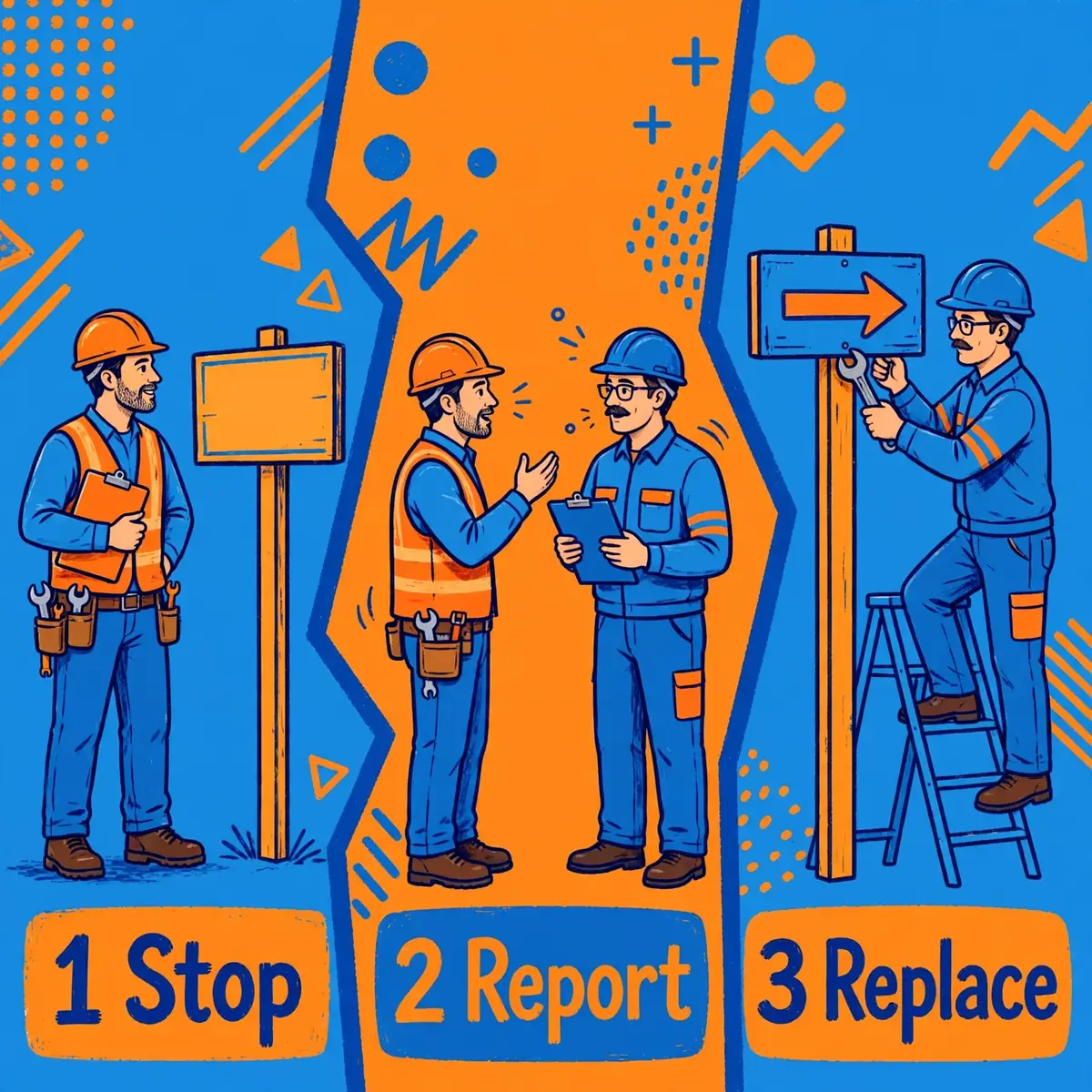
A missing sign is a hazard in itself: the next worker walks into a risk nobody warned them about. The response is the same whether you are a worker, a visitor or a supervisor — stop, report, and do not improvise.
- Stop before the hazard. If the sign is gone, treat the area as unsigned and do not enter it until someone confirms it is safe.
- Tell the supervisor or site manager. Say which sign is missing or damaged and where it was. A verbal report on the day beats a note filed at the end of the week.
- Do not make a handwritten sign. A marker-pen note is not a compliant sign. It fades, it falls off, and it does not carry the standard shape and colour other workers rely on.
- Record it. The supervisor logs the fault so the signage plan is updated and the replacement is checked.
- Check again after the fix. Confirm the replacement is the right sign, in the right place, and readable from where the reader must act.
Supervisors carry the other half of the duty. Signs must be inspected as part of the site walk, replaced when faded, damaged or obscured, and updated as the site changes — a new excavation, a new crane, a new storage area all need new signs. And the reverse rule is just as important: when a hazard is gone, the sign comes down the same day. A sign left up after its hazard is gone teaches workers to ignore signs, and the next real warning gets ignored with it.
AlertA sign left up after its hazard is gone teaches workers to ignore signs. Take it down the day the hazard goes.
Checklist: planning signage for a site
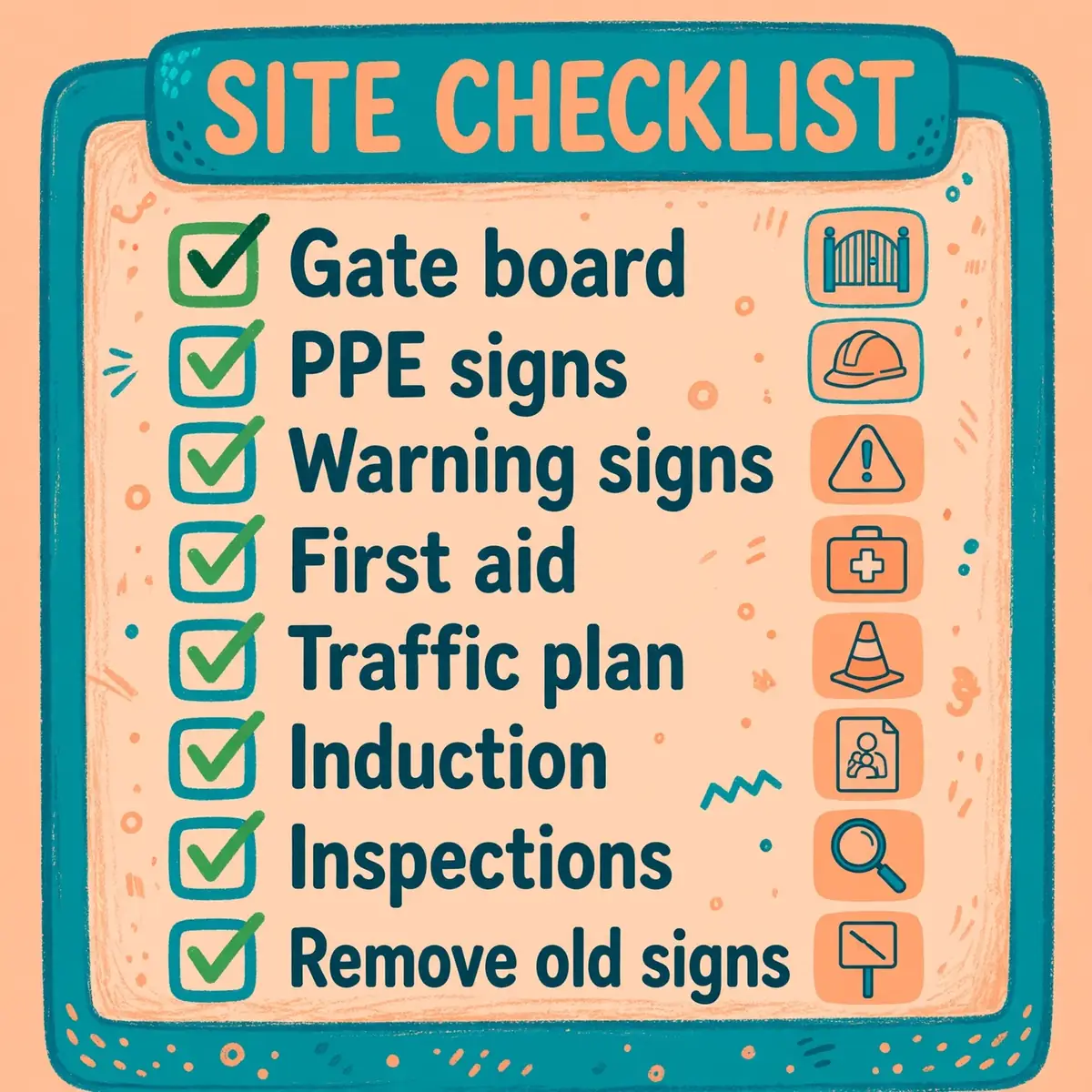
Plan signage with the risk assessment, before the first worker arrives. Construction safety planning starts with the risk assessment, and the signage plan is built from it. Walk the site on paper first, then walk it on foot and check every sign from the reader's position.
- Walk the site with the risk assessment and list every hazard that needs a sign, with its sign family.
- Put the gate board at the entrance: site rules, minimum PPE, induction requirement and emergency contacts.
- Place a mandatory PPE sign at every entry to a work area, not only at the main gate.
- Put each warning sign before its hazard, at eye level, where the reader can see it in time to act.
- Mark first aid, eyewash, fire points and the assembly point with green and red square signs.
- Write the traffic management plan: speed limits, one-way routes, walkways, crossings and reversing areas.
- Cover every sign in the site induction, and walk new starters past the first aid point and assembly point.
- Inspect signs on the regular site walk; replace faded, damaged or obscured signs at once.
- Remove or cover a sign the day its hazard is gone, and log the change in the signage plan.
- Check language needs: pictograms first, and words in the languages the workforce actually speaks.
Frequently Asked Questions
What is the difference between a Danger sign and a Caution sign?
Under OSHA 1926.200, a Danger sign is used only where an immediate hazard exists, and its upper panel is predominantly red. A Caution sign is used only to warn against potential hazards or unsafe practices, with yellow as the predominating colour. DANGER means the hazard will cause death or serious injury if it is not avoided; CAUTION means it may cause minor or moderate injury.
What do the five colours of construction signs mean?
Red forbids an action or marks fire equipment, blue orders an action or a piece of equipment, yellow warns of a hazard, and green points to safety equipment and escape routes. In the United States, orange is added for WARNING, the signal word between DANGER and CAUTION. The shape matters as much as the colour: a red circle forbids, while a red square marks fire equipment.
Are construction signs a legal requirement?
Yes, in both systems covered here. In the United States, OSHA 29 CFR 1926.200 requires accident prevention signs and tags on construction sites. In Great Britain, the Health and Safety (Safety Signs and Signals) Regulations 1996 require signs where a risk assessment shows a significant risk that other controls cannot remove. The duty is to provide the right signs, not to sign everything.
What should I do if a construction sign is damaged or missing?
Stop before the hazard, tell the supervisor or site manager which sign is missing and where it was, and do not make a handwritten replacement. The supervisor replaces the sign with a compliant one and logs the change. A missing sign is a hazard itself, because the next worker gets no warning.
What is the difference between a sign and a tag?
A sign is a fixed warning about a hazard that is part of the site, such as high voltage or falling objects. A tag is a temporary warning about a condition, such as a defective tool or a scaffold that has not been signed off. Under OSHA 1926.200(h), tags must never be used in place of signs.
Do visitors need to follow construction signs?
Yes. Signs apply to everyone on site — workers, visitors, delivery drivers and the public at the boundary. Visitors must follow the gate board, wear the PPE the mandatory signs require, and stay on the signed routes. The site induction covers visitors as well as workers.
Who is responsible for signs on a construction site?
The employer or principal contractor is responsible for providing the signs the risk assessment calls for, and for keeping them visible, accurate and up to date. Supervisors and competent persons check them on site walks. Every worker shares the duty to report a missing, damaged or wrong sign instead of walking past it.
Sources
- OSHA — 29 CFR 1926.200, Accident prevention signs and tags (eCFR)
- OSHA — 29 CFR 1926.201, Signaling (eCFR)
- HSE — L64, Safety signs and signals: Guidance on Regulations
- The Health and Safety (Safety Signs and Signals) Regulations 1996 (SI 1996/341)
- The Construction (Design and Management) Regulations 2015 (SI 2015/51)
- ISO 7010:2019 — Graphical symbols: Safety colours and safety signs, Registered safety signs
- WorkSafe ACT — Signage (AS 1319:1994)
- FHWA — Manual on Uniform Traffic Control Devices, Part 6, Temporary Traffic Control
- eSigns — Understanding OSHA Construction Safety Signs
- MySafetySign — What Are Standard Construction Site Safety Signs?