An environmental management framework is the documented set of policy, processes, responsibilities and controls an organisation uses to manage its environmental impacts and meet its legal duties. It starts with a policy and a list of the organisation's environmental aspects, then sets objectives, puts controls in place, measures results and reviews the whole system. The most widely used reference for building one is ISO 14001, and the current edition is ISO 14001:2026, published on 15 April 2026.
A framework is not a certificate and not a pile of procedures. It is a working loop: plan what matters, do what was planned, check whether it worked, and act on what was found. Small organisations can build a working version in weeks, not years, if they start from their real impacts instead of a template. The steps below follow that loop, with a worked example for a small manufacturer at the end.
What is an environmental management framework?
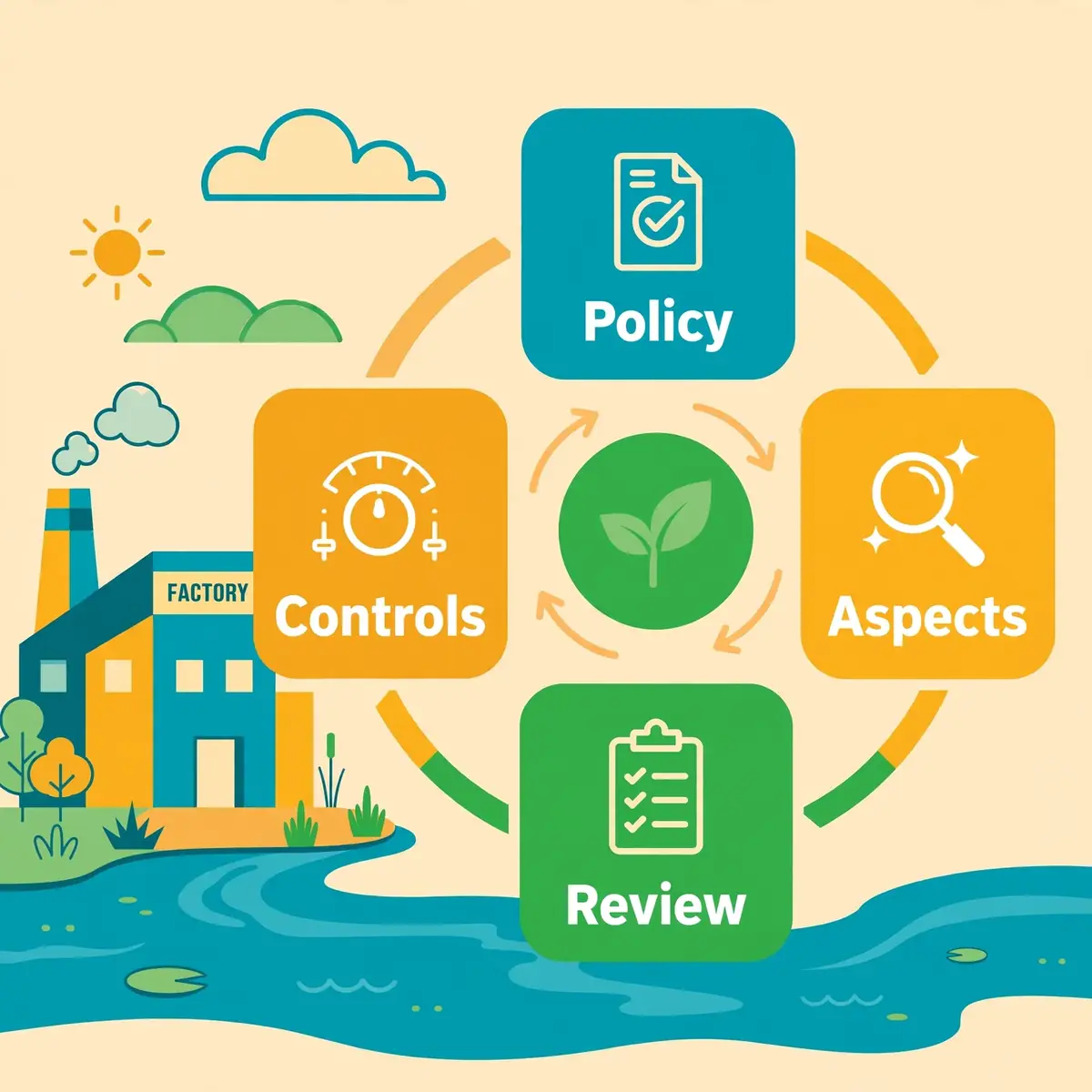
An environmental management framework is the structure an organisation uses to understand how its activities, products and services interact with the environment. It then manages those interactions in a planned way. It covers the same ground as an environmental management system (EMS). The two terms are used almost interchangeably, and ISO 14001 calls the result an environmental management system. A framework is the plan for that system: the policy, the registers, the roles, the controls and the review cycle that hold it together.
The framework exists to do three jobs. First, it finds the organisation's environmental impacts and ranks them, so effort goes to what matters most. Second, it keeps the organisation inside the law, by tracking every legal duty and checking compliance on a schedule. Third, it drives improvement, by setting targets, measuring results and fixing what falls short. Without the third job, the framework is only a compliance file.
Framework, system and certificate are three different things
People use these three terms as if they meant the same thing, and the confusion causes real problems in tenders and audits. The framework is the design: the policy, the registers and the process map. The system is the framework running in daily work: people following procedures, records being kept, checks being done. The certificate is an independent statement that the system meets ISO 14001. An organisation can have a framework without a system, and a system without a certificate.
That distinction matters because a certificate is not proof of good environmental performance. ISO 14001 certifies the management system, not a level of performance. The standard sets no emissions cap, no waste diversion rate and no energy target. It requires the organisation to identify what matters, commit to its compliance duties and continual improvement, set its own objectives and prove it is managing against them. A certified organisation can still have a poor environmental record if its own targets are weak.
What the framework covers
A complete framework covers every way the organisation touches the environment. That includes energy and water use, raw materials, waste, wastewater, air emissions, noise, land use and biodiversity, and the environmental effects of products across their life cycle. It also covers abnormal situations: spills, leaks, fires, power failures and any other event that could release a pollutant. The 2026 edition of ISO 14001 adds climate change, biodiversity, resource availability and ecosystem health to the context an organisation must consider.
The scope is a decision, not an accident. A framework can cover one site, several sites or the whole organisation, and it can include or exclude particular activities. Whatever the scope, it must be written down and explained. Auditors, customers and regulators all start by asking what the framework covers and what it leaves out. A vague scope is the first sign of a system that was built for the shelf.
Who needs one
No single law in the United States or the United Kingdom requires most organisations to have an environmental management framework. The duties that sit underneath it are legal, though: permits, waste rules, discharge limits and reporting duties all apply whether or not a framework exists. The framework is the tool that keeps those duties under control. Many organisations build one because a customer, a tender or a parent company asks for it. Certification to ISO 14001 is often the proof they are asked to show.
Small organisations need the same elements as large ones, in proportion to their risks. A ten-person workshop does not need the system a chemical plant needs. It still needs someone accountable, its aspects identified, its legal duties listed, its workers trained and its performance checked. The United States Environmental Protection Agency (EPA) describes an EMS as a tool that helps an organisation address its regulatory requirements "in a systematic and cost-effective manner". Its implementation guide was written for small and medium-sized organisations.
Environmental safety sits alongside occupational safety and health in the wider EHS discipline, and the same management-system thinking applies to all three.
TipStart from the organisation's real impacts, not from a template. A framework copied from another company answers another company's questions.
Environmental management framework vs ISO 14001 vs EMAS
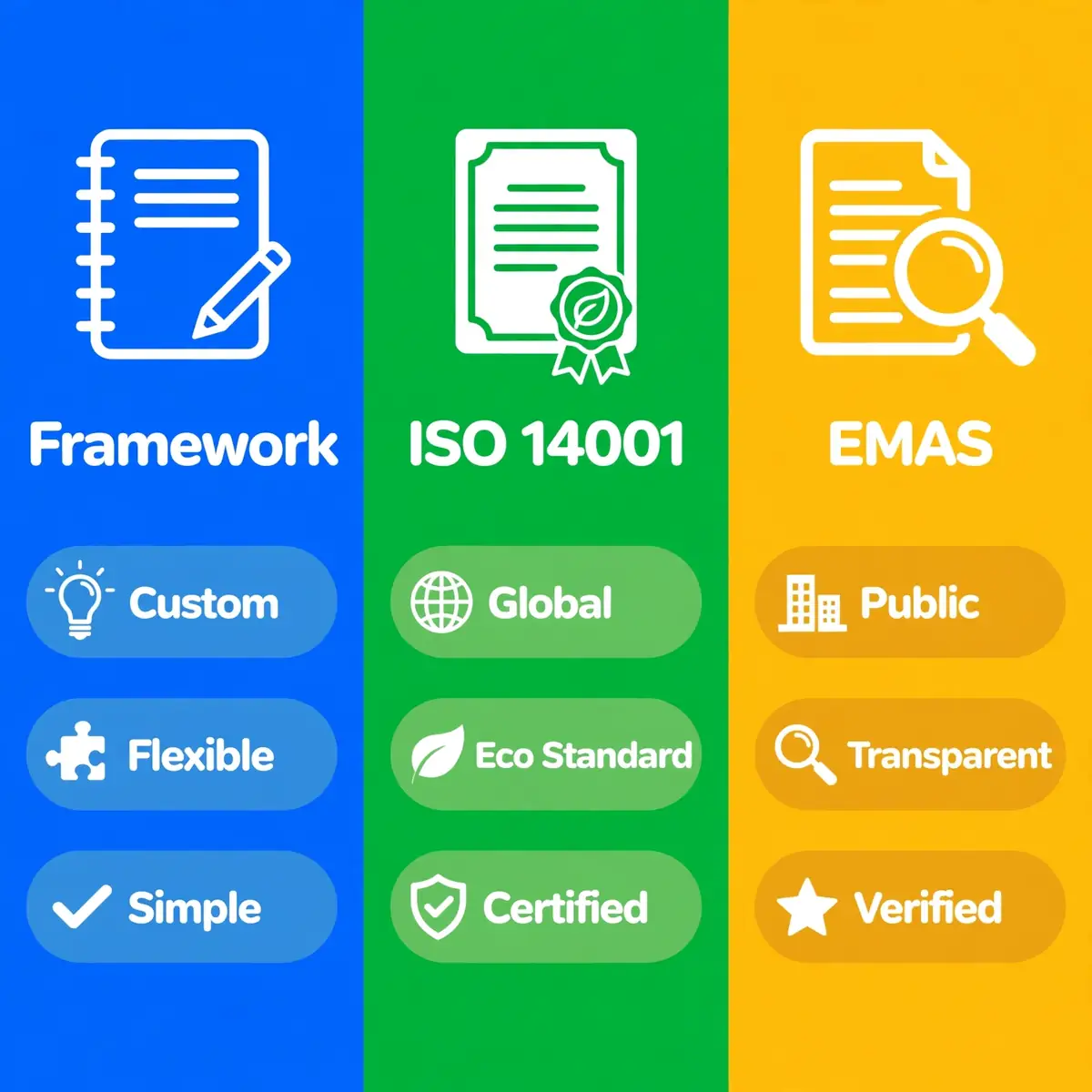
Three options face any organisation that wants to manage its environmental performance. It can build its own framework, follow ISO 14001, or join the European Union's Eco-Management and Audit Scheme (EMAS). They are not rivals. They are rungs on the same ladder, and each adds something the one below does not. The choice depends on who will check the work and what proof they expect to see.
A home-grown framework follows the same Plan-Do-Check-Act shape as ISO 14001 but answers to nobody outside the organisation. It suits a business that wants better control and lower costs without paying for audits or a certificate. ISO 14001 adds an internationally recognised set of requirements and the option of third-party certification. EMAS adds public reporting and verified legal compliance on top of ISO 14001, and it is the most demanding of the three.
| Feature | Home-grown framework | ISO 14001:2026 | EMAS |
|---|---|---|---|
| Requirements | Organisation's own choice | Clauses 4 to 10 of the standard | ISO 14001 plus extra EMAS rules |
| Certification or registration | None | Optional third-party certificate | Registration after verification |
| Public reporting | Optional | Not required | Validated environmental statement, published |
| Legal compliance | Self-checked | Evaluated by the organisation | Proven to the verifier |
| Employee involvement | Organisation's choice | Expected through awareness and competence | Required |
| Where it applies | Anywhere | Worldwide | Any organisation, in or outside the EU |
ISO 14001: the reference standard
The ISO 14001 environmental management system standard is published by the International Organization for Standardization (ISO). The current edition, ISO 14001:2026, was published on 15 April 2026 and replaces the 2015 edition. More than 670,000 organisations worldwide hold ISO 14001 certification, according to the ISO Survey 2024. The standard is organised in seven requirement clauses, numbered 4 to 10: context, leadership, planning, support, operation, performance evaluation and improvement. The same structure is used by ISO 9001 and ISO 45001, which is why the three combine into one integrated system.
The 2026 edition does not reinvent the standard. It sharpens it. Guidance is clearer and the environmental conditions to consider are broader. The life cycle perspective is stronger, and a new requirement asks organisations to plan changes before they are made. Organisations already certified to the 2015 edition have a three-year transition period ending in April 2029. For most of them the change is evolutionary, starting with a gap analysis against the new edition and a transition roadmap.
EMAS: ISO 14001 plus public proof
EMAS is the European Union's voluntary eco-management and audit scheme, established by Regulation (EC) No 1221/2009. It takes the ISO 14001 management system as its core and adds requirements ISO 14001 does not have. They are proof of legal compliance, employee involvement, and a published environmental statement validated by an accredited verifier. Registration is with the Competent Body in the organisation's country, and the validated statement is made publicly available. Organisations that run safety, health and environment together in one system can read the SHEMS guide alongside this framework.
EMAS registration follows a fixed sequence. It starts with an environmental review, then an environmental management system in line with ISO 14001. Internal audits and a management review follow, then an environmental statement. Verification by an accredited or licensed verifier comes next, and registration closes the sequence. The European Commission's user's guide gives an indicative schedule of about ten months for a first registration. The time varies with the size of the organisation and the country. An organisation that wants the strongest public signal chooses EMAS; one that wants international recognition with less public reporting chooses ISO 14001.
Which one to choose
Choose the home-grown framework when the goal is internal control and cost saving, and no customer or regulator is asking for proof. Choose ISO 14001 when customers, tenders or a parent company ask for a recognised certificate, or when the organisation operates in more than one country. Choose EMAS when the organisation wants to publish verified environmental performance and demonstrate legal compliance in public, usually in the EU or for EU-facing stakeholders.
The choice is not permanent. Many organisations start with a home-grown framework, shape it to ISO 14001, and certify when a customer asks. Others run ISO 14001 for years and add EMAS registration for one flagship site. What matters is that the framework underneath is real. A certificate on top of a framework nobody uses is worse than no certificate at all. It teaches everyone in the organisation that the system is a performance.
AlertNever buy a certificate without building the system first. Auditors test whether procedures are followed on the ground, not whether the manual reads well.
How the framework works: Plan-Do-Check-Act
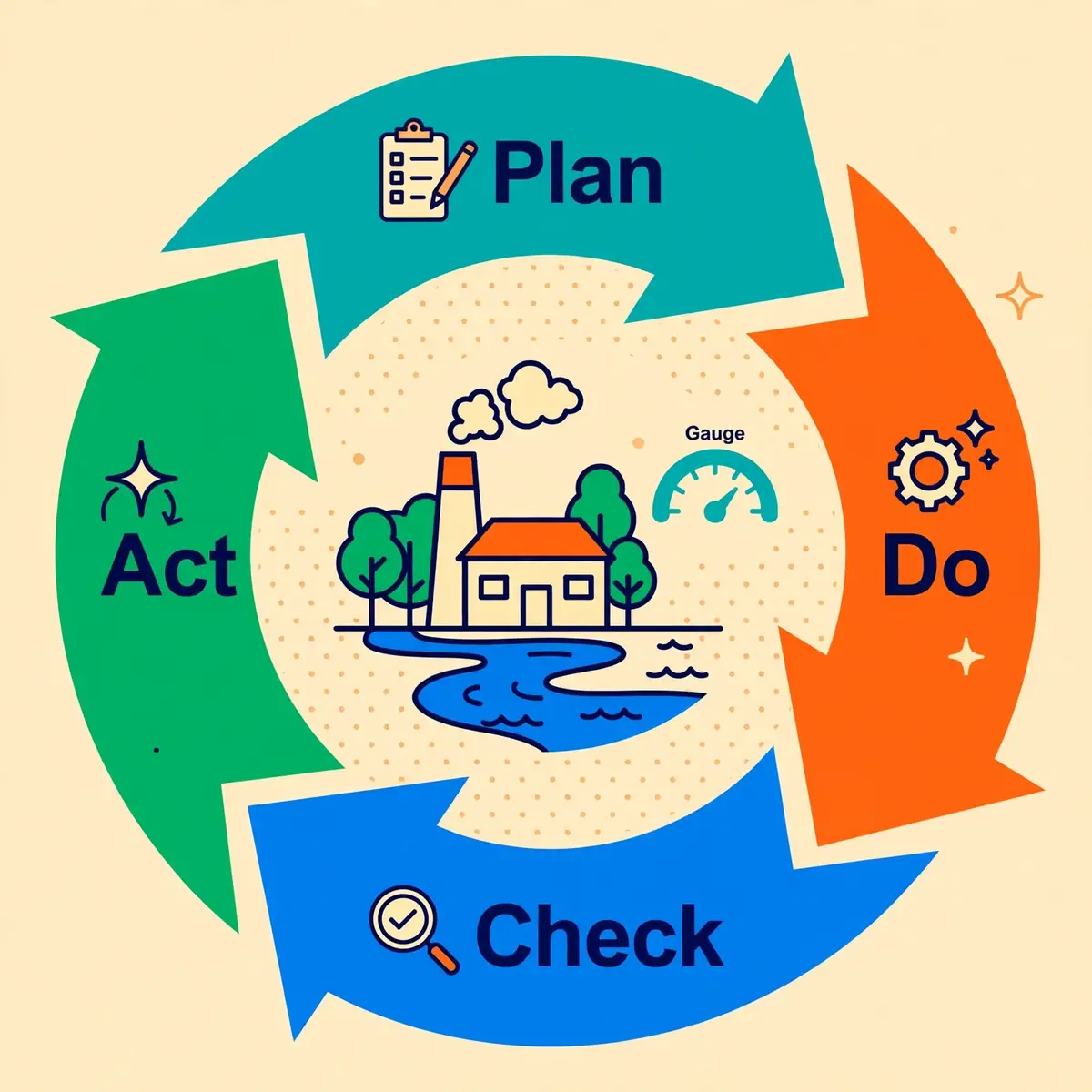
Every environmental management framework runs on the Plan-Do-Check-Act cycle, usually shortened to PDCA. Plan means working out what matters, what the law requires and what the organisation will achieve. Do means putting the controls, training and procedures in place. Check means measuring performance, auditing the system and evaluating compliance. Act means fixing what fell short and improving the system. The cycle then repeats, so the framework improves instead of standing still.
PDCA is not a project with an end date. It is the operating rhythm of the framework, and it is the same cycle that underpins ISO 9001 and ISO 45001. That shared structure is one reason organisations combine their quality, safety and environmental systems into one integrated system. The environmental part of the cycle is what changes: the subject matter is aspects, compliance duties and environmental performance, threaded through every phase.
Plan: work out what matters
Planning starts with context: the internal and external issues that affect what the organisation does and what its framework is meant to deliver. The 2026 edition of ISO 14001 names five environmental conditions to consider here: climate change, pollution, the availability of natural resources, biodiversity and the health of ecosystems. Planning also covers interested parties — regulators, customers, neighbours, employees — and the expectations the organisation adopts as compliance duties.
The planning phase produces the framework's core documents: the scope, the environmental policy, the aspects register, the legal register, and the objectives, targets and programmes. Each of these is covered as a step below. Nothing in the Do phase should start before the Plan phase has named what is significant. Controls built before the aspects are known will control the wrong things.
Do: put controls and training in place
Doing means turning plans into daily work. Operational controls are set for the significant aspects: procedures, work instructions, equipment settings and checks that keep impacts within the limits the organisation set. People are trained to the level their role needs, documents are controlled so everyone works from the current version. Communication runs both ways — inside the organisation and with the outside world.
Emergency preparedness belongs in the Do phase too. The organisation identifies the emergencies that could release a pollutant, writes response procedures, trains the people who will respond, and tests the plans. A framework that only covers normal operations is incomplete, because the worst environmental damage usually comes from the abnormal day, not the ordinary one.
Check: measure, audit and evaluate compliance
Checking has three parts, and they are not interchangeable. Monitoring and measurement track performance against objectives: energy per unit of output, waste to landfill, water use, emissions against permit limits. Internal audit tests whether the system itself works as intended: are procedures followed, are records kept, are duties met? Compliance evaluation is a separate, periodic check that the organisation is meeting its legal duties, and it is the part auditors look at most closely.
Each part needs its own records. Monitoring produces data, audits produce findings, and compliance evaluation produces a dated judgement with evidence. Without records, the Check phase is an opinion, and an opinion does not survive an audit or a regulator's questions.
Act: correct, improve and review
Acting starts with nonconformance: anything that went wrong, or that could have gone wrong, is recorded, its cause is found, and corrective action stops it happening again. The distinction matters. Fixing the spill is correction; finding why the bund failed and changing the inspection routine is corrective action. One cleans up, the other prevents the next one.
Top management then reviews the whole system at planned intervals, looking at audit results, compliance status, objectives, incidents and the views of interested parties. The review decides what changes: new objectives, new resources, new controls, or a change to the policy itself. That decision closes the loop, and the next Plan phase starts from what the review found.
Step 1: Commit, scope and assign owners
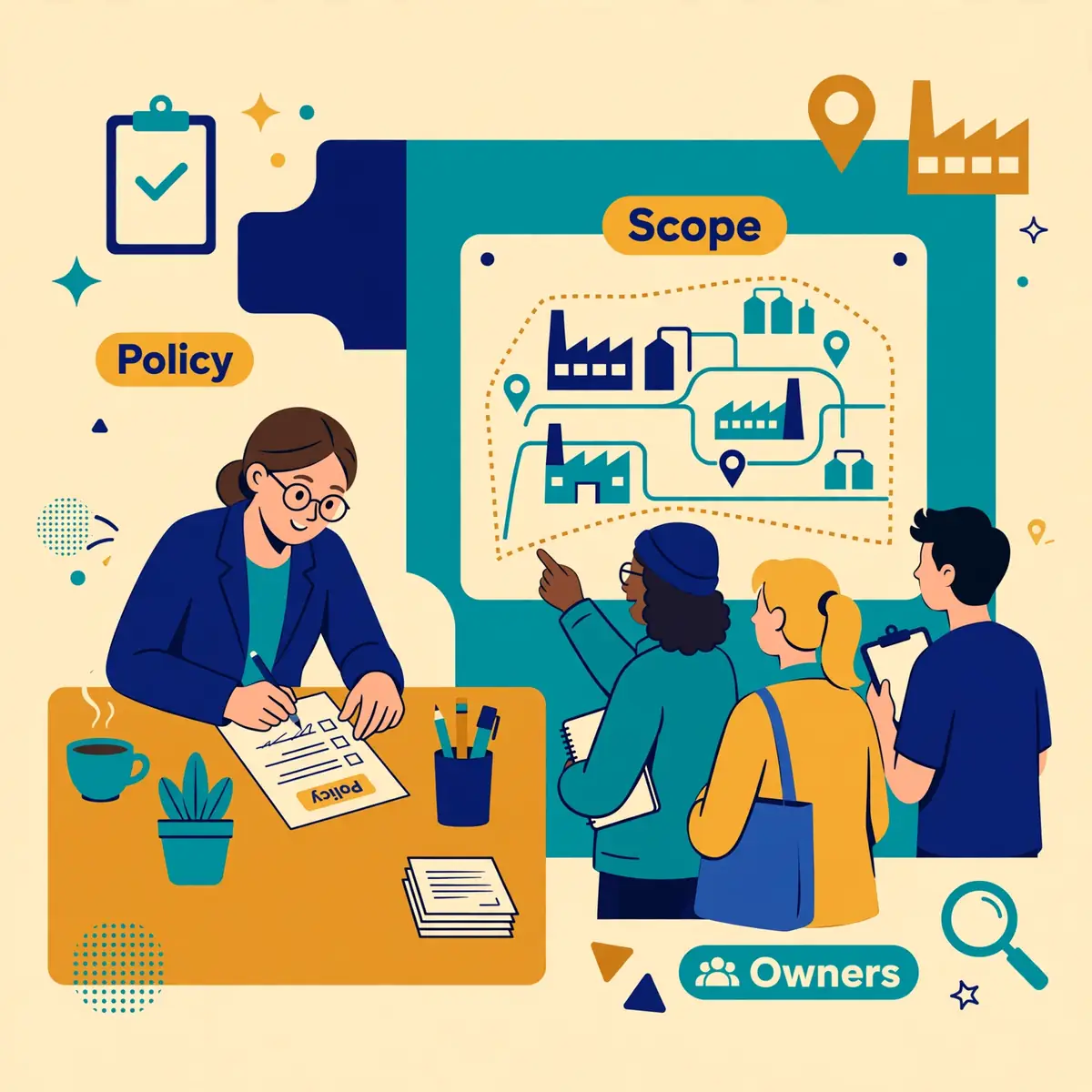
Every framework that works starts with a visible commitment from top management. ISO 14001 puts leadership in its own clause for a reason. The standard makes top management personally accountable for the effectiveness of the system. It also requires them to set the environmental policy and assign roles. A framework launched by one enthusiastic employee, without management backing, stalls at the first request for money, time or a change to how work is done. The same leadership point applies to a safety management system, and the two systems share the same structure.
Commitment has to be visible in decisions, not only in words. Management shows it by approving the scope, naming the people who own each part, giving them time and budget, and attending the management review. If the first management review is cancelled for a production meeting, the organisation has learned what the framework is worth. Get the commitment in writing before building anything else. The eight steps that follow explain how to build an environmental management system from the first commitment to the first management review.
Get top management to own it
Start with a short proposal, not a manual. Set out the organisation's main environmental risks, the legal duties it already carries, the cost of the last incident or fine. What customers or tenders are asking for. Ask for three decisions: the scope, the person who will lead the build, and the budget and time they can have. Record those decisions in a minute or a short memo, and keep it with the framework's records.
The leader of the build does not need to be an environmental specialist, but they need authority and access. They must be able to call a meeting with production, maintenance and purchasing, and to get answers from them. In a small organisation this is often the owner or the operations manager. In a larger one it is usually a dedicated environment manager or the safety, health and environment lead, reporting directly to a director.
Draw the boundary
Scope is the written statement of what the framework covers: which sites, which activities, which products and services. A single-site manufacturer might cover the whole site and its delivery fleet. A multi-site company might start with one site and add the others over two years. A service company might cover its offices, its vehicle fleet and its suppliers' packaging. Whatever the choice, the scope must be documented, and it must consider the life cycle of the organisation's products and services.
The life cycle perspective is one of the points the 2026 edition strengthens. It asks the organisation to consider the environmental aspects of its products and services across their life cycle. That means from raw materials, through use, to end of life. The life cycle view applies when defining the scope and when identifying aspects. A manufacturer that only looks at its own factory walls will miss the packaging its customers throw away and the energy its products consume in use.
Name the roles
Every part of the framework needs a named owner who knows they own it. Name a framework leader, an aspects and legal register owner, and a person for each significant aspect. Add an internal auditor and the management review chair. In a small organisation one person may hold several of these roles, but the roles must still be named and the responsibilities written down.
Responsibility without authority is the most common reason a framework fails. The person who owns waste must be able to change the waste contract. The person who owns energy must be able to question a machine left running overnight. Give each owner the authority to match the job, and make the roles part of job descriptions or a responsibility matrix, not a note in a meeting.
WarningDo not let the framework become one person's hobby. If only the environment lead knows how it works, it stops working the week they go on holiday.
Step 2: Map environmental aspects and impacts
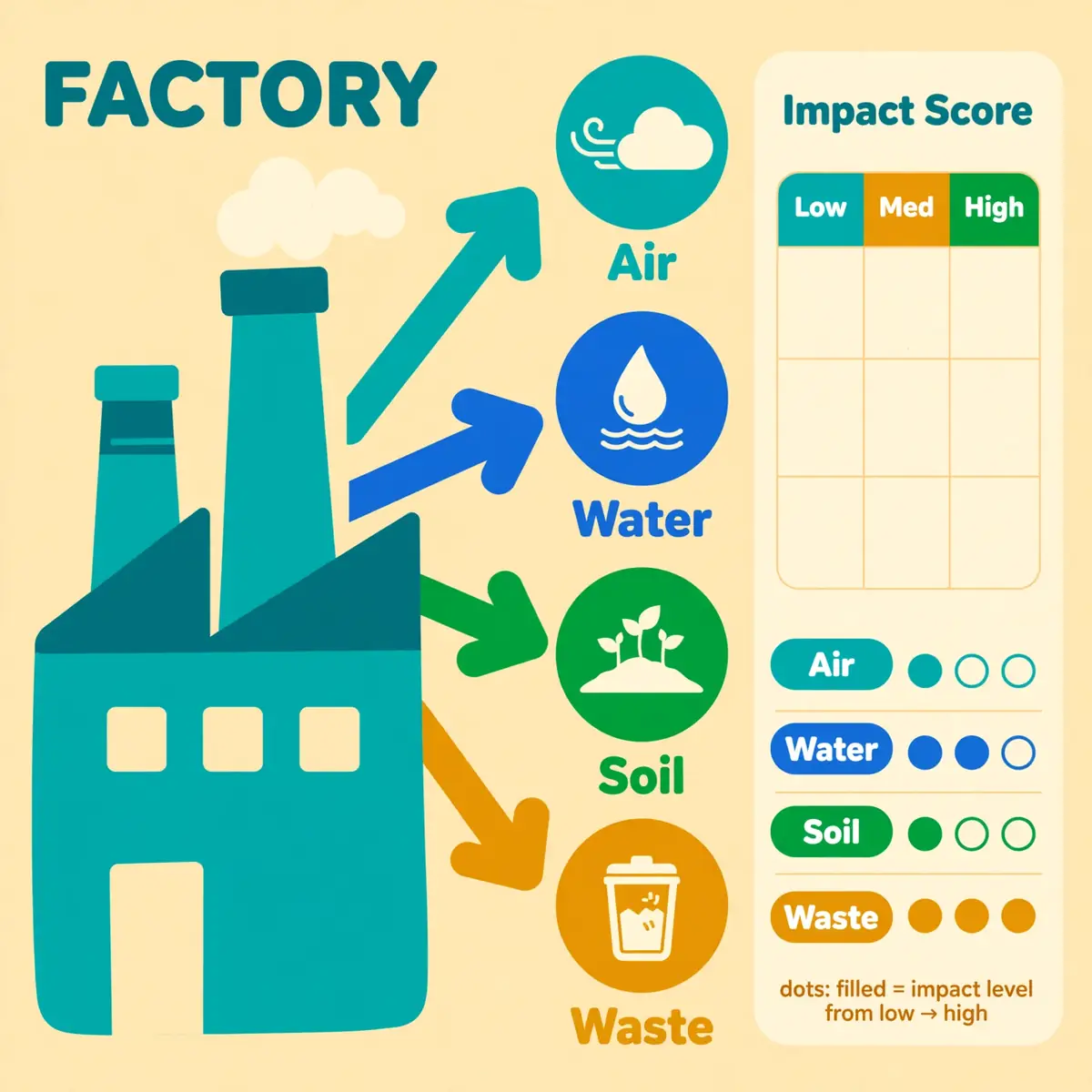
An environmental aspect is any part of an organisation's activities, products or services that interacts with the environment. An impact is the change that interaction causes. Burning gas in a boiler is an aspect; the carbon dioxide it releases is an impact. Discharging wash water is an aspect; the load on the local river is an impact. The framework is built on this distinction, because it is the aspects the organisation can control and the impacts it must judge.
Mapping aspects is the most important step in the whole build. Everything downstream — objectives, controls, monitoring, audits — flows from the aspects register. A register that misses the biggest impact will produce a framework that polishes the small things and ignores the large ones. Spend more time here than on any other step.
List every interaction
Walk the site with a notebook and list every interaction with the environment, activity by activity. Cover normal operations, start-up and shut-down, maintenance, cleaning, storage, transport, and the products themselves in use and at end of life. Include the obvious — energy, water, waste and emissions — as well as the easy ones to miss. The easy ones to miss include leaking refrigerants, wash water from vehicle cleaning, and dust from cutting. Also look for noise at the boundary, packaging from suppliers, and chemicals stored in the back of the workshop.
Use more than one method to build the list. A site walk finds what is visible. Talking to operators finds what happens on the night shift. Looking at purchase records finds what is consumed. Looking at waste transfer notes finds what leaves the site. Looking at permits and past incidents finds what the regulator already knows about. A register built from one method alone will have holes.
Score significance
Not every aspect matters equally, and the framework must say which ones do. Score each aspect against a few clear criteria, and write the criteria down so the scoring can be repeated. Common criteria are the scale of the impact, its severity, how often it happens, whether the law regulates it, and whether interested parties care about it. Any aspect that breaches the law, or that the law regulates through a permit, is significant by definition. The scoring works the same way as a risk assessment: likelihood and severity combined into a judgement about what to act on first.
Keep the scoring simple enough to defend. A three-point scale for each criterion, multiplied or added to a total, is enough for most organisations. The exact arithmetic matters less than consistency: the same aspect scored by two people should land in the same band. Record the score and the reasoning next to each aspect, because an auditor will ask why one aspect is significant and another is not.
| Aspect | Impact | Scale | Severity | Frequency | Legal duty | Significant? |
|---|---|---|---|---|---|---|
| Paint solvent emissions | Air pollution, odour | 3 | 3 | 3 | Yes — permit | Yes |
| Electricity use | Carbon emissions, cost | 3 | 2 | 3 | No | Yes |
| Metal offcuts | Resource use, landfill | 2 | 1 | 3 | No | No |
| Compressor oil leaks | Soil and water contamination | 1 | 3 | 1 | Yes — duty of care | Yes |
| Office paper | Resource use | 1 | 1 | 3 | No | No |
The table shows how scoring works in practice. Paint solvents score high on every count and carry a permit, so they are significant. Electricity is significant on scale and frequency even without a legal duty. Metal offcuts and office paper are real aspects, but they are not significant, so they get routine controls rather than objectives. Compressor oil leaks are small in scale and rare, but severe and legally regulated, so they are significant too.
Keep the register alive
An aspects register is a living document, not a one-off exercise. Review it after a new product, a new machine, a new material or a new supplier. Also review it after a change in the law, or an incident that reveals an aspect nobody listed. The 2026 edition adds a new requirement to plan changes before they are made, and the aspects register is where that planning starts.
Review the register at least once a year, and always after an incident or a near miss. Ask the same question each time. What has changed since the last review? Does any change create a new aspect, or change the significance of an old one? A register that has not changed in two years is probably not being used, because no organisation stands still for two years.
Step 3: Build the legal register
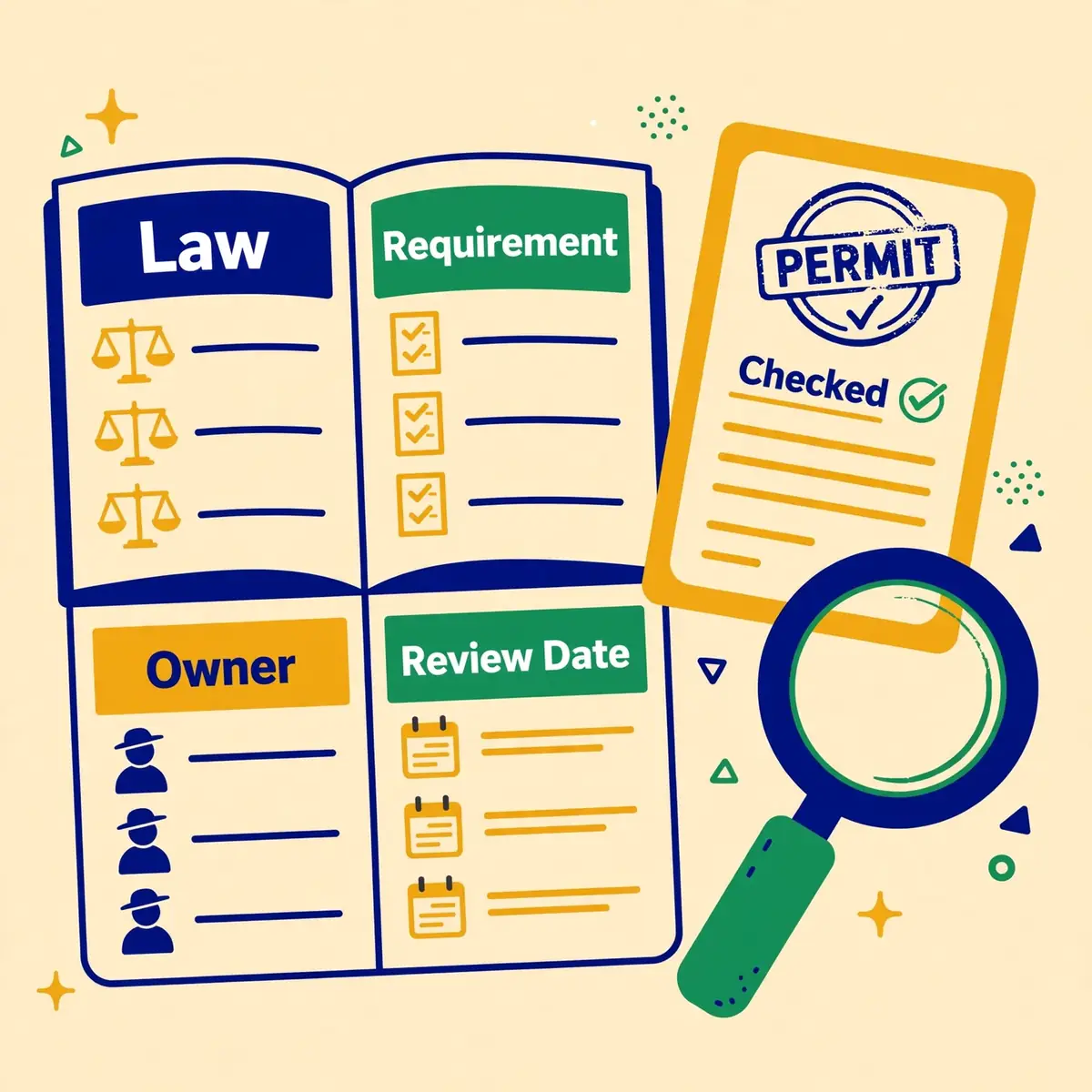
The legal register lists every environmental law, regulation, permit, consent and other requirement that applies to the organisation. For each one it records what is demanded, who checks it, and when it was last checked. It is the backbone of the framework. Without it, compliance is a matter of memory and luck. With it, the organisation can show a regulator or an auditor exactly which duties apply and how each one is met.
Compliance obligations include more than the law. They include permits and their conditions, planning conditions, customer requirements the organisation has accepted, industry codes it has signed up to, and voluntary commitments it has published. The 2026 edition reinforces the management of legal and other applicable requirements, and auditors treat the legal register as the first place to look. Build it carefully.
What goes in the register
Each entry needs the same fields. Record the requirement and its source, and what it demands in plain words. Then add which activities and aspects it applies to. Name the person responsible for meeting it, and the date and result of the last compliance check. A register that lists laws without saying what they demand is a reading list, not a management tool. Write the demand in the organisation's own words, and link to the original text so anyone can check it.
Start from the aspects register, not from a list of laws. For each significant aspect, ask what law or permit controls it. Waste leads to the duty of care and the waste transfer rules. Discharges lead to permits and consent limits. Air emissions lead to permit conditions and stack limits. Energy leads to reporting duties where they apply. This way the register is built from the organisation's real activities, and nothing in it is irrelevant.
Permits and consents
Permits deserve their own attention inside the register, because a permit is a legal duty with conditions attached, and breaching a condition is an offence. In England and Wales, the Environmental Permitting (England and Wales) Regulations 2016 require operators of industrial installations to hold a permit. The Environment Agency regulates the largest and most polluting installations, while local authorities regulate smaller ones. Some low-risk activities can run under an exemption or a standard-rules permit instead of a bespoke one.
In the United States, the equivalent duties sit in separate laws. The Clean Air Act covers air emissions. The Clean Water Act covers discharges to water. The Resource Conservation and Recovery Act covers hazardous waste. Each has its own permits, limits and reporting. The framework must name the permits the organisation holds, their conditions, their expiry dates and the person who tracks them. A permit nobody monitors is a liability with a date on it.
Record every permit condition as a separate line in the register, with its limit and its monitoring requirement. An emission limit of a certain value means nothing until someone records the reading, the date and the person who took it. Permit conditions that are not monitored are the findings auditors write up most often.
Keeping the register alive
Law changes, and a register that is not updated becomes a trap. Assign one person to watch for changes: regulator newsletters, industry association updates, and the government's legislation pages. Review the whole register at least once a year, and after any change in the law, any new permit, or any change in the organisation's activities.
Evaluation of compliance is a separate, scheduled activity, not something done when an audit is announced. Check each duty against the evidence — monitoring data, waste transfer notes, training records, inspection logs — and record the result with a date. A duty marked "compliant" with no evidence behind it is an opinion, and an auditor will treat it as one.
AlertOperating without a required environmental permit is an offence in England and Wales, and the same is true of unpermitted discharges in the United States. Check permit requirements before a new activity starts, not after.
Step 4: Set objectives, targets and programmes
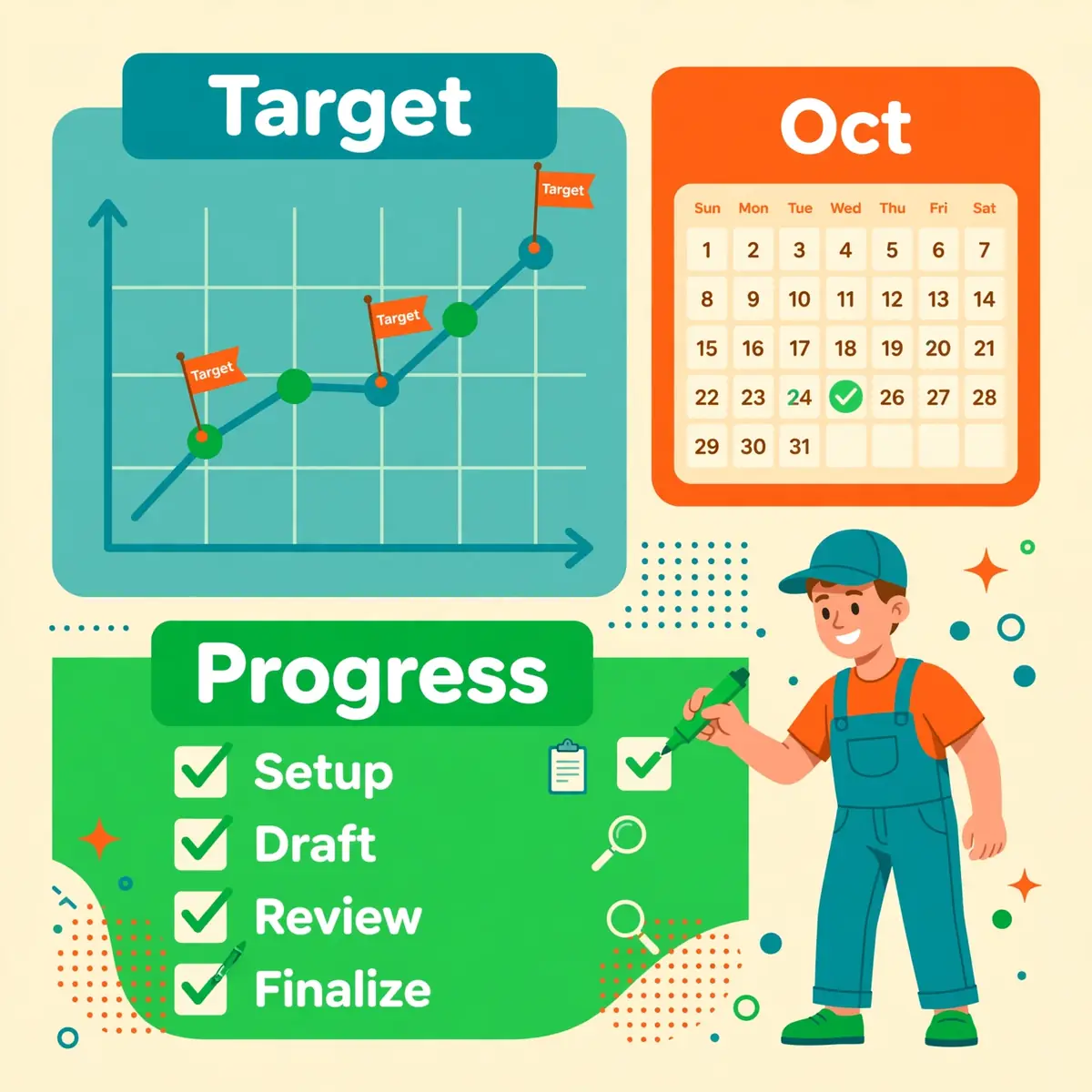
Objectives are the environmental results the organisation commits to achieve. Targets are the measurable numbers attached to them. Programmes are the plans that get the organisation from here to there, with actions, owners, dates and resources. Together they turn the framework from a description of the present into a plan for the future. They are where the framework either earns its keep or becomes decoration.
Objectives must come from the significant aspects and the legal register, not from a brainstorming session. Every significant aspect should have at least one objective, or a documented reason why it does not. An objective with no owner, no deadline and no budget is a wish. The framework's job is to make wishes into plans.
From significant aspects to objectives
Start with the significant aspects and ask, for each one, what improvement is possible and worth doing. Paint solvent emissions might lead to an objective to cut solvent use by switching to a water-based coating. Electricity use might lead to an objective to cut consumption per unit of output. Waste might lead to an objective to raise the recycling rate. The Hong Kong Environmental Protection Department's guide to setting up an EMS recommends starting from the legal requirements as the first objectives. For issues where no standard exists, set targets by measuring a baseline first.
Prioritise. An organisation cannot chase ten objectives at once, and trying to do so guarantees none of them gets done. Pick the three or four that matter most. Choose the ones with the biggest impact, the clearest legal pressure, or the fastest payback. Put the rest on a list for the next review cycle. The management review is the place to promote the next set.
Setting targets that can be measured
A target must be specific, measurable, achievable, relevant and time-bound. "Reduce waste" is not a target. "Cut waste to landfill from 40 tonnes a year to 32 tonnes a year by the end of next year" is a target. It names the number, the baseline, the deadline and the person who owns it. Without a baseline, a target is a guess, so measure first where no data exists, then set the target against the baseline.
Keep targets realistic. A target that is obviously impossible teaches staff that targets do not matter, and a target that is trivial teaches them the same lesson. The Hong Kong guide makes the same point. Refine objectives and targets so they are achievable and bring real satisfaction once reached. Over-ambitious targets lead to failure and discouragement instead. Review progress monthly, and revise a target only when the reason for the revision is recorded — not because the date is approaching.
- Cut electricity use per unit of output by 10% within 12 months, from a measured baseline.
- Raise the recycling rate for non-hazardous waste to 85% within a year.
- Cut packaging waste by 20% across the main product line within 18 months.
- Reduce water consumption at the site by 15% within a year.
- Eliminate all unpermitted discharges, with zero repeat findings at audit.
These are the kinds of targets real organisations set. The first four come from the resource-efficiency steps published by environmental consultants working with ISO 14001 systems. They work because each one names a number, a scope and a deadline. The fifth is different: it is a compliance target, and the only acceptable number for compliance is zero.
The programme: who does what, by when
Every objective needs a programme: the actions that will achieve it, the person responsible for each action, the date it is due, and the resources it needs. Write the programme as a table, not as prose, so anyone can see at a glance what is late. Start with the actions that cost little or nothing, such as good housekeeping and switching off idle equipment. Calculate the payback on the ones that need investment before committing to them.
Report progress to the framework leader at a fixed interval, and to top management at the management review. If an objective is not being met, say so early, find the cause. Either change the action or change the target — and record which one was chosen and why. A programme that is never reported on is a programme that is never finished.
Step 5: Control operations day to day
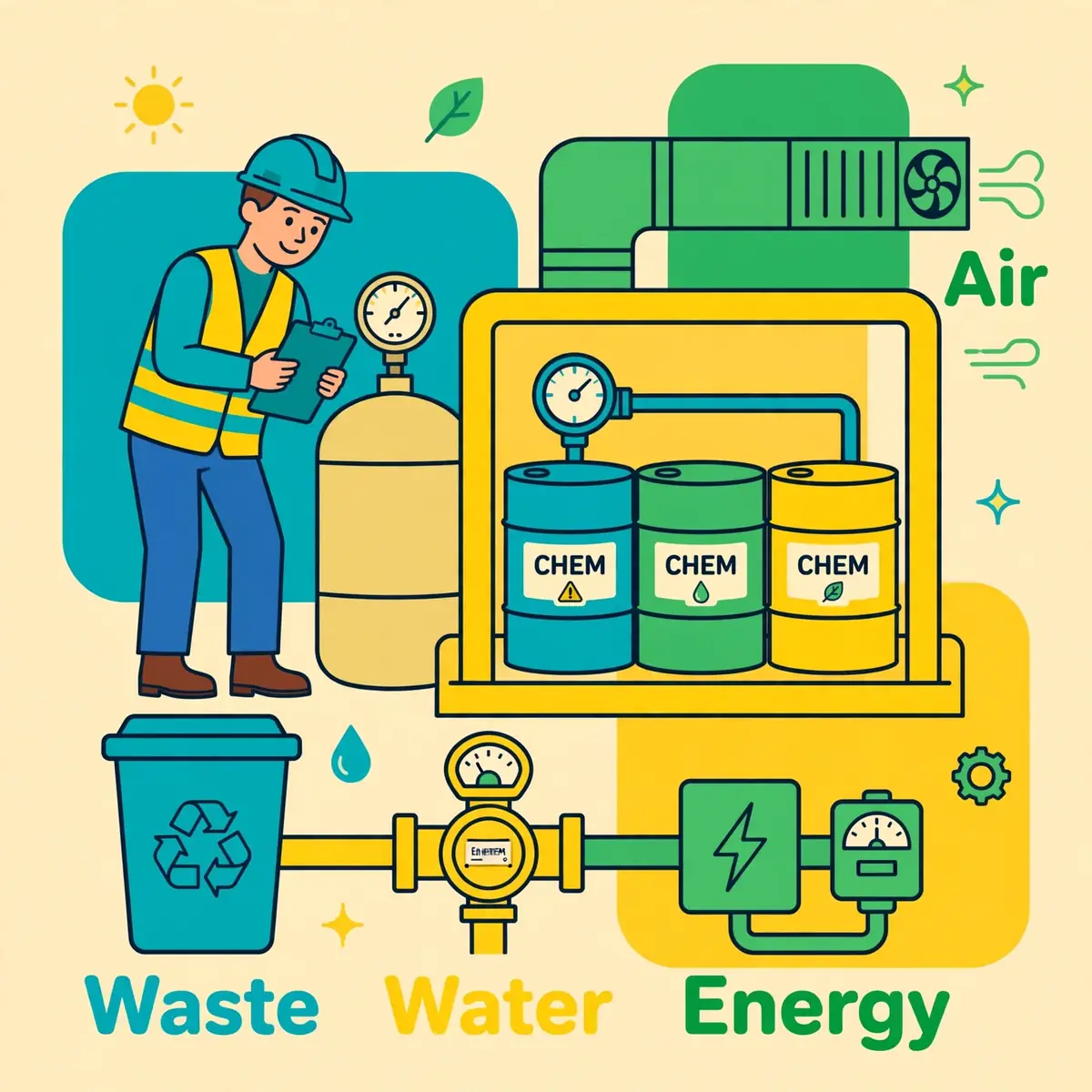
Operational controls are the procedures, work instructions, equipment settings and checks that keep the significant aspects within the limits the organisation set. They are where the framework meets the shop floor. A control that exists only in a manual does not control anything. The test of a control is simple: watch the work being done and see whether the control is followed without anyone being reminded.
Controls must cover normal operations and the abnormal ones. Start-up, shut-down, maintenance, cleaning and changeovers are where most environmental incidents happen, because they are the moments when the usual routine is suspended. Write controls for those moments first, and check them by observation, not by asking whether they were followed.
Procedures and work instructions
Write a procedure for every operation that affects a significant aspect, and keep it short enough to be used. A procedure that runs to twenty pages will not be read at the machine. Use numbered steps, name the person who does each step, state the limit or setting that matters. Say what to do when the limit is exceeded. Put the procedure where the work happens, not in an office folder.
Control documents so everyone works from the current version. Number the versions, date them, and withdraw the old ones. An out-of-date procedure is worse than no procedure, because it gives a false sense of control. The EPA's EMS guidance lists document control as a core implementation element, alongside operational control itself, for exactly this reason.
Controlling contractors and suppliers
Work done by others still affects the organisation's environmental performance, and the framework must cover it. The 2026 edition extends operational control beyond outsourced processes to externally provided processes, products and services. That means contractors working on site, suppliers whose materials and packaging arrive at the gate. Anyone whose work can cause an environmental impact on the organisation's behalf.
Set the requirements before the work starts. Tell contractors what the site rules are, what they must not do, and who to call if something goes wrong. Check that waste carriers hold the right authorisations and that waste transfer notes are completed. Ask suppliers about the packaging they use and the materials in their products, because the life cycle perspective makes those the organisation's aspects too. A contractor who spills a chemical on the organisation's site creates the organisation's incident, so everyone handling chemicals needs to know the chemical hazards involved.
Waste, water, energy and air
Most organisations' significant aspects fall into four groups, and each needs its own controls. Waste needs segregation at the point it is produced, labelled containers, a bunded store for hazardous waste, transfer notes for every load that leaves the site. A check that the carrier and the destination are authorised. Water needs metering, a check on what goes to drain, and a rule that nothing but clean water enters a surface drain.
Energy needs sub-metering by area or machine, a switch-off routine for idle equipment, and maintenance that keeps equipment efficient. A fouled heat exchanger or a leaking compressed-air line wastes energy every hour it runs. Air emissions need the permit conditions as the control limits, monitoring against those limits, and maintenance of the abatement equipment that keeps emissions inside them. Each group gets its own procedure, its own owner and its own monitoring.
TipWalk the site once a month and look for the controls, not the paperwork. A bund with a crack, a drain with no cover and a skip with mixed waste tell the truth faster than any audit.
Step 6: Train people and plan for emergencies
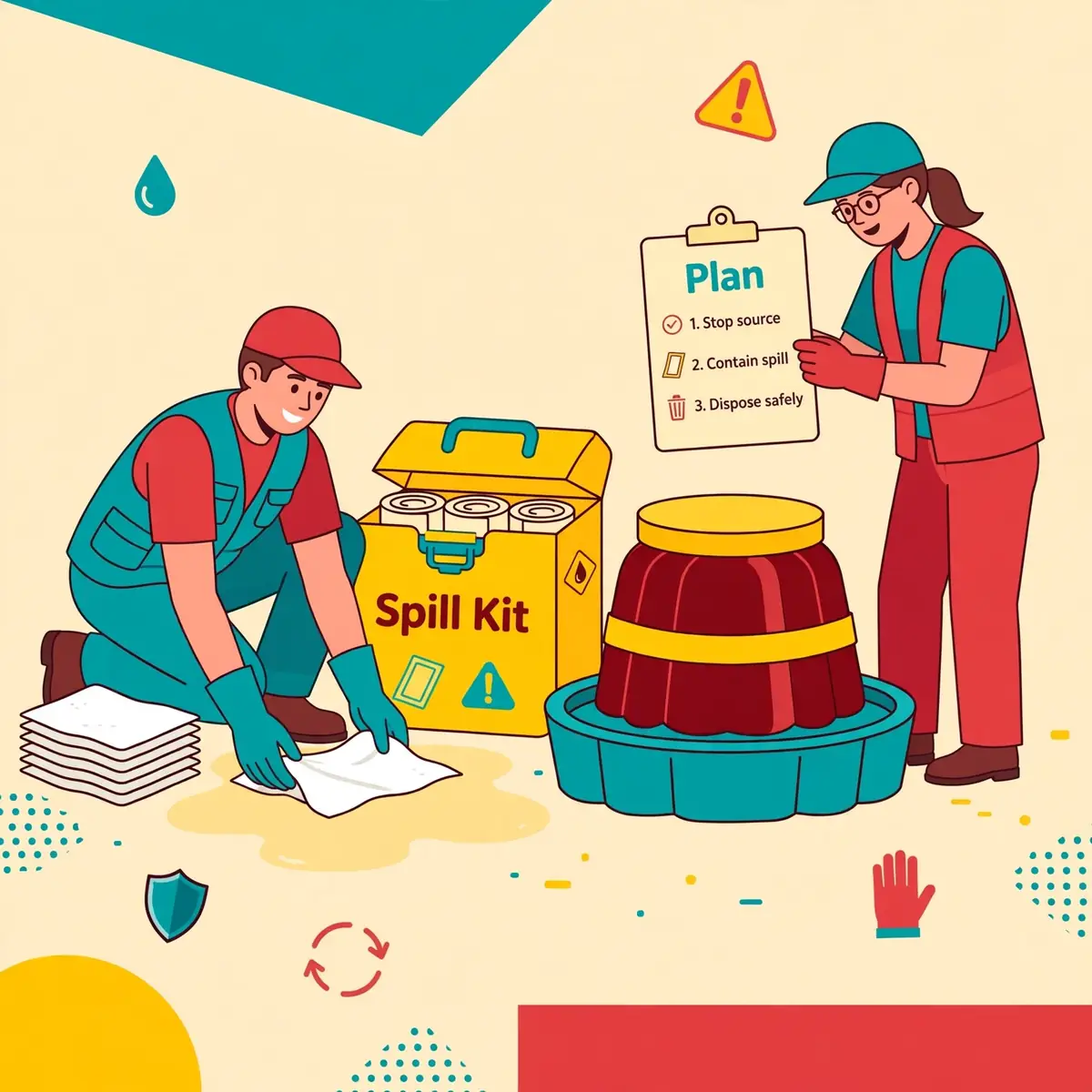
A framework is only as strong as the people who operate it. Training must match the role. Everyone needs to know the policy and their own environmental duties. The people who handle significant aspects need the competence to do the job properly. Competence is more than attendance at a training session. It is the demonstrated ability to do the task, and the framework must record it.
Emergency preparedness is the other half of this step. The organisation must identify the emergencies that could release a pollutant, write response procedures, train the people who will respond, and test the plans. The EPA's EMS guidance lists emergency preparedness and response as a core implementation element, and ISO 14001 carries it in its operation clause. A spill kit nobody has practised with is a decoration.
Who needs what training
Give everyone a short induction that covers the environmental policy, the significant aspects of their own work, and what to do if something goes wrong. Then train by role. Machine operators need the procedures for their machines and the limits they must watch. Store staff need the rules for chemical storage, bunding and segregation. Waste handlers need the duty of care and the transfer-note system. Managers need the legal register and the management review. Where the law sets specific training duties, the OSHA training requirements show how those duties are structured.
Record training with dates, topics and the people who attended, and check competence by observation. A signature on an attendance sheet proves someone was in the room, not that they can do the job. The person who signs off competence should have watched the task being done, and the record should say so.
Emergency preparedness and response
List the credible emergencies for the site. Think of a chemical spill, a fire with contaminated firewater, and a burst pipe. Add a tank failure, a power cut that stops abatement equipment, and a flood. For each one, write a short procedure. State who is called, what is done first, and what equipment is used. Then say how the release is contained, and who is told outside the organisation. Keep the procedures where the emergency will happen, and keep them short enough to be read under pressure.
Test the plans. A tabletop exercise twice a year and a practical drill once a year is a reasonable minimum for most sites. Test the hardest case, not the easiest: the spill at the far end of the site, on the night shift, when the trained responder is on leave. Record what went wrong in the drill and fix it, because a drill that finds nothing is a drill that tested nothing.
A spill response in practice
Spill response follows the same sequence every time, and it is worth teaching as a fixed routine. Stop the source if it is safe to do so. Raise the alarm and call the trained responders. Contain the spill with bunds, absorbent socks or drain covers so it cannot reach a drain or watercourse. Clean it up with the right absorbent, bag the waste and label it as hazardous waste. Report it, record it, and find the cause. Responders need the right PPE requirements for the chemical involved, and the equipment must be checked before it is needed.
The most common failure in spill response is the drain. A spill that reaches a surface drain reaches a river, and the organisation will be explaining itself to the regulator. Keep drain covers and spill kits near the places a spill is most likely, not in a locked store at the other end of the site. Check the kits monthly and replace what has been used, because an empty spill kit is the same as no spill kit.
WarningNever wash a chemical spill into a drain to clear it up. The drain leads somewhere, and the pollutant does not disappear when it leaves sight.
Step 7: Monitor, audit and review
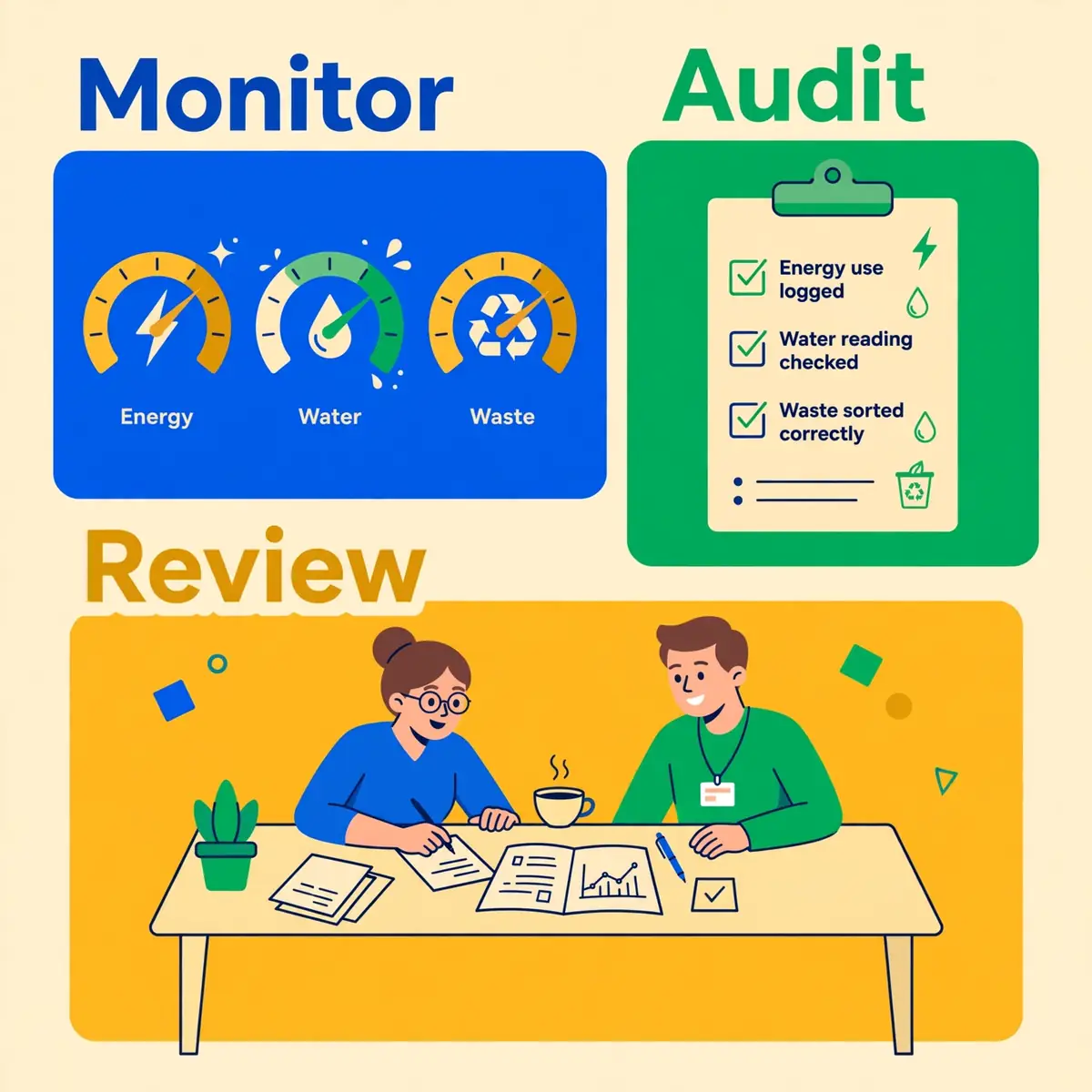
Monitoring, audit and review are the Check and Act phases of the cycle, and they are what keep the framework honest. Monitoring measures performance against objectives and permit limits. Internal audit tests whether the system works as intended. Management review decides what changes. Without these three, the framework is a set of good intentions that nobody verifies.
Each of the three needs its own rhythm. Monitoring is continuous or monthly, depending on the aspect. Internal audit is periodic, covering the whole framework over a year. Management review is at planned intervals, usually at least once a year. Put all three on a calendar at the start of the year, and treat the dates as commitments.
Monitoring and measurement
Monitor what matters: the significant aspects, the objectives and targets, and the permit conditions. Energy per unit of output, water use, waste to landfill, recycling rate, and emissions against permit limits all need measuring. Each one needs a defined method, a defined frequency, and a person responsible for taking and recording the reading. Calibrate the equipment that takes the readings, because a number from an uncalibrated meter is a guess.
Track the numbers on a simple chart, not in a spreadsheet nobody opens. A line that is rising or falling tells a story at a glance, and it gives the management review something real to discuss. Investigate any reading that is out of range, and record the investigation. A limit exceeded with no record of what was done is a finding waiting to happen.
Internal audit
Internal audit checks whether the framework works as it is written, and whether what is written works. Auditors must be independent of the work they audit, and they must be trained. The 2026 edition adds that every internal audit must have defined objectives. The audit plan should state what each audit is trying to find out, not only which area it covers.
Audit the whole framework over the year, and audit the significant aspects and the legal register more often than the rest. Write findings plainly, grade them by importance, and agree corrective actions with dates and owners. An audit that finds nothing is either a sign of a very good system or a sign of a very weak audit. The auditor should be able to say which one it is.
Corrective action and management review
Every finding, incident and nonconformance goes through the same process: record it, find the cause, take corrective action, and check that the action worked. The cause is usually a process, not a person. A missed check is usually a procedure that was unclear, a schedule that was unrealistic, or a role that had no owner. Fix the process and the person stops failing.
Top management reviews the system at planned intervals, looking at audit results, compliance status, progress on objectives, incidents, corrective actions, and the views of interested parties. The review must produce decisions: new objectives, changed controls, more resources, or a change to the policy. Record the decisions and the people responsible for them. A review that produces no decisions is a meeting, not a review, and the framework will not improve until the next one is held.
Worked example: a small manufacturer builds one
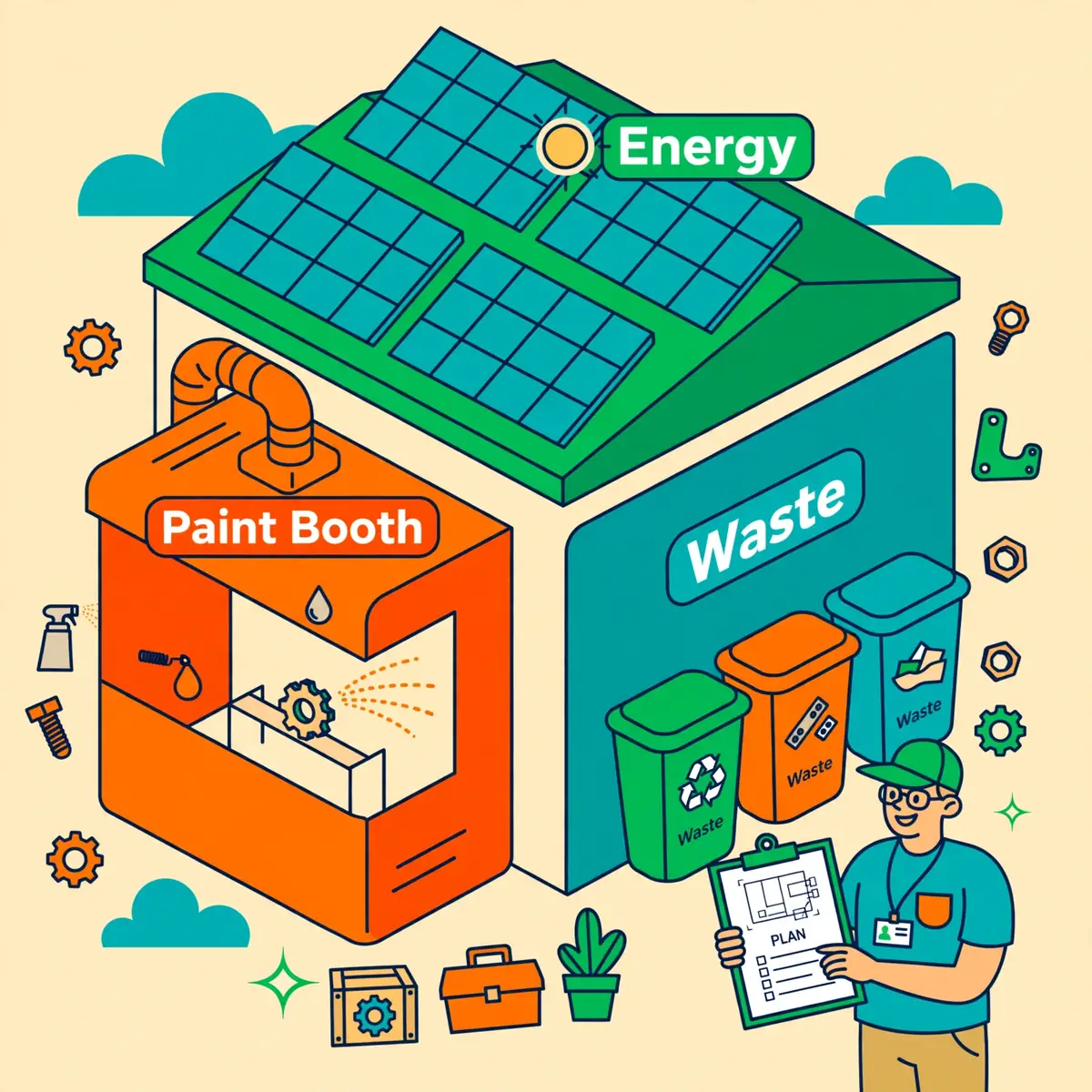
Consider a small manufacturer of metal parts, with 45 employees on one site, building an environmental management framework in six months. The site cuts and welds steel, paints parts in a spray booth, and ships them in cardboard and timber packaging. It holds an environmental permit for the paint booth, buys electricity and gas, and sends general waste and metal offcuts off site. Nothing about the site is unusual, and that is the point.
The worked example below puts the whole environmental management framework guide into practice for one small business, and these environmental management framework steps work for any similar business.
The owner appoints the operations manager to lead the build, with four hours a week and a small budget for training and a consultant's gap analysis. The scope is the whole site, including the delivery fleet and the packaging the company sends out. The policy is one page, signed by the owner, and posted in the canteen and the workshop. It commits to legal compliance, pollution prevention and continual improvement.
The aspects register
The team walks the site and lists 28 aspects. Scoring finds six significant ones. They are paint solvent emissions, electricity use, gas use for heating, metal offcuts, waste paint and thinners, and wash water from cleaning. The paint solvents carry the permit, so they are significant by definition. Electricity and gas are significant on scale and frequency. Waste paint and thinners are significant on severity and legal duty, because they are hazardous waste. The other 22 aspects, including office paper and canteen waste, get routine controls and no objectives.
The legal register that follows has 14 entries. They cover the paint booth permit and its conditions, the hazardous waste duty of care, and waste transfer notes. They also cover the duty to keep records, and the reporting duties that apply to the site. Each entry names the person who checks it and the date it was last checked. The first compliance evaluation finds two gaps: waste transfer notes are missing for three loads, and the permit's solvent monitoring has not been done for two months. Both are fixed in the first month.
Objectives and results after one year
| Objective | Target | Result after 12 months |
|---|---|---|
| Cut solvent emissions | Switch 50% of parts to water-based coating | 54% switched; emissions down by a third |
| Cut electricity per unit | 10% reduction in 12 months | 12% reduction; LED lighting and switch-off routine |
| Raise recycling rate | 85% of non-hazardous waste recycled | 81%; metal offcuts segregated, timber reused |
| Zero permit breaches | No missed monitoring, no exceedances | Zero breaches; monitoring done on schedule |
Three of the four objectives are met, and the fourth is close. The recycling target misses by four points. The management review records why. The timber packaging supplier changed its collection schedule, and the site had no storage for the extra timber. The corrective action is a new collection agreement and a storage bay, and the target is carried into the next year with the reason recorded. The framework worked as designed: it found the gap, explained it and fixed it.
The cost of the build is modest: the consultant's gap analysis, two days of auditor training, spill kits and drain covers, and the operations manager's time. The savings come from lower energy bills, lower waste charges and less solvent bought. The owner does not certify in the first year. The framework is built to ISO 14001, so certification is available whenever a customer asks for it. The gap analysis already says the system would pass.
Getting certified to ISO 14001
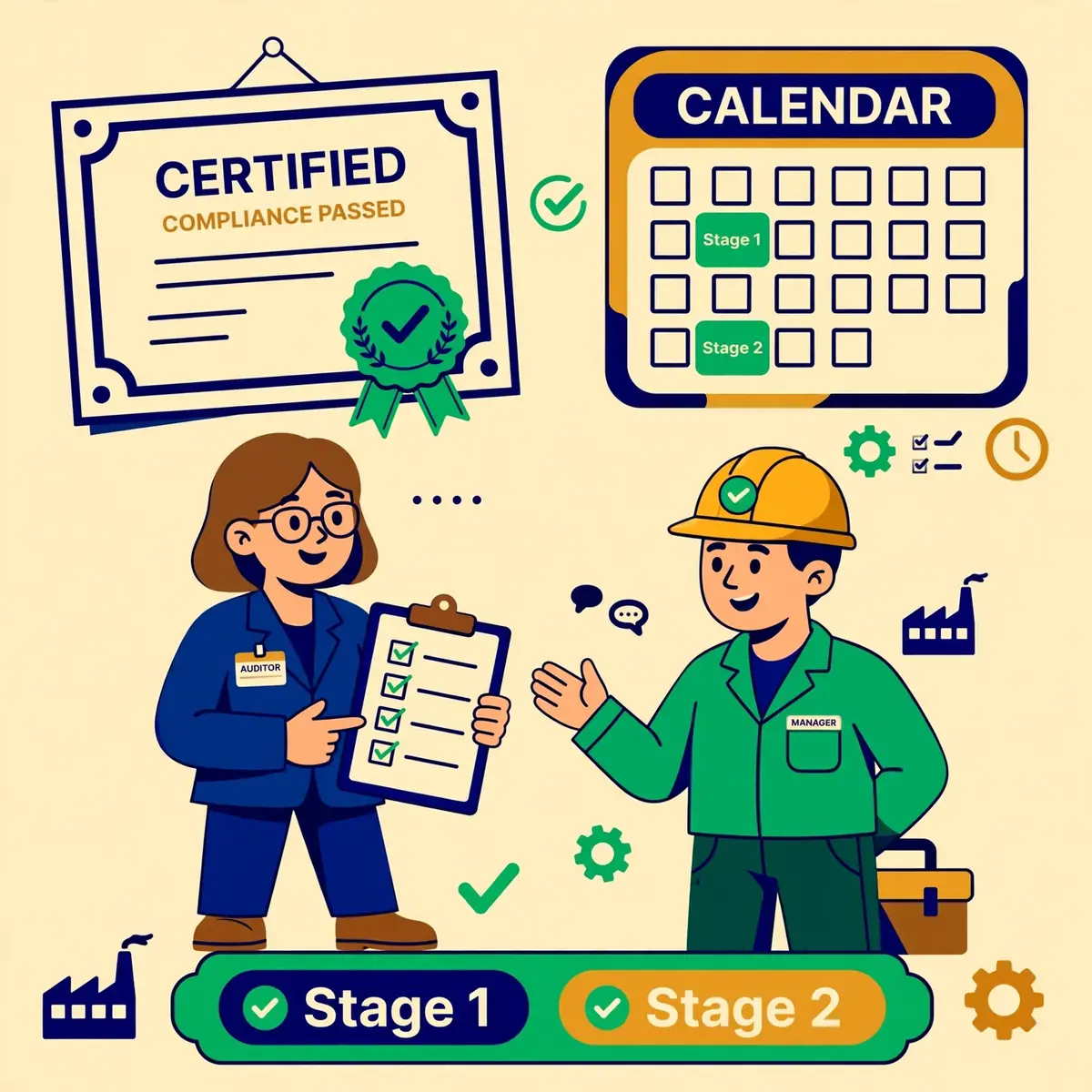
Certification is the independent confirmation that the framework meets ISO 14001. It is voluntary, and it is done by a certification body — a separate organisation that audits the system and issues the certificate. ISO itself does not certify anyone. The certificate belongs to the organisation, and it is valid for three years, with surveillance audits in between.
Before applying, run the framework until one internal audit and one management review are complete, and the findings from both are closed. A certification body will ask for that evidence at Stage 1. An organisation that cannot produce it will be sent back to finish the work. Certification is not the start of the framework. It is the check at the end of the first cycle.
Stage 1 and Stage 2
Certification has two stages. Stage 1 is a documentation review, usually at the organisation's site or remote. The auditor reads the policy, the scope, the aspects register, the legal register, the objectives and the records of the internal audit and management review. Checks that the system is ready for a full audit. Gaps found at Stage 1 must be fixed before Stage 2.
Stage 2 is the full audit. Auditors visit the site, watch work being done, interview staff at every level, and test whether the procedures are followed and the records are real. They pay close attention to the legal register and to compliance evaluation, because those are the parts that fail most often. At the end of Stage 2 the auditors recommend certification, certification with minor findings to close, or no certification until major findings are fixed.
Surveillance and recertification
Once certified, the organisation is audited at least once a year. These surveillance audits check part of the system each time, and over the three-year cycle they cover the whole standard. In the third year a full recertification audit takes place, and a new three-year certificate is issued if the system still meets the standard. A certificate is not a one-off award. It is a subscription to being checked.
Losing a certificate is possible and happens. The usual causes are the same as the usual audit findings. The legal register has not been updated, and compliance has not been evaluated. Objectives show no evidence of progress, and corrective actions promised were never done. Any of these, left for a full audit cycle, can turn into a major finding and a suspended certificate.
The 2026 edition and the transition
Organisations certified to ISO 14001:2015 must transition to the 2026 edition within a three-year period ending in April 2029. After that date, certificates against the 2015 edition will no longer be valid. The change is moderate: the structure and the core requirements stay the same, and the new edition clarifies what was ambiguous. The main changes are the broader environmental conditions in context and the strengthened life cycle perspective. They also include the new requirement to plan changes. Operational control now extends to externally provided processes, products and services.
For an organisation building a framework now, the sensible choice is to build to the 2026 edition from the start. There is no reason to build to a withdrawn edition and then transition. For an organisation already certified to 2015, the transition starts with a gap analysis against the new edition, then a roadmap that closes the gaps before the next surveillance audit. Most of the work is refinement, not rebuilding.
What drives cost and time
Certification cost depends on the size of the organisation, the number of sites, the complexity of its environmental aspects, and the certification body chosen. A single small site costs far less than a multi-site manufacturer with a permit and hazardous waste. Time depends on how much of the framework already exists. An organisation with a working framework, a completed internal audit and a management review can be certified in a few months. One starting from nothing should plan for six to twelve months.
Get quotes from at least two accredited certification bodies. Check that the body is accredited by a recognised accreditation body. In the United Kingdom that is the United Kingdom Accreditation Service (UKAS). In the United States it is the ANSI National Accreditation Board (ANAB). Accreditation is what makes a certificate something a buyer can rely on. An unaccredited certificate is a piece of paper with a logo on it.
TipAsk the certification body for its auditors' experience in the organisation's sector. An auditor who has never seen a paint booth will take longer and find less than one who has.
Common mistakes that sink a framework
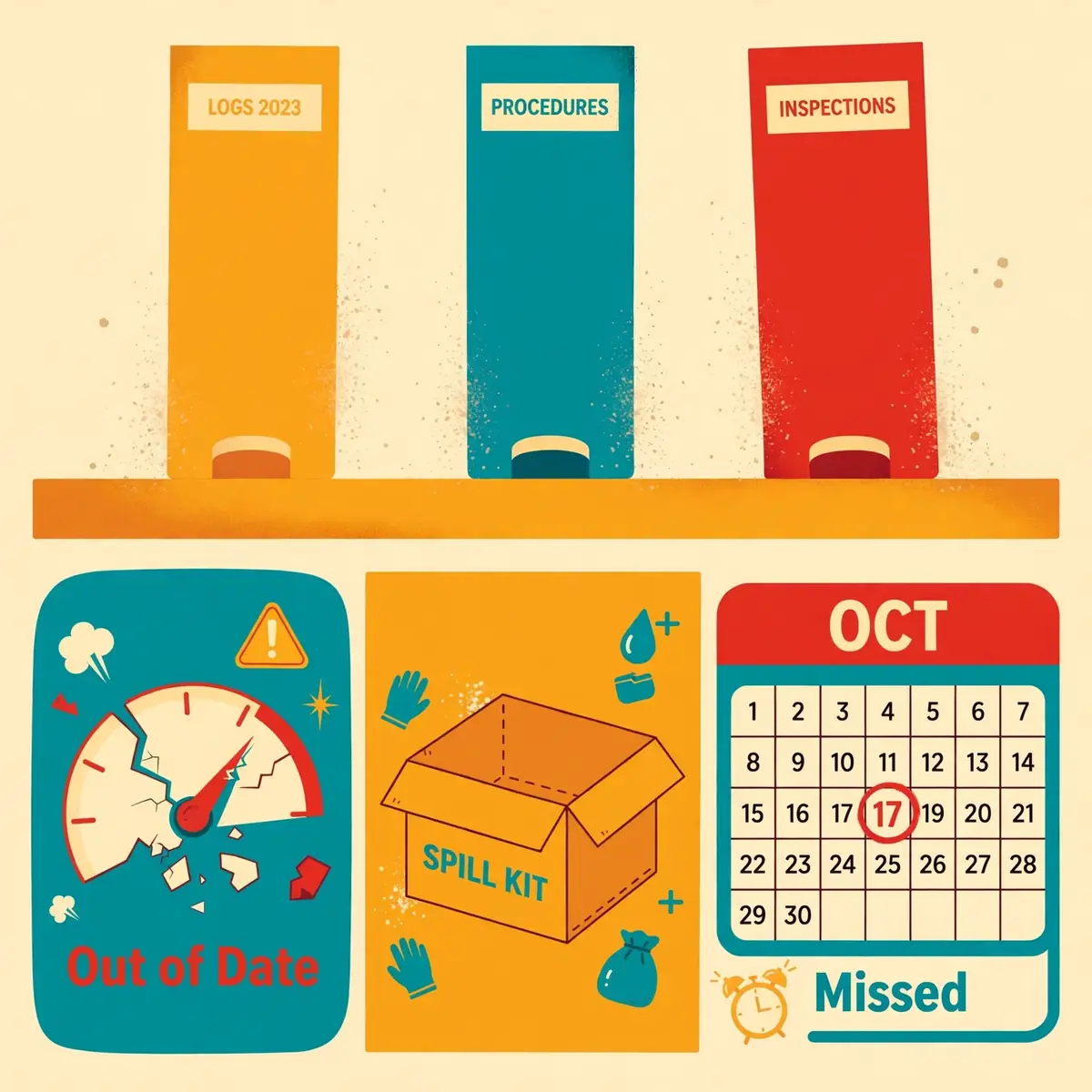
Most frameworks fail in the same handful of ways, and none of them is a lack of paperwork. The paperwork is usually fine. What fails is the connection between the paperwork and the work. The mistakes below are the ones auditors write up most often, and the ones that turn a working framework into a binder on a shelf.
- Copying a template. A framework copied from another organisation answers another organisation's questions. Build from the site's own aspects and legal duties.
- Skipping the aspects register. Objectives and controls built without a scored aspects register control the wrong things. Map first, then plan.
- A legal register nobody updates. Law changes and permits expire. A register last reviewed two years ago is a list of guesses, and auditors treat it as one.
- Objectives with no owner or deadline. An objective without a named person, a date and a budget is a wish. Assign all three before the objective is approved.
- Training without competence checks. Attendance proves someone was in the room. Watch the task being done before signing off competence.
- Monitoring that nobody reads. Data collected and never reviewed is worse than no data, because it creates a false sense of control. Chart the numbers and discuss them monthly.
- Corrective actions that are never closed. A finding left open for a year teaches everyone that findings do not matter. Close every action, or record why it changed.
- Management review as a formality. A review that produces no decisions is a meeting. Record the decisions, the owners and the dates.
Every one of these mistakes is fixable, and fixing them is usually cheaper than the cost of the failure they cause. A missed permit condition can lead to enforcement action. An unclosed corrective action can become a major audit finding. A framework that nobody uses can cost a contract when a customer asks for evidence and there is none.
The test of a framework is not the audit. It is an ordinary Tuesday. Can a supervisor find the aspects register, the legal register and the current procedure in five minutes? Does the operator know the limit they must watch and what to do when it is exceeded? Does the manager know whether the objectives are on track? If the answer to all three is yes, the framework works. If not, the next step is not more paperwork. It is to fix the connection between the paperwork and the work.
Frequently Asked Questions
What is the difference between an environmental management framework and an environmental management system?
The two terms describe the same thing from different angles. The framework is the design: the policy, registers, roles, controls and review cycle. The system is the framework running in daily work. ISO 14001 uses the term environmental management system (EMS), and most organisations use the two terms interchangeably.
Is ISO 14001 certification legally required?
No. ISO 14001 is a voluntary standard, and no law in the United States or the United Kingdom requires an organisation to hold it. The legal duties underneath it — permits, waste rules, discharge limits — do apply whether or not the organisation is certified. Many organisations certify because customers, tenders or parent companies ask for it.
What is the current edition of ISO 14001?
ISO 14001:2026, published on 15 April 2026. It replaces ISO 14001:2015, and organisations certified to the 2015 edition have a three-year transition period ending in April 2029. The 2026 edition adds climate change, biodiversity, resource availability and ecosystem health to the context an organisation must consider. It also strengthens the life cycle perspective and the planning of changes.
How long does it take to build an environmental management framework?
A small organisation with a committed manager can build a working first version in weeks to a few months. A larger or multi-site organisation usually takes six to twelve months, because the scope is wider and more people must be involved. The first version should control the significant aspects now and improve through review, rather than waiting until every procedure is perfect.
What is a significant environmental aspect?
A significant environmental aspect is an interaction with the environment that has, or can have, a significant impact. Organisations decide significance by scoring each aspect against criteria such as scale, severity, frequency, legal control and stakeholder concern. Any aspect controlled by a permit or a legal duty is significant by definition.
Can a small business get ISO 14001 certified?
Yes. ISO 14001 applies to organisations of any size, and the standard is written to fit the organisation's size and circumstances. A small business needs the same elements — policy, aspects, legal register, objectives, controls, audit and review — in proportion to its risks. Certification bodies audit small organisations regularly, and the cost and time reflect the size of the site.
What is the difference between ISO 14001 and EMAS?
EMAS is the European Union's eco-management and audit scheme, established by Regulation (EC) No 1221/2009. It uses ISO 14001 as its core and adds proof of legal compliance, employee involvement and a published environmental statement validated by an accredited verifier. ISO 14001 certification does not require public reporting; EMAS registration does.
Sources
- International Organization for Standardization, ISO 14001:2026 published — raising the bar for environmental performance (15 April 2026). iso.org
- International Organization for Standardization, ISO 14001:2026 — Environmental management systems, standard page (Edition 4, 2026-04). committee.iso.org
- International Organization for Standardization, ISO 14001:2026 — What's changed and what it means for your business. iso.org
- US Environmental Protection Agency, Key Terms — Environmental Management Systems (components of an EMS). archive.epa.gov
- US Environmental Protection Agency, Region 7 Environmental Management System (Plan-Do-Check-Act phases). epa.gov
- European Commission, Better environmental performance: Community eco-management and audit scheme (EMAS), Regulation (EC) No 1221/2009. eur-lex.europa.eu
- European Commission, Decision 2013/131/EU — User's guide setting out the steps needed to participate in EMAS. legislation.gov.uk
- Hong Kong Environmental Protection Department, A Simple Guide to Set Up an Environmental Management System (objectives and targets). epd.gov.hk
- Salford City Council, Industrial installations — Environmental Permitting (England and Wales) Regulations 2016. salford.gov.uk
- ASCB, ISO 14001: requirements for an environmental management system (2026 edition and transition deadline). ascb.com
- ICS Consulting, Environmental Management System: Building Resource Efficiency (example targets). icsconsulting.com.au