A safety management system (SMS) is the organised way a workplace manages safety. It finds hazards, controls risks, trains people and checks that the controls work. It turns scattered safety tasks into one connected framework with named owners, written procedures and regular review. An SMS does not replace individual safety programmes. It connects them so each one feeds the next.
Most workplaces already own the raw parts of an SMS. Training records, inspection checklists, incident reports and risk assessments usually exist in separate folders and on different schedules. The system is what links them. Hazard data shapes training. Training is checked by observation. Observation feeds the next round of hazard assessment. Nothing runs in isolation.
What is a safety management system?
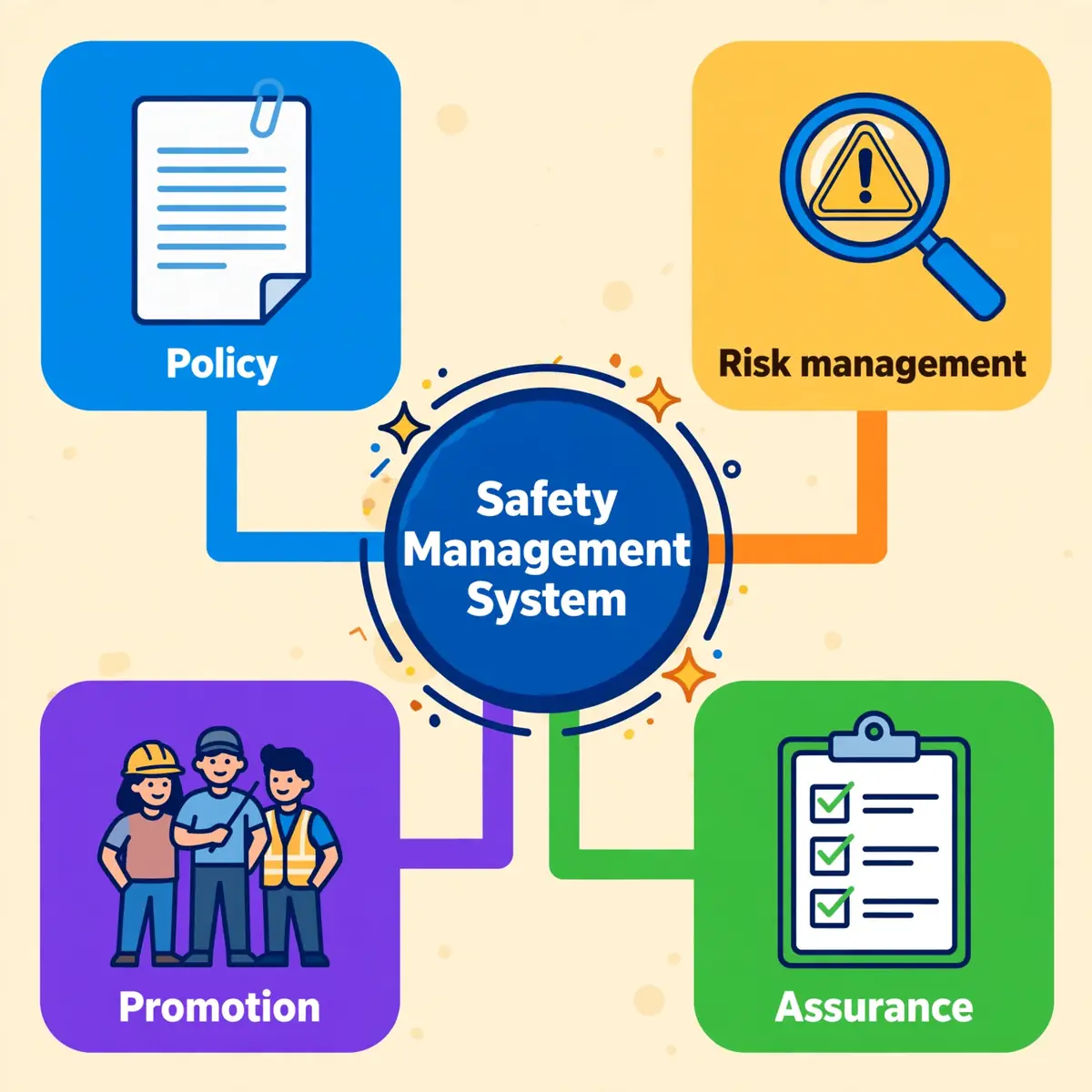
A safety management system is the integrated set of policies, processes, procedures and people that manage workplace health and safety. It works systematically, not by chance. It defines how hazards are found and how risks are controlled. It also defines how workers are trained, how performance is measured and how the system improves over time. The definition matters because it draws a line. A stack of safety programmes is not a system until the parts connect and reinforce each other.
Think of the SMS as the operating system and the individual programmes as the applications that run on it. Lockout and tagout, forklift training, near-miss reporting and permit-to-work are the applications. The SMS is the platform that runs them, connects them and keeps them from working against each other. When a new hazard appears, the system routes it through assessment, control, training and checking. Nobody has to invent a process on the spot.
Three features separate a real SMS from a binder of documents. First, every process has a named owner who knows they own it. Second, the parts share information: incident findings change risk assessments, and risk assessments change training topics. Third, the system produces records as a by-product of daily work. Records do not arrive as a rush of paperwork in the week before an audit. A system that has not changed in two years is probably not being used.
TipAsk one question. Can a new supervisor find, in five minutes, who owns each safety process and what happens when it fails?
A safety management system also differs from a safety, health and environment management system, known as SHEMS. SHEMS folds environmental management into the same framework. Safety, health and environment then share one risk register and one audit programme. An SMS covers safety and occupational health only. Readers who need the integrated version should read the SHEMS guide alongside this one.
The four components of a safety management system
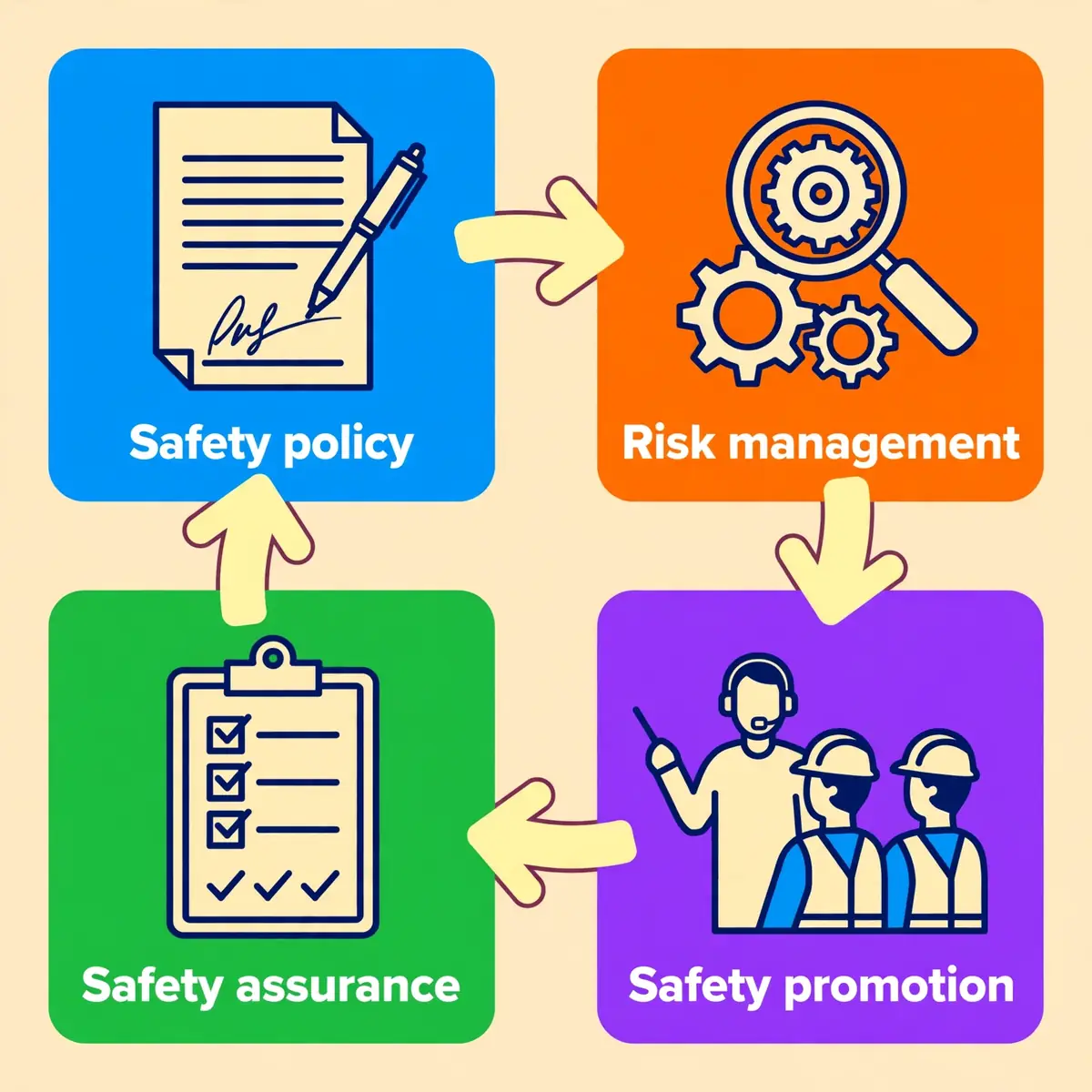
Most SMS frameworks use the same four components, even when they use different labels. The model comes from aviation. The Federal Aviation Administration (FAA) defines an SMS as the formal, top-down, organisation-wide approach to managing safety risk. It also covers assuring the effectiveness of safety risk controls. The four components are safety policy, safety risk management, safety assurance and safety promotion. The 2024 Federal Register final rule on aviation safety management systems confirms that an SMS must include all four.
Each component does a different job, and a system missing any one of them has a visible weak point. Policy gives direction and accountability. Risk management finds hazards and designs controls. Assurance checks that the controls work. Promotion makes sure people understand the system and use it. The sections below explain each component in turn.
Safety policy
Safety policy is the organisation's documented commitment to safety. It states the safety objectives, names who is accountable for what, and sets out how safety is organised. Senior management signs it, and the signature has to mean something: the policy commits resources, not just good intentions. A policy that promises zero harm but funds no inspections is a poster, not a policy.
A good policy is short, specific and visible where work happens. It commits the organisation to legal compliance, hazard control, worker consultation and continual improvement. It also names the safety manager or safety lead. It states that workers may report hazards and stop unsafe work without fear of reprisal. Keep the policy to one page if possible. Workers should be able to read it in under a minute and remember what it asks of them.
Safety risk management
Safety risk management is the working core of the system. It is the formal process for identifying hazards and assessing the risks they carry. It then designs controls that reduce those risks to an acceptable level. It runs in a loop. First describe the system or task and find the hazards. Then analyse the risk, assess it against a clear scale and control it. New work, new equipment and changes to a process all trigger the loop again.
Hazard identification needs several methods, because no single method finds every hazard. Several methods work together:
- Workplace inspections.
- Job safety analysis.
- Near-miss reports.
- Worker consultation.
- Equipment and chemical reviews.
- Emergency scenario reviews.
A risk assessment then ranks the hazards so the worst ones get controlled first. The goal is a decision about controls, not a thick file of assessments.
Safety assurance
Safety assurance checks whether the controls designed under risk management actually work. It uses audits, inspections, performance monitoring and incident investigation to test the system against its own objectives. When a control fails or a new hazard appears, assurance spots it. It routes the problem back for a fix. Without assurance, a system slowly drifts from what the procedures promise to what people actually do.
Assurance also owns the data. It collects inspection findings, audit results, incident reports and indicator trends, then analyses them for patterns. A single incident is a fact; five similar near misses in three months is a system failure. After an incident, a fishbone diagram helps trace the root causes instead of stopping at the immediate error. The findings feed corrective actions with named owners and due dates.
Safety promotion
Safety promotion covers training and communication. It makes sure every worker understands the system, their role in it and the hazards of their own job. Training is tied to actual tasks and risks, not to job titles alone. A forklift driver and a warehouse picker need different training even though both work in the same building. Communication keeps everyone up to date when procedures change.
Promotion also builds the culture that makes the other three components work. Workers report hazards when they trust that reports lead to action and not to blame. Managers send a stronger message than any poster. They run toolbox talks, investigate near misses personally and follow the same procedures they ask others to follow. Safety training should explain why a control exists, not just that it exists. That understanding helps workers adapt safely when a situation changes.
The seven core elements every SMS needs
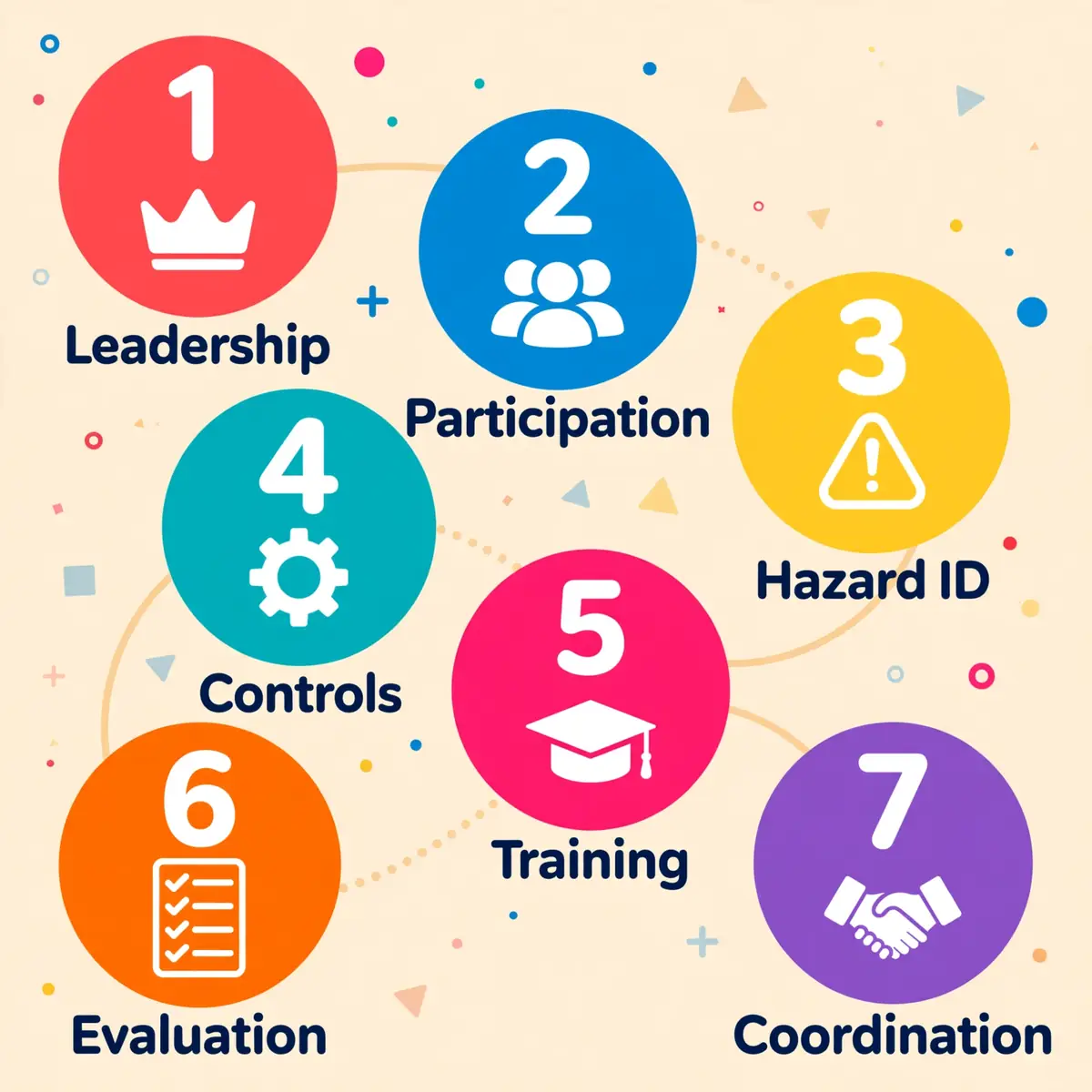
The Occupational Safety and Health Administration (OSHA) describes a safety and health programme as a proactive process. It helps employers find and fix workplace hazards before workers are injured or become ill. Its Recommended Practices for Safety and Health Programs, published in 2016, set out seven core elements. The Recommended Practices are advisory guidance, not a legal standard. Even so, they are the closest thing to a universal blueprint for a workplace SMS in the United States.
The seven elements overlap with the four components above. The table below maps each OSHA element to the FAA component it mainly serves. Readers using either framework can see that the substance is the same and only the labels differ.
| OSHA core element | What it covers | Main FAA component |
|---|---|---|
| Management leadership | Senior managers commit to the programme, set expectations and provide resources | Safety policy |
| Worker participation | Workers help find hazards, shape procedures and review the programme | Safety promotion |
| Hazard identification and assessment | Ongoing processes find and rank hazards before they cause harm | Safety risk management |
| Hazard prevention and control | Controls are chosen and applied using the hierarchy of controls | Safety risk management |
| Education and training | Workers and managers learn the hazards, the controls and their roles | Safety promotion |
| Program evaluation and improvement | Performance is reviewed and the programme is changed where it falls short | Safety assurance |
| Communication and coordination | Host employers, contractors and staffing agencies share safety duties on multi-employer sites | Safety policy |
Two elements deserve emphasis because they are the ones most often done badly. Worker participation means real involvement, not a suggestion box. Workers should help write procedures, report hazards without retaliation and sit on the safety committee with work to do. Communication and coordination matters wherever contractors or temporary workers share a site. Each employer's safety duties must be spelled out before work starts. Jobs should not begin until every worker understands the expectations.
WarningA safety committee where one person talks for 45 minutes and nobody else contributes is not worker participation. Give committee members real tasks, such as leading an inspection or reviewing a procedure.
Map an existing set of programmes against this table. Most workplaces find two or three elements that are weak or missing. Those gaps are where injuries happen and where leadership stops trusting the safety function. The gap analysis in the build steps below starts from exactly this list.
Safety management system vs a traditional safety programme
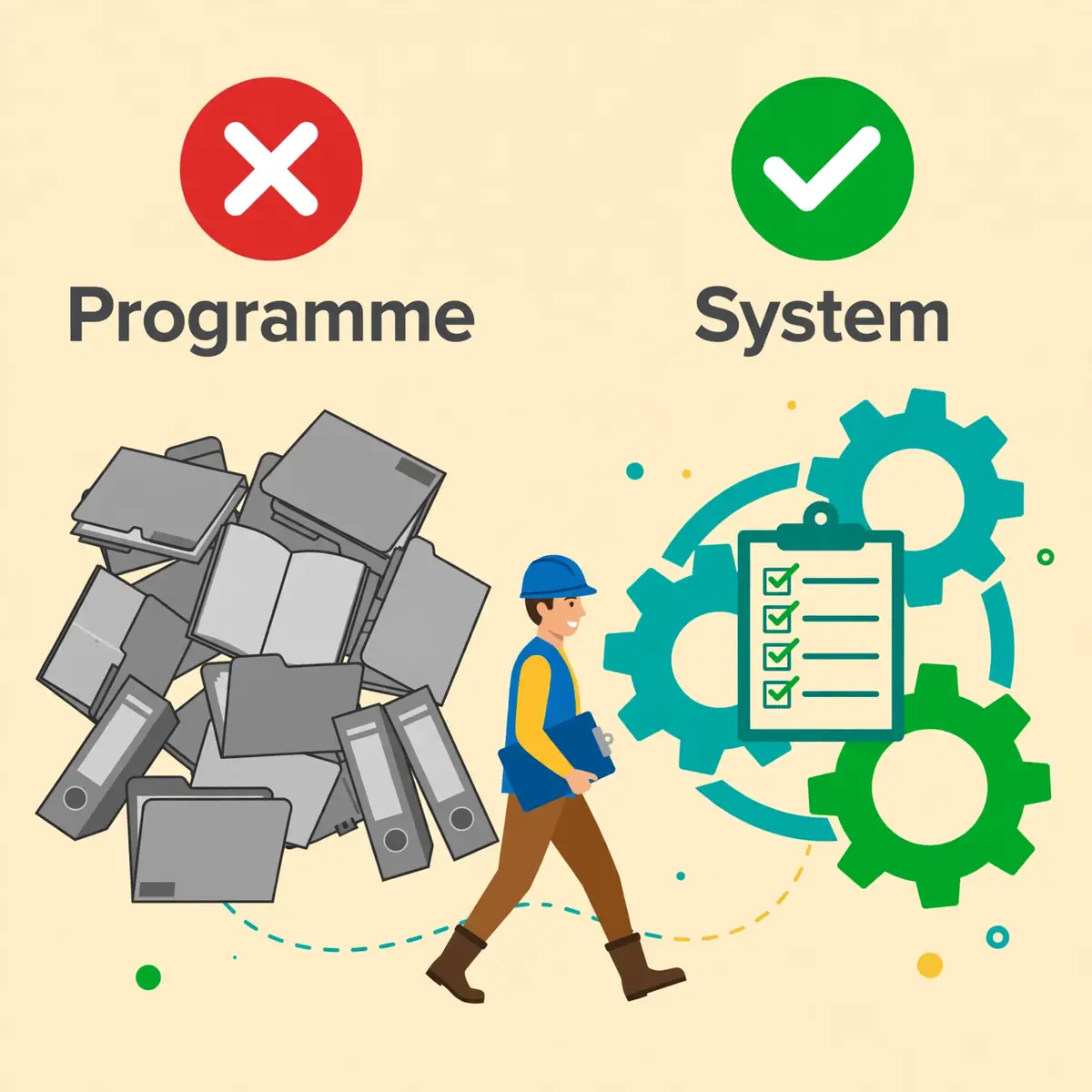
A traditional safety programme reacts. An SMS predicts. Both contain similar activities — training, inspections, incident investigation and written procedures — but they organise them differently. The programme runs each activity on its own schedule. The system wires them together. Each activity feeds the next, and leadership sees leading indicators, not just the injury rate.
| Feature | Traditional safety programme | Safety management system |
|---|---|---|
| Focus | Compliance with rules | Performance and continual improvement |
| Timing | Reactive: acts after incidents | Proactive: acts on hazards and near misses |
| Organisation | Disconnected programmes | Integrated processes |
| Ownership | Safety manager owns everything | Shared accountability through the chain of command |
| Measurement | Lagging indicators such as injury rate | Leading and lagging indicators together |
| Review | Annual programme review | Continuous improvement cycle |
| Records | Documents stored in binders | A living system used every day |
The practical difference shows up when something changes. A new machine arrives on the floor. Under a traditional programme, the machine gets a guard and a training session, and the paperwork is filed. Under an SMS, the change triggers several steps:
- Risk assessment.
- A check of the guard as a control.
- Updated training for the operators.
- A note in the inspection schedule.
- A review after a month of whether the control works.
Moving from a programme to a system does not mean scrapping what exists. Most facilities already have the raw materials: training records, inspection checklists, incident reports and risk assessments. The work is connecting them with intentional process design and a management review that looks at how the parts interact. That connection is the build described below.
Is a safety management system required by law?

The short answer depends on where the work happens and what industry it is in. There is no single law that requires every employer in every country to run a safety management system. The duties that exist are narrower and more specific. They differ between the United States, the United Kingdom and regulated sectors such as aviation. The sections below set out each position separately.
United States
No single federal rule requires most United States employers to have a safety management system. OSHA's Recommended Practices are guidance, and OSHA states plainly that they do not create new legal obligations. What the law does require is a large number of specific written programmes, each under its own standard. They include:
- Hazard communication.
- Respiratory protection.
- Lockout and tagout.
- Confined space entry.
Voluntary does not mean irrelevant to enforcement. Inspectors look at how a workplace manages safety, and a working system is strong evidence of good faith. Some state plans and some industries go further. Several states run their own safety and health programme requirements. Some federal contracts ask for a written programme. OSHA training duties also apply standard by standard. The training element of an SMS must still meet each standard's own requirements.
United Kingdom
United Kingdom law compels the written core of a safety management system. It does not use the term SMS. The Health and Safety at Work etc. Act 1974 requires a written statement of general policy on health and safety. That duty applies to employers with five or more employees. Employers must bring that statement to the attention of employees. Smaller employers are exempt from the written requirement, but they must still manage health and safety.
The Management of Health and Safety at Work Regulations 1999 then add the working core. Regulation 5 requires every employer to make arrangements for planning, organisation, control, monitoring and review of preventive and protective measures. Where an employer has five or more employees, those arrangements must be recorded.
That is, in substance, a management system: plan, organise, control, monitor and review. The Health and Safety Executive (HSE) guidance on managing health and safety follows the same Plan-Do-Check-Act cycle as ISO 45001. It covers leadership, worker involvement, risk assessment, control and review. An employer that builds an SMS around those duties is building the system the law already expects. The records the system produces are the evidence an inspector will ask to see.
Aviation and other regulated sectors
Aviation is the clearest exception to the voluntary pattern. The FAA requires parts of commercial aviation to implement an SMS. The rule covers air carriers, charter and commuter operators, air tour operators and certain manufacturers. The FAA defines the SMS as a formal, top-down, organisation-wide approach to managing safety risk. Its 2024 final rule requires the four components described above. International aviation follows the same model through the International Civil Aviation Organization (ICAO).
Other sectors have their own equivalents. Rail, maritime and offshore oil and gas each run safety management regimes under their own regulators. Major-hazard sites in the United Kingdom operate under the Control of Major Accident Hazards Regulations 2015. The pattern is consistent. The higher the potential consequence of failure, the more likely the regulator is to demand a formal system. Separate programmes are not enough where failure could be catastrophic. Check the sector rules for the industry in question before assuming the voluntary position applies.
AlertNever describe an SMS as legally required without naming the jurisdiction and the sector. The requirement is real in aviation and in parts of United Kingdom law, and voluntary for most United States employers.
How to build a safety management system, step by step
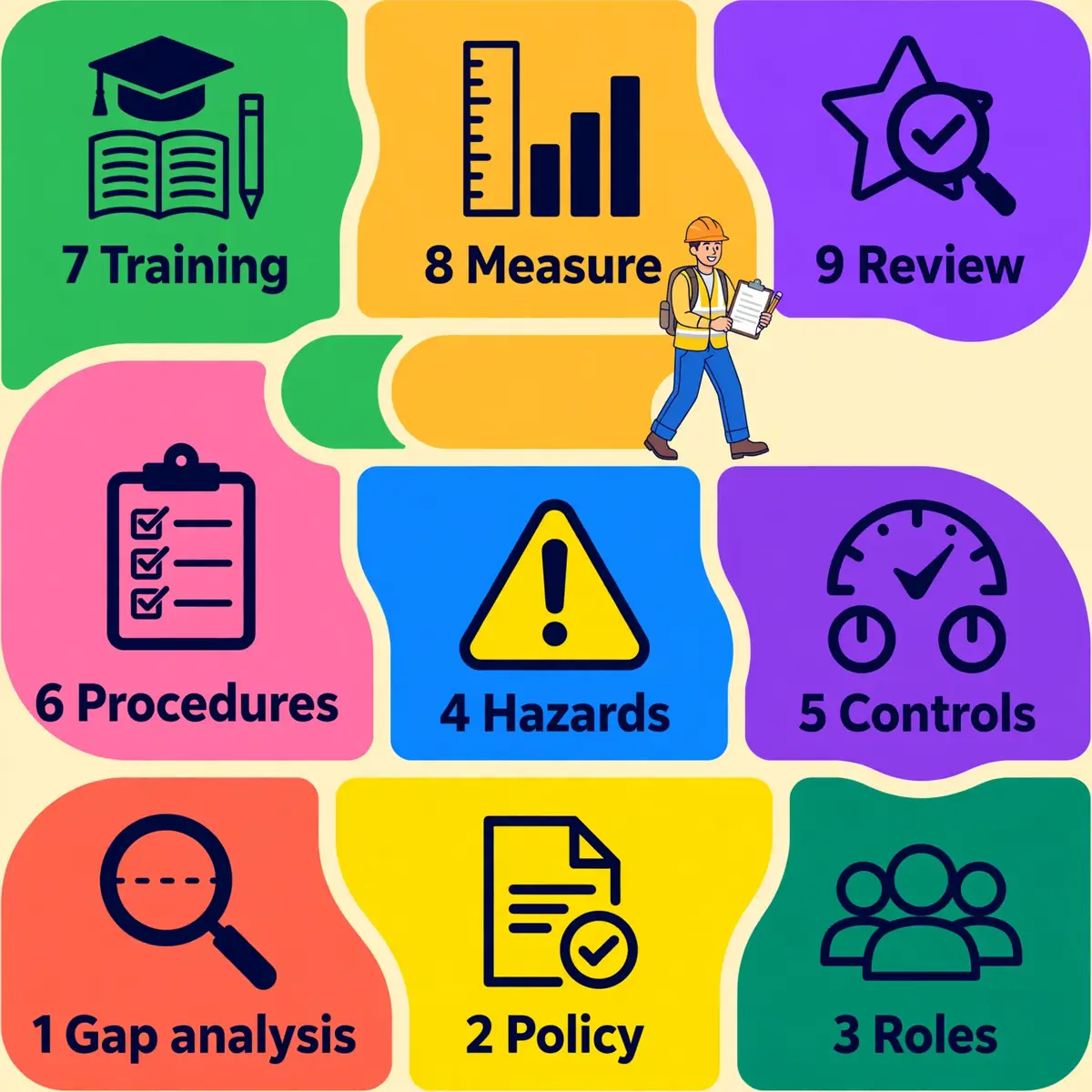
Building an SMS is a process, not a project. It has no single finish line, because the system must keep changing as the work changes. The nine steps below give the order that works in practice. First understand the starting point. Then secure leadership. Then build the working parts one at a time. A small organisation can complete the first version in weeks. A large site will take months. Either way, the first version should control real risks now and improve over time.
Resist the urge to start by writing procedures. Procedures written before the scope, roles and risk picture are clear usually have to be rewritten. Work the steps in order and write each procedure only when the step that needs it is reached.
Step 1: Run a gap analysis
Start by assessing current safety arrangements against a recognised framework, such as ISO 45001 or the OSHA Recommended Practices. List what already exists — policies, risk assessments, training records, inspection checklists, incident reports — and score each element honestly. Most workplaces find that some elements are strong. One or two are missing entirely. Several exist on paper but are not used. An honest gap analysis at this stage saves significant rework later.
Use the seven OSHA elements as the checklist for the analysis, and note the evidence for each score. A training programme with attendance records scores differently from one that exists only as a slide deck. Record the gaps in a simple register with an owner and a target date for each one. That register becomes the build plan for the rest of the steps.
Step 2: Define the scope and write the policy
Define what the system must control before writing anything else. The scope should name the sites, the work activities, the people covered and the boundaries with contractors. It should include employees, contractors, visitors, routine work, non-routine work, emergencies, maintenance and changes to equipment or processes. Three questions shape the scope. What work creates risk? Who can be harmed? What must the organisation do to prevent harm and meet its legal duties?
Then write the safety policy. Keep it short, specific and signed by top management. It should commit the organisation to legal compliance, hazard control, worker consultation and continual improvement. It should also name the person accountable for the system. Avoid generic promises. A policy that names real commitments can be audited; a policy that promises only "safety first" cannot.
Step 3: Assign roles and responsibilities
Clarity about who is responsible for what is foundational. Every process in the system needs a named owner. That owner needs the authority and time to do the job. The safety team advises, monitors and verifies, but it cannot own every process. Line managers implement controls and supervise work safely. Supervisors run toolbox talks and task-level checks. Workers follow controls, report hazards and stop unsafe work.
Write the responsibilities down in a simple table and share it. Include the roles that are easy to forget. Procurement buys equipment and chemicals. Human resources handles competence records. Maintenance keeps guards and ventilation working. When a responsibility has no name beside it, it belongs to nobody, and the process it supports will drift.
Step 4: Identify hazards and assess risks
Hazard identification is the backbone of the system, so do not rely only on past incidents. Many serious risks exist before the first accident happens. Use several methods together:
- Workplace inspections.
- Job safety analysis.
- Review of incident and near-miss reports.
- Worker consultation.
- Equipment and chemical reviews.
- Contractor activity reviews.
- Emergency scenario reviews.
- Management of change reviews.
Each method catches risks the others miss.
Assess the risks with a simple, consistent scale, for example severity against likelihood. Rank them so the worst ones are controlled first. The assessment should end in a decision about controls, not in a file of forms. Record the significant risks in a risk register with the control chosen, the owner and the review date. Link the register to the risk assessment process so every assessment follows the same method.
Step 5: Choose controls with the hierarchy of controls
Work through the hierarchy of controls in order for each significant risk:
- Elimination.
- Substitution.
- Engineering controls.
- Administrative controls.
- Personal protective equipment (PPE).
Elimination removes the hazard entirely, for example by redesigning a task so nobody works at height. Substitution replaces a hazardous substance or process with a safer one. Engineering controls isolate people from the hazard, such as guards or ventilation.
Administrative controls change how people work. They include:
- Procedures.
- Permits.
- Signs.
- Training.
PPE protects the individual when nothing higher up the hierarchy can control the risk fully. PPE has its place, but it should not be the first or only control for a significant hazard. Record which level was chosen for each risk and why, so the reasoning can be reviewed later. The hierarchy of controls guide explains each level with workplace examples.
Step 6: Write the core procedures
Write only the procedures the risks actually need. Many organisations make the mistake of writing too many procedures too early, and the result is a manual nobody reads. Core procedures usually include:
- Hazard identification and risk assessment.
- Incident reporting and investigation.
- Emergency preparedness and response.
- Training and competence.
- Contractor safety management.
- Inspection and audit.
- Corrective action management.
- Management of change.
- Permit-to-work, where high-risk work exists.
Keep each procedure short enough to use at the point of work. State who does what, in what order, and what record proves it happened. A procedure that needs a training course to understand is too complicated. Test each one with the people who will follow it. If they cannot explain it back in their own words, rewrite it before it goes live. Practice emergency procedures and first aid kit arrangements belong in the emergency procedure, with named first aiders and kit locations.
Step 7: Train people and make participation normal
Training should follow job risk, not job title alone. Build a training matrix that names each training area, who needs it and how often it is refreshed. Induction covers every worker, contractor and visitor as applicable. Job-specific hazard training goes to workers exposed to those task risks. Permit-to-work training goes to issuers, receivers, supervisors and affected workers. Risk assessment training goes to supervisors, managers and safety staff. Records prove attendance, but competence is proved by observation on the job.
Participation is not just a meeting. It includes:
- Hazard reporting.
- Consultation before changes.
- Involvement in inspections.
- Feedback on procedures.
- The right to raise concerns without retaliation.
Involve workers in designing the procedures they will follow. Procedures built with the people who do the work reflect reality more accurately. Workers feel more ownership over them. Safety training should cover the system itself: what it is, how to report and who owns what. It should run for everyone, including managers.
Step 8: Measure performance with leading and lagging indicators
A new SMS needs simple, meaningful performance measures. Lagging indicators show what already happened: injuries, incidents, property damage and lost-time cases. Leading indicators show whether the system is active before harm occurs:
- Completed inspections.
- Closed corrective actions.
- Safety observations.
- Toolbox talks completed.
- Risk assessments reviewed.
- Emergency drills conducted.
- Training completion.
- Permit audits.
Track both, but manage by the leading indicators.
Choose a small set — six to eight indicators — and review them monthly with the management team. The most important measure is not how many findings were raised. It is whether serious risks were identified, controlled and closed properly. An indicator that never moves is either measuring the wrong thing or being reported without checking. Replace it.
WarningManaging safety by the injury rate alone hides problems. A site can go a year without an injury. Meanwhile its inspections stop, its reports dry up and its controls decay.
Step 9: Review, audit and improve
Close the loop with the Plan-Do-Check-Act cycle:
- Plan the system.
- Implement the controls.
- Check performance.
- Act on what the checking finds.
- Legal compliance status.
- Incident trends.
- Audit results.
- Corrective action closure.
- Worker feedback.
- Emergency drill outcomes.
- Changes in operations.
- Resource needs.
- Progress against safety objectives.
Treat the first version of the system as a working system, not a perfect one. Every review should produce decisions, owners and due dates — not just minutes. When a review finds that a procedure is ignored, fix the procedure. Blaming the workers is usually the wrong answer. A simple system used every day is stronger than a complex system that only looks good during an audit.
A worked example: building an SMS in a small warehouse
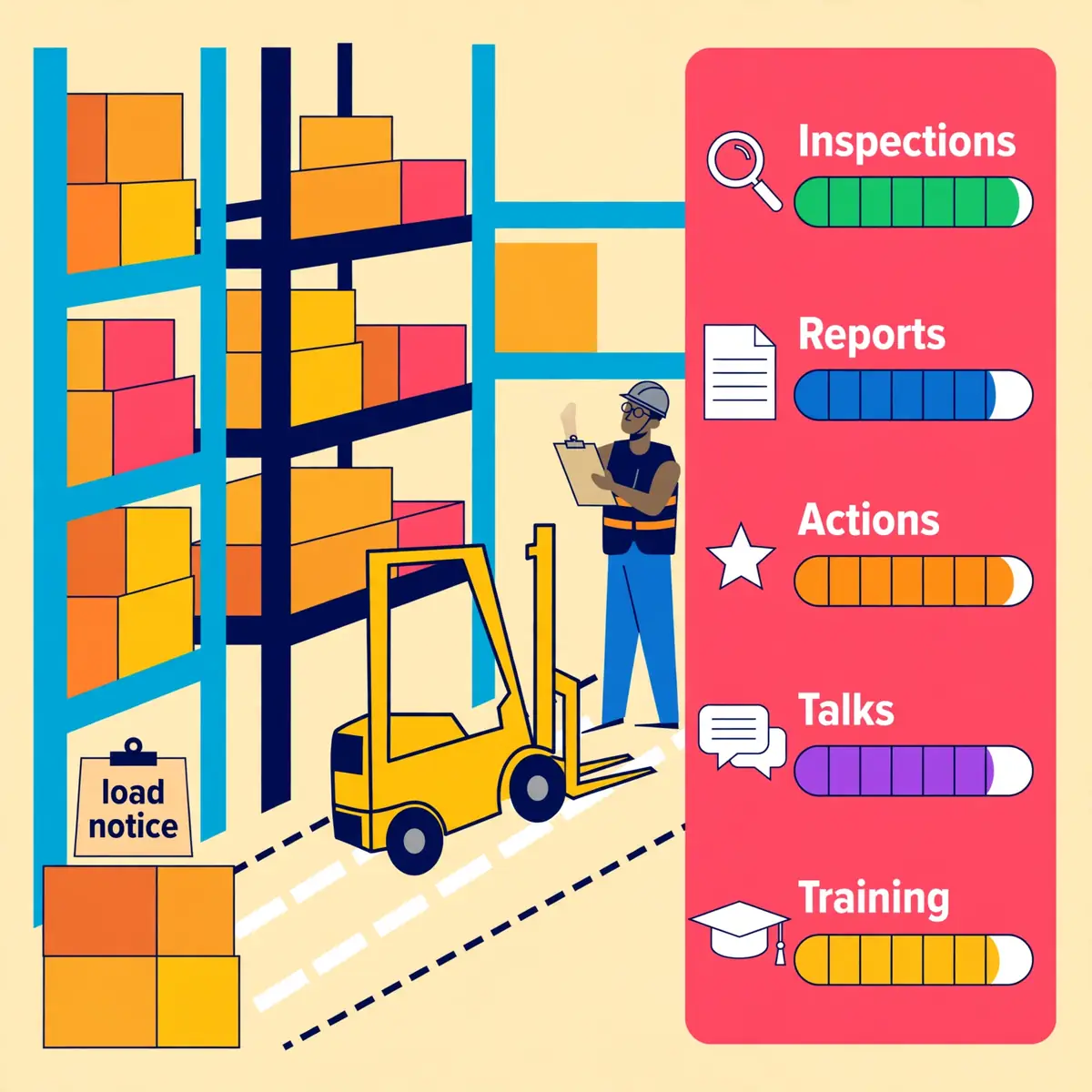
Consider a warehouse with 40 workers, two forklifts, racking three levels high and a small packing line. The site has no formal system. Training records live in a filing cabinet. Inspections happen when someone remembers. Near misses are mentioned at break time and then forgotten. The manager decides to build an SMS, starting with a gap analysis against the seven OSHA elements.
The analysis finds three strengths and three gaps. Training records exist but are incomplete. A risk assessment was done two years ago and never reviewed. Incident reporting exists on paper but produced only two reports in a year, which suggests under-reporting rather than safety. The gaps are worker participation, measurement and review. There is no safety committee. No indicators are tracked. Nobody has reviewed the system since it was created.
The build starts small. The manager writes a one-page policy. The scope covers the warehouse, the yard and the delivery drivers who enter the site. Roles are assigned in a table. The manager owns the system. The shift supervisor owns inspections. A named worker on each shift owns hazard reporting. The risk register starts with twelve risks. They include:
- Forklift and pedestrian interaction.
- Falling goods from racking.
- Manual handling on the packing line.
- Blocked fire exits.
Controls follow the hierarchy. Pedestrian walkways are painted and barriered off from forklift routes — an engineering control. Racking gets a monthly inspection and a load notice on each bay. Manual handling gets a mechanical aid for the heaviest boxes, plus training for the rest. Only three procedures are written first: hazard reporting, forklift pre-use checks and incident reporting. Each fits on one page and names its owner.
Measurement starts with five indicators:
- Inspections completed.
- Hazard reports received.
- Corrective actions closed on time.
- Toolbox talks held.
- Training refreshers completed.
How to tell whether the system works
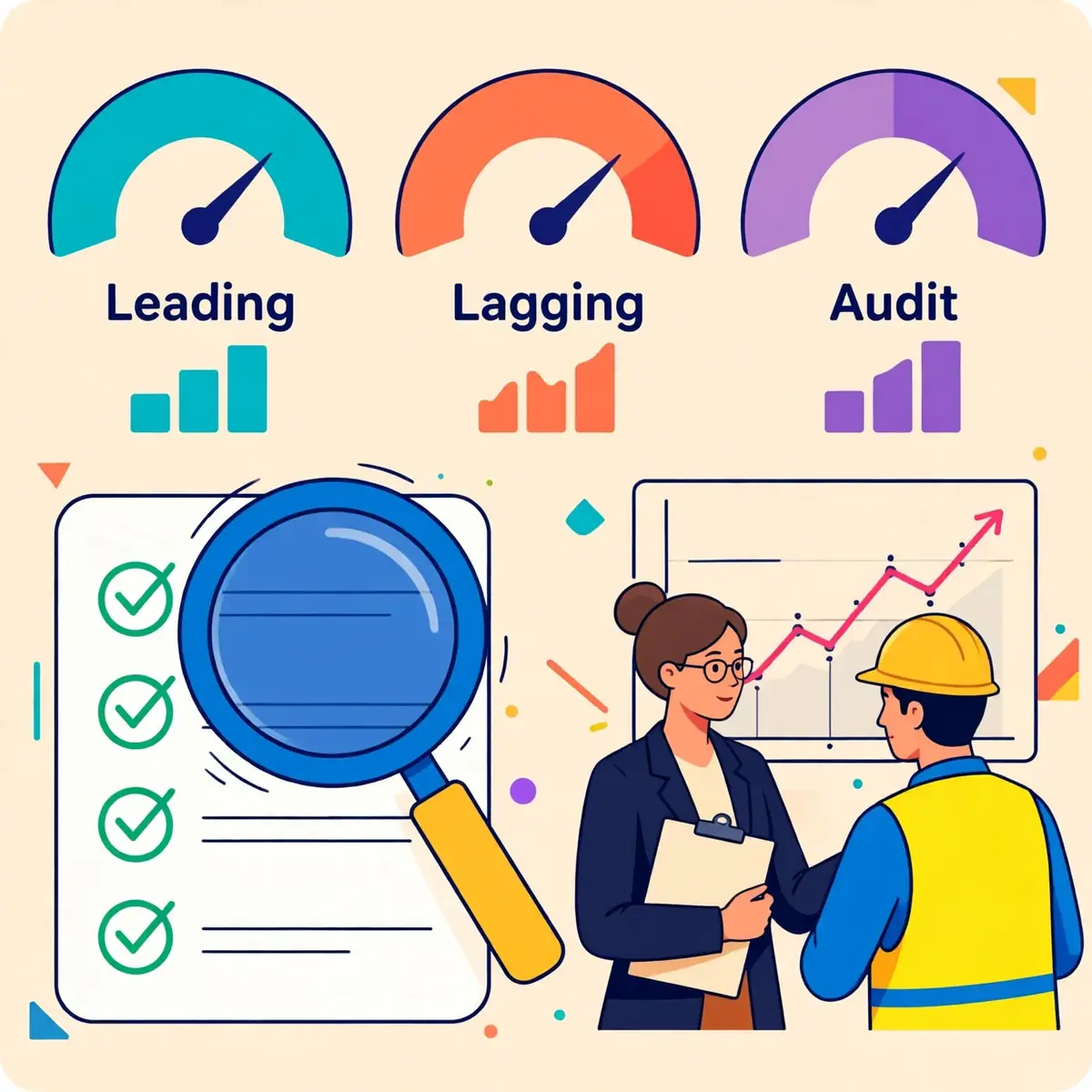
A system that looks complete on paper can still fail on the floor. Three checks reveal the truth: the indicators, the audits and the management review. Each one answers a different question. Indicators show whether the system is active. Audits show whether procedures are followed and effective. Management review shows whether leadership acts on what the other two find.
Leading and lagging indicators
Leading indicators measure activity that prevents harm. Useful examples include:
- The percentage of inspections completed on schedule.
- The percentage of corrective actions closed by their due date.
- The number of hazard reports per month.
- The number of toolbox talks held.
- The percentage of workers with in-date training.
- The number of emergency drills run.
These numbers move quickly, so they warn early when the system slows down.
Lagging indicators measure harm that has already happened: recordable injuries, lost-time cases, reportable incidents and property damage. They matter for reporting and for spotting trends, but they move slowly and they can mislead. A site with no injuries in a year may be safe, or it may simply have stopped reporting. Never judge the system by lagging indicators alone. Never set a target of zero reports. A target of zero hazard reports teaches workers to stay quiet.
Audits and inspections
Inspections check the physical workplace: guards, racking, housekeeping, fire exits, ventilation and PPE use. Audits check the system itself. Are risk assessments current? Are corrective actions closed? Do workers know the procedures? Does the training matrix match the people on shift? Both need a schedule, a checklist and a written record with findings, owners and due dates.
Audit findings should be graded by risk, not counted. Ten minor findings about missing signatures matter less than one finding that a permit-to-work is being skipped. Follow up every finding until it is closed and the closure is verified. Do not stop just because someone says it is done. An audit programme that never finds anything is either auditing the wrong things or auditing too gently.
Management review
Management review is the meeting where leadership looks at the whole system and decides what changes. It should happen at least once a year and after any serious incident or major change in the work. The agenda follows the evidence:
- Legal compliance status.
- Incident and near-miss trends.
- Audit results.
- Corrective action closure.
- Worker feedback.
- Drill outcomes.
- Changes in operations.
- Progress against safety objectives.
The review must produce decisions. Common outputs include a revised policy and new objectives. A procedure may change. Extra resources may go to a weak area. The organisation may decide to seek certification. Record the decisions with owners and dates, and check them at the next review. A review that produces no decisions is a briefing, not a review. The system will not improve because of it.
Choosing a framework: ISO 45001, ANSI/ASSP Z10 or OSHA Recommended Practices
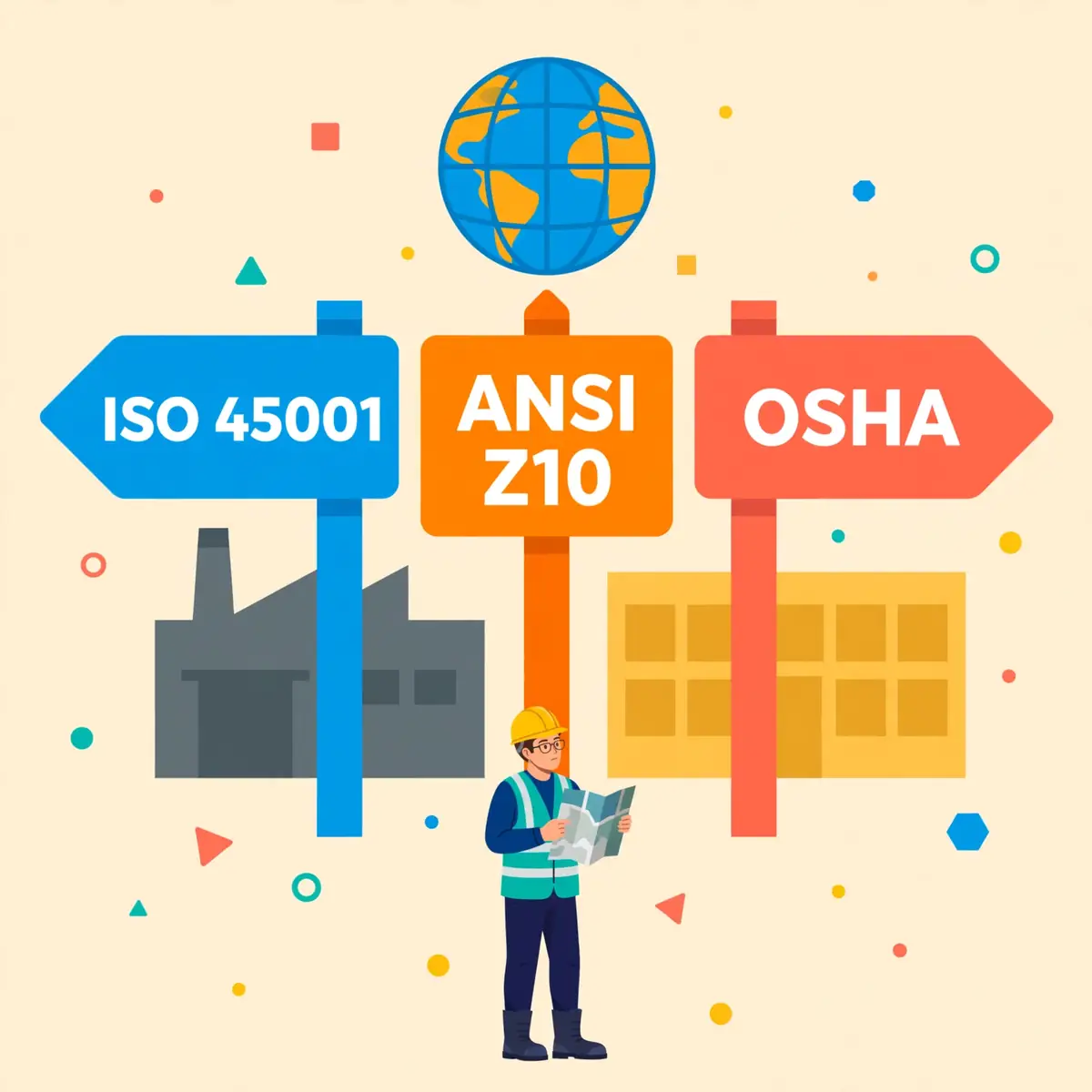
Three frameworks dominate SMS design, and they share the same substance. ISO 45001 is the international standard for occupational health and safety management systems. ANSI/ASSP Z10 is the American national standard for the same subject. The OSHA Recommended Practices are advisory guidance built for small and medium-sized businesses. Choosing between them is a decision about audience, certification and fit, not about which one is "correct".
| Framework | What it is | Certification | Best for |
|---|---|---|---|
| ISO 45001:2018 | International standard with a 10-clause structure and Plan-Do-Check-Act | Yes, through accredited certification bodies | Organisations that trade internationally or need recognised certification |
| ANSI/ASSP Z10.0-2019 | American consensus standard, Plan-Do-Check-Act based, systems-thinking approach | No formal certification scheme | United States employers wanting a detailed national framework |
| OSHA Recommended Practices | Advisory guidance with seven core elements, written for small and medium businesses | No | Smaller employers building their first system |
ISO 45001 is the right choice when customers, insurers or regulators in other countries ask for recognised certification. It applies to organisations of all sizes. It was last reviewed and confirmed in 2024. A revision is planned for publication as ISO 45001:2027. The ISO 45001 guide explains its clauses. It also explains the certification path from gap analysis to Stage 1 and Stage 2 audits. Certification is optional: many organisations use the standard as a blueprint without seeking a certificate.
ANSI/ASSP Z10.0-2019 is the United States benchmark for occupational health and safety management systems. First published in 2005 and revised in 2012 and 2019, it is a voluntary consensus standard. It emphasises systems and how they are managed, rather than individual programmes. It fits United States employers well. It is built around United States regulatory practice, and it has a companion guidance manual for smaller organisations.
The OSHA Recommended Practices suit a first system. They are free, written in plain language and built around seven elements that map cleanly onto the four-component model. A small employer can start with the Recommended Practices and build a working system. It can move to ISO 45001 later if certification becomes necessary. Whatever framework is chosen, the test is the same: does the system find hazards, control them and improve.
TipPick the framework your customers and your regulator already speak. A certificate nobody asked for costs money and attention that the system itself needs.
Common mistakes that turn an SMS into paperwork
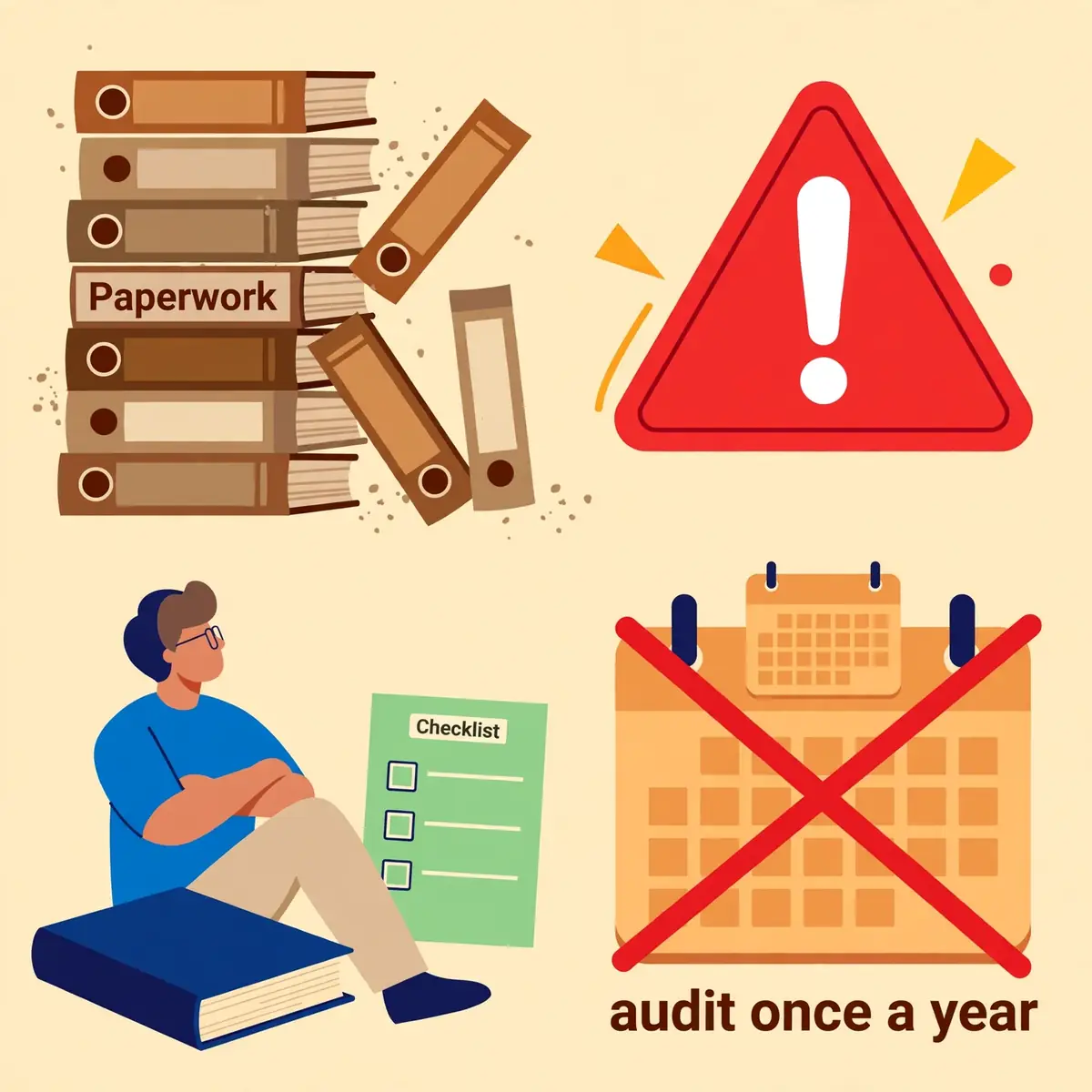
Most failed systems fail in the same few ways, and each one is preventable. The first mistake is writing the manual before understanding the work. A system designed in an office, without walking the floor, produces procedures that do not match reality. Talk to the people who do the jobs first. Workers then follow the real method and ignore the written one. The gap between the two grows until an audit or an incident exposes it.
The second mistake is treating the SMS as the safety team's property. When one person owns every process, the system stops the day that person is on leave. Shared accountability through the chain of command is not a slogan; it is the design that keeps the system running. Line managers must own controls, supervisors must own checks, and workers must own reporting.
- Too many procedures, too soon. Writing twenty procedures in the first month guarantees that none of them is tested. Start with the three that control the worst risks.
- Measuring activity instead of outcomes. Counting training sessions held says nothing about whether workers can do the job safely. Check competence by observation.
- Treating near misses as good news to file away. A near miss is free information about a failure that has not yet hurt anyone. Investigate it like an incident.
- Letting corrective actions drift. An action without an owner and a due date is a wish. Review overdue actions at every management meeting until they close.
- Copying another company's system. A borrowed manual matches someone else's risks, roles and language. Use frameworks and examples, then write the system for the actual workplace.
- Reviewing the system only before an audit. A system reviewed once a year for the auditor is a performance. Review it when the work changes, and audit it on a schedule.
The fix for most of these mistakes is the same. Keep the system small, keep it used and keep it honest. A simple system that workers use every day protects people. A complex system that only looks good during an audit does not. When a procedure is ignored, fix the procedure. When a report is not made, fix the reporting route. The system serves the work, not the other way around.
Frequently Asked Questions
What is a safety management system in simple terms?
A safety management system is the organised way a workplace manages safety. It is one connected framework of policy, risk management, checking and training, instead of separate programmes that never talk to each other. It answers four questions for every hazard:
- Who owns it?
- How is it controlled?
- How do workers learn about it?
- How is the control checked?
What are the four components of a safety management system?
The four components are safety policy, safety risk management, safety assurance and safety promotion. The model comes from the Federal Aviation Administration and is confirmed in its 2024 final rule. Policy sets direction and accountability. Risk management finds hazards and designs controls. Assurance checks that the controls work. Promotion covers training and communication.
What is the difference between an SMS and ISO 45001?
An SMS is the system itself — the policies, processes and people that manage safety in an organisation. ISO 45001 is the international standard that specifies what a good occupational health and safety management system should contain. An organisation can build an SMS using ISO 45001 as the blueprint. It can choose to seek certification against it, but certification is optional.
Is a safety management system legally required?
It depends on jurisdiction and sector. Most United States employers are not required by a single federal rule to have an SMS. Many specific written programmes are legally required, however. In the United Kingdom, the Management of Health and Safety at Work Regulations 1999 require arrangements for planning, organisation, control, monitoring and review. Those arrangements are the core of a management system. Aviation is regulated separately, and the FAA requires an SMS for parts of commercial aviation.
How long does it take to build a safety management system?
A small organisation can build a working first version in weeks. It needs a gap analysis, a one-page policy, a risk register, three core procedures and a small set of indicators. A large or multi-site organisation usually takes months, because the scope is wider and more people must be involved. The first version should control real risks now and improve through review, rather than waiting until every procedure is perfect.
What is the difference between leading and lagging indicators?
Leading indicators measure activity that prevents harm, such as inspections completed, hazard reports received and corrective actions closed on time. Lagging indicators measure harm that has already happened, such as injuries and lost-time cases. A working SMS tracks both. It manages by the leading indicators, because they warn early while there is still time to act.
Do small businesses need a safety management system?
Yes, in proportion to their risks. A small business does not need the system a large factory needs. It still needs the same elements:
- Someone accountable.
- Hazards identified.
- Controls chosen.
- Workers trained.
- Performance checked.
Sources
- OSHA — Recommended Practices for Safety and Health Programs
- Federal Aviation Administration — Safety Management System (SMS)
- Federal Register — Safety Management Systems (final rule, 26 April 2024)
- ISO — ISO 45001:2018, Occupational health and safety management systems
- Legislation.gov.uk — Management of Health and Safety at Work Regulations 1999, Regulation 5
- Health and Safety Executive — Managing health and safety
- Occupational Health & Safety — The New ANSI/ASSP Z10.0 Standard and Its Implementation