OSHA 10-hour training is a voluntary 10-hour hazard-awareness course for entry-level workers in the United States. It runs through the Occupational Safety and Health Administration (OSHA) Outreach Training Program. It ends with a Department of Labor (DOL) course completion card. The course teaches workers to recognise common hazards, understand their rights, and know how to file a complaint.
No federal law requires a worker to hold the card. Many states, contractors, employers and apprenticeship programmes require it anyway, so the card often decides whether a worker can start on a site. The right version matters too: construction and general industry courses teach different hazards, and the wrong one may not satisfy the requirement.
What OSHA 10-hour training is
The Outreach Training Program is OSHA's voluntary training programme for workers. OSHA authorises independent trainers to teach the courses, and those trainers issue the completion cards. OSHA itself does not run the classes and does not teach workers directly.
A voluntary awareness course, not a licence
The 10-hour course builds basic hazard awareness. It covers how to recognise a hazard, avoid it, and report it, plus the worker's rights and the employer's duties. It does not teach a worker how to perform a skilled task, and it does not qualify anyone to do specialised work.
OSHA states the point plainly in its own programme documents. Outreach training does not meet the training requirements in any OSHA standard. A worker who holds the card still needs the separate training each applicable standard requires for their own job.
Three versions for three kinds of work
The programme offers a 10-hour course for construction, another for general industry, and a third for maritime work. A separate 15-hour course covers disaster site workers. Each version follows its own topic list, because the hazards differ from one industry to the next.
Construction courses follow the hazards in Part 1926 of Title 29 of the Code of Federal Regulations (CFR), the construction standards. General industry courses follow 29 CFR 1910, which covers factories, warehouses, healthcare and offices. A card for one industry does not prove awareness of the other's hazards.
What the "10 hours" actually means
The 10 hours are student contact hours: time spent actively learning. Breaks, meals, registration and attendance do not count toward the total. Optional tests do not count either, and OSHA does not require a test at all.
OSHA also caps training at 7.5 contact hours in a single day. A 10-hour course therefore takes at least two calendar days, however it is delivered. Any provider promising a one-day OSHA 10-hour course is not following the programme rules.
TipCheck the version before you enrol. A construction card and a general industry card look alike, and the wrong one can still leave a worker barred from a site.
Who needs OSHA 10-hour training

OSHA designed the 10-hour course for entry-level workers. It suits new starters, apprentices, labourers and helpers, and anyone starting work in a hazardous environment for the first time. Experienced workers who never earned the card also take it, often because a new employer or site asks for it.
Workers the course was built for
The course assumes no prior safety knowledge. It explains hazards in plain terms and gives workers a shared safety vocabulary for the site or the shop floor. Young workers benefit most, because they are the least likely to recognise a hazard before it hurts them.
Employers use the course as a baseline for a new hire. It gives every worker the same grounding before site-specific training begins. That shared baseline is the course's real value, not the card itself.
When a state, contractor or employer requires the card
Federal OSHA never requires the card, but other bodies do. Several states require OSHA 10-hour training by law for construction workers, usually on public works projects above a set contract value. The states most often named are Connecticut, Massachusetts, Missouri, Nevada, New Hampshire, New York, Rhode Island and West Virginia.
Nevada goes further than most. It requires OSHA 10-hour training for construction workers and OSHA 30-hour training for supervisors within 15 days of being hired. New York City adds its own Site Safety Training rules for many workers on larger sites, on top of the OSHA 10-hour course. Rules and thresholds change, so check with the state labour department before relying on a list.
General contractors are the most common reason a worker is asked for a card. Many require OSHA 10-hour training for everyone on site and OSHA 30-hour training for anyone supervising, whatever state the site sits in. Large projects such as data centres, hospitals and industrial plants almost always require it.
Who should take the 30-hour course instead
Supervisors, foremen, superintendents and safety coordinators belong in the 30-hour course. OSHA says the 30-hour class suits supervisors or workers with some safety responsibility. It covers the same ground in greater depth and adds managing safety and health.
A worker moving toward a crew-lead role can go straight to the 30-hour course. No rule requires the 10-hour card first. The choice should follow the job, not the shorter course.
Construction topics: what the 10 hours cover
OSHA's Construction Industry Procedures set the construction syllabus exactly. Six hours are required topics, two hours are electives, and two hours are optional content. The trainer cannot skip a required topic or shorten it below its minimum time.
| Topic | Hours | What it covers |
|---|---|---|
| Introduction to OSHA | 1 hour | Worker rights, employer responsibilities, and how to file a complaint |
| Focus Four hazards | 4 hours | Falls (at least 1.5 hours), electrocution, struck-by, and caught-in or between (at least 30 minutes each) |
| PPE requirements | 30 minutes | Selecting and using personal protective equipment for construction hazards |
| Health hazards in construction | 30 minutes | Noise, silica dust, hazardous chemicals, or another construction health hazard |
| Electives | 2 hours | At least two topics from OSHA's elective list, at least 30 minutes each |
| Optional topics | 2 hours | Other construction hazards, or deeper coverage of required or elective topics |
The Focus Four: four hours on the deadliest hazards
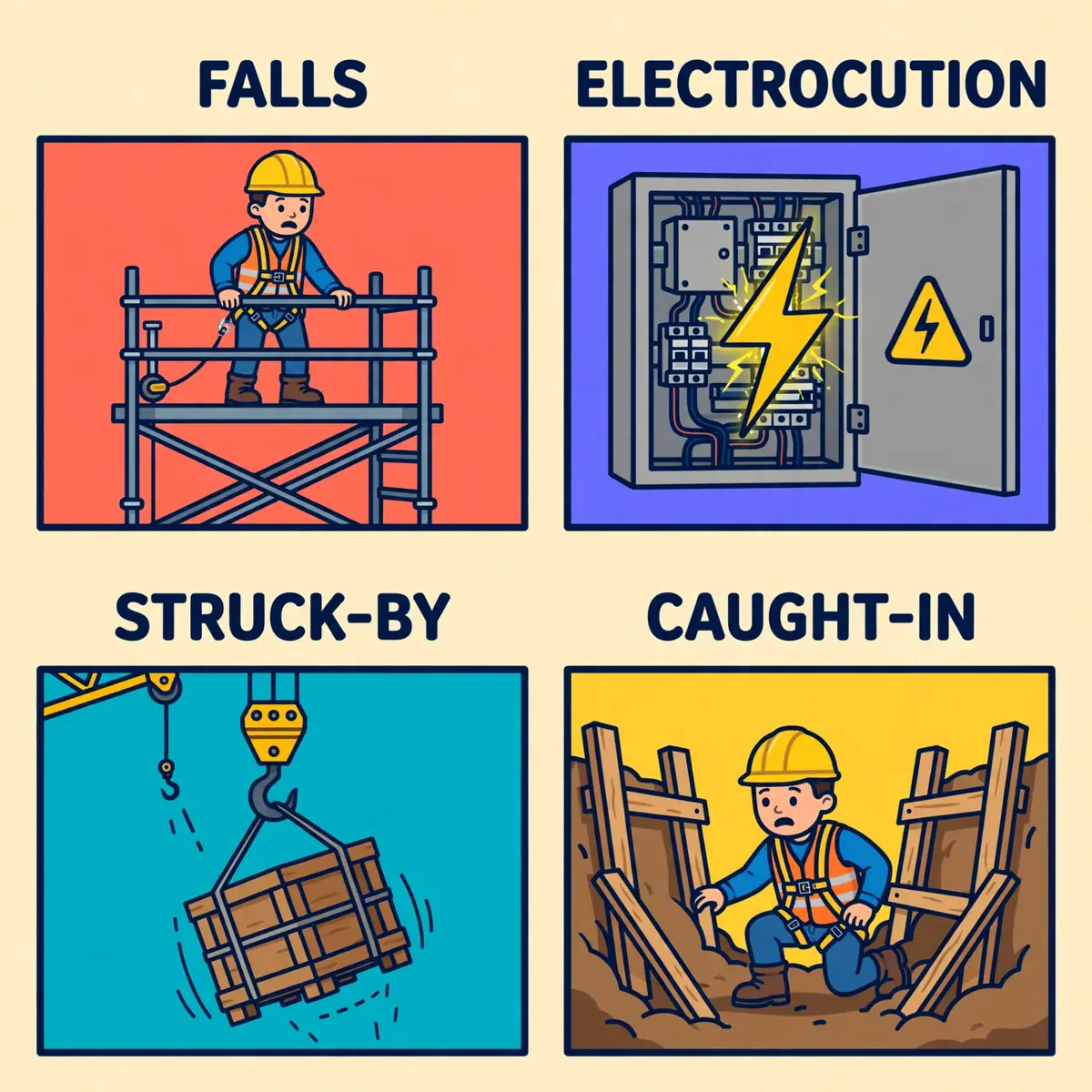
The Focus Four are falls, electrocution, struck-by and caught-in or between hazards. OSHA gives them four of the ten hours because they sit behind most construction fatalities. Falls get the largest share, at least 1 hour and 30 minutes, because most construction fatalities are caused by fall hazards.
Each Focus Four lesson follows the same pattern. Workers learn to identify the hazard, describe its types, protect themselves from it, and recognise what the employer must do. The lessons use a participatory model, so workers discuss real site situations rather than only listening to a lecture. Fall protection is the largest single lesson, and it sets up the detailed training the fall protection standard requires later.
Electives: shaping the last hours to the job
The trainer picks at least two elective topics for the remaining two hours. The list includes scaffolds, excavations, stairways and ladders, cranes and derricks, confined spaces, tools, welding and cutting, concrete work, ergonomics, fire protection and materials handling. Each elective runs at least 30 minutes.
Good trainers pick electives the workers will actually meet. A crew digging foundations needs excavations, and a crew on a steel frame needs steel erection. Ask the trainer which electives a course covers before enrolling, and pick the course that matches the work ahead. Confined space entry is a common elective, and it shows how an awareness lesson differs from the full permit training the standard requires.
General industry topics: what the 10 hours cover
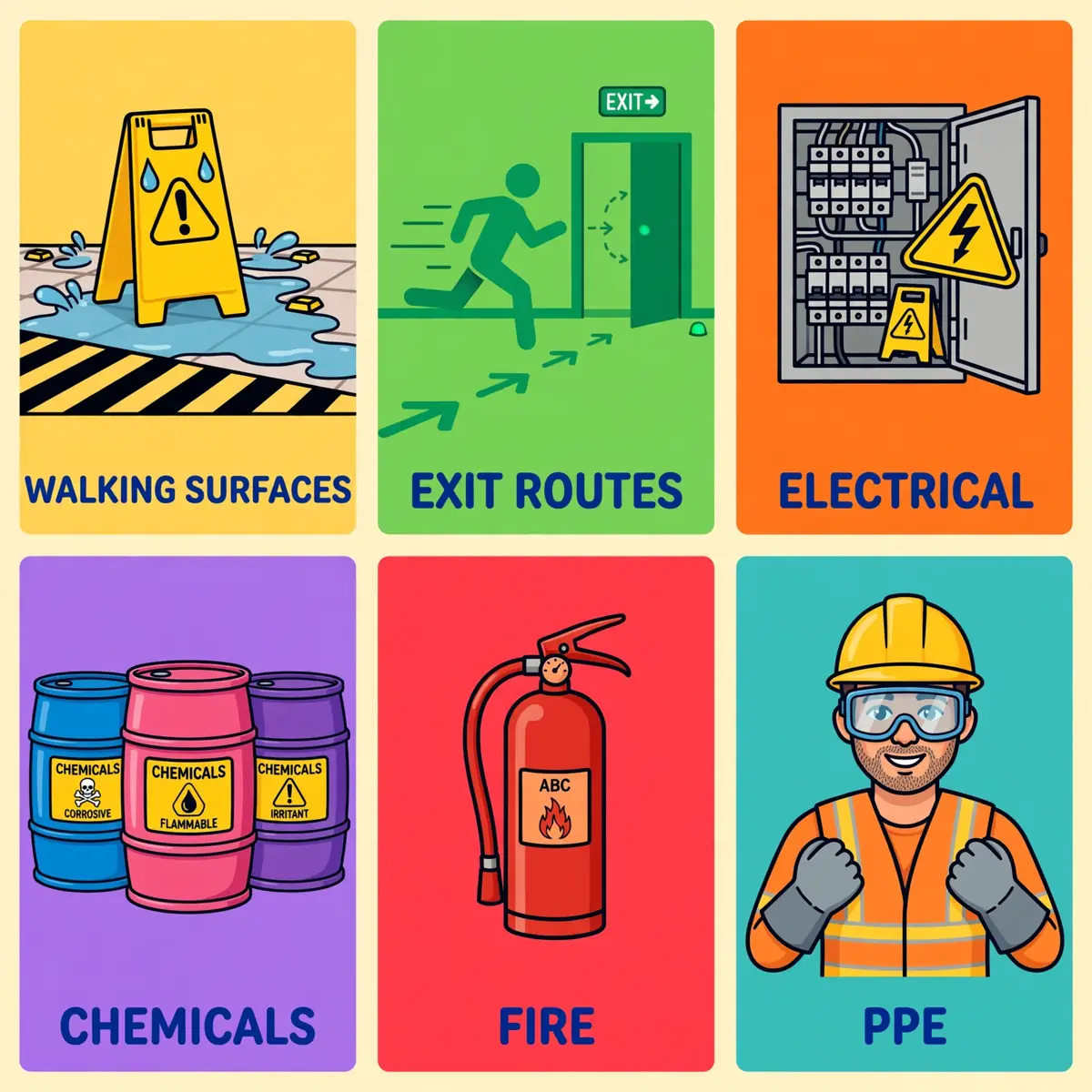
The general industry syllabus follows the same shape: six required hours, two elective hours and two optional hours. The hazards differ, because a factory floor is not a construction site. The required topics come from 29 CFR 1910, the general industry standards.
| Topic | Hours | What it covers |
|---|---|---|
| Introduction to OSHA | 1 hour | Worker rights, employer responsibilities, and how to file a complaint |
| Walking and working surfaces, including fall protection | 1 hour | Slips, trips, falls, floor openings and ladders |
| Exit routes, emergency action plans, fire prevention plans and fire protection | 1 hour | Getting out safely and what to do in an emergency |
| Electrical | 1 hour | Electrical hazards and safe work practices |
| Personal protective equipment | 1 hour | Selecting and using personal protective equipment |
| Hazard communication | 1 hour | Chemical labels, safety data sheets and hazard classes |
| Electives | 2 hours | At least two topics, at least 30 minutes each |
| Optional topics | 2 hours | Other general industry hazards, or deeper coverage |
The six required hours
Each required topic gets exactly one hour. Walking and working surfaces cover slips, trips and falls, the everyday injuries of factories and warehouses. Exit routes and fire protection cover how workers get out and where they gather when an alarm sounds.
Hazard communication teaches workers to read chemical labels and safety data sheets and to recognise hazard classes. Electrical safety covers the hazards of live parts and the practices that keep workers clear of them. Together the six hours give a broad picture of the hazards in a fixed workplace.
Electives for factory, warehouse and healthcare work
Electives let the trainer aim the course at the workplace. The list includes hazardous materials, permit-required confined spaces, lockout/tagout, machine guarding, welding and cutting, industrial hygiene, bloodborne pathogens and ergonomics. A food plant and a hospital would pick different pairs.
Machine guarding and lockout/tagout suit factories with moving machinery. Bloodborne pathogens suit healthcare and first aid kit roles. Ergonomics suits warehouses and packing lines. The electives are where a general industry course earns its keep, so check them before enrolling.
WarningCPR and first aid training cannot count toward the 10 hours. OSHA's procedures list them as ineligible topics, so a course that counts first aid time toward the total is not following the rules.
How much OSHA 10-hour training costs

The course fee depends on the format and the provider. OSHA sets no price, so providers charge what the market bears. The ranges below come from current authorised provider listings, and they move with sales and group rates.
| Format | Typical cost per person | Notes |
|---|---|---|
| Online, self-paced | $40–$125 | Most common format; card by mail after completion |
| In person, classroom | $50–$250 | Usually two days; live questions and discussion |
| Group or employer rate | $60–$100 | Per person for a booked group |
| Union or apprenticeship | Often free | Included in membership or training |
Who usually pays
Employers often pay, because they are the ones who require the card. Many list the card as a hiring condition and cover the fee for new starters. Apprenticeship programmes often include the course in the first year at no extra charge to the apprentice.
A worker who pays for the course should keep the receipt and the card details. Some employers reimburse the fee after hiring. The card belongs to the worker, not the employer, and it travels with the worker to the next job.
Free and low-cost routes
Union halls often run the course free for members. Trade schools and community colleges sometimes include it in tuition. OSHA's Susan Harwood Training Grant Program funds free or low-cost training through nonprofits, aimed at small businesses and underserved workers.
State-plan states sometimes subsidise training through their own programmes. The cost people forget is lost time: two days of training means two days of reduced output or cover. Build that into the training calendar before booking.
TipAsk who pays before you book. Employers, unions and apprenticeship programmes often cover the fee, and a worker who pays first may never get it back.
OSHA 10 vs OSHA 30: which one to take
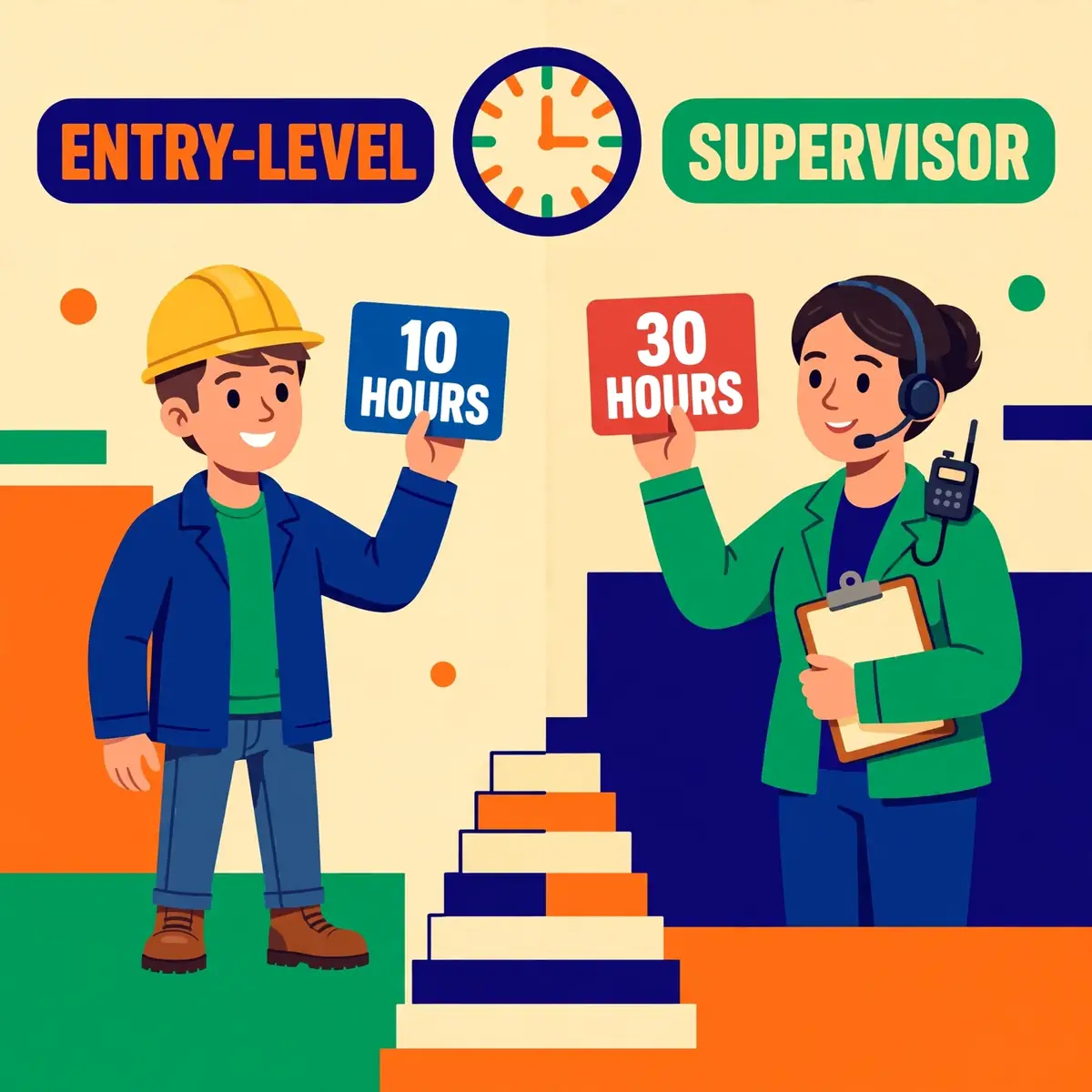
The 10-hour and 30-hour courses come from the same programme, but they serve different people. The number is the minimum hours of instruction. The 30-hour course is not simply a longer 10-hour course: it adds topics aimed at people who manage a site.
| OSHA 10-hour | OSHA 30-hour | |
|---|---|---|
| Who it is for | Entry-level workers | Supervisors, foremen and safety leads |
| Length | At least 10 hours, usually 2 days | At least 30 hours, usually 4 to 5 days |
| Construction required topics | 6 hours | 14 hours |
| Construction electives | 2 hours, at least 2 topics | 12 hours, at least 6 topics |
| Typical online cost | $40–$125 | $150–$300 |
| Typical in-person cost | $50–$250 | $300–$500 |
When the 10-hour is enough
The 10-hour course is enough for a worker who follows instructions on site rather than giving them. Labourers, helpers, apprentices and new starters fit the course. It is also enough where a contract or a state law asks for the 10-hour card by name and nothing more.
It is the faster and cheaper route to a site-ready card. Most workers finish it in two days online or in a classroom. For a first job in construction or general industry, it is usually the right first step.
When the 30-hour is the right call
The 30-hour course adds managing safety and health, including jobsite inspections, accident investigation and running safety meetings. It gives the Focus Four six hours instead of four, and it gives personal protective equipment and health hazards two hours each instead of 30 minutes. It also adds stairways and ladders as a required topic.
A foreman who only holds a 10-hour card may find the card questioned at the gate. Many general contractors require OSHA 30-hour training for anyone supervising, as a contract term. The 30-hour card also signals readiness for a leadership role when a worker applies for one.
Do you need the 10 before the 30?
No. OSHA sets no rule that a worker must hold a 10-hour card before taking the 30-hour course. A worker heading toward a supervisor role can go straight to the 30-hour course and skip the 10-hour entirely.
The only limit is time. A 30-hour class takes at least four calendar days, because of the 7.5-hour daily cap. A worker who needs a card this week should take the 10-hour course and plan the 30-hour course later.
How to get an OSHA 10 card
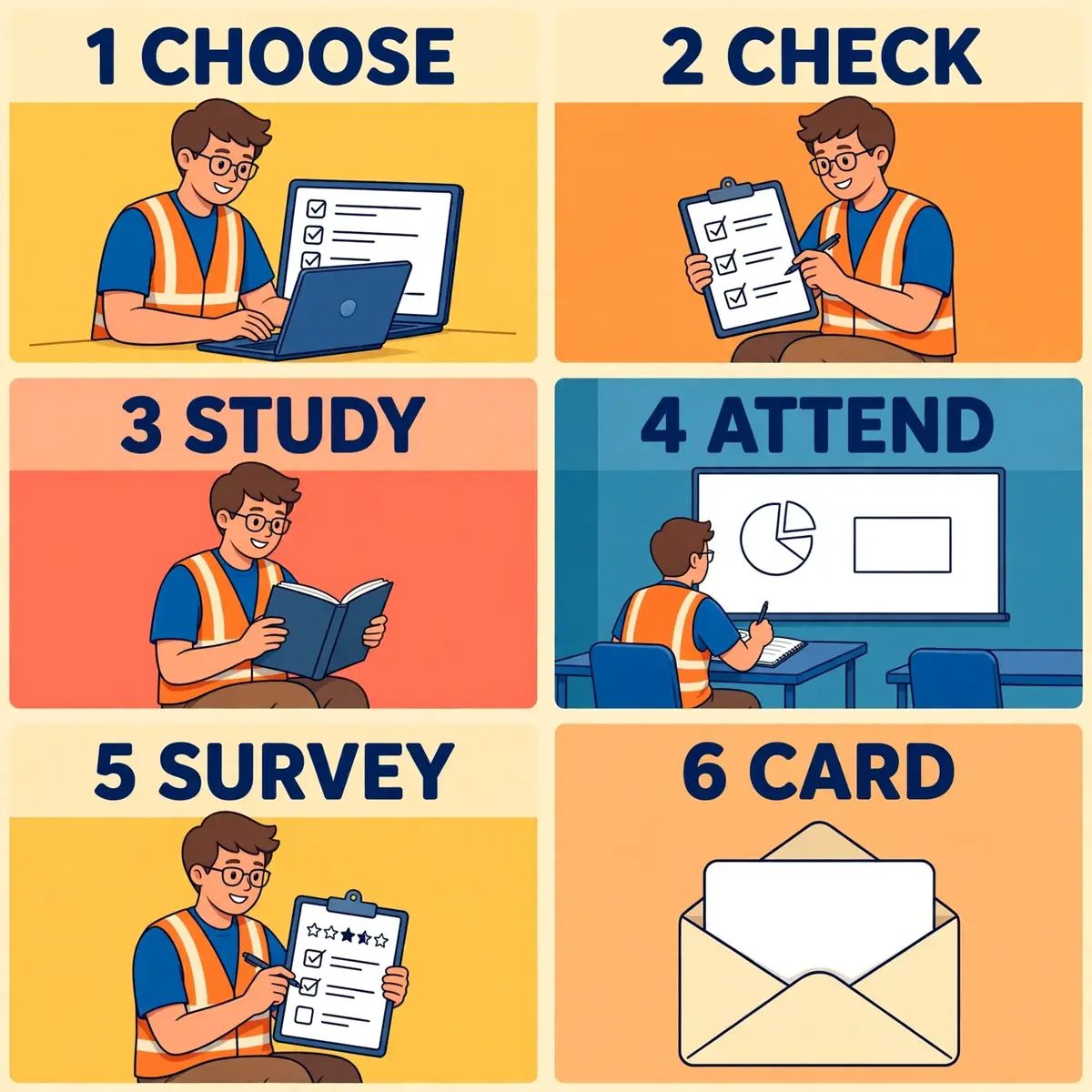
Getting a card takes six steps, and the last two belong to the trainer. The worker's job is to pick the right course, finish all ten hours, and keep the proof. The trainer's job is to report the class and issue the card.
- Pick the right version: construction, general industry or maritime, and 10-hour or 30-hour for the role.
- Check the provider is OSHA-authorised: an authorised trainer, or an approved online provider listed by OSHA.
- Enrol and start within the provider's window, then finish all ten hours within 180 days.
- Attend the whole class and cover every required topic, since partial attendance earns no card.
- Complete the end-of-course survey, which OSHA requires before a card is issued.
- Receive the card by mail from the trainer, usually within a few weeks.
What happens after you finish
The trainer reports the class to their Authorizing Training Organization (ATO) within 30 days of the class end date. The ATO processes the report and issues the plastic Department of Labor card. OSHA's programme rules require the card to reach the student within 90 days of the class end date.
Trainers may hand out a class certificate at the end of the course as interim proof. Whether an employer accepts that certificate is the employer's decision. Keep it safe until the card arrives, and keep a note of the trainer's name and the class date.
Lost your card?
Ask the trainer or provider who taught the course. Only they can request a replacement, because OSHA does not keep student records and does not issue replacement cards directly. A replacement is possible only if the class ended within the last five years, and only one replacement is allowed per class.
If the class ended more than five years ago, or the trainer can no longer be found, the only route is to retake the course. Keep a photo of the card and a note of the trainer's details, so a lost card is a phone call rather than a new course.
Online or in person: how the course runs
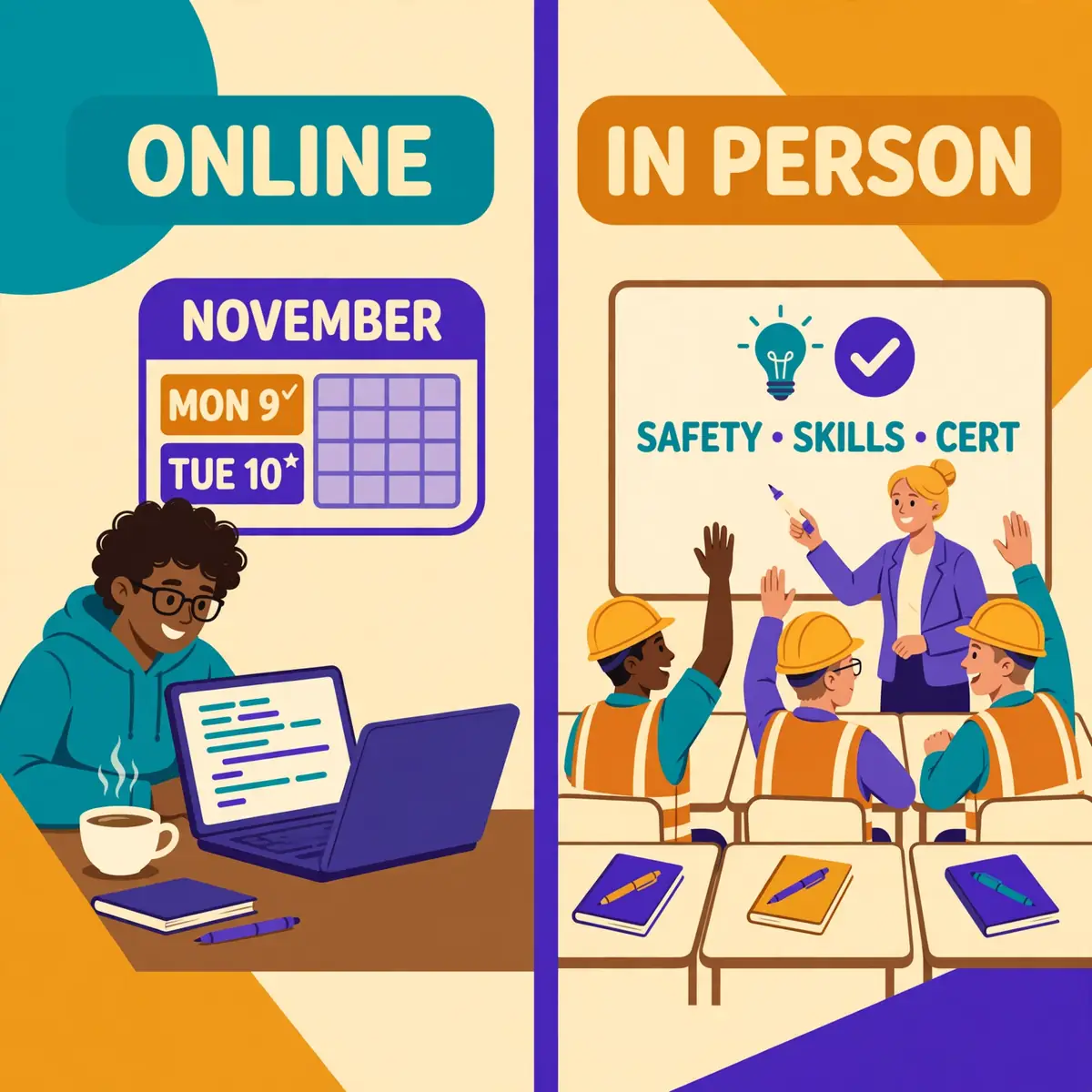
OSHA approved online delivery of Outreach courses in 2009, and both formats now lead to the same card. The choice is about how a worker learns best, not about which card counts. Both formats must follow the same programme rules.
The daily limit and the 180-day window
Training is limited to 7.5 student contact hours per day, in person or online. A 10-hour course therefore takes at least two calendar days in either format. Online platforms lock the course once the daily cap is reached, and the worker resumes the next day.
The whole course must be finished within 180 days of starting. The end-of-course survey must be completed inside the same window, or no card is issued. A worker who starts and then stops should set a finish date at enrolment, not leave it open.
Online: flexible but paced
Online courses run at the worker's own pace, in short sessions around shifts. The platform holds each module open until its minimum time has passed, so a worker cannot click through in minutes. Most workers finish within one or two weeks of starting.
Online suits workers who read well in English or Spanish and can study alone. It suits workers who struggle with reading or with the language less well, because there is no trainer in the room to ask. Many providers offer the course in Spanish, so check the language before enrolling.
In person: faster questions, fixed days
Classroom courses usually run over two days, with a live trainer and other workers in the room. Questions get answered on the spot, and the participatory activities work as OSHA intends. Workers who learn by talking and doing usually prefer the classroom.
The trade-off is the fixed schedule. Two days out of work must be arranged, and travel may be needed. For a group of new starters, a booked classroom course is often the simplest option, because everyone finishes together.
Does an OSHA 10 card expire?
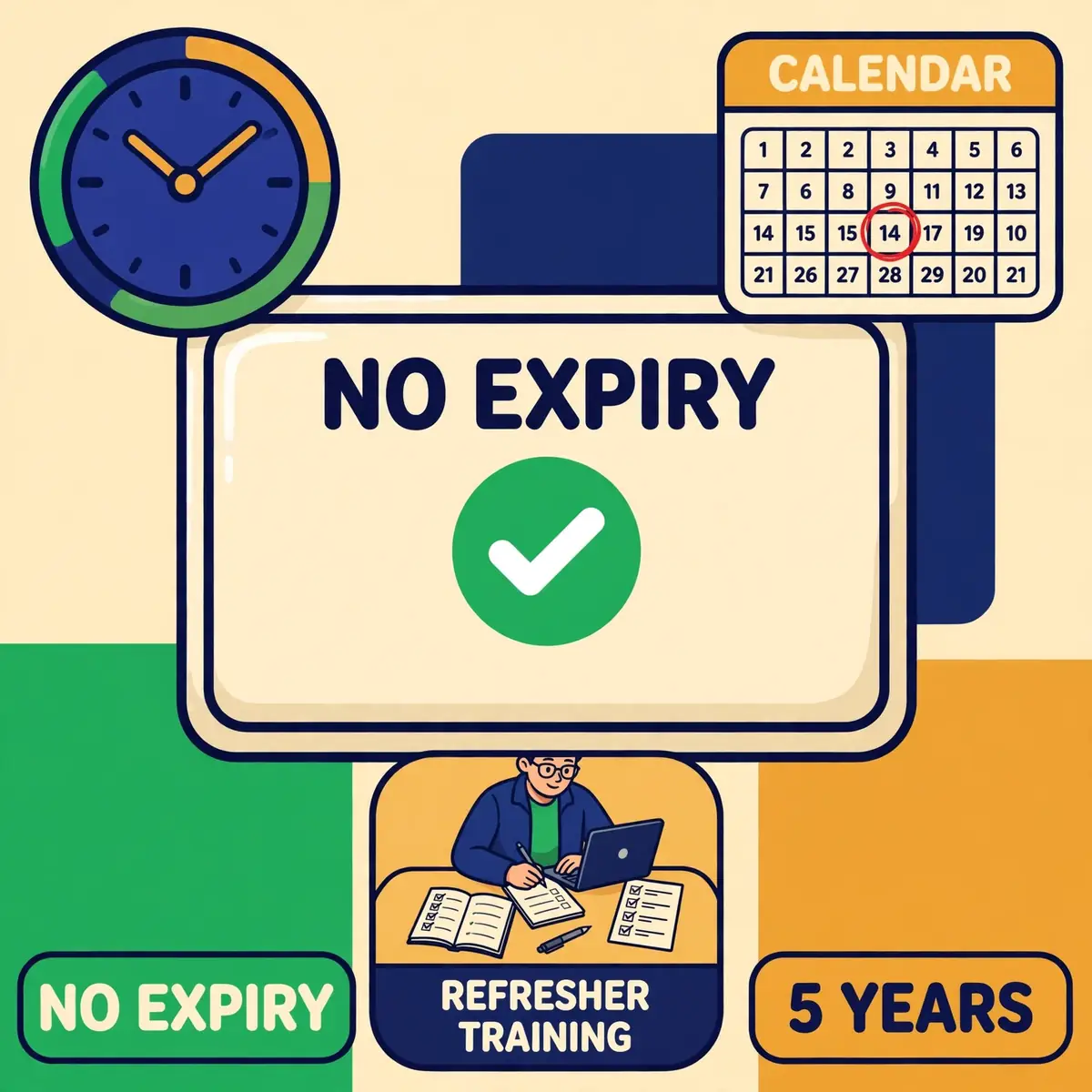
No. At federal level, OSHA Outreach completion cards carry no printed expiry date and no renewal schedule. A card earned ten years ago is still a valid card under OSHA's programme rules. That is the federal position, and it is where the confusion starts.
When to retake it anyway
States, employers, unions and project owners set their own rules. Many treat a card as valid for five years and ask for a refresher after that. Some project specifications demand a card earned within a set number of years, even though OSHA sets no such limit.
OSHA also recommends refresher training when conditions change, new hazards appear, or a worker's performance shows the lesson did not stick. A worker returning to construction after years away should retake the course, even if the old card is still valid.
How employers check a card
OSHA runs no national database of student cards, so an employer cannot look a card up online. Plastic cards carry a QR code that links to the OSHA Training Institute Education Center that processed the card, and that centre can confirm it. Otherwise the issuing trainer is the point of contact.
Keep the card with work documents and bring it to any site that asks for it. A photo on a phone helps, but a site gate may ask for the plastic card itself. Record the trainer's name, the class date and the card details somewhere safe.
What the card does not do
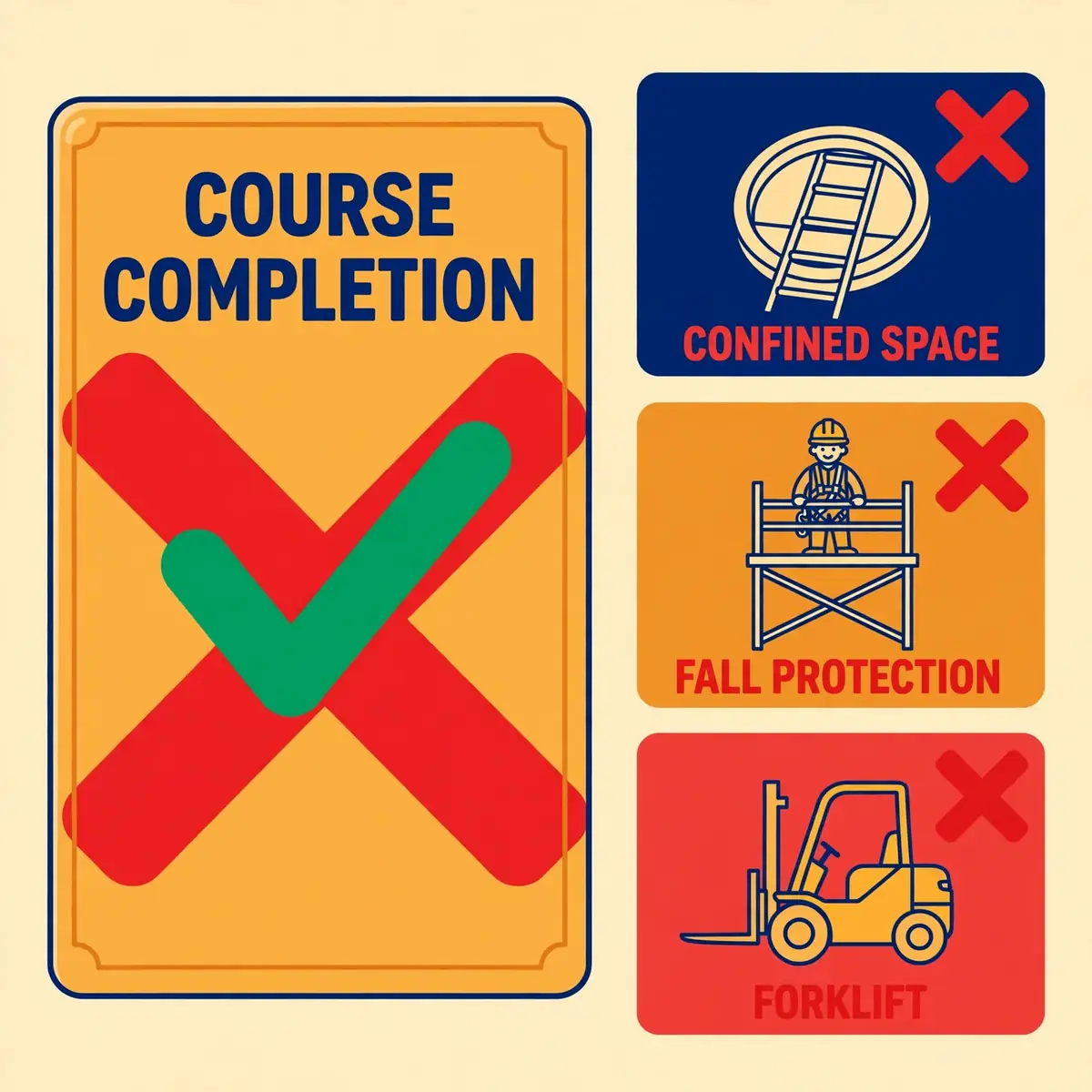
The card's limits matter more than its benefits. Most misunderstandings about OSHA 10-hour training come from treating the card as proof of something it never claimed. Three limits deserve a clear statement.
It meets no OSHA standard's training requirement
OSHA states the rule in its programme documents and in its own frequently asked questions. Outreach training does not meet the training requirements in any OSHA standard. The card proves hazard awareness, not training on a specific hazard. For the full list of standards that do require training, OSHA points to its booklet Training Requirements in OSHA Standards (OSHA 2254). The full set of duties is wider than Outreach: OSHA training follows the hazard, with each standard setting its own who, what and when.
A worker with a general industry card has still not met the confined space training requirement under 29 CFR 1910.146. A construction worker with the card still needs fall protection training under 29 CFR 1926.503 before exposure to a fall hazard. Forklift training under 29 CFR 1910.178 is also still needed before operating a truck. Each standard's training must be delivered for the worker's own hazards.
It is not a certification or a licence
OSHA describes the card as neither a certification nor a licence. It is a student course completion card: proof that a worker attended and finished a class taught by an authorised trainer. Calling it a certification overstates it, and employers who know the programme will notice.
The distinction matters on a CV. List it as an OSHA 10-hour Outreach completion card, not as an OSHA certification. The honest wording still shows a worker who takes safety seriously, without claiming a credential that does not exist.
It does not guarantee a job
OSHA warns against providers who promise jobs to course graduates. The card can open doors, because many employers ask for it before hiring. It cannot promise employment, and no provider can promise it either.
What the card does guarantee is a shared baseline. Every worker who holds one has heard the same introduction to OSHA, the same hazard lessons and the same account of worker rights. That shared baseline is useful, and it is all the card claims.
AlertA 10-hour card does not prove a worker was trained on the hazards of their own job. An inspector will ask for the training each applicable standard requires, and the card will not answer that question.
How to choose a real provider and spot a fake course

Only OSHA-authorised trainers and approved online providers can issue a real Department of Labor card. Cards from anyone else are invalid, and employers and inspectors do check. Choosing a provider is the one step where a wrong choice wastes both the fee and the ten hours.
Three checks before you pay
First, check that the provider appears on OSHA's current list of authorised online Outreach providers, or that the trainer holds a current authorised trainer card. OSHA's lists change, so a bookmark from years ago can mislead.
Second, ask how the card is submitted and how long it takes. A legitimate provider answers plainly: the trainer reports the class to the Authorizing Training Organization, and the card follows by mail within 90 days.
Third, ask what happens if a worker does not pass or does not finish. A legitimate provider explains the retake or reset terms before taking payment, and never promises a card without the full ten hours.
Warning signs of a fake course
Walk away from any provider that promises a card in a few hours, offers to sell a card without the course, or advertises no quizzes and no required hours. A real course takes at least two days, because of the daily hour cap, and it requires full attendance.
Other warning signs are a price far below every other provider, no trainer name on the booking, and no mention of OSHA authorisation anywhere on the site. Fake cards are caught at site check-in, and a worker caught with one can lose the job.
WarningNever buy a card without taking the course. Fake cards are caught at site check-in, and the worker who presents one can lose the job on the spot.
Common mistakes with OSHA 10-hour training
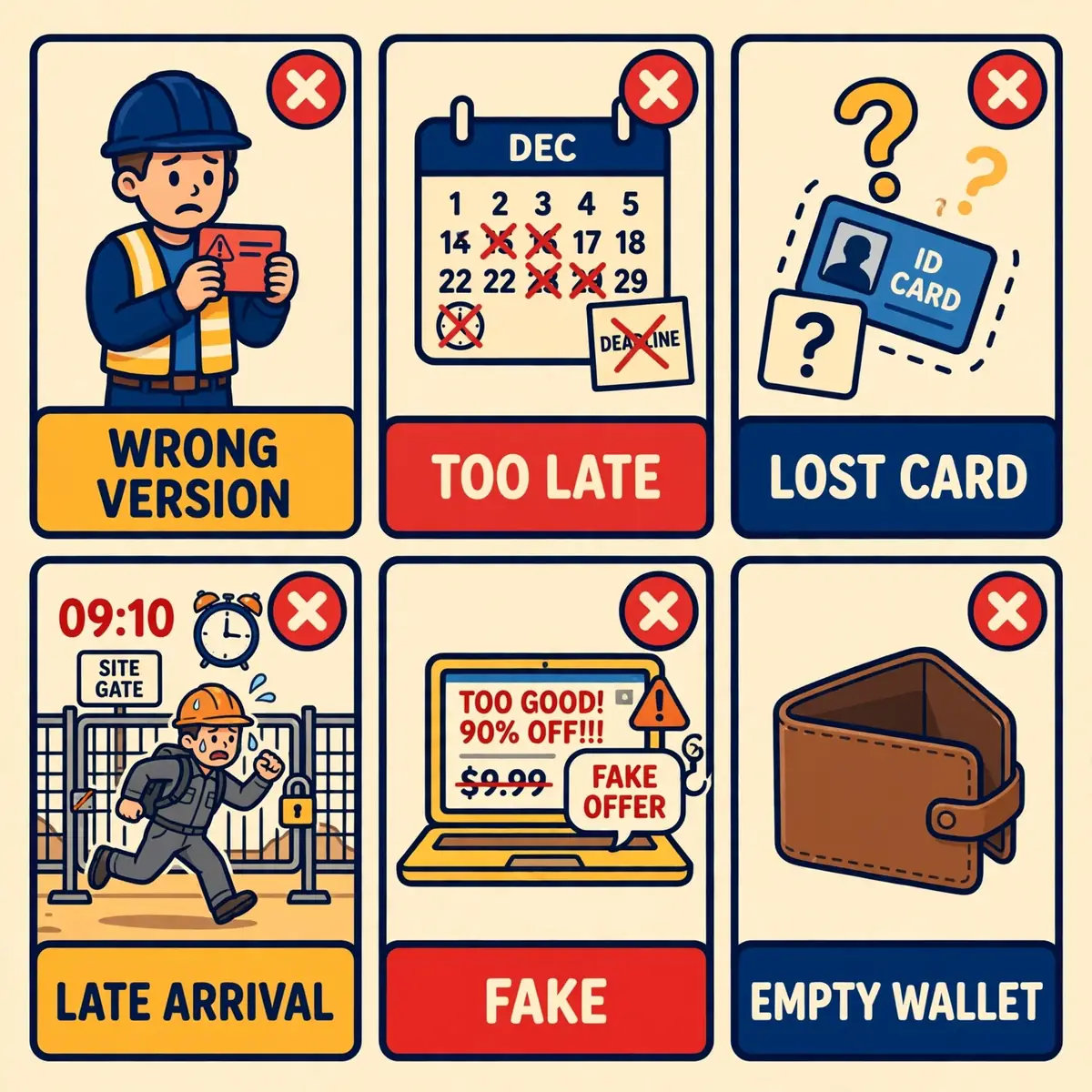
Most trouble with OSHA 10-hour training comes from a handful of avoidable mistakes. Each one is easy to make and easy to prevent, once the rules are clear.
- Taking the wrong version: a construction worker with a general industry card, or the reverse, may still be barred from the site.
- Treating the card as a certification: it is a completion card, and calling it a certification overstates it.
- Assuming the card covers standard-specific training: confined space, fall protection and forklift training are still needed separately.
- Booking an unauthorised provider: the card will be invalid, and the fee and the ten hours are lost.
- Leaving the course unfinished: after 180 days the progress expires and the course must be bought again.
- Losing the card details: without the trainer's name and the class date, a replacement is hard to request.
- Waiting until the first day on site: the course takes at least two days, so a last-minute booking leaves a worker short.
Frequently Asked Questions
Is OSHA 10-hour training required by law?
Not by federal law. OSHA's Outreach Training Program is voluntary. Several states require the card by law for construction work, usually on public works projects, and many employers and contractors require it as a condition of work.
How much does OSHA 10-hour training cost?
Online courses typically cost $40 to $125, and in-person courses typically cost $50 to $250. Union-sponsored courses are often free, and employers often pay the fee. Prices are market ranges, not fixed fees.
Can I take OSHA 10-hour training online?
Yes, through an OSHA-authorised online provider listed by OSHA. The online course follows the same rules as the classroom version: a 7.5-hour daily cap, a 180-day completion window, and the same required topics.
How long does it take to get the card after finishing?
The trainer reports the class to the Authorizing Training Organization within 30 days, and the card must reach the student within 90 days of the class end date. Most cards arrive within a few weeks.
Does an OSHA 10 card expire?
No, not at federal level. OSHA prints no expiry date on the card. Some states, employers and unions treat a card as valid for five years and ask for a refresher after that.
What is the difference between OSHA 10 and OSHA 30?
OSHA 10 is a 10-hour awareness course for entry-level workers. OSHA 30 is a 30-hour course for supervisors and workers with safety responsibility, with deeper coverage and extra topics on managing safety and health.
I lost my OSHA 10 card. What do I do?
Contact the trainer or provider who taught the course. A replacement is possible only if the class ended within the last five years, and only one replacement is allowed per class. OSHA does not issue replacement cards directly.
Sources
- OSHA, Outreach Training Program — Construction Industry Procedures (revised July 1, 2024; effective October 1, 2024)
- OSHA, Outreach Training Program — General Industry Procedures (revised July 1, 2024; effective October 1, 2024)
- OSHA, Outreach Training Program — Frequently Asked Questions (Directorate of Training and Education)
- OSHA, Outreach Training Program overview
- OSHA, Training Requirements in OSHA Standards (OSHA 2254)
- OSHA, 29 CFR 1926.503 — Training requirements (fall protection)
- OSHA, 29 CFR 1910.146 — Permit-required confined spaces