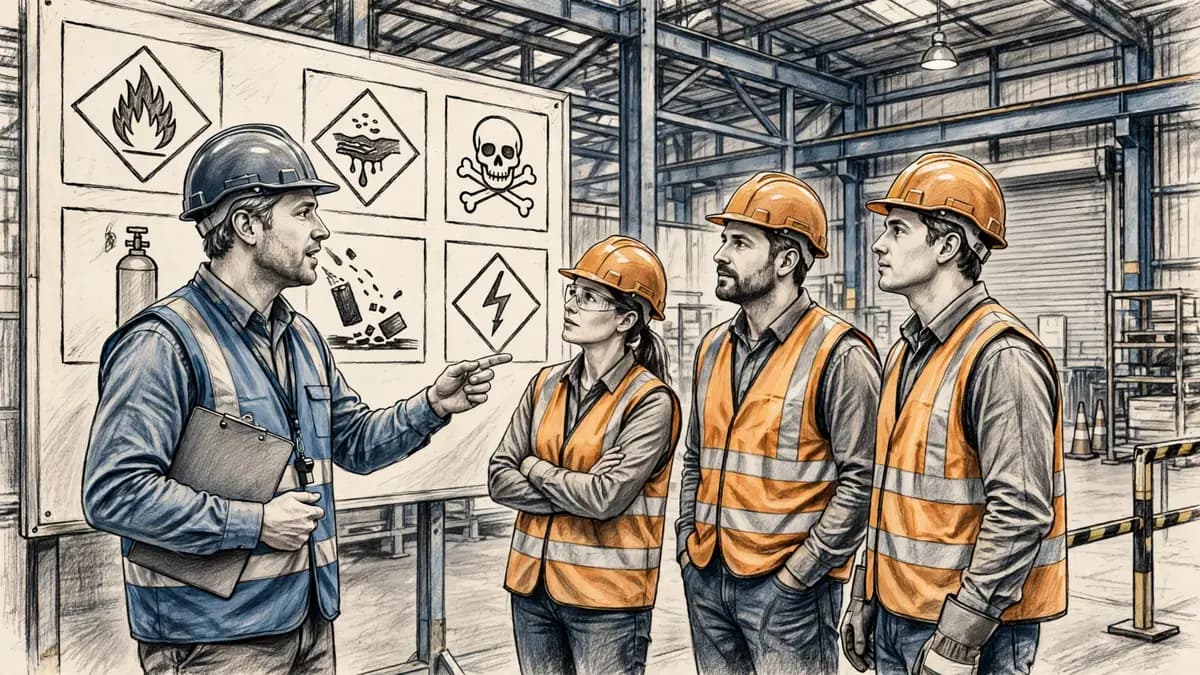
Safety training is structured teaching that gives workers the knowledge and skills to recognise hazards, use controls correctly, and respond when something goes wrong. It is not a single course. It is a set of programmes matched to the hazards in a workplace, delivered before workers meet those hazards, and repeated when the job, the equipment, or the law changes. Employers in the United States and the United Kingdom both owe their workers training by law, although the duties are written differently in each country.
Good training changes behaviour, not just knowledge. A worker who passes a quiz on harness use and still fits the harness wrong has not been trained. A supervisor who sits through a video on lockout and still cannot isolate a machine has not been trained either. The test is always the same: can the person do the safe thing, on the real job, without being told? Everything in the sections below serves that test.
What safety training is (and what it is not)
Safety training is organised instruction with a clear purpose: a worker finishes it able to do a specific safe thing. The Health and Safety Executive (HSE), the UK regulator, puts it plainly in its brief guide for employers. Training means helping people learn how to do something, telling people what they should or should not do, or giving them information. Training is not only a formal classroom course. A supervised practice session on a machine counts. A toolbox talk counts. A short video alone usually does not, unless someone checks that the worker understood it and can apply it.
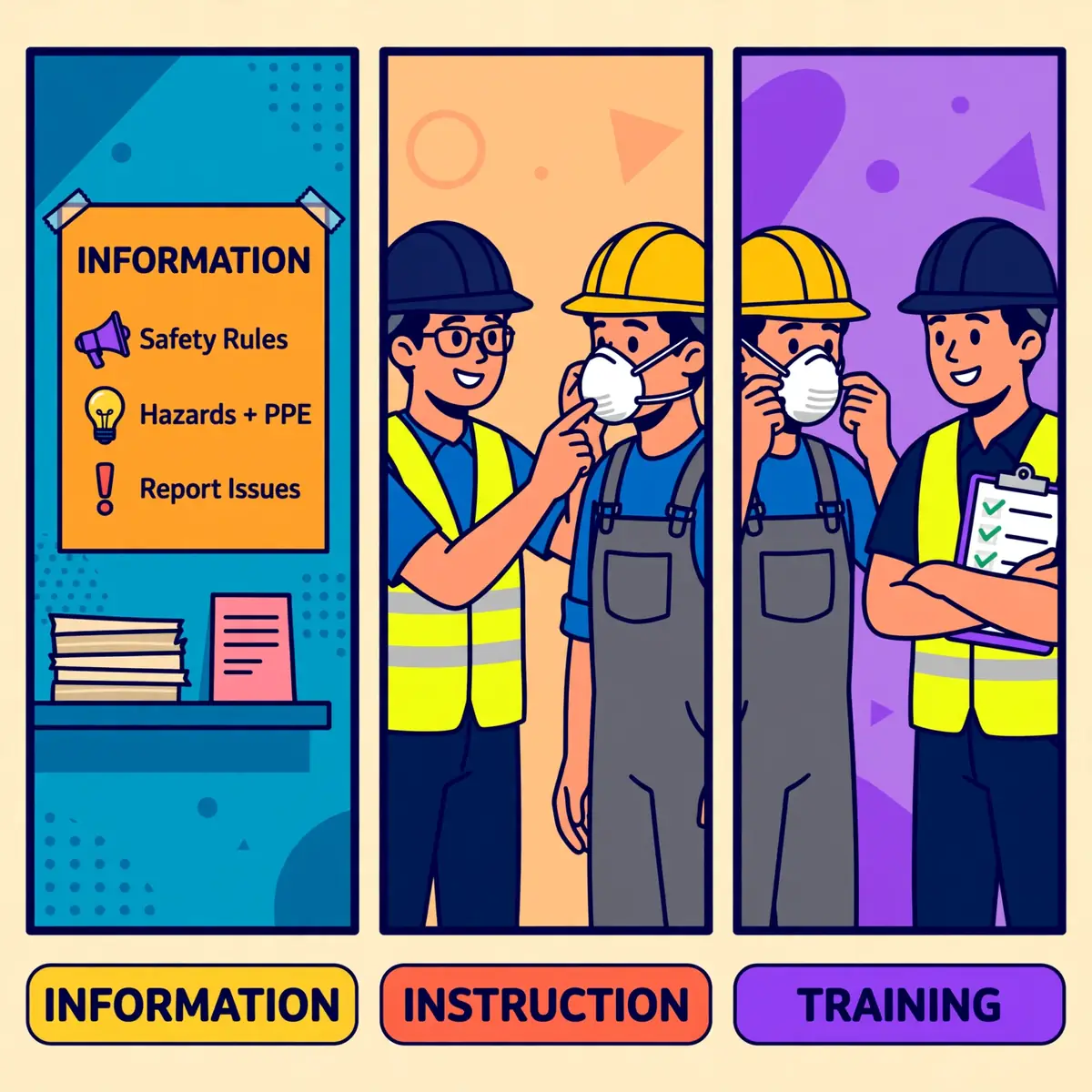
Three words are often used as if they meant the same thing, and the difference matters. Information tells workers what a risk is. Instruction tells them what to do about it. Training builds the competence to do it reliably, under real conditions, when nobody is watching. A poster about dust masks is information. A supervisor showing a worker how to fit a mask is instruction. Watching that worker fit the mask, correcting the seal, and signing the worker off is training. Most workplaces need all three, but only training produces lasting change in behaviour.
Safety training and health training also cover different ground, although they belong together. Safety training prevents sudden events such as falls, fires, electric shocks, and machinery incidents. Health training prevents harm that builds over time, including noise-induced hearing loss, respiratory disease, musculoskeletal disorders, and work-related stress. A worker who is exhausted, anxious, or in pain is far more likely to make an unsafe decision, so a programme that ignores health leaves a real gap. The strongest programmes treat the two together.
What safety training is not
Safety training is not a certificate on a wall. A certificate records that a session happened. It says nothing about whether the worker can still do the task a month later, or whether the session covered the hazards of that worker's own job. Inspectors and courts look past the certificate to the training itself: what was taught, who taught it, whether the worker understood it, and whether the worker's practice was checked.
Safety training is not a one-off event either. Skills fade, rules change, equipment is replaced, and new workers arrive. A programme that trains everyone once and never returns to the subject will drift out of date within a year. The law recognises this in both countries. Refresher training, change-triggered training, and periodic review are part of the duty, not optional extras, and the later sections explain when each one applies.
TipJudge every training session by one question: could the worker do the safe thing tomorrow, alone, on the real job? If the answer is no, the session was information, not training.
Types of safety training
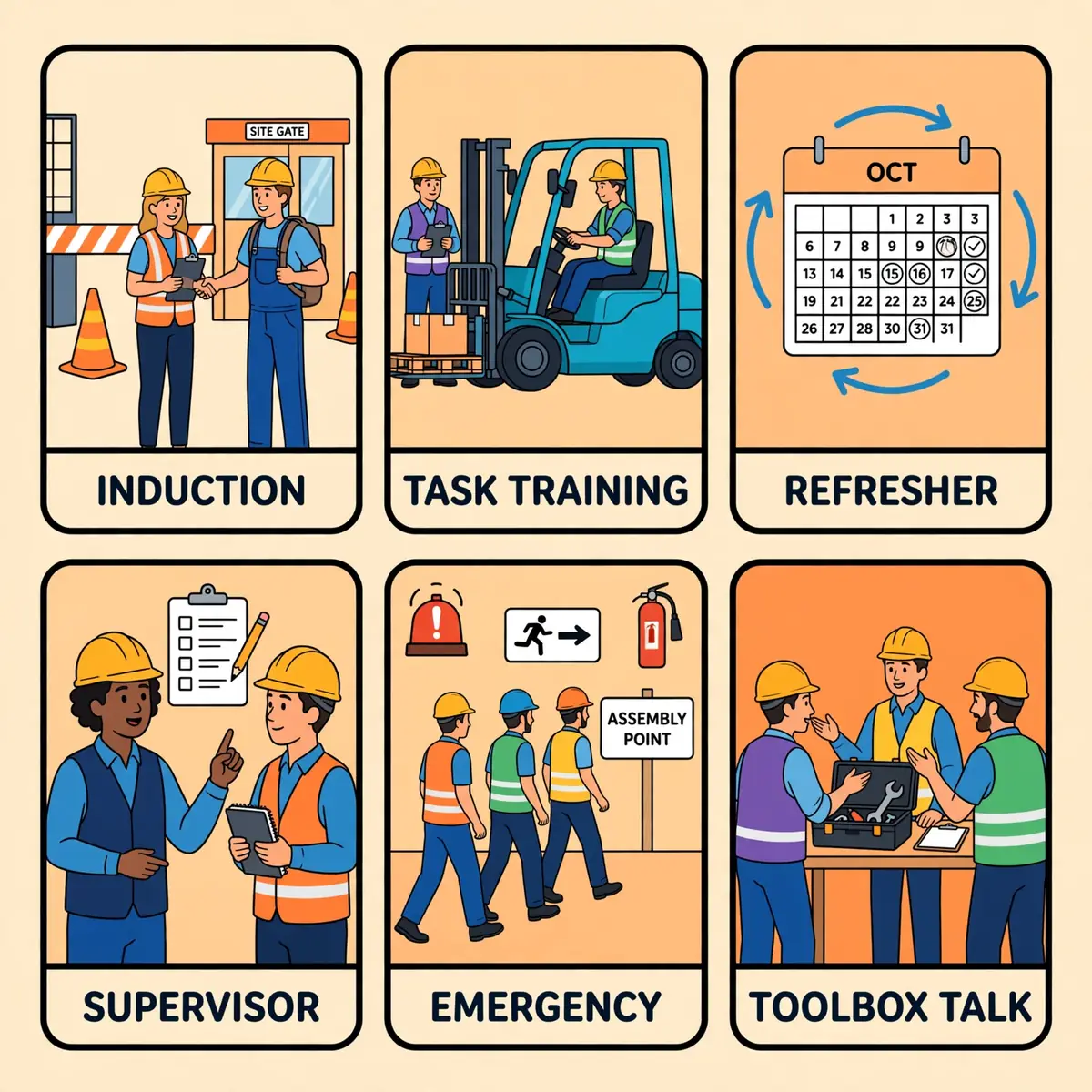
No single programme can cover every risk, so employers normally build a portfolio of training types matched to their hazards. Each type answers a different question: who is new, what is the task, what has changed, who supervises, and what happens in an emergency. The six types below appear in most workplaces, and the mix changes with the risk profile. A warehouse weights manual handling and vehicle safety heavily. An office emphasises ergonomics, fire safety, and wellbeing. A laboratory concentrates on chemical and biological hazards.
Induction training
Induction is delivered on a worker's first day, before the worker meets the hazards of the job. It introduces site rules, emergency arrangements, reporting routes, welfare facilities, and the main hazards of the workplace. Strong induction sets expectations early and stops newcomers from learning by trial and error. New workers face higher risk than experienced workers, so induction is the type that most often prevents a first-week injury.
Induction must be specific to the site, not a generic video. A new starter needs to know where the alarms sound, where the assembly point is, who the first aider is, and which areas are out of bounds. Contractors, temporary workers, and agency staff need induction too, and their induction should happen before their first entry to the site. A contractor who starts work without induction is an untrained worker in a hazardous place.
Task-specific training
Task-specific training teaches the safe method for one particular job, such as operating a forklift, using a power tool, or cleaning a production line. It combines demonstration, supervised practice, and a final competence check. The trainer shows the task, the worker practises it under supervision, and the trainer confirms the worker can do it safely before signing the worker off. Without that final check, the training is incomplete.
This type is the largest part of most programmes, because hazards live in tasks, not in job titles. Two people with the same job title can need different task training if one handles a chemical and the other does not. A training plan built around job titles alone will miss hazards and waste time on topics some workers never meet. Build the plan around tasks and the hazards each task carries.
Refresher and update training
Refresher training keeps competence current. Skills fade, rules change, and procedures are revised. Some refreshers run on a fixed cycle, such as annual bloodborne pathogens training in the United States. Others follow an event, such as a new machine, a new chemical, or an incident that shows a gap. Both kinds belong in the training calendar, and the fixed-cycle ones are the easiest to let lapse.
Refresher training should not repeat the original course word for word. Workers who already know the basics need the changes, the common mistakes, and practice on the parts they get wrong. A short, focused refresher that targets real weaknesses beats a full repeat of a course workers have already passed. Incident reports and near-miss logs show exactly which weaknesses to target.
Supervisory and management training
Supervisors and managers need their own training, because their job is different. They must supervise safely, investigate incidents, coach workers, enforce rules, and model the behaviour they expect. A supervisor who cannot recognise an unsafe act cannot stop it. A manager who does not understand the legal duties cannot resource the programme properly.
Recognised courses exist for this group. The Institution of Occupational Safety and Health (IOSH) runs Managing Safely, a three-day course for managers and supervisors in any sector, with a one-day refresher for those who have completed it. The National Examination Board in Occupational Safety and Health (NEBOSH) offers the National General Certificate, a broader qualification for people with safety responsibilities. Both are covered in more detail in the courses section below.
Emergency and fire safety training
Emergency training covers evacuation routes, assembly points, alarm procedures, and the correct use of extinguishers. Fire wardens and first aiders receive deeper training and regular drills. Drills matter because an evacuation plan that has never been practised is only a document. Workers who have walked the route once will follow it under stress. Workers who have only read about it may not.
Emergency training also covers the roles people play when something goes wrong: who calls the emergency services, who accounts for people at the assembly point, and who shuts down equipment. These roles must be assigned to named people, and those people must be trained for them. A plan that names no one is a plan that fails at the first alarm.
Toolbox talks
Toolbox talks are short, frequent, on-the-job briefings, usually ten to fifteen minutes, delivered by a supervisor at the start of a shift. They cover one topic: a recent incident, a hazard on today's job, or a reminder about a control. They are cheap, relevant, and easy to run, which is why they work. They are also shallow by design, so they cannot replace formal training on their own.
Toolbox talks work best as the reinforcement layer of a programme. A formal course teaches the method. A toolbox talk reminds workers of it on the day it matters. A short record of each talk, with the topic and the names of those present, turns a casual chat into evidence that the message was delivered. Without a record, the talk is hard to prove later.
WarningNever use a toolbox talk as a substitute for task-specific training on a high-risk job. A ten-minute talk cannot teach a worker to operate a forklift or enter a confined space safely.
Safety training topics every programme should cover
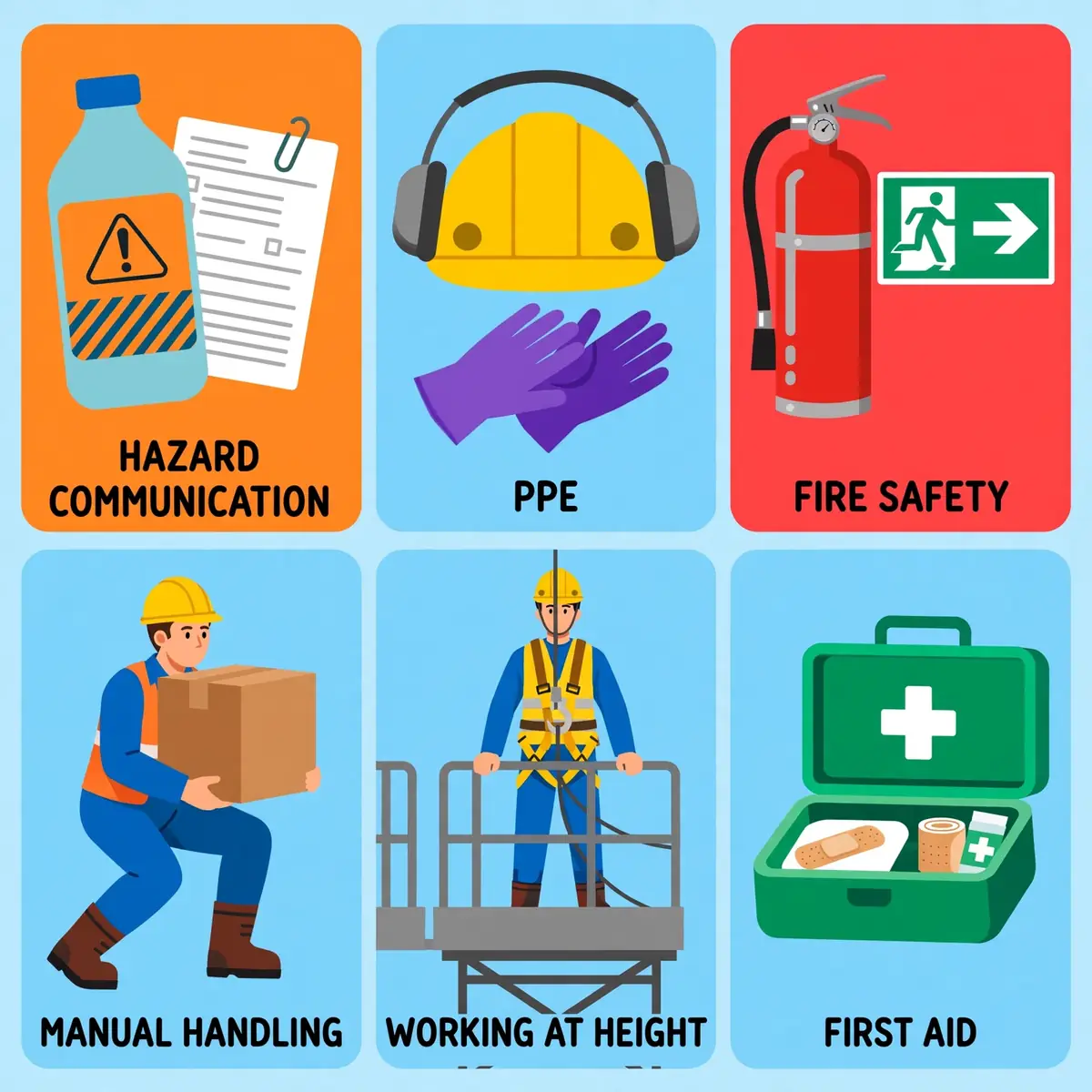
Every programme needs a core set of topics, and the rest follows from the hazards in the workplace. The core topics below appear in most workplaces, because the hazards behind them are common. The table gives the topic, the workers it applies to, and what the training must achieve. Topics beyond the core, such as confined space entry or electrical safety, belong in the programme only when the hazard is present. When the hazard is present, they need their own task-specific training.
| Topic | Who needs it | What good training achieves |
|---|---|---|
| Hazard communication | Anyone exposed to hazardous chemicals | Workers can read labels and safety data sheets and choose the right protection |
| Personal protective equipment (PPE) | Anyone who must wear PPE | Workers can select, fit, use, and look after each item |
| Fire safety and evacuation | All workers | Workers know the alarm, the routes, and the assembly point |
| Manual handling and ergonomics | Anyone who lifts, carries, or sits at a workstation | Workers can assess a load, use aids, and adjust a workstation |
| Working at height | Anyone who works above ground level | Workers can recognise fall hazards and use the fall protection system |
| First aid | Appointed first aiders; all workers need basic awareness | First aiders can act in the first minutes before help arrives |
| Incident reporting | All workers | Workers report hazards, near misses, and injuries without delay |
| Emergency procedures | All workers | Workers know their role when an alarm sounds or a spill happens |
The table is a starting point, not a finished programme. A chemical plant adds process safety and hazardous waste operations. A construction site adds scaffolding, excavation, and electrical safety. A healthcare setting adds bloodborne pathogens and safe patient handling. The training needs analysis, covered in the programme section, decides which topics belong and which do not.
Hazard communication: the worked example
Hazard communication is the most common training duty in general industry, because almost every workplace stores or uses a chemical. Under the United States standard, 29 CFR (Code of Federal Regulations) 1910.1200(h), training must explain how to detect hazardous chemicals, what their hazards are, how to protect against them, and how the employer's programme works.
That means four things:
- The methods used to detect a chemical, such as monitoring, visual appearance, or odour.
- The physical and health hazards of the chemicals in the work area.
- Protective measures, including work practices, emergency procedures, and personal protective equipment.
- The details of the written programme, including labels and safety data sheets.
Training may cover categories of hazards, such as flammability or carcinogenicity, rather than each chemical one by one, provided chemical-specific information stays available on labels and safety data sheets. The test is practical: can workers detect a chemical's presence, name its hazards, choose the protective measures that apply, and find the label and safety data sheet for it? A session that only shows a video about chemicals in general does not meet that test. For a fuller map of what the standard requires and how often it must be repeated, see OSHA training.
Topics that are easy to miss
Three topics are often left out of programmes, and each one causes real harm. The first is mental health and psychosocial risk: workload, stress, bullying, and support routes. Managers need to spot warning signs and respond appropriately. The second is lone working: workers who work alone need training on the extra risks, the check-in arrangements, and what to do if something goes wrong. The third is young and new workers, who need more supervision and clearer instruction than experienced staff, not less.
Vehicle safety is another common gap. Many employers train workers on the machines inside the building and forget the vehicles outside it, even though driving is one of the largest causes of work-related deaths in several countries. Delivery drivers, site vehicles, and forklifts each need their own training. A programme that covers the factory floor and ignores the yard is incomplete.
AlertA topic belongs in the programme when the hazard is present, not when a course vendor suggests it. Check the risk assessment first, then choose topics from what it finds.
Who needs which training
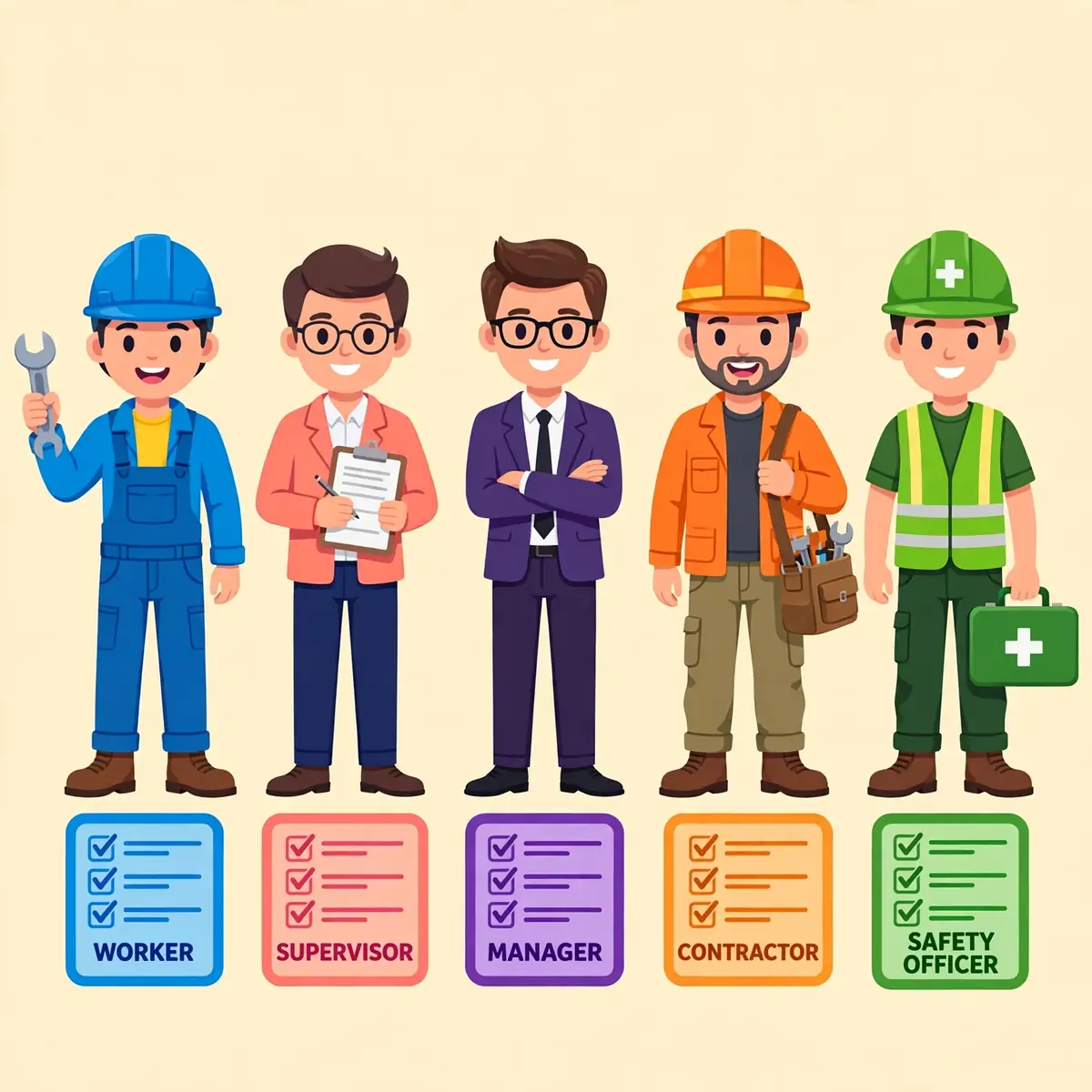
Everyone in an organisation needs some level of training, but the depth and focus differ by role. Giving every employee the same generic course wastes time and leaves critical gaps. The table below summarises typical needs by role. Use it as a starting point, then adjust it to the hazards each person actually meets. Two people with the same job title can need different training if their tasks differ.
| Role | Core training focus | Typical timing |
|---|---|---|
| Frontline workers | Task-specific safe methods, hazard reporting, emergency procedures | On induction, then refreshers |
| Supervisors and team leaders | Risk assessment basics, incident reporting, coaching, enforcing rules | On appointment, then every one to three years |
| Managers and executives | Legal duties, leadership accountability, performance data, safety culture | On appointment, then periodic updates |
| Health and safety officers | Risk assessment, auditing, investigation, legislation, management systems | Continuous professional development |
| Contractors and visitors | Site rules, restricted areas, emergency arrangements | Before every site entry |
Contractors, temporary workers, and young or new employees deserve special attention. They are often the least familiar with the workplace and the most likely to meet unfamiliar hazards, yet they are also the easiest groups to overlook. A contractor's own employer may have trained them on their trade, but only the host employer can train them on the site's hazards. That site induction must happen before the work starts, not after the first shift.
Training by hazard, not by job title
Safety training is hazard-driven rather than role-driven. The obligation follows the hazard, so the plan must too. A cleaner who handles chemicals needs hazard communication training. An office worker who never handles chemicals does not. A maintenance worker who services machines needs lockout/tagout training. A worker who only walks past those machines does not. Build the training matrix from hazards to people, and the gaps become visible at once.
This approach also stops the most common waste in training programmes: sending everyone to the same course. A generic course teaches nobody what they need for their own job. It also creates a false sense of coverage, because the attendance list looks complete while the real hazards stay uncovered. A hazard-based matrix is harder to build, but it is the only version that answers an inspector's first question: who was trained, on what, and why them?
Workers who need extra attention
Some workers need more than the standard programme. Workers with limited literacy need materials they can understand, not written handouts they cannot read. Workers who do not speak the language of the workplace need instruction in a language they understand. Workers with disabilities need materials and methods adapted to them. Young workers need closer supervision and more frequent checks. Night-shift workers need the same training as day-shift workers, delivered at a time they can attend.
None of this is optional generosity. In the United States, the Occupational Safety and Health Administration (OSHA) directs inspectors to treat "train" and "instruct" as meaning to present information in a way the employee can understand. In the United Kingdom, the Management of Health and Safety at Work Regulations require employers to take workers' capabilities into account when assigning tasks. Training that the worker cannot understand is not training at all.
What the law requires in the United States
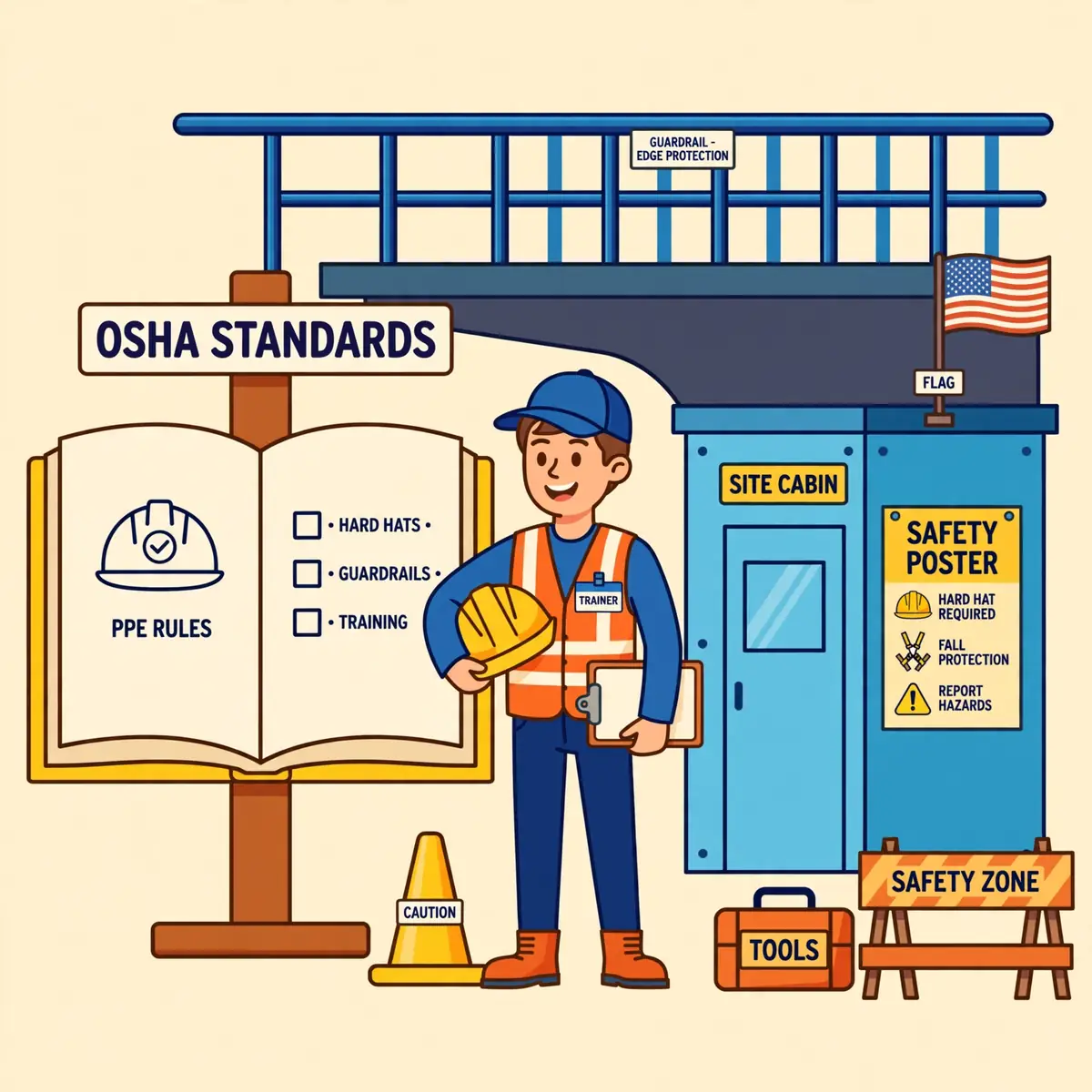
There is no single list of required safety training that applies to every employer in the United States. The obligation is assembled from a general duty plus the specific standards that attach to the hazards in the workplace. The honest answer to what the law requires is that it depends on what is in the building. An employer who understands the two layers, and checks each hazard against them, can build a defensible programme. An employer who buys one generic course cannot.
The broad layer is the General Duty Clause of the Occupational Safety and Health Act of 1970 (OSH Act). Section 5(a)(1) requires every covered employer to furnish employment and a place of employment free from recognised hazards likely to cause death or serious physical harm. It applies even where no specific standard exists, so an unregulated hazard is still one the employer cannot ignore. When no standard names training for a hazard, an employer who knows the hazard exists and does not train workers on it can still be cited under the General Duty Clause.
On top of that sit the specific standards. More than 100 OSHA standards contain training requirements, each with its own who, what, and when. OSHA collects them in its booklet Training Requirements in OSHA Standards (OSHA 2254), which organises them by sector. The booklet is guidance, not a standard. It creates no new legal obligations, and the standards themselves are the binding text.
Use it as a map, then read the standard it points to. Construction has the closest thing to a general training duty. Under 29 CFR 1926.21(b)(2), the employer must instruct each construction employee in the recognition and avoidance of unsafe conditions and the regulations that apply to their work environment.
Which standards most often require training
The standards that hit general industry most often are:
- Hazard communication.
- Respiratory protection.
- Lockout/tagout.
- Personal protective equipment.
- Hearing conservation.
- Bloodborne pathogens.
- Powered industrial trucks.
- Emergency action plans.
Each one names the workers it covers, the topics they must be taught, and when the training must be repeated. Construction adds fall protection, scaffolding, excavation, and ladder training under Part 1926. The pattern is the same in every case: the standard describes the hazard, then describes the training that must go with it.
Training failures show up in enforcement data year after year. In OSHA's preliminary list of the most frequently cited standards for fiscal year 2026, covering October 2025 to August 2026, fall protection training in construction stands at number eight. It is its own line item, separate from the fall protection equipment requirement at number one.
Hazard communication, lockout/tagout, respiratory protection, and powered industrial trucks also appear in the top ten, and every one of them carries an explicit training component. Employers are cited not only for missing equipment, but for failing to train anyone to use it, or to prove they did.
Language, literacy, and cost
Training must be understood, not merely delivered. OSHA's Training Standards Policy Statement of 28 April 2010 directs inspectors to treat "train" and "instruct" as meaning to present information in a manner the employees receiving it can understand. If an employee does not speak or understand English, instruction must be given in a language the employee can understand. Written materials alone do not satisfy the duty for employees who cannot read them. Several standards build this into their text, and the bloodborne pathogens standard requires material appropriate to the educational level, literacy, and language of the employees.
Required training must also be provided by and paid for by the employer. The OSH Act places the cost on the employer, and the bloodborne pathogens standard states it directly: training must be provided at no cost to the employee and during working hours. An employer who charges workers for required training, or who runs it only in unpaid time, is breaking the rule. Voluntary courses that workers choose for their own development are a different matter, and the cost of those is a matter for the employer and the worker to agree.
State Plans and small employers
Enforcement depends on where the workplace sits. Federal OSHA enforces the standards in most states, but 29 states and territories run their own OSHA-approved State Plans. Twenty-two of those plans cover private-sector and state and local government workers, and seven cover only state and local government workers. State Plans must be at least as effective as federal OSHA and may set stricter or additional requirements, including extra training rules. Multi-state employers should treat the federal standards as a floor and check each State Plan state where they operate.
Small employers are not exempt. The most expensive misunderstanding in small business safety is the belief that companies with ten or fewer employees sit outside the rules. They do not. The exemption is real, it is narrow, and it covers recordkeeping only. A company with ten or fewer employees at all times during the previous calendar year does not have to maintain injury and illness logs, unless the agency notifies it in writing.
Every safety standard applies in full, at every size, and no training requirement is affected by the exemption. For the standard-by-standard detail, including the repeat clocks and the records each standard requires, see OSHA training.
WarningNever hand a worker a training handout in a language they cannot read and record the session as complete. OSHA treats training as the understanding it produces, not the paper it generates.
What the law requires in the United Kingdom
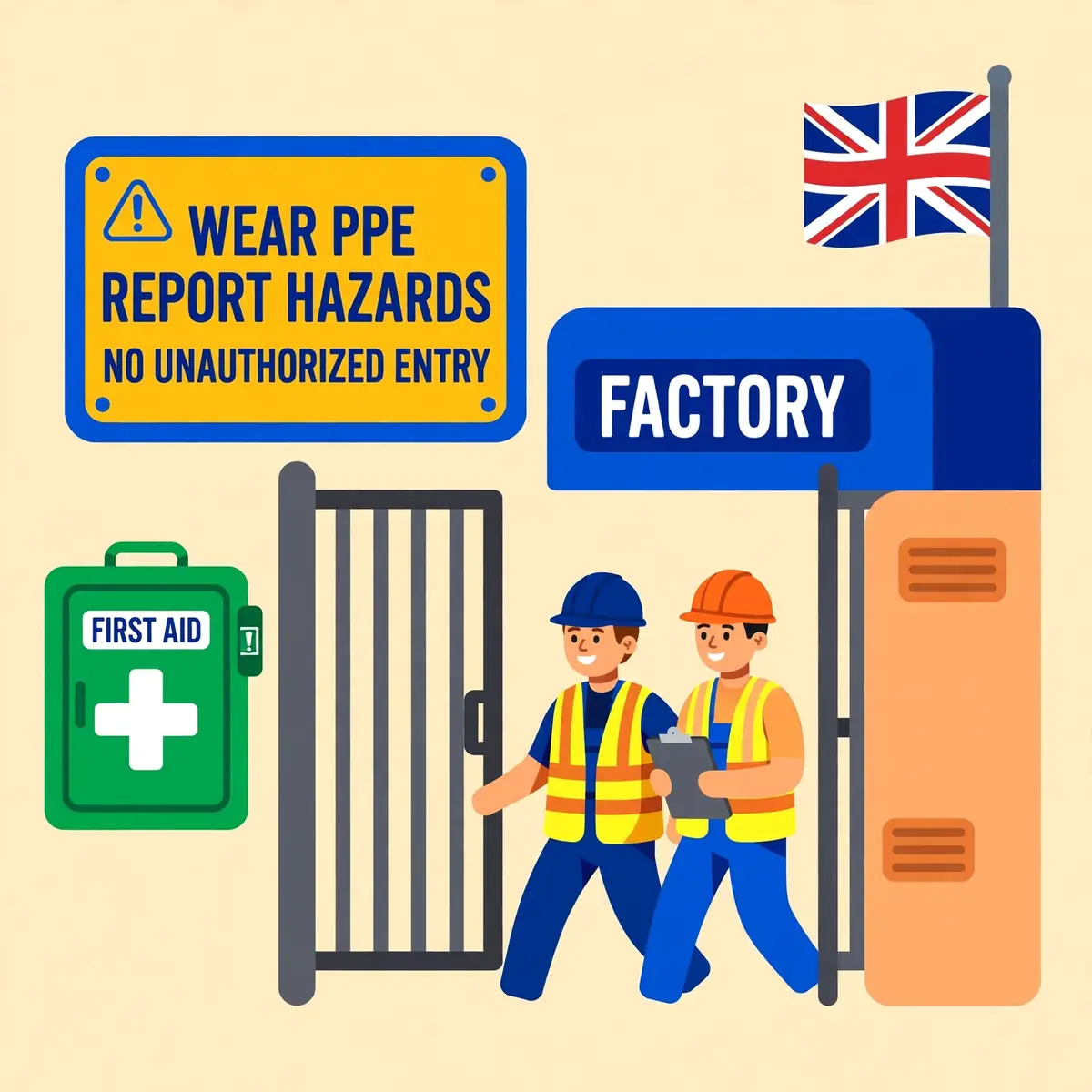
UK law states the training duty in plain language. Section 2(2)(c) of the Health and Safety at Work etc. Act 1974 requires every employer to provide "such information, instruction, training and supervision as is necessary to ensure, so far as is reasonably practicable, the health and safety at work of his employees". The duty is general: it covers every employee, and the test is whether the training was necessary for that worker's safety. A court asks what the employer did, not what the employer intended to do.
The Management of Health and Safety at Work Regulations 1999 add the detail. Regulation 13 requires employers to take workers' capabilities into account when assigning tasks. Employers must provide adequate health and safety training on recruitment, and whenever workers are exposed to new or increased risks. The regulation lists the triggers: transfer or a change of responsibilities, new work equipment or a change to existing equipment, new technology, and a new or changed system of work. Training must be repeated periodically where appropriate, adapted to new or changed risks, and given during working hours.
The HSE's brief guide for employers, INDG345, explains how the duty works in practice. Training is not only formal classroom courses. It includes on-the-job instruction, supervised practice, and short briefings, provided the worker learns what to do and the employer checks that learning. The guide also covers who may need training, what form it may take, and how to organise it. It is guidance, not law, but it shows how an inspector will judge whether the duty was met.
How the UK duty differs from the US duty
The two systems reach the same place by different routes. US law attaches training duties to individual hazard-specific standards, so the employer must find the standard for each hazard. UK law states one general duty and one regulation that covers the triggers, so the employer must judge what is adequate for each worker and each risk. The UK approach gives employers more freedom in how they train, and more responsibility for the judgement. The US approach gives more specific instructions, and more chances to miss a standard.
Both systems agree on the essentials. Training must happen before exposure, not after. It must be understood by the worker. It must be repeated when things change. And it must be free to the worker and given in working time. An employer who meets those four tests in either country is most of the way to compliance. An employer who fails any of them has a gap, whatever the paperwork says.
Other UK duties that carry training
Several UK regulations add their own training duties on top of the general ones. The Control of Substances Hazardous to Health Regulations require training on the risks of hazardous substances and the precautions to take. The Provision and Use of Work Equipment Regulations require training on the safe use of work equipment. The Manual Handling Operations Regulations require training where manual handling cannot be avoided.
The Regulatory Reform (Fire Safety) Order 2005 requires employers to provide employees with comprehensible and relevant information on fire risks. Employers must also train staff in the measures to be taken when a fire breaks out.
The pattern to follow is the same as in the United States: find the regulation for each hazard, read what it says about training, and build that into the programme. A risk assessment that names the hazard but not the training for it is unfinished. The training matrix, covered in the programme section, is the tool that turns a list of regulations into a list of people, topics, and dates.
AlertUK training must be given during working hours and repeated when risks change. Training squeezed into unpaid time, or delivered once and never revisited, does not meet the duty in Regulation 13.
How often training must be repeated
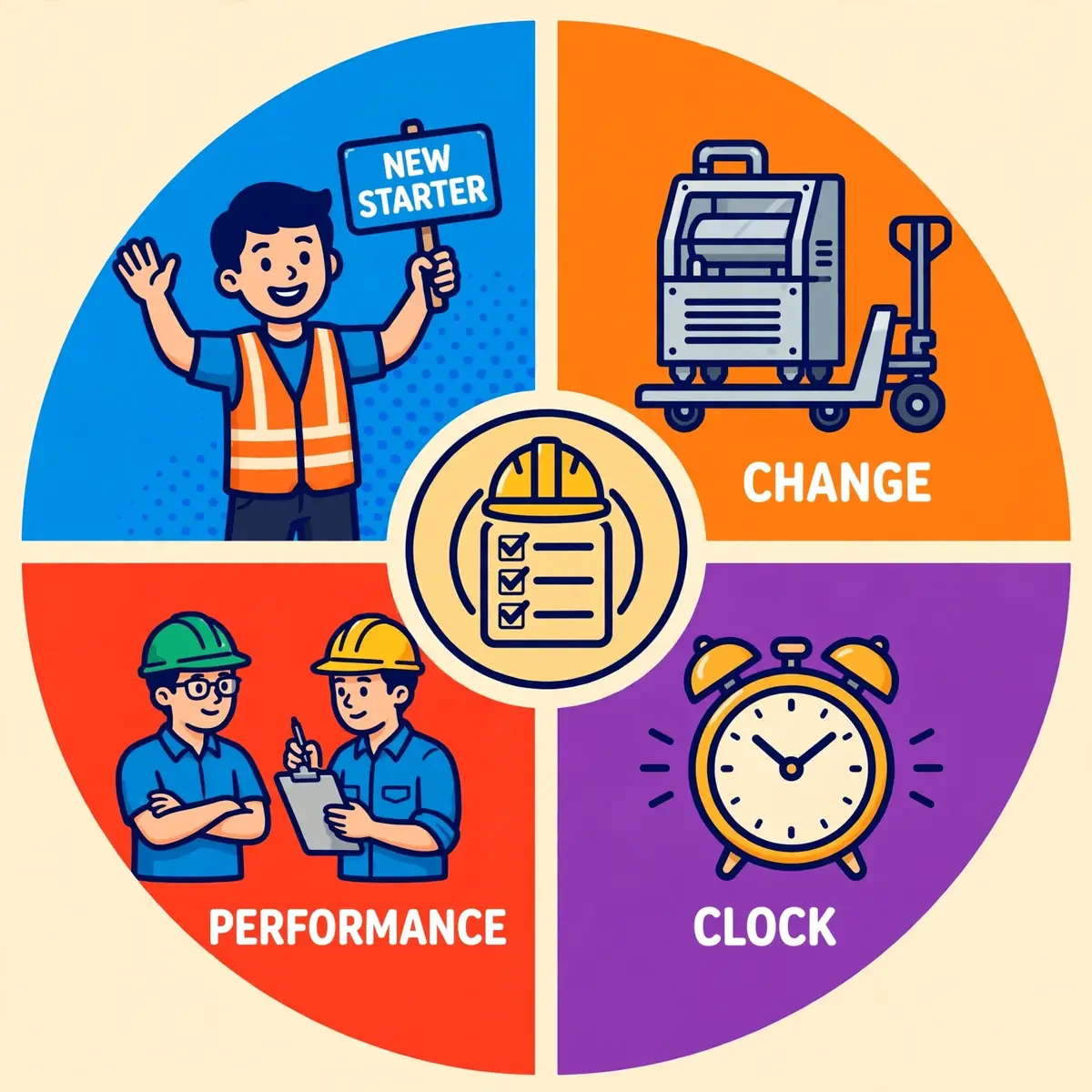
There is no single "annual training" rule that covers everything. The obligations run on four different triggers, and a programme built around one annual session will miss most of them. The four triggers are a person starting, something changing, a clock running out, and performance showing a gap. A training calendar that tracks all four is the difference between a programme that stays compliant and one that only looks compliant on the day of the annual session.
A person starts
Every hazard present in the work must be covered before the employee can encounter it. This includes part-time, temporary, and seasonal staff, and it includes the person hired for the office who now helps in the back once a week. Nothing about the employment arrangement changes the obligation. Induction training belongs inside the arrival process, not on a separate list. If safety instruction sits apart from the rest of onboarding, it gets delivered after the exposure has already started.
Contractors need the same treatment. A contractor's induction must happen before the first entry to the site, and it must cover the site's hazards, not only the contractor's trade. A site that lets contractors start work and promises to brief them later has an untrained worker in a hazardous place from the first minute.
Something changes
A new machine, a substituted product, a moved workstation, or a modified procedure all reopen the training obligation for everyone affected. This is the trigger businesses miss most often, because the change feels operational rather than regulatory, and nobody asks whether the safety instructions still describe reality. A company that ran a thorough safety day in January and bought a slicing machine in March has an untrained crew on that machine from the day it arrives. Nothing on the calendar will say so.
The fix is a habit, not a form. Any time equipment is bought, a supplier is changed, a workstation is moved, or a procedure is altered, ask one question before it goes live. Does anyone need to be told something different now? That question takes ten seconds and catches most of what small businesses miss. In the United Kingdom, Regulation 13 names these exact changes as triggers for new training. In the United States, the hazard communication, lockout/tagout, and fall protection standards all require retraining when the hazard, job, equipment, or procedure changes.
The clock runs out
Some obligations recur on a fixed cycle regardless of whether anything changed. In the United States, bloodborne pathogens, respiratory protection, hearing conservation, and portable fire extinguisher training repeat annually. Forklift operator evaluations and process safety management refresher training run at least every three years. In the United Kingdom, refresher training is required periodically where appropriate, and the right interval depends on the risk. First aid at work certificates in the United Kingdom, for example, are valid for three years, and fire warden training is usually refreshed annually.
Fixed cycles are invisible without a calendar. The annual bloodborne pathogens cycle runs from each employee's previous training date, within one year of that date. A single calendar date for everyone can put late joiners out of compliance. Track each worker's own date, not a company-wide training day. A training matrix that lists every worker, every topic, and every due date is the tool for this, and it is covered in the programme section.
Performance shows a gap
The fourth trigger is the hardest to see and the easiest to ignore. When a worker shows inadequate knowledge or skill, when an incident or near miss reveals a misunderstanding, or when a periodic inspection finds a deviation from the procedure, retraining is required. The US lockout/tagout standard requires retraining when an inspection reveals deviations or inadequacies in the energy control procedure. The respiratory protection standard requires retraining when a worker shows inadequate knowledge or skill.
This trigger is a judgement call, and inspectors use it to cite employers who never retrained after an incident or a near miss. The practical rule is simple: any incident, near miss, or failed check is a training question, not only an equipment question. Ask whether the worker knew what to do, whether the worker could do it, and whether the training covered it. If the answer to any of those is no, the gap is a training gap, and the fix is training.
TipPut all four triggers on one calendar: start dates, change dates, fixed due dates, and review dates after incidents. A calendar that shows only the annual session will let the other three lapse.
How to choose a training method
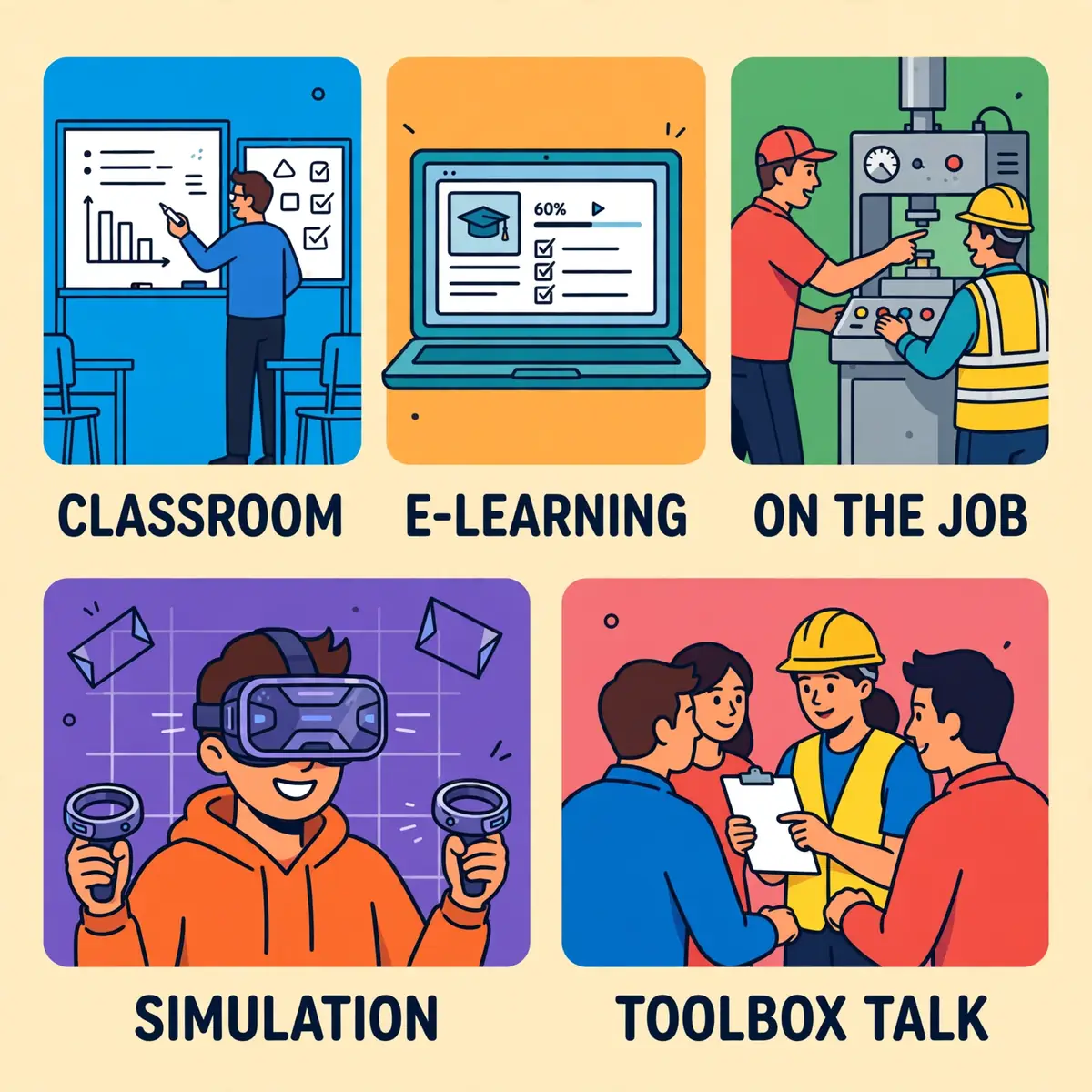
Choosing the right delivery method matters as much as choosing the right content. Each approach has strengths and limits, and most organisations combine several. The table below compares the five main methods. The right choice depends on what is being taught: hands-on skills need hands-on training, while awareness topics can be delivered online. A method that fits the content will work. A method chosen for convenience will not.
| Method | Best suited to | Key strength | Main limitation |
|---|---|---|---|
| Classroom | Complex topics, discussion, new managers | Interaction and immediate questions | Cost and time away from work |
| E-learning | Awareness topics, compliance refreshers | Scalable, trackable, flexible | Limited hands-on practice |
| On-the-job coaching | Task-specific skills | Real context and instant feedback | Quality depends on the coach |
| Simulation and virtual reality | High-risk or rare scenarios | Safe practice of dangerous situations | Set-up cost and technology needs |
| Toolbox talks | Short reminders, incident lessons | Frequent, relevant, low cost | Shallow depth if used alone |
Blended programmes usually perform best. An e-learning module can deliver the underlying knowledge, a practical session can build the skill, and a supervisor sign-off can confirm competence on site. A worker can pass a written quiz on harness use and still fit the equipment incorrectly. Observed demonstration should be part of the sign-off wherever the consequences of error are serious. For step-by-step guidance on harness fitting and inspection, see fall protection harness.
Matching the method to the learner
Learners differ in experience, language, age, and confidence. Experienced workers respond well to scenario-based discussion that respects what they already know, while new starters need clear step-by-step guidance. Adjusting examples and pacing to the audience improves both engagement and retention. A session pitched at the wrong level will bore the experienced workers and lose the new ones, and both groups will leave with nothing.
Language, literacy, and accessibility must be considered in the choice of method. Materials must be understood by every worker, including those with disabilities or limited access to digital devices. An e-learning course is no use to a worker with no device or no digital skills. A classroom session is no use to a worker who cannot understand the language it is delivered in. Check the audience before choosing the method, not after.
What good design looks like
Programmes that transfer well tend to share a number of features. They start from the real hazards, not from a course catalogue. They use realistic examples from the workers' own jobs. They give workers a chance to practise, not only to listen. They check understanding during the session, not only at the end. And they follow up afterwards, with a supervisor check on the job. A programme with all five features will change behaviour. A programme with none of them will change only the attendance record.
Research supports this. A meta-analysis of 157 studies published in the Journal of Applied Psychology found that safety training has a clearly positive effect overall. The effects were especially strong on what trainees learn, and smaller but still positive on organisational safety and individual health outcomes. Training reliably builds knowledge, but results on the shop floor depend on how well learning is transferred and supported afterwards. The design of the session and the follow-up on the job decide whether knowledge becomes behaviour.
TipNever let a worker learn a high-risk skill from a screen alone. E-learning can teach the knowledge, but only supervised practice can prove the skill.
How to tell whether training worked
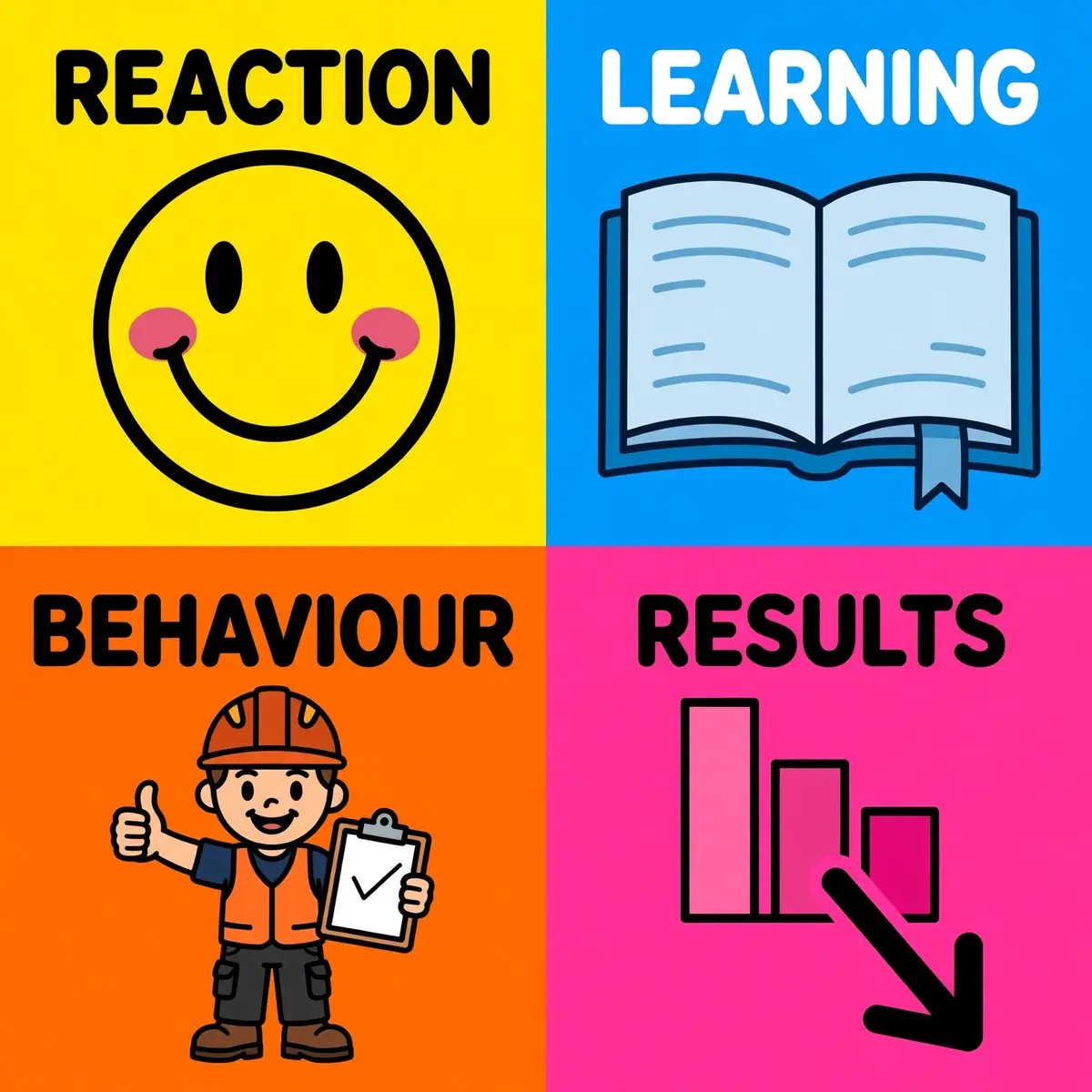
Attendance proves nothing on its own. A sign-in sheet proves that a worker was in the room, not that the worker understood anything or can do the task. Employers who measure training by attendance will pass every audit and still have untrained workers. The honest measure is competence: can the worker do the safe thing, on the real job, without being told? Four levels of evidence answer that question, from weakest to strongest.
The four levels of evidence
The first level is reaction: did workers find the session useful and clear? A short feedback form answers this, and it is worth collecting, because a confusing session rarely teaches anything. The second level is learning: did workers gain the knowledge or skill? A quiz, a verbal question, or a demonstration answers this. The third level is behaviour: do workers act differently on the job? Only observation answers this, and it needs a supervisor who watches the work and checks it against the safe method.
The fourth level is results: did incidents, near misses, or unsafe acts fall? This is the level that matters most, and the hardest to prove, because incidents have many causes. A fall in one measure does not prove the training worked, and a rise does not prove it failed. Use results as a signal to investigate, not as a verdict on one course. All four levels together give a fair picture. Any one of them alone does not.
Competence checks that work
The most useful check is also the simplest: watch the worker do the task. A supervisor who watches a worker fit a respirator, isolate a machine, or rig a harness can see in a minute what a quiz cannot show. The check should be recorded: the date, the task, the person who checked, and the result. A pass means the worker can do the task safely. A fail means more training, not a note in a file and a hope that it improves.
Written tests have their place, especially for knowledge topics such as hazard communication, where the worker must know the meaning of labels and the contents of safety data sheets. Keep tests short, job-specific, and in a language the worker understands. A test that workers fail because of the wording, not the content, measures literacy, not safety knowledge. And a test passed by guessing measures nothing at all.
Records: what to keep and for how long
Records are the proof that training happened, and missing records are often the first gap an inspector finds. At minimum, keep the date of the training, the topic covered, the trainer's name and qualifications, the names of the attendees, and some sign that comprehension was verified. A record without a comprehension check proves attendance only. Some standards are explicit about what must be recorded: the US bloodborne pathogens standard requires written records including dates, content, trainer qualifications, and trainee names.
How long to keep records depends on the standard, and the safe rule is to keep them for the length of employment plus three years. Forklift evaluations have no fixed retention period in the US standard, but the sensible move is the same: keep them for the length of employment plus three years. In the United Kingdom, there is no single retention period for training records, so the same rule is a reasonable default. Records should be organised and easy to pull. An inspector who waits an hour for a training file will draw conclusions from the wait.
WarningAn undocumented trained employee and an untrained employee look exactly the same from the outside. Keep the record, or the training may as well not have happened.
Recognised courses and certificates
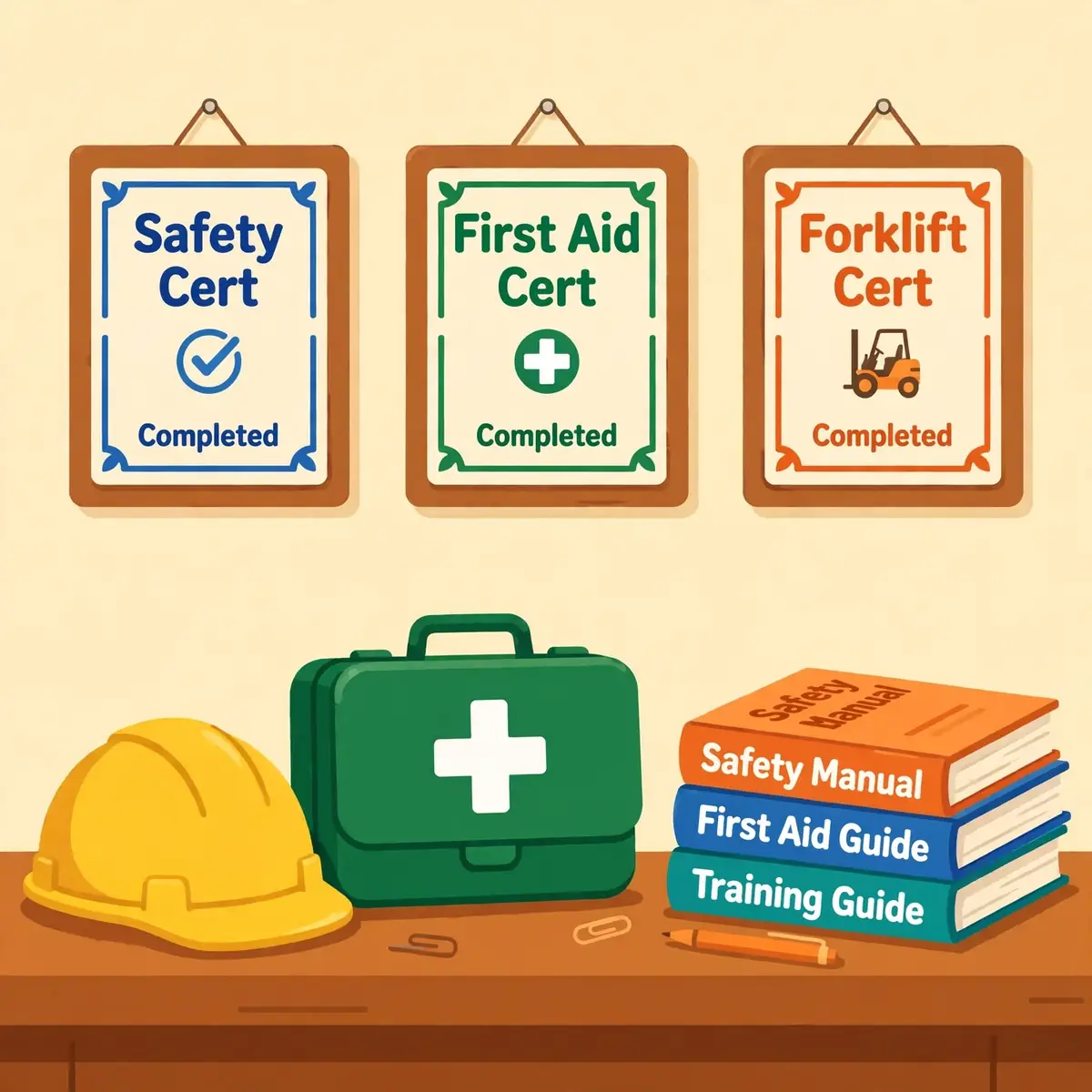
Not every course ends with a certificate, and not every certificate means the same thing. Some certificates prove competence in a specific skill. Some prove attendance at an awareness course. Some are required by law or by a client, and some are only useful on a CV. Choosing the wrong course wastes money and leaves the real duty uncovered. The courses below are the ones employers ask about most often, and the differences between them matter.
OSHA Outreach courses: 10-hour and 30-hour
The OSHA Outreach Training Program offers 10-hour and 30-hour courses for construction and general industry. The 10-hour course gives general hazard awareness for entry-level workers, and the 30-hour course gives a broader overview for supervisors. Both end with a student course completion card. The card is not a certification or a licence, and it is not required by OSHA. Some states, municipalities, and organisations do require Outreach cards as a condition of work, and those are state or local requirements, not federal ones.
The important point is that Outreach courses do not meet the training requirements of any OSHA standard. A worker with a 10-hour card still needs the training each applicable standard requires, delivered for their own hazards, before exposure. Training conducted to comply with OSHA standards also cannot be counted toward Outreach Training Program requirements. The two run in opposite directions. For the full detail on the 10-hour course, including topics, hours, and costs, see OSHA 10-hour training.
IOSH and NEBOSH qualifications
IOSH Managing Safely is a three-day course for managers and supervisors in any sector, with no prior safety experience needed. It covers assessing risks, controlling risks, understanding responsibilities, identifying hazards, investigating incidents, and measuring performance. A one-day refresher is available for delegates who have completed the full course. Successful delegates receive a Managing Safely certificate, which employers can verify online with IOSH. It is a management course, not a practitioner qualification, and it will not turn a manager into a safety expert.
The NEBOSH National General Certificate is a broader qualification for managers, supervisors, and advisers with safety responsibilities. It covers how to manage health and safety effectively, and it is widely recognised by employers in the United Kingdom and internationally. It takes considerably longer than a three-day course and includes formal assessment. Employers who need a qualified safety adviser should look at NEBOSH qualifications. Employers who need their managers to understand their duties should look at IOSH Managing Safely.
First aid, CPR, and specialist certificates
First aid and cardiopulmonary resuscitation (CPR) courses are the most common specialist certificates in workplaces. In the United States, OSHA's first aid standard requires adequate first aid supplies and persons trained to render first aid where no clinic or hospital is near the workplace. In the United Kingdom, employers must provide adequate first aid equipment, facilities, and personnel, and the HSE publishes guidance on how many first aiders a workplace needs. First aid certificates commonly last three years, and refresher training keeps skills current between renewals.
Specialist certificates exist for most high-risk tasks: forklift operation, confined space entry, working at height, electrical work, and hazardous materials handling. Each one is tied to its own standard or regulation, and each one needs its own renewal cycle. A certificate for one task never covers another. For the practical detail on confined space entry training, including the three entry roles and the rescue plan, see confined space entry. For the detail on fall protection training and the equipment it covers, see fall protection.
AlertA course certificate proves the course happened, not that the worker is competent. Check the certificate's scope, its expiry date, and whether the worker can still do the task.
Building a training programme that stays compliant
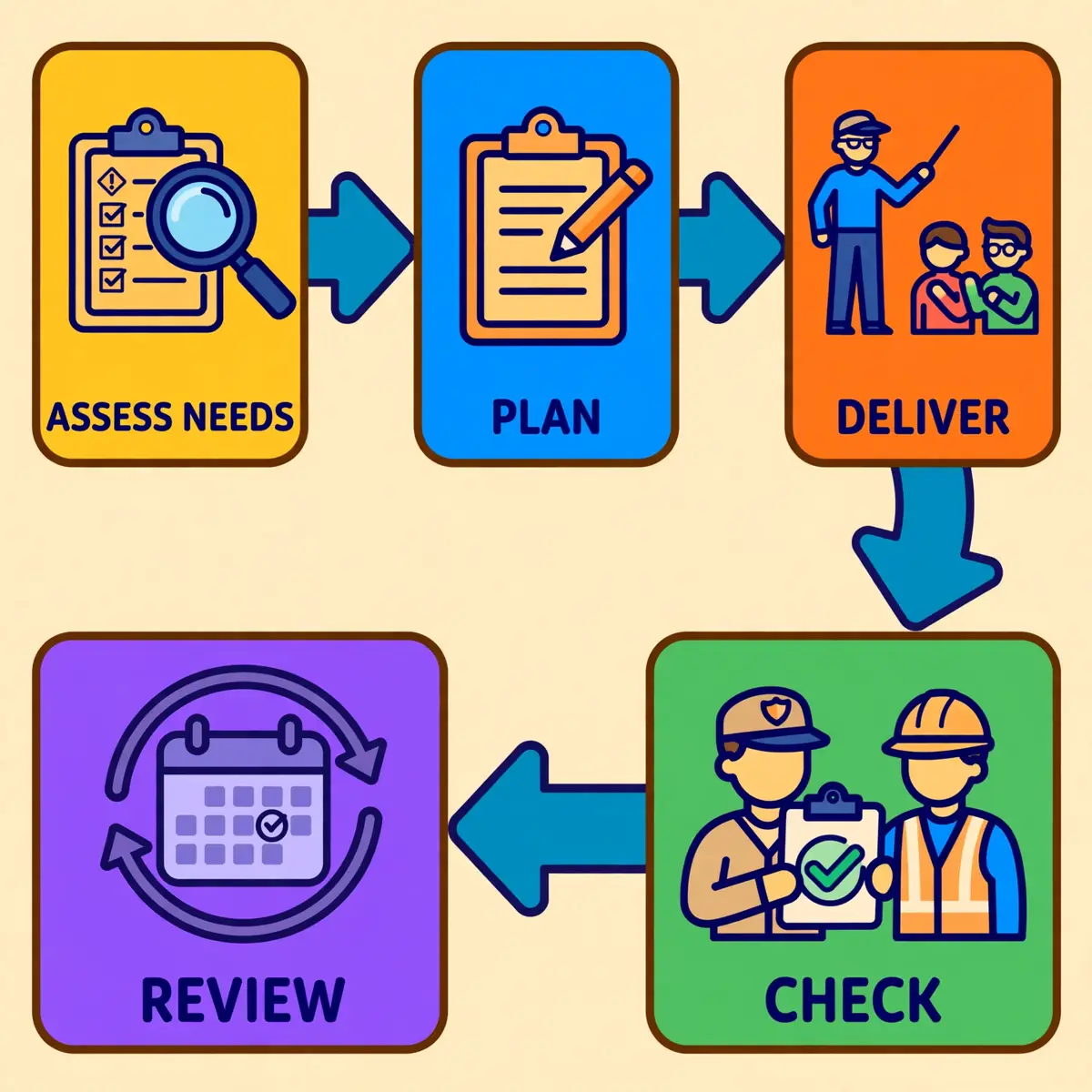
A working safety training programme has five parts. Miss one and a gap is left that an inspector or an incident will find. The five parts are a written training plan, content specific to the hazards workers actually face, a delivery method that fits the content, a competence check, and records. The steps below turn those five parts into a programme that can be built, run, and kept current, even by a small employer with no safety department.
Step 1: Assess the training needs
Start with evidence, not assumption. A training needs analysis compares the competence the organisation requires with what workers currently have, and the difference defines what must be taught. Hazard identification and risk assessment supply the evidence, because they show which tasks, locations, and exposures present the greatest danger. Incident reports, near-miss logs, inspection findings, and national statistics all help to prioritise content.
Consult the workers as well. Workers who do the job every day often know where the real hazards lie. Surveys, toolbox discussions, and safety committee feedback reveal gaps that formal assessments can miss, and they build ownership of the resulting programme. A needs analysis built only from documents will miss the hazards that workers already know about and nobody has written down.
Step 2: Write the training plan
Write a training plan that names every applicable law or standard, the topic it requires, who must get that training, and how often. Build a training matrix from it: one row per worker or role, one column per topic, and a date in each cell. The matrix is the programme in one view, and it answers the inspector's first question at a glance. Keep the plan short and specific. A plan that nobody can read in ten minutes is a plan nobody will follow.
The plan should also name the trainer for each topic and the method for each session. Some topics need an external provider, such as a NEBOSH course or a forklift certification. Some need only a competent supervisor with a good checklist. Choosing the trainer is part of the plan, and the trainer's competence matters as much as the content. A trainer who does not know the subject cannot teach it, whatever the slides say.
Step 3: Deliver and check competence
Deliver the training before the worker meets the hazard, in a language and at a level the worker understands, and check competence before signing the worker off. The check can be a demonstration, a verbal question, or a short quiz, but it must match the task. Hands-on skills need a hands-on check. Knowledge topics need a knowledge check. Record the date, the topic, the trainer, the attendees, and the result of the check. A record without a check proves attendance only.
Keep the delivery practical. Use the workers' own equipment, their own procedures, and their own workplace. A generic video about chemicals in general does not train a worker on the chemicals in their own work area. A session built around the real labels, the real safety data sheets, and the real protective equipment in the building will stick, because it is about the worker's own job.
Step 4: Review and improve
Review the programme regularly, and after every incident, near miss, or change. The review should ask five questions:
- Did the training cover the hazards that actually caused harm?
- Did workers understand it?
- Did their behaviour change?
- Did the records stay current?
- Did any fixed-cycle training lapse?
The answers decide what changes. A programme that is never reviewed will drift out of date, because the workplace changes faster than the plan.
Review is also where the hierarchy of controls belongs. Training sits low in the hierarchy of controls, below elimination, substitution, engineering controls, and administrative controls. Training cannot fix a hazard that should have been designed out. If the same training gap appears after every incident, the answer may not be more training. It may be a better guard, a safer chemical, or a redesigned task. Training is essential, but it is the last line of defence, not the first.
TipReview the training matrix every month and the full programme every year. A matrix that is a month out of date is a warning. A matrix that is a year out of date is a failure.
Common mistakes that undo good training
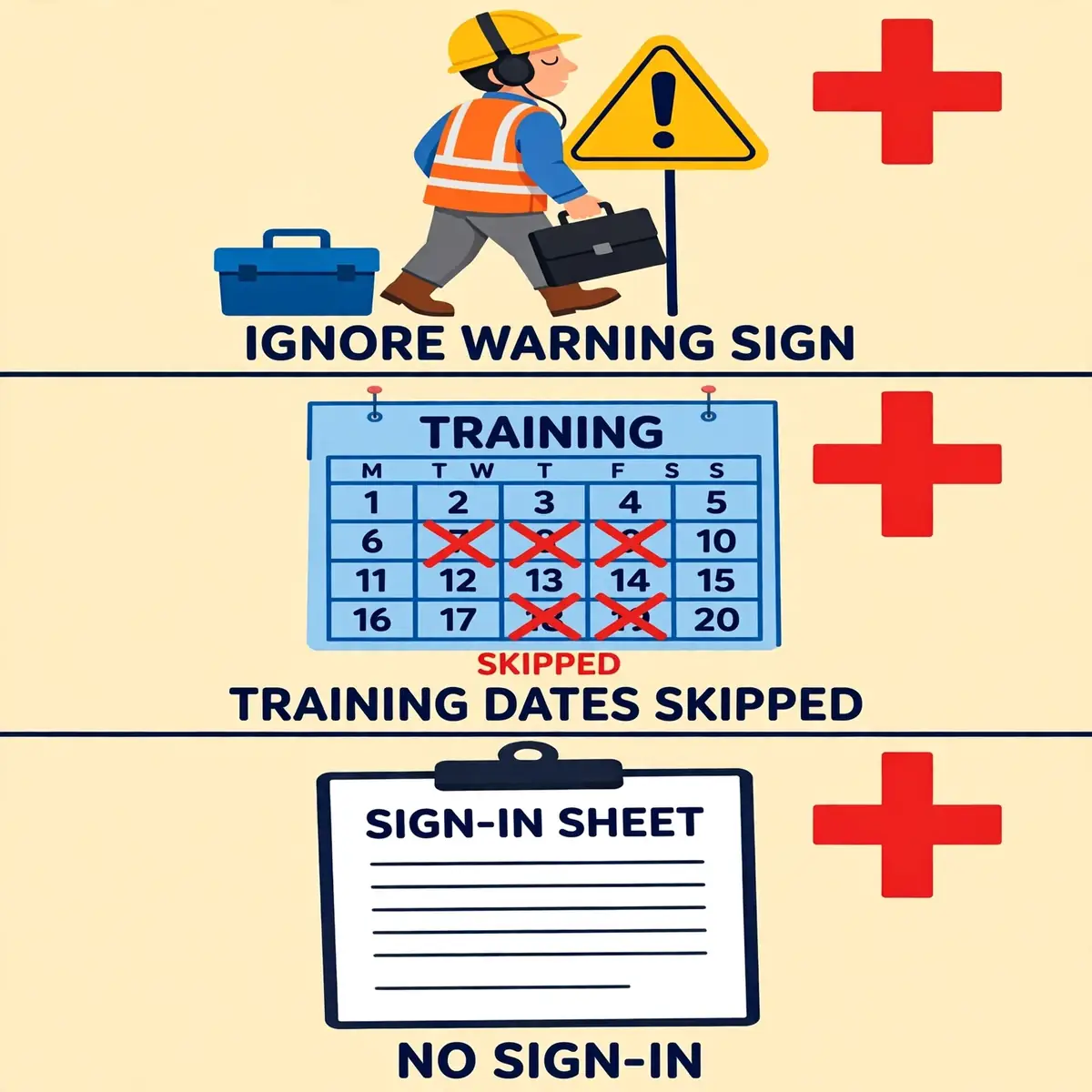
Most training failures are not caused by bad courses. They are caused by good courses delivered in the wrong way, at the wrong time, or to the wrong people. The mistakes below appear again and again in inspection reports and incident investigations. Each one is easy to make and easy to fix, once it is named. Check the programme against this list before the next review.
One generic course for everyone
The most common mistake is buying one generic course and sending everyone to it. Generic material is a starting point, not a finish line. Add the site-specific procedures, equipment, and chemicals, or the training will not answer the hazards workers actually meet. A worker who can name the hazard but cannot use the control has not been trained. The fix is to build the programme from the risk assessment, not from a course catalogue.
Generic courses also create a false sense of coverage. The attendance list looks complete, the certificates are filed, and the hazards stay uncovered. An inspector who asks a worker about the chemicals in their own work area will find the gap in a minute. The attendance record will not help, because it proves only that the worker sat through a course about something else.
Training after exposure, not before
The second mistake is timing. Almost every training standard requires training before the employee touches the covered hazard, and training delivered a month after the worker starts was already a violation on day one, not day thirty. The fix is to put safety instruction inside the arrival process, so that no worker reaches the hazard untrained. A new starter's first day should include the training for the hazards of that day's work, not only the paperwork and the tour.
Change-triggered training fails in the same way. A new machine arrives, a product is substituted, a procedure is changed, and nobody asks whether anyone needs to be told something different. Build the ten-second question into every change: does anyone need to be told something different now? Put that question on the change form, in the purchase order, and in the handover meeting, and the gap closes.
Attendance treated as competence
The third mistake is treating a sign-in sheet as proof of competence. A sign-in sheet proves attendance, not understanding. Some standards require a written certification of training. The fall protection standard in construction, for example, requires a written certification record with the worker's name, the training dates, and the signature of the person who conducted the training. Even that record proves only that the training happened. The competence check is separate, and it must be done by watching the worker or by a test that matches the job.
The fix is to record the check as well as the attendance. Note the date, the task, the person who checked, and the result. A worker who fails the check needs more training, not a note in a file. A programme that records checks honestly will find its weak spots quickly, and a programme that does not will find them in an incident report.
No records, or records nobody can find
The fourth mistake is poor records. Training that cannot be proved may as well not have happened, and records that cannot be found in a reasonable time are almost as bad. The fix is simple. Keep one training file per worker, or one entry per worker in the training matrix, with the date, topic, trainer, attendees, and the result of the competence check. Keep the records for the length of employment plus three years. Organise them so that an inspector's request can be answered in minutes, not hours.
Records also protect the employer when an incident is investigated. A clean record shows what was taught, when, and by whom, and it shows that the worker's competence was checked. A missing record leaves the employer with only a memory of the session, and a memory is not evidence. The smallest employers have the most reason to keep clean records, because they have no safety function whose word would otherwise carry weight.
Training used to paper over a bad design
The fifth mistake is using training to cover a hazard that should have been removed. Training is the last line of defence in the hierarchy of controls, not the first. If workers keep getting hurt doing the same task, the answer is rarely more training on the same task. The answer is usually a guard, a safer chemical, a redesigned layout, or a different method of work. Training a worker to cope with a hazard that could have been eliminated is a failure of design, not a failure of the worker.
Ask the question at every review: would a control higher in the hierarchy remove this hazard? If the answer is yes, fix the hazard first, then train workers on the new arrangement. Training works best when it supports a safe system of work, not when it compensates for an unsafe one. For the detail on each level of the hierarchy and how to apply it, see hierarchy of controls.
WarningNever let a certificate file substitute for a safe workplace. Training is the last line of defence, and it cannot fix a hazard that should have been designed out.
Frequently Asked Questions
Is safety training required by law?
Yes, in most countries. In the United States, the OSH Act's General Duty Clause and more than 100 hazard-specific OSHA standards require training. In the United Kingdom, the Health and Safety at Work etc. Act 1974 and the Management of Health and Safety at Work Regulations 1999 require employers to provide training on recruitment and whenever risks change. The exact duties depend on the hazards in the workplace and the country the workplace sits in.
What types of safety training are there?
The main types are induction training for new starters, task-specific training for particular jobs, refresher and update training, supervisory and management training, emergency and fire safety training, and toolbox talks. Most workplaces need a mix of all six, weighted toward the hazards they actually have. No single type covers every risk.
How often does safety training need to be repeated?
It depends on the trigger. Some training repeats on a fixed cycle, such as annually for bloodborne pathogens in the United States. Some repeats when something changes, such as a new machine or a new chemical. Some repeats when a worker starts a new role. And some repeats when performance shows a gap, such as after an incident or a failed check. There is no single annual rule that covers everything.
Does an OSHA 10-hour card count as safety training?
No. The OSHA 10-hour course is a voluntary awareness course, and its card is not a certification. It does not meet the training requirements of any OSHA standard. A worker with a 10-hour card still needs the training each applicable standard requires, delivered for their own hazards, before exposure.
How long should safety training records be kept?
Keep them for the length of employment plus three years as a safe default. Some standards set their own periods, and the bloodborne pathogens standard requires written records including dates, content, trainer qualifications, and trainee names. Records should show the date, the topic, the trainer, the attendees, and the result of the competence check.
Can safety training be done online?
Online training works for awareness topics and compliance refreshers, where the goal is knowledge. It does not work alone for hands-on skills such as fitting a harness, using a fire extinguisher, or operating a forklift. Those skills need supervised practice and an observed competence check. Blended programmes, with online knowledge and practical sessions, usually perform best.
Who pays for safety training?
The employer pays for required training. In the United States, the OSH Act places the cost on the employer, and the training must be given during working hours. In the United Kingdom, Regulation 13 requires training to take place during working hours, and the cost falls on the employer. Workers should never have to pay for training the law requires them to have.
Sources
- OSHA — Training Requirements in OSHA Standards (OSHA 2254)
- Occupational Safety and Health Act of 1970 — Section 5, Duties
- OSHA — 29 CFR 1926.21, Safety training and education (construction)
- OSHA — 29 CFR 1910.1200, Hazard Communication
- OSHA — 29 CFR 1910.151, Medical services and first aid
- OSHA — Training Standards Policy Statement, 28 April 2010
- OSHA — Top 10 Most Frequently Cited Standards, Fiscal Year 2026 (preliminary)
- OSHA — Outreach Training Program
- Health and Safety at Work etc. Act 1974 — Section 2, General duties of employers
- Management of Health and Safety at Work Regulations 1999 — Regulation 13, Capabilities and training
- Health and Safety Executive — Health and safety training: A brief guide (INDG345)
- ISO — ISO 45001:2018, Occupational health and safety management systems
- Bisbey et al. — How does training contribute to workplace safety? A meta-analysis examining the effects of safety training, Journal of Applied Psychology, 2026
- IOSH — Managing Safely awareness course
- NEBOSH — National General Certificate in Occupational Health and Safety