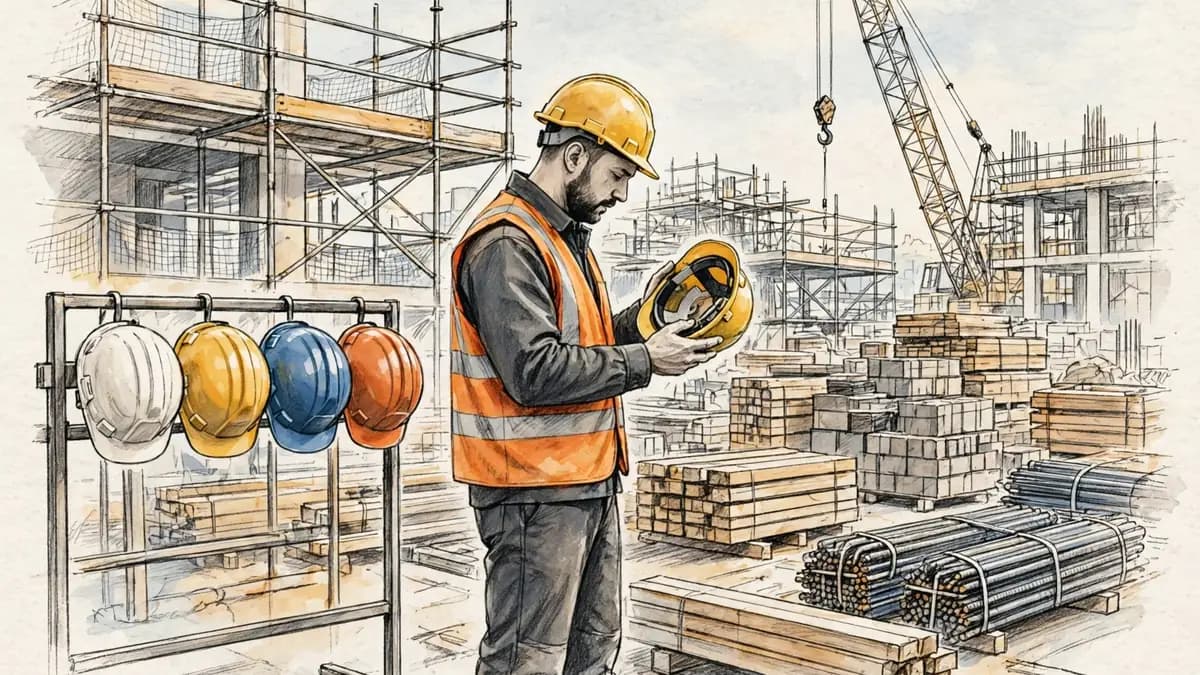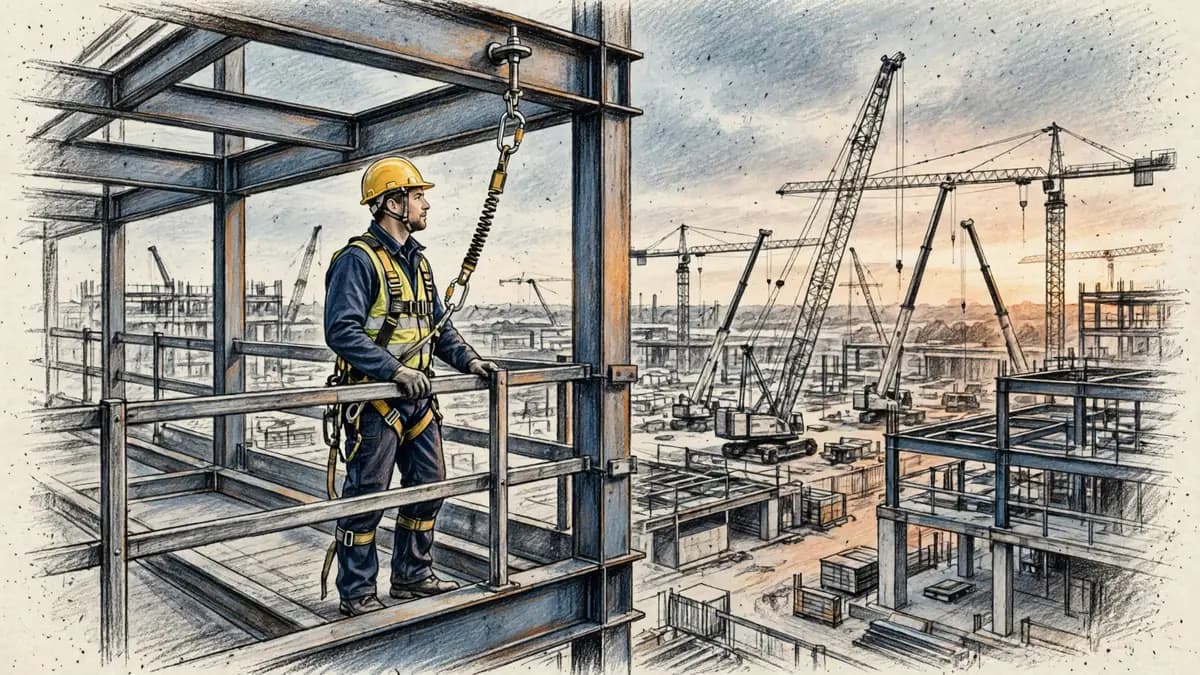
Fall protection is a system that keeps a worker from reaching the ground after a fall. It also stops the fall from happening at all. In United States construction work, the Occupational Safety and Health Administration (OSHA) requires it at 6 feet above a lower level. In general industry, the line is 4 feet. A harness alone is not fall protection. The system is an anchor, a body support, and a connector, chosen together, fitted to the worker, inspected before every use, and backed by a rescue plan.
Many workplaces get the order wrong. They hand out harnesses first and ask questions later. The law and the safety hierarchy both put collective protection first. Guardrails, covers, and nets protect everyone on a deck without asking any worker to clip in correctly. A personal fall arrest system comes last because it only works when every part holds, the clearance below is enough. Someone can bring the worker down after the fall.
What fall protection is — and what it is not
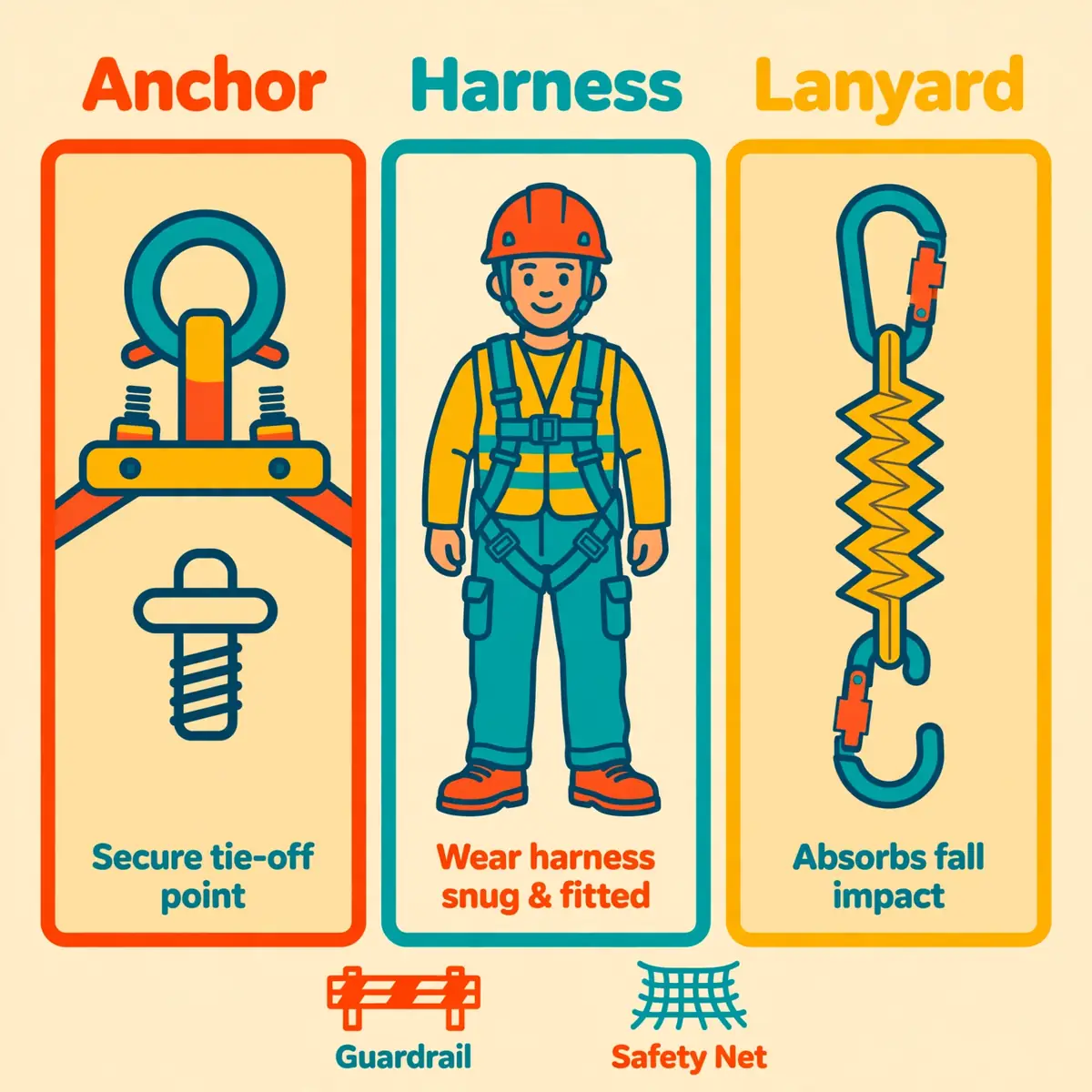
Fall protection means every measure that prevents a person from falling from height. It also limits the harm when a fall happens. The phrase covers guardrails and covers that stop a fall before it starts. It covers restraint lines that keep a worker short of an edge. It also covers arrest systems that catch a worker mid-fall. One term holds all three jobs, and confusing them is where most mistakes begin.
A harness is not fall protection by itself. A harness with no anchor is decoration. A lanyard clipped to a guardrail is a hazard, not a safeguard. Protection exists only when the parts work as a tested system, each rated for the load it must carry, and each compatible with the others. Employers who buy the parts separately and hope they fit together are gambling with the one event the system exists for.
A system, not a single product
Every fall protection system has the same three jobs, whatever the site looks like. First, it must keep the worker on the working surface or stop the fall at the edge. Second, it must hold the forces of a fall without breaking or injuring the worker. Third, it must leave the worker retrievable after the fall. A system that passes the first two tests and fails the third is incomplete. A worker hanging in a harness faces a second emergency of its own.
The three jobs explain why no single product can carry the name. A guardrail does the first job for everyone at once and never needs the other two. A harness and lanyard do the second job only when the anchor holds and the clearance below is enough. The rescue plan does the third job, and it must exist before anyone ties off. Buying equipment without planning all three jobs leaves the most dangerous minutes unplanned.
Three jobs: prevent, restrain, arrest
Prevention stops the fall from starting. Guardrails, parapets, covers over holes, and properly built scaffolds all prevent falls. They protect every worker in the area, they work while the worker thinks about something else. They need no fitting or clipping. Prevention is the strongest form of fall protection, and it should be the first option considered on every job.
Restraint keeps a worker from ever reaching the edge. A short line, anchored so the worker cannot physically reach the fall hazard, means no fall can happen. Arrest accepts that a fall may happen and catches the worker in progress. Arrest demands the most from the equipment, the maths, and the rescue plan. The order matters: prevent first, restrain second, arrest last.
AlertA harness clipped to an anchor that cannot hold 5,000 pounds is not a fall protection system, whatever the label on the harness says.
When the law requires fall protection
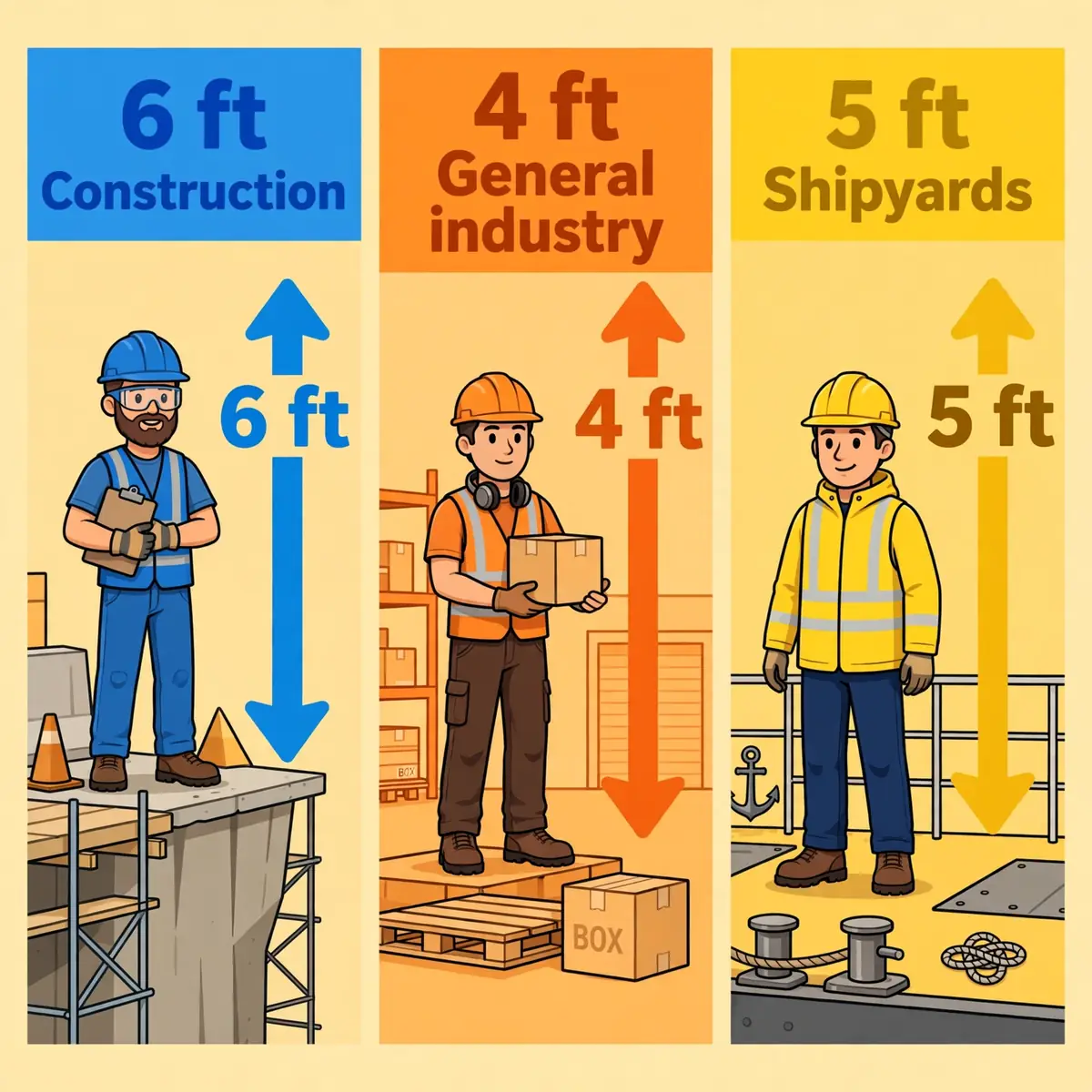
The duty to provide fall protection turns on height, on the kind of work, and on the country. In the United States, federal rules set different trigger heights for construction, general industry, and shipyards. In Great Britain, the rule works differently: there is no trigger height at all. The test is whether a person could fall a distance liable to cause personal injury. The employer must then work through a fixed hierarchy of controls.
Knowing the trigger height matters because it decides when protection becomes a legal duty rather than good practice. A mezzanine edge at 5 feet needs protection in a warehouse but not under the construction rule. A roofer at 6 feet needs it under either rule. A worker beside a floor opening at ground level may still need it under the British rule. The fall only has to be liable to cause injury.
Construction: 6 feet and the listed situations
Under 29 CFR (Code of Federal Regulations) 1926.501, construction employers must protect every worker on a walking or working surface with an unprotected side or edge 6 feet or more above a lower level. The protection may be a guardrail system, a safety net system, or a personal fall arrest system. The rule then lists fifteen situations, and each names which systems are allowed for it.
The listed situations cover most construction work at height. Leading edges, hoist areas, holes including skylights, formwork and reinforcing steel, ramps and walkways, excavations, roofing on low-slope and steep roofs, precast concrete erection, residential construction, and wall openings all appear by name. Dangerous equipment is the exception to the height rule: workers below 6 feet above dangerous equipment must still be protected by guardrails or equipment guards.
| Situation | Trigger | Protection allowed |
|---|---|---|
| Unprotected sides and edges | 6 feet or more | Guardrail, safety net, or personal fall arrest system |
| Leading edges | 6 feet or more | Guardrail, net, or arrest; a written fall protection plan only if conventional systems are infeasible |
| Holes, including skylights | More than 6 feet for falling through; any height for stepping in | Covers, guardrails, or arrest |
| Hoist areas | 6 feet or more | Guardrail or arrest; arrest when leaning through the opening |
| Ramps, runways, and walkways | 6 feet or more | Guardrails |
| Dangerous equipment | Any height | Guardrails or equipment guards below 6 feet |
Two points in the rule catch employers out. First, the employer must determine that the walking and working surfaces can support the workers before anyone steps onto them. Second, the fall protection must be provided and installed before the worker begins the work that needs it. Protection fitted after the work starts is a violation, not a delay.
General industry: 4 feet, and shipyards at 5 feet
Under 29 CFR 1910.28, general industry employers must protect every worker on a walking-working surface with an unprotected side or edge 4 feet or more above a lower level. The options are guardrail systems, safety net systems, or personal fall protection systems such as personal fall arrest, travel restraint, or positioning systems. Warehouses, factories, loading docks, and maintenance platforms all fall under this rule.
The general industry rule also names its own situations. Hoist areas, holes, dockboards, runways, dangerous equipment, wall openings, stairway landings, and fixed ladders taller than 24 feet each carry their own paragraph. Fixed ladders installed since 19 November 2018 must have a personal fall arrest system or a ladder safety system. By 18 November 2036 every fixed ladder must carry one of those two systems.
Shipyard work sits between the two, with a 5-foot trigger under the shipyard standards. The practical lesson is simple: the trigger height depends on the industry. A safety plan copied from construction onto a warehouse floor, or the reverse, will be wrong. Check which rule governs the work before choosing the protection.
WarningWorking over dangerous equipment needs protection at any height, so a low platform over a machine pit is not exempt from the rules.
The UK rule: no minimum height
Great Britain's Work at Height Regulations 2005 apply wherever a person could fall a distance liable to cause personal injury. There is no minimum height in the Regulations, and the old two-metre threshold was removed when they came into force. A fall from a low platform, a stepladder, or the back of a vehicle can count as work at height if the landing could injure the worker.
Regulation 6 sets the hierarchy every employer must follow. Work at height must be avoided where it is reasonably practicable to do the work safely another way. Where it cannot be avoided, the employer must take suitable and sufficient measures to prevent a fall, so far as is reasonably practicable. Where the risk of a fall remains, the employer must provide equipment that minimises the distance and consequences of a fall. The employer must also provide extra training and instruction to prevent injury.
Collective protection comes before personal protection at every step. A guarded platform protects everyone without depending on one worker clipping on correctly. A harness is the last resort in the hierarchy, not the first. The Regulations also require the work to be properly planned, appropriately supervised, carried out by competent people, and planned for emergencies and rescue.
The order of controls: eliminate, guard, restrain, arrest
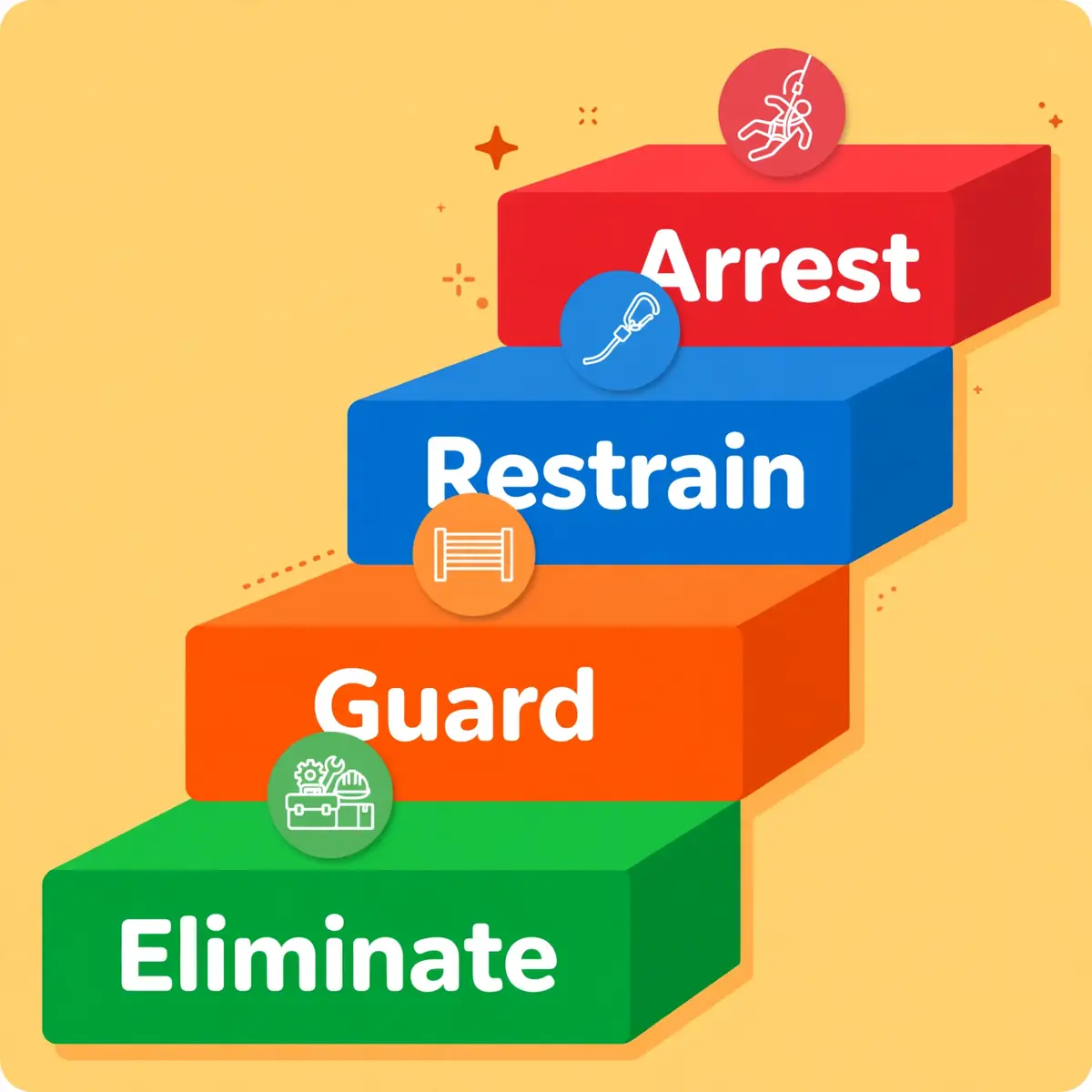
Fall protection works best when the controls are chosen in order, from the strongest to the weakest. Elimination removes the work at height entirely. Guarding puts a barrier between the worker and the edge. Restraint keeps the worker short of the edge. Arrest catches the fall. Each step down the order depends more on the worker doing everything right, and each step carries more ways to fail.
The order is not a suggestion. It is the structure of the UK Work at Height Regulations. It is also the logic behind the US rules, which let an employer meet the duty with guardrails or nets instead of a harness. A plan that jumps straight to harnesses skips the controls that protect everyone and protect them passively. That plan is weaker, harder to supervise, and more expensive to get wrong. The ranking matches the hierarchy of controls, which puts elimination first and personal protective equipment last.
Eliminate the work at height
Elimination asks whether the job can be done without anyone going up at all. Assembling a structure at ground level and lifting it into place removes the fall hazard completely. Using extendable tools for cleaning, painting, or inspection does the same for routine tasks. Prefabricating pipework, ducting, or roof sections on the ground moves the risky work to a safe level.
Design decisions eliminate more falls than any harness ever will. A roof anchor fitted during construction, a walkway built into the plant layout, or a light fitting reachable from the ground each remove a lifetime of exposure. The question belongs at the planning stage, not on the day the work starts. Elimination is usually cheap at design and impossible afterwards.
Guard and restrain before arresting
When the work must happen at height, the next question is whether a barrier can do the job. Guardrails, parapets, scaffold edge protection, and covers over holes all guard the edge for everyone. A mobile elevating work platform with its gate closed is a guarded workplace. These controls work all day, for every worker, without a fitting check or a clip-in decision.
Restraint is the next step down. A short lanyard anchored so the worker physically cannot reach the edge means no fall can happen at all. Restraint is simpler than arrest: the forces are small, the clearance maths disappears, and there is no suspended worker to rescue. It only works where the anchor position and the lanyard length genuinely keep the worker short of the edge. The geometry must be checked on the actual job, not assumed.
TipBefore ordering harnesses for a job, ask whether a guardrail, a cover, or a shorter line would remove the fall entirely.
Guardrails and safety nets
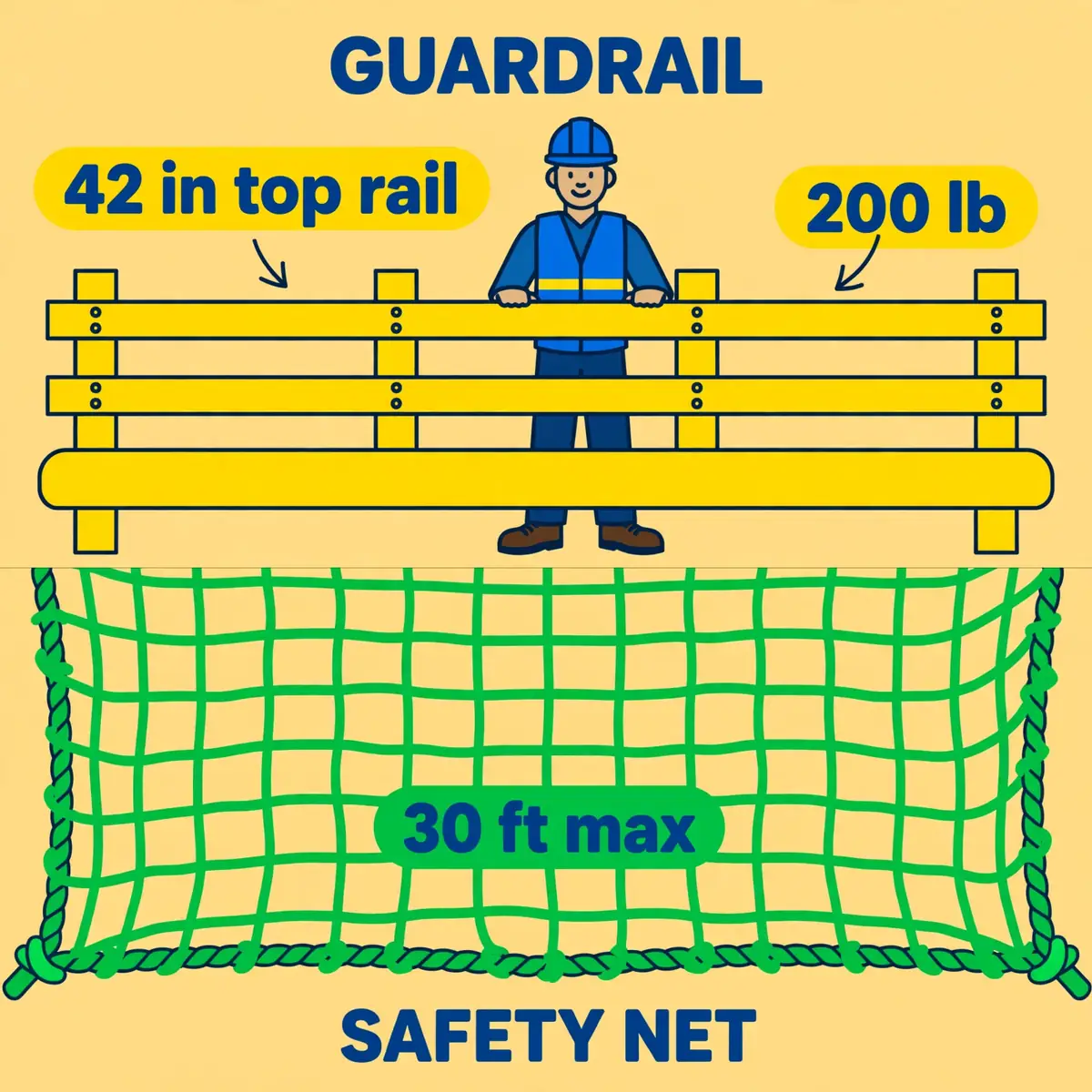
Guardrails and safety nets are collective protection: they protect everyone in the area without depending on any individual worker. A guardrail stops the fall at the edge. A safety net catches the worker who falls past it. Both are passive systems, which is why the rules allow either one to satisfy the duty wherever the situation permits it.
Their strength is also their limit. A guardrail only protects the edge it stands on, and a net only catches falls inside its span. Neither helps a worker who steps outside the protected area or climbs over the rail. They must be installed before the work starts, inspected regularly, and kept in place until the work is done.
Guardrails: the numbers that matter
Under 29 CFR 1926.502, a construction guardrail's top rail must stand 42 inches above the walking or working level, plus or minus 3 inches. The system must withstand a force of at least 200 pounds applied outward or downward near the top edge, without failing. When that load pushes down, the top edge must not deflect below 39 inches above the level.
Midrails, screens, mesh, or equivalent members must fill the gap between the top rail and the surface where no wall at least 21 inches high stands. Midrails sit midway between the top rail and the level. They must withstand at least 150 pounds applied in any outward or downward direction. Toeboards keep tools and materials from falling onto workers below, and the rail surfaces must not snag clothing or cut skin.
Steel or plastic banding must never serve as a top rail or midrail. Wire rope used as a top rail must be flagged with high-visibility material at intervals of no more than 6 feet. In Great Britain, the Work at Height Regulations require a top guardrail at least 950 millimetres above the edge on construction work. Intermediate rails must be spaced so no gap exceeds 470 millimetres.
Safety nets: catching the fall
Safety nets must be installed as close as practicable under the walking or working surface, and never more than 30 feet below it. The net must extend outward from the edge of the work surface:
- 8 feet where the drop to the net is up to 5 feet.
- 10 feet where it is more than 5 feet up to 10 feet.
- 13 feet where it is more than 10 feet.
Enough clearance must remain under the net so a falling worker does not strike the surface below.
Nets must be drop-tested at the jobsite after installation, whenever they are relocated, and after major repair. Nets left in one place need a test at six-month intervals. The test drops a 400-pound bag of sand from the highest working surface. Nets must be inspected at least once a week for wear, damage, and deterioration, and defective nets must not be used. Anything that falls into a net must be removed as soon as possible, and always before the next shift.
WarningA net with a torn mesh, a missing border rope, or tools lying in it is not a safety net, so inspect it weekly and after every event that could damage it.
The personal fall arrest system: anchorage, harness, connector
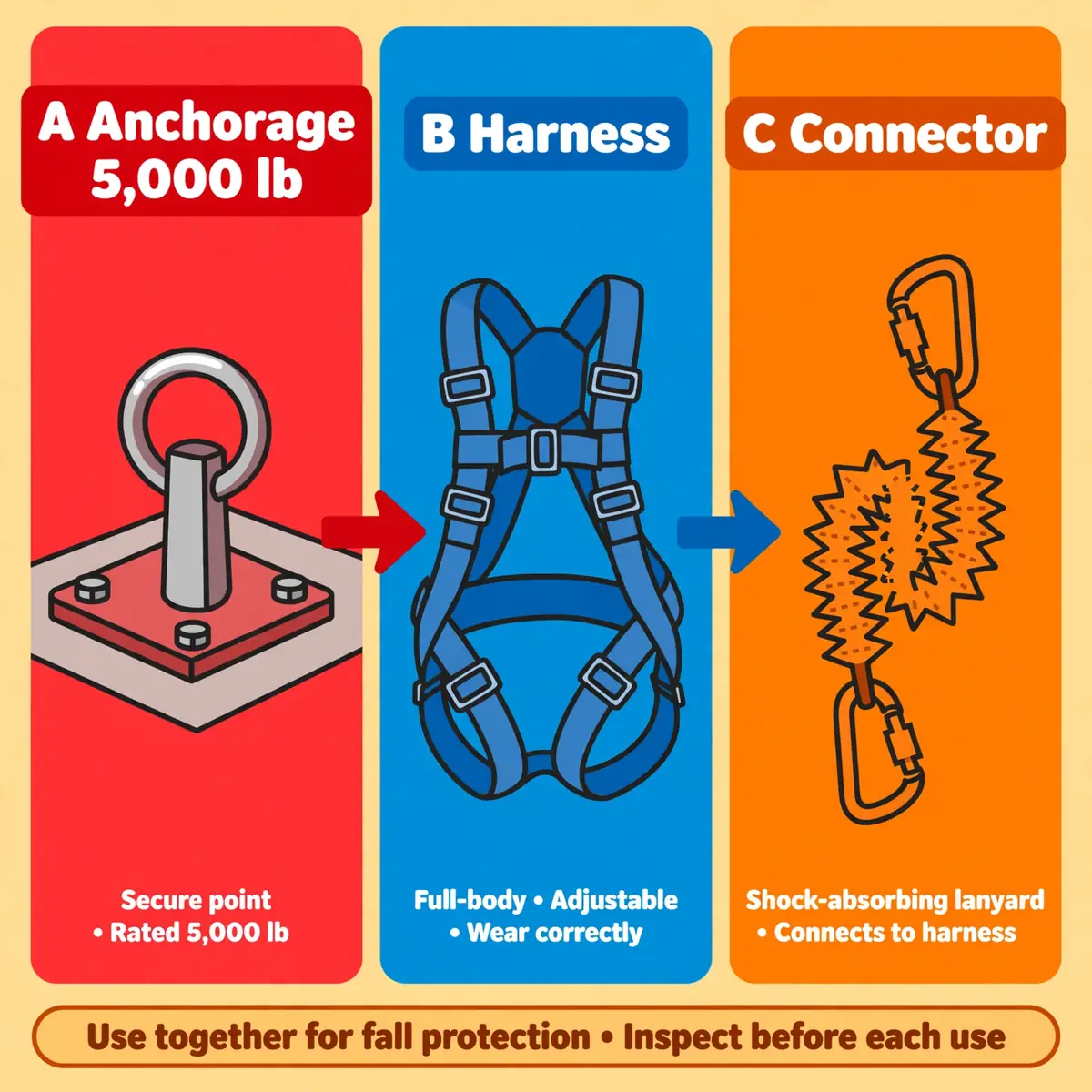
A personal fall arrest system, usually shortened to PFAS, is the system that catches a worker who falls. It has three parts, known in the trade as the ABCs: the anchorage, the body support, and the connector. All three must be right at the same time. A strong harness on a weak anchor fails at the anchor. A strong anchor with a damaged lanyard fails at the lanyard.
The law sets the performance of the whole system, not of each part alone. Under 29 CFR 1926.502, the system must limit the maximum arresting force on a worker in a harness to 1,800 pounds. It must be rigged so the worker can neither free-fall more than 6 feet nor contact any lower level. It must bring the worker to a complete stop within a maximum deceleration distance of 3.5 feet.
A — Anchorage
The anchorage is the fixed point the system ties to, and it is the part most often guessed at. Under the construction rule, an anchorage must be independent of any anchorage supporting or suspending a platform. It must support at least 5,000 pounds per attached worker. The alternative is an engineered system, designed, installed, and used under a qualified person, that maintains a safety factor of at least two.
An anchor that looks solid is not necessarily rated. Vent pipes, chimneys, guardrails, and truck hitches are not anchorages. Roof anchors, beam straps, and certified anchor points are, provided they are installed exactly as the manufacturer instructs and the structure behind them can carry the load. The anchor should sit above the worker where possible, because an anchor at foot level doubles the free fall and can put the fall outside the connector's rating.
B — Body support
The body support is the full-body harness, and it is the only body-holding device the law accepts for fall arrest. The attachment point sits in the centre of the wearer's back, near shoulder level or above the head. That position keeps the worker upright during the arrest and in suspension afterwards, which matters for breathing and for rescue.
Harness choice depends on the work. A construction harness, a harness with a positioning belt, and an arc-flash-rated harness are different tools for different jobs. Comfort matters more than it sounds: a harness that chafes or pinches will be worn loose, adjusted badly, or quietly left off. Fit is covered in detail in the harness section below.
C — Connector
The connector joins the harness to the anchorage. It is usually a shock-absorbing lanyard, a self-retracting lifeline, or a vertical lifeline with a rope grab. Under the construction rule, lanyards and vertical lifelines must have a minimum breaking strength of 5,000 pounds. Each worker on a vertical lifeline needs a separate lifeline, and lifelines must be protected against cuts and abrasion.
Connectors decide the clearance maths, because the connector sets how far the worker falls before stopping. A 6-foot shock-absorbing lanyard needs far more clear space below the anchor than a self-retracting lifeline does. The connector also sets the anchorage rules. A device rated for overhead anchorage may not be rated for foot-level anchorage. The label on the device, not habit, decides which it is.
TipCheck the connector label for its permitted anchorage range before every job, because an overhead-rated device used at foot level can fail the clearance maths completely.
Harnesses: fit, types, and what the law says
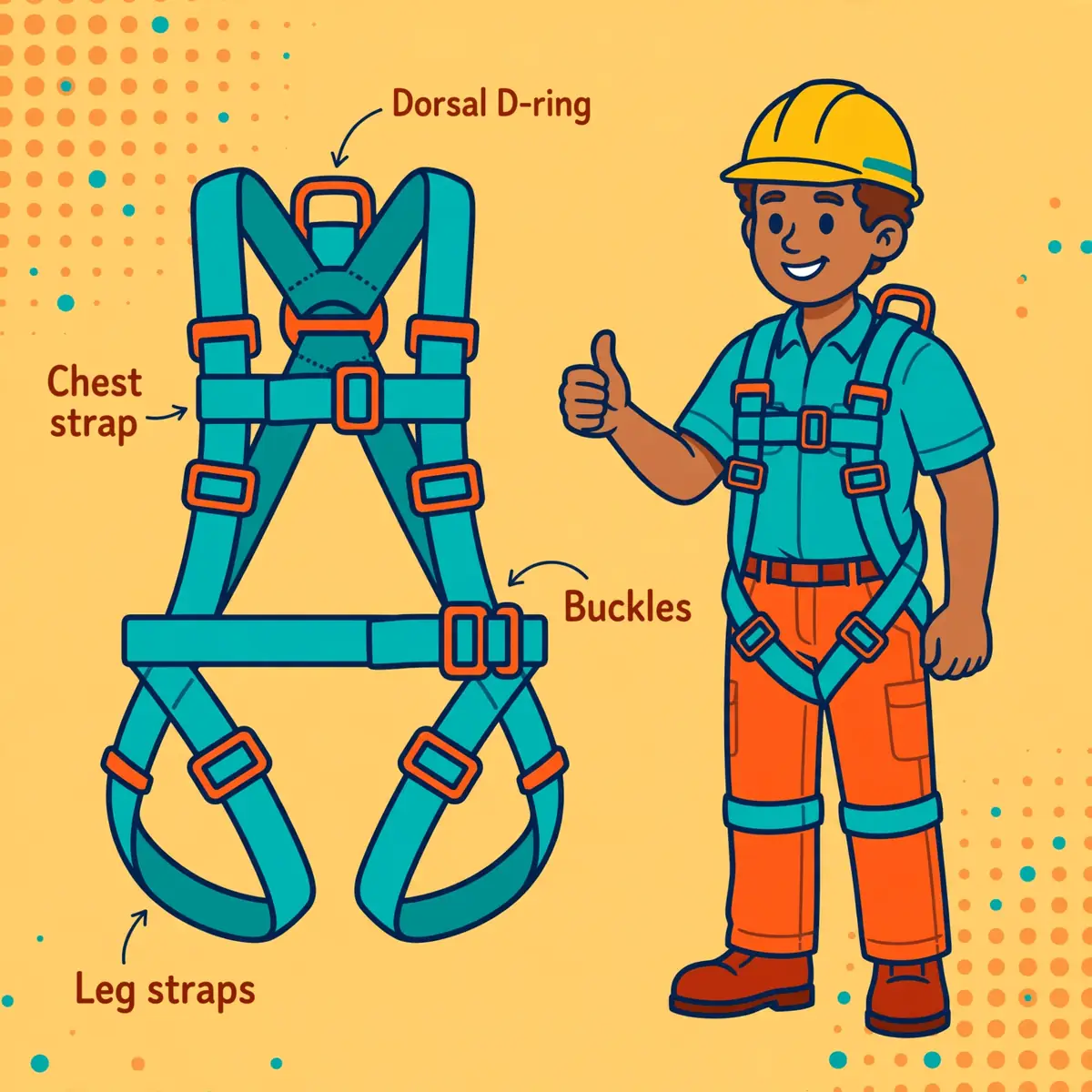
The harness is the part the worker wears, so it is the part that gets the most attention and the most mistakes. A harness must fit snugly, sit correctly on the body, and be the right type for the work. A loose harness injures the worker during the arrest it was bought for. A harness of the wrong type for the task leaves the worker unprotected in the situation that actually happens.
United States law is blunt about which body support may arrest a fall. Since 1 January 1998, body belts have not been acceptable as part of a personal fall arrest system in construction. Only a full-body harness may do that job. Body belts remain acceptable in positioning device systems, where no fall is arrested, but the ban on their use for arrest is absolute.
Why only a full-body harness arrests a fall
A fall arrest loads the body violently. The harness must spread that load across the parts of the body that can take it. A full-body harness distributes the arresting force across the shoulders, chest, pelvis, and thighs. The dorsal D-ring, centred between the shoulder blades, keeps the worker upright while the fall is arrested and while the worker hangs waiting for rescue.
A body belt concentrates the same force on the waist. The result is a far higher risk of internal injury. The arresting force limit for a belt is only 900 pounds, against 1,800 pounds for a harness. The law reflects that difference directly. A positioning belt, worn with a full-body harness, is a different item. It holds the worker in position while both hands work. It never takes an arrest load on its own. Positioning systems must be rigged so the worker cannot free fall more than 2 feet.
Harness standards sit on top of the legal floor. In the United States, ANSI/ASSP Z359.11 — the harness standard from the American National Standards Institute and the American Society of Safety Professionals — covers full-body harnesses, Z359.13 covers energy-absorbing lanyards, and Z359.14 classifies self-retracting devices. In Europe, the equivalent harness standard is EN 361. General PPE requirements cover how employers assess, provide, and maintain protective equipment. The law sets the minimum; the standards describe the current state of the art that manufacturers certify against.
The five-point fit check
Fit is checked before every shift, with the same five points in the same order. The dorsal D-ring must sit centred between the shoulder blades, reachable with a thumb over the shoulder. The chest strap must cross the sternum, not the throat, and sit tight enough to keep the shoulder straps from slipping off.
Leg straps must be snug to a flat hand: two fingers is the limit, and a fist is too loose. Loose leg straps let the body slide until the sub-pelvic strap loads the groin. Webbing must lie flat everywhere, with no twists under a buckle. Strap tails must be stowed in their keepers so nothing snags or unthreads during the work.
- Dorsal D-ring: centred between the shoulder blades, reachable over the shoulder.
- Chest strap: across the sternum, never at the throat, tight enough to hold the shoulder straps.
- Leg straps: snug to a flat hand, two fingers at most, never a fist.
- Webbing: flat everywhere, with no twists caught under a buckle.
- Tails: stowed in their keepers so nothing snags or unthreads.
Fit starts with buying the right size and style. Harnesses are built for different work: a warehouse harness, a construction harness with a positioning belt, and a harness rated for arc flash. The wrong one will fit badly however carefully it is adjusted. Workers must be able to adjust their own harness, and supervisors must check the fit rather than assuming it.
Lanyards and connectors: shock absorbers, SRLs, and clearance
The connector is the part that decides whether a fall is survivable. It sets how far the worker falls and how hard the system stops them. Two connectors can look alike and behave very differently. A shock-absorbing lanyard stretches and tears to absorb energy over distance. A self-retracting lifeline locks almost at once and stops the fall in inches. The choice between them is a clearance decision, not a preference.
Connectors also carry the strictest compatibility rules in the system. Snaphooks must be locking type, sized to fit the member they connect to. They must never be engaged:
- Directly to webbing, rope, or wire rope.
- To each other.
- To an occupied D-ring.
- To a horizontal lifeline.
- To any shape that could depress the keeper and release itself.
Those rules exist because a connector that opens under load fails silently.
Shock-absorbing lanyards
A shock-absorbing lanyard is a fixed-length line with an energy absorber built in, usually a folded or stitched pack that tears open as it deploys. The absorber extends the stopping distance, which keeps the arresting force within the 1,800-pound limit. A standard 6-foot lanyard is the most common connector on construction sites. It is also the one that needs the most clear space below the anchor.
Twin-leg lanyards let a worker stay tied off while moving past an anchor point, clipping the second leg before unclipping the first. That practice is called 100% tie-off. It matters on steel erection, tower climbing, and any route where the worker must pass an obstruction. One leg is always attached, so there is never a moment with no protection at all.
Lanyards and vertical lifelines must have a minimum breaking strength of 5,000 pounds under the construction rule. The absorber pack must never be opened, cut, or modified, and a lanyard that has arrested a fall must be removed from service at once. The absorber is a one-use device, and a deployed pack tells the next user plainly that the lanyard is spent.
Self-retracting lifelines
A self-retracting lifeline, often shortened to SRL, works like a seat belt. The line pays out as the worker moves and retracts as they return, staying taut with almost no slack. When a fall begins, the device locks within a short distance and arrests the fall far sooner than a fixed lanyard can. That short arrest distance is the SRL's main advantage, and it is why SRLs fit jobs with little clearance below.
The construction rule sets different strength requirements by type. SRLs that automatically limit free fall to 2 feet or less must sustain a minimum tensile load of 3,000 pounds with the line fully extended. SRLs that do not limit free fall to 2 feet or less must sustain 5,000 pounds. Devices rated for leading-edge work, marked Class 2 under ANSI/ASSP Z359.14, are built to survive loading over a steel or concrete edge during a fall.
An SRL is not a universal replacement for a lanyard. The device must be rated for the anchorage position in use, overhead or foot level, and for the edge it may meet. A Class 1 device anchored overhead behaves differently from a Class 2 device anchored at foot level. The manufacturer's manual states the permitted range, the maximum arrest distance, and the minimum required clearance for that exact model.
Clearance: the maths that decides whether the system works
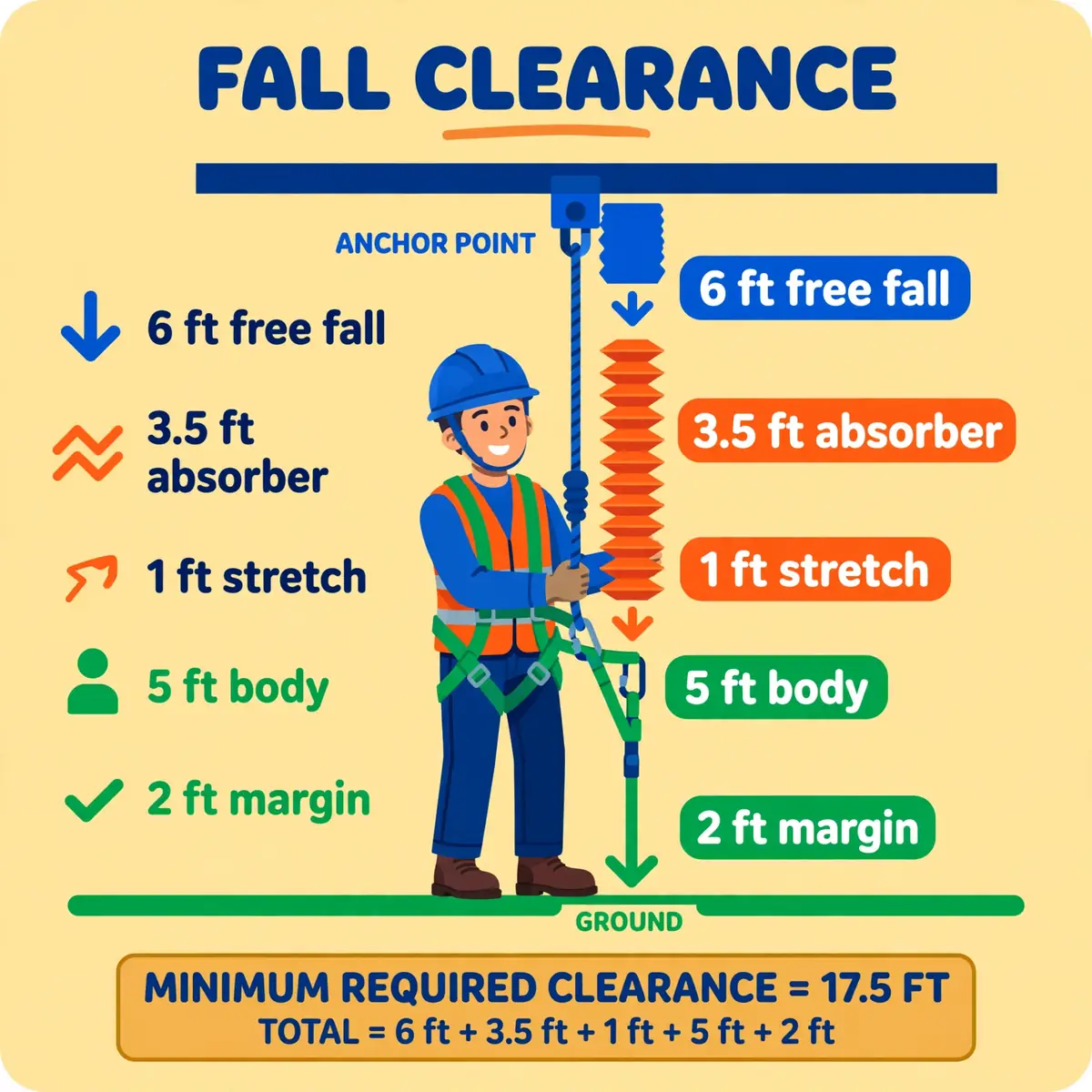
Clearance is the distance below the anchorage that must stay empty for the system to stop the worker before the ground does. Every part of the fall adds to the total:
- Free fall before the connector engages.
- Deceleration distance as the absorber deploys.
- Stretch of the harness under load.
- Length of the worker's body below the D-ring.
- A safety margin.
If the total exceeds the space below, the system fails, however strong its parts are.
An illustrative stack for a 6-foot lanyard anchored at the dorsal D-ring shows how quickly the numbers grow:
- 6 feet of free fall.
- 3.5 feet of absorber deployment.
- 1 foot of harness stretch.
- 5 feet of body below the D-ring.
- 2 feet of safety margin.
Those five parts add up to 17.5 feet. That figure is an example, not a rule for every lanyard. The free fall, deceleration distance, and minimum clearance are model-specific numbers from the connector's own manual. Those are the numbers that belong in the plan.
Anchoring at foot level breaks the maths entirely. A 6-foot lanyard anchored at the worker's feet means a 12-foot free fall, which is beyond the 6-foot limit and outside most lanyards' rating. Boom lifts create the same trap, because the basket anchor sits at the worker's feet. That is why lift work is a restraint-first application: a short restraint lanyard that keeps the worker inside the basket, or a Class 2 SRL rated for foot-level anchorage.
Swing falls add a sideways danger. A worker who falls away from the anchor swings like a pendulum and can strike a column, a wall, or a beam at fall speed. Working in line below the anchor, and keeping the anchor as close to directly overhead as possible, removes that risk. Horizontal lifelines let a worker move along a span while staying tied off. The line sags under arrest load, so the manufacturer's deflection figure must be added to the clearance stack.
WarningNever anchor a standard 6-foot shock-absorbing lanyard at foot level, because the 12-foot free fall it creates exceeds the legal limit and the lanyard rating.
Inspection, care, and when to retire equipment
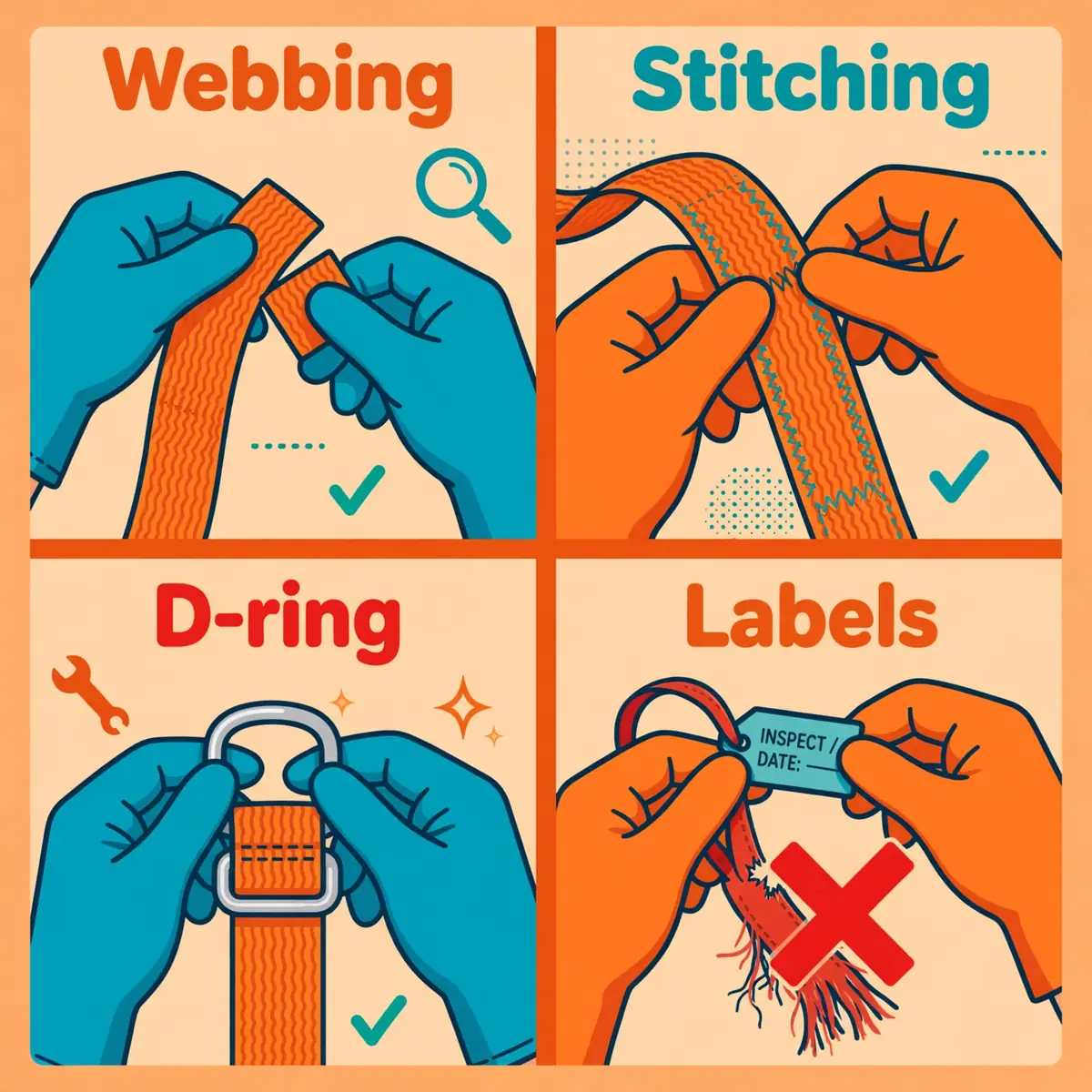
Fall protection equipment is lifesaving gear, and it fails quietly. Webbing frays, stitching breaks, buckles crack, and absorber packs hide damage inside a neat cover. The law answers that risk with a simple rule. Personal fall arrest systems must be inspected before each use for wear, damage, and other deterioration. Defective components must be removed from service.
Inspection has two layers, and confusing them is the most common error in the subject. The before-each-use inspection is the worker's own check, done every time the equipment is put on. The documented periodic inspection by a competent person, commonly annual, comes from ANSI/ASSP Z359.2 and from manufacturer instructions, not from the OSHA rule. The annual inspection never replaces the daily one.
The before-each-use inspection
Start at the labels. Every harness and lanyard must carry legible labels showing the manufacturer, model, date of manufacture, and applicable standards. A missing or unreadable label is itself a reason to remove the item from service, because the user cannot confirm what it is rated for or how old it is.
Then work through the webbing, inch by inch. Look for cuts, fraying, broken fibres, burns, chemical damage, and UV fading. Flex the webbing and check both sides, including the parts hidden under buckles and keepers. Stitching must be complete, with no pulled, broken, or missing stitches, especially at the D-ring attachments and the absorber pack.
- Webbing: no cuts, fraying, burns, chemical stains, or sun fading on either side.
- Stitching: complete at every attachment, with no pulled or missing stitches.
- D-rings and buckles: no cracks, distortion, corrosion, or sharp edges; buckles engage and hold.
- Connectors: locking snaphooks close and lock fully, with no bent gates or worn keepers.
- Absorber pack: cover intact, stitching unbroken, with no sign of deployment.
- Labels: legible, showing manufacturer, model, date, and standards.
Check the hardware next. D-rings must be free of cracks, distortion, and corrosion, and snaphooks must close and lock fully with no bent gates. A snaphook that does not lock is defective, however new it looks. Any component that has arrested a fall, or been subjected to impact loading, must be removed from service at once. It may be used again only after a competent person inspects it and finds it undamaged and suitable for reuse.
Storage, care, and retirement
Store harnesses and lanyards in a cool, dry place away from sunlight, chemicals, and sharp edges. Hang them or coil them loosely, never knotted or crushed under other equipment. Clean webbing with mild soap and water, and let it dry away from direct heat. Never use solvents, bleach, or abrasive cleaners on webbing, because chemical damage is often invisible until the fibres fail.
Retirement follows the manufacturer's instructions, which set the service life and the retirement criteria for each model. There is no universal expiry date for a harness, so the manual is the authority. Remove equipment from service when it fails any inspection point, when it has arrested a fall, when its labels are unreadable, or when the manufacturer states its service life has ended. Mark retired gear clearly so it cannot drift back into use.
AlertEquipment that has arrested a fall must be removed from service at once and used again only after a competent person confirms it is undamaged.
Rescue after a fall: the plan that must exist before work starts
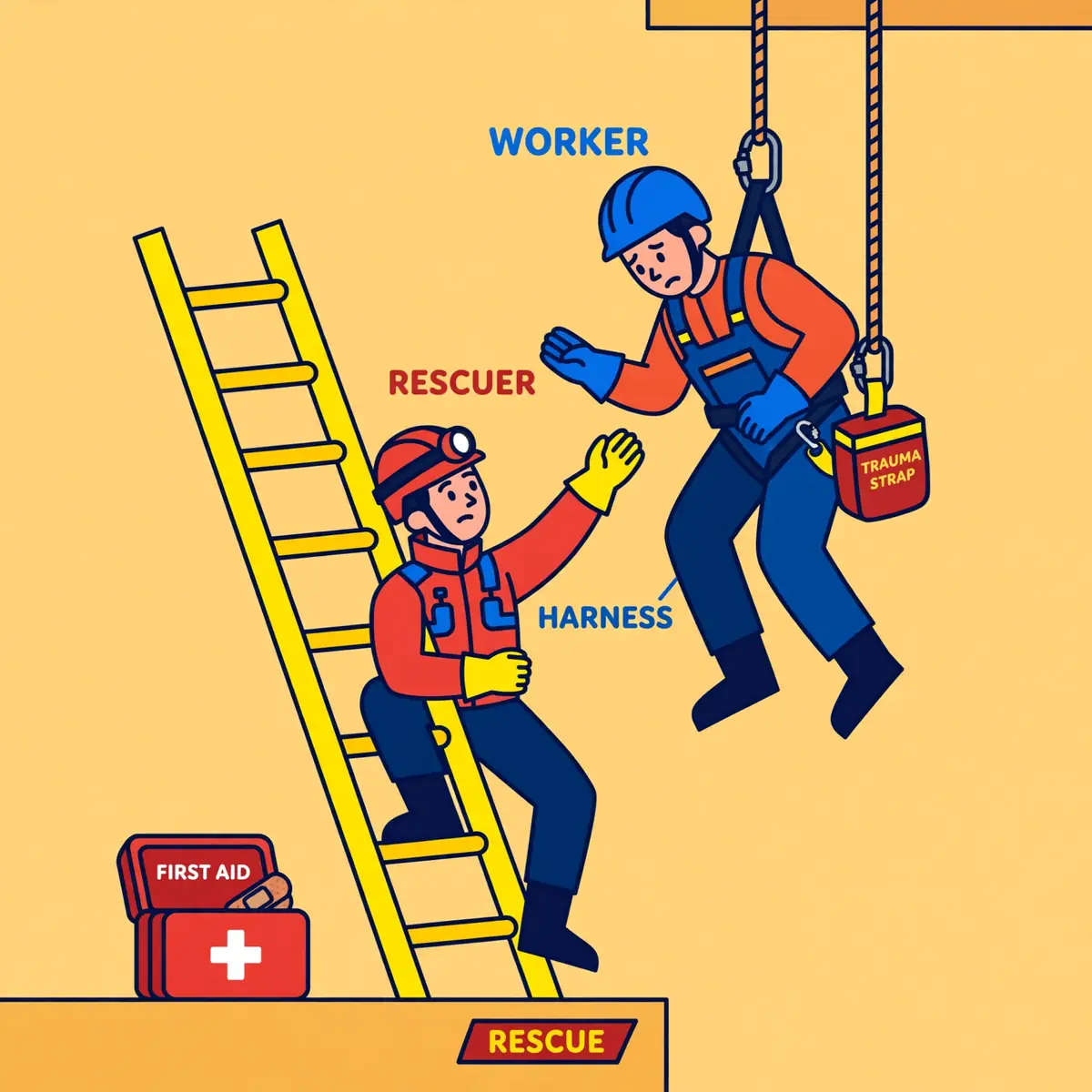
Arresting a fall is only half the job. A worker who hangs motionless in a harness faces a second emergency: blood pools in the legs, circulation to the brain falls. The worker can lose consciousness. OSHA's bulletin on suspension trauma and orthostatic intolerance (SHIB 03-24-2004) warns that this can develop while the worker waits. The recommendation is to perform rescue and treatment as quickly as possible. The bulletin cites research showing that suspension in a fall arrest device can lead to unconsciousness and then death in less than 30 minutes.
The law states the duty plainly. Under 29 CFR 1926.502, the employer shall provide for prompt rescue of employees in the event of a fall. The employer shall also assure that employees are able to rescue themselves. The general industry rule carries the same duty. A plan that amounts to calling the emergency services is not a plan, because the emergency response time then becomes the rescue time.
Why rescue is part of the system, not an afterthought
Suspension trauma, also called orthostatic intolerance, begins when a motionless worker hangs upright in a harness. The leg muscles stop pumping blood back to the heart, blood pools in the lower body, and the brain receives less oxygen. Onset varies with the individual, the harness, and whether the worker is injured or unconscious, but the risk starts as soon as the worker is hanging still.
Trauma relief straps buy time. They ride on the harness in a pouch, and a suspended worker deploys them into loops to stand in, keeping the legs pumping blood instead of letting it pool. Straps are not rescue: they are the bridge that keeps a worker conscious until the rescue that was planned actually arrives. Compatibility is not universal, so the attachment method must be checked against the harness manufacturer's instructions.
The rescue plan must be written for the actual job, not copied from another site. It must name who rescues, with what equipment, from where, and how long each step takes. A ladder staged nearby, an aerial lift on site, or a dedicated rescue device each work only where they can actually reach the suspended worker. The plan must be tested before the work starts, because a rescue method discovered during an emergency is a guess.
What a workable rescue plan contains
A workable plan names the rescue method for each work location, the equipment staged for it, and the people trained to use it. Self-rescue comes first where the worker can reach a safe surface or deploy a descent device. Assisted rescue follows where a colleague or a dedicated team must bring the worker down. The plan states how the alarm is raised, who calls the emergency services, and what first aid follows the rescue.
Every worker on the job must know the plan before tying off. That includes the suspended worker's own role: deploying trauma straps, staying calm, and signalling for help. It includes the rescuer's role: reaching the worker without becoming a second casualty. It also includes the supervisor's role: stopping the work, clearing the area below, and keeping the rescue route open.
- Method: self-rescue, assisted rescue, or both, named for each work location.
- Equipment: ladders, lifts, or rescue devices staged where they can reach the worker.
- People: named rescuers, trained and present on site during the work.
- Time: a realistic rescue time, short enough to prevent suspension trauma.
- Aftercare: first aid and medical assessment for every rescued worker.
Training and the employer's duties
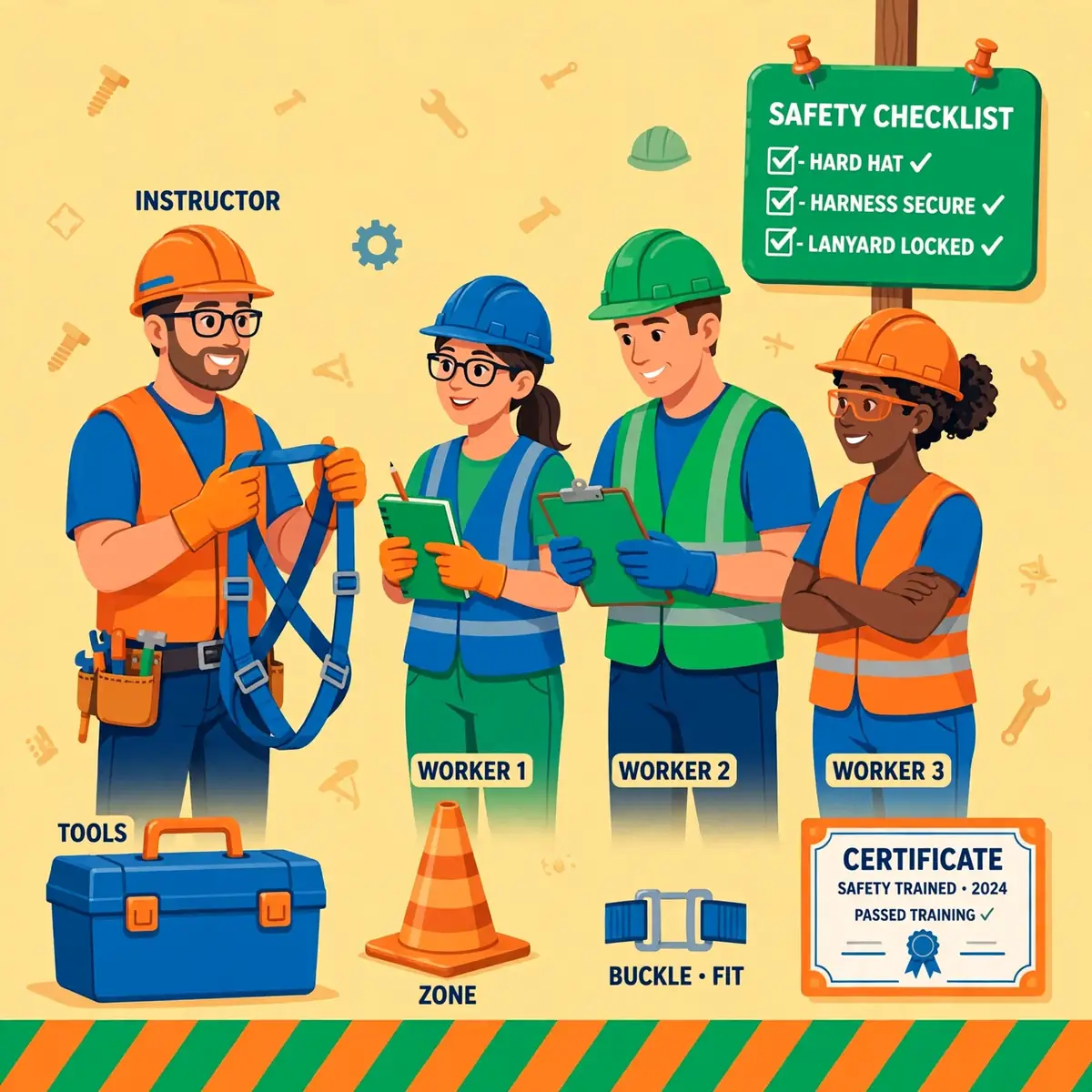
Equipment without training is a hazard with a label on it. Workers who cannot recognise a fall hazard, fit a harness, judge clearance, or inspect a lanyard will make the same mistakes. The equipment makes no difference, new or worn out. The law therefore puts training beside the equipment, and it names who must deliver it and what it must cover.
Under 29 CFR 1926.503, the employer must provide a training programme for each employee who might be exposed to fall hazards. The training must be delivered by a competent person: someone capable of identifying existing and predictable fall hazards and authorised to take prompt corrective action. The employer must certify the training in writing, with the worker's name, the date, and the trainer's signature.
What the training must cover
Construction training covers:
- The nature of the fall hazards in the work area.
- The correct procedures for erecting, maintaining, disassembling, and inspecting the fall protection systems used.
- The use and operation of those systems.
It also covers:
- The role of each employee in any safety monitoring system.
- The limitations on the use of mechanical equipment during roofing work.
- The correct procedures for handling and storing equipment.
General industry training under 29 CFR 1910.30 covers the same ground for warehouses, factories, and maintenance work. It covers recognising fall hazards, the procedures that protect against them, and the correct use of the systems provided. Retraining is required when the workplace changes, the equipment changes, or the worker's knowledge or use shows a gap. A worker who was trained on one system is not automatically trained on another.
Training must be practical, not a signature on a form. Workers need hands-on practice fitting a harness, connecting to an anchor, judging clearance, and inspecting their own gear. A worker who has only watched a video will not recognise a twisted strap or a bent snaphook gate on a real job. Supervisors must verify the skill, not just the attendance. The OSHA training rules cover what the training must include and how often it repeats.
The employer's five duties
The employer's duties under the construction rules fall into five parts, in the order the work happens. First, the employer must determine that the walking and working surfaces can support the workers safely. Second, the employer must provide and install all required fall protection before the work starts. Third, every system must meet the criteria in 1926.502, from guardrail heights to anchor strengths.
Fourth, the employer must train every exposed worker through a competent person and keep the written certification record. Fifth, the employer must provide for prompt rescue after a fall, or assure that workers can rescue themselves. Protective equipment used to comply with the construction rules is provided at no cost to employees. It must be selected to fit each affected employee properly.
- Assess the surface: confirm it will support the workers before anyone steps on it.
- Provide before work starts: install every required system before the work begins.
- Meet the criteria: guardrails, nets, and arrest systems built to the numbers in 1926.502.
- Train and certify: a competent person trains each exposed worker, with a written record.
- Provide for rescue: prompt rescue, or assured self-rescue, for every worker at height.
AlertFall protection equipment is provided at no cost to employees, and it must be selected to fit each affected employee properly.
Common mistakes that cause falls
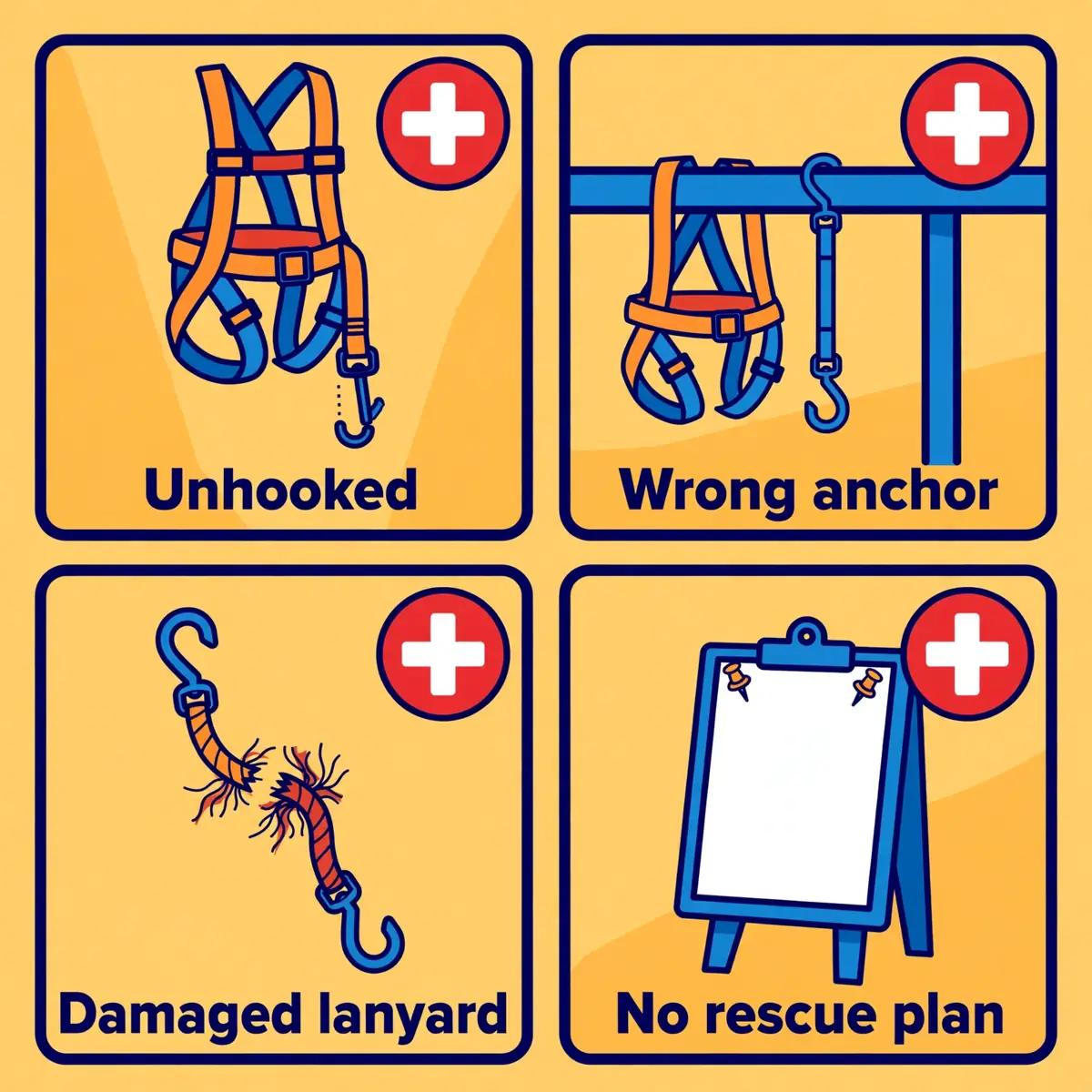
Most falls from height are not caused by missing equipment. They are caused by four equipment failures:
- Equipment bought but not used.
- Equipment used but not connected.
- Equipment connected to the wrong anchor.
- Equipment connected correctly, with no rescue plan behind it.
The pattern repeats across industries, and each mistake in the list below has injured workers who believed they were protected.
The mistakes split into two groups: mistakes with the equipment, and mistakes with the plan. Equipment mistakes are visible on the job and can be caught by inspection. Plan mistakes are invisible until the fall happens, which is why they kill. Both groups are preventable, and both are the employer's responsibility to find before the work starts.
Mistakes with the equipment
The most common equipment mistake is wearing a harness without connecting it. A harness in a bag, or a harness worn with the lanyard dangling, protects no one. The second is connecting to the wrong anchor: a guardrail, a vent pipe, a scaffold tube, or a hoist. The construction rule forbids attaching a personal fall arrest system to a guardrail system or to a hoist. An unrated anchor can fail at loads far below the 5,000-pound requirement.
Mixing incompatible components is the third mistake. A connector from one manufacturer, a harness from another, and an anchor from a third may not work together, even when each part meets its own standard. Snaphooks that do not fit the D-ring can depress their own keeper and open under load. Restraint equipment used for arrest, or arrest equipment used for restraint, can fail because the ratings and the rules differ between the two jobs.
Damaged equipment kept in service is the fourth. A lanyard with a cut, a harness with broken stitching, or a snaphook with a bent gate all look usable at a glance. That is why the before-each-use inspection exists, and why defective components must be removed from service rather than set aside for later repair. Later repair usually means quiet reuse.
Mistakes with the plan
The most dangerous plan mistake is treating a harness as the whole plan. A job that could have been guarded, restrained, or eliminated, but was given harnesses instead, has accepted the weakest control for no reason. The second is skipping the clearance check. A 6-foot lanyard on a low roof, a foot-level anchor, or a swing-fall path each turn a compliant system into one that cannot stop the worker before the ground.
The third is having no rescue plan. Crews that assume the emergency services will handle the rescue have no answer for the minutes between the fall and the ambulance arriving. Those minutes are when suspension trauma develops. The fourth is training that never happened, or happened once and was never refreshed. Equipment changes, sites change, and workers forget. Retraining when things change is a legal duty, not a courtesy.
- Unconnected harness: worn but never clipped in, so the fall is unarrested.
- Wrong anchor: guardrails, pipes, and hoists are not rated anchorages.
- No clearance check: the system cannot stop the worker before the lower level.
- No rescue plan: the suspended worker waits with no one able to bring them down.
- Stale training: new equipment or a new site, with training from a different job.
Each mistake has a simple countermeasure. Each countermeasure belongs in the daily routine:
- Inspect before use.
- Check the anchor.
- Check the clearance.
- Confirm the rescue plan.
- Verify the training.
A supervisor who checks those five points at the start of the shift will catch most of the failures that cause falls. The checks take minutes, and they are the difference between a system and a costume.
Frequently Asked Questions
At what height is fall protection required?
In United States construction work, fall protection is required at 6 feet above a lower level under 29 CFR 1926.501. In general industry, the trigger is 4 feet under 29 CFR 1910.28, and in shipyards it is 5 feet. In Great Britain, the Work at Height Regulations 2005 set no minimum height: protection is required wherever a person could fall a distance liable to cause personal injury.
Is a harness always required when working at height?
No. A harness is one way to meet the duty, not the only one. Guardrails, safety nets, covers, and restraint systems can all satisfy the legal requirement, and collective protection should be considered first. A harness becomes necessary where guarding or restraint is not reasonably practicable. It must then be part of a complete arrest system with a rated anchor, a compatible connector, enough clearance, and a rescue plan.
What is the difference between fall restraint and fall arrest?
Fall restraint prevents the fall from happening: a short line keeps the worker from ever reaching the edge, so no fall occurs and no rescue is needed. Fall arrest accepts that a fall may happen and catches the worker in progress, which demands a full-body harness, a rated anchor, clearance below, and a rescue plan. Restraint is the simpler and safer option wherever the geometry allows it.
How much clearance does a shock-absorbing lanyard need?
It depends on the model, and the connector's manual gives the exact figure. An illustrative stack for a 6-foot lanyard anchored at the dorsal D-ring totals 17.5 feet. The stack is 6 feet of free fall, 3.5 feet of absorber deployment, 1 foot of harness stretch, 5 feet of body below the D-ring, and a 2-foot margin. Always use the maximum arrest distance and minimum required clearance printed in the manual for the device actually in use.
How often should a harness be inspected?
A personal fall arrest system must be inspected before each use for wear, damage, and deterioration, and defective components must be removed from service. A documented periodic inspection by a competent person, commonly annual, comes from ANSI/ASSP Z359.2 and manufacturer instructions. The periodic inspection never replaces the before-each-use check, and any gear that has arrested a fall must be removed until a competent person clears it.
Can a body belt be used for fall arrest?
No. Body belts have been banned as part of a personal fall arrest system in construction since 1 January 1998. Only a full-body harness may arrest a fall, because a belt concentrates the arresting force on the waist and risks serious internal injury. Body belts remain acceptable in positioning device systems, where the worker is held in position and no fall is arrested.
Sources
- OSHA — 29 CFR 1926.501, Duty to have fall protection
- OSHA — 29 CFR 1926.502, Fall protection systems criteria and practices
- OSHA — 29 CFR 1910.28, Duty to have fall protection and falling object protection
- OSHA — 29 CFR 1926.503, Training requirements
- OSHA — 29 CFR 1910.140, Personal fall protection systems
- The Work at Height Regulations 2005, Regulation 6 — Avoidance of risks from work at height
- The Work at Height Regulations 2005, Schedules — Requirements for guard-rails and working platforms
- OSHA — SHIB 03-24-2004, Suspension Trauma/Orthostatic Intolerance (PDF, FDLP archive)