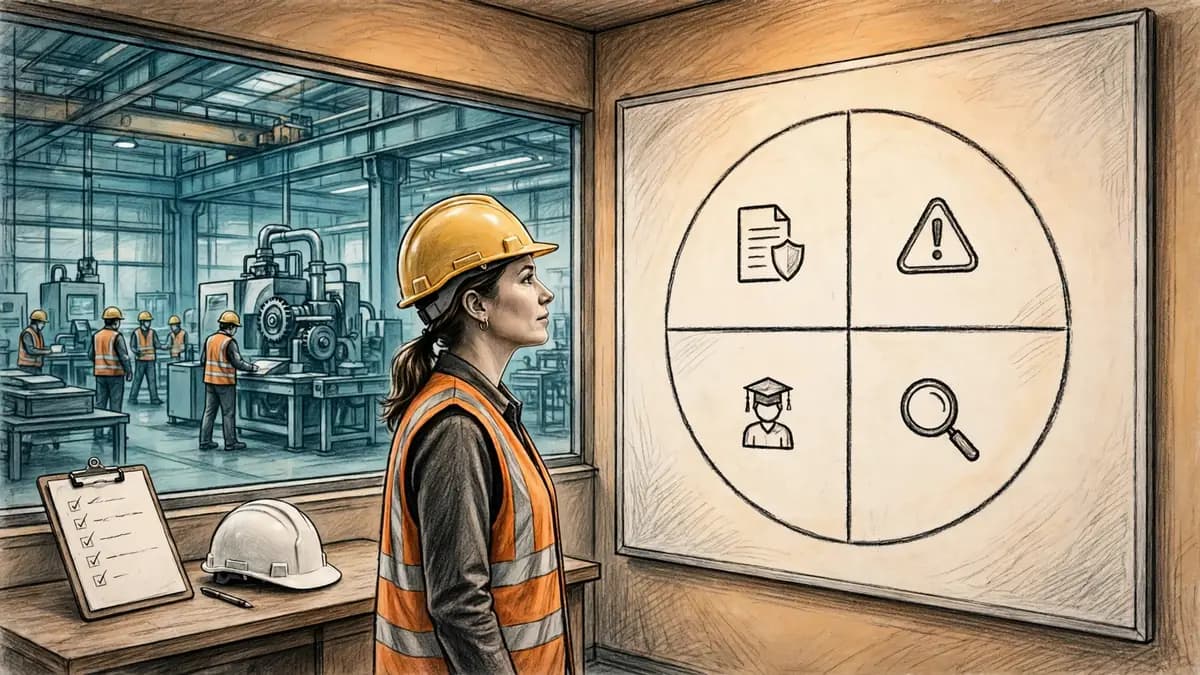
A toolbox talk is a short safety talk held at the work area before a shift or a task begins. It lasts 5 to 15 minutes, covers one topic, and ends with a single action the crew will take that day. Supervisors run the talk, workers take part, and the record shows who attended.
Twenty topics sit below, each with the point the talk should make and the rule behind it. The rest covers how to pick a topic, run the talk in 10 minutes, deliver it so workers listen, plan a month of talks, and keep a record that stands up after an incident.
What is a toolbox talk?
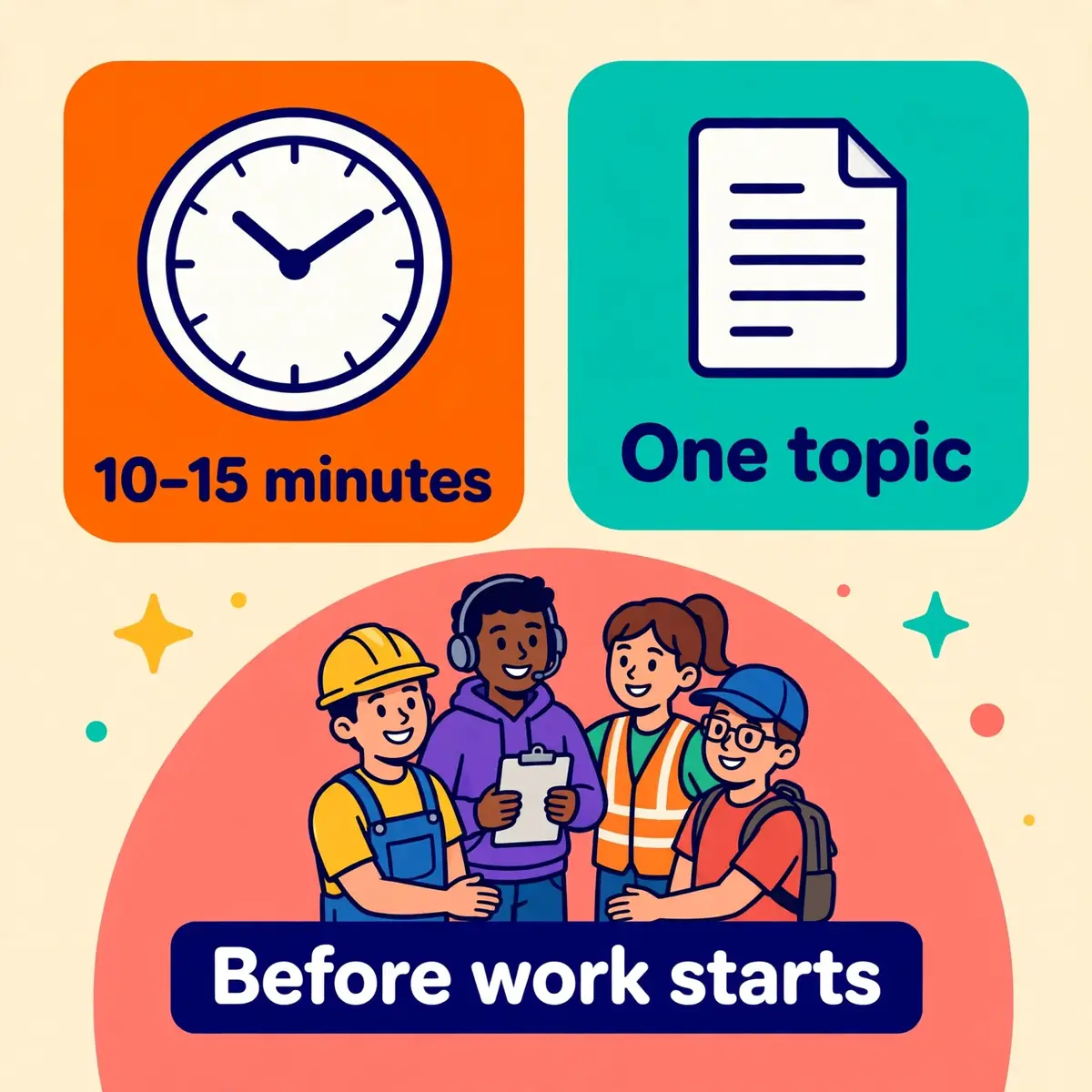
A toolbox talk is a short, focused safety meeting held where the work happens. It goes by several names: tailgate meeting, safety talk, pre-shift briefing, or safety moment. The label changes by industry and region, but the purpose stays the same. A supervisor gathers the crew, talks about one hazard, and sends them to work with the risk fresh in mind.
The talk covers one narrow subject tied to the work ahead. A ladder talk happens before the crew climbs. A heat talk happens on the first hot day of summer. A trench talk happens before the excavator starts digging. That link to the day's job is what makes the talk useful instead of generic.
How long should a toolbox talk last?
Most toolbox talks run 5 to 15 minutes, and 10 minutes is the usual target. Five minutes is enough for a quick reminder about one control. Fifteen minutes is the upper limit for a single topic with discussion. Past 15 minutes, attention drops and the talk turns into a meeting the crew resents.
Time the talk by its parts, not by the clock on the wall. A short story takes about a minute. Three key points take about four minutes. Questions take about three minutes. One commitment and the sign-in take the last two minutes. A talk that runs to this shape finishes on time without feeling rushed.
Who should lead the talk?
The direct supervisor of the crew should lead the talk in most cases. A foreman or crew leader knows the day's work, knows the crew, and can answer questions about the job. The crew also listens more closely to the person who assigns their work and checks it afterwards.
An expert should lead when the topic needs specialist knowledge. A talk about a new chemical, a new machine, or a permit system may need the person who knows it best. Rotating presenters also helps: a worker who explains why they always tie off carries more weight than a manager repeating the same rule.
How often should talks happen?
Daily talks suit crews doing physical, higher-hazard work. A short talk every morning before work starts gives the strongest reinforcement, because safety awareness fades between talks. Weekly talks are the minimum for most sites. Less often than weekly, the effect wears off and the talk becomes an event instead of a habit.
Many sites mix the two rhythms. A two-minute reminder runs most days, and a longer 5 to 10 minute talk runs once a week on a specific topic. The schedule should follow the work: add a talk the same day after any near miss, because those are the talks crews remember.
Why toolbox talks work
Most incidents do not happen because the crew never knew the rules. They happen because a known hazard was not front of mind when the work started. A pump still holds pressure. A confined space is entered without a fresh gas reading. A hot work job runs beside a line break nobody flagged. A toolbox talk puts the day's hazard back in front of the people doing the work, right before they pick up the tools.
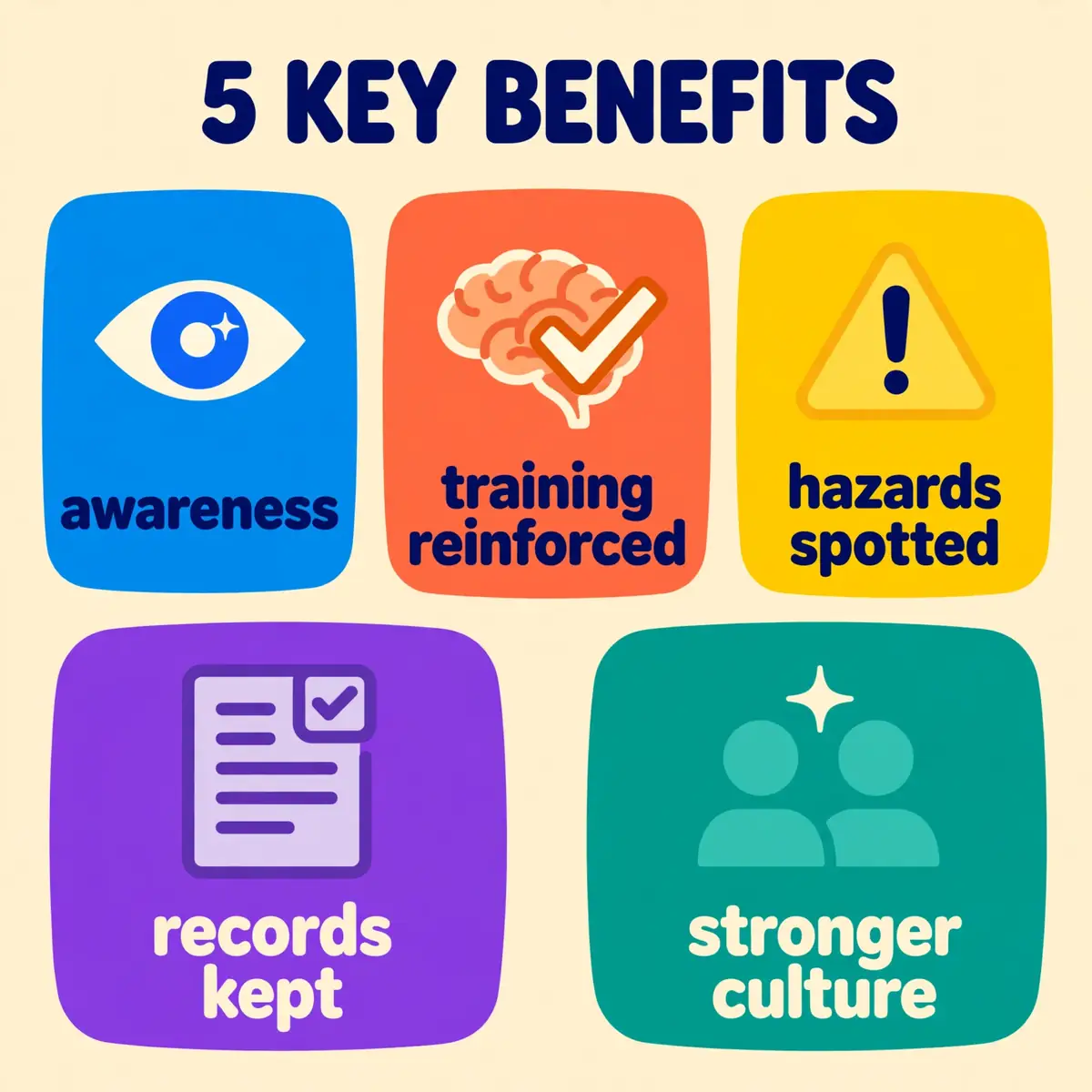
Short, regular talks work for five reasons. Each one is simple on its own, and together they explain why safety leaders treat the talk as a core practice rather than a nice extra.
They keep safety top of mind
Complacency is the biggest risk on a mature site. Workers who have done a task a thousand times stop seeing its hazards. A short talk at the start of the shift resets that awareness. A two-minute reminder about isolation this morning does more than a training course six months ago, because it lands at the moment it matters.
Repetition is the point, not a flaw. Safety awareness fades with time, and a regular talk sharpens it again. A crew that hears the ladder talk four times a year, each time tied to that week's work, remembers the angle, the tie-off, and the three points of contact.
They reinforce formal training in real conditions
Classroom training covers the rules. A toolbox talk applies them to today's reality. A worker may have passed confined space training last year, but a talk before entry reminds the crew that this vessel, this atmosphere, and this weather change how those rules apply. Training is the foundation, and the talk keeps it live.
OSHA 3824, the training guide from the Occupational Safety and Health Administration (OSHA), sets out principles of adult education that fit talks exactly. Adults need to see that the subject is relevant, they learn by taking part, and they learn best by doing. A talk that ties the rule to today's task, asks the crew questions, and shows the real equipment follows those principles.
They surface the hazards of today's job
Site conditions change daily. A new contractor crew arrives. A unit comes down for maintenance. Two jobs end up running side by side. A toolbox talk lets a supervisor name the hazards that are specific to today, including the clash between two jobs in the same area that a static procedure would never capture.
Workers also raise hazards the supervisor missed. A crew member who works the area every day sees the blocked walkway, the frayed cord, and the missing guard before anyone else. A talk that asks the crew what they are seeing turns that knowledge into a control before the shift starts.
They build a safety culture
Culture is not built by posters. It is built by what happens every morning. When a supervisor runs a talk each day and asks the crew what they are seeing, the message is clear: safety is how work is done here, not a box to tick. Over time, workers speak up about hazards, report near misses, and hold each other to the standard.
OSHA's Better Safety Conversations guidance makes the same point. The example a supervisor sets, and the way they talk to workers about safety, shapes the safety culture and the ability to reduce injury and illness. Leading by example is the strongest way to encourage workers to engage.
They create a record of communication
A documented talk, with the date, topic, presenter, and attendance, is direct evidence that the employer informed and trained workers about the risks they face. During an audit or an incident investigation, that record shows due diligence. Without it, the employer has only memory to rely on.
The record also helps the site itself. It shows which topics the crew has covered, how long it has been since each one, and which workers missed a talk and need a catch-up. A sign-in sheet that sits in a truck for six months is no use; a filed record answers questions fast.
What a toolbox talk is not
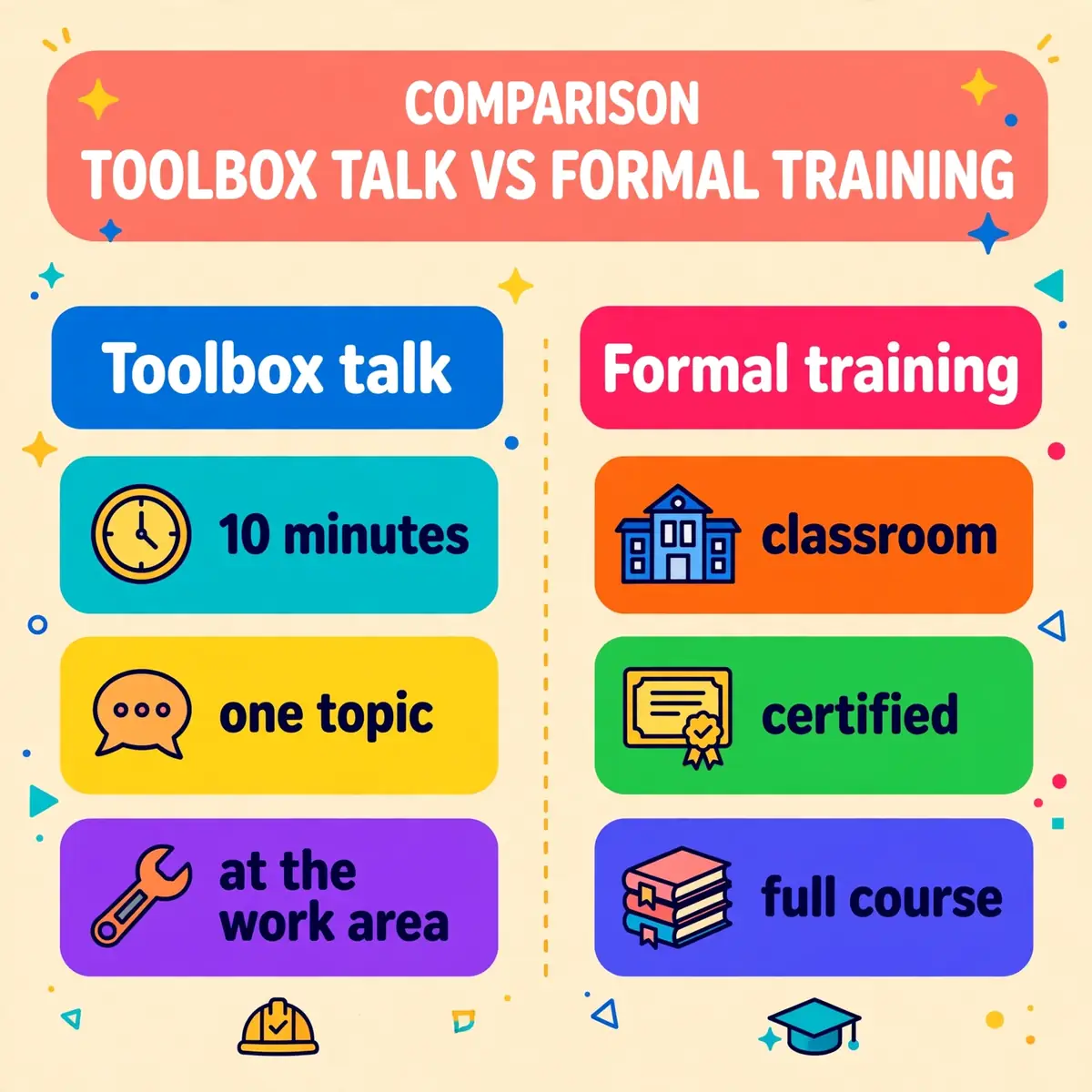
A toolbox talk is a reinforcement and communication tool. It prepares a crew for the hazards of today's work, refreshes key points from formal training, shares lessons from a recent near miss, and gathers workers' concerns. It is not a substitute for the formal training that specific standards require, and treating it as one leaves the crew unqualified for the work.
The distinction matters in law as well as in practice. More than 100 OSHA standards contain training requirements, and many set out the content, the timing, or a demonstration of competence that a ten-minute talk cannot satisfy. A talk can support that training, but it cannot replace it.
The legal line in the United States
In construction, 29 CFR (Code of Federal Regulations) 1926.21(b)(2) sets the duty. It requires the employer to instruct each employee in the recognition and avoidance of unsafe conditions. The instruction must also cover the regulations that apply to the work environment.
Other standards go further and set their own training rules. Fall protection training under 29 CFR 1926.503 must be given by a competent person and certified in writing. A toolbox talk about falls refreshes that training; it does not deliver it. The same applies to confined space entry, hazard communication, and respiratory protection, where the standard names the trainer, the content, and the record.
In the UK, the Health and Safety at Work etc. Act 1974 puts a general duty on employers to provide information, instruction, training, and supervision. The Health and Safety Executive (HSE) publishes ready-made toolbox talks for construction, including falls from vehicles, safe use of ladders, roof work, and manual handling. Those talks support the duty; they do not discharge the full training duty on their own.
What a talk cannot do
A talk cannot teach a skill from scratch in ten minutes. Nobody learns to inspect a harness, set a trench box, or use a respirator from a single short talk. Those skills need proper training with demonstration, practice, and a check that the worker can do the job. A talk can remind a trained worker what to check; it cannot create the competence.
A talk also cannot fix a broken system. If the crew has no anchor points, no gas monitor, or no permit system, ten minutes of talking changes nothing. The talk should surface those gaps so the supervisor can fix them, not paper over them with words.
WarningNever record a toolbox talk as formal training for a standard that requires certified instruction. The record must say what the talk was: a short briefing, not a course.
20 toolbox talk topics
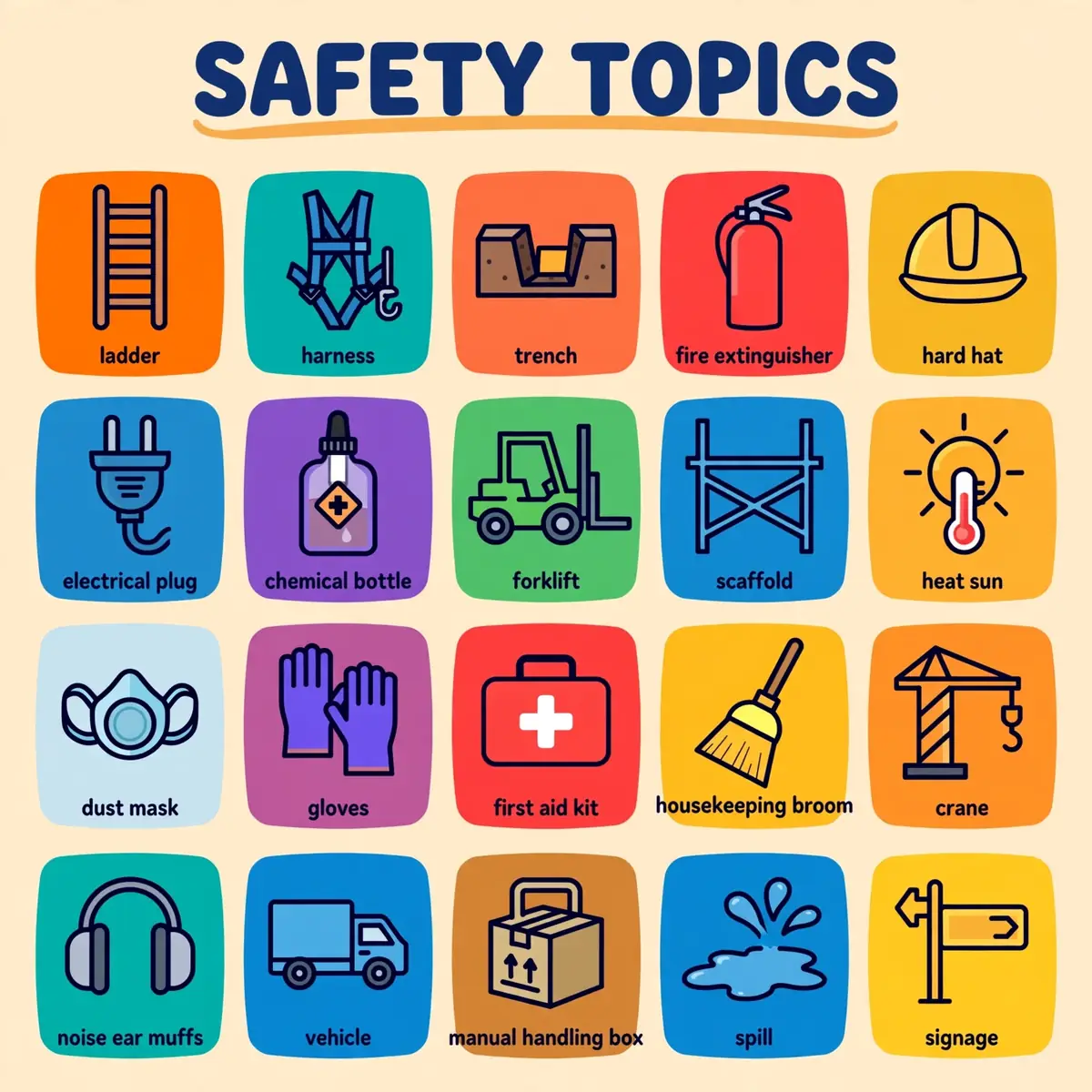
Twenty topics follow, each with the point the talk should make and the rule it maps to. Every topic fits in 10 minutes when the presenter sticks to one hazard and three key points. Use the list as a starting point, then adapt each topic to the site: name the real ladder, the real trench, and the real chemical the crew will meet that day.
The topics fall into five groups: working at height, energy and equipment, health hazards, people and behaviour, and site basics. A month of talks should draw from more than one group, so the crew does not hear four fall talks in a row.
| Topic | What the talk should cover | Rule it maps to |
|---|---|---|
| 1. Ladder safety | Angle, three feet above the landing, tie-off, three points of contact | 29 CFR 1926.1053 |
| 2. Fall protection | Guardrails, covers, harness inspection, anchor points at 6 feet | 29 CFR 1926.501 |
| 3. Scaffolds | Guardrails, planking, safe access, fall protection above 10 feet | 29 CFR 1926.451 |
| 4. Trench safety | Protective systems, the 5-foot rule, spoil 2 feet back, competent person | 29 CFR 1926.652 |
| 5. Personal protective equipment | Selection, inspection, and fit for the task at hand | 29 CFR 1926.95–106 |
| 6. Hard hats | Classes, inspection for cracks, replacement after an impact | 29 CFR 1926.100 |
| 7. Eye protection | When safety glasses are not enough, and face shields for grinding | 29 CFR 1926.102 |
| 8. Hearing protection | When noise needs protection, fit, and keeping it in place | 29 CFR 1926.52 |
| 9. Electrical safety | Damaged cords, ground pins, ground fault protection, overhead lines | 29 CFR 1926.404 |
| 10. Lockout/tagout | Isolating energy before service, stored energy, lock ownership | 29 CFR 1910.147 |
| 11. Hazard communication | Reading labels, finding safety data sheets in under a minute | 29 CFR 1926.59 |
| 12. Silica dust | Water on the blade, vacuum shrouds, when respirators are needed | 29 CFR 1926.1153 |
| 13. Heat illness | Water, rest, shade, acclimatising new workers over the first week | OSHA heat guidance |
| 14. Cold weather | Layering, wind chill, warming breaks, watching for frostbite | OSHA cold guidance |
| 15. Manual handling | Planning the lift, keeping the load close, team lifts, trolleys | HSE manual handling |
| 16. Slips, trips and falls | Housekeeping, clear walkways, trailing cables, wet floors | 29 CFR 1926.25 |
| 17. Fire safety | Storing flammables, extinguisher types, escape routes, hot work | 29 CFR 1926.150 |
| 18. Struck-by hazards | Spotters, backup alarms, staying out of blind spots, falling objects | 29 CFR 1926.601 |
| 19. Vehicle and traffic safety | Seat belts, reversing, pedestrian routes, mobile plant exclusion zones | 29 CFR 1926.601 |
| 20. First aid and emergencies | Where the kit is, who the first aiders are, raising the alarm | 29 CFR 1926.50 |
Each topic links to a longer treatment on the site. The ladder talk points to the rules for safe ladder use; the fall protection talk points to fall protection and the harness talk points to fall protection harness types and inspection. The trench talk points to confined space entry where the work overlaps. Use those links when the crew asks for more detail than ten minutes allows.
Topics that work on any site
Ten topics from the list work on almost any construction job. Each one maps to a standard and a hazard crews see every week:
- Ladders, fall protection, and trenches.
- Electrical cords and heat illness.
- Silica dust and hand and power tools.
- Housekeeping and hazard communication.
- Struck-by hazards.
Rotate through them, then repeat: a crew that hears the ladder talk four times a year remembers it.
Non-construction sites need their own list. Warehouses lean on manual handling, forklifts, and racking. Offices lean on slips, electrical safety, and fire escape routes. Healthcare leans on sharps, manual handling, and infection control. Pick from the work the crew actually does, not from a generic list.
Topics to add after an incident
A near miss or an incident on the site should set the next topic. If a ladder slipped, talk about ladders that week. If a worker found a damaged cord, talk about electrical safety. The crew was there, the hazard is real, and the lesson lands because everyone saw what almost happened.
Industry incidents work too, when they match the site's work. A published OSHA case about a trench collapse makes a strong opening for a trench talk. Name what happened, not who it happened to, and keep the story to a minute. The point is the control that would have stopped it, not the drama.
How to choose the right topic
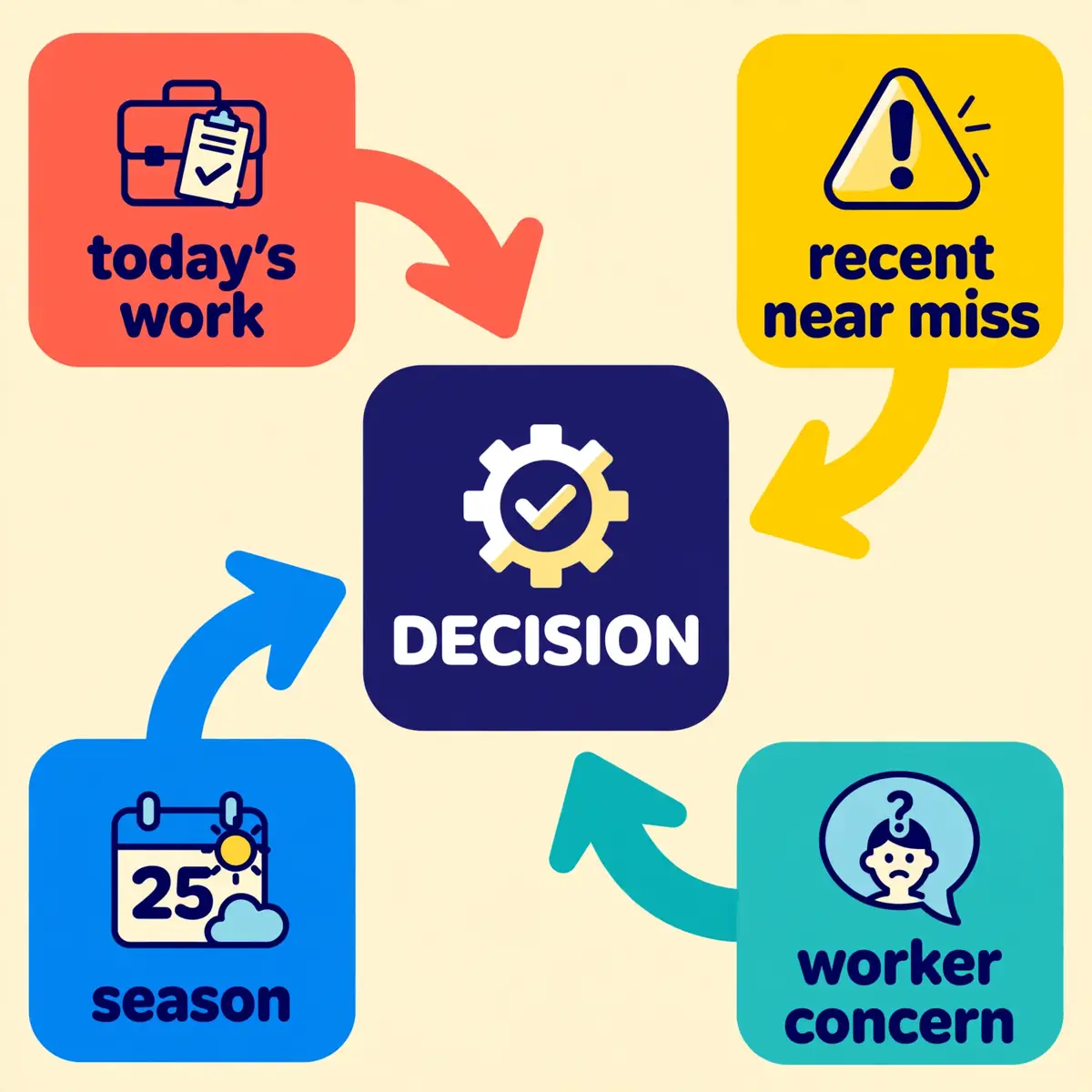
The best topics come from the work itself, not from a purchased list. A generic topic from a printed sheet can fill a gap, but it should be adapted to the site before it is delivered. Four sources give a supervisor a topic for every talk, and the order below is the order to check them in.
Start with today's work
Look at the day's tasks and their specific hazards. A crane lift, a trench, hot work, or a chemical changeover each carries its own talk. The talk should name the hazard the crew will meet in the next few hours, the control that manages it, and the one action that matters most.
Check the permits and the job hazard analysis before choosing. If a permit to work is in play for the job, the talk should cover the same hazards the permit names. When the talk, the permit, and the controls all name the same hazard, the crew hears one message instead of three different ones.
Then check recent events
Recent near misses, incidents, and inspection findings are the second source. A near miss is a free lesson: the hazard showed itself and nobody was hurt. Talk about it while the memory is fresh, and the crew will connect the rule to a moment they lived through.
Inspection findings work the same way. If an inspector noted missing guardrails or unguarded openings, the next talk should cover them. The crew sees that the talk responds to real findings, not to a calendar.
Then check the season and the changes
Seasonal hazards set the third source. Heat belongs in summer, cold and ice in winter, storms when the forecast turns. A talk about driving on icy roads makes sense in January and wastes everyone's time in May. Plan seasonal talks a month ahead so the material is ready when the weather turns.
Changes in equipment, procedures, site layout, or crew are the fourth source. A new machine, a new chemical, a new subcontractor, or a new starter each needs a talk. New workers in particular need the basics early: where the exits are, where the first aid kit is, and who to tell about a hazard.
Ask the crew what they want covered
Concerns raised by workers are the last source, and often the best. A worker who asks about a hazard is telling the supervisor what worries them. Answering it in a talk shows the crew that raising a concern leads to action, which makes the next concern more likely to be raised.
Ask the crew to suggest topics for future talks at the end of each one. Keep a simple list of suggestions and work through it. A topic the crew asked for gets more attention than one the supervisor picked alone.
How to run a toolbox talk in 10 minutes

A format that fits in ten minutes keeps the talk short and makes it stick. The shape below comes from what works on real sites: open with a story, make three points, ask the crew questions, agree one commitment, and sign in. The same ten minutes, run this way, beats a foreman reading a page out loud while the crew looks at their boots.
Prepare before the talk, not during it. Decide the one key point workers should remember, one or two questions to ask, a demonstration or physical example if possible, and any action items to follow up. Write those four things on a single page in large print. That page is the talk.
Minute 1: open with a story
Start with a short, real incident, not a statistic. A near miss on the site, or a published case from the industry, works best. Name what happened, not who it happened to. OSHA's Better Safety Conversations guidance suggests a short, compelling story about a real event, delivered in 15 to 20 seconds, as a persuasive way to reinforce safety.
Keep the story to one minute at most. The story earns attention; the points that follow use it. A story that runs for five minutes eats the time the crew needs for questions, and the talk becomes a lecture.
Minutes 2 to 5: three key points
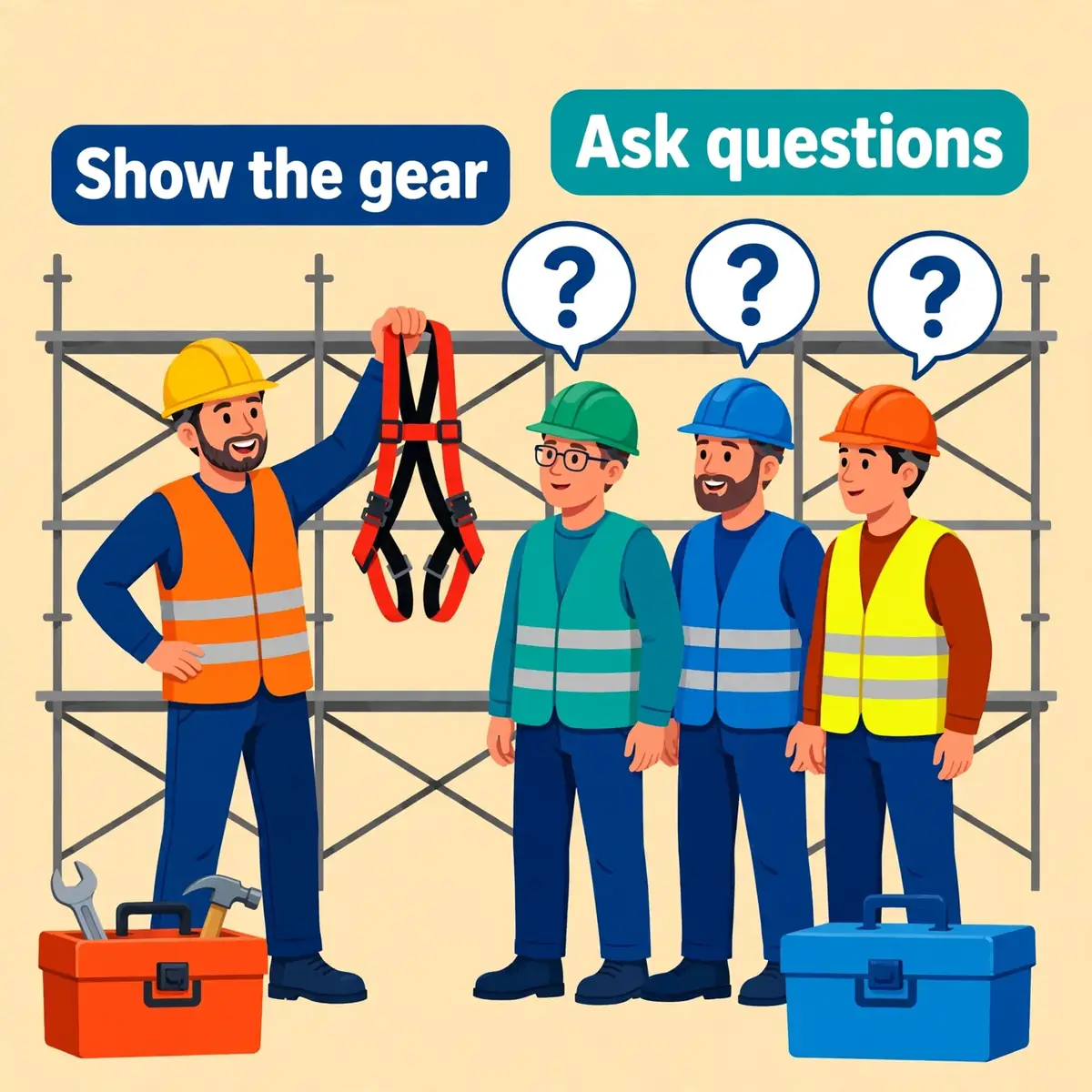
Make no more than three points. Show the actual equipment where possible: hold up the harness and point to the D-ring, hold the ladder and show the angle, hold the chemical bottle and point to the label. Workers retain more when they see a demonstration than when they are only told about it.
Each point should name a hazard, a control, and the action. "Five feet or deeper, we use a protective system: the trench box or sloping, every time" is a point. "Be careful in trenches" is not. The crew should leave able to repeat the three points back to the supervisor.
Minutes 6 to 8: ask, do not tell
Ask open questions and let the crew answer. "Where on this job could that happen?" works better than "Any questions?" The people who talk remember the talk. The supervisor also learns what the crew is seeing: a hidden skylight, a cracked wall, a cord nobody reported.
Listen and respond to what comes back. If a worker raises a problem, write it down and say when the follow-up will happen. Ignoring a concern teaches the crew not to raise the next one. Closing the loop at the next talk shows the crew that speaking up leads to action.
Minute 9: one commitment
End with a single action for the day. "Every ladder gets tied off before anyone climbs" is a commitment. "Nobody steps into the trench until the competent person says the box is set" is a commitment. One action, named out loud, gives the crew something to hold onto for the rest of the shift.
Do not end with a list of ten things. The crew will forget nine of them by lunch. One clear takeaway, repeated back by a worker, is worth more than a page of points nobody remembers.
Minute 10: sign in
Record the date, the topic, the presenter's name, and each attendee's printed name and signature. That sheet is the evidence that the talk happened. Do not skip the sign-in because everyone was there: if it is not recorded, it did not happen as far as a regulator is concerned.
Photograph the sheet the same day and file it by site and date. Note the topic and the standard it relates to, and track attendance: a worker who misses three talks in a row needs a catch-up. Those records answer two questions fast: what training has this crew had on falls, and when did the crew last talk about heat.
TipStand where the hazard is. A fall protection talk at the edge of the deck beats one in the site office, because the crew can see the edge while they hear the rule.
How to deliver a talk workers listen to
Preparation decides most of the result. Delivery decides the rest. A supervisor who knows the topic, speaks plainly, and involves the crew will hold attention for ten minutes. A supervisor who reads a sheet word for word will lose the crew in the first minute, however good the topic is.
Speak in the crew's language
Deliver the talk in the language the crew works in. If half the crew speaks another language, give the talk in both languages or pair a bilingual lead. OSHA's training policy requires that training be presented in a language and vocabulary workers understand, and the same test decides whether a talk works at all.
OSHA 3824 adds a second rule: write and speak in the everyday language of the participants. Avoid jargon and acronyms, or explain them on first use. A handout alone never satisfies the test for workers with limited reading ability, so the spoken talk must carry the message.
Use props and the real work area
Gather at the work area where the hazard is visible, not in a noisy corridor or a distant office. A talk about ladder safety works best beside a ladder. A talk about PPE works best with the kit in hand. The crew connects the words to the thing in front of them.
Props beat slides. Hold up the harness, the respirator, or the chemical label and point to the part that matters. A demonstration takes a minute and sticks in memory far longer than a paragraph read aloud. Keep the paper short too: one page, large print, three points.
Make it two-way
Ask open questions, invite stories, and let a worker lead part of the talk. OSHA 3824 highlights participant-to-participant learning: workers learn from one another's experiences. A journeyman who explains why they always tie off carries more weight than a safety manager saying the same thing.
Check understanding by asking questions, not by asking "Any questions?" Ask a worker to explain the anchor plan back to the group, or to show the seal check on a respirator. A worker who can explain it understands it; a worker who only nods may not.
Lead by example
Wear the PPE and follow the procedure being talked about. A supervisor who talks about hard hats while not wearing one tells the crew the rule is optional. OSHA's guidance describes leadership by example as the strongest way to encourage workers to engage with the safety and health program.
Follow up later the same day. Watch for the commitment in how the work is done, and say something when it is done right. A talk that ends at the sign-in sheet fades; a talk that the supervisor checks on during the shift stays alive.
Planning a month of toolbox talks
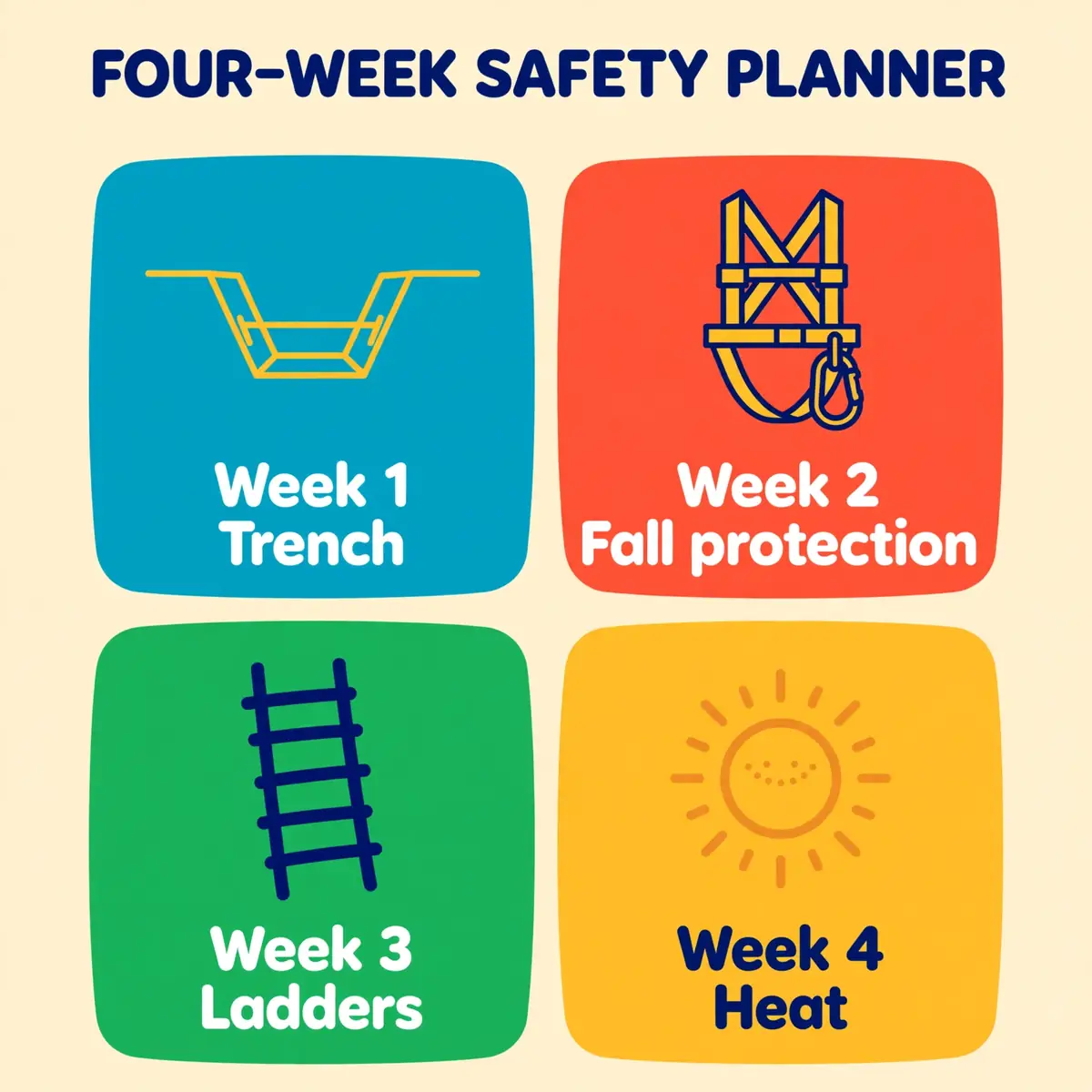
Plan topics a month ahead and adjust as the work changes. A month plan stops the morning scramble for a topic, and it lets the supervisor prepare material in advance. The table below shows a typical month on a commercial construction job, matched to the work happening each week.
| Week | Work happening | Topic |
|---|---|---|
| 1 | Excavation and utilities | Trench protective systems and the competent person |
| 2 | Steel and decking | Fall protection, anchor points, and leading edges |
| 3 | Framing and ladders | Ladder setup and three points of contact |
| 4 | Summer heat | Heat illness: water, rest, shade, and buddy checks |
Build the plan from the project schedule, the season, and the topics already covered. Check the record first: which topics has the crew heard, and how long ago? A topic covered last month needs a different angle or a different example when it comes round again, or the crew will switch off.
Keep the plan flexible
A plan is a starting point, not a contract. A near miss, a new hazard, or a worker's concern should replace the planned topic the same day. Those are the talks crews remember, because everyone saw what almost happened.
Leave one slot a month open for the unexpected. A blank week in the plan is not a gap; it is room for the talk the site actually needs. Fill it with the topic the last week of work produced, and the plan stays honest.
Share the plan with the crew
Tell the crew what to expect and when the talk will happen. Brief the team in advance about the topic, so workers who want to can think about it or bring a question. A talk that is announced feels like part of the job; a talk that ambushes the crew at the gate feels like an interruption.
Post the month's topics where the crew can see them: the site office board, the break room, or the daily briefing sheet. Workers who know the ladder talk is coming on Thursday will notice ladders all week, which is exactly the point.
Documenting the talk
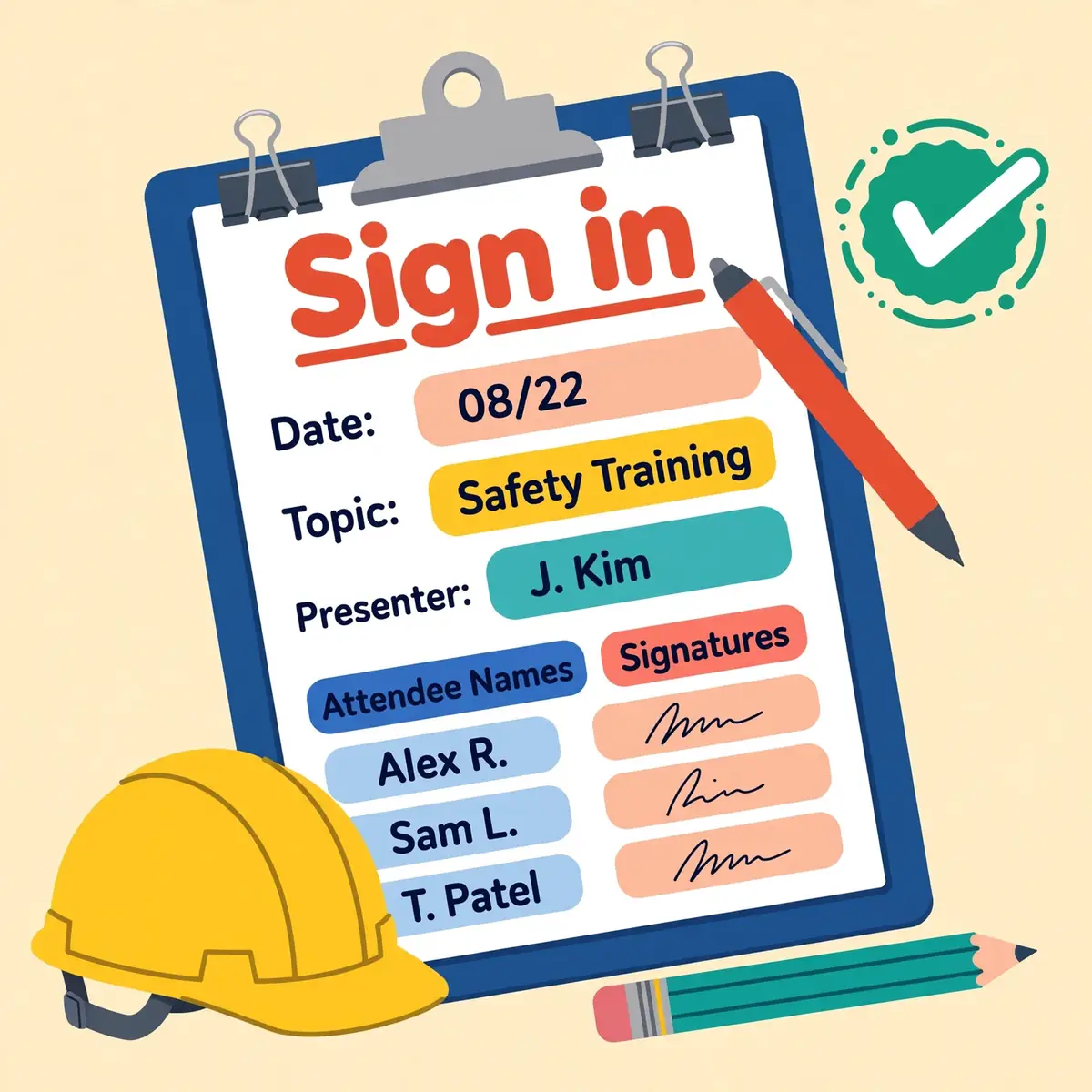
Keep a simple record of every talk. The record proves the talk happened, shows what the crew has covered, and lets the site follow up on anything raised. It does not need to be complicated: a single sheet per talk, filed the same day, is enough.
What the record should include
Record the date, the location, the topic, the key points, the presenter's name, the attendees, and any concerns or actions raised. Each attendee should print their name and sign, or initial, the sheet. Note the language used if the talk was not in English, and note the standard the topic relates to.
A signature sheet shows attendance, not understanding. Judge understanding by the questions the crew asked and by watching the work afterwards. A worker who signed the sheet but cannot explain the anchor plan needs a follow-up, not another signature.
A simple sign-in template
Use one template for every talk, so the records stay consistent and easy to search. The template below fits on one page and covers the fields an auditor or an investigator will ask for.
- Date and time of the talk, and the site or location where it was held.
- Topic of the talk, in a few words, plus the standard it relates to.
- Presenter's name and job title.
- Key points covered, in two or three short lines.
- Attendee names printed clearly, with a signature or initials beside each one.
- Concerns raised by the crew, and the action agreed for each one.
- Language used, if the talk was given in a language other than English.
Free ready-made material helps here too. The Center for Construction Research and Training (CPWR) publishes free construction toolbox talks in English and Spanish, each one a single-page sheet a supervisor can use as the basis of a talk. The HSE publishes ready-made talks for construction, including falls from vehicles, safe use of ladders, and roof work. Use those sheets as a starting point, then adapt them to the site.
Filing and follow-up
Photograph the sheet the same day and file it by site and date, with the topic noted. Paper that sits in a truck for six months is no use when an auditor asks what training the crew had on falls. A filed record answers that question in seconds.
Follow up on every action the talk produced. If a worker raised a hazard, fix it or say when it will be fixed, and report back at the next talk. If a worker missed the talk, catch them up before they start the task it covered. Records that nobody reads are paperwork; records that drive follow-up are evidence.
AlertA toolbox talk record is evidence of communication, not proof of competence. Do not file a talk as training for a task that needs certified instruction.
Common mistakes that kill a toolbox talk
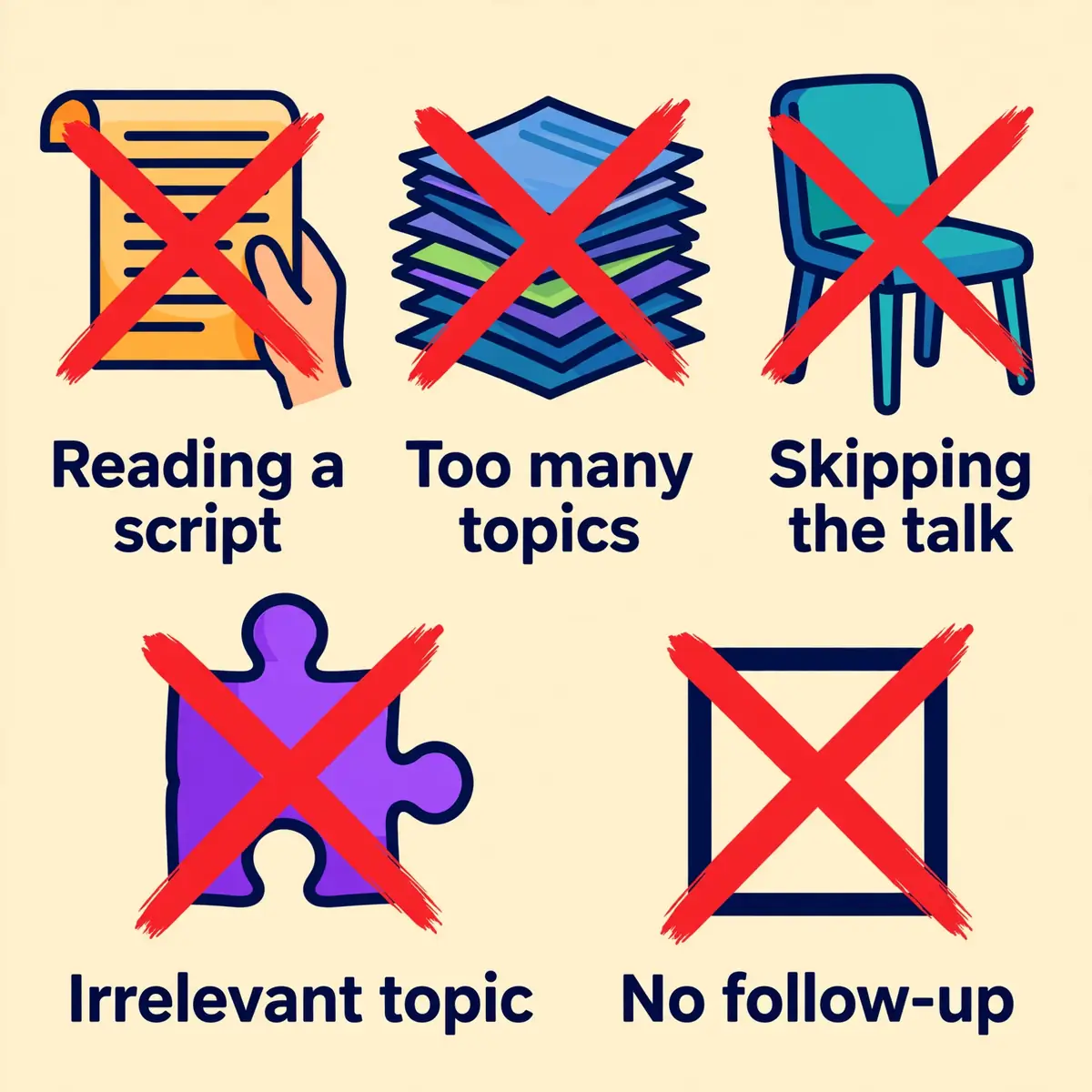
Most toolbox talks fail in the same five ways. Each one is easy to spot and easy to fix, but left alone they teach the crew to ignore the next talk too. Check the list below against the last few talks on the site and fix the ones that match.
Reading a script word for word
A presenter who reads a sheet with no eye contact loses the crew in the first minute. Use the sheet as a guide and speak in your own words. The crew can tell the difference between a supervisor who knows the topic and one who is reading it for the first time.
Prepare the three points in advance, then talk from them. Short notes beat a full script: the talk sounds like a conversation, the presenter can watch the crew, and questions fit naturally into the flow.
Covering too many topics at once
One topic per talk. Cramming three topics into ten minutes means the crew retains none of them. A talk that tries to cover falls, electricity, and housekeeping in one go delivers three half-messages instead of one clear one.
If three topics all feel urgent, pick the one tied to today's work and put the other two on the plan for later in the week. The crew will hear each one properly, and the record will show three talks instead of one confused one.
Skipping talks when the schedule is tight
Skipping a talk when work gets busy is the most damaging habit of all. It tells the crew that safety is optional when the schedule is tight, which is exactly when the risk is highest. A two-minute reminder is better than no talk at all.
Hold the talk even on the busiest days, and keep it short when time is short. The crew notices when the supervisor protects the talk under pressure, and that notice is worth more than the talk itself.
Choosing topics unrelated to the day's work
A talk that has nothing to do with today's hazards wastes everyone's time and trains the crew to ignore the next one. The topic must match the work in front of the crew, the season, or a recent event on the site. Generic topics from a purchased list should be adapted to the site before they are delivered.
Test every topic with one question: will the crew meet this hazard today or this week? If the answer is no, pick another topic. Relevance is what makes the crew listen.
Ignoring what the crew raises
If a worker raises a hazard and nothing changes, participation dries up. Workers who speak up once and hear nothing back will not speak up twice. Write down every concern, say when the follow-up will happen, and report back at the next talk.
Use concerns raised in talks to update hazard assessments and procedures. A talk that changes how the work is done proves its own value, and the next talk starts with a crew that believes it matters.
When a talk should become formal training
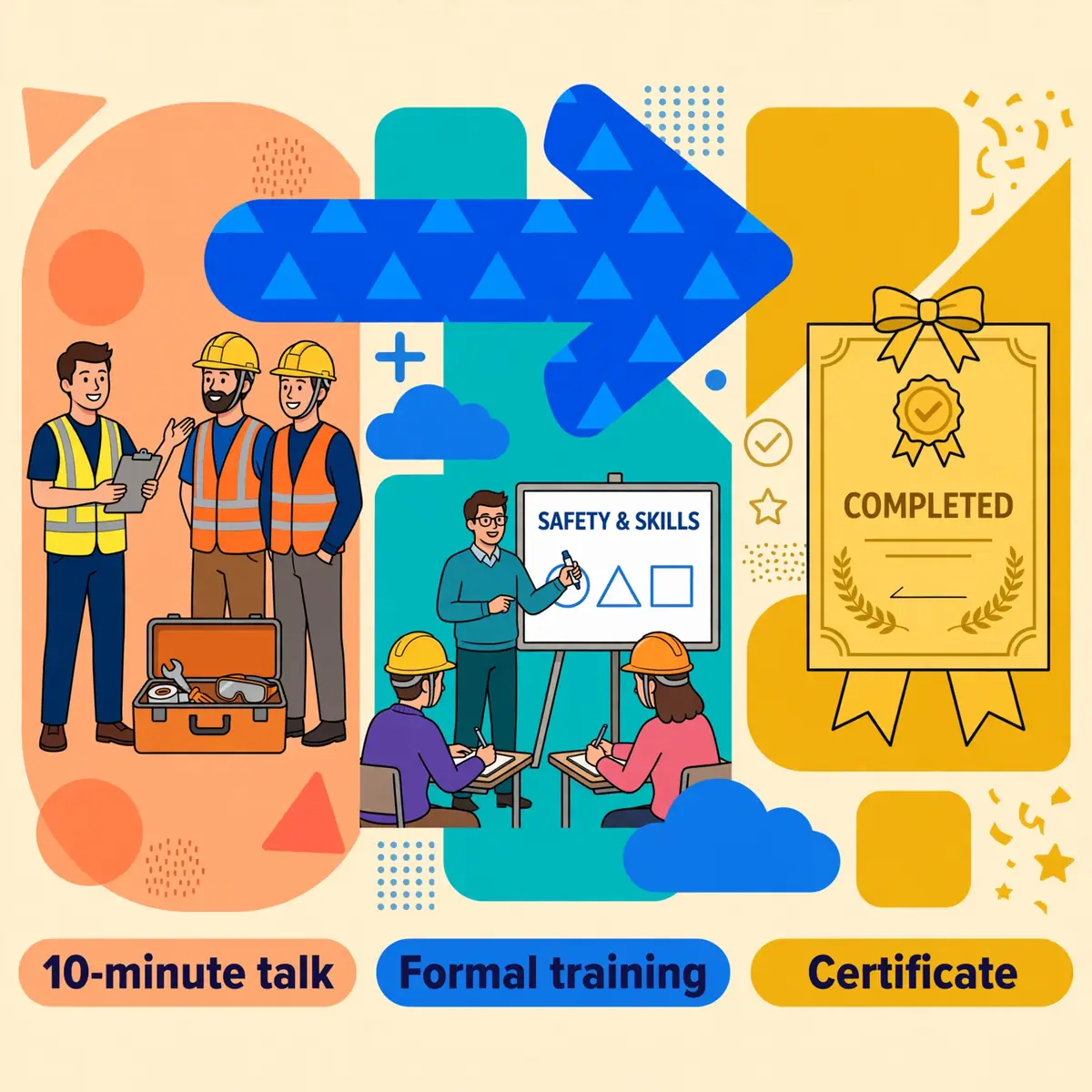
Some subjects are too big for ten minutes. If a talk turns up a gap the crew cannot close in a discussion, stop and schedule real training. Toolbox talks reveal gaps; they do not close all of them. Knowing when to stop the talk and book a course is part of running talks well.
Signs the crew needs training, not a talk
Book formal training when the crew cannot inspect their harnesses. Book it when nobody can say who the competent person is for the excavation. Book it when workers cannot explain the controls for the chemical they handle. Those are competence gaps, and a talk cannot fill them.
The same applies when a standard names the training. Fall protection, confined space entry, hazard communication, and respiratory protection each carry training rules that a talk cannot satisfy. Safety training covers the types of training, the topics, and what the law requires, and OSHA training covers the courses and the cards in detail.
How to make the handover
Name the gap in the talk itself, so the crew knows it was heard. "Nobody here could explain the harness inspection, so we will book the course this week" is a clear handover. Then book it, tell the crew the date, and follow up at the next talk.
Keep the talk running while the training is arranged. A short talk on the hazard still helps the crew work safely in the meantime, as long as nobody pretends the talk replaced the course. The record should show both: the talk, and the training that followed it.
A worked example: 10 minutes on ladder safety
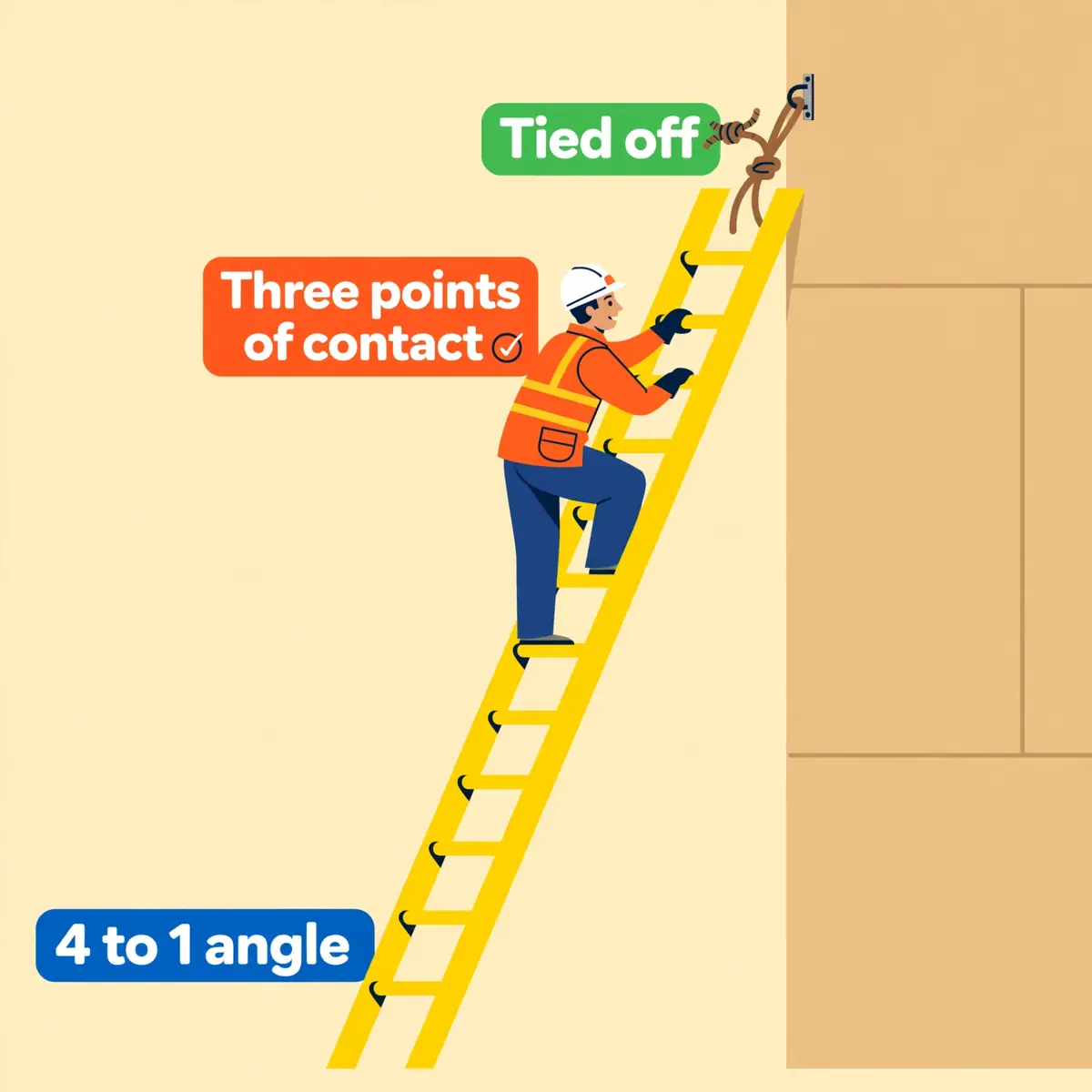
The example below shows how the ten-minute format sounds on a real morning, before a crew starts work that involves ladders. Read it once, then put it in your own words. Every number in the talk comes from the ladder standard, and each point ties to something the crew will see that day.
Minute 1: the story
"Last month on a job across town, a worker set a ladder against a wall, climbed to the second floor, and the base slipped out. He fell about ten feet and broke his wrist. The ladder was too steep, it was not tied off, and nobody had checked the feet. That is what we are talking about before anyone climbs today."
The story takes under a minute. It names what happened and the three failures that caused it, which are the same three points the talk will cover. No names, no blame, just the facts and the controls.
Minutes 2 to 5: the three points
Point one is the angle. Set the ladder at one foot out for every four feet up, and check it before climbing. Point two is the tie-off: extend the side rails three feet above the landing, and secure the top so the ladder cannot slip. Point three is the climb itself: keep three points of contact at all times, face the ladder, and carry nothing in the hands that should be on the rails.
Demonstrate each point on the ladder standing beside the crew. Show the angle with a tape, show the tie-off, and climb two rungs to show three points of contact. The crew sees the rule on the real ladder they will use.
Minutes 6 to 8: the questions
Ask the crew two questions. "Where on this job could a ladder slip today?" The answers should name the real spots: the smooth floor in the lobby, the uneven ground at the back door. "What would make you stop and re-check a ladder?" The answers should name the signs: a damaged rail, a missing foot, a ladder that feels wrong.
Listen to the answers and correct them gently where needed. If a worker says they climb with a tool in one hand, that is the moment to explain the tool belt or the hoist line, not a reason to single anyone out.
Minutes 9 and 10: the commitment and the sign-in
The commitment is one sentence: "Every ladder on this job gets tied off before anyone climbs." Anyone who sees a ladder that is not tied off calls it out. One worker repeats it back, the crew signs in, and work starts.
The supervisor checks the ladders during the morning walk-around. When the tie-off is done right, the supervisor says so.
That is the whole talk: a story, three points, two questions, one commitment, and a record. Run the same shape for any topic, and the crew will know what to expect and what to remember.
Frequently Asked Questions
How long should a toolbox talk last?
Most toolbox talks last 5 to 15 minutes, and 10 minutes is the usual target. Five minutes is enough for a quick reminder about one control. Past 15 minutes, attention drops and the talk turns into a meeting the crew resents.
Are toolbox talks required by OSHA?
No federal standard requires toolbox talks by name. OSHA does require employers to instruct workers in the recognition and avoidance of unsafe conditions, under 29 CFR 1926.21(b)(2) in construction, and many general contractors and owners require documented weekly talks in their contracts.
Do toolbox talks count as OSHA training?
No. A toolbox talk is reinforcement, not the training a standard requires. Fall protection training, for example, must be given by a competent person and certified in writing under 29 CFR 1926.503. A talk refreshes that training; it does not deliver it.
How often should toolbox talks happen?
Daily talks suit crews doing physical, higher-hazard work. Weekly talks are the minimum for most sites. A short talk every morning gives the strongest reinforcement, and a talk should be added the same day after any near miss.
Who should give the toolbox talk?
Usually the foreman or a supervisor, because they know the day's work and the crew listens to them. An expert should lead when the topic needs specialist knowledge, and rotating presenters keeps crews engaged.
What should a toolbox talk sign-in sheet include?
The date, the topic and the standard it relates to, the presenter's name, the site, and each attendee's printed name and signature or initials. Note the language used if the talk was not in English, and record any concerns raised and the action agreed.
Can toolbox talks be done remotely?
They work best in person at the work area, where the crew can see the hazard being discussed. If crews are spread out, a short video call can work, but the talk should still be recorded with attendance.
Where can I find free toolbox talk material?
CPWR publishes free construction toolbox talks in English and Spanish, and the HSE publishes ready-made talks for construction, including ladders, roof work, and manual handling. Use those sheets as a starting point, then adapt them to the site.
Sources
- OSHA 3824: Resource for Development and Delivery of Training to Workers (2021)
- OSHA: Better Safety Conversations (Safe + Sound)
- 29 CFR 1926.21: Safety training and education
- OSHA: General Duty Clause, Section 5(a)(1) — interpretation letter, 18 December 2003
- Health and Safety Executive: Toolbox talks
- CPWR: Toolbox Talks (free, in English and Spanish)