

Only about one in nine fireworks fires starts inside a building — yet those few incidents cause the overwhelming majority of the harm. Fireworks started an estimated 32,302 fires across the United States in 2023, and 3,760 of those were structure fires. That is 11 per cent of the total. Those same 11 per cent produced 77 per cent of the civilian deaths, 83 per cent of the injuries and 88 per cent of the $142 million in direct property damage (NFPA).
That single split tells you where to put your attention. Most fireworks advice concentrates on the moment of ignition — light it, step back, don't hold it. The fire data says the decisive question is where the burning debris lands ninety seconds later, and whether anything under it will catch.
This guide is built around that. It covers consumer fireworks in the United States, United Kingdom and Australia, and it is written for the person who ends up organising the night — the one holding the lighter while everyone else holds a drink.
Key takeaways
The six points below are what the rest of this guide is built on:
- Structure fires are only 11 per cent of US fireworks fires but cause 77 per cent of the deaths, according to NFPA's 2023 data — plan the fallout zone, not just the firing point.
- The safety distance is printed on the firework. RoSPA puts UK category F2 items at 8 to 15 metres and F3 items at 25 metres; the marked figure on the product governs, not the category.
- CPSC recorded 15 fireworks deaths and an estimated 13,000 emergency-room-treated injuries in 2025, with burns making up 38 per cent of those visits, per CPSC's 2025 report.
- Consumer fireworks are not legal everywhere. Public use of display fireworks has been illegal in Queensland since 1972, and only licensed operators may fire them.
- ANZCOR recommends cooling a burn with running water for at least 20 minutes, starting as soon as practicable and still worth doing up to three hours afterwards — never with ice.
- A dud is a live device. Leave it, soak it, and never return to it inside the first 20 minutes.
Check the law where you are before you buy anything
Fireworks law varies more than almost any other domestic safety rule, and it varies at state and council level as well as national. I have worked across fourteen countries and the pattern is consistent: the advice travels, the legality does not. Before any of the technical guidance below applies, confirm what you are permitted to buy, possess and fire where you live.
Four jurisdictions cover most readers of this site, and they sit in very different places.
| Jurisdiction | Consumer fireworks | Age and category limits | Timing limits | Primary instrument |
|---|---|---|---|---|
| United States | Legal in most states, banned or heavily restricted in some; city and county rules layer on top | Consumer-labelled devices only; professional 1.3G items are not for public use | Set locally by state, county or fire code | CPSC consumer fireworks regulations; NFPA 1123 for professional displays |
| England and Wales | Legal for adults, categories F1–F3 | F1 not sold under 16; F2 and F3 not sold under 18; F4 restricted to professionals | 11pm–7am curfew, extended to midnight on 5 November and 1am on New Year's Eve, Diwali and Chinese New Year | Fireworks Regulations 2004; Pyrotechnic Articles (Safety) Regulations 2015 |
| Scotland | Legal for adults, same categories | As England and Wales, plus a 5kg supply limit and council firework control zones | Use restricted to 6pm–11pm, with the same seasonal extensions | Fireworks (Scotland) Regulations 2004; Fireworks and Pyrotechnic Articles (Scotland) Act 2022 |
| Queensland, Australia | Display fireworks illegal for the public; only small "unrestricted" items exempt | Licensed operators only for anything beyond unrestricted novelties | Set as licence conditions on authorised displays | Explosives Act 1999; Explosives Regulation 2017 |
United States
Consumer fireworks are regulated federally by the Consumer Product Safety Commission, which sets construction, labelling and performance requirements, but whether you may light one in your driveway is a state and local question. CPSC's own guidance is to confirm fireworks are legal in your area and to buy only devices labelled for consumer rather than professional use. Professional 1.3G display shells are a different regulatory category entirely and sit under NFPA 1123.
United Kingdom
The UK position is permissive on purchase and strict on behaviour. Under the Fireworks Regulations 2004 it is an offence for anyone under 18 to possess an adult firework in a public place, and for anyone at all other than a firework professional to possess a category F4 display firework. Sale is also restricted to seasonal windows unless the retailer holds a licence.
The devolved positions diverge, and this is where readers most often go wrong. Scotland restricts public use to between 6pm and 11pm, caps supply at 5kg per transaction and lets councils designate firework control zones where use is banned outright, including on private property. In Northern Ireland the 2004 Regulations do not apply at all — a licence is required to buy, possess or use most fireworks. The categories matter for a practical reason covered below: they carry the safety distance.
Australia
Most Australian states removed consumer fireworks decades ago. Queensland banned Cracker Night in 1972 after repeated injuries and property damage, and limited fireworks to public displays run by licensed operators; most other states progressively adopted the same approach. Possessing or using display fireworks there without a licence is a criminal offence. The Northern Territory is the only jurisdiction where the public may buy and use fireworks without a licence, and only on Territory Day. If you are in Brisbane, as I am, the correct fireworks safety tip is short: go and watch an authorised display.
Before you spend money, work through these four checks:
- Confirm legality at the lowest level — national law, then state or county, then council bylaw or body corporate rule
- Buy only from a licensed retailer — unlabelled or imported product is where the serious injuries cluster
- Check the category or class on the box and whether it is sold for consumer use
- Check the date and time restrictions that apply to your location, including any curfew

Failure one: the setback distance is guessed instead of measured
The distance between the firework and the nearest person is the one control that does the most work, and it is the one most often estimated by eye in a dark garden. It should not be estimated at all — it is printed on the device.
In the UK, RoSPA puts category F2 garden fireworks at a minimum safe distance of 8 to 15 metres and category F3 display fireworks at 25 metres — a range, not a single number, because the marked figure on the individual product is what governs. Not every F2 firework suits every garden. In the US, fire marshal guidance for consumer devices commonly sets a spectator line of at least 25 feet from the firing point, with the area kept clear of spectators, buildings, vehicles and combustible material.
The professional numbers put the consumer ones in perspective. NFPA 1123 Section 5.1.3.1 requires the minimum radius of an outdoor display site to be 70 feet for every inch of internal mortar diameter — a 6-inch shell needs a 420-foot radius before a spectator stands anywhere. That is the scale of clearance a trained operator works to. A domestic garden is not a small version of that; it is a different activity with different products, which is exactly why consumer categories exist.
Measure the distance in daylight. Pace it, mark it with something visible, and set the spectator line before anyone arrives.
Auditing a live works interface for Chubb Fire & Security in Australia, I found a barrier gap beside an active work area. The public boundary existed on the plan but not on the ground. A section of fence had been moved to let a vehicle through and never reinstated. It was not a fireworks event, and I am not going to pretend it was. The failure mode transfers exactly, though: a boundary that was correct when it was set and wrong by the time it mattered. I stopped the work, had the line reinstated and briefed the crew before restart. On a fireworks night the equivalent is the spectator line that everyone drifts forward of once the first shell goes up.
The measurements worth taking before dark are:
- Spectator distance — the marked figure on the largest firework you plan to fire, measured and marked
- Overhead clearance — nothing above the firing point: no branches, cables, washing lines, awnings or balconies
- Distance to structures — sheds, fences, timber decking, parked cars, gas cylinders, wheelie bins
- A clear route out for the person lighting, away from the spectator line rather than through it

Failure two: the fallout zone is treated as empty ground
The firing point gets planned. The area the debris lands on almost never does — and that is where the structure fires come from.
Spent casings, unburnt stars and hot cardboard fall downwind of the firing point on a trajectory nobody watched, because everyone was looking up. They land on shed roofs, in gutters full of dry leaves, on plastic garden furniture, on trampolines, in dry grass, and on the neighbour's timber deck. Only 11 per cent of the fireworks fires NFPA counted in 2023 were structure fires, but those incidents produced 77 per cent of the deaths, 83 per cent of the injuries and 88 per cent of the property damage (NFPA). The ignition was outside; the harm was indoors.
Professional displays treat this as a designed area with a name. Under NFPA 1123 the fallout area must be open and free of spectators, unauthorised vehicles, watercraft and readily combustible materials for the duration of the display. Nobody expects a household to survey a fallout radius. What is reasonable is to walk the downwind ground before dark and clear what will burn.
Wind is the variable that turns a planned night into an unplanned one. If it has picked up since you set the site, the fallout zone has moved and your clearance has not. That is a stop condition, not an inconvenience.
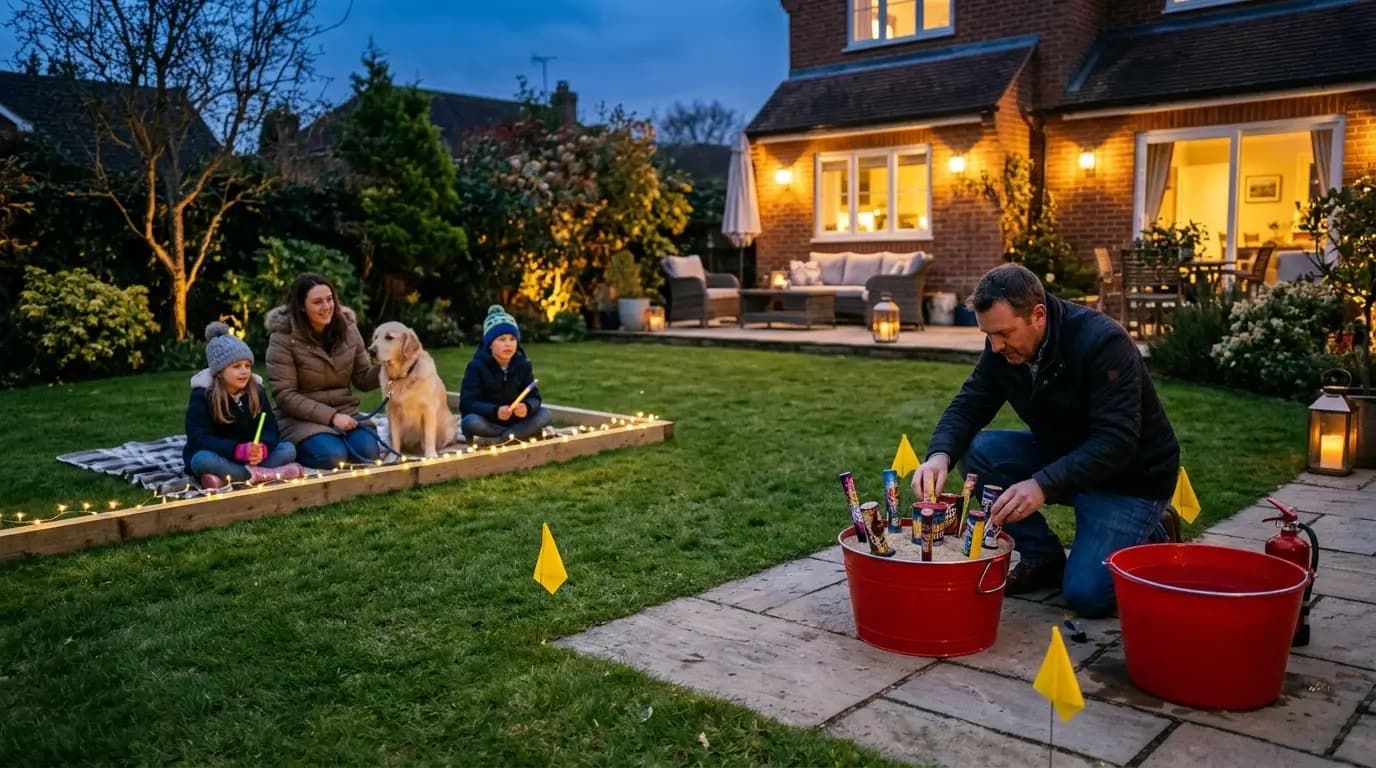
Walk the downwind ground and deal with these before you light anything:
- Clear the gutters and roof valleys within the fallout area, or accept that you are firing over a fuel bed
- Move anything plastic, upholstered or fabric — furniture covers, trampolines, gazebos, bins
- Wet down dry grass and mulch beds if conditions are dry, and check for any local fire ban
- Close windows and outward-opening doors on nearby buildings, including the neighbour's if they are home
- Have water at the firing point — a charged hose or filled buckets, not a decorative watering can
⚠️ Safety critical: Where a total fire ban or high fire danger rating applies, consumer fireworks are off. That is not a judgement call to make on the night — check the current rating with your fire service before you buy.

Failure three: the dud gets approached too soon
A firework that does not go off has not failed safely. It has failed in an unknown state, with a fuse that may be smouldering internally at a rate you cannot see.
The interval between the misfire and the moment someone walks over to look is where hands and faces get lost. CPSC attributes most of the 15 fireworks deaths recorded in 2025 to misuse and to device misfire or malfunction. The most frequently injured body parts were hands and fingers at 35 per cent, followed by head, face and ears at 22 per cent, in the same CPSC report. Those are the injuries of someone standing over a device.
The guidance from fire services on both sides of the Atlantic converges on the same procedure, and the waiting period is the part people shorten.
Work through it in this order, and do not compress step two:
- Announce it and hold the line. Tell everyone a device has not fired. Nobody moves forward, including you.
- Wait at least 20 minutes. Time it on a phone rather than estimating. Never relight a dud.
- Approach from the side, never from over the top. Keep your face and body out of the line of the tube.
- Soak it. Submerge spent and dud fireworks in a bucket of water for at least 20 minutes, or overnight, to be sure they are cooled and extinguished.
- Dispose of it wet, and outside. Never dispose of fireworks in a garage or building, and never place used fireworks in a combustible container.
- Sweep the ground at the end. In daylight the next morning, walk the fallout area for anything unexploded before children or pets do.
📋 From the field: The reason step two fails is social, not technical. Twenty minutes of standing around in the dark with an audience is uncomfortable, and someone always offers to "just check". Give that job a name before the night starts — one person owns the misfire, and their instruction is to do nothing for twenty minutes.

Failure four: sparklers get handed to children
The sparkler is the only firework routinely put directly into a child's hand, and it is the one whose hazard is most consistently underestimated.
CPSC puts sparkler burn temperatures at around 2,000°F — approximately 1,090°C, hot enough to melt some metals (source: CPSC). For comparison, that is well above the melting point of aluminium. An estimated 1,300 emergency-room-treated injuries in 2025 involved sparklers, and the wire stays dangerously hot long after the sparks stop, which is when it usually gets dropped.
There is a further point about children that has nothing to do with sparklers. Children under 15 accounted for 32 per cent of estimated fireworks injuries in 2023, per the same NFPA report — and the exposure is not only to the person holding the device. A child standing at the spectator line is inside the noise, the light and the debris path.
If sparklers are being used at all, the controls that make a measurable difference are:
- One per person at a time, lit from an already-lit sparkler rather than from a bundle
- Held at arm's length, away from the body, and never carried while running
- A metal bucket of water at the point of use, wire-end down, the moment it goes out
- Gloves for young children — a cheap pair does more here than any instruction
- No sparklers for the youngest — RoSPA advises against giving sparklers to under-fives, and I would set the floor higher than that

Failure five: emergency access and headcount belong to nobody
This is the part I look for first, because it is the part that decides how bad a bad night gets — and at a family gathering, nobody is assigned to it.
Two questions matter. Can an ambulance or fire appliance reach the property without moving vehicles? And does anybody know how many children are in the garden? Those are muster and access questions, and they are exactly the questions that go unanswered in industrial settings too.
On a Wormald Fire Systems assignment in Brisbane I found equipment staged across an emergency access route — legitimately delivered, put down in the nearest convenient place, and left there. It blocked the only approach a fire appliance could use. Again, not a fireworks event, and the transfer is honest rather than exact: the access route existed on the plan and was unusable in the field. I raised it, had the route cleared and verified it stayed clear on follow-up walks. On a domestic street the same failure looks like six cars parked for a party across the only turning point.
The accountability half of it is simpler than it sounds. In muster assurance work the headcount always fails at peak, when the population is largest and least familiar. A garden at 9pm on Bonfire Night or the Fourth of July is a population peak.
Assign these four jobs by name before anyone arrives:
- Firer — the only person who approaches the firing point, sober, wearing eye protection, and not also hosting
- Spectator line marshal — keeps the line where it was measured, including when people drift forward
- Child and pet accountability — knows how many children are outside and where they are, all night
- Access keeper — makes sure the driveway and street approach stay clear, and knows the property address to give to an emergency operator
✅ Auditor's tip: The test I use on any site applies here unchanged. Ask the person who owns a control to describe how they would use it, out loud, before it is needed. "If we have to call an ambulance, what address do you give and who opens the gate?" A hesitant answer is a finding.

Burns, eyes and hands: what to do in the first two minutes
Fireworks injuries are dominated by burns, and burn outcomes are decided in the first minutes by whoever is standing there — not in the emergency department later.
ANZCOR Guideline 9.1.3 recommends cooling a thermal burn with cool running water as soon as practicable, for at least 20 minutes, and notes cooling still helps if started up to three hours after the injury (ANZCOR). Twenty minutes feels much longer than it sounds when someone is in pain and everyone wants to drive to hospital. Cool first, then travel.
The same guideline is explicit about what not to do: no ice or iced water, no breaking blisters, no lotions, ointments, creams or powders, and no peeling off adherent clothing. Cover the cooled burn with a loose non-stick dressing or cling film laid over rather than wrapped around a limb, and keep the person warm to avoid hypothermia — small children cool quickly.
Eye injuries follow a different rule. Do not rub, do not flush a mechanical or blast injury, and do not try to remove anything embedded. Shield the eye without pressure and get urgent medical care.
Call an ambulance without waiting to see how it develops if any of these apply:
- The burn involves the face, hands, feet, genitals or a major joint, or is larger than the palm-sized areas ANZCOR treats as significant
- The casualty is an infant or young child — all infants and children with burns should be medically assessed
- There is any eye involvement, however minor it looks
- There is a hand or finger injury from a device that went off in the hand — these are surgical injuries, not first aid ones
- There is any suggestion of inhaled hot gas — hoarseness, soot around the nose or mouth, singed facial hair

Pets, neighbours and people for whom the noise is not fun
A display that is safe and legal can still cause real harm, and the people most affected are usually not at the party.
Noise-sensitive neighbours, veterans and others with post-traumatic stress, people with autism, night-shift workers, and animals all experience an unannounced display differently. Queensland handles this through notification: authorised displays carry safety planning and community notification obligations, and residents within 200 metres who have not been notified are encouraged to report it. That is a regulatory answer to what is otherwise a courtesy problem, and the courtesy version works nearly as well.
RoSPA's guidance is straightforward on animals: avoid lighting fireworks near animals, and keep pets indoors in a closed, comfortable room away from the noise.
A few minutes of notice prevents most of the friction:
- Tell the neighbours a day or two ahead, including a rough finish time you will stick to
- Ask about animals, shift workers and anyone noise-sensitive rather than assuming there are none
- Bring pets inside before dusk, with curtains closed, background sound on and ID tags current
- Finish when you said you would — the curfew is the legal floor, not the social one

A ten-minute pre-display check you can run yourself
Everything above collapses into a short walk you do in daylight, while you can still change your mind about something.
I run site verifications for a living, and the format that works is always the same: walk the ground in the order the event will happen, and say each check out loud. Reading a list on a phone catches far less than standing in the spot and looking.
Do this in daylight, in this order:
- Confirm the law and the conditions. Legality where you are, plus the current fire danger rating or fire ban.
- Read every product label. Note the largest marked safety distance in the box; that number sets your site.
- Measure and mark the spectator line to that distance, and check overhead clearance above the firing point.
- Walk the downwind fallout ground. Clear gutters, move plastics and fabrics, wet dry vegetation.
- Set up water at the firing point — charged hose or filled buckets, plus a metal bucket for sparklers and spent items.
- Check the emergency access route is clear and that someone knows the address to give.
- Name the four roles and tell those people what they own.
- Agree the stop conditions out loud — wind picking up, anyone crossing the line, alcohol, or a device that lands wrong.

Frequently asked questions
These are the questions readers most often search alongside this topic.
How far away should spectators stand from fireworks?
Use the distance printed on the individual firework, not the category. RoSPA puts UK category F2 garden fireworks at 8 to 15 metres and F3 display fireworks at 25 metres. US fire marshal guidance for consumer devices commonly sets at least 25 feet. Measure it in daylight and mark it.
What should I do if a firework doesn't go off?
Treat it as live. Never relight it. Hold everyone back for at least 20 minutes, timed rather than estimated, then approach from the side and soak it in water for 20 minutes or overnight. Dispose of it wet, outdoors, and never in a garage or a combustible bin.
Are sparklers safe for young children?
No. CPSC puts sparkler temperatures at roughly 2,000°F (1,090°C), and an estimated 1,300 US emergency-room injuries in 2025 involved sparklers. Most guidance sets a minimum age of five; in practice, gloves, one at a time, and a metal water bucket at the point of use matter more than age alone.
What time do fireworks have to stop in the UK?
The Fireworks Regulations 2004 impose an 11pm to 7am curfew in England and Wales, extended to midnight on 5 November and to 1am on New Year's Eve, Diwali and Chinese New Year. Scotland is tighter: use is restricted to between 6pm and 11pm, with the same seasonal extensions. Northern Ireland requires a licence.
Can I let off fireworks in Australia?
In most states, no. Queensland has prohibited public use of display fireworks since 1972, and only licensed operators may fire them; penalties are substantial. The Northern Territory permits public use on Territory Day only. Check your state regulator before buying anything.
How long should you cool a firework burn?
At least 20 minutes under cool running water, started as soon as practicable, per ANZCOR Guideline 9.1.3. Cooling still helps up to three hours after the injury. Do not use ice, butter, creams or ointments, and do not break blisters. Seek urgent care for burns to the face, hands or eyes.
Is it safer to go to a public display?
Yes. Professional displays run under codes such as NFPA 1123, with calculated separation distances, licensed operators, a surveyed fallout area and fire cover on site. Consumer fireworks reproduce none of that infrastructure, which is why every fire service recommends the public display first.
The question that decides whether you light them at all
There is one honest test, and it takes ten seconds.
Stand where the fireworks will be, look downwind, and ask what is under the fallout. If the answer is a shed roof, a dry paddock, a neighbour's timber deck or anything you would not accept a lit match landing on, the site has answered the question for you. Distance can be measured. Wind can be waited out. A site with nowhere safe for the debris to land does not become safe because the box says consumer grade.
I would rather someone read this and decide to go to the council display than follow every step above in a garden that was never big enough. Both are good outcomes; only one of them requires you to get it right in the dark.
The three decisions that carry the most weight on the night are:
- Site selection — everything else is downstream of whether the fallout ground is clear
- The named firer — one sober person, no exceptions, no swapping mid-display
- The stop condition you agreed — and actually stopping when it happens

About the author — Mia Collins
Mia Collins is an Australian Fire Life Safety & Emergency Response Assurance Consultant with 15 years of continuous field experience across industrial fire protection, high-rise fire life safety, warehouse fire systems, chemical store fire controls, and detection and alarm systems. Her focus is practical assurance — checking that controls still work where work actually happens. She has inspected 180+ workplaces and conducted 70+ audits across 14 countries, and previously led egress integrity and muster assurance programmes for Chubb Fire & Security AU, Kidde Fire Australia Partners and Wormald Fire Systems. She currently leads Collins Fire & Emergency Assurance in Brisbane, Australia.
Credentials: NEBOSH International General Certificate, ISO 45001 Lead Auditor, ISO 14001 Internal Auditor, IOSH Managing Safely, Emergency Response Planning Awareness, Fire Safety Awareness, First Aid / CPR.
Sources and further reading
- NFPA — Fireworks fires and injuries — US fire and injury statistics
- CPSC — Fireworks safety education centre — 2025 injury and fatality data, consumer guidance
- Fireworks Regulations 2004, regulation 10 — supplier duties on age and category restrictions
- Fireworks Regulations 2004, explanatory note — curfew hours and exceptions
- House of Commons Library — Fireworks: purchase, possession and use — UK legal summary
- Business Queensland — Fireworks licensing and handling — Queensland licensing position
- Queensland Government — About fireworks — authorised displays and notification
- ANZCOR Guideline 9.1.3 — First Aid for Burns — burn cooling and significant-burn criteria
- RoSPA — Firework safety — UK consumer guidance, disposal and animals
- National Safety Council — Fireworks — US consumer safety guidance