

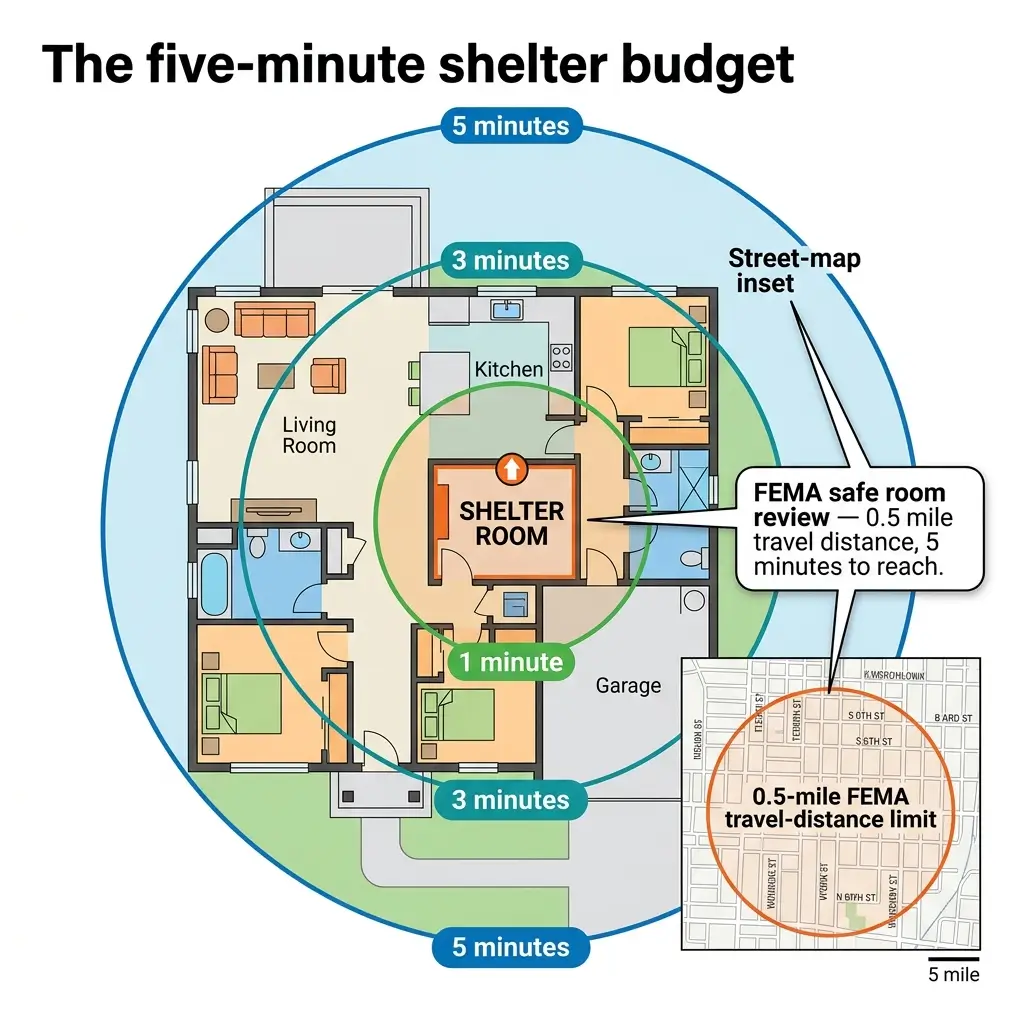
Plan your tornado safety around five minutes, not around the warning. That is the number FEMA uses when it reviews a community safe room: occupants should be within half a mile of it by travel distance, and able to reach it inside five minutes. Everything useful you can do for your family follows from that one constraint — because five minutes is not enough time to find a phone charger, argue about whether the sky looks bad, and then decide where to go.
I work in refuge and muster assurance rather than meteorology. In my work on mine sites and production plants, the job is the unglamorous half of emergency planning: proving that the shelter seals, that people can physically reach it, and that someone knows who made it inside. Those three questions transfer directly to a tornado at home, and they are the three that household advice almost never covers.
This article is written primarily for the United States, where tornado risk and the relevant standards sit. A note on the UK and Europe appears in the FAQ.
⚠️ Safety critical: This covers protective action for households and, briefly, workplaces. It does not cover safe room design or construction, which needs a licensed design professional working to FEMA P-361 and ICC 500, and it does not cover post-storm clean-up, which carries its own hazard set. If you are commissioning a shelter or writing an employer's emergency action plan, get competent professional input rather than relying on any article, including this one.
Key takeaways
Six points carry most of the practical value in this article:
- FEMA's design assumption is five minutes. Community tornado safe rooms are reviewed against a half-mile travel distance and a five-minute reach time (FEMA safe room technical review). Time your own route before storm season.
- A watch means position yourself; a warning means move now. Confirming a warning by looking outside is the single most common way families spend the minutes they needed.
- Structure type dominates survival. Source: National Weather Service — people in mobile or manufactured homes are 15 to 20 times more likely to be killed than people in permanent homes.
- Debris, not wind, is what hurts you. Tornado shelters built to FEMA P-361 and ICC 500 are tested against a 15-pound 2×4 fired at 100 mph, which tells you what you are hiding from.
- Employers must plan, but no US standard requires a storm shelter. OSHA requires an emergency action plan under 29 CFR 1910.38 and alarm testing under 1910.165 — it does not mandate a shelter.
- Accountability is part of the plan. Knowing who reached the shelter is what turns a rescue into a search.
Your tornado plan has a five-minute budget
The most useful thing you can do this week has nothing to do with weather apps. Walk the route from where your family actually spends time — the sofa, the bedroom, the back garden — to the place you intend to shelter, and time it. Then walk it again carrying a child, or at the pace of the slowest person in the house.
Five minutes sounds generous until you add the real steps. FEMA applies the criterion to community safe rooms specifically because designers kept siting them where people could see them rather than where people could reach them. The same error happens in houses. A basement is worthless if the only access is an external hatch on the windward side, and a neighbour's storm cellar three streets away is a plan on paper only.
The criteria below come from FEMA's Hazard Mitigation Assistance guidance and the ICC 500 standard that FEMA references. They are design numbers for engineers, but they tell a household what "adequate shelter" actually means.
| Criterion | Tornado value | Source |
|---|---|---|
| Design wind speed | 250 mph (3-second gust) for all locations under FEMA funding criteria | FEMA P-361 |
| Debris impact test | 15-lb 2×4 at 100 mph, vertical surfaces | ICC 500 §305 / FEMA P-361 |
| Travel distance to community safe room | 0.5 mile, measured as travel distance not radius | FEMA safe room review |
| Time to reach community safe room | 5 minutes | FEMA safe room review |
| Floor area, residential (1–2 family dwelling) | 3 sq ft per occupant | FEMA HMA guidance |
| Floor area, community safe room | 5 sq ft standing or seated; 10 sq ft wheelchair user | FEMA HMA guidance |
Three checks turn those numbers into something you can act on this weekend:
- Time the route, do not estimate it. If it takes more than about two minutes at a walk, you have no margin for the delay that always happens.
- Count the floor area. Three square feet per person is tight — a family of five needs a genuinely clear 15 sq ft, not a corner of a storeroom stacked with boxes.
- Check what is above and around the space. Avoid a spot with a heavy appliance, water tank or piano on the floor directly overhead.
Watch or warning: what each one asks you to do
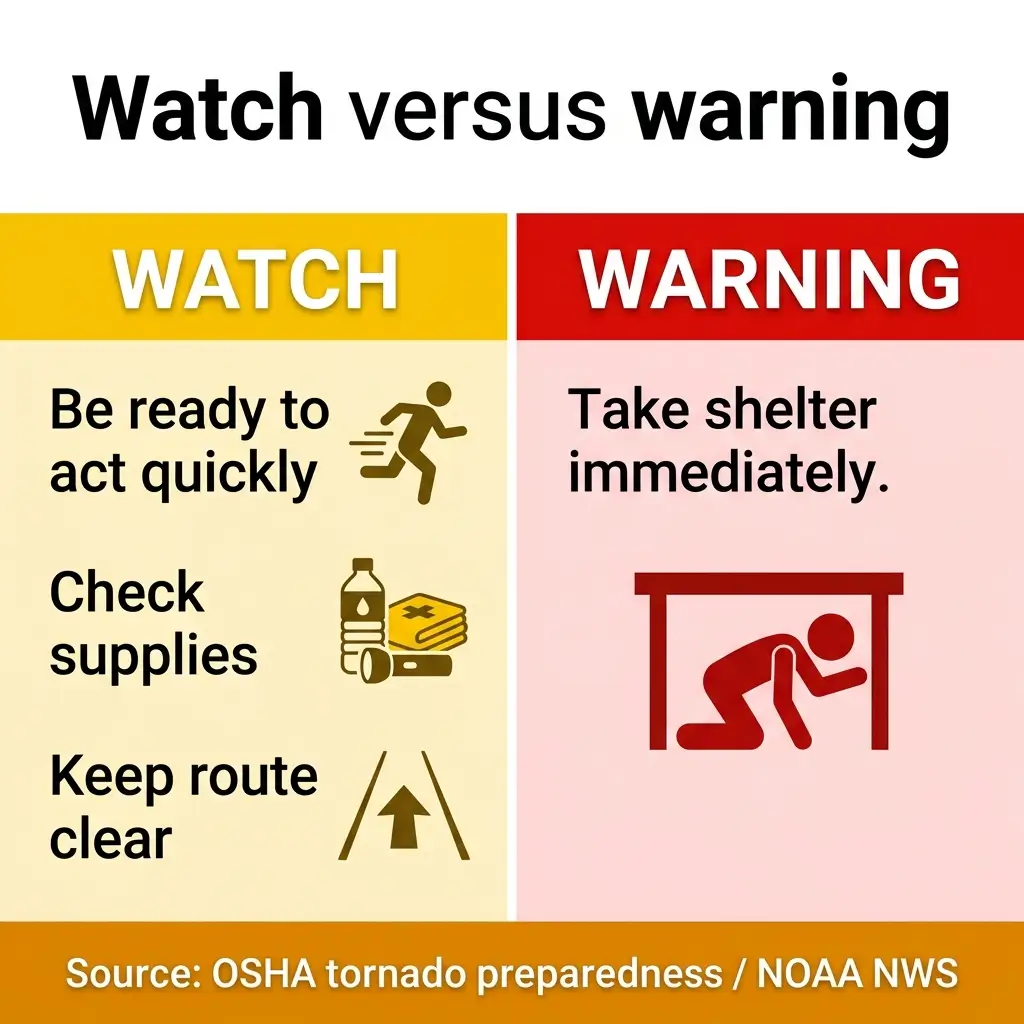
These two words are the most misunderstood pair in severe weather, and the confusion costs time at exactly the wrong moment. A watch is a positioning instruction. A warning is a movement instruction.
OSHA's tornado guidance puts it plainly for workplaces, and the logic is identical at home: under a tornado watch, conditions are favourable, so be ready to act quickly and check your supplies. Under a warning, a tornado has been sighted or shown on radar, and the instruction is to take shelter immediately.
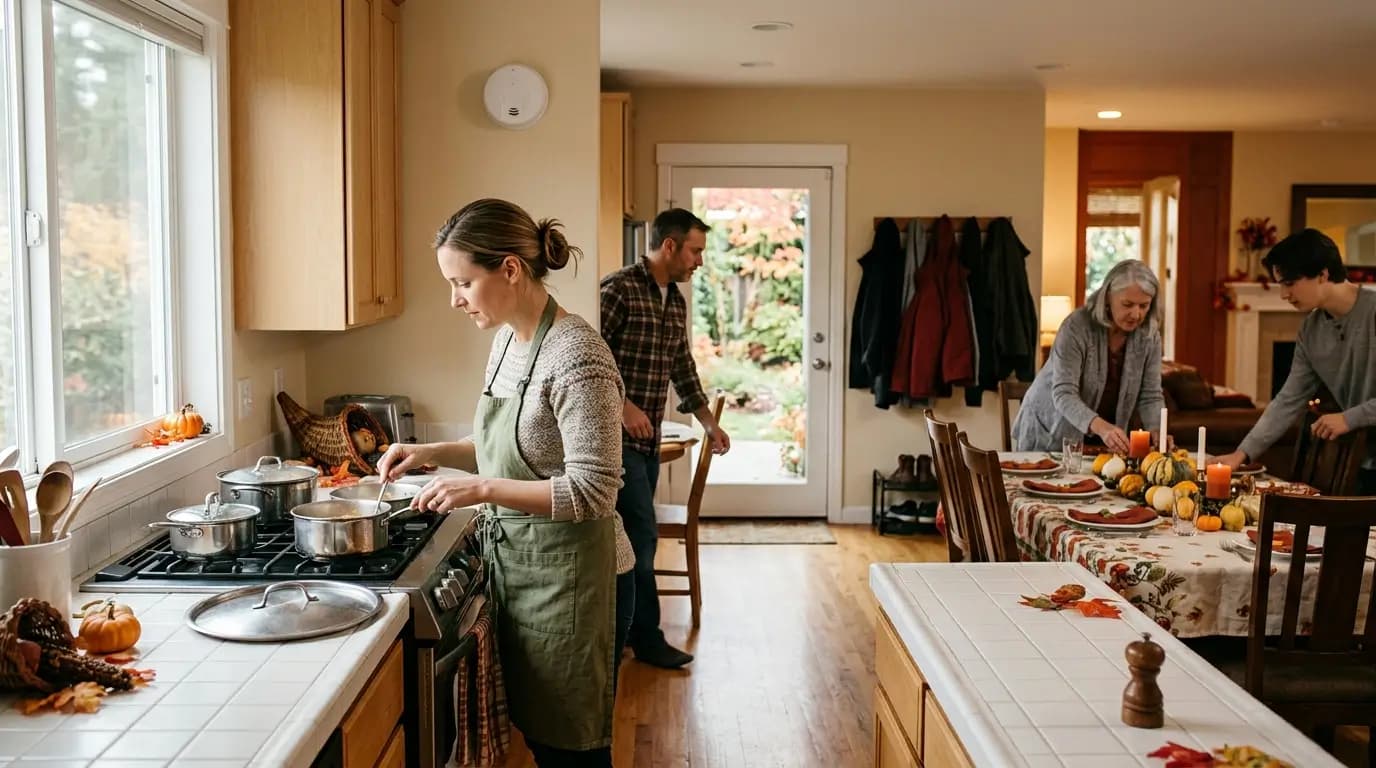
The practical difference is what you are allowed to still be doing. During a watch, you can be cooking dinner — provided shoes are on, the phone is charged, and the shelter route is clear. During a warning, you should already be moving.
| Tornado watch | Tornado warning | |
|---|---|---|
| What it means | Conditions favour tornado development | Tornado sighted or radar-indicated |
| Typical area | Large, often several counties | Small polygon, specific storm |
| Your instruction | Position and prepare | Move to shelter now |
| Reasonable to still be doing | Normal activity, with route clear and phone charged | Nothing except moving |
| Common error | Ignoring it entirely, so the warning arrives cold | Going outside to confirm it |
Set your alerting up during the watch, not during the warning. The three that work when the power and the mobile network fail are:
- A NOAA Weather Radio with battery backup and an alarm tone — it will wake you, which a muted phone will not.
- Wireless Emergency Alerts left switched on — many people disable them after a false alarm and never re-enable them.
- A second adult who has agreed to phone you — redundancy matters most at night, which is when the deadliest tornadoes tend to catch people asleep.
Where to shelter, ranked by what actually stops debris
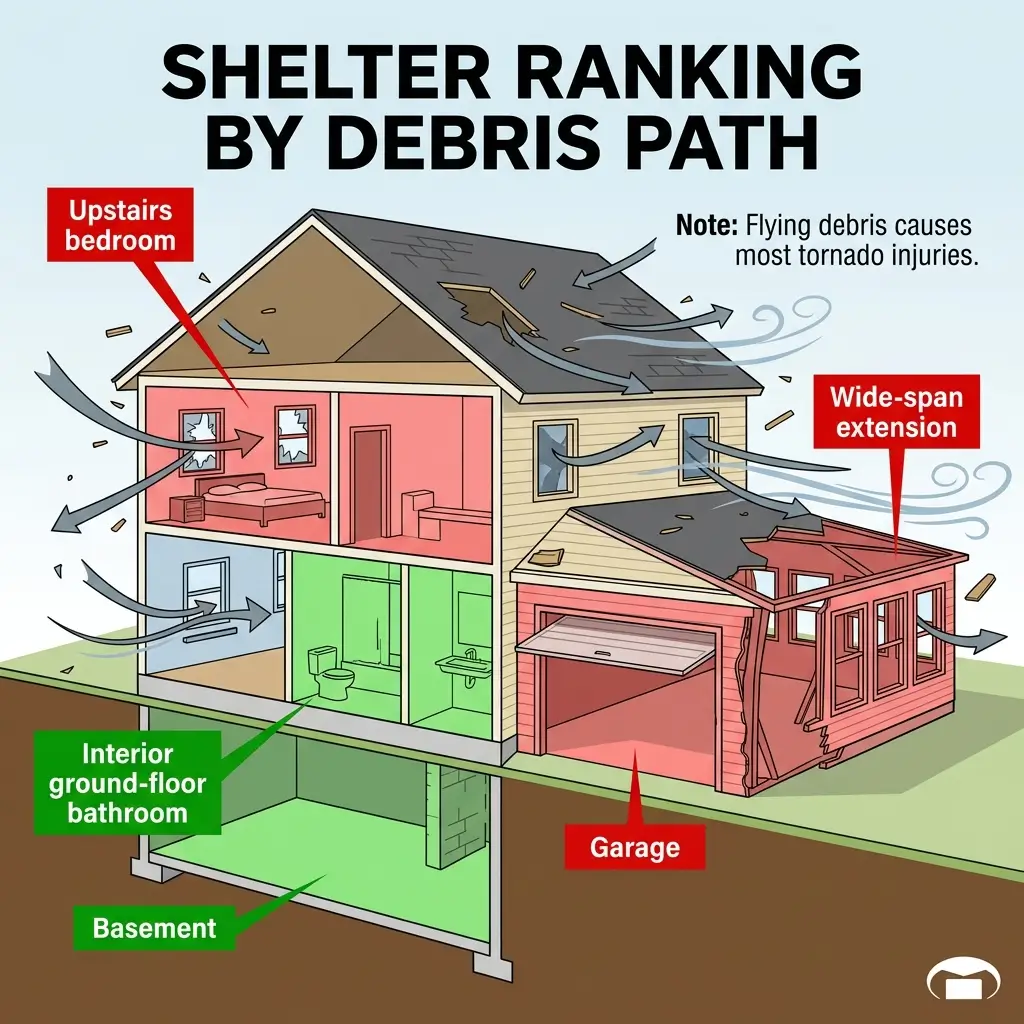
Rank shelter options by how many walls sit between you and flying debris, and how heavy those walls are. That single criterion explains every piece of standard advice, including the parts that sound arbitrary.
Flying debris causes most tornado deaths and injuries. Once you hold that in mind, "go to the lowest floor, innermost room, away from windows" stops being a slogan and becomes a count: below grade beats above grade, interior beats exterior, small span beats wide span.
At home, with or without a basement
An underground area gives the best protection. If you have a basement, shelter under something sturdy — a heavy workbench or table — and away from the floor space directly beneath heavy appliances upstairs.
With no basement, take the smallest interior room on the lowest floor: an interior bathroom, a closet, or a centre hallway. Interior bathrooms are often the best of a poor set because the plumbing adds reinforcement and the span is short. Cover yourself with a mattress, cushions or thick blankets. The NOAA Storm Prediction Center notes that a helmet offers some protection against head injury — keep bike or sports helmets in the shelter space itself, not upstairs where fetching them costs you a minute you cannot spare.
In a mobile or manufactured home
Leave. This is the one situation where the advice is unambiguous. The National Weather Service reports that occupants of mobile homes are 15 to 20 times more likely to be killed than occupants of permanent homes, and that anchoring failure is behind most of those deaths. A longer-run NOAA National Severe Storms Laboratory analysis of Storm Data records found that mobile homes accounted for about a third of all US tornado deaths across 1975–1995 — an older dataset, but one that made the pattern visible decades before the current figures.
Tie-downs do not change this. An EF-1 tornado — the second-weakest rating — can destroy a manufactured home outright. Identify a sturdy building or community shelter now, agree the trigger with your household (leave at the watch, not the warning), and know its opening hours.
At work, in a store or in a public building
Avoid wide-span roofs. Auditoriums, gymnasiums, cafeterias, warehouses and big-box retail floors are the worst places to be, because the roof structure has nothing to bear on in the middle. Move to an interior bathroom, storage room or stairwell away from glass, and stay off the lifts.
Employers in the US are required to have an emergency action plan under 29 CFR 1910.38 where the standard applies, and to test alarms annually under 1910.165. Clause 1910.38(c)(4) requires procedures to account for all employees afterwards, which is the accountability point again in regulatory form. Neither standard requires a storm shelter, and neither requires a tornado drill. That gap between what is required and what keeps people alive is worth raising with your employer directly.
In a vehicle or caught in the open
Do not shelter under a highway overpass. OSHA's guidance gives two options if you meet flying debris while driving: stay belted in the vehicle with your head below the window line and covered, or — if there is ground noticeably lower than the roadway — lie in it and cover your head. Neither is good. Both beat an overpass, which funnels wind and channels debris into the space people crawl into.
| Location | Protection | What to do |
|---|---|---|
| Basement or below-grade storm shelter | Best | Get under sturdy furniture, away from heavy loads overhead |
| Interior bathroom or closet, lowest floor | Good | Cover with mattress or blankets, protect head |
| Interior stairwell, multi-storey building | Good | Descend if not crowded, stay off lifts |
| Wide-span roof space (gym, warehouse, mall floor) | Poor | Move to an interior room before the warning, not during |
| Mobile or manufactured home | Very poor | Leave for a sturdy building at the watch stage |
| Vehicle | Very poor | Drive to a sturdy building if possible; otherwise belt in, head down |
| Highway overpass | Dangerous | Never — wind accelerates and debris is channelled through |
Whatever building you are in, the same four questions rank your options in seconds:
- How many floors are between me and the roof? More is better; below grade is best.
- How many walls are between me and the outside? Interior beats exterior, every time.
- How wide is the roof span above me? A bathroom ceiling is held up on all sides; a warehouse roof is not.
- What is stored above and beside me? Heavy loads overhead and glass alongside are both reasons to move on.
Why families lose the minutes they thought they had
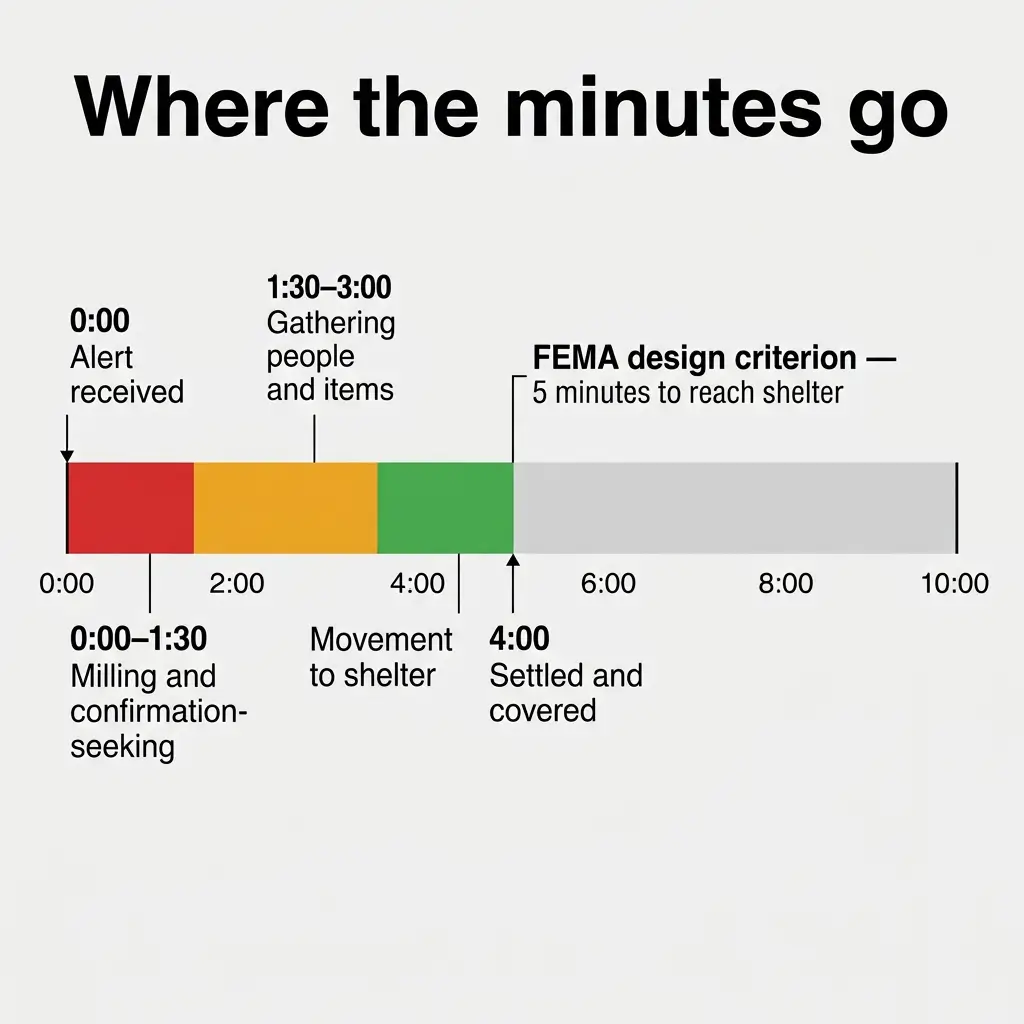
The gap between having a plan and using it is a human factors problem, and it is the part of tornado safety that household advice almost entirely ignores.
People do not respond to a warning by acting. They respond by trying to resolve uncertainty — checking a second source, phoning a relative, stepping outside to look at the sky. Researchers call this milling, and it is normal, rational behaviour that happens to be lethal when the budget is eight minutes. Warning fatigue makes it worse. A peer-reviewed analysis in Weather, Climate, and Society found that tornadoes in areas with a higher false alarm ratio kill and injure more people. A one-standard-deviation rise in false alarms raised expected fatalities by roughly 12 to 29 percent.
I see the same pattern in industry, where I can measure it. Auditing the night drills for mining emergency preparedness at Glencore, and again on cleanroom emergency access at Intel, I watched the losses land in the same place every time — almost never in the movement itself, because people walk fast once they finally go. The time went in the thirty to ninety seconds before, while someone looked for a supervisor, checked whether this was the real thing, or finished the task in front of them. Rehearsed groups do not skip that instinct. They shorten it, because the decision has already been made for them.
That is the transferable insight for a family: you cannot train yourself out of wanting confirmation, so remove the need for it. Decide in advance that the alert is the confirmation.
Three habits close most of the gap:
- Pre-commit the trigger. Agree that the warning tone means move, with no vote and no second opinion. Say it out loud as a household so it is a shared rule rather than one person's anxiety.
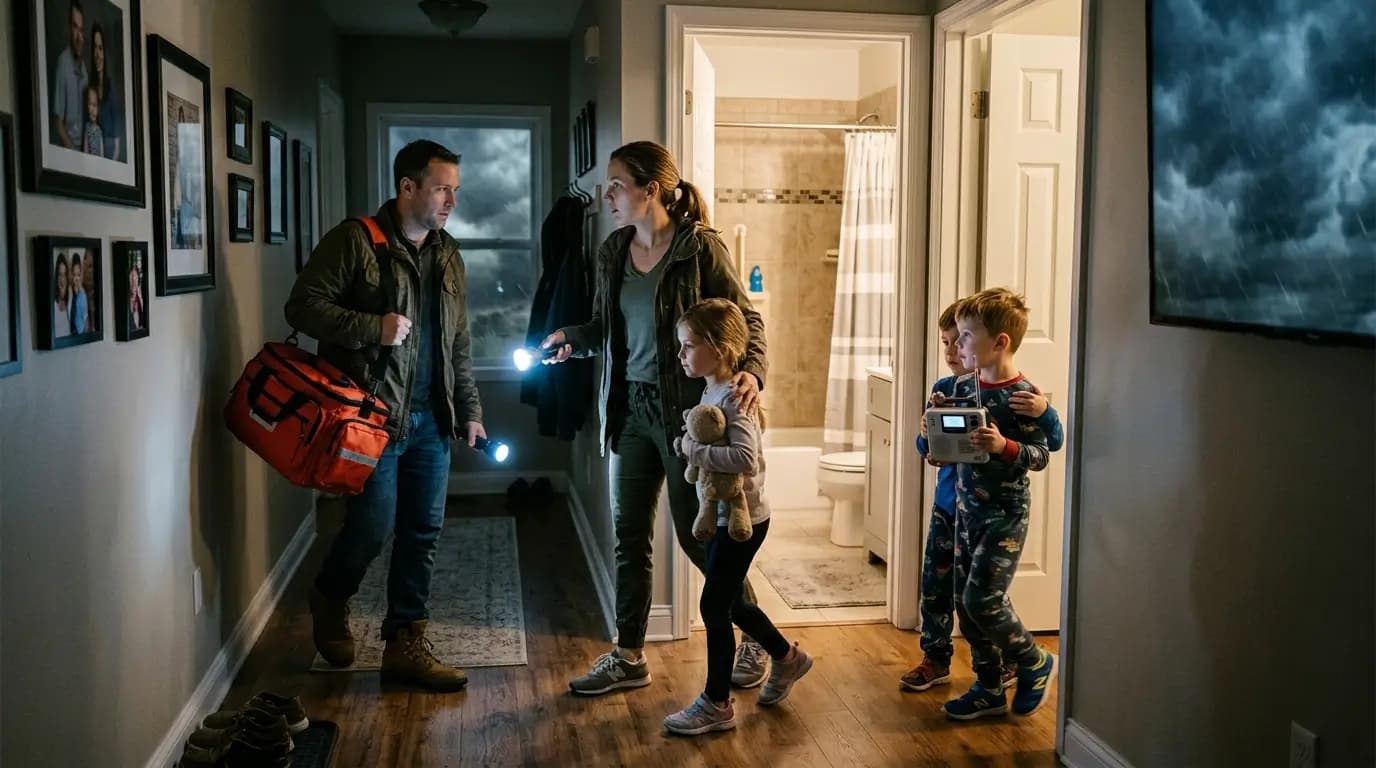
- Give everyone a single job. One adult takes the children, one takes the go-bag, one closes the door. Assigned tasks displace milling better than instructions do.
- Rehearse once a season, at an awkward time. A drill at 2 pm on a Sunday proves nothing. One at 10 pm on a school night finds the real problems — the sleeping child, the locked internal door, the shoes nobody can find.
The two checks that decide whether your shelter works
A shelter is not a place. It is a place plus a door that holds plus a count of who is inside. Two findings from my own work make the point better than a general argument, and I want to be clear about what they are: neither happened in a tornado. They happened underground and on night shift, in the refuge and muster assurance work that is my day job. The mechanism is what transfers.
The first was in an underground district in South Africa, on a Glencore assignment. I found a refuge checklist signed off while the door seal test had not actually been performed. Everything on paper was complete. The one thing that determines whether a refuge works — whether the door seals — had been assumed. I voided the sign-off, required a real seal test at the door, and coached the crew on verification you can measure rather than tick. The lesson translates without modification: if you did not test it, you did not verify it. For a household that means opening the shelter door this month, checking it closes fully against a warped frame, and confirming nothing is stored behind it.
The second was at a mine camp muster during a Zambia support assignment. On a night drill I watched the headcount fail whenever contractor density peaked — people were on site, moving correctly, and invisible to the roster. I reset the muster cards, added gate controls for contractors, and asked for the drill to be re-run until the numbers held. If people are invisible to the count, the emergency plan is fiction. At home the equivalent is a sleepover, a visiting grandparent, or a teenager who left twenty minutes ago. Somebody has to be responsible for the count, and everyone has to know who that is.
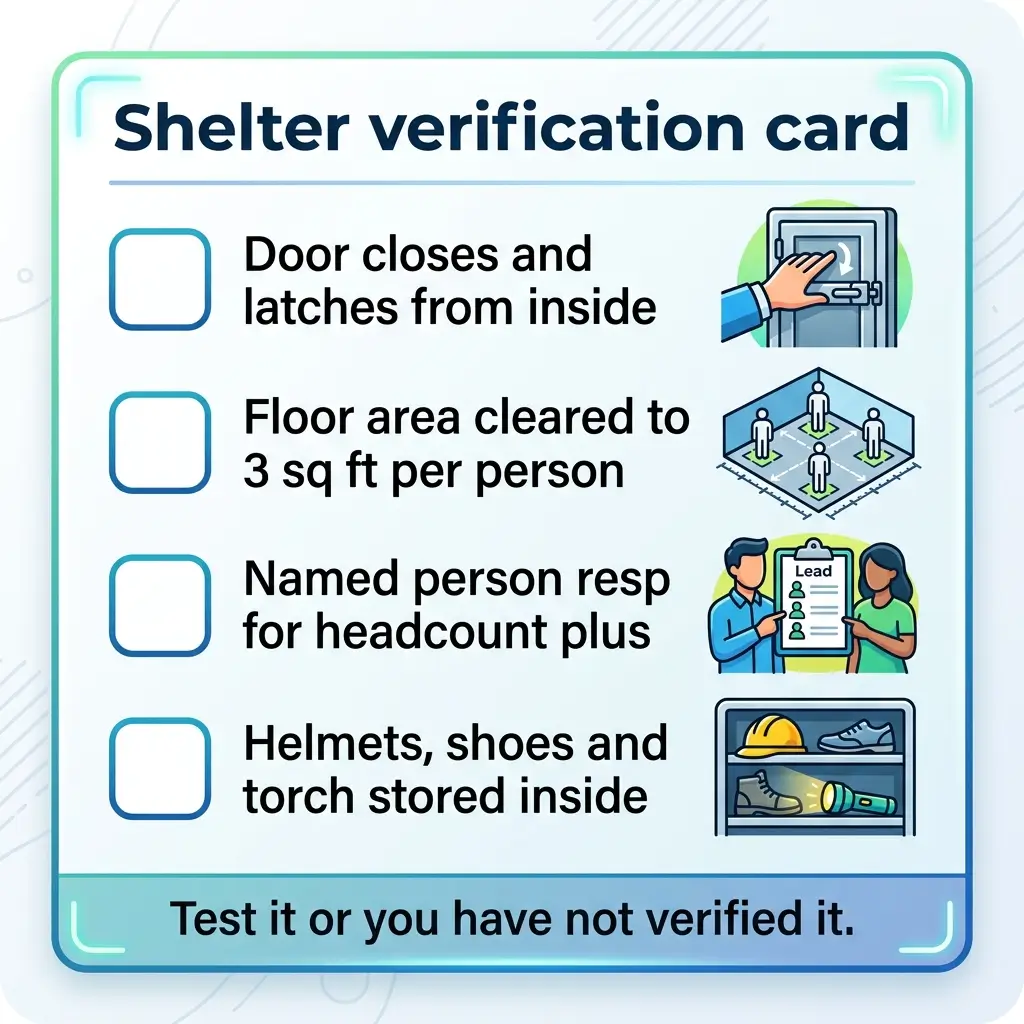
Run these four checks on your own shelter before the next storm season:
- Open and close the door fully. Confirm it latches, is not obstructed, and can be opened from inside if something falls against it outside.
- Clear the floor to the area you actually need — three square feet per person, measured, not guessed.
- Name the person who does the count, and name their backup for when they are out.
- Store head protection and shoes inside the space, so nobody leaves it to fetch anything.
Build the plan in one evening
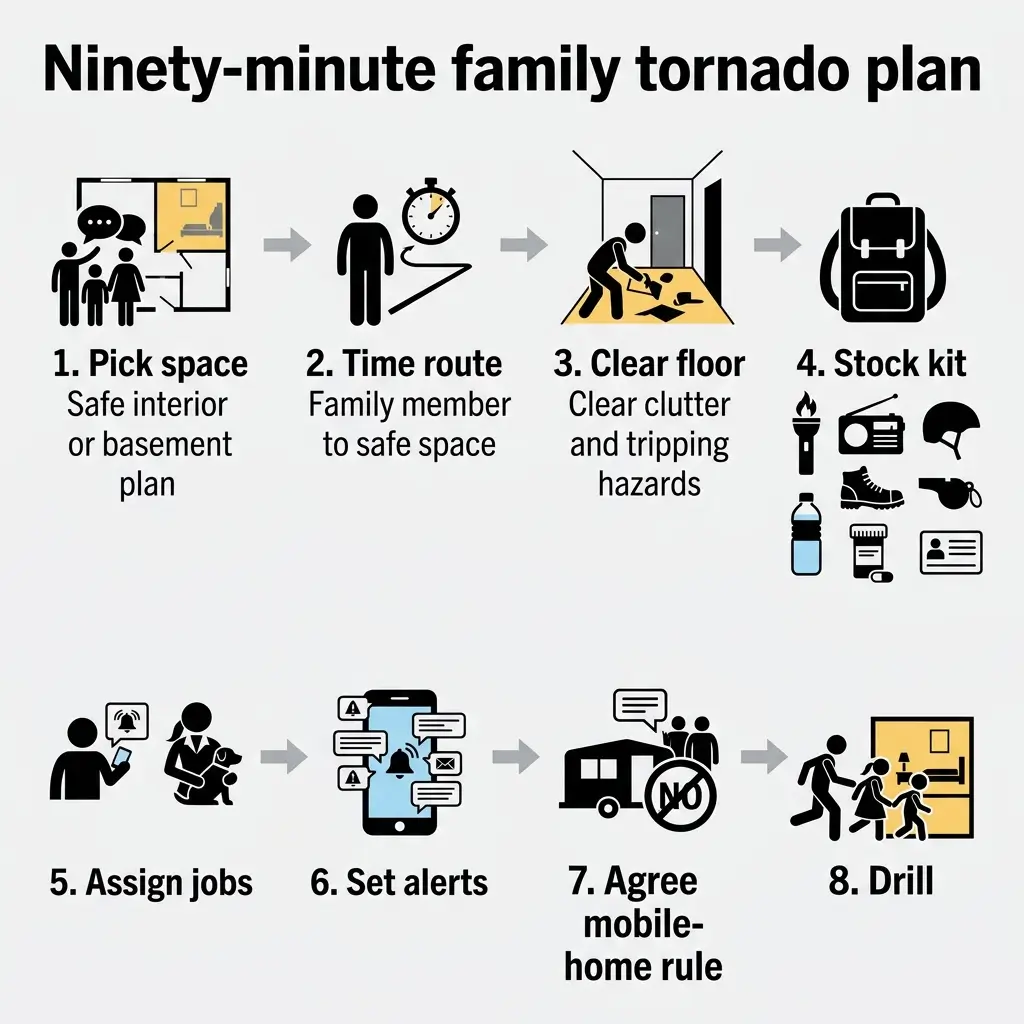
This takes about ninety minutes and does not need any purchases beyond a weather radio. Do it before tornado season rather than during it, because a plan written under a watch is a plan written badly.
Work through it as a household with everyone present, including children old enough to walk. The value is less in the written plan than in the shared understanding of who does what, which is what survives when people are frightened.
Follow these steps in order:
- Pick the shelter space using the debris-path ranking above — lowest floor, innermost room, smallest span, no windows.
- Time the walk from each room people use, at the pace of the slowest household member.
- Clear it out. Measure three square feet per person and remove whatever is in the way, permanently.
- Stock it. Torch, spare batteries, weather radio, shoes for everyone, helmets, a whistle, drinking water, any daily medication, a spare phone charger and a paper card with contact numbers.
- Assign the jobs. Who takes the children, who takes the bag, who does the count, who closes the door.
- Set the alerting. Weather radio alarm on, Wireless Emergency Alerts on, and one out-of-area contact everyone knows to call after.
- Agree the mobile-home rule if it applies: leave at the watch, and name the specific building you are leaving for.
- Drill it once, at an inconvenient hour, then fix whatever the drill exposed.
The whistle earns its place for one reason: if the structure comes down, shouting exhausts you within minutes and a whistle carries through debris far better than a voice. Rescuers listen for it.
The first hour after it passes
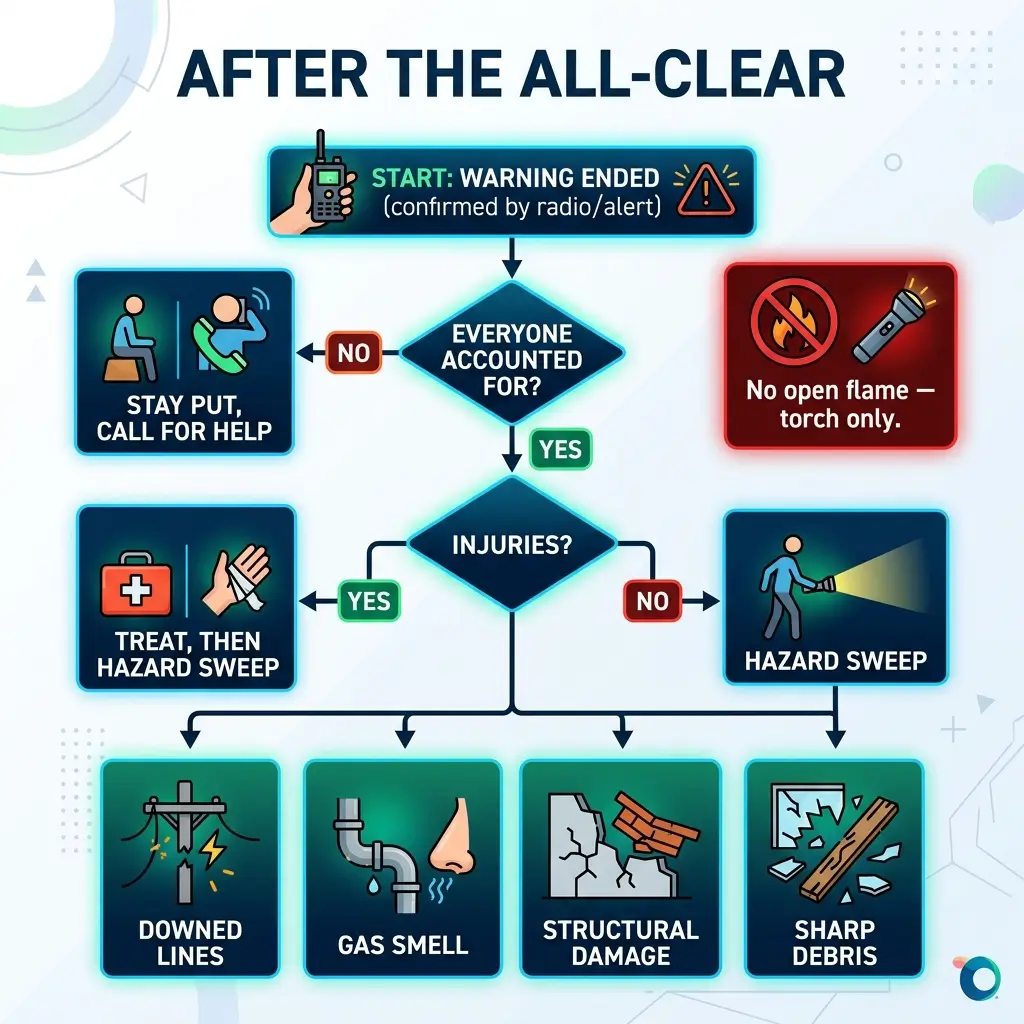
The tornado passing is not the end of the hazard, and the injury profile changes rather than disappearing. Most post-storm injuries come from the environment people walk into: downed conductors, gas leaks, broken glass, unstable structures, and nail-through-timber underfoot.
Stay in the shelter until you have confirmation from a radio or alert that the warning has ended, because more than one tornado can follow the same corridor. When you do come out, treat the building as unsafe until proven otherwise. Do not use a candle, match or lighter to see — if there is a gas leak, an open flame will find it. Use a torch, and use your phone screen only as a backup.
Then do the count. This is where muster discipline matters, and where a family is at exactly the same risk as a night shift: people scatter to check on neighbours with the best of intentions, and twenty minutes later nobody can say who is missing and who is next door. The finding I write up most often after a drill is not that the count was wrong — it is that nobody owned it.
Work through the aftermath in this order:
- Account for everyone before you move, using the named counter and the list agreed in advance.
- Check for injuries and treat what you can, prioritising bleeding and head injuries.
- Assume every downed cable is live and keep everyone well clear, including pets.
- Smell for gas and get out if you detect it — do not switch anything on or off, and call the utility from outside.
- Wear boots and gloves before walking through debris, which is why footwear lives in the shelter.
- Photograph damage before moving anything, for insurance, once people are safe.
Four tornado myths that still get people killed
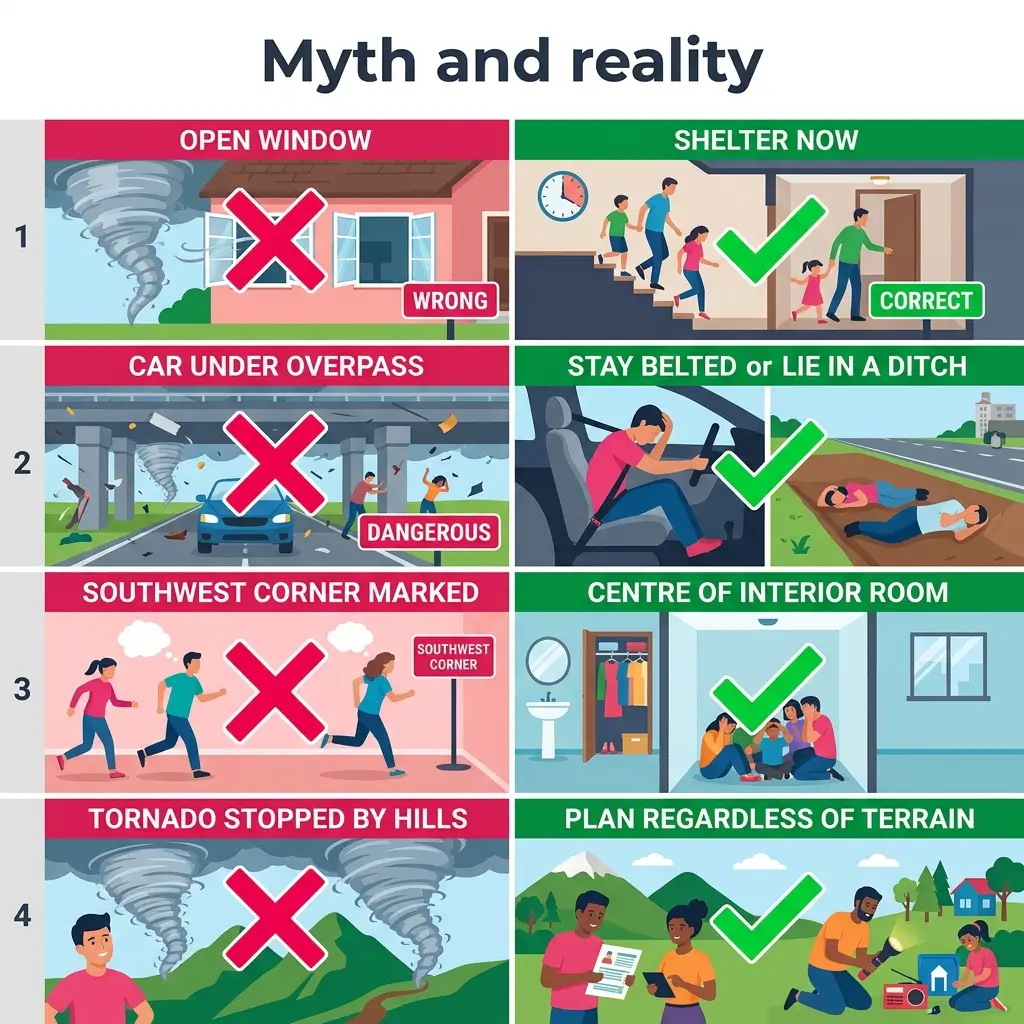
Some of these are folklore, and some were reasonable advice forty years ago that never got retracted. All four cost time, which is the resource you have least of.
The overpass myth is the most dangerous of them, and it has a traceable origin: 1991 news footage of a crew sheltering under a bridge and surviving, which was replayed nationally and taken as instruction. The bridge in that case had an unusual design and the tornado's path shifted. In the 3 May 1999 Oklahoma outbreak, people who followed the example under other overpasses were killed.
| Myth | Reality | What it costs you |
|---|---|---|
| Open the windows to equalise pressure | The tornado will open them regardless; pressure equalisation does not save structures | Time, plus injury from flying glass |
| Shelter under a highway overpass | The gap accelerates wind and channels debris; people have been lifted out and killed | Often fatal |
| The southwest corner is safest | Debris arrives from all directions; corners collect it. Centre of the room, lowest floor | Puts you against an exterior wall |
| Cities, hills and rivers break tornadoes up | Tornadoes have crossed rivers, ridges and downtown cores | False confidence, so no plan |
When I coach supervisors on emergency arrangements, the question I ask is which piece of bad advice they would act on under pressure. Overpasses come up almost every time, because the footage is memorable and the alternative feels worse. Take these three actions to close the myths out with your household:
- Say the overpass rule out loud to anyone who drives, because it is the myth most likely to be acted on under pressure.
- Delete the window instruction from any old family plan or school note you still have.
- Replace "southwest corner" with "smallest interior room, lowest floor" in how you describe your own shelter.
Frequently asked questions
These are the questions people ask most often once they have a plan and start stress-testing it.
How much warning will I actually get before a tornado?
Usually minutes, not hours. NOAA's performance goal for average tornado warning lead time is 13 minutes or more, and actual national averages have run lower in recent years as forecasters traded lead time for fewer false alarms. Plan on having roughly five usable minutes once you subtract hesitation.
Is a bathroom really safer than a bedroom?
Generally yes, if it is an interior bathroom on the lowest floor. The span is short, plumbing walls add stiffness, and there is usually no exterior window. A bedroom on an outside wall with a window is among the worst rooms in a house.
Should we wear helmets during a tornado?
The CDC's position is that head injuries are a common cause of tornado deaths and that people should protect their heads, while noting there is no research quantifying helmet effectiveness. If you use helmets, store them in the shelter — searching for one is worse than not having one.
Does OSHA require my employer to have a tornado shelter?
No. OSHA requires an emergency action plan under 29 CFR 1910.38 where the standard applies, including procedures to account for all employees under 1910.38(c)(4), plus annual alarm testing under 1910.165. There is no federal requirement for a storm shelter or a tornado drill.
What should I do if I am driving when a warning is issued?
Drive to a sturdy building if one is close and traffic allows. If debris is already flying, stay belted in with your head below the windows and covered. If there is ground clearly lower than the road, lie in it and cover your head. Never stop under an overpass.
Do tornadoes happen outside the United States?
Yes. The UK records a high number of tornadoes for its size, though almost all are weak and damage is usually limited to roofs, fences and trees. There is no UK or EU equivalent of the ICC 500 storm shelter standard, and UK guidance treats severe wind under general emergency planning rather than a dedicated shelter regime.
About the author
Grace Thompson is an Irish Occupational Health, Safety and Environment consultant specialising in human factors, fatigue and emergency preparedness, with 15 years of continuous field experience across 14 countries. Her emergency preparedness work centres on proving that refuge seals, muster headcounts and access routes hold up under real conditions — including as Mining Emergency Preparedness Lead at Glencore, where she led mine emergency response and muster assurance across South African, Zambian and Canadian interfaces and developed a refuge seal-test verification standard, and on cleanroom emergency access integrity at Intel. She holds NEBOSH Diploma and Certificate qualifications, ISO 45001 Lead Auditor and ISO 14001 Internal Auditor credentials, Emergency Response Planning Awareness and Incident Investigation training, and is a Chartered Member of IOSH. She leads Thompson Human Factors Safety in Dublin.
Sources and further reading
- OSHA — Tornado Preparedness and Response
- 29 CFR 1910.38 — Emergency action plans
- NOAA Storm Prediction Center — Tornado safety FAQ
- National Weather Service — Mobile and manufactured home tornado safety
- FEMA — Safe rooms guidance and publications
- FEMA — Safe room technical review criteria
- NSSL — Mobile home tornado fatalities
- Simmons & Sutter, False Alarms, Tornado Warnings, and Tornado Casualties