

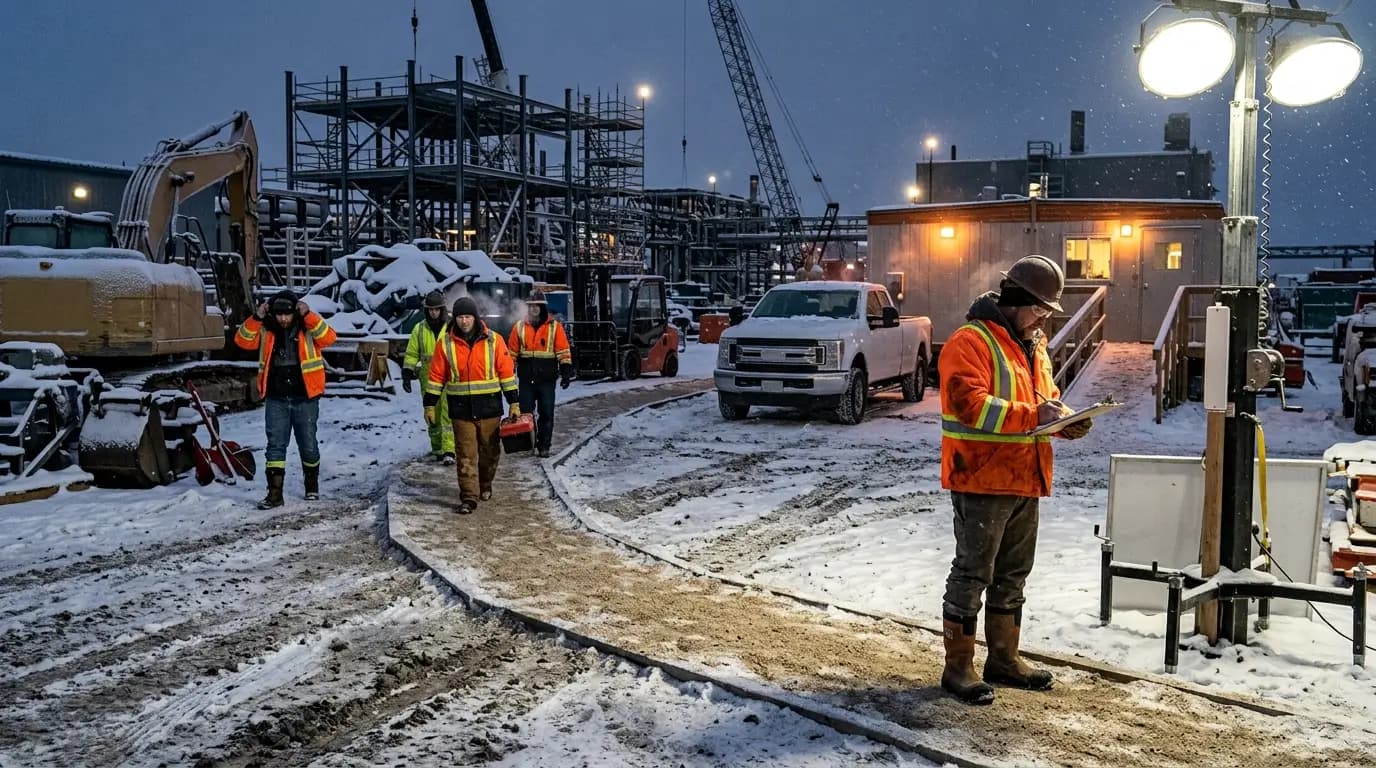
The single most useful winter safety measure is not a better jacket. It is re-planning the work around two conditions that summer procedures never had to survive: surfaces that freeze, thaw and refreeze inside one shift, and daylight that runs out before the job does. Everything else — footwear, layers, gritting, weather limits — hangs off that.
This is written as a walkdown, in the order I actually do one on a cold-weather site, from the gate to the drive home. It covers construction and industrial sites in the US, UK, Ireland and mainland Europe, where I have run winter work, and it flags where the legal position differs. It is not a guide to home or driving safety for the public.
Key takeaways
Six points carry most of the practical weight of what follows:
- No country I work in sets a legal minimum temperature for outdoor work. The duty is to assess the risk and control it, which means the threshold is one you set and can defend.
- In the US, cold is handled under the General Duty Clause, section 5(a)(1) of the OSH Act. There is no dedicated federal cold standard.
- In Great Britain, the 16°C / 13°C figures people quote are the ACOP minima for work inside buildings under Regulation 7 of the Workplace (Health, Safety and Welfare) Regulations 1992. They do not apply outdoors.
- Same-level falls dominate winter injury data far more than cold illness does. Ice on the route to the job hurts more people than the job.
- A snow-loaded roof needs a competent person to determine it can carry weight before anyone steps on it — that is an explicit OSHA expectation, not good practice.
- Weather limits only work if a named person owns the measurement and the stop decision. A limit with no owner is a paragraph in a method statement.
What winter actually changes on a live site
Winter does not introduce new hazards so much as it defeats controls that worked in October. The walking route is the same route. The scaffold is the same scaffold. What changes is that the surface, the light, the load and the worker's dexterity all move at once, and the risk assessment was written when none of them did.
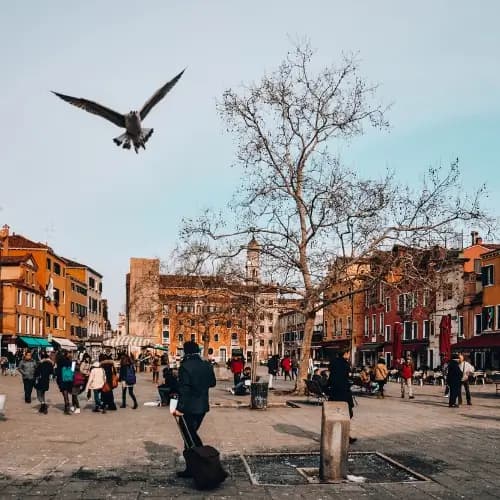
Four conditions do most of the damage, and they interact. Freeze–thaw is the one people underestimate: a car park gritted at 06:00 is wet by 11:00 as the sun hits it, and that meltwater refreezes into black ice at 16:00, which is roughly when the day shift walks back across it in the dark. The gritting was done. The control still failed, because it was scheduled once.
Wind chill is the second. Cold injury does not need sub-zero air — moving air strips heat from exposed skin much faster than still air at the same temperature. Third, daylight: in northern Europe a December shift can start and finish in darkness, so temporary lighting stops being a convenience and becomes the control that keeps the route usable. Fourth, load — snow and ice add weight to roofs, scaffold sheeting, temporary structures and lifting gear that was never checked against it.
The conditions that break summer controls, and what each one actually defeats, are:
- Freeze–thaw cycling — defeats one-off gritting, defeats "the route was inspected this morning"
- Wind chill — defeats clothing chosen for the forecast air temperature alone
- Reduced daylight — defeats visual checks, defeats hazard spotting on routes and in work zones
- Snow and ice loading — defeats assumptions about roofs, sheeted scaffolds, gutters and temporary works
- Reduced dexterity and grip — defeats gloved work on connectors, fasteners and controls

What the law requires when there is no cold-weather standard
Readers usually arrive at this topic looking for a temperature at which work must stop. There isn't one — not in the US, not in Great Britain, not in EU law. What exists instead is a general duty to assess the risk and control it, which puts the threshold decision on you and makes the quality of your reasoning the thing that gets tested afterwards.
That is a harder position than a fixed number, and it is worth being honest about why. A number would have to cover a rigger at height in wind and a driver in a heated cab. Regulators have chosen assessment over a figure, so an inspector will ask what you assessed, what you decided, and whether the crew knew.
United States
There is no federal OSHA standard for cold. The duty runs through the General Duty Clause, section 5(a)(1) of the OSH Act, supported by OSHA's winter weather hazards and precautions guidance. Hazard-specific standards still apply in full and are usually what gets cited: fall protection at 6 feet in construction under 29 CFR 1926.501 and at 4 feet in general industry under 29 CFR 1910.28.
One clause deserves highlighting because it is the snow-load clause and almost nobody quotes it: 1926.501(a)(2) requires the employer to determine that a walking or working surface has the strength and structural integrity to support employees, and to allow work on it only then.
United Kingdom and Ireland
Regulation 7 of the Workplace (Health, Safety and Welfare) Regulations 1992 requires a reasonable temperature inside buildings. The Approved Code of Practice adds the figures everyone repeats — normally at least 16°C, or 13°C where much of the work involves rigorous physical effort. Those are indoor figures, and quoting them at an outdoor crew is a common mistake.
Outdoors, the duty comes from the risk assessment required by the Management of Health and Safety at Work Regulations 1999, backed by HSE's guidance on cold stress at work, which points employers at the relevant British Standards rather than at a temperature limit. HSE has said it is reviewing the ACOP, so this is worth re-checking each season.
EU and international
The Framework Directive 89/391/EEC puts the same assessment duty on employers across member states, with national implementations varying in detail. Where you want a technical method rather than a judgement call, BS EN ISO 11079 gives the recognised approach to assessing cold environments through required clothing insulation. In Canada and Australia the requirements sit with provinces and states, so check the regulator for the jurisdiction you are actually working in.
The legal position across the jurisdictions I work in compares like this:
| Jurisdiction | Primary duty | Numerical figure | What an inspector asks for |
|---|---|---|---|
| United States | OSH Act 5(a)(1) General Duty Clause | None for cold; fall triggers 6 ft / 4 ft | Your hazard assessment and training records |
| Great Britain | Workplace Regs 1992 Reg. 7; MHSWR 1999 | 16°C / 13°C, indoors only | Your thermal risk assessment for outdoor work |
| EU (general) | Framework Directive 89/391/EEC | None; national variation | Risk assessment and worker consultation |
| International standard | BS EN ISO 11079 | Required clothing insulation method | The basis for your clothing decision |
Whatever the jurisdiction, an inspector is looking for the same four things:
- A thermal risk assessment covering outdoor work, not only indoor temperature
- A stated threshold with the reasoning behind it recorded
- Evidence the crew was briefed on that threshold and knows who can stop work
- Hazard-specific compliance — fall protection, PPE, plant — unaffected by the absence of a cold standard

Stop 1 — The gate, the car park and the walking routes
I start every winter walkdown outside the fence, because that is where most winter injuries happen and where the control most often has no owner. US federal data makes the point: the Bureau of Labor Statistics recorded 42,480 work injuries involving ice, sleet or snow in 2014, of which 82 percent were same-level falls. The figures move year to year — the 2017 count was 20,460, a rate of 1.8 per 10,000 full-time workers — but the pattern holds. People fall on the flat, walking.
So my first question at the gate is not about equipment. I ask who gritted, at what time, and when the next round is scheduled. On a site in Ireland one January the answer was a name, a time and a laminated route map — the round had been done at 05:30 and there was no second one. By mid-afternoon the ramp to the welfare cabins had refrozen. Nobody had fallen yet, which is not the same as the control working.
Two details separate sites that manage this from sites that hope: a written round with times and a named owner, and a re-inspection trigger tied to conditions rather than the clock. I also look at where the meltwater goes. Downpipes discharging across a footpath produce a sheet of ice in exactly the place people walk, every night, all winter.
The checks I run on routes before I look at any work activity are:
- The gritting log — who, when, which route, and what triggers the next round
- The drainage path — where meltwater runs and where it will refreeze
- Entrance transitions — matting long enough to dry boots, and slip-resistant flooring inside the door
- Lighting on the route — usable at the end of the shift, not only at the start
- Footwear in use — insulated, water-resistant, with tread that is still there
- The route people actually take — not the one drawn on the logistics plan

Stop 2 — Access equipment and edge protection once surfaces freeze
Access equipment is where winter quietly removes the margin a design was built with. Scaffold boards that drain fine in rain hold a film of ice. Ladder feet that grip a dry slab slide on a frozen one. Boots carry compacted ice onto a working platform and leave it there.
The failure I write up most often in this area is not missing edge protection — it is edge protection that is present and unusable. Guardrails and toe boards ice over, sheeting fills with snow and starts acting as a sail, and access gates freeze in the open position because nobody can force them shut with gloves on.
Cold also changes the person. Gloved hands lose fine control, so connectors get clipped by feel and double-action karabiners get fumbled. If your fall protection plan assumes an operative can attach a lanyard one-handed at height, test that assumption at −5°C before you rely on it.
What I look for on access equipment in freezing conditions is different from summer:
- Post-storm re-inspection by a competent person before the platform is used again, not just the routine periodic check
- Ice on boards, treads and rungs, and whether anyone is responsible for clearing it
- Sheeting and netting loaded with snow, or catching wind it was not designed for
- Ladder footing on frozen ground that will thaw and soften during the shift
- Connector handling with gloves on — demonstrated, not assumed
- Harness and lanyard condition after storage in a cold, damp container

Stop 3 — Roofs and snow-loaded surfaces
Snow removal from roofs is the winter task most likely to kill someone on a construction or industrial site, and the decision that matters is made before anyone gets near a ladder. OSHA is direct about it: a surface weighed down by snow must be inspected by a competent person to determine whether it is structurally safe to access, because it may be at risk of collapsing.
So the question I ask is simple and it stops a surprising number of jobs: who determined this roof can carry the load plus the people, and what did they base it on? If the answer is that it has always been fine, the job does not start. Roof structures are designed to a snow load, drifting concentrates that load unevenly, and a wet snowfall on top of an old frozen layer is a different loading case from the one on the drawing.
Snow also hides things. Skylights and fragile roof lights disappear under a few inches of cover, and workers fall through them. Roof edges stop being visible. Overhead power lines come into play once someone is standing on a raised surface with a metal tool.
The order of preference is not a matter of opinion here — remove the need to be on the roof first. Snow rakes from ground level, aerial lifts, and designing the clearance so it never requires foot access all beat a harness. OSHA's Hazard Alert on falls from roof snow removal sets out the same hierarchy.
Before any roof snow work starts, these questions need answers on paper:
- Can the work be done without anyone going on the roof? Ground-based rakes or lift access
- Has a competent person assessed the structure for the current snow load, including drifting?
- Where are the skylights, fragile panels and openings, and how are they marked or covered under snow?
- What is the fall protection arrangement, and where are the anchor points — are they accessible and rated?
- How close are overhead lines to the working position and to any tool with reach?
- What is the rescue plan if someone falls and is suspended in cold conditions?

Stop 4 — Lifting and plant: the limit that stops the lift
Every lift plan I have ever read contains a weather limit. The limit is rarely the problem. What fails is the arrangement around it — who measures, where they measure, and whether stopping is a decision the person on the ground is allowed to make while a crane is booked by the hour.
On a Skanska USA Civil assignment as public interface safety advisor, I found a critical lift proceeding with the weather limit in the plan already exceeded. I stopped it, had the controls reinstated and the crew re-briefed before the lift restarted. I want to be straight about what that case is and is not: it was not a snow or ice incident, and I am not presenting it as winter experience. It is a weather-limit discipline failure, and winter is when that discipline gets tested hardest, because wind, cold and short daylight arrive together and the programme is already behind.
The winter-specific parts sit around the plan. Wind speed at hook height is not the speed at ground level, and an anemometer in a sheltered compound will read low. Frozen ground carries an outrigger beautifully at 07:00 and turns to a soft, saturated pad by early afternoon when equipment and a weak sun have worked on it. Ice on a load changes its weight and its sling geometry.
The arrangements that make a weather limit real, rather than written, are:
- A named person who measures, with an instrument, at a stated location — not a judgement from the cab
- Measurement at hook height or a documented correction from ground-level readings
- Explicit authority to stop, held by someone who is not accountable for the schedule
- Ground condition re-checked during the shift, not only at set-up, wherever frost is thawing
- Ice and snow cleared from loads, slings and hooks before lifting, and lifting points confirmed visible

Stop 5 — Cold stress, welfare and the warm-up plan
Cold stress is the section every winter article leads with, and I put it fifth deliberately: on the sites I audit, more people are hurt by the ice on the route than by the cold itself. It still needs managing properly, and the part that gets skipped is the recovery arrangement rather than the clothing.
Wind chill is where the assessment usually goes wrong. OSHA's cold stress guidance gives a worked example: air at 40°F with a 35 mph wind has the effect on exposed skin of 28°F. Read the forecast temperature alone and you will dress a crew for conditions they are not working in. Damp clothing does the same thing from the inside, which is why a crew that sweats through a layer in the morning gets cold fast in the afternoon.
Recognising cold stress, and what to do
Supervisors need to recognise three conditions in a colleague, not in themselves — judgement is one of the first things cold takes. Anything beyond mild, quickly reversed symptoms is a medical matter, and the correct response is to get the person warm, dry and assessed by a trained first aider or medical professional rather than to work through a list.
| Condition | What you see or hear | Immediate action |
|---|---|---|
| Hypothermia | Shivering that then stops, slurred speech, confusion, clumsiness, drowsiness | Move to warmth, remove wet clothing, get medical help — treat as an emergency |
| Frostbite | Numb, waxy or firm skin, usually fingers, toes, ears, nose; colour change | Move to warmth, do not rub the area, seek medical assessment |
| Trench foot | Wet, cold feet over hours; numbness, swelling, pain on rewarming | Dry and warm the feet, keep them elevated, seek medical assessment |
Clothing, breaks and the warm-up arrangement
The clothing guidance is well established and worth stating precisely: at least three loose-fitting layers — a wicking inner layer, an insulating middle layer, and a wind and water resistant outer layer with some ventilation so sweat can escape. Cotton next to the skin is the common error, because once it is wet it stays wet.
The arrangements that turn a cold weather policy into something a crew can use are:
- Heated welfare within a short walk of the work face, not across the site
- A break schedule set by conditions, shortening as wind chill increases
- Hot drinks and somewhere to dry gloves and boots during the shift, not only at the end of it
- Spare gloves and socks stocked on site — the control that fails is the wet pair
- Head and face cover that fits under a hard hat without lifting the suspension
- New, returning and lone workers watched more closely while they acclimatise

Stop 6 — Temporary heating, generators and carbon monoxide
The moment a site gets cold, heaters and generators appear, and they arrive faster than the risk assessments covering them. This is the section of the walkdown where I find the most improvisation: a fuel-burning heater in a poorly ventilated drying room, a generator sitting just outside a doorway with its exhaust drifting back in, cylinders stored against a cabin wall.
Carbon monoxide is the hazard that gets people, because it gives no warning at the concentrations that matter. Anything that burns fuel produces it, including the heaters people move indoors precisely because the weather turned. OSHA's winter weather resource list carries the CO material alongside its other cold weather publications.
Fire risk climbs at the same time, and for related reasons. Drying rooms fill with clothing draped over heaters. Extension leads run under doors. Cabin exits get blocked by stored kit that used to sit outside before it started snowing.
The controls I check on any temporary heating arrangement are:
- Fuel-burning appliances kept out of enclosed spaces unless the equipment is rated for it and ventilation is designed
- Generator and heater exhausts positioned so they cannot re-enter through doors, windows or air intakes
- CO alarms in cabins, welfare units and any enclosed heated space, tested and in date
- Drying rooms designed for the job, with clothing kept off heat sources
- Fuel and cylinder storage at a proper separation from occupied units and ignition sources
- Escape routes from cabins still clear once winter storage habits set in

Stop 7 — Driving and the journey home
The last stop is the one most safety plans treat as somebody else's problem. Workers are driven to and from winter sites, and the decision to keep working until 17:00 in deteriorating conditions is a decision about the drive as much as about the work.
OSHA's guidance is worth following on the mechanics — trained drivers, a maintenance regime, pre-use checks on brakes, tyres, lights, wipers and defrosters, and an emergency kit carried in the vehicle. The guidance on being stranded is the part people remember wrongly: stay with the vehicle, run the engine intermittently for heat, keep the exhaust pipe clear of snow, and crack a downwind window, because a blocked exhaust in a running vehicle is a carbon monoxide fatality.
The decision I push hardest on is timing. Site closures called at 16:00 during a storm put the entire workforce on the road at the worst moment. Calling it at 11:00 costs half a day and gets everyone home.
The winter journey arrangements worth having in writing are:
- A stand-down trigger with a decision time, so closure is called early rather than at shift end
- Pre-use vehicle checks covering tyres, brakes, lights, wipers, washer fluid and defrosters
- An in-vehicle kit — scraper, shovel, traction aid, blankets, torch, water, charged phone or radio
- A check-in arrangement for lone drivers on rural or remote routes
- A briefing that stranded drivers stay with the vehicle and keep the exhaust clear
- Permission not to travel, stated by name and understood by the crew

Building a winter plan with thresholds someone owns
Everything above collapses into one question: what conditions change what you do, and who decides? A winter plan that says conditions will be monitored and appropriate action taken is not a plan. The version that works names a measurement, a threshold, an action and a person.
The thresholds below are illustrative — they are the shape of what a site sets, not regulatory limits, and yours should come from your own assessment, your tasks and your equipment manufacturers' limits. What matters is that each row has a number, an action and a name.
| Condition | Example threshold | Action | Owner |
|---|---|---|---|
| Wind at hook height | Manufacturer limit for the crane and load | Lift suspended | Appointed person / lift supervisor |
| Ice on routes | Any observed refreeze | Additional gritting round, route closed if needed | Site logistics lead |
| Wind chill | Site-set trigger from the thermal assessment | Shortened break cycle, buddy checks | Supervisor |
| Snow load on structures | Any accumulation over the assessed depth | Competent person assessment before access | Temporary works coordinator |
| Forecast storm | Named warning issued by the met service | Stand-down decision taken by a stated time | Project manager |
Turning that table into something the site runs on takes a handful of steps, in this order:
- Assess before the season, not during the first cold snap — thermal assessment, route survey, structural snow loads
- Set thresholds against your own tasks and equipment limits, and write down the reasoning
- Name an owner for each threshold, and confirm they have authority to stop work
- Brief the crew on the numbers, so they can call it too — including agency and contractor staff
- Test the arrangement once before you need it, including welfare capacity and the stand-down call
- Review after each event and adjust, recording what actually happened

The winter site checklist
This is the walkdown compressed into something a supervisor can carry. It follows the same route — outside the fence first, work at height next, then plant, welfare, heating and the drive home.
Run it before the first cold snap and again after any storm:
- Routes — gritting round scheduled with named owner and a re-inspection trigger
- Drainage — meltwater paths identified and diverted away from footpaths
- Lighting — routes and work areas lit for the end of the shift
- Access equipment — re-inspected after storms, ice cleared, sheeting checked for load and wind
- Roofs and elevated surfaces — structural assessment done before access, skylights located
- Lifting — weather limits with a named measurer and stop authority, ground re-checked for thaw
- Welfare — heated facilities within reach, drying arrangements, spare gloves and socks stocked
- Heating — CO alarms fitted and tested, exhausts routed away, cabin exits clear
- Vehicles — pre-use checks, kit carried, stand-down decision time agreed
- Briefing — crew, contractors and agency staff know the thresholds and who can stop the job

Frequently asked questions
These are the questions I am asked most often on winter sites, answered short.
What temperature is too cold to work?
No jurisdiction I work in sets a legal minimum for outdoor work. The 16°C and 13°C figures widely quoted in the UK are Approved Code of Practice minima for work inside buildings. Outdoors, you set a threshold from your own risk assessment, based on wind chill, wet conditions, task duration and the clothing provided.
Does OSHA have a cold weather standard?
No. There is no dedicated federal OSHA standard for cold environments. Employers are covered by the General Duty Clause, section 5(a)(1) of the OSH Act, which requires a workplace free from recognised hazards. Hazard-specific standards — fall protection, PPE, powered equipment — apply in full alongside it.
What are the three types of cold stress?
Hypothermia, frostbite and trench foot. Hypothermia is the drop in core body temperature and is the emergency; frostbite is freezing of tissue, usually at the extremities; trench foot comes from prolonged wet and cold without freezing. All three need medical assessment rather than a work-through.
How many layers should workers wear in cold weather?
At least three loose-fitting layers: a wicking inner layer, an insulating middle layer such as wool or fleece, and a wind and water resistant outer layer with some ventilation. Avoid cotton next to the skin. Add insulated gloves and boots, plus head and face cover that fits under a hard hat.
Who is responsible for clearing ice at a workplace?
The employer controlling the premises holds the duty, but effectiveness depends on naming an individual owner for the gritting round with a schedule and a re-inspection trigger. Shared or multi-employer sites need this written into the bridging arrangements, or each party assumes the other did it.
Can workers refuse to work in extreme cold?
Rights vary by jurisdiction, but every framework I work under gives workers a route to raise serious and imminent danger without penalty. The better position is not to rely on refusal: set thresholds in advance, brief them, and give a named person clear authority to stop work.
Conclusion
Winter safety looks like a clothing and gritting problem and behaves like a planning problem. The controls that fail are the ones scheduled once — the single gritting round, the weather limit measured in the wrong place, the roof nobody reassessed after the snowfall, the closure called at the end of the shift instead of the middle of it.
If you take one thing from this walkdown, take the ownership question. Walk your own site this week and ask, at each stop, who owns this control and when do they run it again. Where the answer is a name and a time, you are in good shape. Where it is a procedure, you have found the thing that will fail in February.
About the author — Jack Peterson
Jack Peterson is a Principal Construction & Infrastructure HSE Assurance Consultant with 18 years of continuous field experience across 14 countries, spanning civil infrastructure, high-rise construction, bridges and highways, tunnelling and industrial construction. His focus is practical assurance — checking that controls still work where work actually happens.
He currently leads Peterson Construction Safety Partners, based in Houston, United States, after senior roles including Public Interface Safety Advisor at Skanska USA Civil and Excavation Controls Lead at Kiewit Infrastructure — winter civils work in the US, Canada, Ireland and the UK, which is where the experience in this article comes from.
Credentials: NEBOSH International General Certificate; ISO 45001 Lead Auditor; ISO 14001 Internal Auditor; IOSH Managing Safely; Working at Height Rescue Awareness; incident investigation (ICAM or equivalent pathway).
Sources and further reading
- OSHA — Winter Weather: Hazards and Precautions
- OSHA — Winter Weather: Cold Stress
- OSHA — Hazard Alert: Falls and Other Hazards to Workers Removing Snow from Rooftops
- OSHA — 29 CFR 1926.501, Duty to have fall protection (construction)
- OSHA — 29 CFR 1910.28, Duty to have fall protection (general industry)
- HSE — Cold stress in the workplace
- legislation.gov.uk — Workplace (Health, Safety and Welfare) Regulations 1992, Regulation 7
- Bureau of Labor Statistics — Work injuries involving ice, sleet or snow, 2014
- Bureau of Labor Statistics — Ice, sleet and snow-related injury rate, 2017