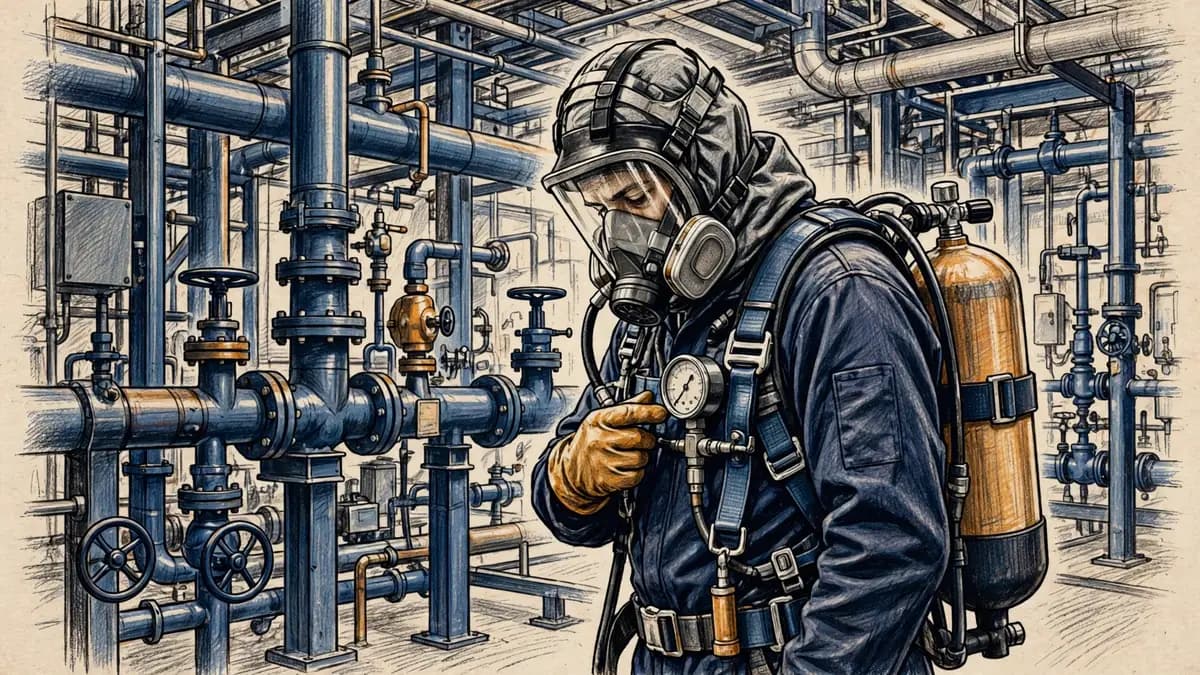
A self-contained breathing apparatus (SCBA) comes in three families. Open-circuit sets vent exhaled air. Closed-circuit rebreathers recycle it. Escape-only sets get the wearer out and nothing more. For entry into an atmosphere that is immediately dangerous to life or health (IDLH), the Occupational Safety and Health Administration (OSHA) allows only pressure-demand equipment. It is a full-facepiece, pressure-demand SCBA, certified by NIOSH (National Institute for Occupational Safety and Health) for at least 30 minutes. A combination supplied-air set with an auxiliary SCBA supply is the other accepted option.
Choosing the right type means matching the set to the job, the duration and the wearer. Using one means following a fixed sequence: inspect it, don it, check the seal, manage the air, and leave at the low-air alarm. What follows covers that sequence in full, with the standards that govern each choice.
The parts of an SCBA you will operate
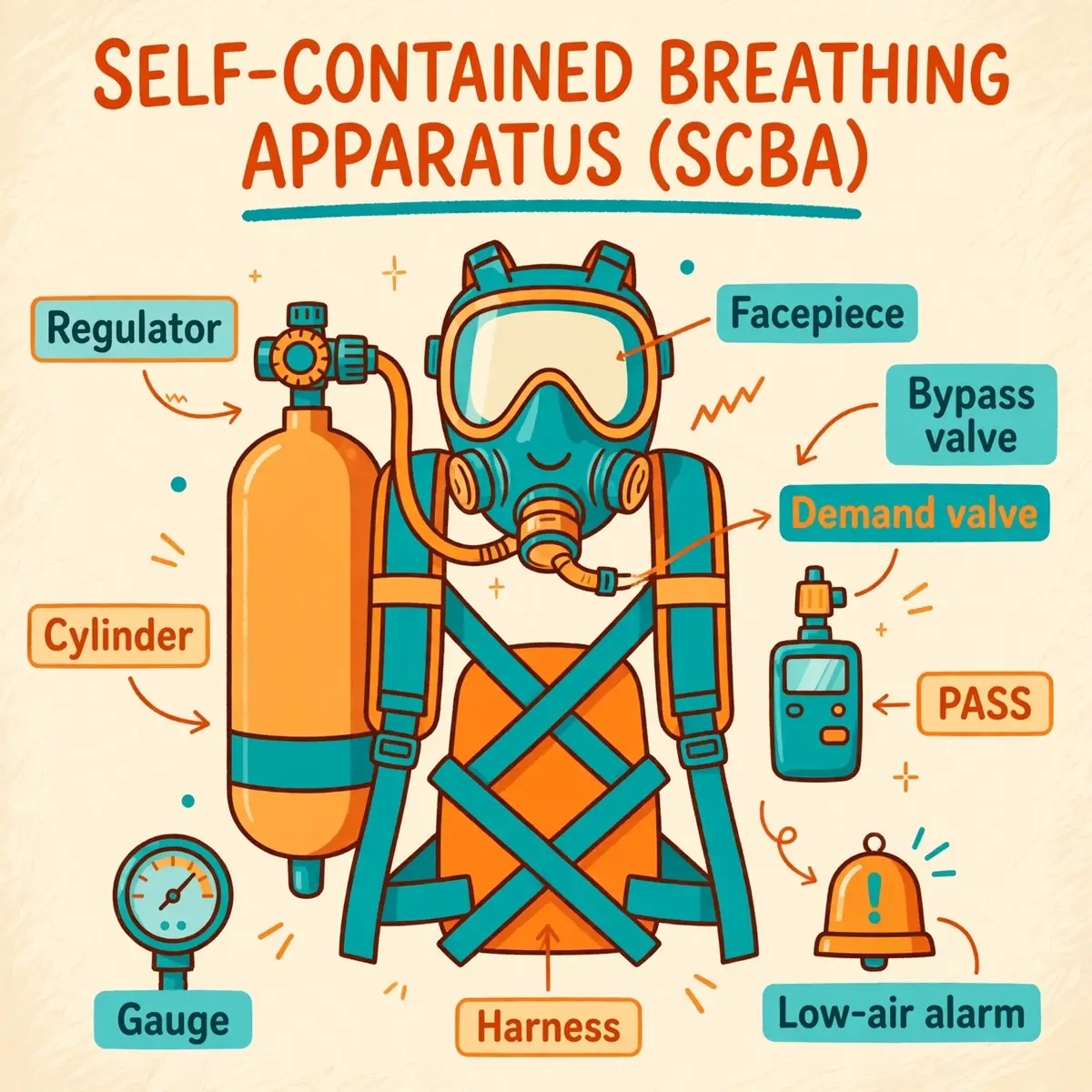
Every SCBA is a system, not a single device. The wearer operates six parts in every use: the cylinder, the regulators, the facepiece, the harness, the gauge and the alarms. Knowing what each one does makes the checks and the donning sequence make sense. Every step in the procedure tests one of them.
The air path: cylinder to facepiece
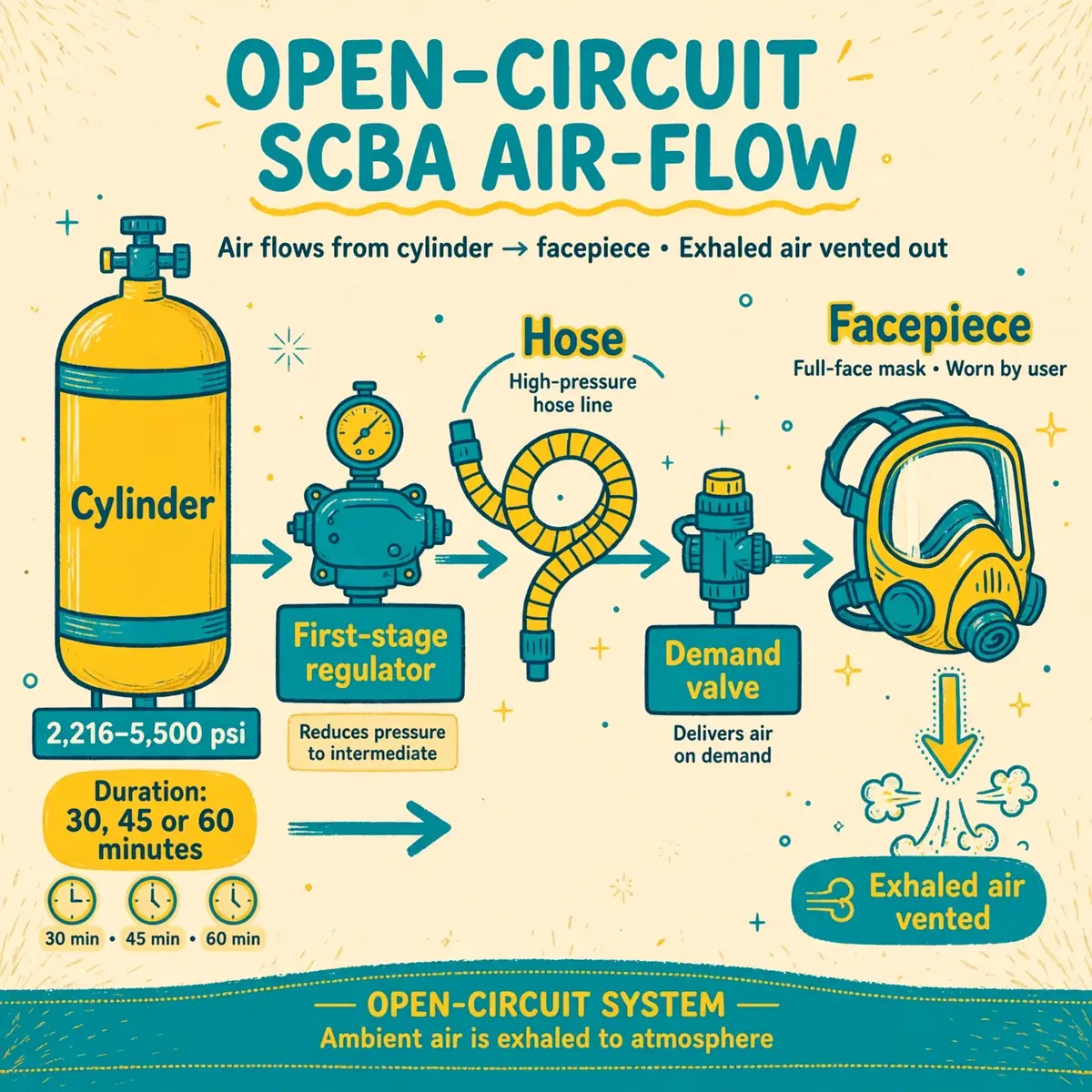
The cylinder holds breathing air at 2,216, 4,500 or 5,500 psi, depending on the set. A first-stage regulator on the cylinder valve drops that pressure to a few hundred psi. It sends the air down a hose. A second-stage regulator, called the demand valve, sits on the facepiece and delivers air as the wearer breathes.
The facepiece is a full-face mask with a shatterproof visor, a nose cup, an exhalation valve and a speech diaphragm. It seals against the face and protects the eyes as well as the lungs. The harness and backplate carry the weight on the hips and shoulders. The set weighs 20 to 35 pounds depending on the cylinder.
The alarms and safety devices
A pressure gauge on the chest strap shows how much air is left. A heads-up display inside the mask shows the same reading on fire-service sets. The low-air alarm sounds when the air runs low. NIOSH requires the warning at 25% of rated service pressure. The NFPA (National Fire Protection Association) 1970 end-of-service indicator sounds when about 35% of the cylinder volume remains.
Two more devices protect the wearer. The personal alert safety system, or PASS, sounds if the wearer stops moving, so a collapsed wearer can be found. The bypass valve on the demand valve gives a steady flow of air if the regulator fails. A buddy-breathing connection on fire-service sets lets a second wearer share air in an emergency.
TipFind the bypass valve by touch before you ever need it. In a dark, smoke-filled space you will not be able to see it. It is the one control that keeps air flowing when the regulator fails.
Open-circuit SCBA in depth
The open-circuit set is the type most wearers will use, and the type ships carry. It is simple, reliable and easy to service, which is why fire services and most industrial teams standardise on it. Understanding its two operating modes and its cylinder options is the core of choosing the right set.
How an open-circuit set works
An open-circuit SCBA stores breathing air under high pressure and uses it once. The wearer inhales air from the cylinder through the demand valve. The exhaled breath leaves through the exhalation valve into the atmosphere. Nothing is recycled, so the air the wearer breathes is always fresh from the cylinder.
That simplicity is also its limit. The set lasts only as long as the cylinder. It is rated at 30, 45 or 60 minutes at a standard breathing rate. Under hard work a 30-minute cylinder can last 15 to 20 minutes. The rated time is a planning figure, never a promise. The low-air alarm, not the clock, decides when to leave.
Pressure-demand and demand: why only one counts
NIOSH classifies open-circuit SCBA into two types in 42 CFR 84.70. A demand set delivers air only when inhalation creates negative pressure inside the facepiece. A pressure-demand set keeps the pressure inside the facepiece above the surrounding pressure during both inhalation and exhalation.
That difference decides safety. In a demand set, a small leak at the seal pulls contaminated air in with every breath. In a pressure-demand set, a leak pushes clean air out, so contaminated air cannot enter. OSHA therefore allows only pressure-demand SCBA in IDLH atmospheres, under 29 CFR 1910.134(d)(2). A demand set has no place in an IDLH entry.
WarningNever accept a demand SCBA for IDLH work, even if it looks identical to a pressure-demand set. Check the NIOSH approval label: it must say pressure-demand, and the set must be certified for at least 30 minutes.
Cylinder sizes, pressures and materials
Cylinders come in three rated durations: 30, 45 and 60 minutes. They also come in three working pressures: 2,216, 4,500 and 5,500 psi. A larger cylinder gives more air but adds weight. The weight is the main practical limit alongside heat and limited air. The choice is a trade between duration and the load the wearer must carry.
Three materials are in common use. Steel cylinders are tough and cheap but heavy. Aluminium cylinders are lighter and common in industrial sets. Carbon-fibre composite cylinders are the lightest at a given rating. They are the standard choice for fire services. They cost more and are retired after 15 years of service. All cylinders are hydrostatically tested every 5 years, and an out-of-date cylinder must not be filled.
| Cylinder | Working pressure | Rated time | Weight and service life |
|---|---|---|---|
| Steel | 2,216 psi | 30 minutes | Heaviest; long service life with testing |
| Aluminium | 2,216 or 4,500 psi | 30 or 45 minutes | Lighter than steel; tested every 5 years |
| Carbon-fibre composite | 4,500 or 5,500 psi | 30, 45 or 60 minutes | Lightest; tested every 5 years, retired at 15 years |
Closed-circuit SCBA (rebreathers) in depth
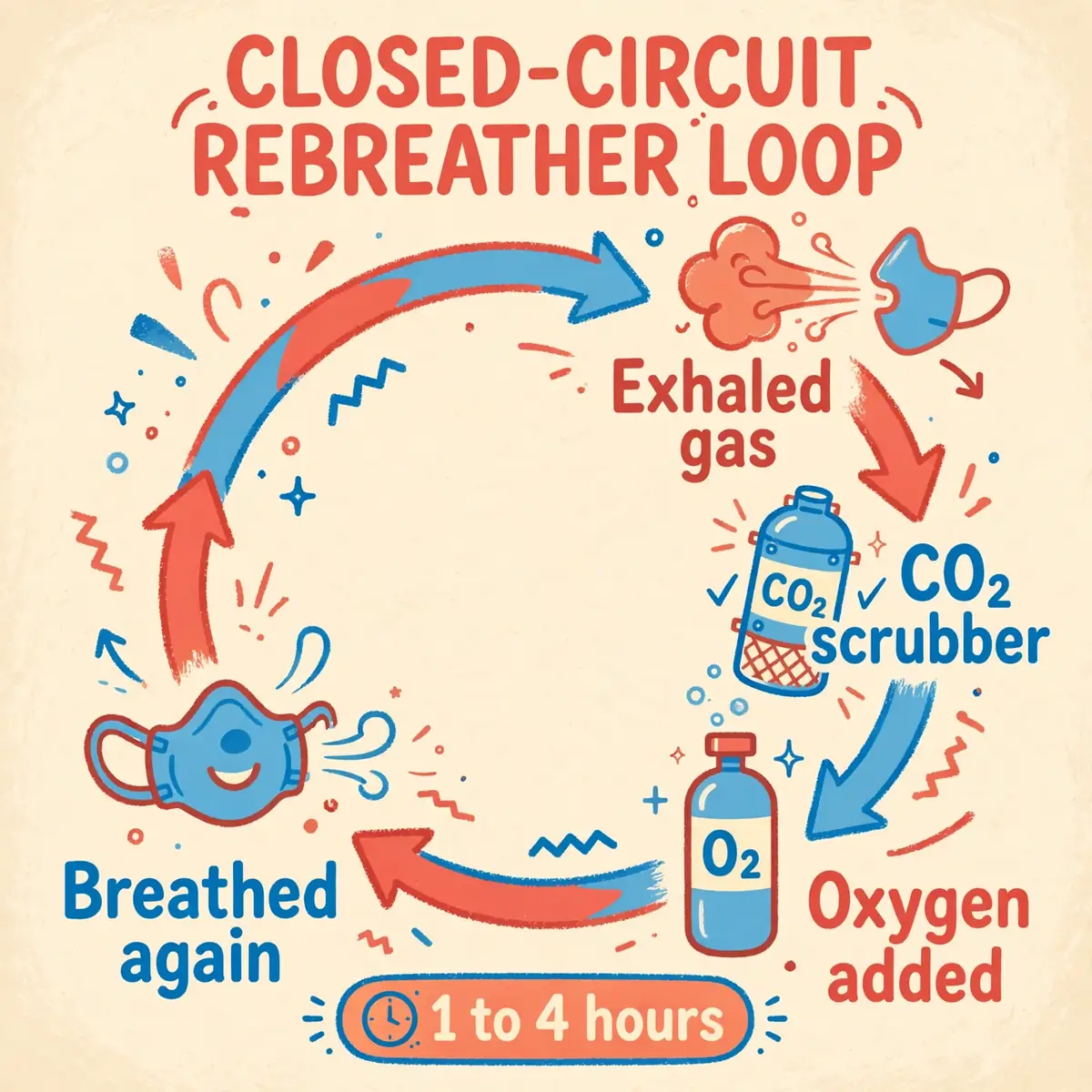
A closed-circuit set, also called a rebreather, does not vent exhaled air. It cleans the exhaled breath and uses it again. A small oxygen supply lasts far longer than a cylinder of compressed air. That long duration is the only reason to accept the extra weight, complexity and training a rebreather demands.
How a rebreather works
Exhaled gas passes through a carbon dioxide absorber, usually a chemical scrubber. It removes the carbon dioxide the wearer breathed out. Fresh oxygen is then added from a small supply, and the wearer breathes the mixture again. The loop repeats until the scrubber is exhausted or the oxygen runs out.
NIOSH lists three oxygen sources for closed-circuit sets in 42 CFR 84.70: compressed oxygen, chemical oxygen from a reaction that releases it, and liquid oxygen. The choice of source decides the set's weight, its preparation time and how it is serviced. All three do the same job: replace the oxygen the wearer consumed.
Duration, weight and limits
A rebreather's rated service life runs from 1 to 4 hours, far longer than any open-circuit cylinder. That is the decisive advantage for a rescue that cannot be finished in an hour. The wearer carries no large air cylinder, so the set is smaller than an open-circuit set of the same duration.
The trade-offs are real. A rebreather is heavier and more complex than an open-circuit set, and it demands more training and more careful maintenance. The scrubber can be exhausted without warning if it is not prepared correctly. The breathing gas warms as it is recycled. A wearer who has not trained on a rebreather must not use one in an emergency.
Where rebreathers are used
Mine rescue is the classic use. A rescue team may need hours underground, far beyond any open-circuit cylinder, and a rebreather gives them that time. Long tunnels and passages too narrow for a large open-circuit cylinder are the other main use. There, the set's small size matters as much as its duration.
NIOSH sets a floor for this work. A set rated under 1 hour is not approved for underground mine rescue and recovery, except as auxiliary equipment. A set rated under 30 minutes is not approved even as auxiliary equipment. For most workplaces, the open-circuit set is the right choice, and the rebreather stays with specialist teams.
Entry, escape and combination sets
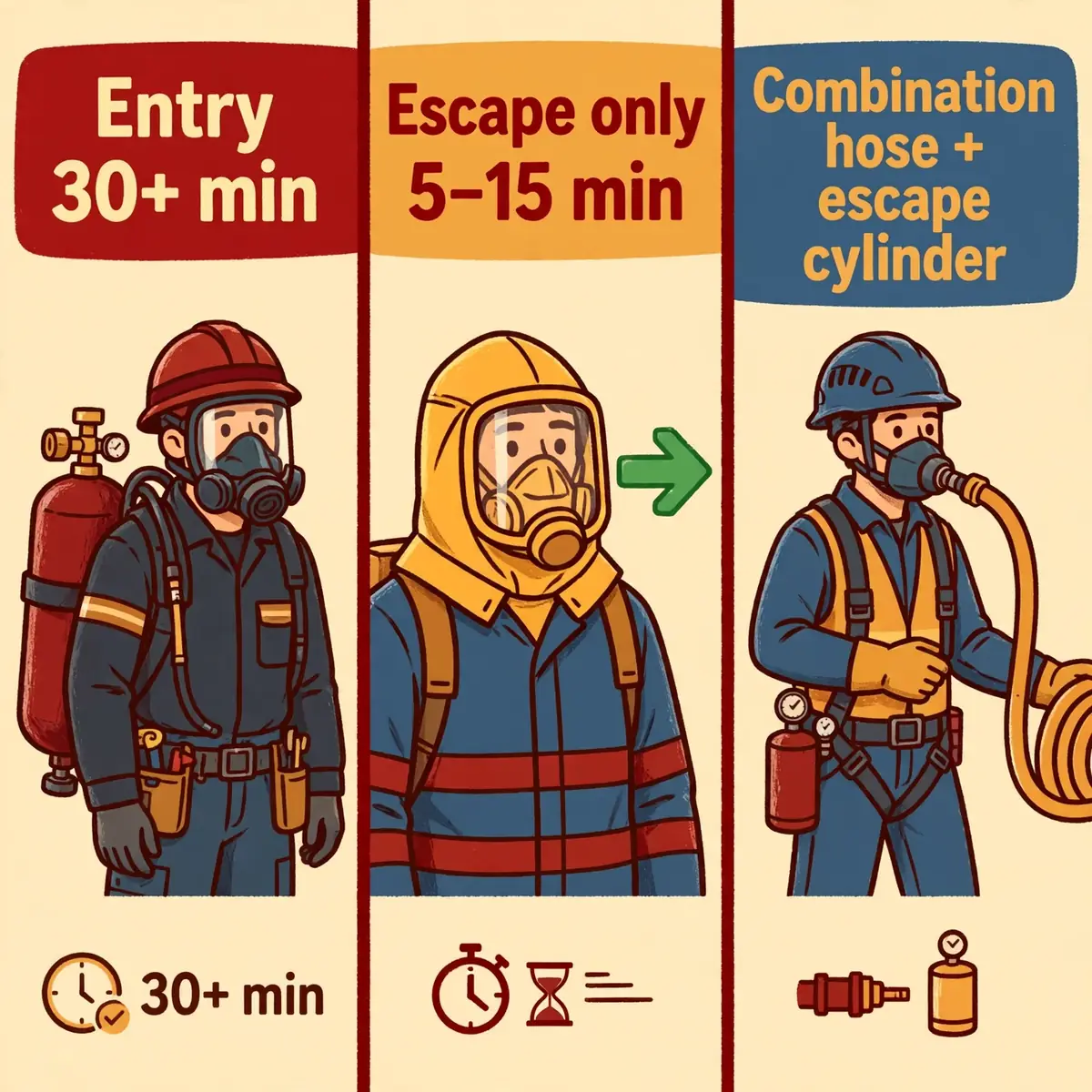
SCBA is also classified by what it is approved to do: enter a hazardous atmosphere, escape from one, or both. The classification is printed on the NIOSH approval label, and it matters more than the shape of the set. An escape set and an entry set can look similar and do opposite jobs.
Entry sets
An entry set is a full-facepiece, pressure-demand SCBA, NIOSH-certified for at least 30 minutes. That is the minimum OSHA allows for IDLH entry under 29 CFR 1910.134(d)(2). Fire-service entry sets add certification to NFPA 1970. That brings heat and flame resistance, a heads-up display, an integrated PASS device and a buddy-breathing connection.
Entry sets are the only SCBA used to go into an IDLH atmosphere for work or rescue. They are worn with a standby person outside, in contact with the entrant and ready to rescue. A retrieval line is used where the space allows. No other type may be substituted for them.
Escape-only SCBA and EEBD
An escape-only SCBA is a small set, usually a hood over the head, rated 5 to 15 minutes. It is NIOSH-certified for escape from the atmosphere in which it will be used, and for nothing else. It gives a worker time to leave after a sudden release, a leak or a spill.
The emergency escape breathing device, or EEBD, does the same job on ships, in refineries and in ammonia plants. It is usually rated 10 to 15 minutes. In the UK, escape sets fall under separate standards such as EN 402 and EN 1146. They do not fall under the entry-set standard BS EN 137:2006. An escape set is never an entry set, whatever the emergency.
AlertAn escape-only unit is approved for leaving a hazardous area and must never be used to enter or work in one. Reaching for an escape hood to attempt a rescue puts a second person in the same danger.
Combination supplied-air sets
A combination set pairs a supplied-air respirator with an auxiliary SCBA cylinder on the belt. The wearer breathes hose air during the work and switches to the cylinder only to escape if the hose fails. OSHA accepts this arrangement for IDLH entry as an alternative to a full SCBA.
NIOSH approves two versions for emergency entry. One carries a 3-, 5- or 10-minute SCBA and uses the air line during entry. The other carries a 15-minute or longer SCBA, with no more than 20% of its rated capacity used during entry. Both keep the wearer lighter than a full SCBA. Both give unlimited air on the hose, which suits long jobs such as tank cleaning and abrasive blasting.
Industrial and fire-service sets
Both kinds of set are NIOSH-approved and work the same way. A fire-service SCBA is additionally certified to NFPA 1970, the current home of the old NFPA 1981 requirements. That certification adds heat and flame resistance, a heads-up display, a universal emergency breathing connection, PASS integration and the end-of-service indicator, at higher cost and weight.
An industrial SCBA meets 1910.134 for IDLH entry, confined-space rescue and emergency response in plants, refineries and utilities without the fire-specific features. OSHA requires the NFPA-certified unit only for interior structural firefighting. Industrial fire brigades that fight fires beyond the incipient stage need it too.
How to choose the right type
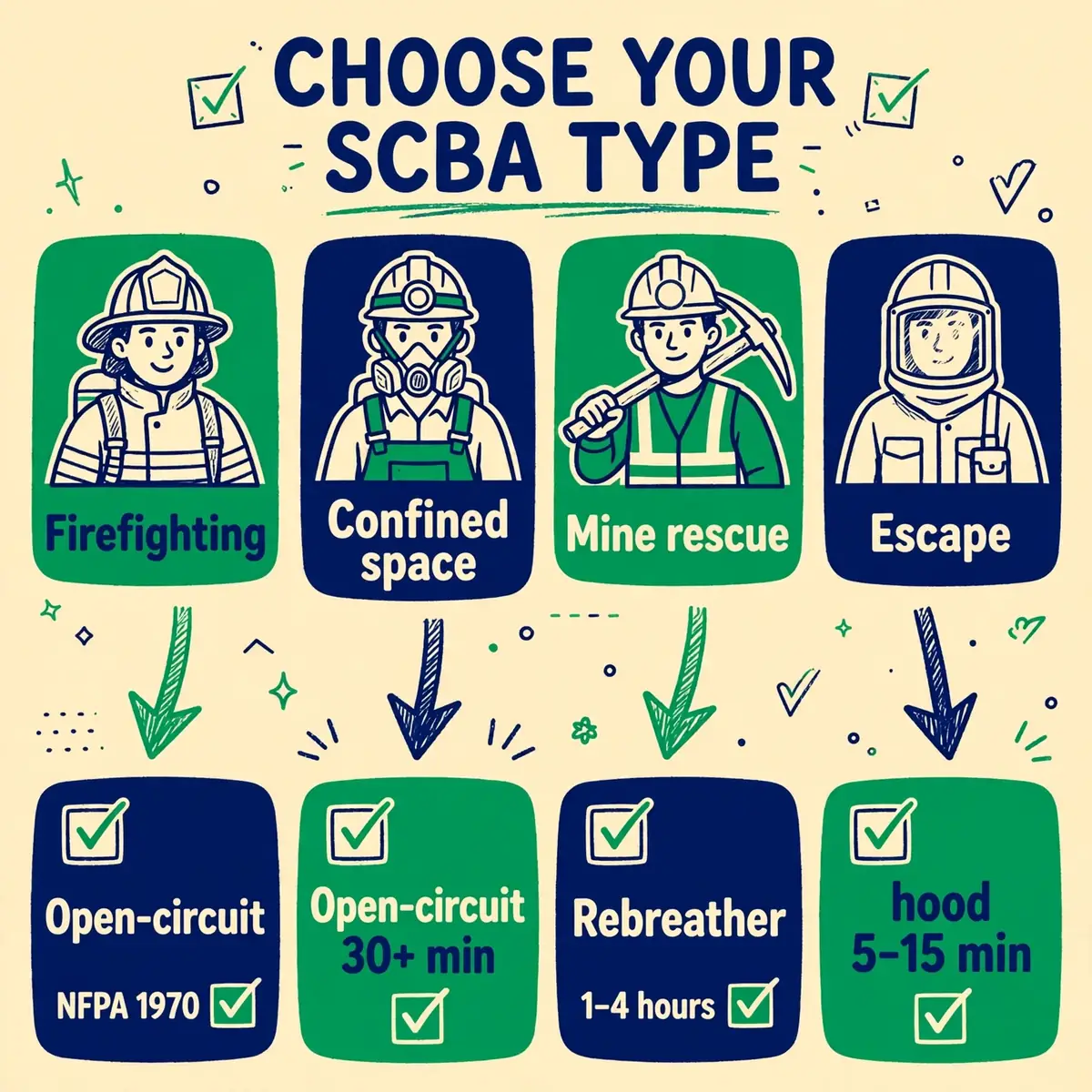
Choosing a set starts with the risk assessment, not with a catalogue. The atmosphere, the task, the duration and the wearer decide the specification. The certificate decides whether the set may be used at all. In the UK, HSE's HSG53 guide sets out selection, use, fit testing and maintenance for respiratory protective equipment. For the triggers that make SCBA necessary, see when SCBA is required.
| Job | Type to choose | Why |
|---|---|---|
| Interior structural firefighting | Open-circuit pressure-demand, NFPA 1970 | Heat, flame and smoke; needs HUD, PASS and buddy connection |
| Confined-space entry or rescue | Open-circuit pressure-demand, 30 minutes or more | Unknown atmosphere; needs standby person and retrieval line |
| Hazardous-materials response | Open-circuit pressure-demand, chemical, biological, radiological and nuclear (CBRN) option | Unknown chemicals; needs full facepiece and positive pressure |
| Mine rescue, long tunnels | Closed-circuit rebreather, 1 to 4 hours | Duration beyond any cylinder; small size in narrow passages |
| Shipboard firefighting, enclosed spaces | Open-circuit pressure-demand | Ships carry open-circuit sets; needs spare cylinders on board |
| Long industrial jobs, tank cleaning, blasting | Combination SAR with escape cylinder | Unlimited air on the hose; cylinder only for escape |
| Escape from a sudden release | Escape-only SCBA or EEBD, 5 to 15 minutes | Leaving only; never for entry or work |
Five factors decide between the sets that pass the table. Duration must cover the job plus the exit, with a margin for the unexpected. Weight must suit the wearer's medical clearance, since a set weighs 20 to 35 pounds. Fit must be proven by a fit test on the exact make, model and size. Standards must match the job: NIOSH certification always, NFPA 1970 for firefighting, BS EN 137:2006 in the UK. Support must be planned: spare cylinders, a fill station with Grade D air, a standby person and a retrieval line.
A chemical hazard that is unknown or unmeasured is treated as IDLH until monitoring proves otherwise. That rule alone often decides the type. When the atmosphere cannot be characterised in advance, only a pressure-demand SCBA with its own air supply is acceptable.
Before you use one: pre-use checks, step by step
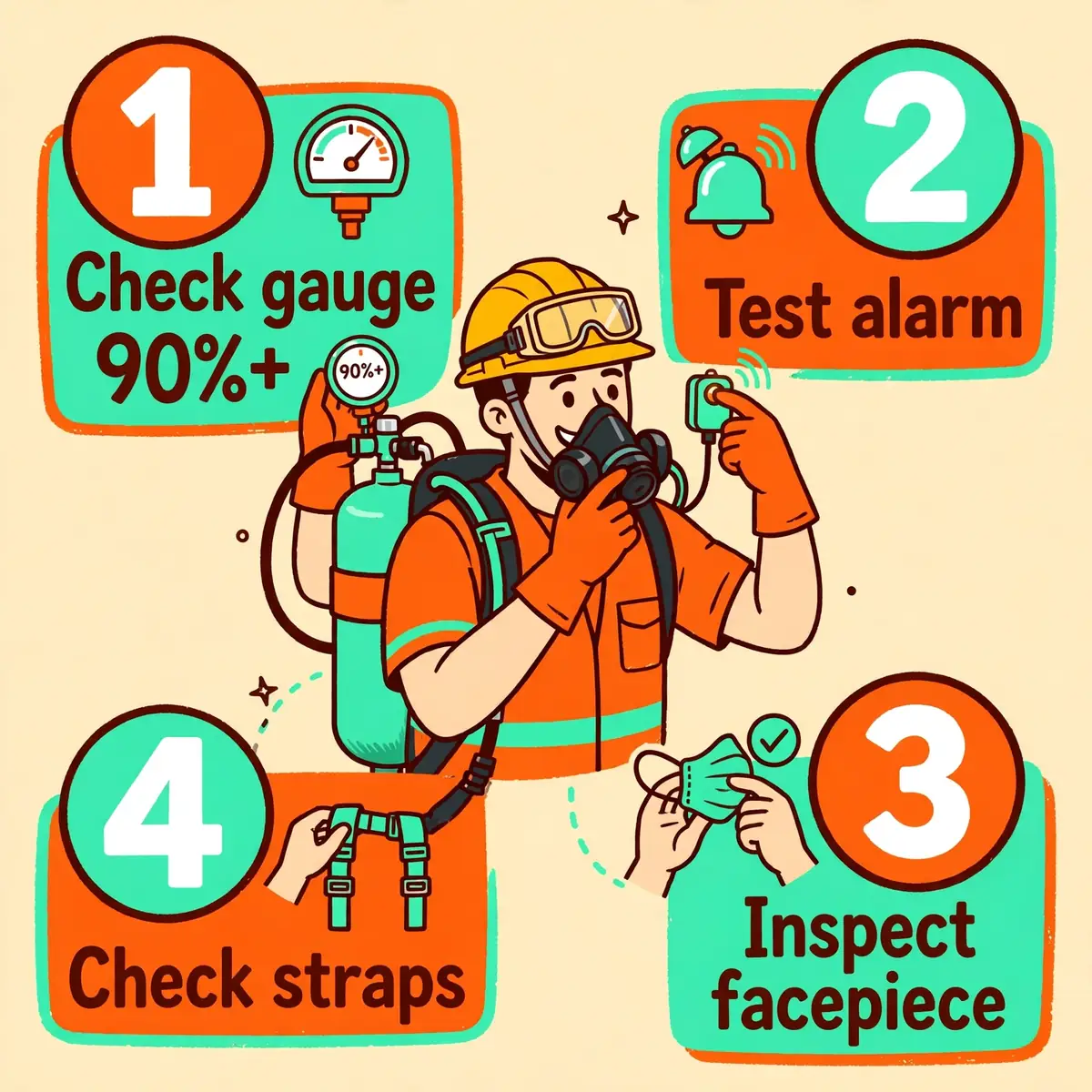
Every use starts with the same checks, and no entry starts without them. OSHA requires emergency-use respirators to be inspected before each use and at least monthly. Cylinders must be recharged when the pressure falls below 90% of full. Work through the checks in order and record the result on the unit.
- Inspect the whole set visually: cylinder, hoses, regulator, facepiece, straps and backplate, looking for damage, wear, burns or cracks.
- Check the cylinder pressure on the gauge. It must be at least 90% of full; a set that starts at 90% has already lost a tenth of its working time.
- Compare the cylinder gauge with the remote gauge on the chest strap. The two readings should agree.
- Inspect the facepiece: visor clear and undamaged, seal supple with no cracks, straps and buckles sound, exhalation valve clean.
- Open the cylinder valve slowly and fully. Listen for the PASS alarm and the low-air alarm as the set pressurises.
- Close the cylinder valve and watch the gauge for a minute. The pressure should hold steady; a falling needle means a leak.
- Bleed the air through the bypass valve and confirm the low-air alarm sounds as the pressure falls.
- Open the cylinder valve again, connect the facepiece, don it and take one or two normal breaths to confirm airflow.
- Press the centre of the demand valve cover to check the supplementary air supply, then close the bypass.
- Confirm the PASS device is armed and the heads-up display, if fitted, shows the cylinder pressure.
Any fault found at this stage means the set stays out of service until a competent person repairs it. A cracked visor, a leaking hose, a silent alarm or a cylinder below 90% are all reasons to take a different set. The checks take a few minutes; a failed set inside an IDLH atmosphere takes far longer to deal with.
WarningNever enter an IDLH atmosphere with a set that has not been inspected and checked that day, and never enter alone. A standby person outside, trained and equipped to rescue, is part of the equipment, not an extra.
How to put on an SCBA, step by step
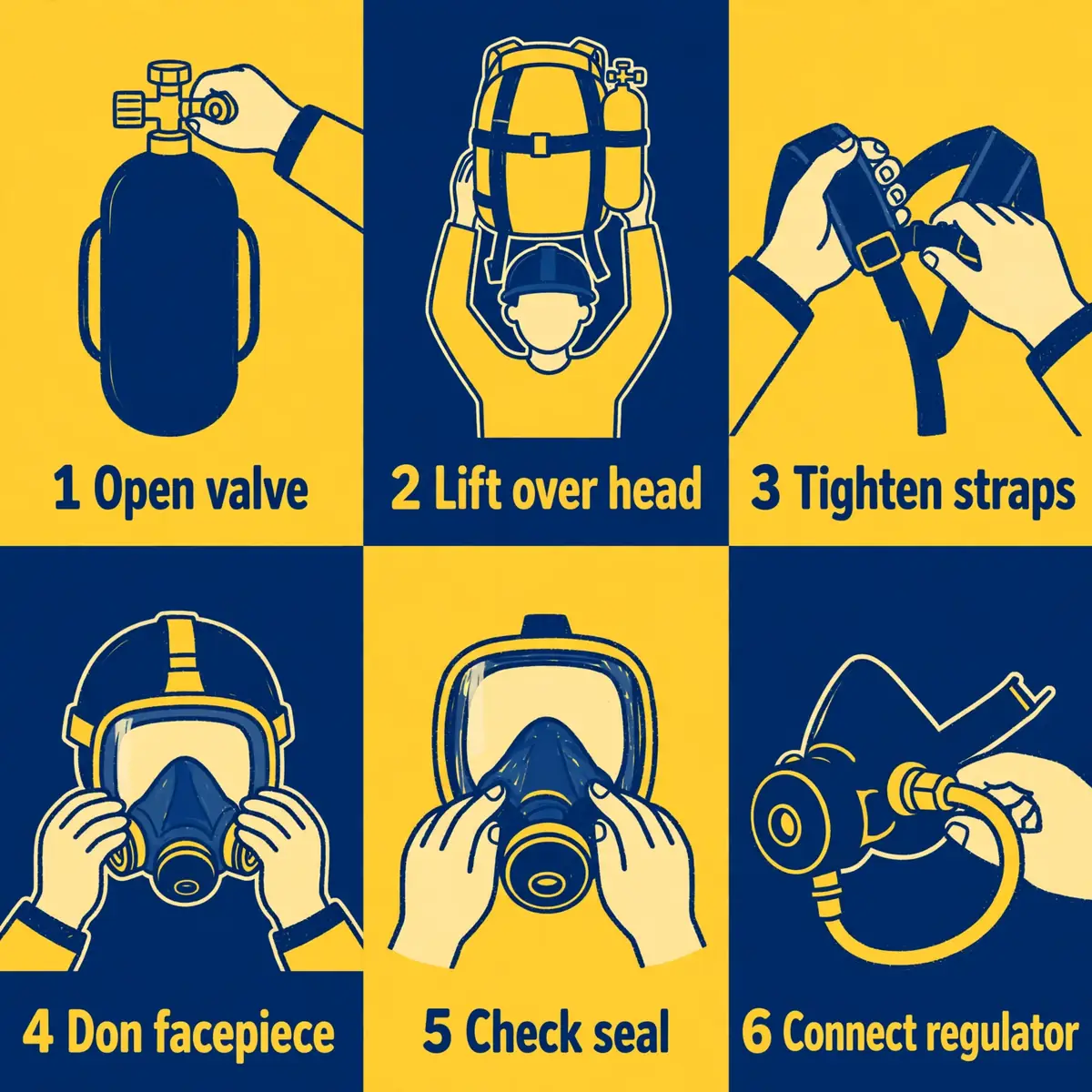
Donning is a fixed sequence, and it must be practised until it is automatic. Training has to include hands-on donning, seal checks and inspection, watched by someone competent. A video or a classroom talk is not enough. Two methods are in common use, and both end the same way: straps tight, facepiece sealed, air flowing.
Over-the-head method
The over-the-head method is the standard way to don a set on the ground, and the fastest to learn. Lay the set out first, then work through the steps in order.
- Place the SCBA directly in front of you, cylinder valve away from you, and lay the shoulder straps out to the sides.
- Fully open the main cylinder valve and listen for the PASS alarm and the low-air alarm.
- Bend down, grasp the backplate with both hands and lift the set over your head, rotating it 180 degrees.
- Slide the set down your back while sliding your arms into the shoulder straps.
- Tighten the shoulder straps, then fasten and tighten the waist belt so the weight sits on the hips.
- Don the facepiece and hood, making sure no skin is exposed, and check the seal as described below.
- Connect the regulator to the facepiece, breathe normally to confirm airflow, and check the gauge.
Coat method
The coat method suits tight spaces where there is no room to lift a set overhead. Examples are a ship's companionway or a narrow plant aisle. It swings the set onto the back the way a coat is put on. It keeps the set low and controlled throughout.
Hold the set by one shoulder strap and slide that arm through the strap. Swing the set around your back, letting the cylinder rest against the backplate. Then slide the other arm into its strap. Tighten the shoulder straps and the waist belt. Then don the facepiece and connect the regulator exactly as in the over-the-head method. Practise both methods, because the space at the entry point decides which one you can use.
Donning the facepiece and checking the seal
Loosen all facepiece straps fully and hold your breath. Place your chin into the mask and pull the head harness over your head. Make sure the nose cup sits correctly on the nose. Then tighten the straps in sequence: the upper pair first, then the middle pair, and finally the lower pair. Do not over-tighten, because that causes discomfort and can distort the seal.
Perform a user seal check every time you don the set. Cover the regulator inlet, inhale gently and hold for a few seconds: the facepiece should pull slightly inward and hold. Then exhale gently: the facepiece should push slightly outward with no air leaking at the edges. Facial hair breaks the seal. OSHA prohibits a tight-fitting facepiece where hair comes between the sealing surface and the face. A beard or stubble across the seal line means the wearer cannot use the set.
Using an SCBA inside the hazard
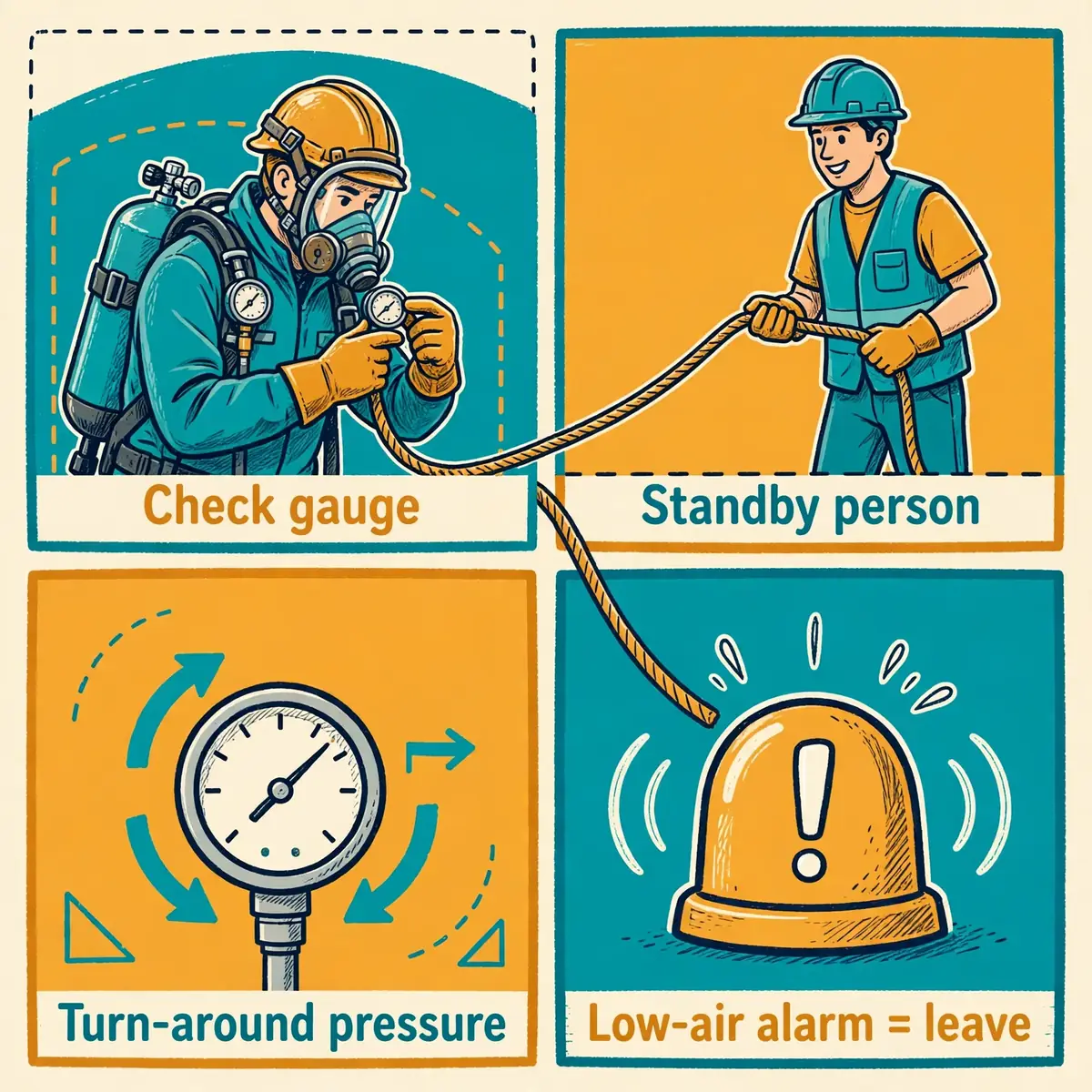
Once inside, the work is air management. The set gives a fixed amount of air. Every decision inside is about spending it on the job and keeping enough to get out. Calm, steady breathing uses far less air than fast, shallow breathing under stress. Pace and discipline matter as much as the cylinder size.
Managing the air
Good air management starts before entry: check the gauge, write the reading down, and agree the turn-around pressure with the standby person. Inside, check the gauge regularly and report the reading to the standby person at agreed intervals. Someone outside then always knows how much air is left.
- Know how much air the job needs, including the exit, and keep a margin for the unexpected.
- Work in pairs and stay in voice, visual or signal contact with the standby person at all times.
- Treat the low-air alarm as an order to leave, not a reminder to hurry. It sounds with roughly a third of the air left.
- Slow down when the work allows it. Heavy work and nervousness raise the breathing rate and drain the air faster.
- Never remove the set until you are in fresh air, even if the job looks finished.
TipAgree the turn-around pressure with the standby person before entry, and write it on the entry board. A number agreed in advance is easier to obey than a judgement made under stress.
Working with the standby person
OSHA requires at least one employee outside the IDLH atmosphere, in contact with the entrant and trained and equipped to rescue. For interior structural firefighting, the rule is two in and two out. At least two firefighters enter together. At least two stay outside, in contact with the team inside and ready to rescue them.
The standby person keeps the retrieval line. They watch the entrant's air readings and time inside, and hold a spare set ready. The employer must be notified before the standby enters to rescue. The standby's own SCBA must be checked and ready before the entry starts. That standby rule exists because rescuers die in the same atmosphere that trapped the first victim.
If something goes wrong
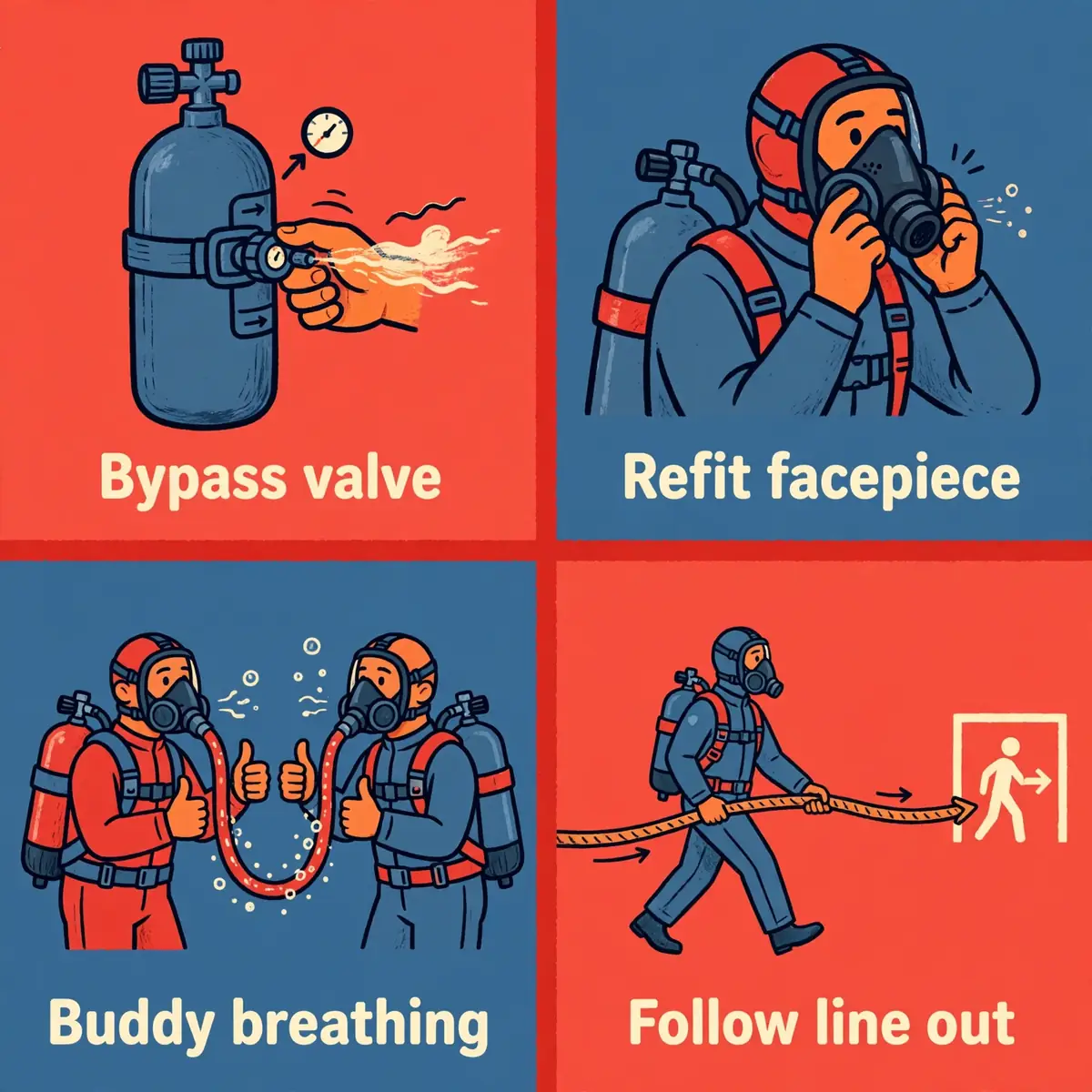
Every failure inside an IDLH atmosphere has the same first answer: leave now. Do not try to repair the set inside the atmosphere, and do not wait to see whether the alarm stops. Tell the standby person, follow the retrieval line or the planned exit route, and follow the site's practice emergency procedures for an IDLH alarm.
Low-air alarm
The alarm sounds when about a third of the air is left. It is the signal to leave, not a suggestion. Stop the task, tell the standby person, and walk out by the planned route at a steady pace. Running raises the breathing rate and burns the remaining air faster.
Under the NFPA 1970 2025 edition, the end-of-service indicator sounds at 34% of rated service pressure on a 2,216 psi set. It sounds at 31% on a 4,500 psi set and 29% on a 5,500 psi set. That leaves about 35% of the cylinder's air volume. Older sets sound at 25% of rated service pressure under the NIOSH approval rules. Know which set you are wearing and what its alarm means.
Regulator or hose failure
If the demand valve stops delivering air, open the bypass valve. It gives a steady flow of air that keeps the wearer breathing while they leave. It uses the remaining air faster. Do not try to fix the regulator inside the atmosphere. Do not turn the bypass off again until you are in fresh air.
A torn or cut hose means the same thing: bypass on, leave at once, tell the standby person. The bypass is a way out, not a way to carry on working. If the air stops completely and the bypass does not help, hold your breath. Move toward the exit and the standby person. Use the buddy-breathing connection if a team member can reach you.
Facepiece dislodged or seal lost
If the facepiece comes off in a toxic atmosphere, hold your breath and refit it immediately. Do not inhale while the mask is dislodged, even for a second. A small amount of toxic air can disable a person fast. Once refitted, clear the mask by breathing out sharply, then breathe normally.
The positive pressure inside the mask buys a short margin when the seal fails. Air flows outward through the leak. That margin is measured in seconds, not minutes. A lost seal is a reason to leave. The standby person should be told at once so the exit can be covered.
Entanglement or disorientation
If a hose or strap snags, stop moving. Pulling harder tightens the snag and wastes air. Work the snag free by hand and call the standby person. Follow the hose or the retrieval line back toward the exit if you have lost your bearings.
In smoke or darkness, disorientation is common, and it is why the standby person and the retrieval line exist. Stay calm, keep breathing slowly, and follow the line. The PASS device will sound if you stop moving. That helps the standby team find you. Do not switch it off to stay quiet.
Buddy rescue
Fire-service sets carry a universal emergency breathing connection that lets a second wearer share air with a casualty. The standby team enters with a checked set. They connect the casualty to the donor's air and walk them out on the retrieval line. The donor's air is shared, so both wearers leave at once and neither stays behind.
A casualty who has inhaled a toxic gas needs first aid as soon as they reach fresh air. Keep a first aid kit at the entry point, ready for a casualty, and call for medical help. The exit plan, the standby person and the spare air are what turn a failure into a story instead of a casualty.
Taking it off and putting it away
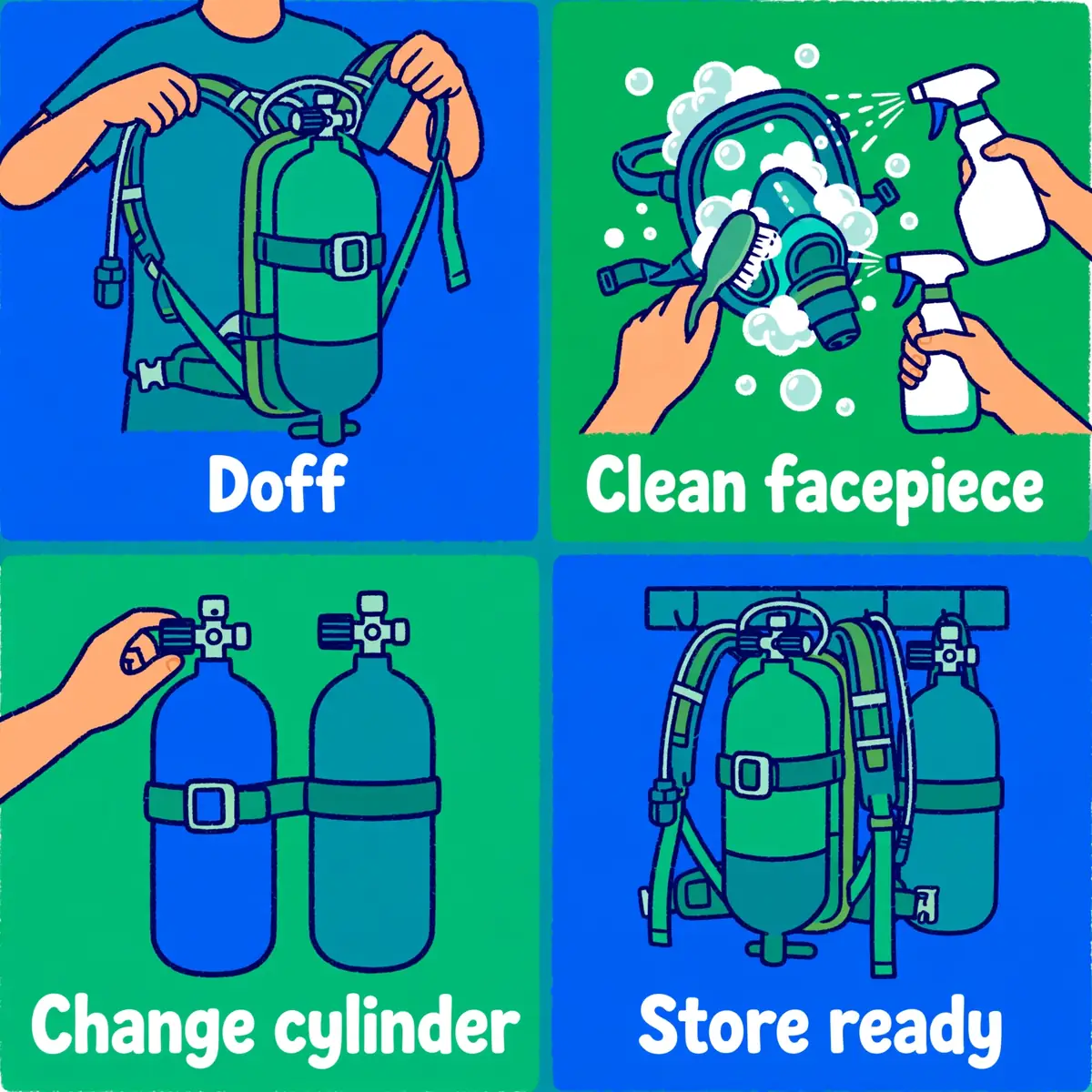
Doffing has a fixed order too. It matters because the facepiece, the cylinder and the set itself must all be ready for the next use. A set thrown into a locker after a job is not ready, however good its last inspection was. The work is not finished until the set is clean, full and stored correctly.
Doffing, step by step
Work through the steps in order, in fresh air. Keep the facepiece somewhere safe where the lens cannot be scratched and the seal cannot be damaged.
- Press the air-saver switch and disconnect the regulator from the facepiece.
- Remove the helmet and hood, then loosen the facepiece straps and take the facepiece off.
- Loosen the waist belt and the shoulder straps, remove the set and place it on the ground.
- Turn off the main cylinder valve and purge the remaining air from the regulator using the bypass valve.
- Turn off the PASS device last, so it is not left sounding on the floor.
- Refill or replace the cylinder so the set is ready again before it is stored.
Cleaning and disinfection
Clean and disinfect the facepiece after each use. Wash it with a mild disinfectant, rinse under running water and dry it fully before storage. Inspect the straps and rubber parts for deterioration while you do it. A facepiece shared between wearers must be disinfected between individuals, because it sits against the skin and the breath.
The NFPA 1970 2025 edition now requires cleaning and disinfecting instructions in the SCBA user instructions. They cover when preliminary exposure reduction applies, which detergents are acceptable, and how to dry the set. Follow the manufacturer's instructions for the set you own: the wrong solvent can damage the visor or the seal.
Changing a cylinder
A cylinder change is a routine job, and it follows the same care as the pre-use checks. Work on a flat surface, with the set depressurised, and never force a fitting that does not turn freely.
- Close the cylinder valve fully, then open the bypass valve to bleed the pressure from the lines.
- Unscrew the handwheel connecting the reducer valve to the cylinder, turning it until it is free.
- Release the cylinder strap and lift the empty cylinder out of the cradle.
- Check the full cylinder: test date in date, no damage, valve cap in place, pressure at full.
- Line the full cylinder up with the reducer valve and turn the handwheel until it is hand-tight. Do not use tools.
- Hook the cylinder strap over the cylinder and pull the operating lever down until it clips in place.
- Open the cylinder valve slowly, check the gauge, and run the pre-use alarm and leak checks again.
Storage and inspection rhythm
Store the set where it is protected from damage, sunlight and contamination, ready for immediate use. Cylinders are filled with breathing air that meets at least Grade D, the standard in ANSI/CGA G-7.1. It requires oxygen 19.5% to 23.5%, carbon monoxide 10 ppm or less, carbon dioxide 1,000 ppm or less, hydrocarbons 5 mg/m3 or less, and no noticeable odour.
Keep the inspection rhythm. Inspect the set before each use and at least monthly. Service it annually through a certified representative. Hydrostatically test the cylinders every 5 years, and retire composite cylinders at 15 years. The test date is stamped or labelled on the cylinder, and an out-of-date cylinder must not be filled. OSHA training for respirator users covers inspection, donning and emergency use, and the annual refresher keeps those skills current.
Frequently Asked Questions
What is the difference between open-circuit and closed-circuit SCBA?
An open-circuit set vents exhaled air to the atmosphere and runs 30, 45 or 60 minutes from a compressed-air cylinder. A closed-circuit set, or rebreather, removes carbon dioxide from exhaled air, adds oxygen and recycles it. It runs 1 to 4 hours. Open-circuit sets suit most entry work; rebreathers suit mine rescue and long-duration entry.
Can a demand SCBA be used in an IDLH atmosphere?
No. A demand set delivers air only when inhalation creates negative pressure inside the facepiece. A leak can then draw contaminated air in. OSHA allows only pressure-demand SCBA in IDLH atmospheres, where the facepiece stays above surrounding pressure at all times. Check the NIOSH approval label before any IDLH entry.
How do I change an SCBA cylinder?
Close the cylinder valve and bleed the lines through the bypass valve. Unscrew the handwheel, release the cylinder strap and lift the empty cylinder out. Check the full cylinder's test date and pressure, then fit it. Turn the handwheel until hand-tight and clip the strap. Open the valve slowly and run the pre-use alarm and leak checks again.
What is the coat method for donning an SCBA?
The coat method swings the set onto the back the way a coat is put on. Slide one arm through a shoulder strap, swing the set around the back, and slide the other arm in. Then tighten the straps and the waist belt. It suits tight spaces where there is no room to lift a set overhead. Examples are a ship's companionway or a narrow plant aisle.
How much air should I keep in reserve?
Keep enough to leave. The low-air alarm sounds with roughly a third of the air left. That is the signal to leave, not a reminder to hurry. Agree a turn-around pressure with the standby person before entry. Plan the job so the alarm never sounds while you are still working.
Do I need a different SCBA for firefighting than for industrial work?
Both are NIOSH-approved pressure-demand sets. A fire-service set is additionally certified to NFPA 1970. That adds heat and flame resistance, a heads-up display, PASS integration and a buddy-breathing connection. OSHA requires the NFPA-certified unit only for interior structural firefighting. Industrial IDLH entry, confined-space rescue and emergency response can use an industrial set.
Sources
- OSHA, 29 CFR 1910.134 — Respiratory protection (full text, Cornell Law Institute)
- NIOSH, 42 CFR 84.70 — Self-contained breathing apparatus; description (Cornell Law Institute)
- HSE, "Respiratory protective equipment at work" (HSG53, fourth edition, 2013)
- 3M, "Standards Update: NFPA 1970, 2025 Edition (1981 and 1982 Chapters)"
- Sir Safety System, "EN 137 standard" (BS EN 137:2006)