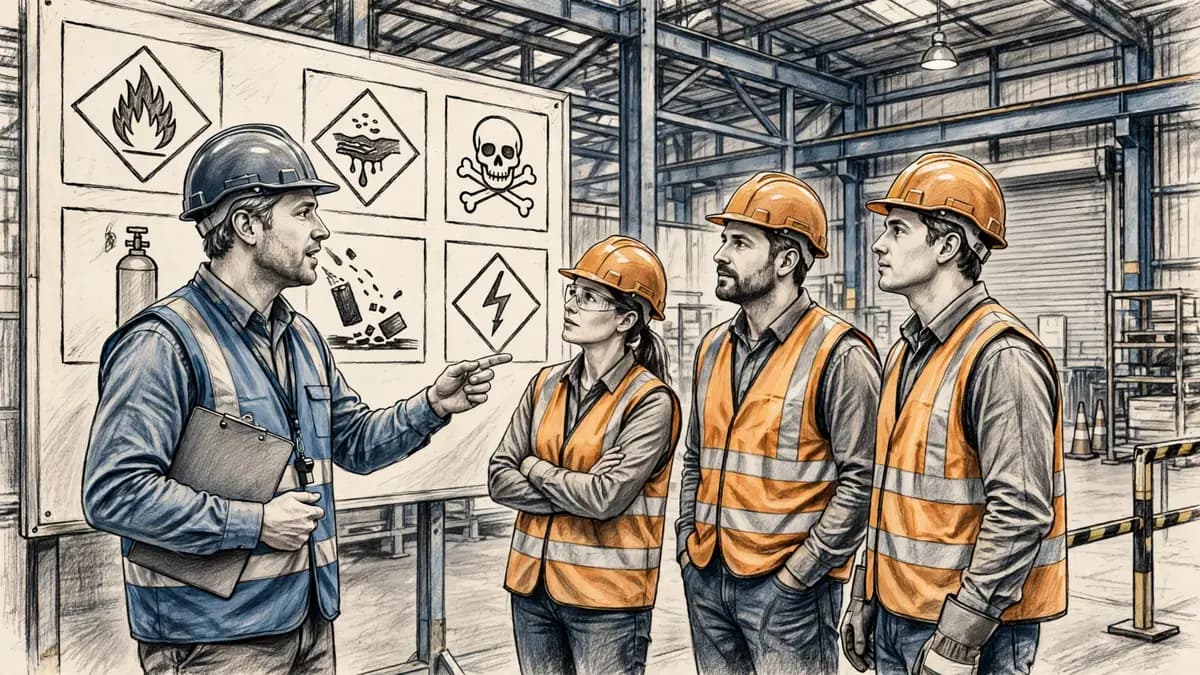
Fire extinguisher training teaches workers when to pick up an extinguisher, which one to use, and when to leave the fire alone. A good course mixes short classroom teaching with hands-on practice on a real or training extinguisher. In the United States, federal law requires training on first employment. It must then repeat at least once a year, for every worker expected to use an extinguisher. In the United Kingdom, the employer must provide adequate safety training and repeat it periodically where appropriate.
The training is not a certificate course in the usual sense. No federal agency issues a fire extinguisher licence, and the law sets no minimum course length. What matters is whether each worker can size up a small fire. Each one must be able to operate the extinguisher on their own site, and decide in seconds when to stop and get out. A course that delivers that is compliant. A course that only shows a video is not.
WHO Needs Fire Extinguisher Training
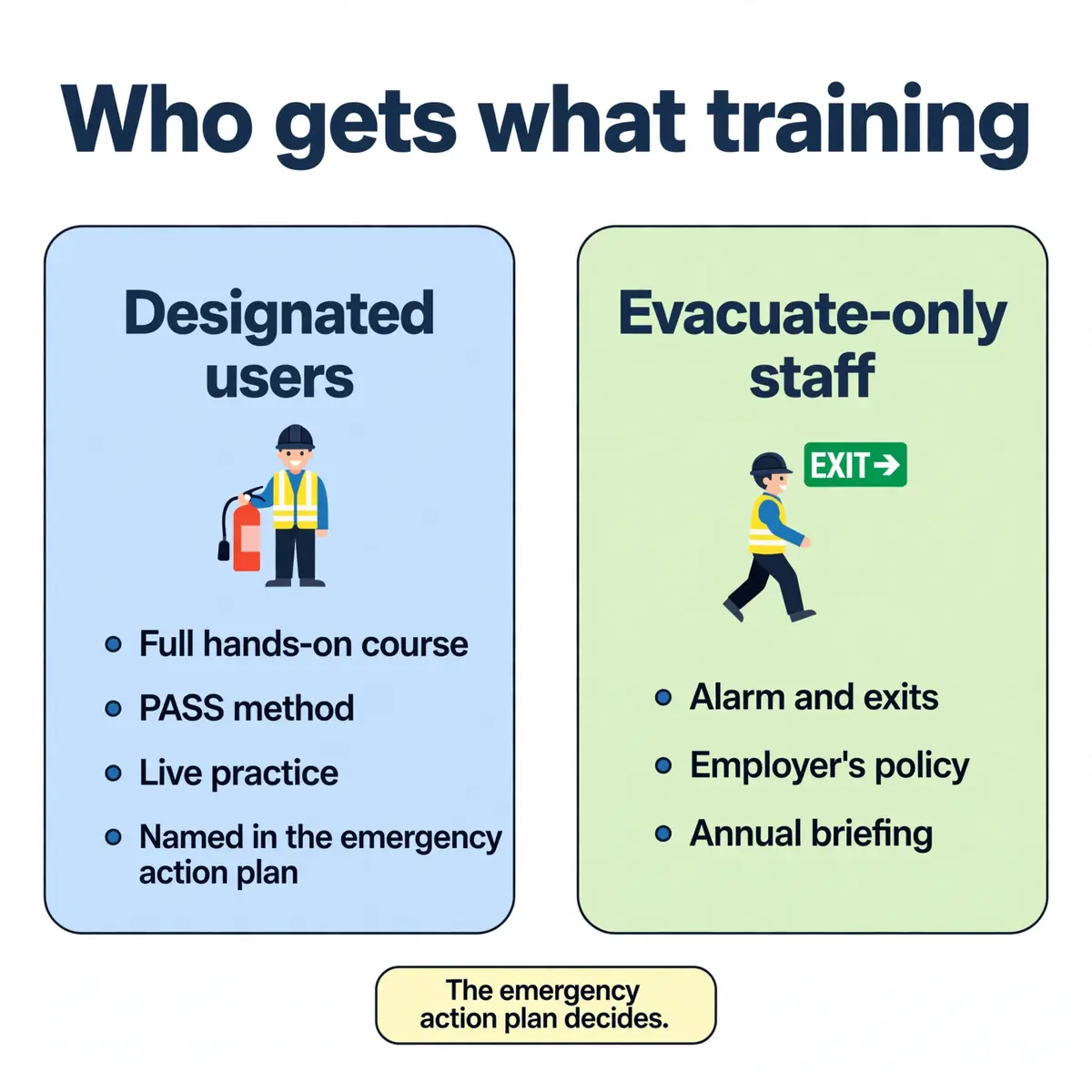
The short answer is that everyone on site needs some level of it, but not everyone needs the same level. The law in both countries draws a line between two groups. One group is expected to fight a small fire. The other group's only job is to get out. That line decides the training each person receives. Getting it wrong in either direction wastes money or leaves a gap.
Employees WHO Are Expected to Use an Extinguisher
These are the designated users. They are the people named in the emergency action plan as the ones who will pick up an extinguisher if a small fire starts. In a small workshop that may be two people. In a warehouse it may be a shift team. The employer chooses them, writes their names into the plan, and trains them properly.
Designated users get the full course. They learn the fire classes, the extinguishers on their own site, the PASS method, and the decision to fight or leave. They also practise with a real or training extinguisher, because reading about a pin and a handle is not the same as pulling one under pressure. Without that practice, the training does not hold up when it matters.
Employees WHO Only Evacuate
Most workers fall into this group. Their instruction is to raise the alarm and leave the building. They do not need the full hands-on course. Training them as if they did creates a worse problem. A worker who has practised on an extinguisher may decide to stay and fight a fire they should have left.
Evacuation-only staff still need annual instruction. They must know the employer's policy, where the exits and assembly points are, who to notify, and why the policy exists. They should also know where the extinguishers are, even though they are not expected to use them. That instruction is part of the wider safety training every employer must provide, and it should be refreshed on the same annual cycle. A worker who understands that an uncontrolled fire grows fast is more likely to follow an evacuate-first policy without second-guessing it.
WarningNever train evacuation-only staff on live fire and then tell them not to use an extinguisher. Mixed messages cause hesitation, and hesitation in a fire is dangerous.
New Starters, Job Changers and Contractors
New employees need training before they start work in the area, not at the next annual session. United States law is explicit: the education happens upon initial employment. A worker who joins in March and waits until the October refresher has spent seven months beside an extinguisher they cannot use.
The same rule applies when a worker changes role. A transfer to a different department, new responsibilities, or new equipment can change the fire risks that person faces. Retrain them before the move is complete, and cover the extinguishers in the new area by name. Contractors are a grey area. The safe approach is to walk them through the evacuation plan. Confirm they have had their own extinguisher training before they start work.
Training at home is a choice, not a duty. No law requires a homeowner to take a course. Even so, the same principles apply. Learn the classes. Practise PASS on a training unit. Decide in advance that a fire bigger than a wastebasket means leaving and calling the fire service.
What the Law Requires in the United States
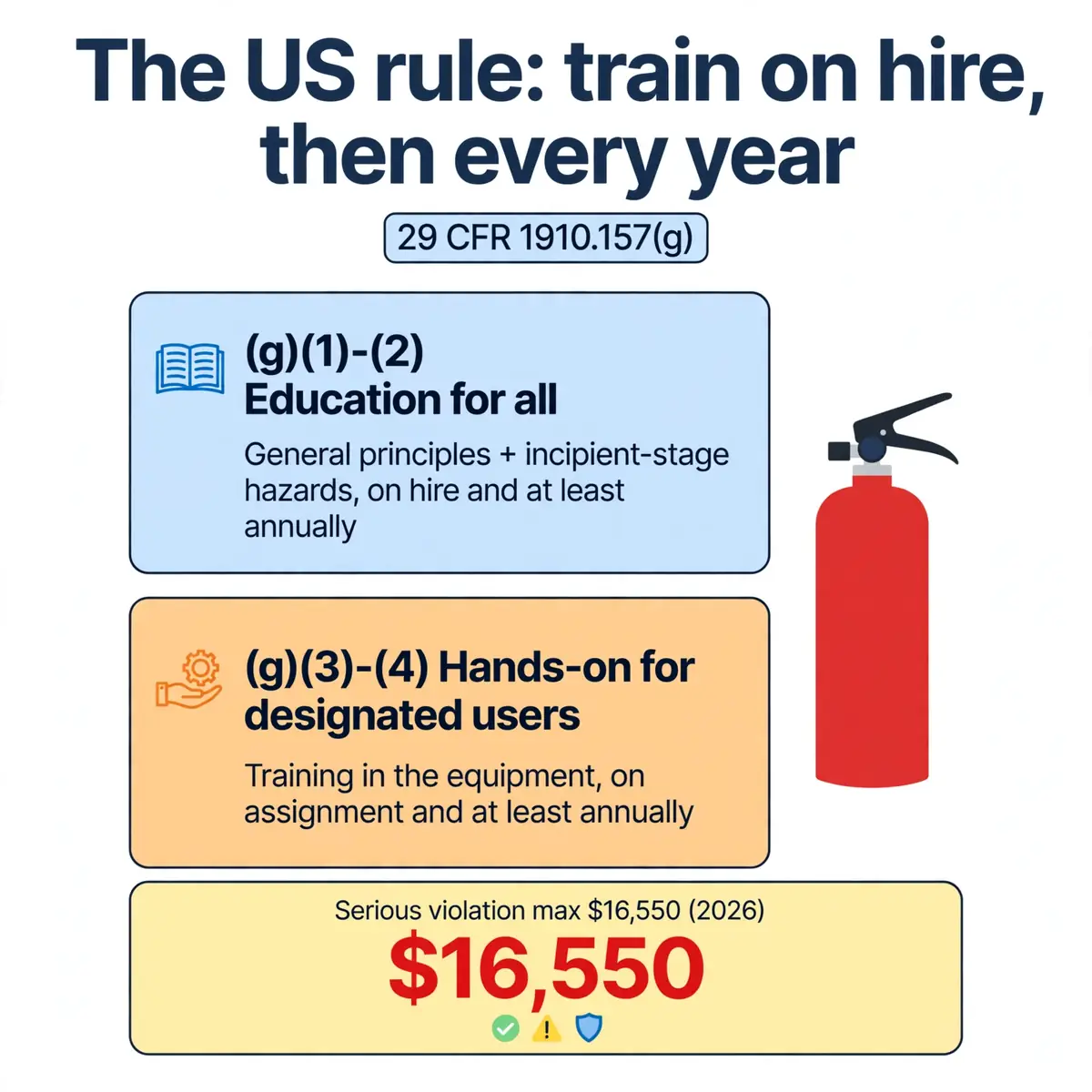
United States law on this topic is short and specific. One section of the federal safety rules, 29 CFR 1910.157, carries the whole duty for general industry. It does not set a course length, a syllabus, or a test. It sets a timing rule and a content rule, and it leaves the delivery to the employer. That freedom is useful, but it also means a thin course can look compliant until an inspector asks what it actually taught.
The OSHA Rule in One Paragraph
Section 1910.157(g) splits the duty into two parts. Paragraph (g)(1) requires an educational program that familiarises employees with the general principles of fire extinguisher use and the hazards of incipient-stage firefighting. Paragraph (g)(2) sets the timing: that education must be provided upon initial employment and at least annually thereafter. Those two sentences are the core of the law.
Paragraphs (g)(3) and (g)(4) add the second part. Employees designated to use firefighting equipment as part of an emergency action plan must receive training in the use of the appropriate equipment. That training happens upon initial assignment to the designated group and at least annually thereafter. In practice, (g)(1) and (g)(2) cover every employee, while (g)(3) and (g)(4) add hands-on training for the designated few.
AlertAnnual means within 12 months of the last session, not sometime in the same calendar year. Training that slips to 14 months is out of compliance.
The Emergency Action Plan Decides WHO Gets What
The emergency action plan is the document that makes the training duty concrete. Under 29 CFR 1910.38, employers with more than 10 employees must have a written plan. Smaller employers may communicate it orally, but a written plan is still the safer choice. The plan names the people who will use extinguishers and the people who will evacuate.
That naming matters because the standard also provides two exemptions. Where extinguishers are provided but are not intended for employee use, the duty is lighter. With an emergency action plan and a fire prevention plan in place, only the inspection and testing paragraphs of the standard apply. And where the plan designates only certain employees to use extinguishers while everyone else evacuates, the employer is exempt from the distribution requirements. Either way, the plan is the evidence. Without it, there is no way to show who was supposed to do what.
Construction and Fire Brigades
Construction work follows its own fire-protection provision, 29 CFR 1926.150. It requires portable firefighting equipment on site and training in its use, with the details shaped by the hazards of the job. A site with hot work, fuel storage, or temporary heating needs more than a warehouse with the same number of extinguishers.
Fire brigades are a different thing entirely. Under 29 CFR 1910.156, an organised team of employees who perform interior structural firefighting faces a much heavier standard. It requires medical evaluations, protective clothing, quarterly practice sessions, and annual training on the hazards in the facility. A couple of employees who agreed to knock down a small fire with an extinguisher before evacuating are not a fire brigade. They fall under 1910.157, not 1910.156.
State Plans and Local Fire Codes
Twenty-nine states and territories run their own OSHA-approved state plans, which must be at least as effective as the federal rules and may go further. California, Washington, Michigan, and Oregon all add their own documentation or program requirements around extinguisher training. In a state-plan state, the federal text alone is not enough. Check the state equivalent of 1910.157 before booking training.
Local fire codes add another layer. A fire marshal enforces rules about extinguisher placement and servicing, and some jurisdictions require a particular edition of the National Fire Protection Association (NFPA) standard NFPA 10, Standard for Portable Fire Extinguishers. The 2026 edition is the latest published, but many jurisdictions still enforce the 2022 edition. The enforceable edition is the one the local authority has adopted, so the training should match the extinguishers actually on the wall.
What a Breach Can Cost
A failure to train under 1910.157(g) is usually cited as a serious violation. For 2026, the maximum penalty for a serious violation is $16,550 per violation, and willful or repeated violations can reach $165,514. OSHA published no inflation adjustment for 2026, so the 2025 amounts remain in effect. Small employers with no prior citations and a genuine attempt at compliance usually see far lower penalties, but the figure is not the real cost.
The real cost follows an actual fire: injuries, property damage, workers' compensation claims, and liability. Training that was never delivered is hard to defend after the event, and a missing sign-in sheet makes it harder still. A short annual session costs far less than a single citation, and far less than a single injury.
What the Law Requires in the United Kingdom
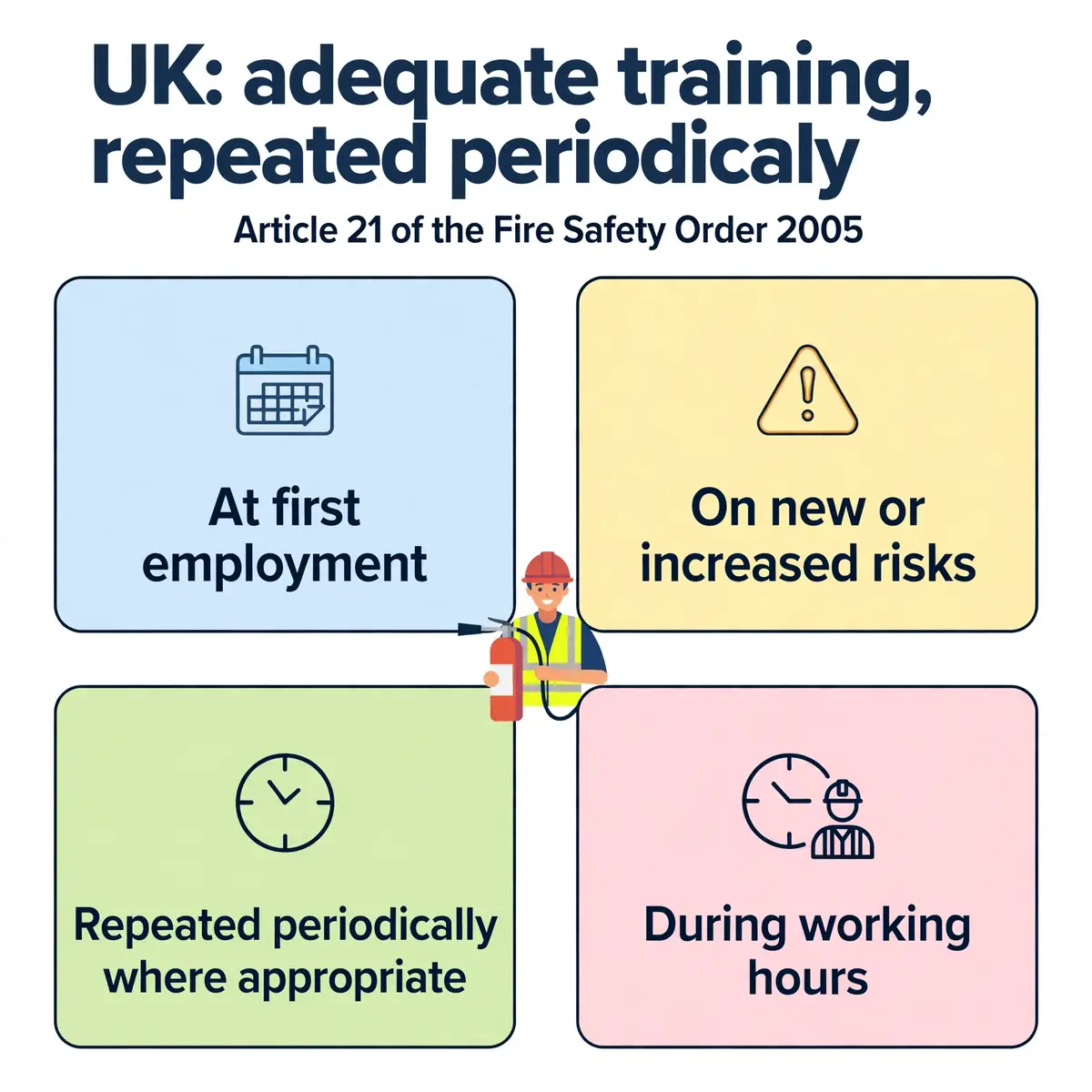
United Kingdom law takes a different shape. There is no single extinguisher-training regulation with a fixed interval. Instead, the duty sits inside the general fire safety law for England and Wales, and the employer decides the detail through the fire risk assessment. The result is more flexible than the American rule, and it puts more weight on the employer's judgement.
The Responsible Person and the Fire Risk Assessment
Under the Regulatory Reform (Fire Safety) Order 2005, the duty falls on the responsible person — usually the employer, for a workplace under their control. Article 13 requires appropriate fire-fighting equipment where it is necessary to protect relevant persons. Article 19 requires the employer to give employees information about the risks and the measures taken. The fire risk assessment decides what equipment is needed and who needs to know how to use it.
In practice, businesses follow BS 5306: part 8 for the selection and siting of extinguishers, and part 3 for their maintenance and servicing. Extinguishers are checked visually every month by the responsible person and serviced professionally at least once a year. None of that replaces training. Equipment that nobody can use is decoration, and the Order treats it that way.
Article 21: Training When, and How Often
Article 21 of the Order carries the training duty. It requires the responsible person to ensure employees receive adequate safety training when they are first employed. Training must repeat when they are exposed to new or increased risks. Examples include a transfer, a change of responsibilities, new work equipment, new technology, or a new system of work. The training must include suitable and sufficient instruction on the precautions and actions that protect the employee and other relevant persons.
Two points in Article 21 matter most for this topic. First, the training must be repeated periodically where appropriate. Second, it must take place during working hours. The Order sets no fixed interval, and it does not mention fire extinguishers by name. That leaves the timing to the employer's judgement, guided by the risk assessment. A site with high fire risks and high staff turnover needs more frequent refreshers than a small office with a stable team.
TipPut the refresher interval in writing in the fire safety policy, with the reason for it. An inspector can then see the decision, not just the gap between sessions.
Scotland and Northern Ireland
The Fire Safety Order covers England and Wales. Scotland has its own law: the Fire (Scotland) Act 2005, with the Fire Safety (Scotland) Regulations 2006. Northern Ireland has the Fire and Rescue Services (Northern Ireland) Order 2006, with its own fire safety regulations. The duties are similar in shape: a responsible person, a fire risk assessment, and training for staff. The article numbers differ, so a business operating across the border should check the local text rather than assume one law covers all sites.
The practical effect for employers is the same in all three jurisdictions. Train staff on induction, refresh the training regularly, and keep a record. A business with sites in more than one country should write one training policy that meets the strictest of the three duties, rather than a different policy per site.
What "Adequate" Looks Like in Practice
Because the Order does not fix an interval, United Kingdom practice has settled on a convention. Fire safety training happens on induction. A refresher follows about once every 12 months, and again whenever something changes. Fire marshal or fire warden courses run longer, usually around three hours, and include working with extinguishers. That annual rhythm is a convention, not a legal deadline — but it is the rhythm inspectors and insurers expect to see.
Non-compliance can lead to enforcement notices, prohibition notices, prosecution, unlimited fines, and up to two years' imprisonment in serious cases. The enforcement authority is usually the local fire and rescue authority. On construction sites, nuclear premises, and ships under construction, the Health and Safety Executive holds the duty instead. A training record that shows who was trained, when, and on what is the simplest defence.
What a Good Course Covers
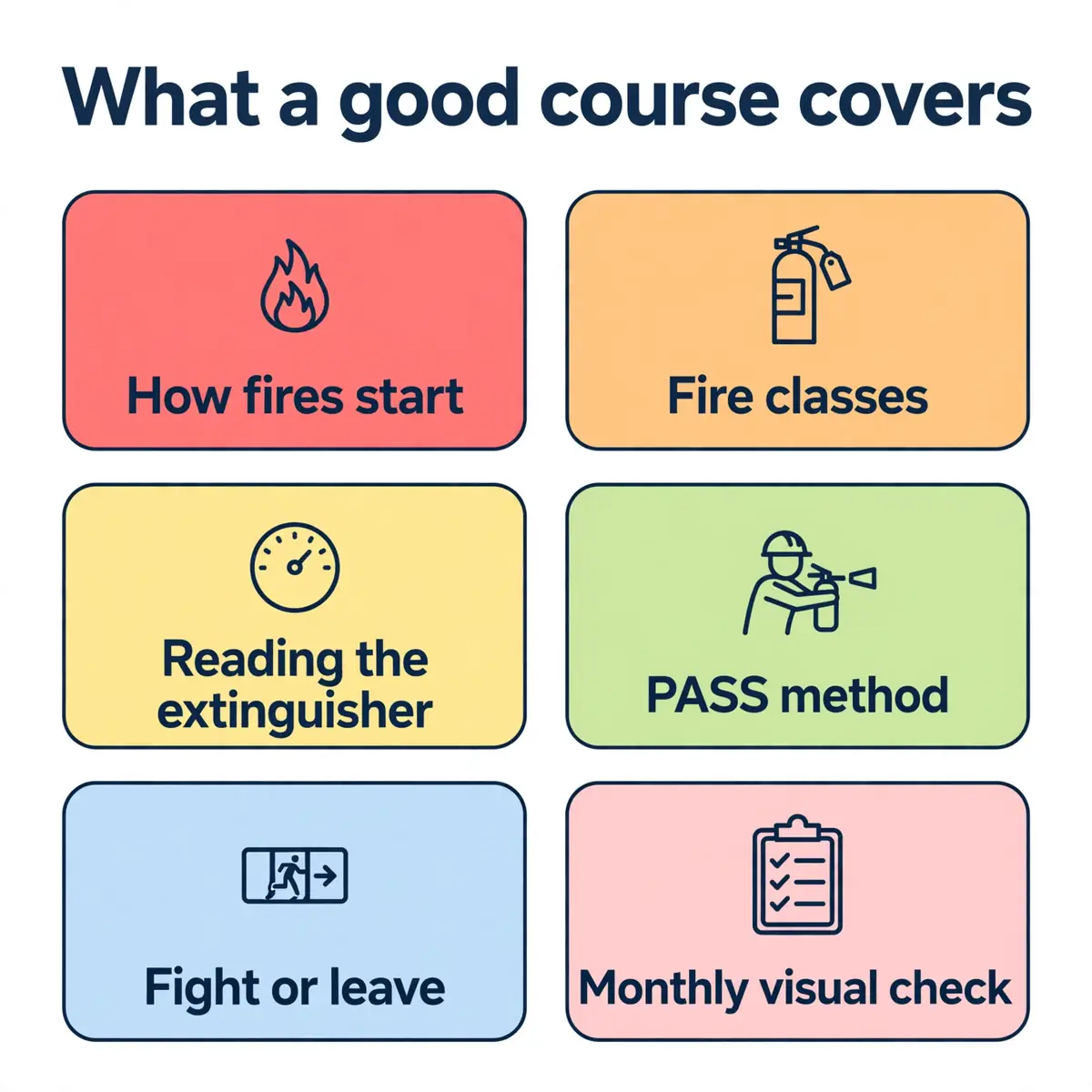
There is no federally mandated curriculum in the United States, and no prescribed syllabus in the United Kingdom. That leaves the buyer to judge quality, which is why the course content matters more than the certificate. A good course covers the same ground in both countries. The physics of fire and the limits of a handheld extinguisher do not change at a border. The sections below are the minimum a buyer should expect.
How Fires Start and How They Spread
Every course should start with how a fire begins. A fire needs fuel, heat, and oxygen, and most teaching adds a fourth element, the chemical chain reaction, making the fire tetrahedron. Removing any one element stops the fire, and each type of extinguisher works by removing one of them. That single idea explains why the wrong extinguisher can make a fire worse.
The course should also cover how fires behave in a real building. Smoke rises and fills a room from the ceiling down. Heat builds fast. An uncontrolled fire grows quickly, and a small fire that looks manageable can become unmanageable in a minute. Workers who understand that growth are less likely to waste time on a fire that is already beyond a handheld unit.
Fire Classes and Matching Extinguishers
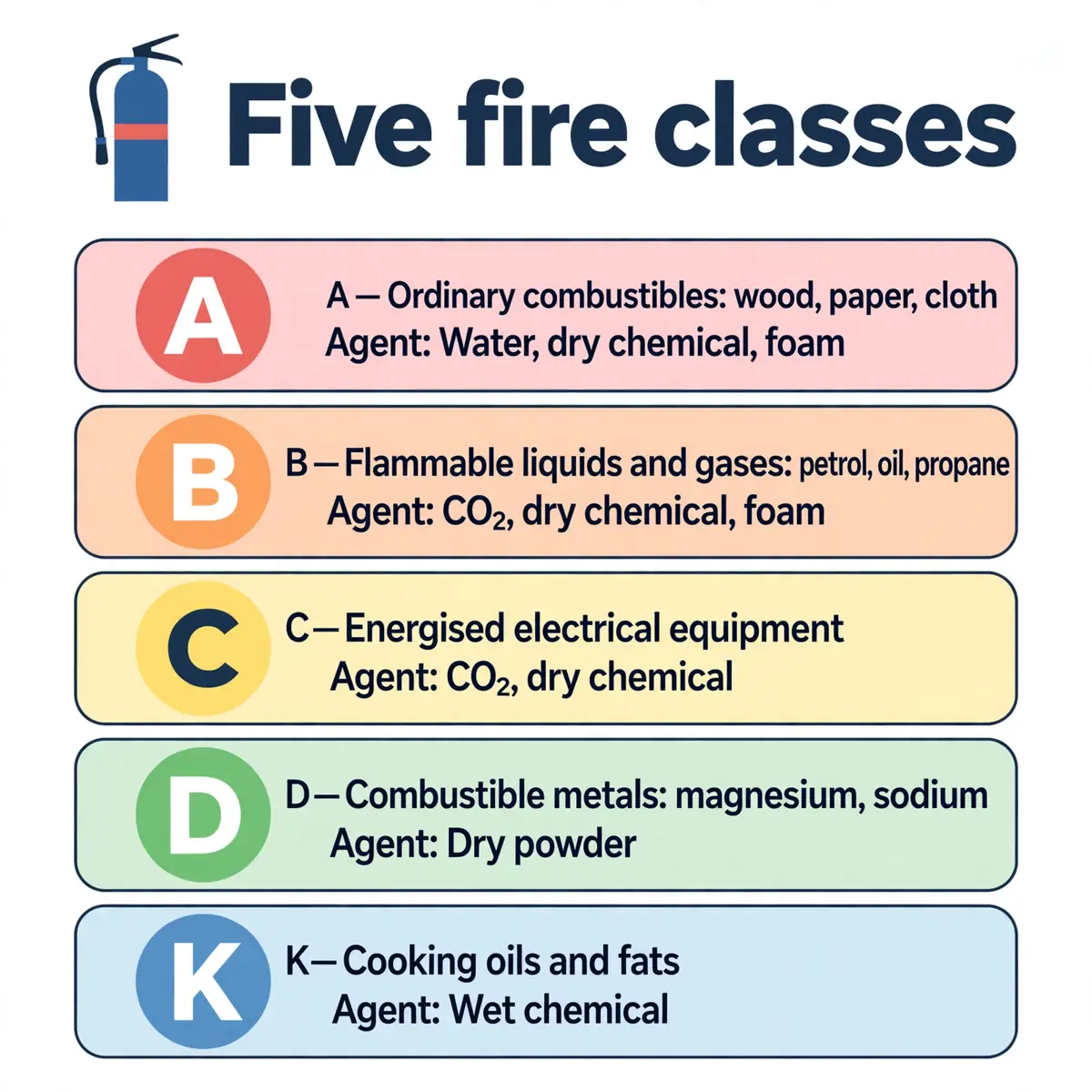
Fire classes are the sorting system every extinguisher label uses. Class A covers ordinary combustibles such as wood, paper, cloth, and rubbish. Class B covers flammable liquids and gases such as petrol, oil, and propane. Class C covers energised electrical equipment. Class D covers combustible metals such as magnesium and sodium. Class K covers cooking oils and fats in commercial kitchens.
Matching the extinguisher to the class is the point of the lesson. Water on a grease fire spreads flaming oil. Carbon dioxide on a metal fire can trigger a violent reaction. The wrong agent is not a neutral mistake. Workers should be able to read the label on the extinguishers in their own building and say which fires each one handles. Most workplaces outside a laboratory or a commercial kitchen will only ever see ABC dry-chemical units. The course should say so plainly, rather than pretend every class is equally likely.
Reading the Extinguisher: Parts, Gauge and Label
A course should put a real extinguisher in front of the group and walk through it. The parts are the handle, the safety pin with its tamper seal, the hose or nozzle, the pressure gauge, and the label. Each part has a job, and each one can fail. A broken tamper seal means the pin may have been pulled. A gauge needle outside the green zone means the unit cannot be trusted.
Labels carry the rating, and ratings matter. A 2-A:10-B:C rating tells the user the unit handles a certain size of Class A and Class B fire and is safe on energised equipment. Workers do not need to memorise rating tables. They should know that a bigger number means a bigger fire the unit can handle. They should also know that a small domestic unit is not the same tool as a large industrial one. The fire extinguisher types on site should be named in the session, one by one.
The PASS Method in Four Steps
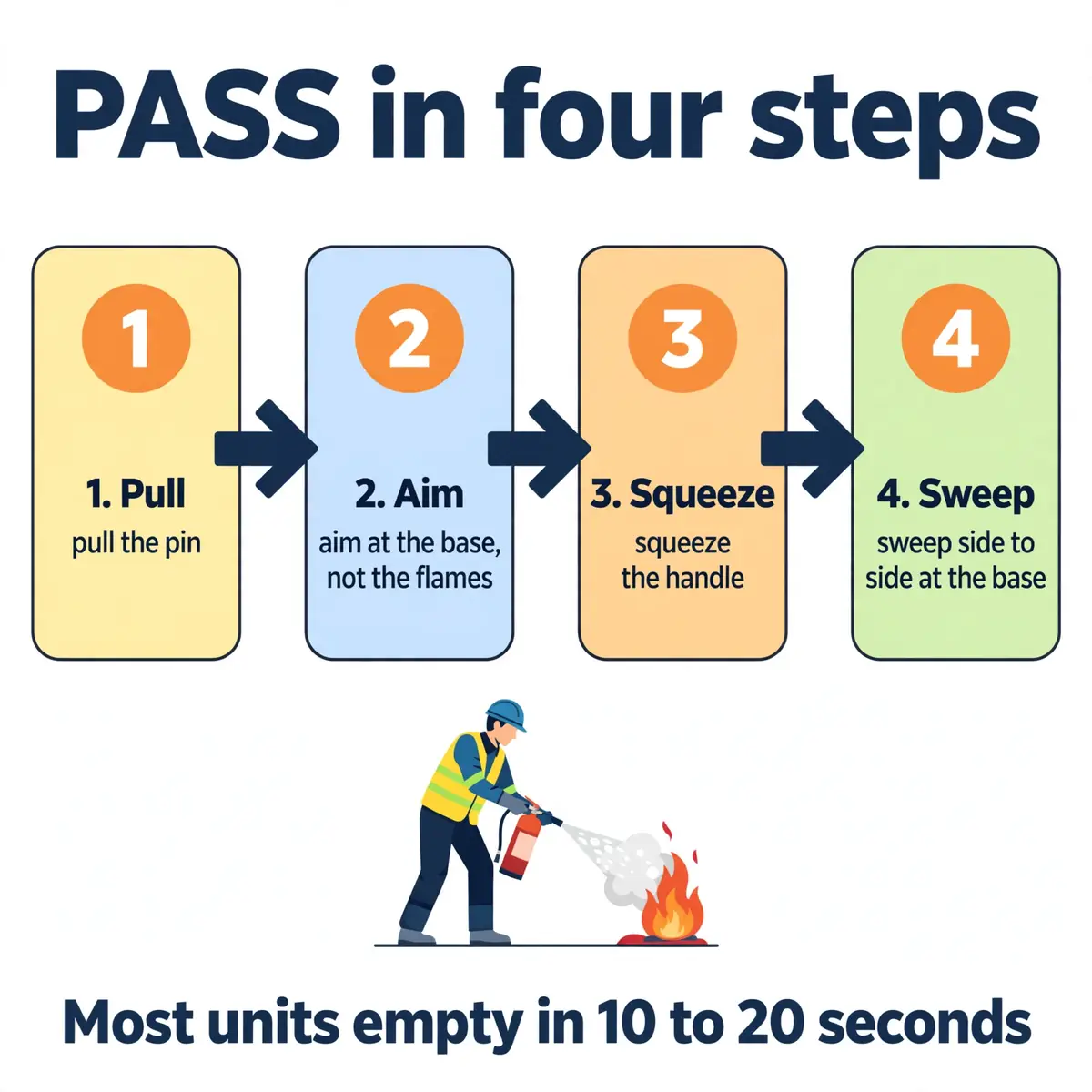
PASS is the four-step method for operating a portable extinguisher, and every course teaches it. Pull the pin from the handle. Aim the nozzle or hose at the base of the fire, not the flames. Squeeze the handle to release the agent. Sweep the nozzle side to side at the base until the fire is out. Then back away, without turning your back on a fire that has just been knocked down, because many re-ignite from residual heat.
Two details deserve emphasis. First, most portable units empty in 10 to 20 seconds, so there is no time to hesitate or fine-tune once the handle is squeezed. Second, people who have never held an extinguisher are often startled by the pressure and let go. Saying so in advance cuts that reaction. The full step-by-step method is covered in the guide to use a fire extinguisher, which pairs each step with the mistakes that waste the agent.
When to Fight and When to Leave
The decision to fight or leave is the most important part of the course, and it is the part most courses rush. The rule taught in accepted training is simple: fight only if four conditions are all true. The fire is small, no bigger than a wastebasket. It has not spread to other materials. The extinguisher is the right one for the fire class. There is a clear exit path behind the person fighting it.
If any one condition fails, the answer is to raise the alarm, alert others, and get out. Anyone burned while fighting a fire needs first aid at once, so a stocked first aid kit should be part of every fire plan.
A portable extinguisher was built for incipient-stage fires, not established ones. A worker who tries to fight a growing fire is standing in a room filling with toxic smoke and superheated air. Posting the four conditions on a laminated card beside each extinguisher costs almost nothing. It returns more safety per pound or dollar than most signage in a building.
WarningIf the fire does not shrink in the first 15 to 20 seconds, stop and leave. An extinguisher that is not winning is an extinguisher that is nearly empty.
The Monthly Visual Check
Training should also cover the monthly visual check, because the same workers who use extinguishers are often the ones who notice when one is out of service. The check takes about two minutes per unit. Check each of these points:
- The extinguisher is in its designated place.
- The gauge reads in the green.
- The tamper seal is intact.
- There is no visible damage.
- The label is legible.
- The annual service tag is current.
Log the check with the date and the initials of the person who did it.
That monthly check is separate from the annual maintenance visit, which must be done by a trained person, usually a fire protection company. The annual service covers the mechanical parts, the agent amount, and the expiry date. Monthly checks are no substitute for the annual service, and the annual service is no substitute for monthly checks. The classes themselves are explained in the guide to fire extinguisher classes.
Hands-On Practice: Why Watching is Not Enough
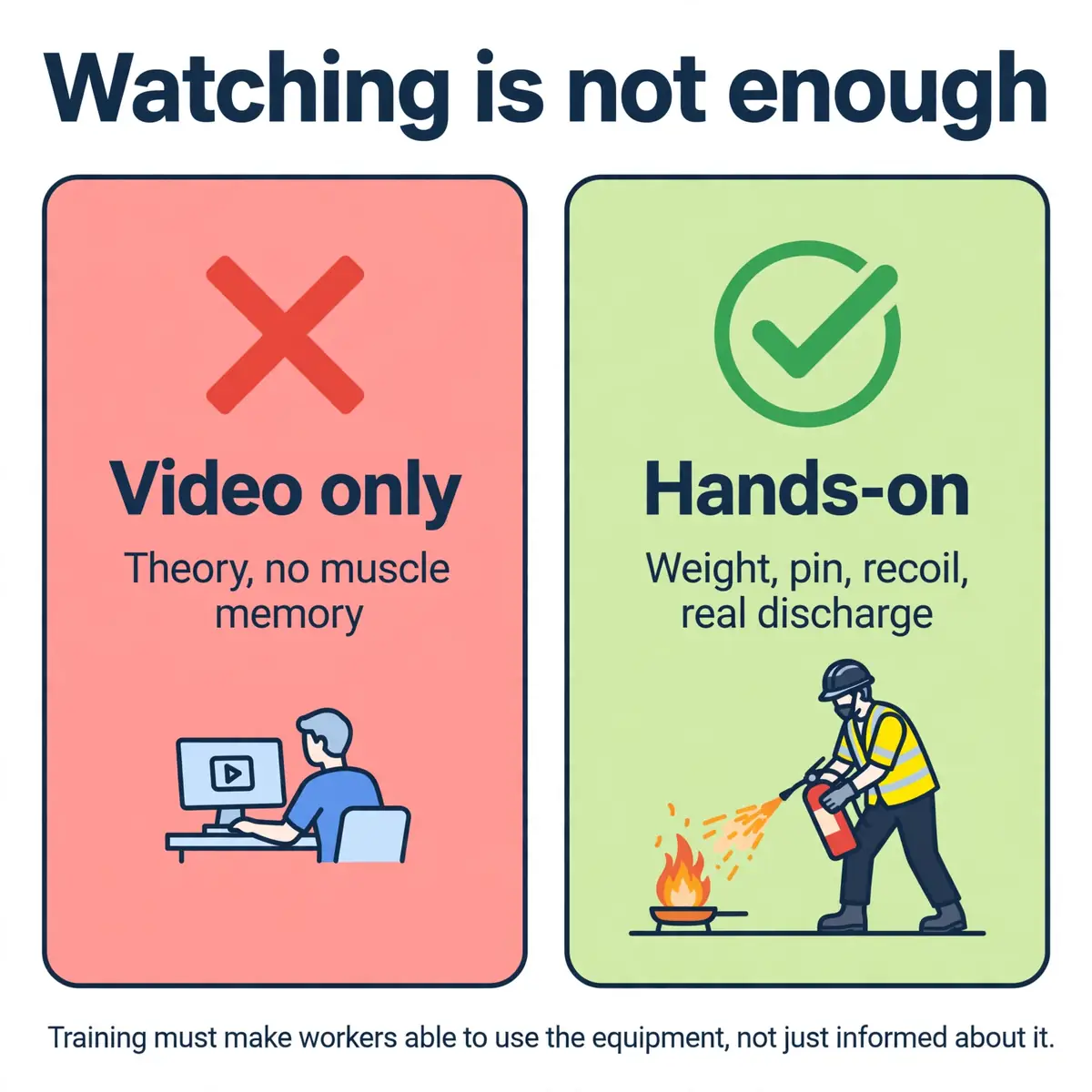
Watching a video about an extinguisher is not the same as holding one. The weight surprises most people who have never picked one up. The pressure surprises them again when the handle is squeezed. The noise, the recoil, and the short discharge time all have to be experienced once, in a safe setting, before they are experienced for real. That is why hands-on practice is the part of the course that matters most.
OSHA's standard does not use the words "hands-on" in 1910.157(g). Its interpretation is clear enough, though. Training must make the employee capable of using the equipment safely, not merely exposed to information about it. A worker who watched a video and then cannot operate a pull-pin extinguisher has not been trained. The same logic applies in the United Kingdom, where the training must be suitable and sufficient for the risks identified. A classroom-only course for designated users is a weak defence in either country.
Live-Fire Practice
Live-fire practice is the strongest form of hands-on training. A controlled propane-fuelled training fire lets each person pull the pin, aim, squeeze, and sweep against real flame and real heat, with an instructor beside them. The fire behaves like a fire: it shrinks when the technique is right and flares when the aim is wrong. That feedback cannot be faked.
Live fire needs a safe outdoor area, a trained instructor, and a fire risk assessment of its own. It also needs extinguishers to spare, because each discharge empties a unit. Many providers run live-fire sessions at their own training ground and charge accordingly. For designated users in higher-risk workplaces, that cost is justified. For a small office with one ABC unit by the door, it may be more than the risk requires.
Simulators and Water-Based Trainers
Simulators are the practical alternative when live fire is not possible. Laser-based trainers pair a training extinguisher with a sensor array and a simulated flame on a screen, scoring aim and sweep without any discharge. Water-based trainers use a real extinguisher body filled with water, so the weight, the pin, and the sweep are real, while the mess is not. Both let every person in the group practise, which a single live-fire rig often cannot do in the time available.
Simulation-only training is not prohibited, but it is harder to defend if an inspector asks whether the training matched the actual hazard. The sensible approach is to match the method to the risk. A warehouse team that may face a real liquid fire should feel real heat at least once. An office team that will almost certainly evacuate can learn the motions on a simulator and still be well served.
Running a Hands-On Session, Step by Step
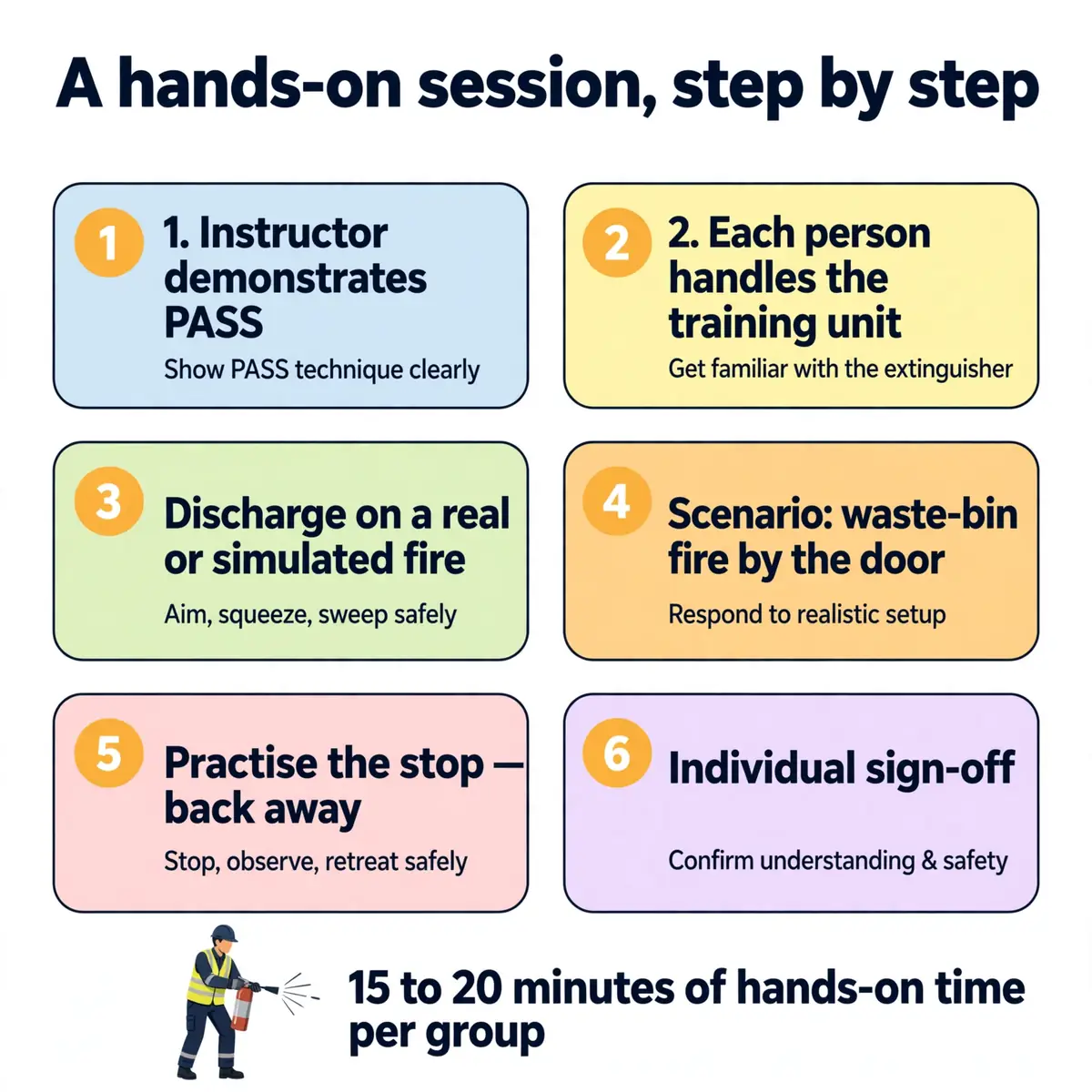
A good hands-on session follows a fixed order. First, the instructor demonstrates the full PASS sequence on a training fire or simulator, slowly, while the group watches. Second, each person picks up a training extinguisher, checks the pin and gauge, and runs the motions without discharging, so the weight and the grip become familiar. Third, each person discharges on a real or simulated fire, aiming at the base and sweeping until the flame is out.
Fourth, the instructor runs a scenario. A small flame burns in a waste bin by the door. The group is asked what to check before reaching for the extinguisher. Fifth, the group practises the decision to stop — the instructor calls the stop, and everyone backs away without turning their back. Sixth, the instructor signs off each person individually, noting who handled the extinguisher and who only watched. A session that runs this way takes 15 to 20 minutes of hands-on time per group. It is the part of the course people remember a year later.
How Long a Course Takes and What It Costs
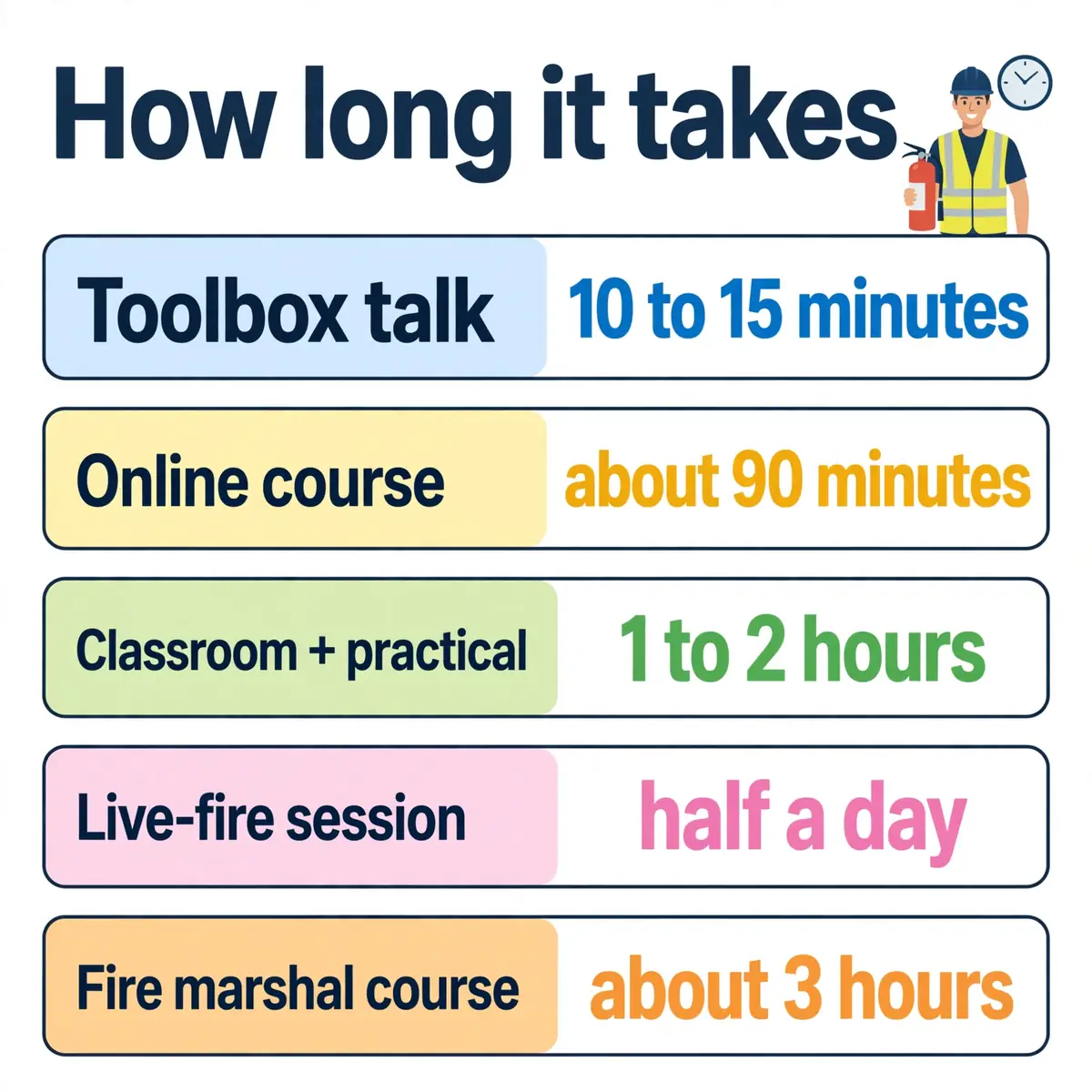
Fire extinguisher training is short compared with most safety courses. A toolbox talk runs 10 to 15 minutes. A classroom session with a hands-on element runs one to two hours. An online course runs about 90 minutes. A fire marshal course, which adds evacuation duties and leadership, runs about three hours. None of these figures is set by law. The law sets the outcome — a worker who can use the equipment — and the course length follows from that.
Cost follows the same pattern: it depends on the format, not on a fixed tariff. An online course from a single provider costs about $35 per person at the time of writing, with bulk discounts for teams. An in-person session from a fire protection company is usually priced per session rather than per person. A session for a small group often costs less than replacing the extinguishers a live-fire drill empties. Local fire departments sometimes run free or low-cost sessions for small businesses, which is worth a phone call before spending anything.
| Format | Typical length | Hands-on practice | Best for |
|---|---|---|---|
| Toolbox talk | 10 to 15 minutes | Demonstration only | Annual refresher for all staff |
| Online course | About 90 minutes | None | Theory and awareness-level staff |
| Classroom plus practical | One to two hours | Yes, per person | Designated users |
| Live-fire session | Half a day | Yes, against real flame | Higher-risk workplaces |
| Fire marshal course | About three hours | Yes, with evacuation duties | Fire wardens and marshals |
Online Courses
Online courses suit the theory well. A typical course has four modules: how fires start, the fire classes, the parts and ratings of extinguishers, and how to respond when a fire occurs. Each module ends with a short quiz, and the course ends with a final exam. On passing, the learner can download a certificate of completion. The format is cheap, scalable, and easy to track across a large workforce.
The weakness is obvious: nobody holds an extinguisher. For evacuation-only staff, that weakness does not matter much, because their job is to leave. For designated users, it matters a great deal. The best approach for most small businesses has two parts. A short online component covers the theory. Then a 15 to 20 minute hands-on session lets each designated person physically work a training extinguisher. That combination is both cheap and defensible.
In-Person Courses
In-person courses cost more per head. They deliver what online courses cannot: the weight of the unit, the pull of the pin, the recoil of the discharge, and an instructor who can correct a bad aim on the spot. A good provider brings training extinguishers, a simulator or a live-fire rig, and extinguishers that match the types on the buyer's own site. Ask the provider to confirm that before booking. A session practised on a CO2 unit does not prepare a worker for the ABC dry-chemical unit on their own wall.
In-person training also lets the instructor walk the site. Reading the label on the actual extinguisher by the door, pointing at the class marking, and walking the escape route beats five minutes of slides. A provider who refuses to look at the site is selling a generic course, and a generic course is what the law does not want.
Free and Low-Cost Options
Not every employer needs to pay a training company. Some fire protection vendors include a short training session in the annual maintenance visit. Some local fire departments run free sessions for small businesses in their area. Some trade associations offer group sessions at a fraction of the commercial price. A toolbox talk delivered by a competent supervisor, using the provider's own extinguishers and a training unit, can satisfy the annual refresher for many workplaces.
Free does not mean unrecorded. Whoever delivers the training, the record must still show the date, the names, the topics, and the trainer. A free session with no record is worth less than a paid session with one, because the record is the only proof the training happened.
How Often to Refresh Training
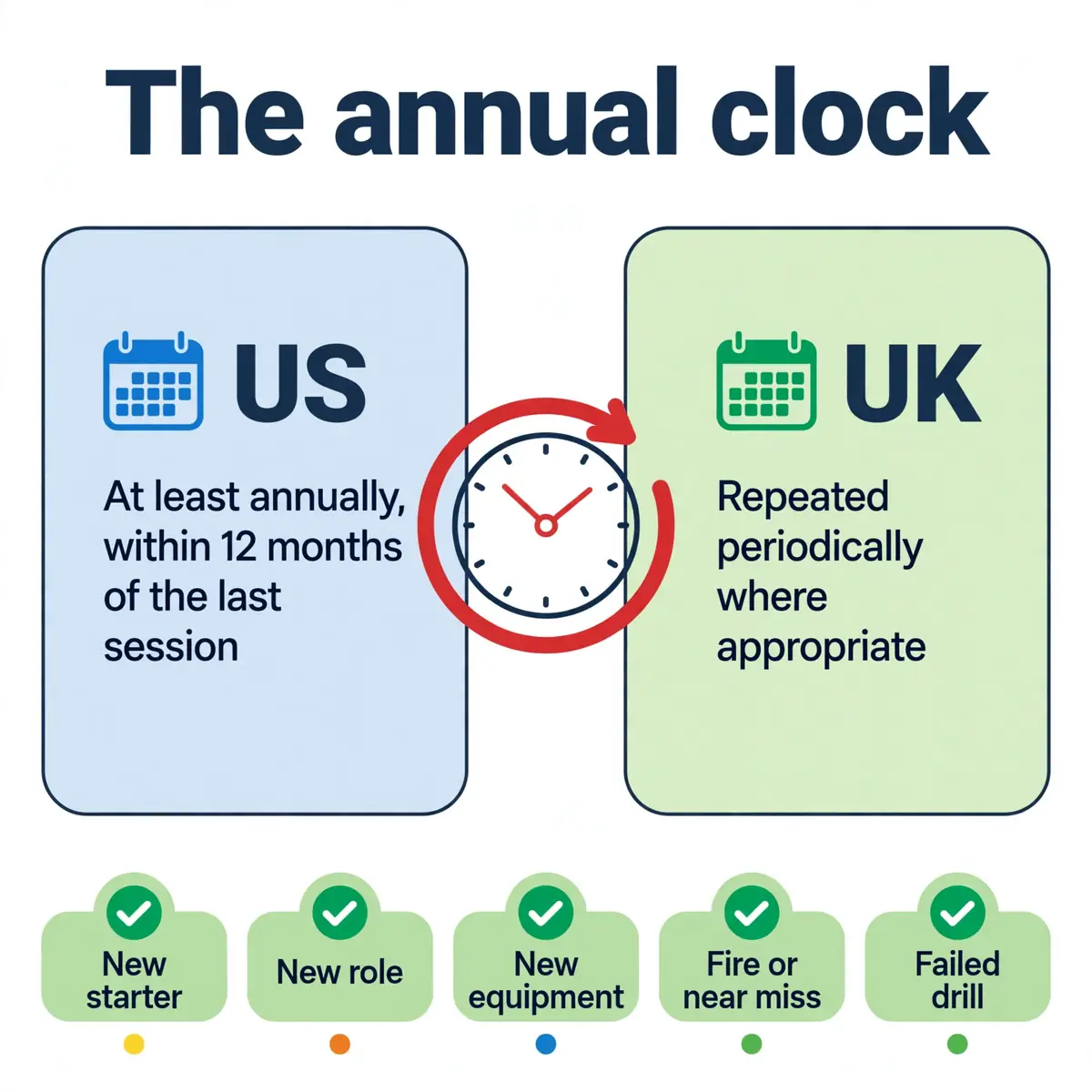
Refresh timing is the question the title promises to answer, and it has two different answers depending on the country. In the United States the rule is a fixed clock. In the United Kingdom it is a duty to repeat the training periodically, with the interval left to the employer's judgement. Both answers share the same triggers: anything that changes the risk changes the training need.
The Annual Clock in the United States
Under 1910.157(g)(2), education must be provided upon initial employment and at least annually thereafter. Under (g)(4), the same annual timing applies to the hands-on training of designated users. There is no minimum number of hours, no required test, and no certification card. The standard requires only that the training happen, and happen every year.
Annual means within 12 months of the last session. A session in March last year and a session in May this year is 14 months apart, and that gap is a breach. The practical fix is a calendar reminder set 11 months after each session, with a named owner.
Some employers schedule the annual training on the same day as the vendor's annual maintenance visit, so both sets of records land on one date. That annual rhythm is the pattern OSHA training follows across many topics, and extinguishers are no exception. That is a clean arrangement, and it makes the inspection easier.
The Periodic Duty in the United Kingdom
Article 21(2)(b) of the Fire Safety Order requires training to be repeated periodically where appropriate. It sets no number of months, and no inspector can cite a business for missing a date that the law never fixed. What an inspector can do is ask whether the interval the business chose was appropriate to the risks identified in the fire risk assessment.
The convention in the United Kingdom is a refresher about once every 12 months, with fire safety training on induction and again whenever something significant changes. That convention is the answer most providers give, and it is the rhythm insurers expect. A business that refreshes every year, and can show the record, will rarely be challenged on timing. A business that last trained its staff three years ago will be, because three years is hard to call periodic for any workplace with real fire risks.
Refresh Triggers That Beat the Calendar
Several events should trigger refresher training before the next scheduled date, in both countries. A new starter joins and needs training before starting work in the area. A worker moves to a different department or takes on new responsibilities. New work equipment, new technology, or a new system of work changes the fire risks. A fire, a near miss, or a failed drill shows that the training did not stick.
Other triggers are quieter but just as real. New extinguishers of a different type arrive on site. A building is altered, changing escape routes. A drill shows that designated users hesitate or aim at the flames instead of the base. Any of these is a reason to retrain now rather than wait for the annual date. Regular drills that practice emergency procedures keep the escape route familiar, so nobody has to think about it in a real fire. The calendar is a minimum, not a plan.
TipAfter any fire or near miss, retrain the people involved before they go back to normal duties. A frightened worker who never practises again is a worker who will freeze next time.
Certificates, Records and Proof
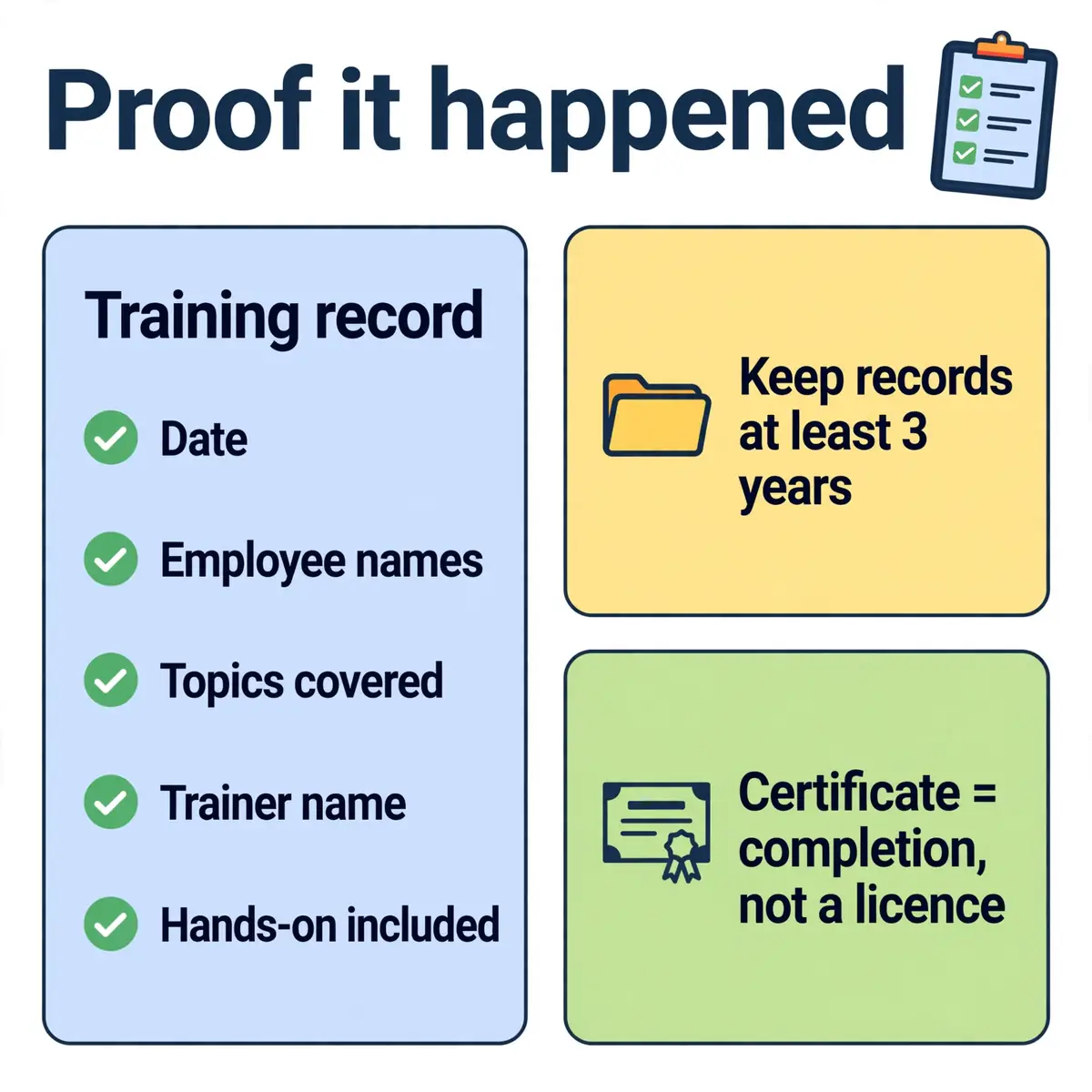
Training that cannot be proved is training that did not happen, as far as an inspector is concerned. The proof is a simple record, and the rules around it are simpler than most employers expect. The law asks for very little on paper. Common sense asks for a little more, and the extra lines cost nothing to keep.
What a Training Record Must Show
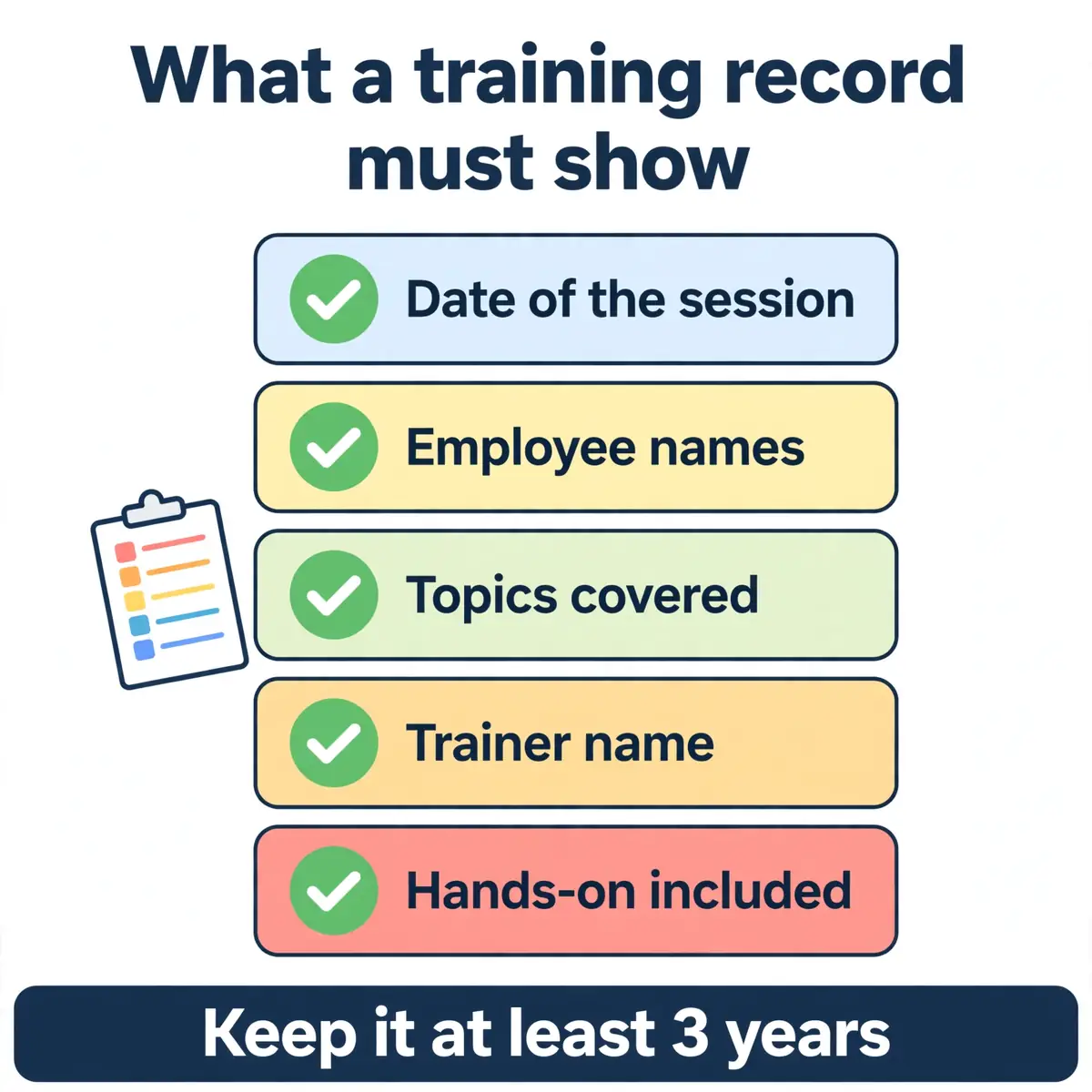
A training record needs five things. The date of the session. The names of the employees who attended. The topics covered, listed rather than described in general terms — fire classes, PASS, the fight-or-leave decision, the monthly check. The name of the trainer. And whether hands-on practice was included, with the names of the people who handled an extinguisher. A sign-in sheet with those columns is enough, and a scanned copy in a shared folder is as good as a binder.
Two details strengthen the record. First, ask employees to sign beside their printed name, and invite questions or concerns on the same sheet. That documents that feedback was invited, which strengthens a good-faith showing in any inspection. Second, note the extinguishers covered by type and location, so the record shows the training matched the equipment on site rather than a generic course.
How Long to Keep Records
OSHA's standard contains no explicit rule for how long to keep fire extinguisher training records. The one-year retention rule in 1910.157(e)(3) applies to the annual maintenance record of the extinguisher itself, not to training. That gap catches employers out. They keep the maintenance tag for a year and throw away the training record with it. Then they have nothing to show an inspector two years later.
The practical minimum is three years. That matches the general expectation for safety training records and the period most state plans look for. Keep the record with the other safety training records, not in a drawer that leaves with the manager. If the training was delivered online, export and save the completion certificates alongside the attendance record. A platform that closes or changes hands can take the proof with it.
Certificates: What They Prove and What They Do Not
Most online courses issue a certificate of completion when the learner passes the final exam. In-person providers often issue one too. These certificates prove that a named person completed a named course on a named date. They are useful evidence, and they are worth filing with the training record.
What they do not prove is competence. A certificate does not show that the holder can operate the extinguisher on their own site, and it does not replace hands-on practice. There is no national fire extinguisher licence, no OSHA certificate, and no card that an inspector will ask to see. The draft meta description for this topic once promised guidance on how to get certified; that promise misleads, because certification is not what the law requires. Education, practice, and a record are what it requires.
How to Choose a Training Provider
Choosing a provider is the decision the whole article leads to, and it is the one the top search results never cover. Most providers look similar on a website: a course outline, a price, and a promise of compliance. The differences show up in the questions they can answer before you book. A provider who cannot answer them is selling a generic course, and a generic course is the risk.
What to Ask Before You Book
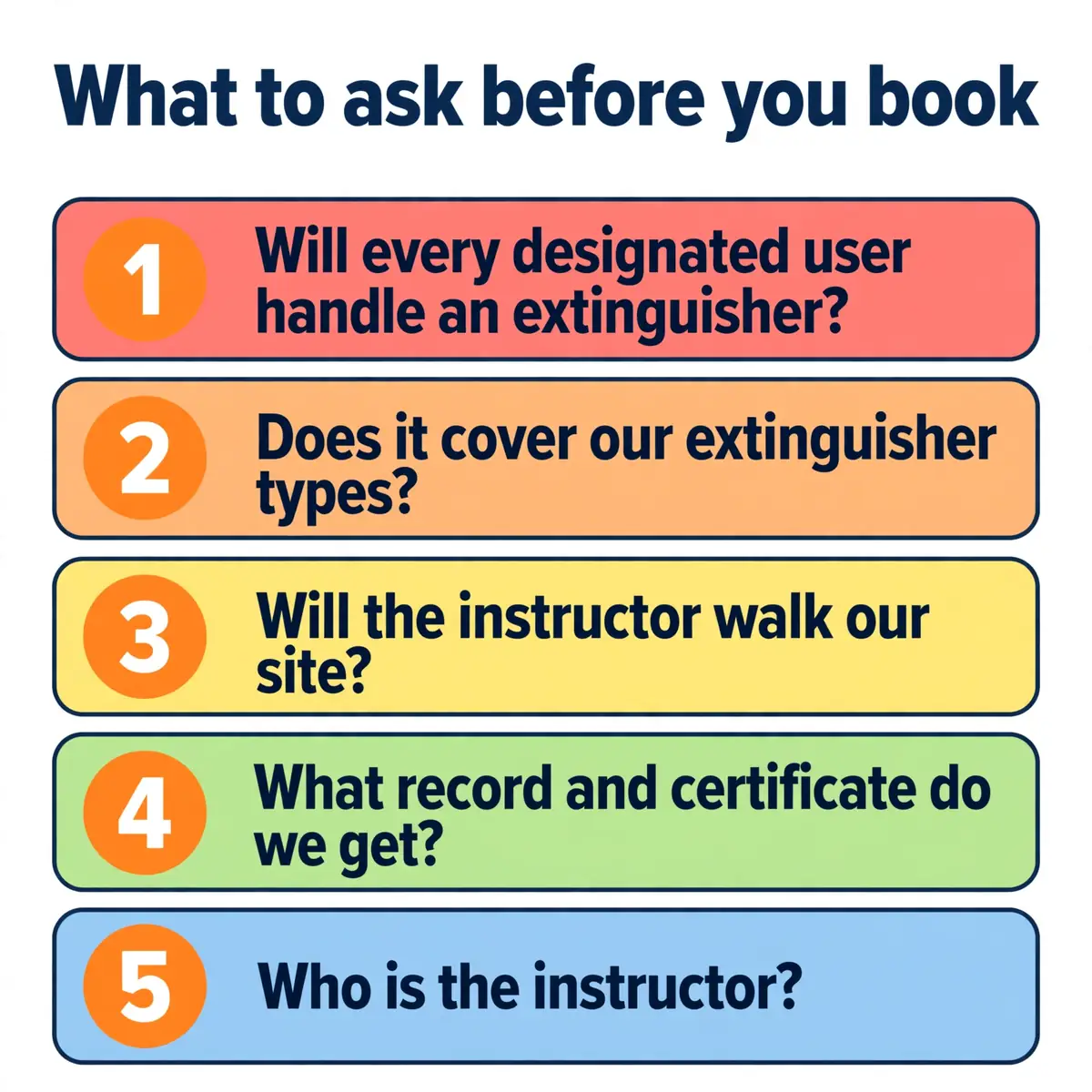
Ask whether every designated user will handle a real or training extinguisher, and how much hands-on time each person gets. Ask whether the session covers the extinguisher types on your site, by name. Ask whether the instructor will walk the site and read the labels on your own units. Ask what the course covers beyond PASS: the fire classes, the fight-or-leave decision, and the monthly visual check.
Ask about the record. Will the provider supply a sign-in sheet with the date, names, topics, and trainer, and a certificate of completion for each person? Ask about the instructor's background: who they are, what they have taught, and whether they have worked with your type of workplace. A provider who answers all of this plainly is usually a safe choice. A provider who answers with a brochure is not.
TipAsk for the course outline in writing before you pay. Compare it against the sections of a good course above, and walk away if PASS is the only practical content.
In-House Training or an Outside Provider
In-house training works when the employer has a competent person to deliver it. A supervisor who has been trained, who knows the site, and who can run a hands-on session with a training extinguisher can deliver a good annual refresher. The advantages are cost, timing, and relevance: the session uses the employer's own extinguishers, in the employer's own building, with the employer's own risks.
An outside provider works better in three cases. The first is the initial course for designated users, where live-fire practice and professional instruction matter most. The second is a high-risk workplace, where the provider's equipment and experience justify the fee. The third is a business with no competent person in-house. The common pattern is to use a provider for the first course and for live-fire refreshers, and to deliver the annual theory refresher in-house. That split keeps the cost down without losing the practice.
Red Flags
Several signs should end the conversation with a provider. The course is online-only and sold as suitable for designated users. The outline promises a certificate but never mentions hands-on practice. The provider cannot name the extinguisher types the course covers. The provider guarantees compliance or a pass. No honest provider can do that. Compliance depends on the employer's records and the workers' competence as much as on the course.
Other red flags are subtler. The course teaches PASS and nothing else. The instructor has never visited a workplace like yours. The provider charges per person for a live-fire session but cannot say how many discharges each person gets. The cheapest course is often the one that teaches the least, and the least-taught course is the one that fails when it matters. Price is a poor way to choose training that exists for a single purpose: a worker who can act in the first minute of a fire.
Common Mistakes That Waste the Training
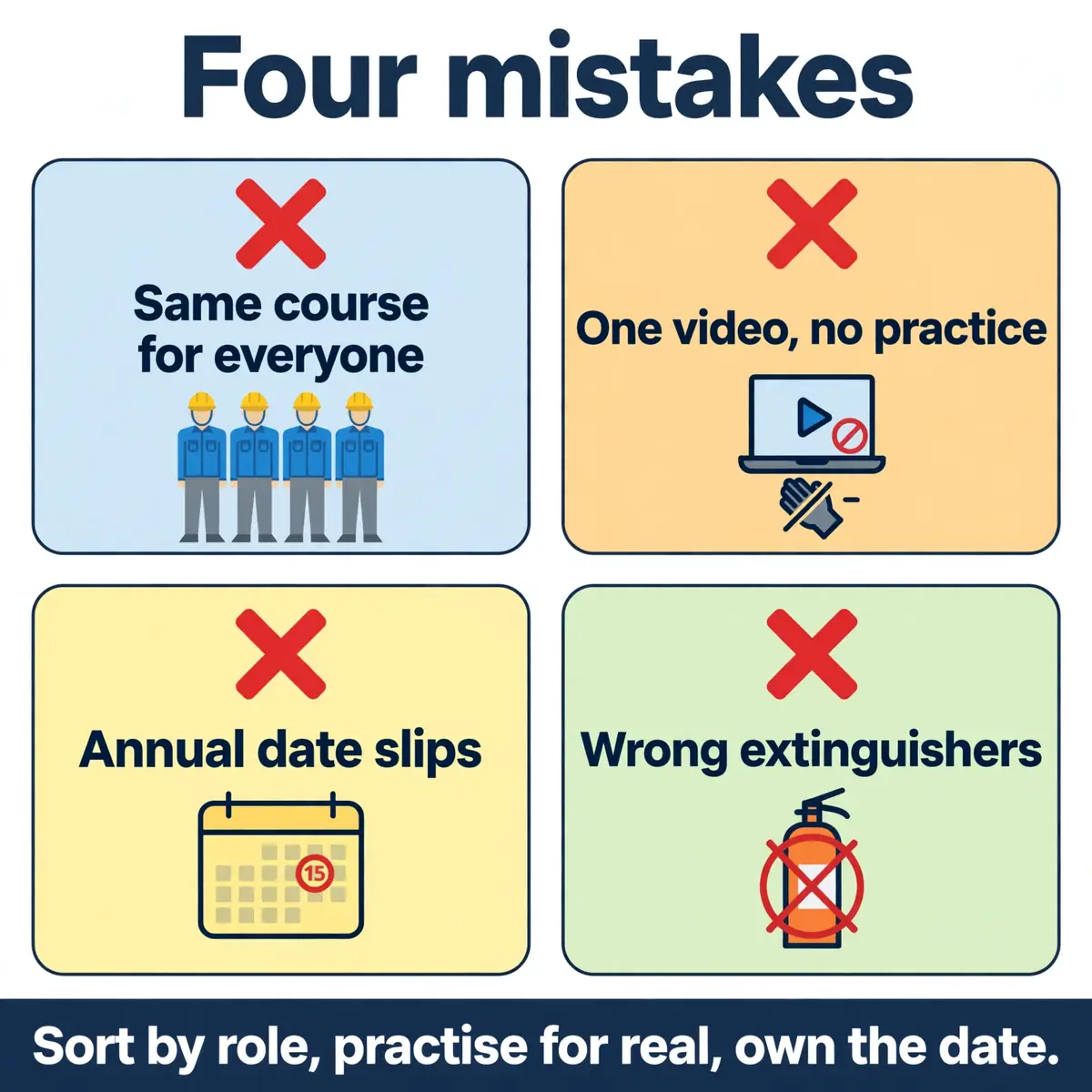
Most failed training is not failed teaching. It is a good course delivered in the wrong way, or a good course whose lessons are never used again. The mistakes below show up in inspection reports and in the accounts of providers who are called in to fix a programme. Each one is easy to avoid once it is named.
Training Everyone the Same Way
The most common mistake is giving every employee the same course. Designated users get a short talk and no practice, while evacuation-only staff sit through a live-fire session they will never use. Both groups leave worse off. The designated users cannot operate the equipment, and the evacuation-only staff have been trained to stay and fight a fire they should have left.
The fix is to sort the workforce by the emergency action plan before booking anything. Two lists, two courses, two records. The designated list gets the full hands-on course. The evacuation list gets the annual policy briefing. The lists change when roles change, and the training changes with them. That sorting is the employer's job, not the provider's.
One Video and No Practice
The second mistake is treating a video as training. A video can teach the theory: the fire classes, the PASS steps, the decision to leave. It cannot teach the weight of the unit, the pull of the pin, or the recoil of the discharge. A designated user who has only watched a video will hesitate at the exact moment hesitation is dangerous.
The fix is to pair every theory session with practice. For designated users, that means handling a training extinguisher in the same session, not in a separate session that never gets booked. For evacuation-only staff, a video is acceptable, because their job is to leave. The standard is simple: if the worker is expected to use the equipment, the worker must have used the equipment.
Letting the Annual Date Slip
The third mistake is the quietest. The training happens, the record is filed, and then nobody owns the next date. Fourteen months pass, then sixteen. Nobody notices until an inspector asks for the record, or a fire shows that the designated users have forgotten the steps. The gap is not a failure of teaching. It is a failure of administration.
The fix is to name an owner and a date. Put the refresher in the calendar the day the training happens, with a reminder 11 months later. Tie it to the annual maintenance visit if that helps. Review the date at the same meeting that reviews the fire risk assessment, so the training and the risks are considered together. A training programme with no owner is a programme that will lapse.
Training on the Wrong Extinguishers
The fourth mistake is training on equipment the workers will never see. A provider brings CO2 units to a site that runs ABC dry-chemical units. A course uses a training rig that looks nothing like the extinguishers on the wall. The workers pass the course and still cannot operate their own equipment, because the pin, the handle, and the hose are all in different places.
The fix is to insist that the session uses the extinguishers on site, or training units of the same type. Walk the group to the actual units, read the labels aloud, and point at the class markings. That ten-second physical reference teaches more than five minutes of slides. The same walk also checks the monthly visual inspection, which is the part of the programme that keeps the equipment ready between sessions.
Frequently Asked Questions
Do I Need Fire Extinguisher Training by Law?
In the United States, yes, if extinguishers are provided for employee use. OSHA requires education on first employment and at least annually after that. Designated users also need hands-on training. In the United Kingdom, the Fire Safety Order requires the responsible person to provide adequate safety training, repeated periodically where appropriate. If the employer's policy is total evacuation and extinguishers are not provided for employee use, the full training duty does not apply. Staff still need instruction on the evacuation policy.
How Often Do I Need Fire Extinguisher Training?
In the United States, at least once a year, within 12 months of the last session, and on first employment or assignment to a designated role. In the United Kingdom, there is no fixed interval in the law. The common practice is a refresher about once every 12 months. Training must repeat sooner when risks change: a new role, new equipment, new technology, a new system of work, or after a fire or near miss.
Does Fire Extinguisher Training Give Me a Certificate?
Most providers issue a certificate of completion, and online courses usually do. That certificate proves a named person completed a named course on a named date. It is not a licence, and no federal agency issues a fire extinguisher certificate. Unlike OSHA 10-hour training, which ends with a Department of Labor card, fire extinguisher training has no standard card. What matters for compliance is the education, the hands-on practice, and the training record — not the certificate on the wall.
Can Fire Extinguisher Training Be Done Online?
Partly. The theory — fire classes, PASS, the fight-or-leave decision — works well online, and evacuation-only staff can reasonably be trained that way. For workers expected to use an extinguisher, online-only training is weak. The standard requires training that makes the employee capable of using the equipment. A video alone does not do that. Pair the online theory with a short hands-on session on a training extinguisher.
How Long Does Fire Extinguisher Training Take?
A toolbox-talk refresher takes 10 to 15 minutes. A classroom session with hands-on practice takes one to two hours. An online course takes about 90 minutes. A live-fire session takes half a day, and a fire marshal course takes about three hours. The law sets no minimum length in either country. The course should take as long as it needs to leave each worker able to use the equipment on their own site.
What Happens If an Employer Never Trains Staff?
In the United States, a failure to train under 1910.157(g) is usually cited as a serious violation, with a maximum penalty of $16,550 per violation for 2026. In the United Kingdom, the fire and rescue authority can issue enforcement or prohibition notices. Prosecution can bring unlimited fines and up to two years' imprisonment in serious cases. Beyond the penalties, untrained staff are the real cost. A worker who cannot use an extinguisher is at far greater risk than a trained one. So is a worker who tries to fight a fire they should have left.
Sources
- OSHA, 29 CFR 1910.157 — Portable fire extinguishers
- OSHA, 29 CFR 1910.38 — Emergency action plans
- OSHA, 29 CFR 1910.156 — Fire brigades
- OSHA, 29 CFR 1926.150 — Fire protection in construction
- OSHA, OSHA penalties — maximum amounts in effect for 2026
- Regulatory Reform (Fire Safety) Order 2005, Article 21 — Training
- Regulatory Reform (Fire Safety) Order 2005, Article 13 — Fire-fighting and fire detection
- GOV.UK, Workplace fire safety — your responsibilities (includes fire safety training)
- NFPA 10, Standard for Portable Fire Extinguishers