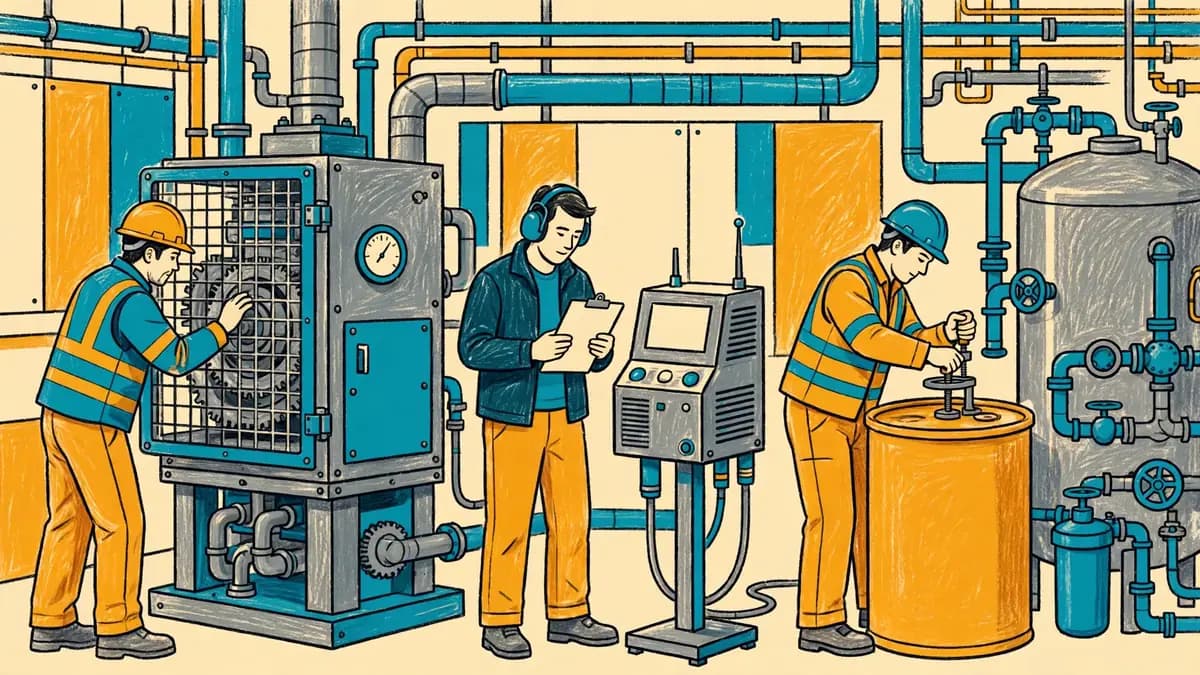
Environmental health and safety, usually shortened to EHS, is the system that stops work from hurting people and damaging the environment around it. It covers three linked jobs: protecting the environment outside the fence, protecting the health of the people inside it, and preventing the accidents that injure them. One system holds all three together, because the same chemical, machine or work routine can create all three kinds of harm at once.
The work starts with finding hazards before they cause harm. A hazard is anything that can hurt a person or damage the environment. It can be a noisy machine, a leaking drum or a bullying manager. Once hazards are found, they are ranked by how likely they are to cause harm and how serious that harm would be. Controls follow in a fixed order, from removing the hazard entirely down to personal protective equipment as the last resort.
What Environmental Health and Safety Covers
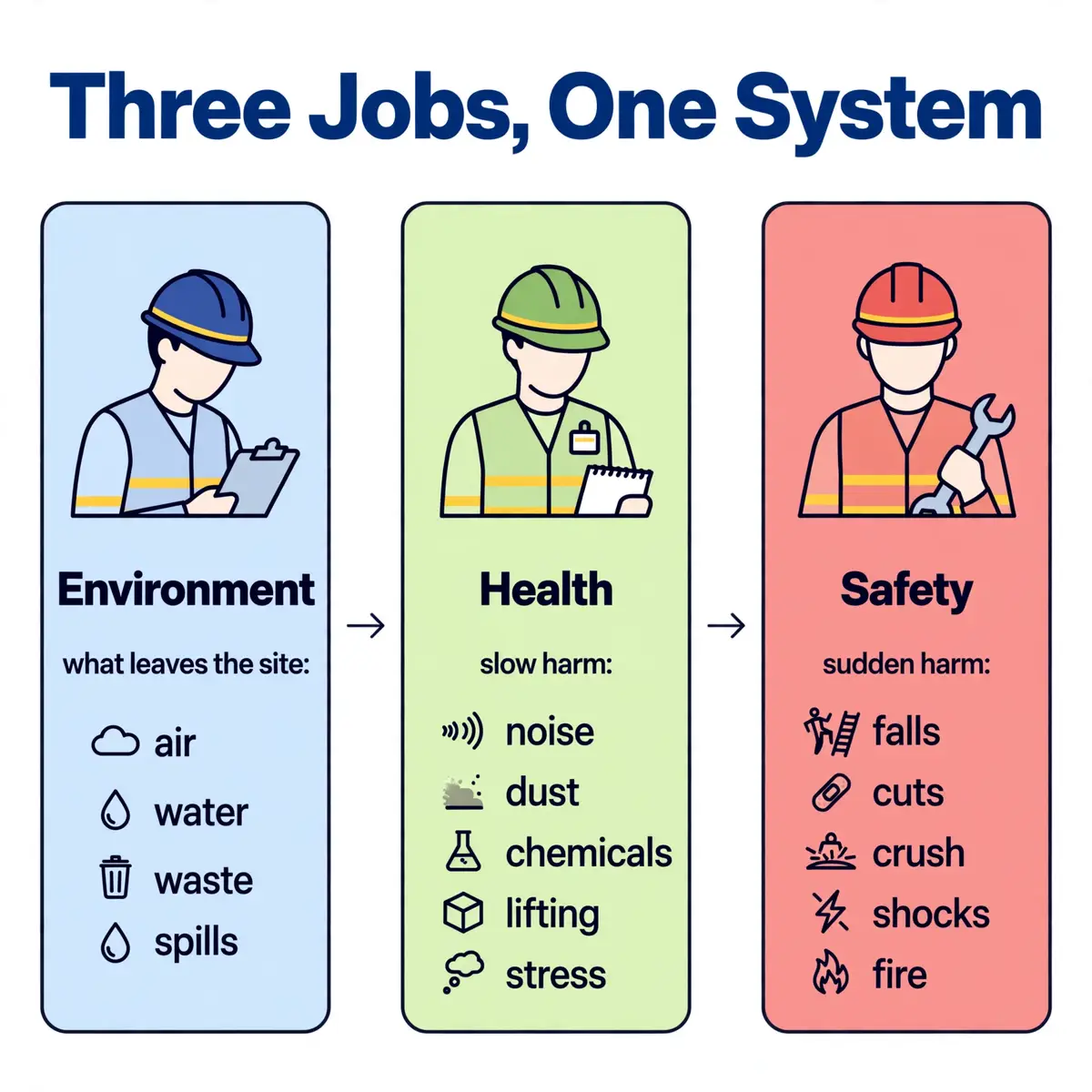
The environment part deals with what leaves the workplace: air emissions, wastewater, waste, spills and noise that reaches neighbours. A factory that stores solvents must keep them out of drains and soil. An office that replaces fluorescent tubes must dispose of them as hazardous waste, not general rubbish. The rule is simple: nothing harmful leaves the site uncontrolled.
The health part deals with slow harm to workers. Noise causes hearing loss, dust damages lungs, chemicals cause skin disease, and lifting injures backs. Stress from workload harms health too. These injuries build over months or years, so they are easy to miss until they are serious. Health checks, exposure monitoring and limits on exposure time exist to catch them early.
The safety part deals with sudden harm: falls, cuts, crush injuries, electric shocks, fires and explosions. These are the injuries that show up in accident books the same day. Guards, safe systems of work, training and protective equipment all serve this part. The three parts overlap constantly, which is why they are managed as one system rather than three separate ones.
TipWhen a new task, chemical or machine arrives, check all three parts before work starts. Check what it releases, what it does to health, and what can go wrong suddenly.
The Six Hazard Families at Work
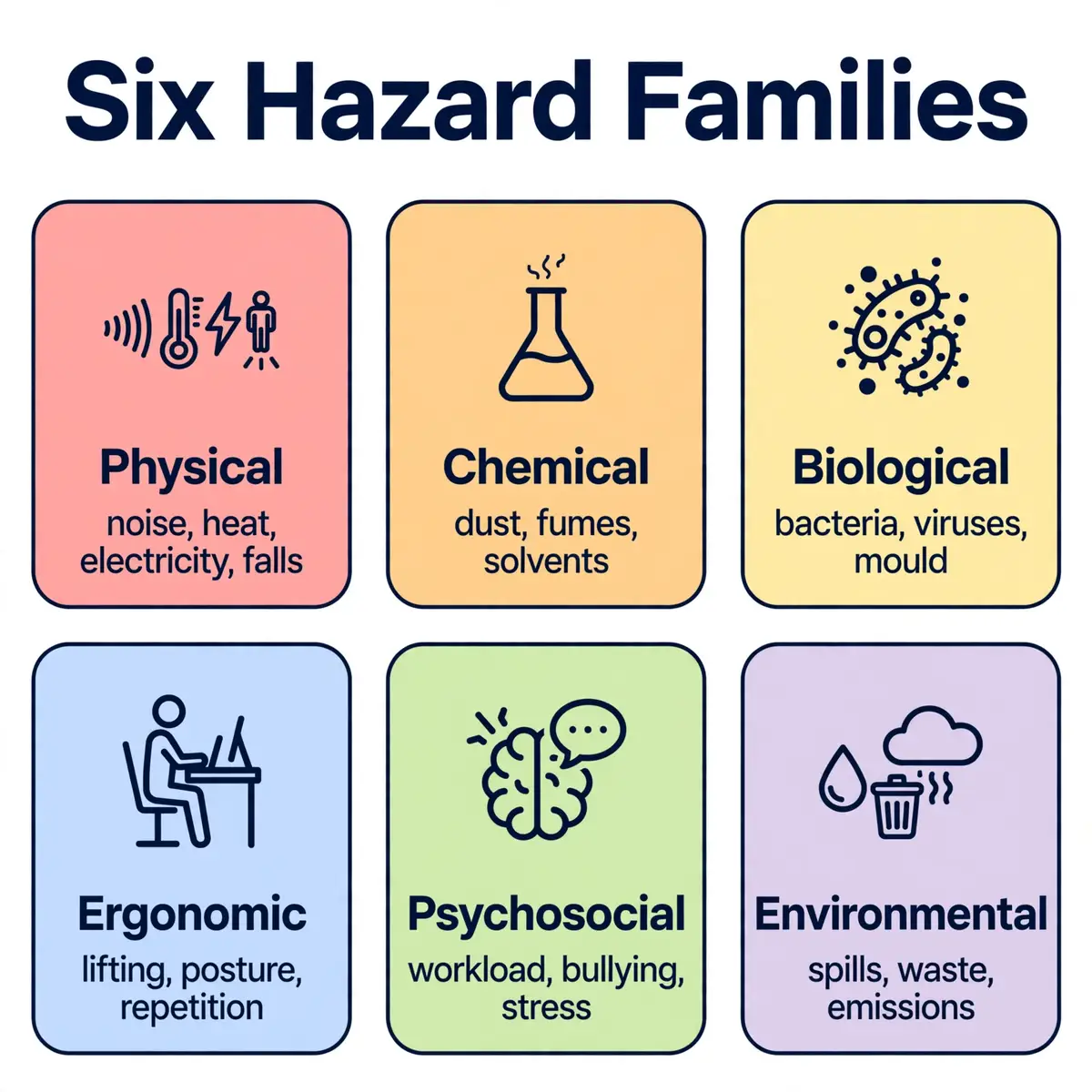
Almost every workplace hazard fits into one of six families. Learning the families makes spotting hazards faster, because a walkthrough becomes a checklist: check each family in turn, in each area, and ask what could hurt someone here. The families also decide which rules apply and which controls work, since a noise problem and a chemical problem need different answers.
Physical Hazards
Physical hazards are forms of energy: noise, vibration, heat, cold, electricity, radiation, moving machinery and falls from height. Noise is one of the most common physical hazards. In the United States, the Occupational Safety and Health Administration (OSHA) sets the permissible exposure limit for noise at 90 decibels averaged over an eight-hour shift. Above that level, hearing protection and a hearing conservation programme are required.
Heat and cold deserve the same attention as noise. Hot work in summer, foundries, kitchens and poorly ventilated rooms can cause heat exhaustion and heat stroke. Cold stores and outdoor winter work can cause frostbite and loss of feeling in the hands. Controls start with the environment: shade, ventilation, rest breaks and drinking water for heat, and warm clothing and shelter for cold.
Chemical Hazards
Chemical hazards come from dusts, fumes, vapours, gases and liquids that workers breathe in, swallow or absorb through the skin. Solvents, acids, cleaning products, welding fume, silica dust and asbestos all belong here. Some cause immediate harm, such as burns or breathing difficulty. Others cause disease years later, such as lung cancer from asbestos or silica.
Every chemical used at work should have a safety data sheet that names its hazards, safe handling, storage and first aid. Workers must be trained on the chemicals they actually use, and labels must stay on containers. Where a safer chemical does the same job, substitution is the first control to try. For more detail on this family, see the guide to chemical hazards.
Biological Hazards
Biological hazards are living things that cause disease: bacteria, viruses, fungi, mould and bloodborne pathogens. Healthcare, laboratories, waste handling, farming and food work carry the highest exposure. A needlestick, a splash of blood, mould in a damp building or bacteria in a cooling tower can all infect a worker.
Controls include hygiene, vaccination where it is offered for the risk, safe sharps disposal, ventilation and cleaning. In healthcare and laboratories, an exposure control plan is a legal requirement in the United States under the bloodborne pathogens standard. Anyone who cleans up blood or body fluids needs training and the right protective equipment before they start.
Ergonomic Hazards
Ergonomic hazards come from the fit between people and their work: heavy lifting, awkward postures, repetition, force and badly designed workstations. They cause the back, shoulder and wrist injuries that account for a large share of days lost to ill health. A worker who lifts 25-kilogram boxes from floor level all day faces a different risk from one who lifts the same boxes from waist height.
Controls follow the same order as everywhere else: redesign the task first, then the equipment, then the way the work is organised. Mechanical aids, adjustable benches, job rotation and rest breaks all help. Training in lifting technique alone is not enough when the load, the layout or the pace is the real problem.
Psychosocial Hazards
Psychosocial hazards affect mental health: excessive workload, long hours, lack of control over the work, bullying, harassment, violence and poor support after a difficult event. They are real hazards, not personal weakness, and they cause stress, anxiety, depression and sleep problems. They also raise the risk of physical accidents, because tired and distracted workers make more mistakes.
Controls are organisational: realistic workloads, clear roles, fair rosters, a way to report bullying without fear, and support after incidents. Managers need to treat a report of bullying the way they would treat a report of a broken guard: investigate it, fix it, and record what was done. Lone working also belongs here, since isolation raises the risk when something goes wrong.
Environmental Hazards
Environmental hazards are the ways work can damage the world outside the fence. They include spills into drains and waste in the wrong skip. Emissions to air, contaminated soil and water, and noise that disturbs neighbours also count. A small spill of oil can pollute a watercourse for a long distance. Mixed waste can turn a cheap disposal into a costly clean-up.
Controls are practical. Use bunds under stored liquids and labelled waste streams. Keep spill kits where liquids are handled. And let nothing go down a drain unless it is meant to. Waste must be stored, labelled and removed by a licensed carrier where the law requires it. The same discipline that protects workers usually protects the environment too.
How to Spot Hazards Before Someone Gets Hurt
Most hazards are visible to anyone who looks properly. The United States Bureau of Labor Statistics reported 2.5 million nonfatal workplace injuries and illnesses in private industry in 2024. The rate was 2.3 cases per 100 full-time workers. That was down from 2.6 million cases and a rate of 2.4 in 2023, and the lowest rate since the series began in 2003. Behind each case is a hazard that was missed, or found too late. Spotting hazards early is the cheapest control there is.
Walk the Workplace
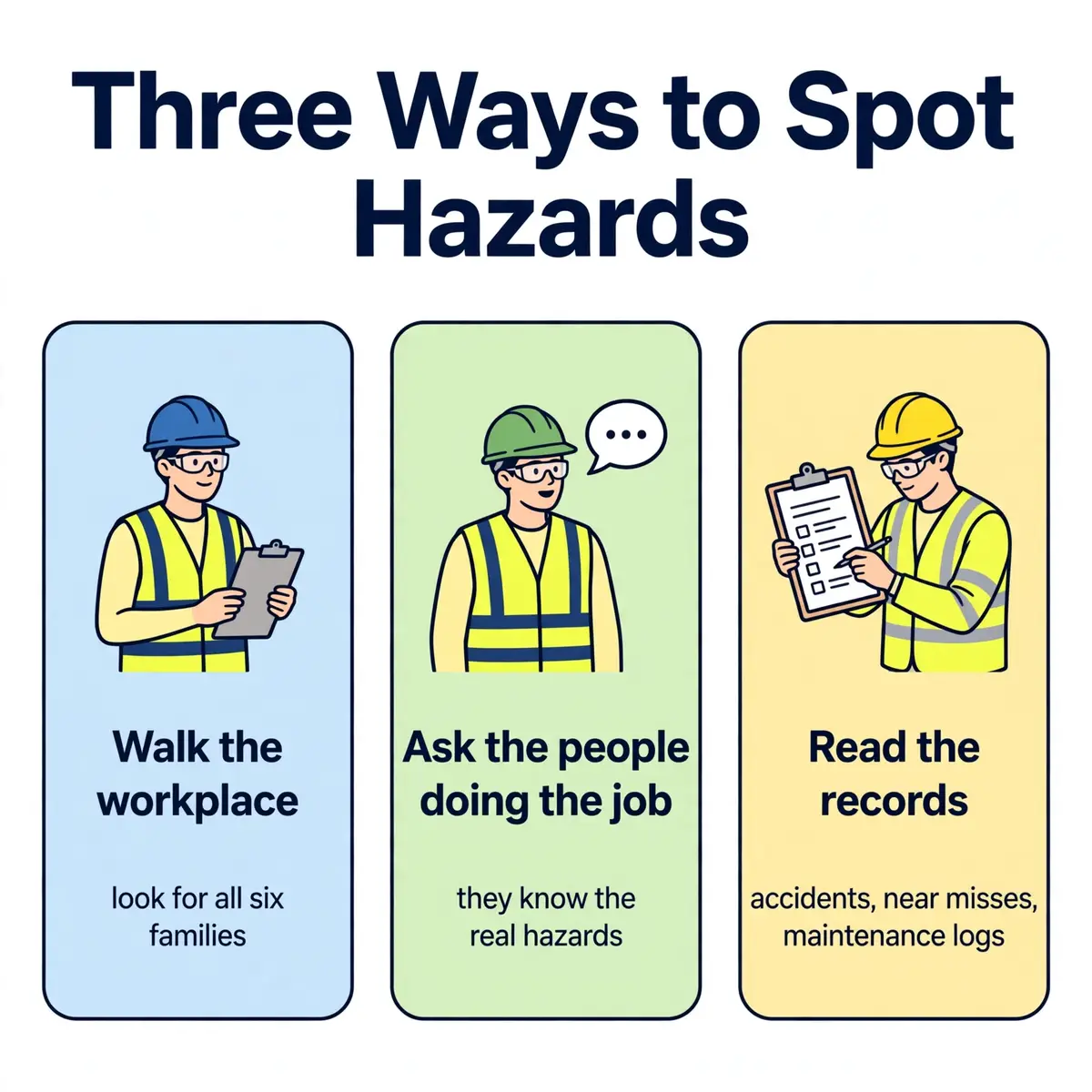
A planned walkthrough beats a casual glance. Walk the route workers actually take, watch the task being done, and look for the six hazard families in turn. Check floors, lighting, storage, guards, labels, ventilation and exits. Look up as well as down: overhead loads, unguarded edges and stacked materials cause injuries that a floor-level look misses.
Take notes and photographs of what needs fixing, and give each item an owner and a date. A hazard found and recorded is halfway to being controlled. Repeat the walk after any change. A new machine, a new chemical, a new layout or a new shift pattern can create new hazards.
Ask the People Doing the Job
Workers know where the real hazards are. They know which guard is always removed, which chemical stings the eyes, which lift hurts the back and which shortcut everyone takes. Ask them directly, and ask what they would change first. A short conversation at the workstation often finds more than a formal inspection does.
Make reporting easy and safe. A worker who reports a hazard must never be punished or ignored for it. In the United States, retaliation against a worker for raising a safety concern is unlawful under section 11(c) of the Occupational Safety and Health Act. The same principle applies everywhere: silence is more dangerous than a report.
Read the Records
Accident books, near-miss reports, inspection notes, maintenance logs and health records all point at hazards. Three similar near misses in one area are a warning, not a coincidence. A machine that breaks down often is a hazard waiting for a victim. A cluster of skin complaints in one team points at a chemical or a process worth investigating.
Compare the records with the walkthrough. If the accident book shows slips in a corridor that looks clean during the walk, check it when it is wet, busy or dimly lit. Records also show whether past fixes worked: if the same incident repeats, the control failed and needs a different answer.
WarningA near miss is a free lesson. Investigate it the same way as an injury, because the next time the same hazard is met, someone may not be so lucky.
The Rules That Apply
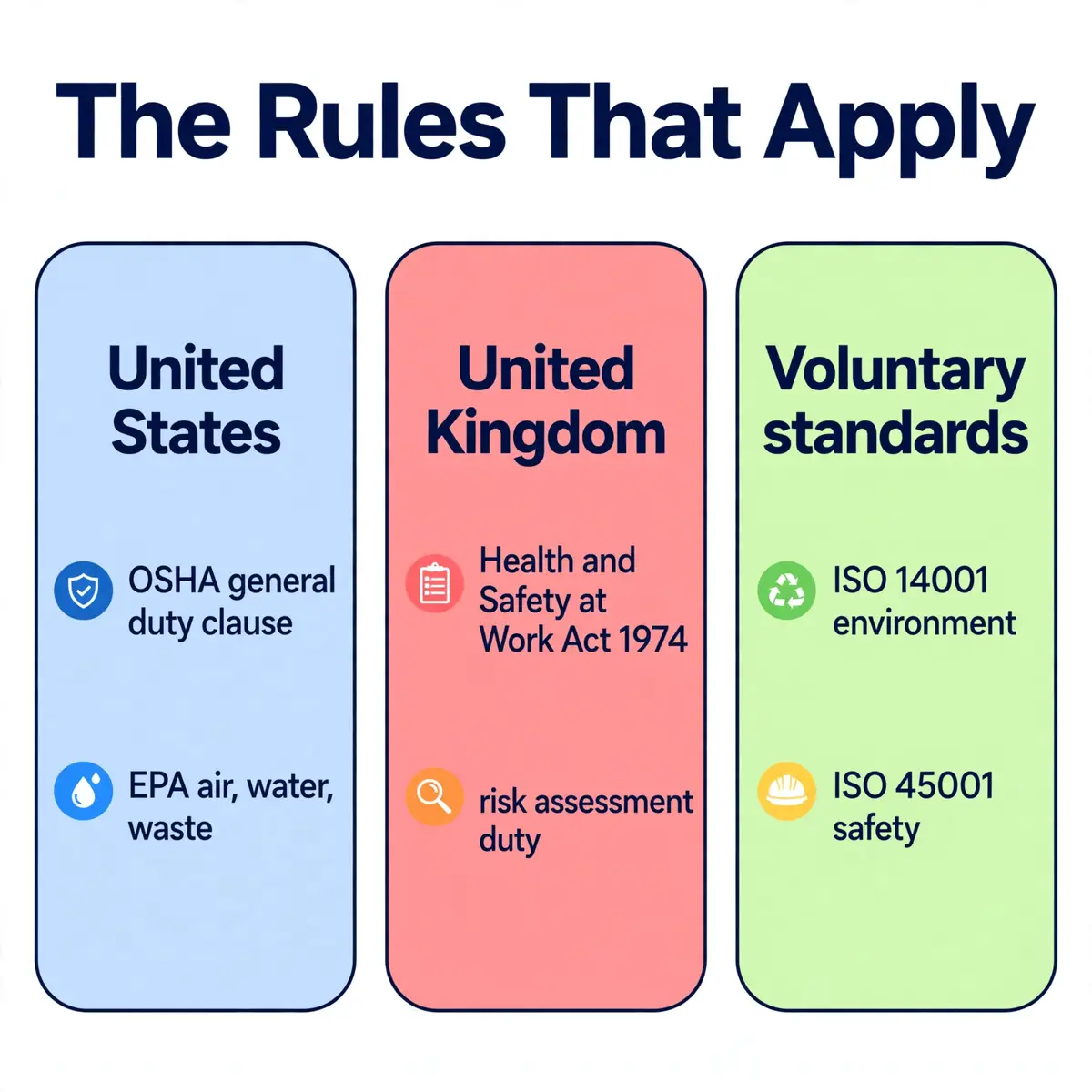
EHS rules come from three different sources. The law must be obeyed. Regulators' guidance shows how to obey it. Voluntary standards describe good practice. Confusing them causes two mistakes: treating a voluntary standard as a legal duty, and treating guidance as optional when a court would treat it as the expected standard. The sections below keep them apart.
The United States
In the United States, the Occupational Safety and Health Administration (OSHA) sets and enforces workplace safety and health standards. The starting point is the general duty clause, section 5(a)(1) of the Occupational Safety and Health Act. It requires every employer to provide employment free from recognised hazards. That covers hazards likely to cause death or serious physical harm. It applies even where no specific standard covers that exact hazard.
Below the general duty clause sit specific standards for particular hazards. Many of them require a written programme:
- Hazard communication for chemicals.
- Lockout/tagout for hazardous energy.
- Permit-required confined space entry.
- Bloodborne pathogens.
- Process safety management for highly hazardous chemicals.
There is no single OSHA rule that says every employer must hold one written EHS programme, but most workplaces owe several written programmes at once.
Reporting and recordkeeping are also duties. A work-related fatality must be reported to OSHA within eight hours. An inpatient hospitalisation, an amputation or the loss of an eye must be reported within 24 hours. Employers with more than ten employees in most industries must keep an OSHA 300 log of recordable injuries and illnesses, and post the 300A summary each year.
On the environmental side, the Environmental Protection Agency (EPA) regulates air emissions, water discharges and waste. A facility may need an operating permit under the Clean Air Act. It may also need a discharge permit under the National Pollutant Discharge Elimination System. Hazardous waste falls under the Resource Conservation and Recovery Act. Some states go further: California requires every employer to hold a written Injury and Illness Prevention Program.
The United Kingdom
In the United Kingdom, the Health and Safety at Work etc. Act 1974 sets the framework. Section 2 requires every employer to ensure, so far as is reasonably practicable, the health, safety and welfare of employees at work. That phrase matters. It means the duty is balanced against the cost, time and trouble of the control. But cost alone is never a reason to leave a serious risk uncontrolled.
Below the Act sit regulations, including the Management of Health and Safety at Work Regulations 1999. Regulation 3 requires a suitable and sufficient assessment of the risks to employees and others affected by the work. Other regulations cover specific hazards, from hazardous substances to manual handling and work equipment. The Health and Safety Executive enforces the law and publishes guidance on how to meet it.
Environmental law in the United Kingdom is enforced separately, mainly by the Environment Agency in England, with equivalent bodies in Scotland, Wales and Northern Ireland. Permits cover emissions, discharges and waste handling. A workplace that stores fuel or chemicals must also prevent pollution of land and water, and report serious spills.
The Voluntary Standards
Two international standards tie EHS together. ISO 14001 covers environmental management: identifying environmental aspects, meeting legal duties, and improving performance. ISO 45001 covers occupational health and safety management: the same structure, applied to worker health and safety. Both follow the Plan-Do-Check-Act cycle, and both are voluntary: no law requires certification to either one.
Certification is often requested by customers and clients as proof that a system works. But a certificate is not a legal duty. It does not replace compliance with the law. The International Organization for Standardization itself does not certify companies; accredited certification bodies do that. For a deeper look at the environmental side, see the guide to the environmental management framework, and for the safety standard, the guide to ISO 45001.
AlertVoluntary does not mean unimportant. A customer can require ISO 14001 or ISO 45001 certification as a condition of a contract, and losing a contract hurts as much as a fine.
The Seven Parts of a Working Ehs Programme
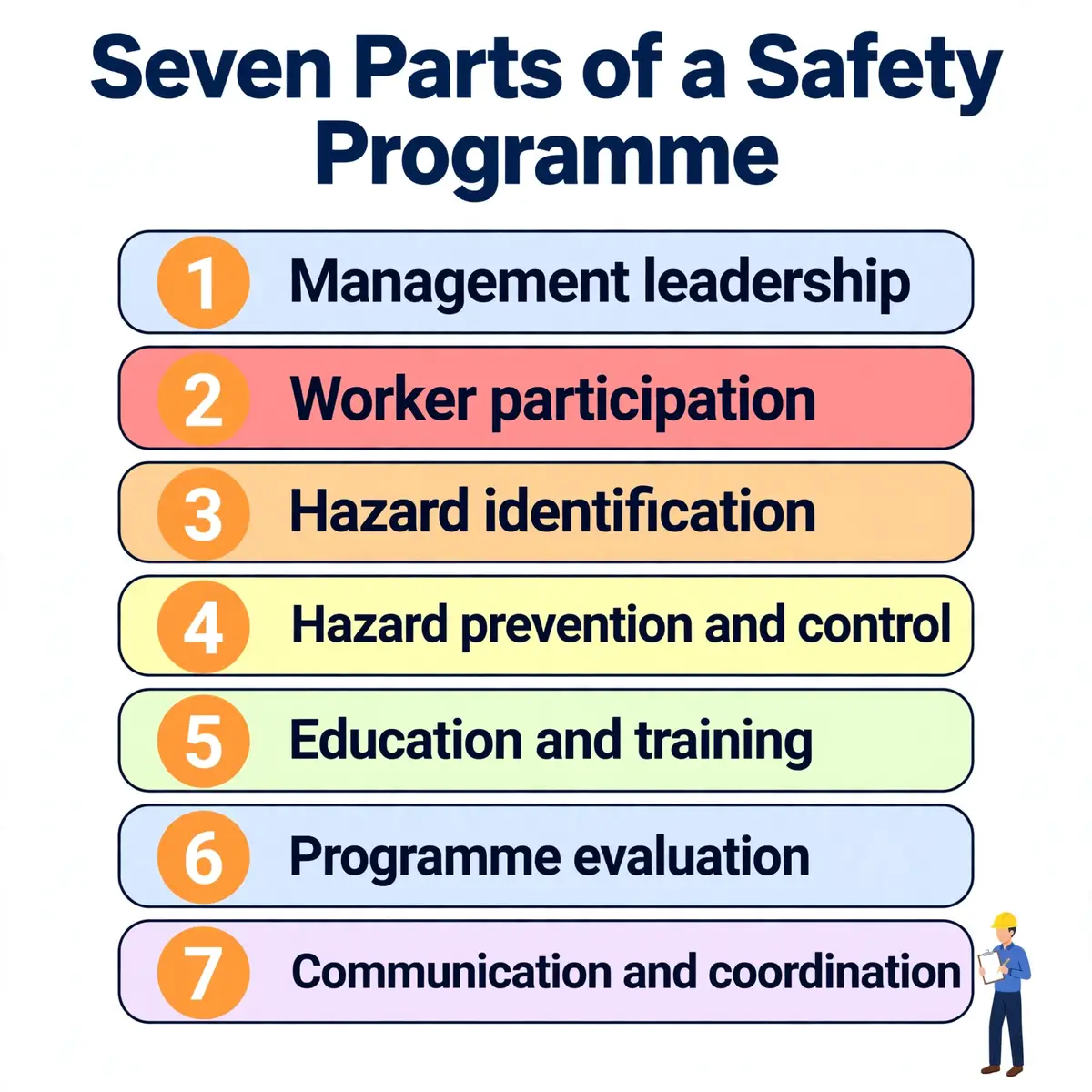
OSHA's Recommended Practices for Safety and Health Programs describe seven core elements of a successful programme. They were published in October 2016. The guidance is not legally binding on its own, but it describes what inspectors look for and what the evidence says actually works. A programme that covers all seven, and actually practises them, is a working programme. A binder that covers them on paper is not.
| Core element | What it means in practice |
|---|---|
| Management leadership | Senior managers commit money and time, set goals, and visibly take safety seriously. |
| Worker participation | Frontline workers help find hazards, investigate incidents and review the programme. |
| Hazard identification and assessment | A proactive, ongoing process of finding and ranking hazards before they cause harm. |
| Hazard prevention and control | Controls chosen in hierarchy order: elimination, substitution, engineering, administrative, then PPE. |
| Education and training | Workers trained before exposure, in a language they understand, with records kept. |
| Programme evaluation and improvement | The programme is reviewed at least once a year and after any serious incident. |
| Communication and coordination | Host employers, contractors and staffing agencies agree in writing who controls which hazards. |
Management leadership comes first because it decides whether the rest happens. A programme that exists because a manager signed a form will not reduce injuries. Workers must also be involved, because the people doing the job find hazards that managers never see. Training must happen before exposure, not after an incident. And the programme must be reviewed at least once a year, and after any serious incident, so that it improves instead of going stale.
Controls deserve a closer look, because they are where most programmes fail. The hierarchy of controls ranks them from most to least effective: elimination, substitution, engineering controls, administrative controls, and personal protective equipment last. PPE comes last because it protects only the worker, never the source of the hazard. The guide to PPE requirements explains selection, fit and care. This is the step most programmes get wrong: the employer jumps straight to PPE. The guide to the hierarchy of controls explains each level with workplace examples.
What to Do When You Find a Hazard
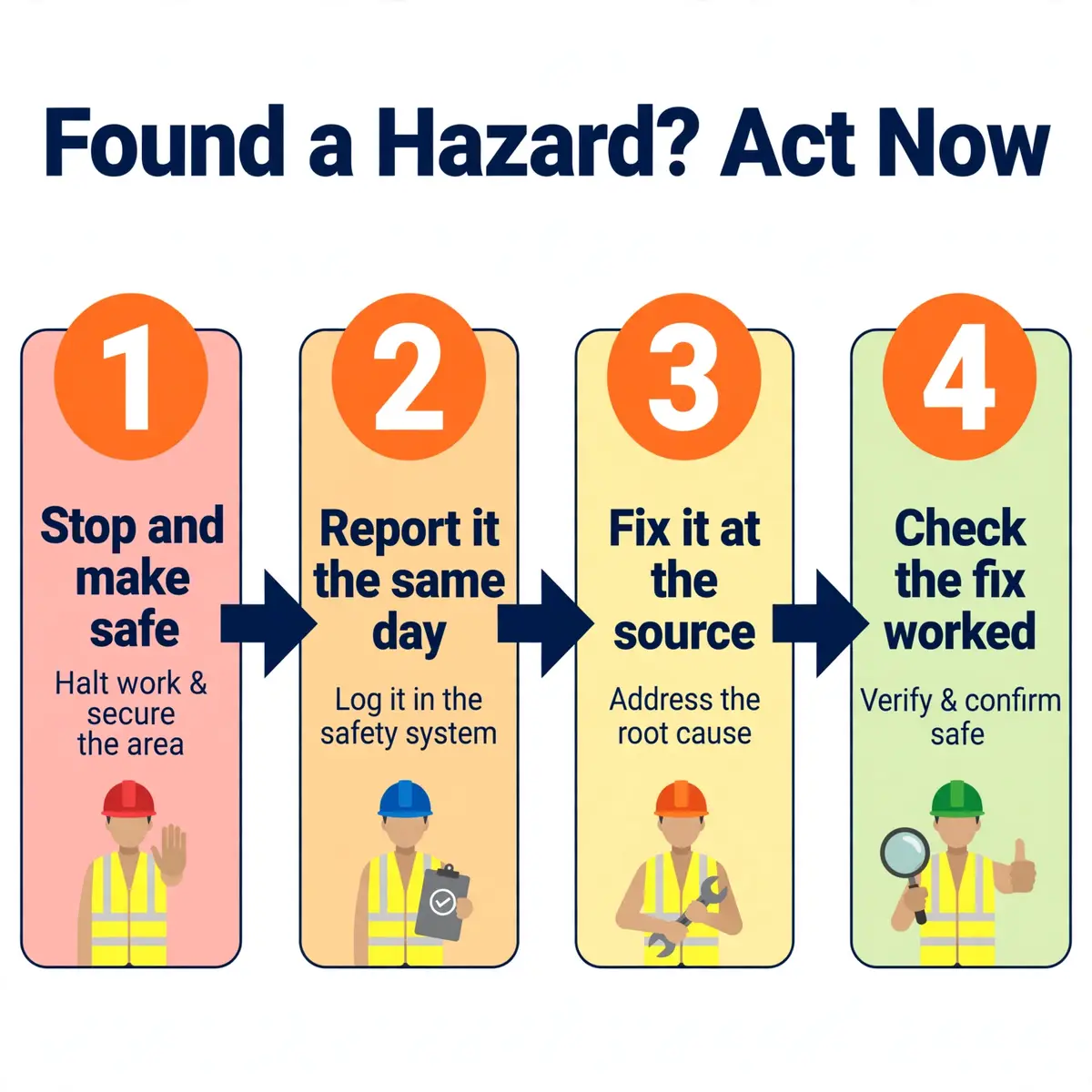
Finding a hazard is only useful if something happens next. The four steps below work for any hazard, from a frayed cable to a leaking drum to a bullying supervisor. They are short on purpose: a worker should be able to follow them without looking anything up. Managers should make sure the steps are known before a hazard appears, not explained afterwards.
Step 1: Stop and Make the Area Safe
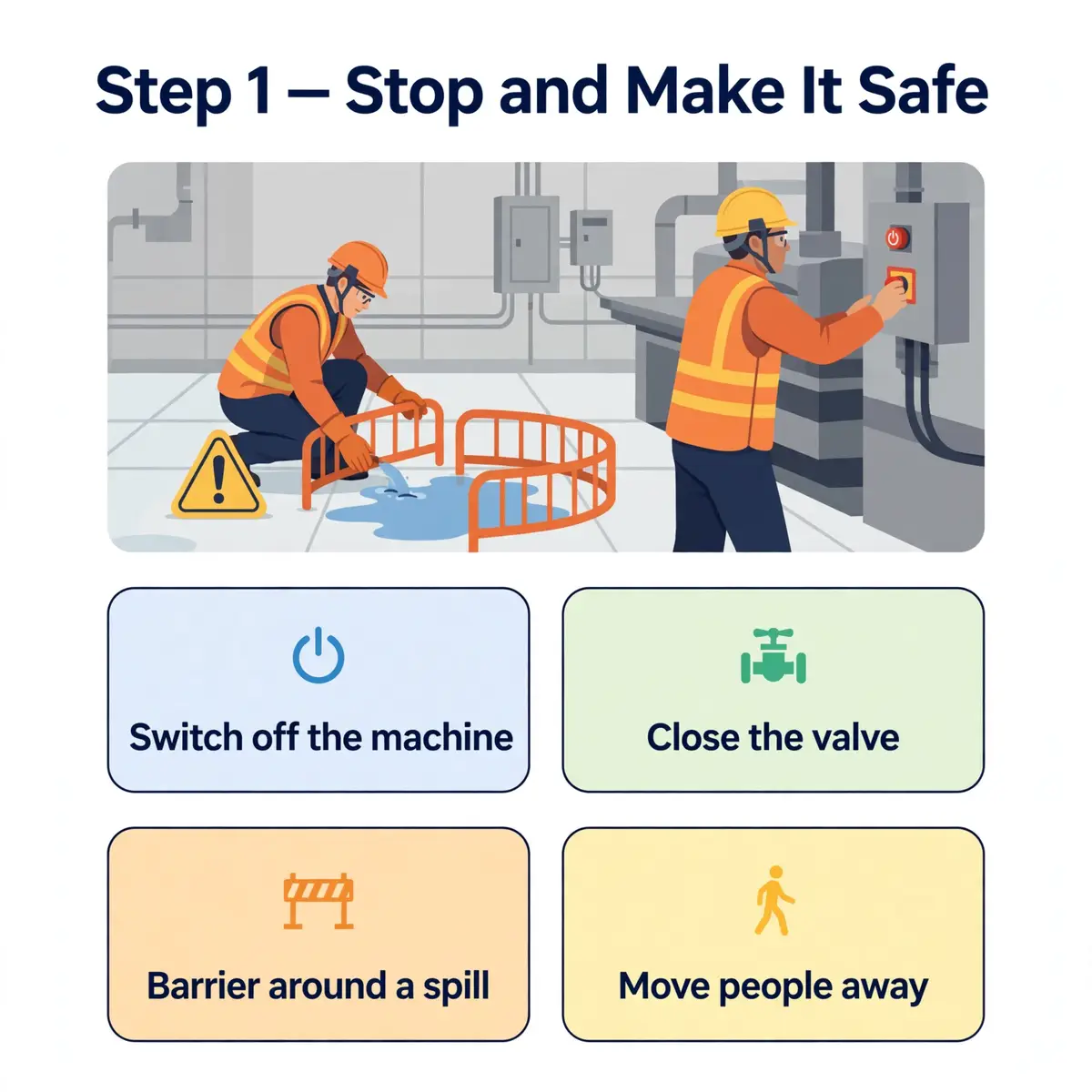
Stop the work that the hazard threatens, and make the area safe for everyone nearby. That can mean switching off a machine, closing a valve, putting a barrier around a spill, or moving people away from the area. Do not try to fix a serious hazard while the work continues around it. A quick barrier and a warning sign cost minutes; an injury costs far more.
Some hazards need specialist help before anyone goes near them: a gas leak, a chemical spill, a damaged electrical panel, a suspected asbestos material. In those cases, the right action is to clear the area and call the person responsible. Never enter a confined space or handle a substance you are not trained to deal with.
Step 2: Report It the Same Day
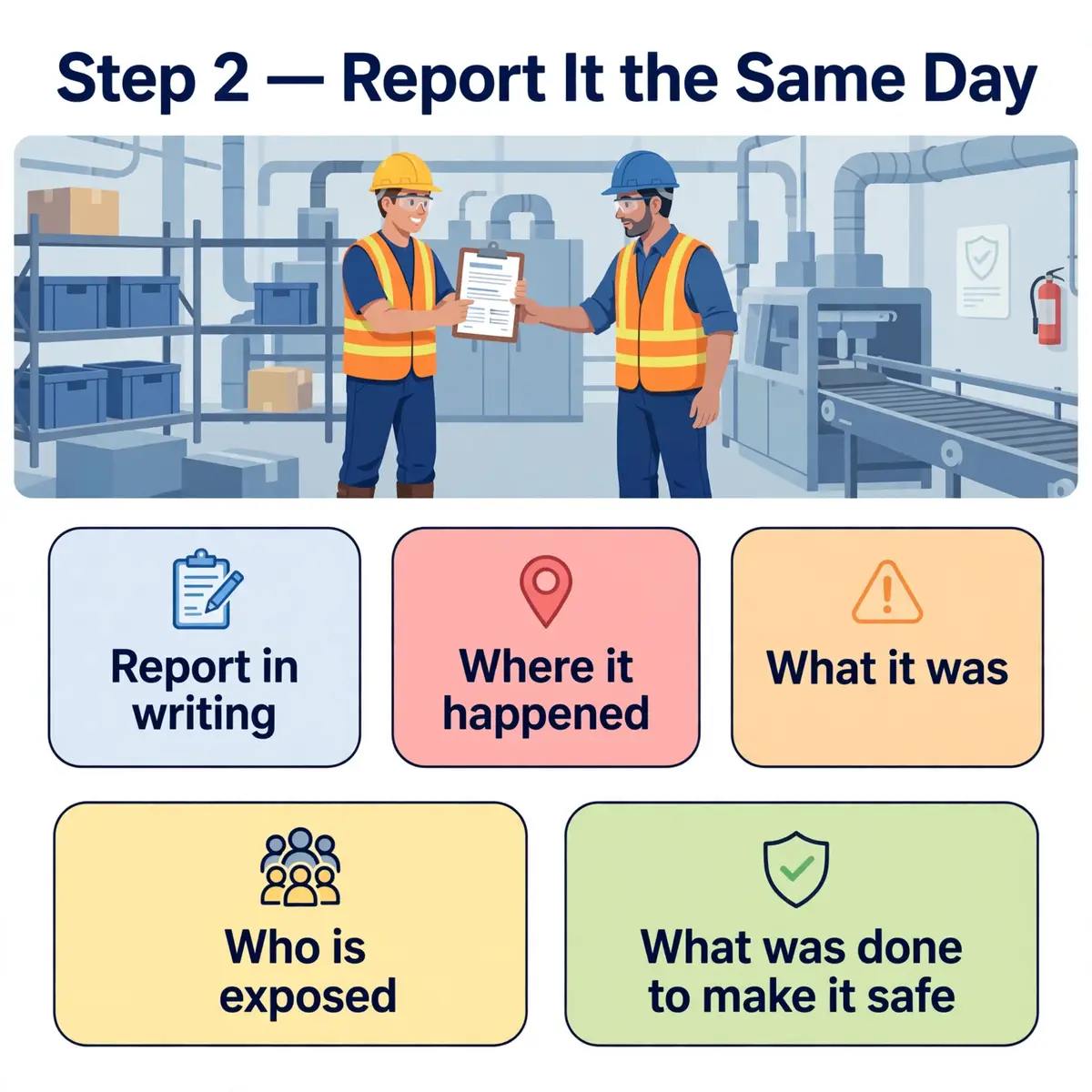
Report the hazard the same day, in writing, to the person responsible for the area. Say where it is, what it is, who is exposed, and what you did to make it safe. A verbal report is better than silence, but a written report creates a record that cannot be forgotten or denied. Photographs help, especially for damage or deterioration.
If the hazard is not acted on, report it again, one level higher. A hazard that is reported and ignored is still the employer's responsibility. Keep a copy of the report and note the date, so the delay is visible if the hazard later causes harm.
Step 3: Fix It at the Source
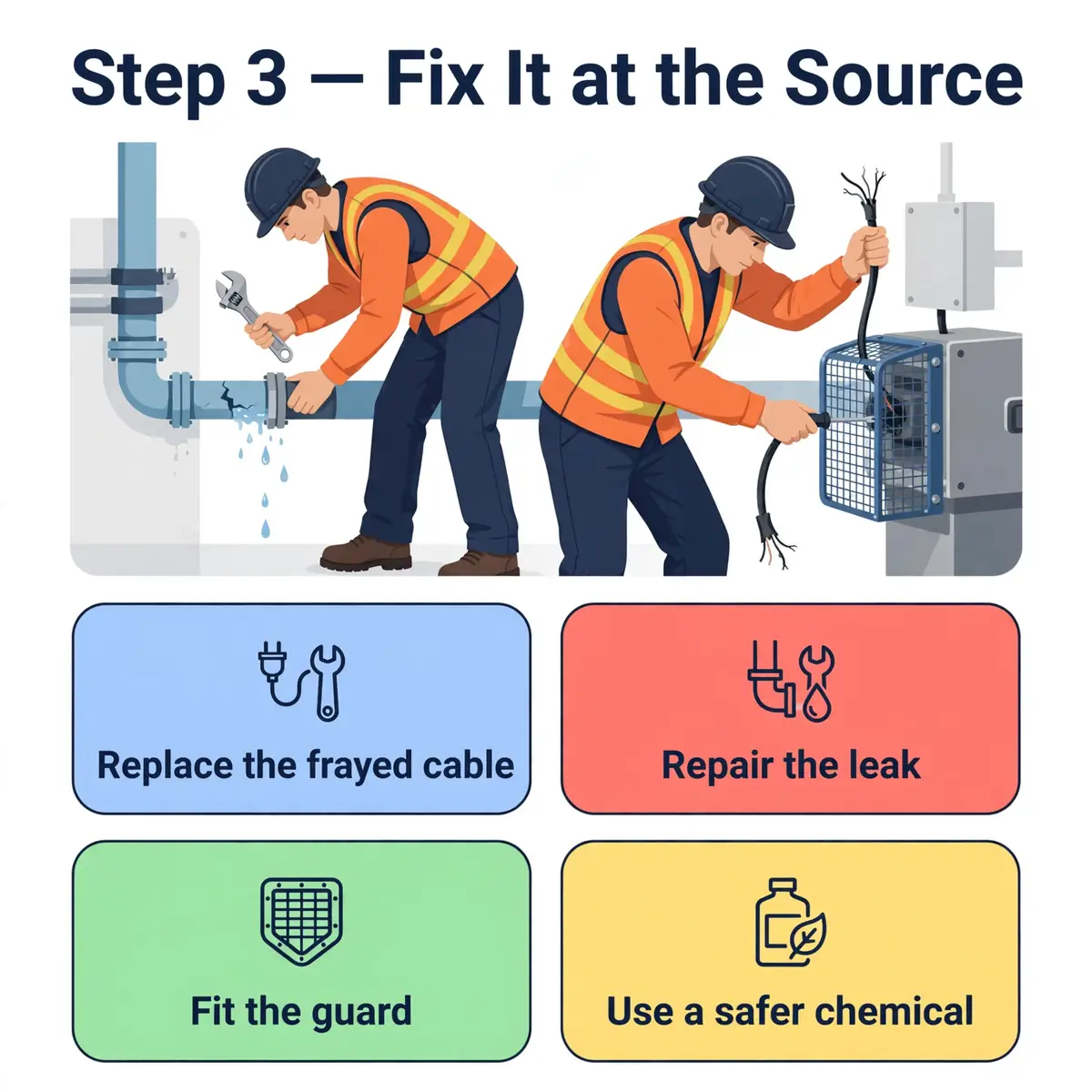
Fix the hazard at its source, not at the worker. Replace the frayed cable, repair the leak, fit the guard, substitute the safer chemical, redesign the lift. A warning sign or a pair of gloves is not a fix when the hazard itself can be removed. Work through the hierarchy of controls and pick the highest control that is reasonably practicable.
Set a date for the fix and name the person responsible for it. Some fixes need parts, a shutdown or a contractor, and that takes time. In the meantime, keep the temporary control in place: the barrier, the sign, the restricted access. A temporary control that is removed before the real fix is done leaves the hazard open again.
Step 4: Check the Fix Worked
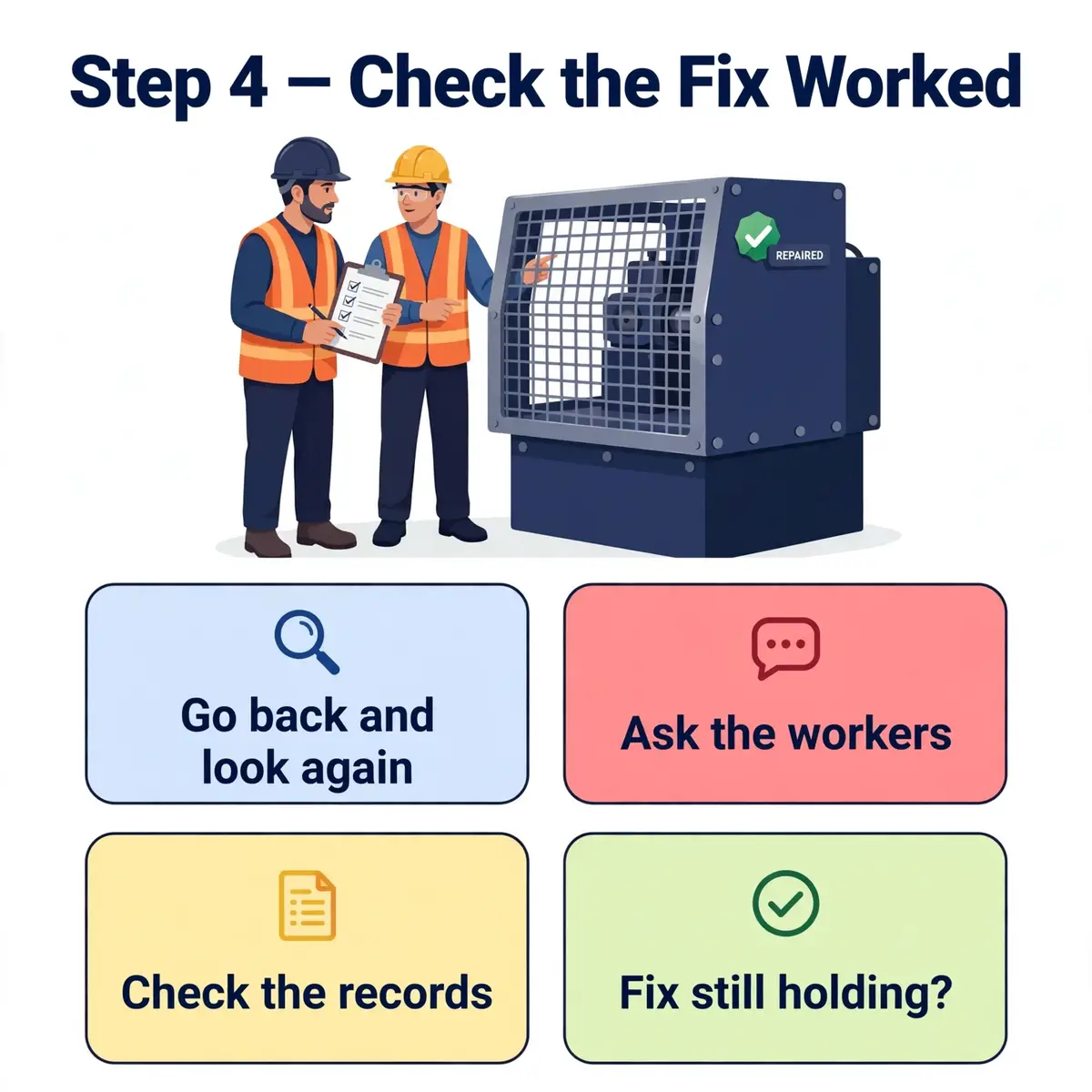
Go back and check that the fix worked. Look at the hazard again, ask the workers who use the area, and check the records for repeats. A guard that is fitted but removed each shift has not fixed anything. A new chemical that still stings the eyes has not solved the problem. A fix that is not checked is a guess.
Record the outcome: what was found, what was done, when it was checked, and who checked it. Close the report only when the hazard is gone or controlled. If the same hazard appears again, the control failed, and a different answer is needed. That is how a reporting system improves instead of just collecting paper.
A Chemical Spill, Step by Step
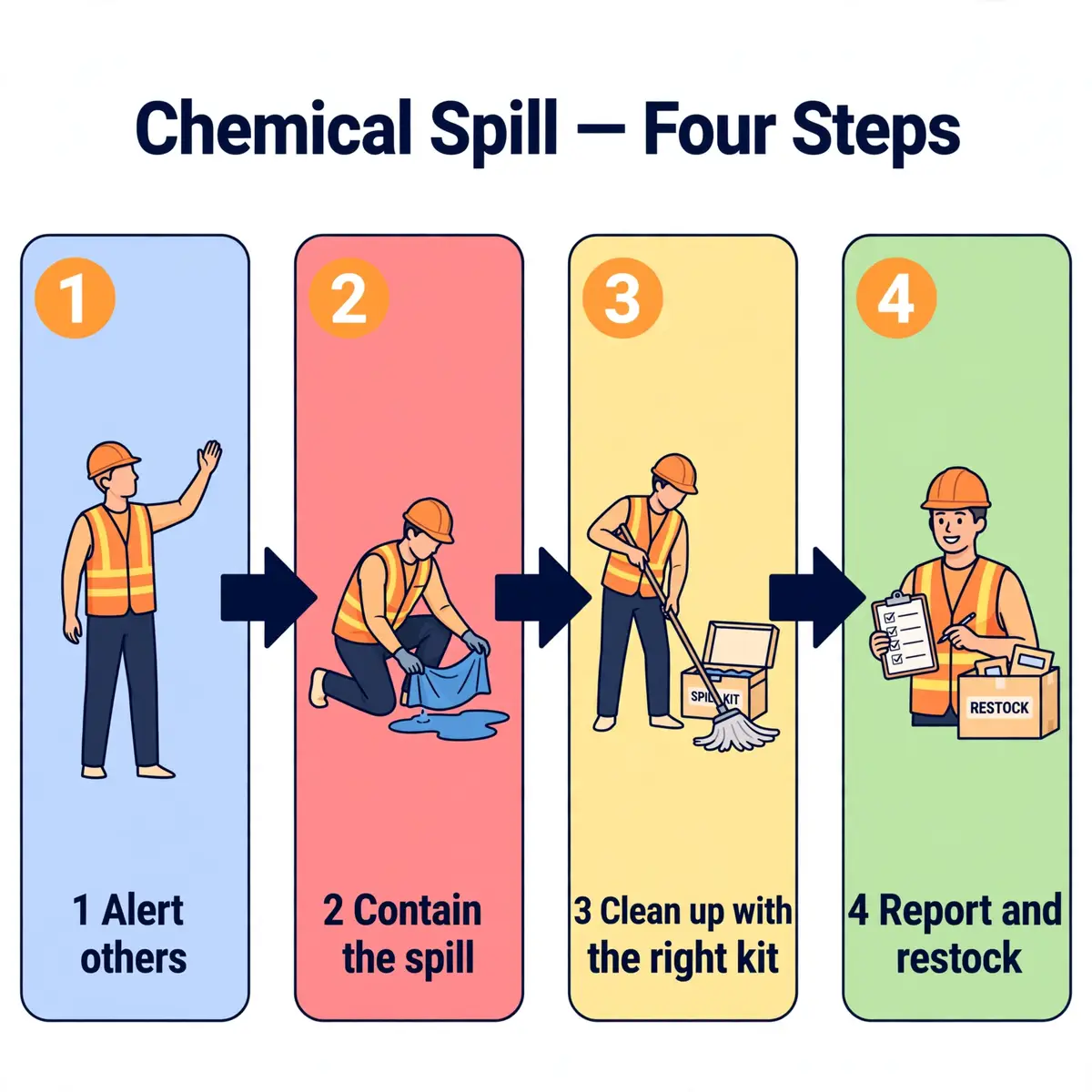
A chemical spill is a common environmental incident in a workplace, and the first minutes decide how bad it gets. The four steps below apply to most small spills of oils, solvents, acids and cleaning chemicals. A large spill, an unknown chemical, a fire, or anyone feeling ill changes the answer: evacuate and call the emergency services. The guide to practice emergency procedures covers evacuation and emergency planning in full.
Step 1: Alert Others and Clear the Area
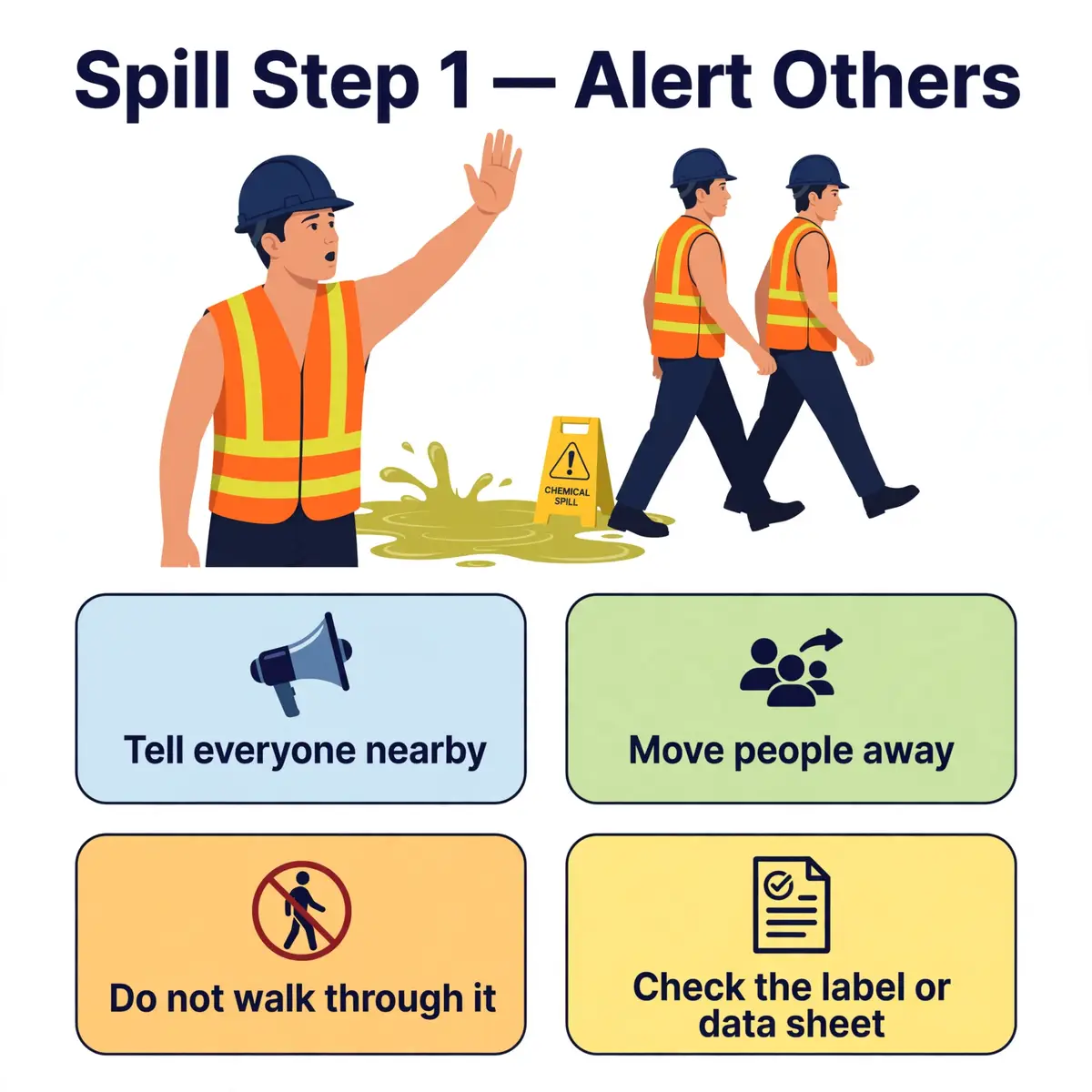
Tell everyone nearby, and move people away from the spill, upwind if there are fumes. Do not walk through the spilled liquid, and do not try to mop it up before knowing what it is. Check the label or the safety data sheet for the chemical name and its hazards. If the chemical is unknown, or anyone feels dizzy, sick or short of breath, leave the area and call for help.
Put on the protective equipment the safety data sheet calls for before going near the spill: gloves, eye protection, and respiratory protection if fumes are present. Open doors and windows if it is safe to do so, and switch off ignition sources if the chemical is flammable. Keep people out until the spill is cleaned up.
Step 2: Contain the Spill
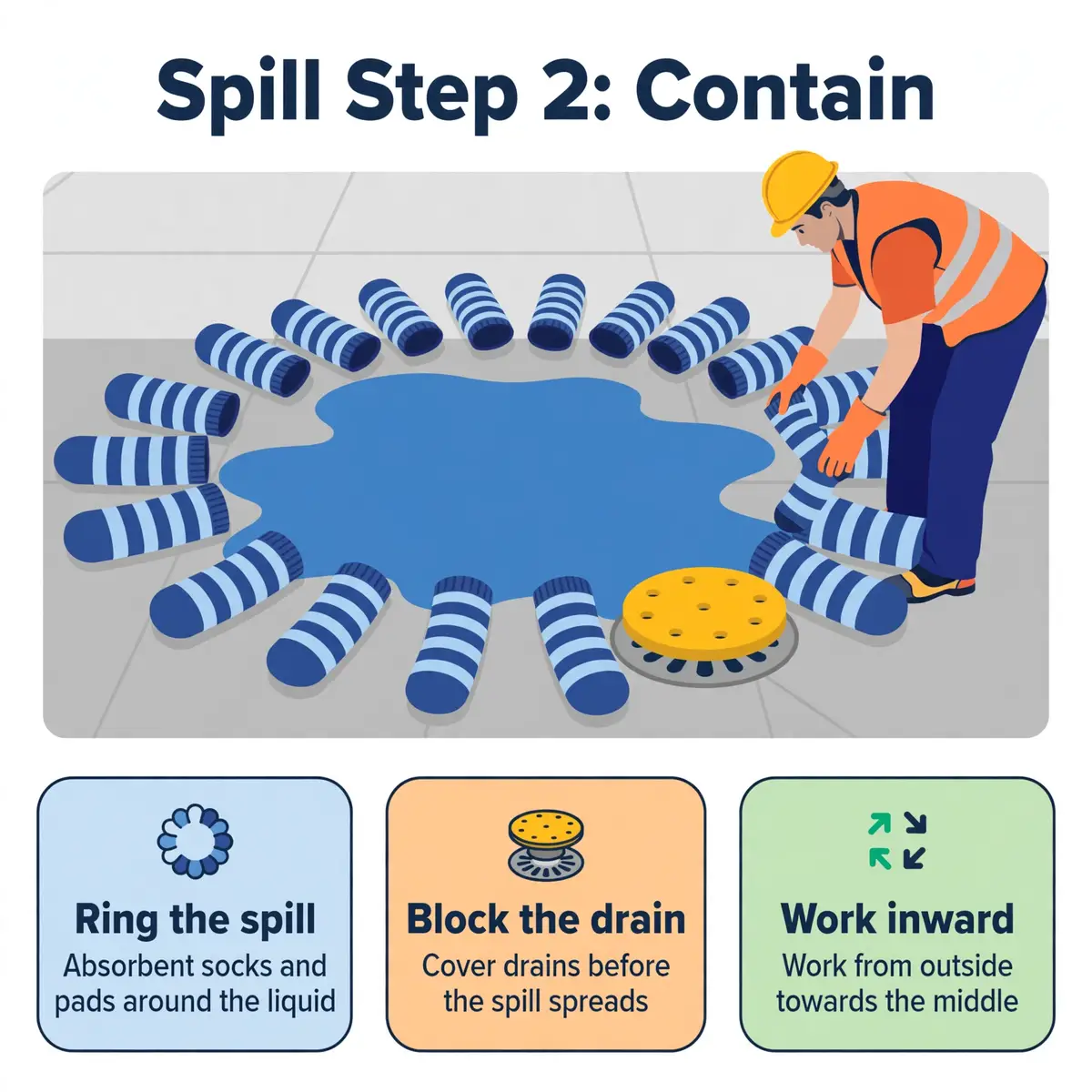
Stop the spill from spreading. Use absorbent socks or pads from the spill kit to surround the liquid, and cover or block any drain it could reach. If the spill comes from a leaking container, stand the container upright or move it into a bund or tray if that can be done safely. Never wash a chemical spill down a drain: drains lead to watercourses or treatment works that cannot handle it.
Work from the outside of the spill towards the middle, so the liquid is pushed inwards rather than spread outwards. Keep the spill kit close to where liquids are stored and used, and make sure everyone who handles chemicals knows where it is. A kit that is locked away or empty is no help at all.
Step 3: Clean It Up with the Right Kit
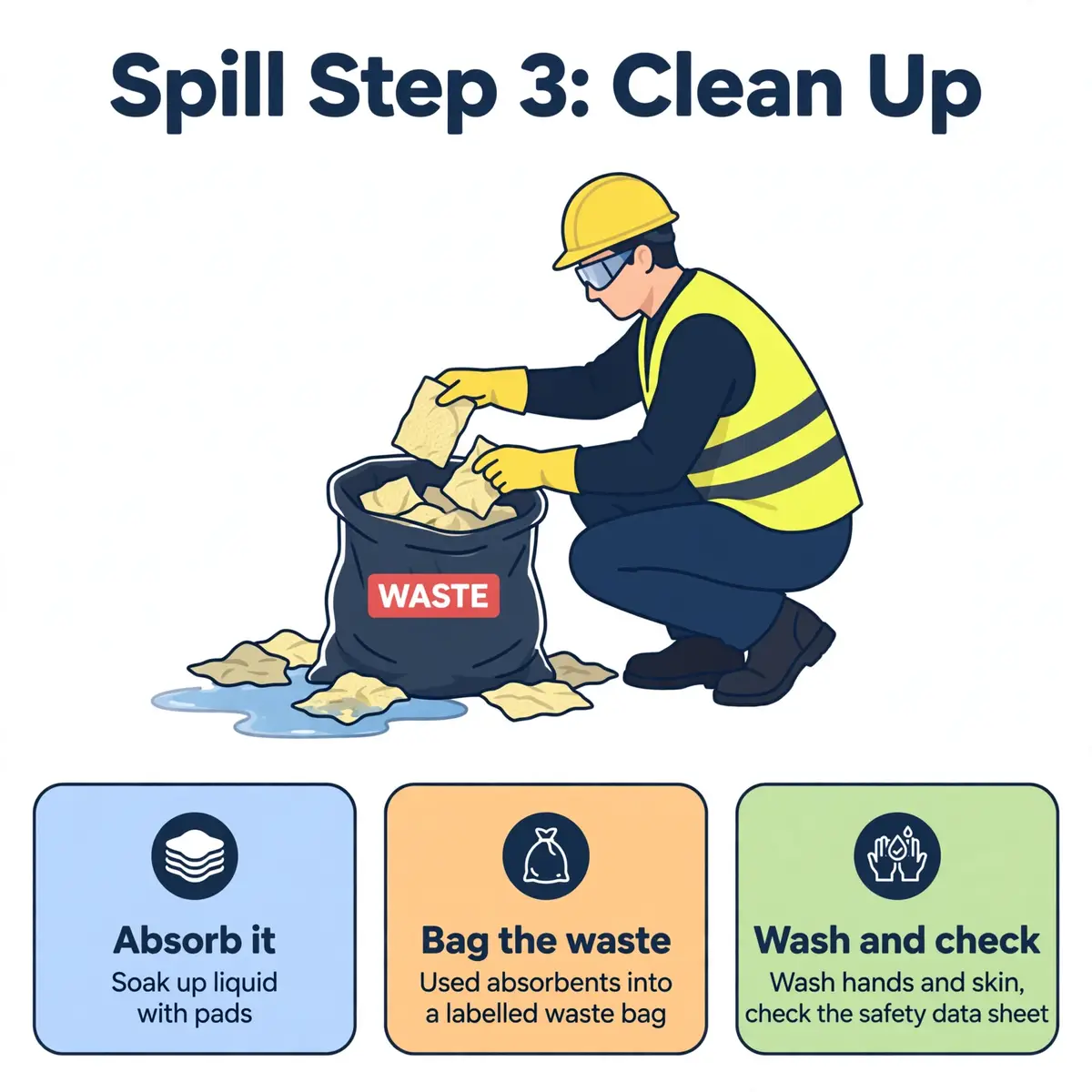
Absorb the liquid with pads or granules from the spill kit, working from the outside in. Put the used absorbents into a labelled waste bag or drum, not into general waste. Some chemicals need a neutraliser, and some react with the wrong absorbent: check the safety data sheet before choosing. For acids and alkalis, the data sheet names the right treatment.
Clean the area with water or the cleaner the data sheet recommends, and ventilate the room. Wash hands and any skin that touched the chemical, and check clothing for contamination. If the chemical touched skin or eyes, follow the first aid instructions on the data sheet and the label, and get medical advice if symptoms appear. The guide to the first aid kit explains what belongs in a workplace kit.
Step 4: Report It and Restock
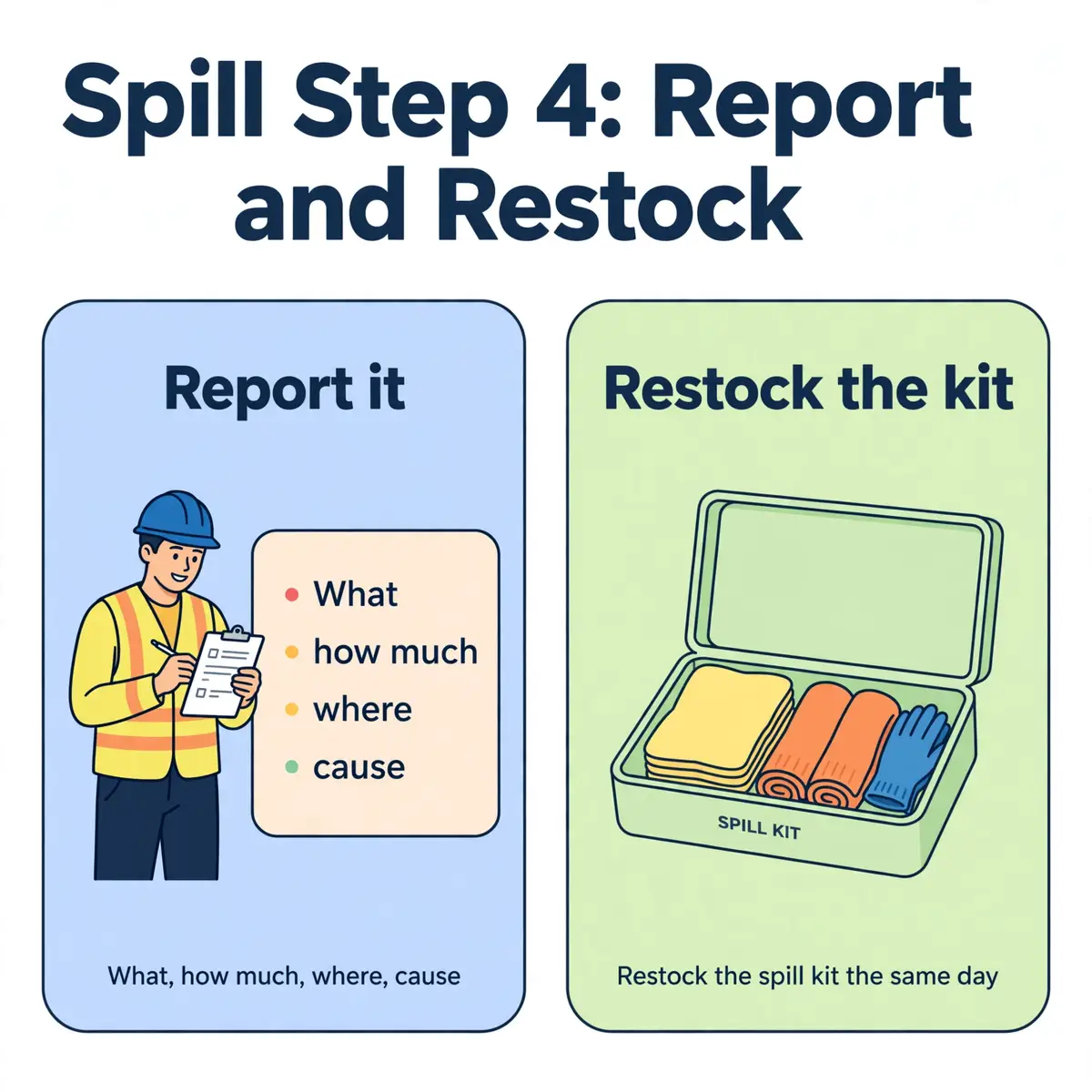
Report the spill in writing: what spilled, how much, where, what caused it, and what was done. A spill that reaches a drain or watercourse may need to be reported to the environmental regulator, and the report should record whether that happened. Investigate the cause, and fix it: a damaged container, a missing bund, a bad decanting method, a worker who was never trained.
Restock the spill kit the same day. Replace the pads, socks, gloves and bags that were used, and check the kit is complete before the next shift. A kit that is half empty after one spill will fail on the second. Record the restock, so the next inspection can confirm the kit is ready.
WarningNever mix spill clean-up materials. Bleach mixed with an acid or with ammonia can release toxic gas, and the wrong absorbent can react with the chemical it is meant to soak up.
Practical Tips That Work in Any Workplace
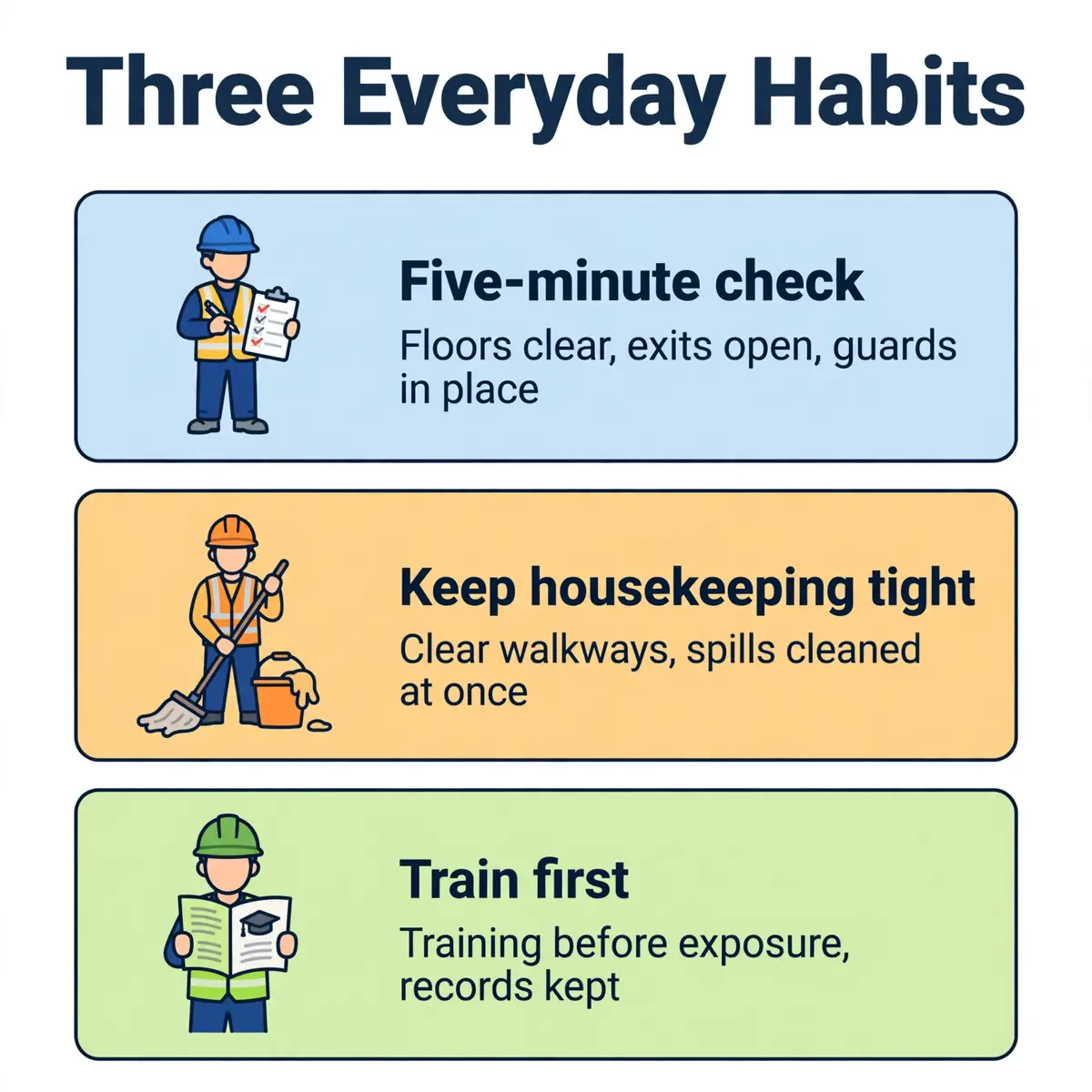
Most EHS improvement comes from small habits repeated every day, not from grand projects. The tips below cost little and work in offices, workshops, warehouses and sites alike. They are the habits that separate a workplace where EHS is real from one where it only exists on paper.
Start the Shift with a Five-Minute Check
Begin each shift by looking at the work area with fresh eyes. Check that:
- Floors are clear.
- Exits are open.
- Guards are in place.
- Labels are readable.
- The spill kit is stocked.
- The first aid kit is sealed.
Five minutes at the start saves the hour lost to an incident later. Make the check a habit, not a formality, and rotate who does it so everyone learns what to look for.
Raise anything wrong before work starts, not after the first task. A missing guard found at 8 a.m. is a two-minute fix. The same guard found after an injury is an investigation. Short checks also show new workers that safety is taken seriously from their first day.
Keep Housekeeping Tight
Good housekeeping is one of the simplest ways to prevent injuries. Clear walkways, stacked materials that cannot fall, cables kept off the floor, spills cleaned at once, waste removed at the end of the shift. Slips, trips and falls are among the most common workplace injuries, and most of them start with something left where it should not be.
Housekeeping also protects the environment: waste sorted into the right streams, chemicals stored upright in bunded areas, empty containers removed rather than left to leak. A tidy workplace is easier to inspect, easier to evacuate, and easier to work in. It also signals to everyone, including visitors and inspectors, that the place is run properly.
Train People Before They Face the Hazard
Training must happen before exposure, not after an incident. A worker who handles a chemical for the first time needs the safety data sheet, the protective equipment, and the spill procedure before the shift starts. A worker who drives a forklift needs the licence before the keys. A new starter needs the fire exits and the assembly point on day one.
Keep training records: who was trained, on what, when, and by whom. Records prove the training happened, and they show what needs refreshing. The guide to OSHA training explains the main courses and who needs them. The guide to fire extinguisher training covers one of the most commonly needed refreshers.
Common Mistakes That Weaken Ehs
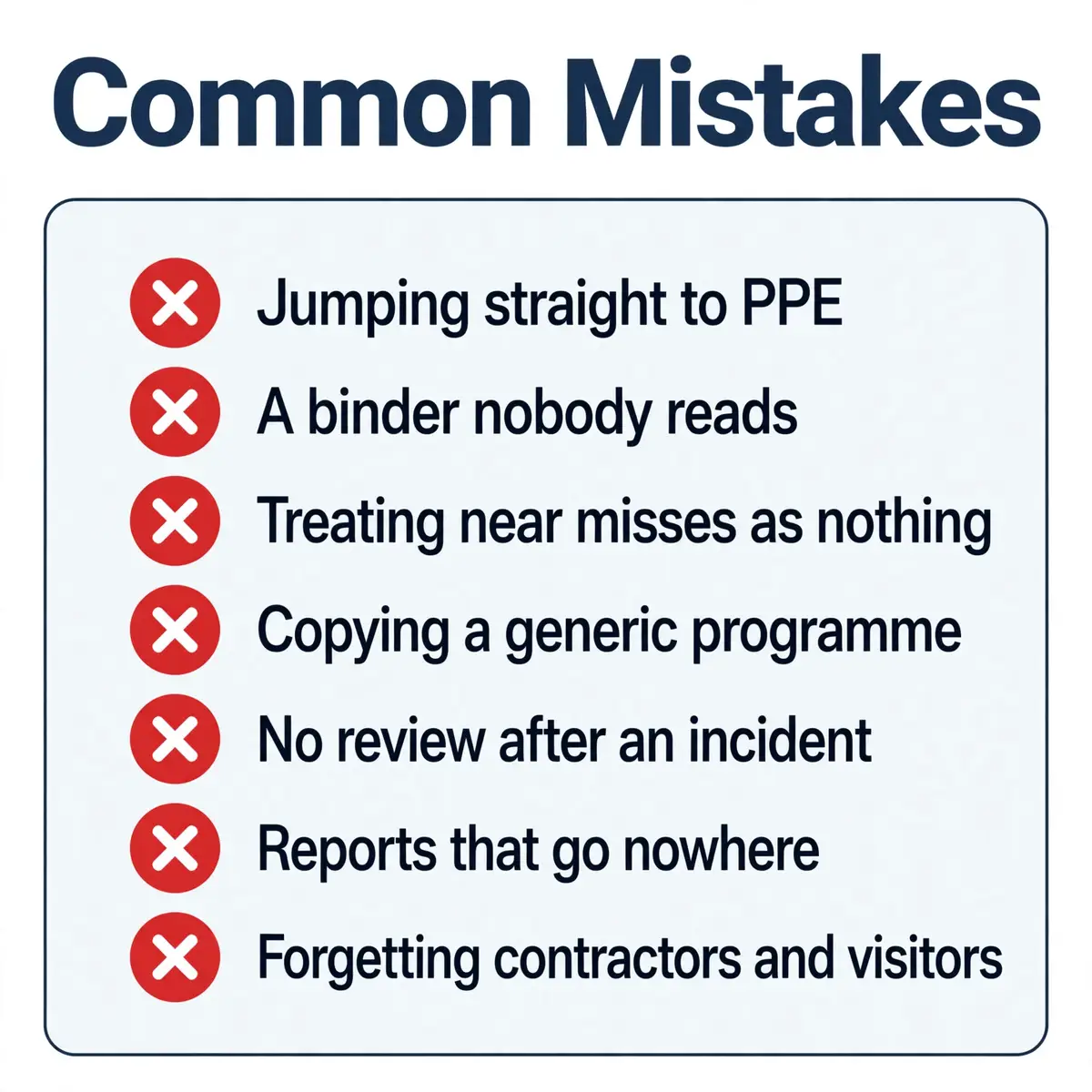
The same mistakes appear in workplace after workplace, and they all have the same result: a programme that looks complete and does not work. Avoiding them matters more than adding new paperwork.
- Jumping straight to PPE. Gloves and masks are the last control, not the first. Fix the hazard at its source before reaching for protective equipment.
- A binder nobody reads. A programme that lives on a shelf helps nobody. If workers cannot say what the procedure is, the procedure does not exist in practice.
- Treating near misses as nothing. A near miss is a warning. Workplaces that ignore them wait for the injury that the near miss predicted.
- Copying a generic programme. A programme that lists chemicals the workplace does not use, or names a contact who left years ago, fails on inspection. It must match the real workplace.
- No review after an incident. A programme that is never reviewed goes stale. Review it at least once a year and after every serious incident.
- Reports that go nowhere. Workers stop reporting hazards when nothing happens. Every report deserves an answer, even when the answer is that the risk is already controlled.
- Forgetting contractors and visitors. Contractors bring their own hazards and face the site's hazards. Agree in writing who controls what before work starts.
None of these mistakes needs money to fix. They need attention, honesty and follow-through. That is the whole of EHS in one sentence: find the hazards, control them properly, and keep checking that the controls work.
Frequently Asked Questions
What Does Ehs Stand For?
EHS stands for environment, health and safety. It is the field that prevents workplace injuries, protects workers' health, and limits the environmental impact of work. For the full meaning of each part, see the guide to what EHS means.
Is an Ehs Programme a Legal Requirement?
There is no single law that requires one written EHS programme. In the United States, OSHA requires written programmes for specific hazards, such as hazard communication, lockout/tagout and confined space entry. The general duty clause covers recognised hazards with no specific standard. In the United Kingdom, the law requires a risk assessment and arrangements for health and safety, which amounts to a programme in practice.
What is the Difference Between Ehs and Occupational Health and Safety?
Occupational health and safety covers worker health and safety only. EHS adds the environment: emissions, waste, spills and pollution. A workplace with no significant environmental impact may need little beyond occupational health and safety, while a factory with chemicals and waste needs the full EHS scope.
WHO is Responsible for Ehs at Work?
The employer holds the legal duty, and senior managers must lead the programme. Supervisors make sure procedures are followed day to day. Workers must follow procedures, use protective equipment, and report hazards. Everyone has a part, but the duty to provide a safe system of work rests with the employer.
How Often Should an Ehs Programme Be Reviewed?
Review it at least once a year. Also review it after a serious incident, a revealing near miss, or a change in the work or the law. A review should check whether controls still work, whether training is up to date, and whether the hazard inventory still matches the real workplace.
Do Small Businesses Need Ehs?
Yes. The law applies regardless of size, though the scale of the programme matches the risk. A small office needs an emergency plan, basic chemical safety for cleaning products, and good housekeeping. A small workshop with chemicals, machinery and waste needs more. The size of the business changes the size of the programme, not whether one is needed.
Sources
- U.S. Bureau of Labor Statistics, Employer-Reported Workplace Injuries and Illnesses, 2023–2024 (news release USDL-26-0101, 22 January 2026)
- Occupational Safety and Health Administration, Recommended Practices for Safety and Health Programs (OSHA Publication 3885, October 2016)
- Occupational Safety and Health Administration, Occupational Safety and Health Act, section 5(a)(1) — General Duty Clause
- Occupational Safety and Health Administration, 29 CFR 1904.39 — Reporting fatalities, hospitalizations, amputations, and losses of an eye
- International Finance Corporation (World Bank Group), General EHS Guidelines: Occupational Health and Safety (30 April 2007)
- Health and Safety at Work etc. Act 1974, section 2 — General duties of employers to their employees
- Health and Safety Executive, Health and Safety at Work etc. Act 1974 — overview
- U.S. Environmental Protection Agency, Resource Conservation and Recovery Act (RCRA) — hazardous waste
- U.S. Environmental Protection Agency, National Pollutant Discharge Elimination System (NPDES) — water discharge permits
- International Organization for Standardization, ISO 14001 — Environmental management systems
- International Organization for Standardization, ISO 45001 — Occupational health and safety management systems