Arc flash PPE is the arc-rated clothing and equipment a worker wears to survive the heat of an arc flash. It is worn when the work has to be done energized. Every piece carries an arc rating in calories per square centimetre. The rating of the whole system must be at or above the incident energy of the task. A shirt, a hood and a pair of gloves that each clear the number are protection. A single piece below it is not.
That rule is simple, and it is the whole subject. Arc flash PPE does not prevent an arc, and it does not stop the blast that comes with one. It limits the burn when the arc goes off with a worker standing in front of it. De-energizing the equipment and proving it dead removes the hazard completely. PPE is the last control in the line, used only when energized work is genuinely unavoidable and properly justified.
What Arc Flash PPE is — and What It Cannot Do
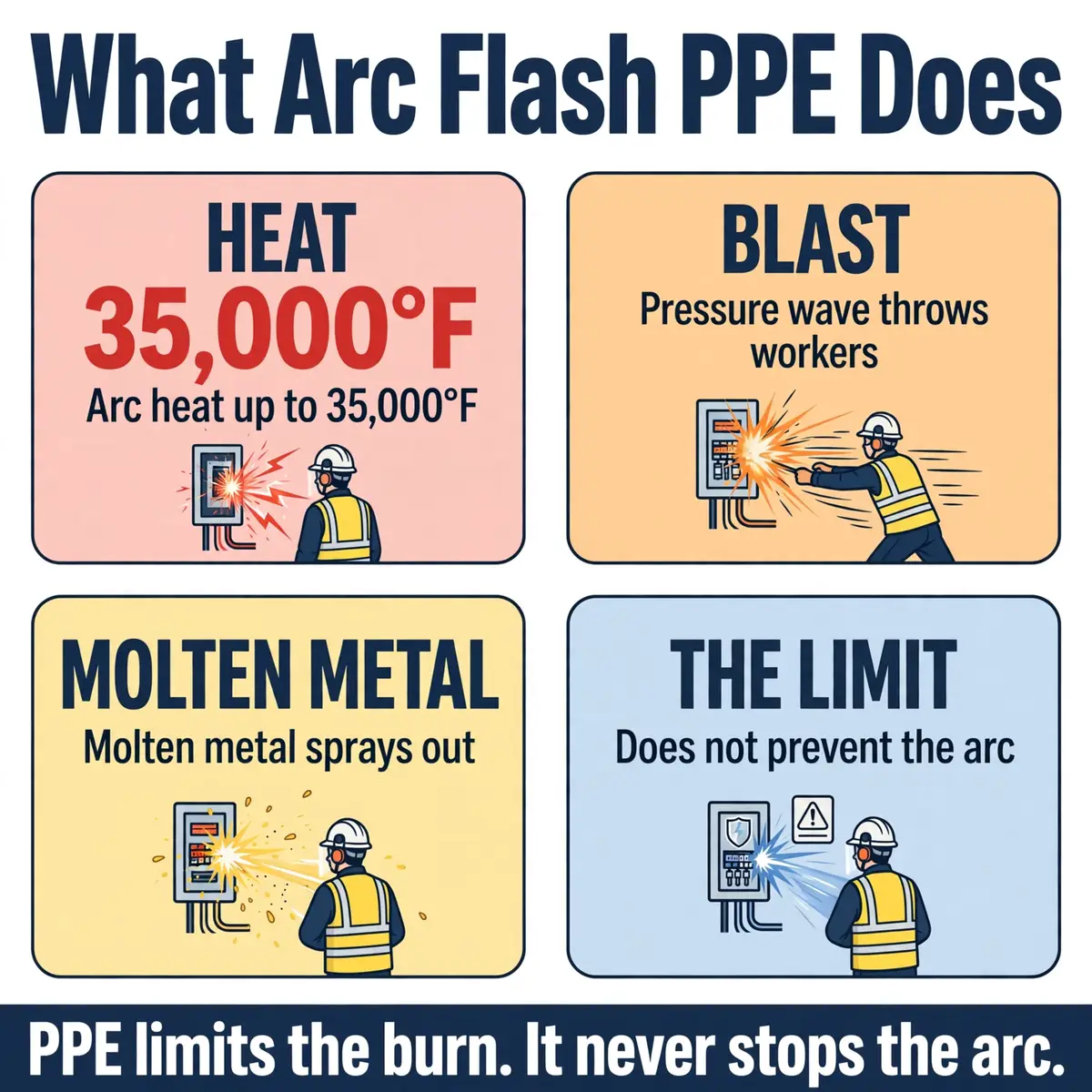
An arc flash is a short circuit through the air. Current jumps between conductors, or between a conductor and earth, and ionizes the air into a sustained plasma arc. Temperatures at the arc can reach about 35,000 °F, several times hotter than the surface of the sun. The flash lasts only a fraction of a second. That is the hazard the clothing is built to survive.
Arc flash PPE is the full set of rated gear a worker wears inside the arc flash boundary. The set includes an arc-rated shirt and pants or a coverall. It also includes an arc-rated face shield or hood, a hard hat, safety glasses, hearing protection, gloves and leather footwear. At higher energies the set becomes a full arc flash suit with a hood. Each piece is tested to a number, and the number is printed on the garment.
What the gear cannot do matters as much as what it can. It does not stop the pressure wave of the arc blast, which can throw a worker off a ladder and rupture eardrums. It does not stop shrapnel from panel parts, and it does nothing against an arc larger than its rating. The arc rating itself is a burn threshold, not a promise of no injury. The arc thermal performance value is the energy at which a second-degree burn behind the fabric is 50 percent likely.
WarningA suit rated below the incident energy looks like protection and is not. Read the number on the label before the suit goes on.
PPE is the Last Control, Not the First
PPE sits at the bottom of the hierarchy of controls on purpose. Elimination comes first: de-energize the equipment, lock it out, tag it and prove it dead. No arc-rated clothing is needed to be safe from it. Engineering controls come next, such as remote racking and arc-energy-reduction settings that lower the energy or move the worker back from the gear.
Crews get this backwards when they reach for the suit first. A 40 cal hood is treated as permission to open a panel that could have been shut down over a lunch break. The suit accepts that the arc happens and tries to keep the worker alive through it. That is the worst protection in the stack, not the best. It is used only when the steps above it genuinely cannot be done.
What an Arc Flash Does to a Worker
The heat is the first injury. It burns exposed skin in a fraction of a second. It ignites ordinary clothing, which then keeps burning against the skin after the arc is gone. That second burn is why arc-rated clothing matters as much as the cal number: a regular work shirt does not just fail to protect, it adds a burn source of its own.
The blast is the second injury. The arc flashes copper to vapour, and the vapour expands hundreds of times in volume. The pressure wave throws workers, ruptures eardrums and turns loose hardware into shrapnel. Molten metal sprays out, and the sound peaks loud enough to cause permanent hearing loss on its own. Arc flash PPE is built for the heat. The hood does not seal out the sound, and no clothing stops the pressure.
The One Rule: Match the Rating to the Energy
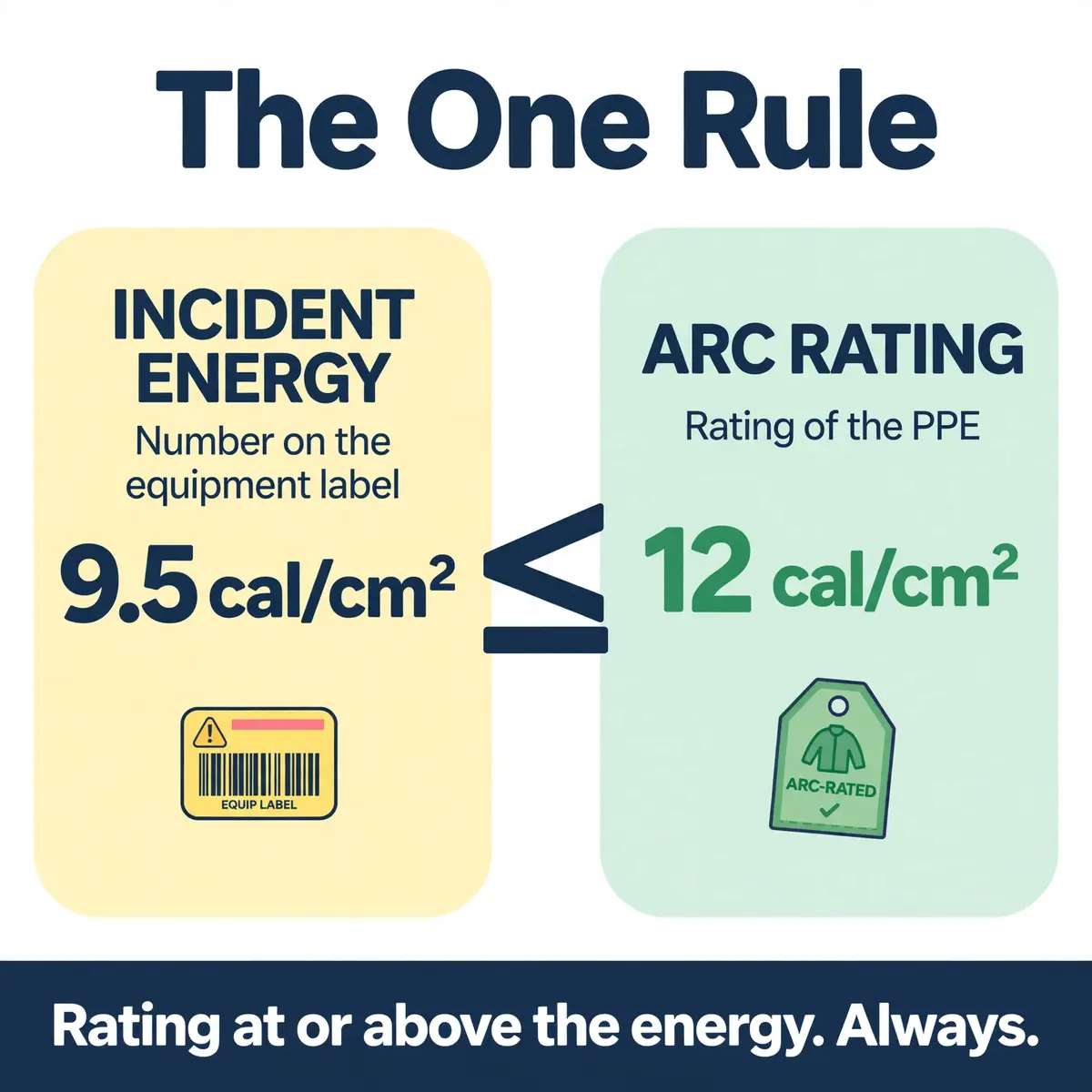
Incident energy is the amount of thermal energy a worker would receive at a normal working distance if the arc went off, expressed in calories per square centimetre (cal/cm²). It is the hazard number. The arc rating of the clothing is the protection number, in the same units. One rule runs through every decision in this subject. The arc rating of the PPE has to be at or above the incident energy the worker could be exposed to.
That number comes off the arc flash label on the specific piece of equipment, or from the arc flash study behind the label. If the label says 8.2 cal/cm² at the working distance, the clothing system has to be rated for at least 8.2. In practice the worker picks gear rated comfortably above it, not exactly on it. A garment rated below the incident energy is the single most dangerous mistake in the subject, because it looks like protection and is not.
AlertThe rating is a threshold for the onset of a burn, not a guarantee of no injury. Dressing exactly at the number leaves no margin for an arc slightly worse than the model assumed.
Where the Number Comes From
An arc flash study calculates the incident energy at each piece of equipment, and the label prints it. The worker is not guessing. The study feeds the system data into the IEEE 1584-2018 model. The label also prints the arc flash boundary and the shock approach boundaries.
The arc flash boundary is the distance from the equipment at which the incident energy falls to 1.2 cal/cm². That level is generally tied to the onset of a second-degree burn on bare skin. Inside that boundary, arc-rated PPE is required. The boundary is a trigger for the clothing, not trivia. Crossing it on energized gear is the moment the arc-rated clothing has to be on and rated.
Why Margin Matters
Field conditions are never the lab. The study assumes a working distance, a fault current and a clearing time. Any of them can be slightly worse than assumed on the day. A system rated comfortably above the label energy absorbs that difference. A system rated exactly at the label energy has no room for it at all.
Margin also covers the weakest piece. A worker is protected to the lowest-rated piece in the line of fire. The head, face, hands and torso all have to clear the number, not just the jacket. A 40 cal coat with a 12 cal hood is a 12 cal system at the head, which is where the worker least wants the weak point.
Arc Flash PPE Categories 1 to 4
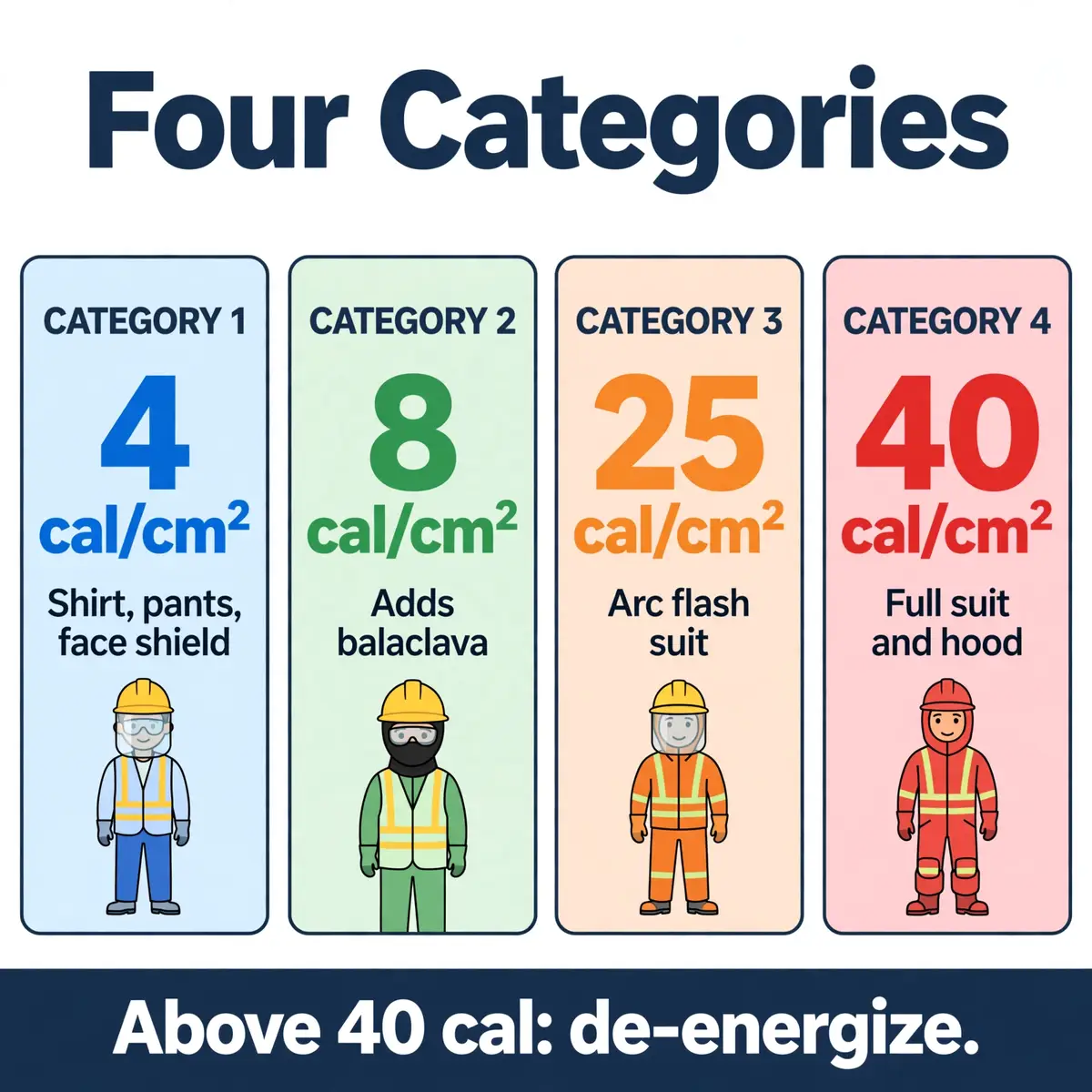
NFPA 70E sorts arc flash PPE into four categories, each tied to a minimum arc rating for the clothing system. The categories belong to the PPE category method, the table method used when there is no incident energy study. A category is not a cal value off a label. It is a tier that bundles the required clothing and equipment together so a crew working from the tables knows what to wear without an engineer running the math.
The minimum arc ratings hold steady across recent editions. Category 1 is 4 cal/cm², Category 2 is 8, Category 3 is 25 and Category 4 is 40. Each step up adds protection and adds layers. Categories 1 and 2 are an arc-rated shirt and pants or a coverall with a face shield or hood. Categories 3 and 4 step up to a full arc flash suit with a hood.
| PPE category | Minimum arc rating | Typical clothing system | Example tasks |
|---|---|---|---|
| Category 1 | 4 cal/cm² | Arc-rated long-sleeve shirt and pants or coverall; arc-rated face shield or hood; hard hat; safety glasses; hearing protection; leather gloves; leather footwear | Reading a panel meter; operating a circuit breaker with covers on |
| Category 2 | 8 cal/cm² | Category 1 clothing at a higher rating, plus arc-rated balaclava with face shield, or a full arc flash suit hood | Voltage testing; thermography with covers off; racking a breaker in or out |
| Category 3 | 25 cal/cm² | Arc flash suit jacket and pants, or multi-layer coverall; arc flash suit hood; insulating gloves with leather protectors | Inserting or removing starters from MCC buckets; work on energized parts up to 600 V with covers off |
| Category 4 | 40 cal/cm² | Heavy multi-layer arc flash suit, jacket and bib overalls; arc flash suit hood; insulating gloves with leather protectors | Work on energized parts above 600 V; tasks where the analysis gives 25–40 cal/cm² |
Category 1 — 4 cal/cm²
Category 1 is the lowest level that requires arc-rated protection. It covers the lightest energized tasks. These include operating normally functioning circuit breakers, reading panel meters and using test instruments on energized panelboards. The clothing is an arc-rated long-sleeve shirt and pants, or an arc-rated coverall, rated to at least 4 cal/cm².
Head and face protection at this level is a hard hat with an arc-rated face shield with wrap-around guarding, or an arc flash suit hood. Safety glasses, hearing protection, heavy-duty leather gloves and leather footwear complete the set. An arc-rated balaclava is added if the back of the head is inside the arc flash boundary.
Category 2 — 8 cal/cm²
Category 2 raises the minimum arc rating to 8 cal/cm². It is the level most often met in routine maintenance on industrial panelboards and motor control centres up to 600 volts. The clothing looks similar to Category 1 but uses heavier fabrics or layered garments to reach the higher thermal threshold.
Head protection steps up at this level. The worker wears an arc-rated face shield paired with an arc-rated balaclava. The balaclava is the sock-style hood that covers the head and neck parts the face shield leaves open. A full arc-rated hood can replace both. Many employers standardize on Category 2 gear to cover both Category 1 and Category 2 exposures with one set.
Category 3 — 25 cal/cm²
Category 3 is where daily-wear clothing stops being enough and the full arc flash suit begins. The system is an arc flash suit jacket and pants, or a multi-layer coverall, worn over arc-rated base layers, with an arc flash suit hood rated to at least 25 cal/cm². Every piece of the ensemble must meet the 25 cal/cm² floor.
At this level a balaclava with a face shield is no longer permitted; the hood is required. Hand protection also steps up: rubber insulating gloves with leather protectors, or arc-rated gloves, replace the heavy-duty leather gloves of Categories 1 and 2. Typical work at this level is inserting or removing starters from motor control centre buckets and working on energized parts up to 600 volts with the covers off.
Category 4 — 40 cal/cm²
Category 4 is the highest PPE level in the NFPA 70E tables, requiring a minimum arc rating of 40 cal/cm². Workers wear a heavy multi-layer arc flash suit with a full hood assembly. Every layer must independently meet the 40 cal/cm² threshold. The suit covers the entire body, and the hood, jacket and bib overalls are all rated to the same number.
This level applies to the most energetic equipment configurations, such as high-amperage switchgear with slower-clearing protective devices and work on energized parts above 600 volts. A Category 4 suit is bulky and hot, which is part of why de-energizing is always the better answer when it is possible.
Above 40 cal/cm² — No Category
One hard limit sits above Category 4. Where the hazard runs past 40 cal/cm², NFPA 70E does not treat that as a higher category to dress for. It is a stop. Energy at that level is treated as too dangerous to work energized. The answer is to de-energize, not to find a bigger suit.
Suits rated 65, 75, 100 and even 140 cal/cm² are sold, built from more layers of the same kinds of fabric. They are specified by the incident energy number on the label rather than by a category, since the category table stops at 40. Buying a bigger suit is not a substitute for the de-energize-first rule, and no category covers work above 40 cal/cm².
NoteThere is no Category 0. It was removed in the 2015 edition of NFPA 70E, so any task with an arc flash hazard needs arc-rated clothing. Ordinary work clothes do not count, even flame-resistant ones that were never arc-tested.
Reading the Arc Rating: Atpv, Ebt and Elim
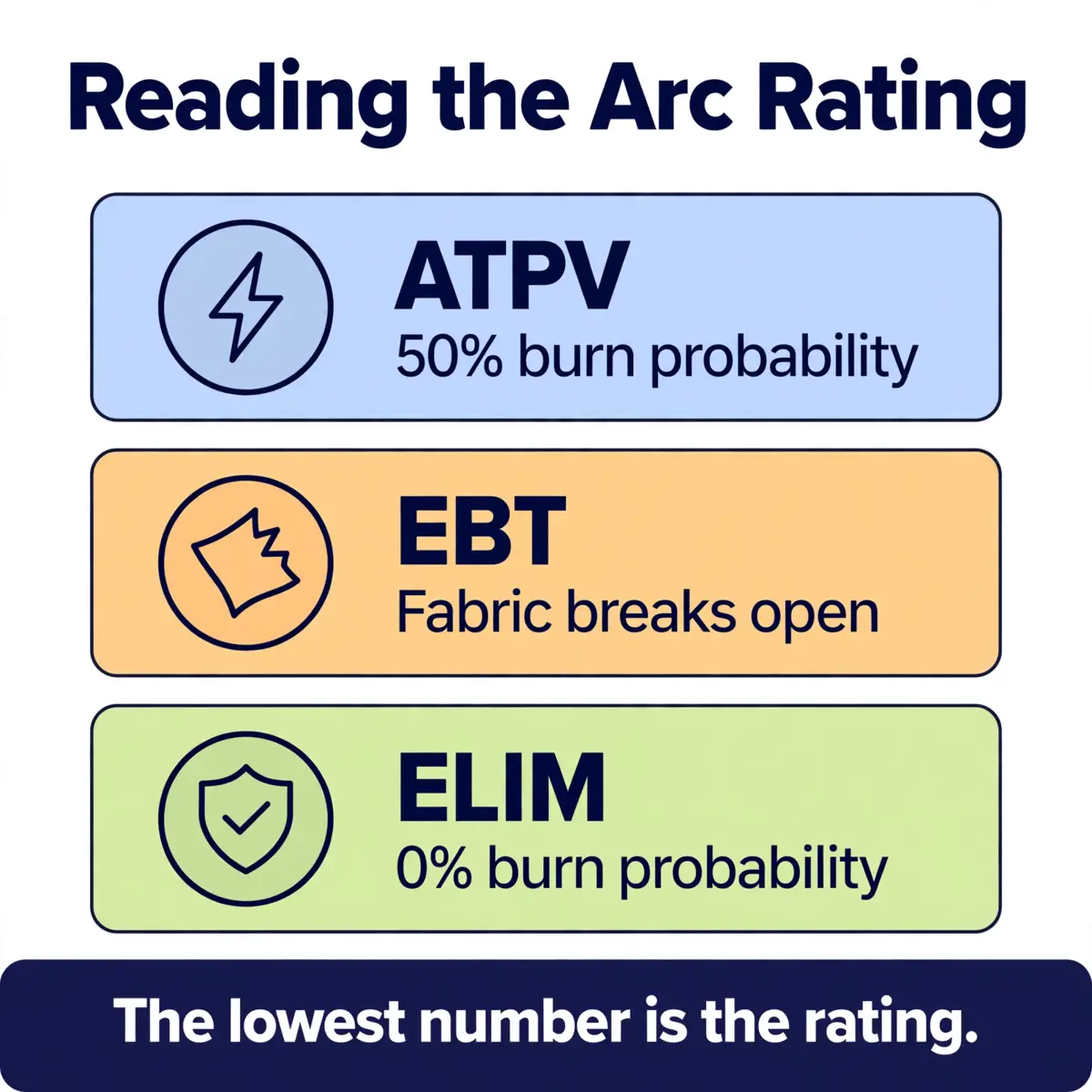
The arc rating is the cal/cm² a garment or fabric protects to. It comes from one destructive test: ASTM F1959. Panels of the fabric are exposed to a controlled arc in a lab. The result is reported one of two ways, ATPV or EBT. A fabric earns whichever value it reaches first, and that single number is its arc rating.
Both are real ratings, and both are determined by the same test method. A garment labelled 12 cal ATPV and a garment labelled 12 cal EBT both protect to 12 cal/cm² for selection purposes. What the buyer compares against the hazard is the arc rating, by whichever method it was earned. The performance specification the garments are made to is ASTM F1506, and the test method is ASTM F1959.
Atpv — the 50 Percent Burn Line
ATPV stands for arc thermal performance value. It is the incident energy at which enough heat passes through the fabric to give the wearer a second-degree burn, judged against the Stoll curve, which models how heat transfer through skin produces a burn. The value marks a 50 percent probability of a second-degree burn, not a guarantee of no injury.
That is why the rating is matched to the estimated energy with margin. It is also why the arc flash boundary keeps the body as far from the arc as the task allows. A garment rated 8 cal/cm² has an ATPV of 8 if heat transfer is the way it fails. If the fabric breaks open first, the rating is the EBT instead.
Ebt — When the Fabric Breaks Open
EBT stands for energy breakopen threshold. It is the energy at which the fabric breaks open and lets the arc through. Some fabrics, especially lighter ones, fail by breaking open before enough heat passes through to cause a burn. Their rating is the EBT rather than the ATPV.
The distinction matters to the buyer only in one way: the rating on the tag is the number to select to, whichever letter sits beside it. A 12 cal EBT garment covers a 12 cal hazard, not a 10 cal one. It does not cover a 25 cal hazard. When a layered system is built, the system has its own tested arc rating, which is what counts, not the sum guessed from the individual pieces.
Elim — the Stricter European Number
ELIM stands for incident energy limit, and it is the most conservative of the three values. It is the energy level at which there is a 0 percent probability of a second-degree burn, calculated from the three highest incident energy data points that stayed below the Stoll curve without breakopen. Where ATPV accepts a 50 percent burn probability, ELIM accepts none.
ELIM comes from the European system, EN 61482-2. Since the 2020 revision of that standard, an ELIM value is mandatory for garments tested by the open arc method. ATPV and EBT are optional extras. A garment must reach at least an ELIM of 3.2 cal/cm², or an ATPV or EBT of 4 cal/cm², to be certified under the standard. The European box test is the other route: it assigns Arc Protection Class 1 at 4 kA or Class 2 at 7 kA, each for 500 milliseconds.
Reading the Label on the Garment
Every arc-rated garment carries a label, and the label is the selection document. Before a garment is worn on an arc flash job, the worker checks the tag. It must show an arc rating in cal/cm², name the standard the garment meets, and give the care instructions. A garment with no arc rating on the tag does not get used to satisfy an arc flash hazard, however flame-resistant it is.
- Arc rating in cal/cm², stated as ATPV, EBT or ELIM. It can be compared with the incident energy on the equipment label.
- Compliance with ASTM F1506, the performance specification for arc-rated apparel for electrical workers.
- Fabric and garment care instructions, including the washing limits that keep the rating.
- Size and the date of manufacture, so the garment can be tracked through inspection and retirement.
Arc-Rated or Flame-Resistant: Not the Same Thing
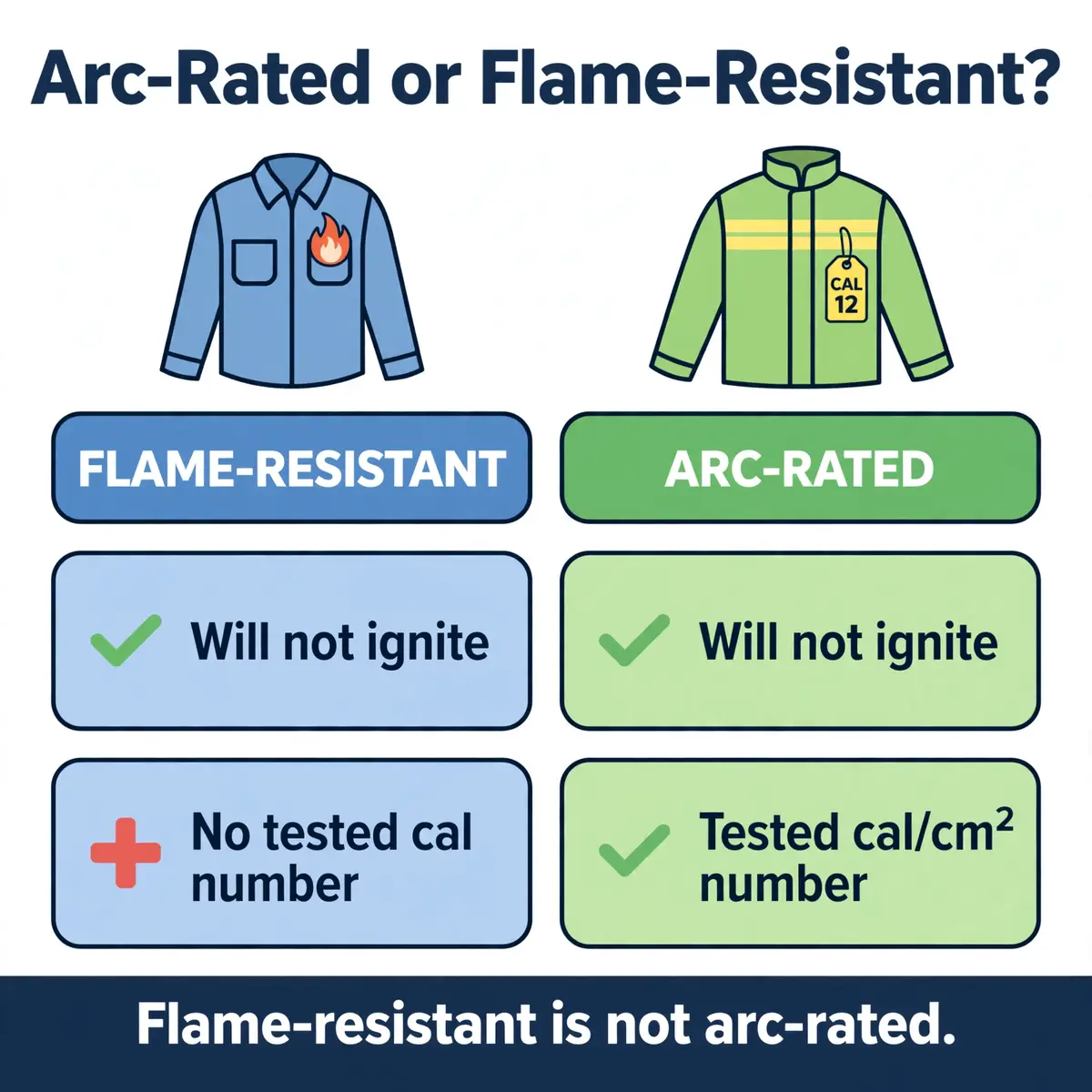
Arc-rated and flame-resistant are related but not the same, and the difference can decide whether a worker is protected. Flame-resistant, or FR, means the fabric resists igniting and self-extinguishes when the flame source is removed. Arc-rated, or AR, means the fabric is flame-resistant and has also been tested and assigned an arc rating in cal/cm² for an electric arc.
Every arc-rated garment is flame-resistant. Not every flame-resistant garment is arc-rated. That asymmetry is where the field mistake lives: a shirt can be genuinely FR, sold for flash fire or welding work, and carry no arc rating at all. Put it on an arc flash job, and the worker has a garment that will not ignite. It has no tested number to compare against the hazard on the label.
TipFor arc flash work, the tag has to show an arc rating in cal/cm² and reference the arc-rated clothing standard. FR alone, with no cal number, is not arc flash PPE.
NFPA 2112 is Flash Fire, Not Arc Flash
The confusion has a specific source. NFPA 2112 is the standard for flame-resistant clothing for protection against flash fire: a three-second engulfing fire from an ignited gas or vapour cloud, tested on an instrumented manikin. ASTM F1506 is the garment specification for electric arc exposure, tested under ASTM F1959. They cover two different ways of catching fire.
Garments can be dual-certified to both standards, and many are, because a worker can face both hazards. But a garment certified only to NFPA 2112 has no arc rating, and it is not arc flash PPE. The check is short: for electrical arc work, the label must show ASTM F1506 and a cal/cm² value.
The Tag Check Before Every Job
A tag check takes seconds and it is done every time, not once a season. The worker reads the arc rating, confirms it is at or above the incident energy for the task. Checks that the garment is the one the rating belongs to. A jacket and a hood from different systems do not inherit each other's ratings.
If the tag is missing, faded past reading or shows a standard the task does not call for, the garment stays in the locker. A rating that cannot be read is a rating that cannot be trusted. The worker who wears it is dressed and exposed at the same time.
The Full Kit, Piece by Piece
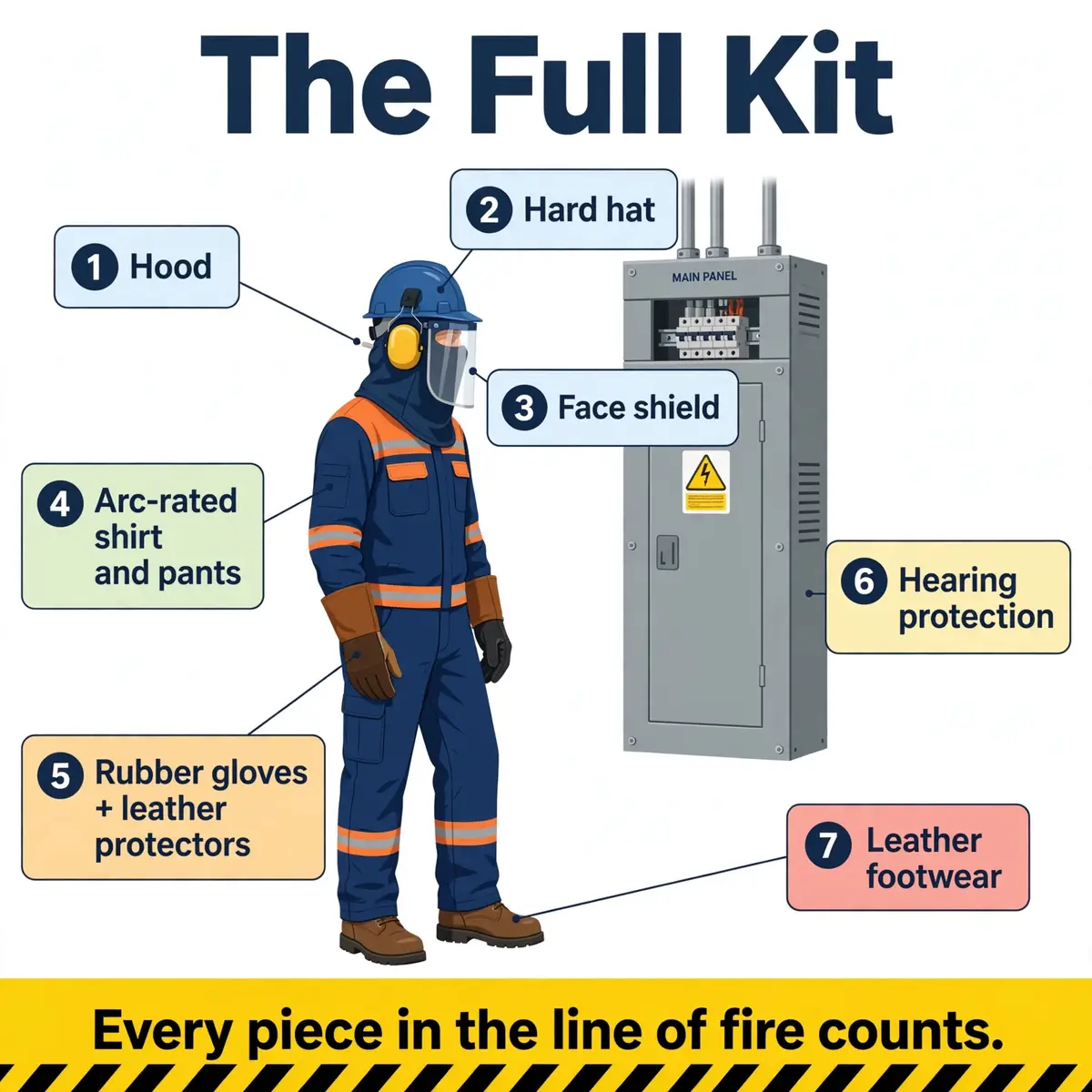
Arc flash PPE is a system, not a single garment. The rating that matters is the rating of the system as worn. For lower hazards in the Category 1 to 2 range, the system is an arc-rated long-sleeve shirt and arc-rated pants, or a single arc-rated coverall, with the sleeves down and the front closed. For higher hazards in the Category 3 to 4 range, the system is a full arc flash suit: an arc-rated coat and bib or coverall plus an arc flash hood, worn over arc-rated base layers.
Coverage has to be complete. An arc flash suit with a wrist gap, an open collar or a missing hood is rated on the tag and unrated on the body. Every piece in the line of fire must clear the hazard number, because the worker is protected to the lowest-rated piece. The gaps are where the arc finds skin.
Arc-Rated Clothing: Shirt, Pants, Coverall or Suit
Daily-wear arc-rated clothing covers Categories 1 and 2. A long-sleeve shirt and pants, or a coverall, in a fabric tested to ASTM F1506, gives the worker the 4 or 8 cal/cm² the task needs without a suit to put on and take off. Many employers standardize on Category 2 daily wear so the same clothing covers both lower categories.
The arc flash suit covers Categories 3 and 4. A kit is the jacket and overpant or bib, the arc hood, a hard hat, safety glasses and a carry bag, with coverall-based systems replacing jacket and pant with one garment. Arc-rated rainwear is a separate item, tested to ASTM F1891, for work in wet conditions where ordinary rainwear would melt or burn. Ordinary rain gear over arc-rated clothing is a hazard, not an extra layer.
Head and Face: Hood, Face Shield and Balaclava
The head and face take their own arc-rated protection, and the level steps with the category. A hard hat protects against impact and falling parts. It is not arc-rated by itself. The arc protection comes from what goes with it. In the Category 1 to 2 range that is an arc-rated face shield plus an arc-rated balaclava, the sock-style hood that covers the parts of the head and neck the face shield leaves open.
At Categories 3 and 4 the face shield and balaclava are not enough. The system uses a full arc flash hood. The hood wraps the entire head with an arc-rated window, sealing the gaps a flat face shield cannot cover. The window and the hood carry their own arc rating, which has to clear the same hazard as the rest of the suit.
OSHA's utility rule sets the floor here. Arc-rated head protection is not necessary below 9 cal/cm² for a single-phase arc in open air, or 5 cal/cm² for other exposures, when the worker wears head protection meeting 29 CFR 1910.135. NFPA 70E's category method is stricter, requiring the hood at Categories 3 and 4.
Eyes and Hearing
Safety glasses or goggles stay on under the face shield or hood, because the shield can be lifted and the arc does not wait for it to come down. The glasses are the last line for the eyes when the shield is up. They are required in every category, not just the higher ones. Safety goggles are the choice where dust or flying debris is also in play.
Hearing protection belongs in the kit for the same reason. The arc blast is loud enough to cause permanent hearing loss in the instant it goes off. The hood does not seal the sound out. Earplugs or muffs under the hood are part of arc flash PPE for higher-energy work, not an optional add. A worker who skips them trades a burn for a hearing injury.
Hands
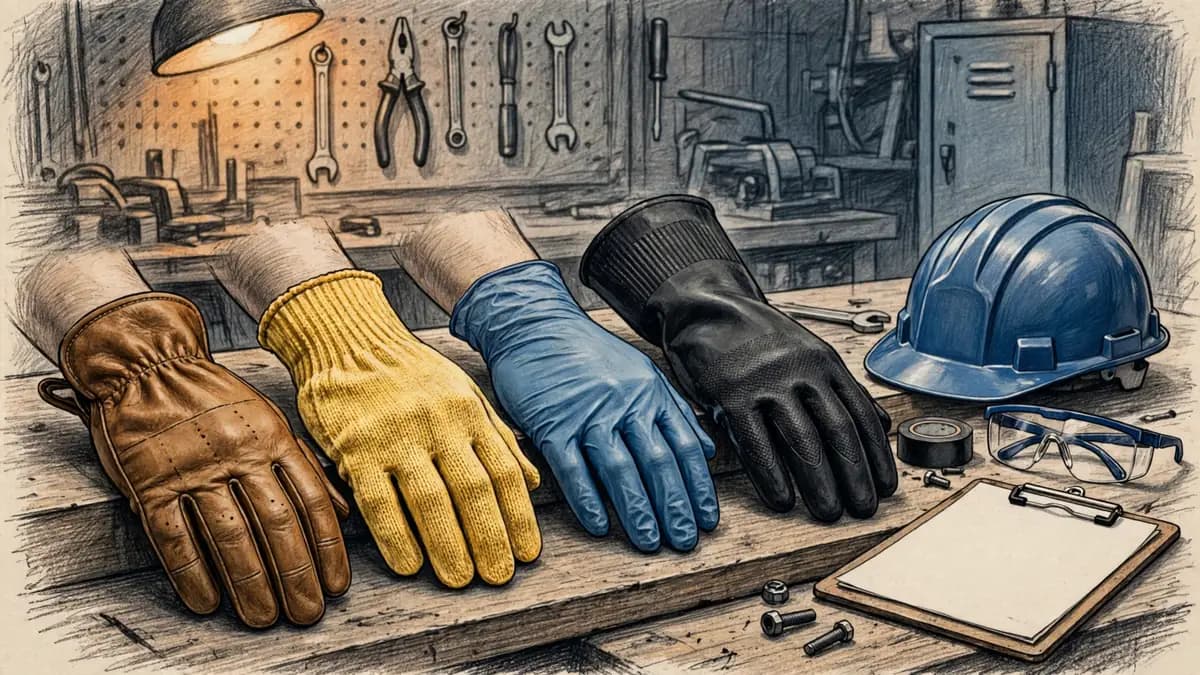
Hand protection changes with the category. In Categories 1 and 2 the hands take heavy-duty leather gloves, which protect against the heat and against cuts and abrasion. In Categories 3 and 4 the hands take rubber insulating gloves with leather protectors, or arc-rated gloves, because the thermal hazard at the hand has risen with the rest of the system.
The 2027 edition of NFPA 70E adds a separate requirement for thermal hand protection where a contact thermal hazard is possible, for example on battery, UPS or DC drive work. Rubber gloves are not thermal gloves, so most glove programs now need a thermal category as well. The hands are also where the two hazards meet: rubber for shock, arc-rated for heat, and both at once on energized work.
Feet and the Rest of the Kit
Footwear matters, and leather work boots resist the heat better than synthetic. Electrical-hazard rated footwear adds a layer of shock protection by resisting current through the foot to ground. The footwear is a backup to the primary methods, not a substitute for de-energizing or for the rubber gloves, but it belongs in the system. Hard hat classes matter here too: the nonconductive head protection OSHA requires is a Class E or Class G hat, not a vented Class C hat.
One more item is easy to miss. Personal fall arrest equipment used by workers exposed to flames or electric arcs must be capable of passing a drop test after exposure to an arc with a heat energy of 40 ± 5 cal/cm², under OSHA's utility rule. A fall protection harness that has been through an arc is retired, not inspected back into service. The rest of the kit is what completes coverage: no exposed skin in the line of fire, sleeves down, collar closed, nothing meltable showing.
What to Wear Underneath
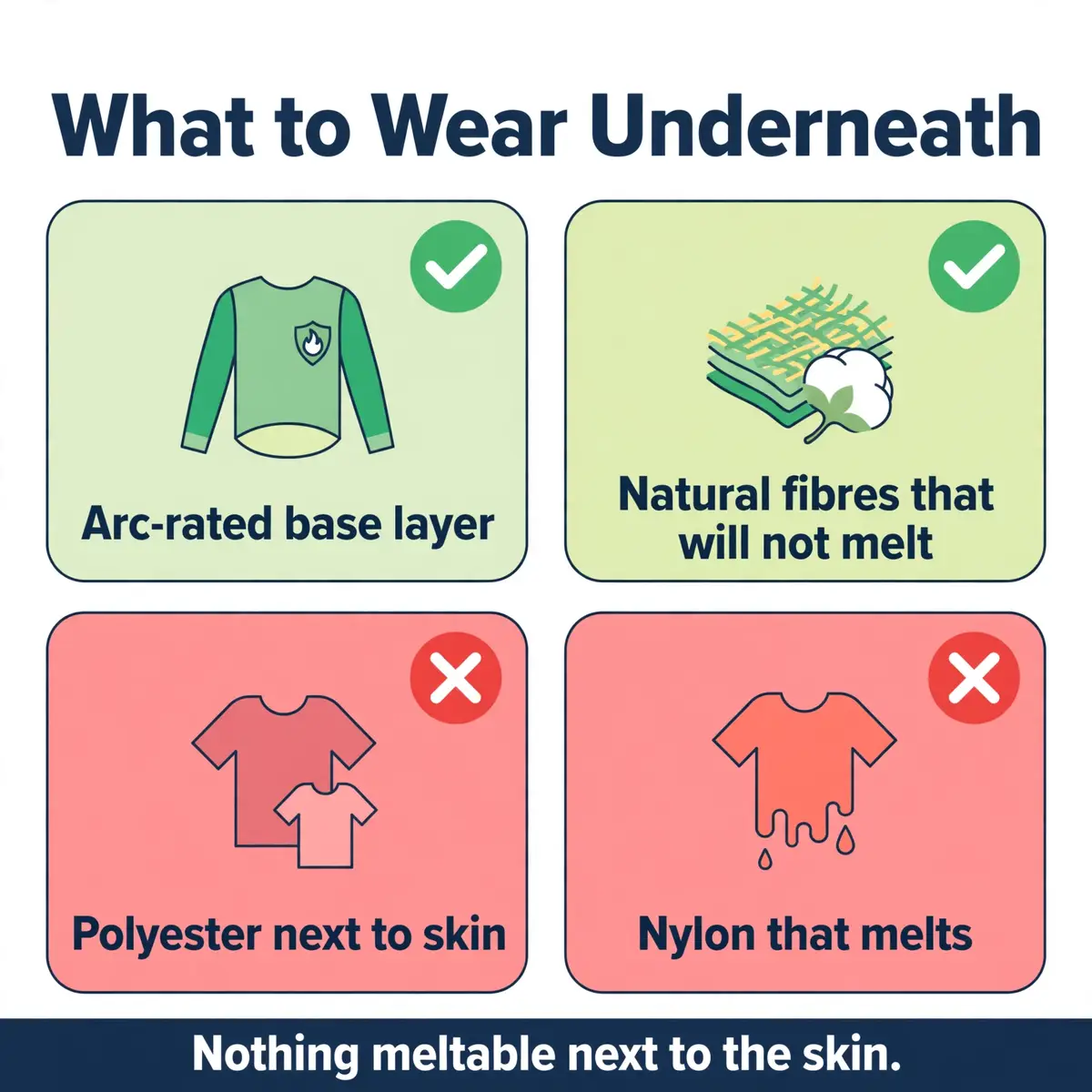
The layer next to the skin decides the burn. Arc-rated clothing does its job and the worker still takes a melt burn from the moisture-wicking shirt nobody checked underneath. Polyester, nylon, acetate, rayon, polypropylene and spandex melt under arc heat. Molten synthetic against skin causes a burn far worse than the arc alone, because it sticks and keeps burning.
The rule is not negotiable: nothing meltable goes next to the skin under arc-rated clothing. OSHA's utility rule puts it in plain terms. An employee exposed to arc hazards must not wear clothing that could melt onto the skin or that could ignite and continue to burn. The base layer must be arc-rated or an untreated natural fibre such as cotton, wool or silk, which chars instead of melting.
WarningCheck the base layer before the suit goes on, every time. A synthetic gym shirt under an arc-rated suit is the classic error. It is the one that does the damage.
What Counts as a Safe Base Layer
Safe base layers are simple: an arc-rated undershirt or underwear, or a plain cotton, wool or silk garment. Non-melting flammable fibres such as cotton may be worn beneath arc-rated garments, but only if the arc rating of the system prevents the innermost arc-rated layer from breaking open at the expected incident energy. Plain cotton on its own is not arc-rated PPE: it can ignite and keep burning.
- Arc-rated base layers, tested to the same standard as the outer garment.
- Untreated natural fibres: 100 percent cotton, wool or silk, worn under the arc-rated outer layer.
- Nothing synthetic against the skin: no polyester, nylon, acetate, rayon, polypropylene or spandex, alone or in a blend, unless the blend is treated and arc-rated.
- The same check for socks, underwear and head coverings — every layer, not just the shirt.
Layering to Reach a Higher Rating
Layering raises the protection, but only if it is done right. Arc-rated layers can be combined, and a tested multi-layer system carries an arc rating higher than its individual pieces, because the air gaps and added fabric slow the heat. That is the legitimate way to reach Category 3 and 4 ratings, with an arc-rated base layer under an arc-rated suit.
The rating of the layered system is the tested rating of the system as worn, not the sum of the pieces. A 12 cal shirt under a 25 cal suit is not a 37 cal system; it is whatever the combination tested to. If the combination was never tested together, the worker selects to the lowest tested rating in the system. Checks the maker's data before assuming the layers add up.
Shock Protection and Arc Protection Are Two Different Jobs
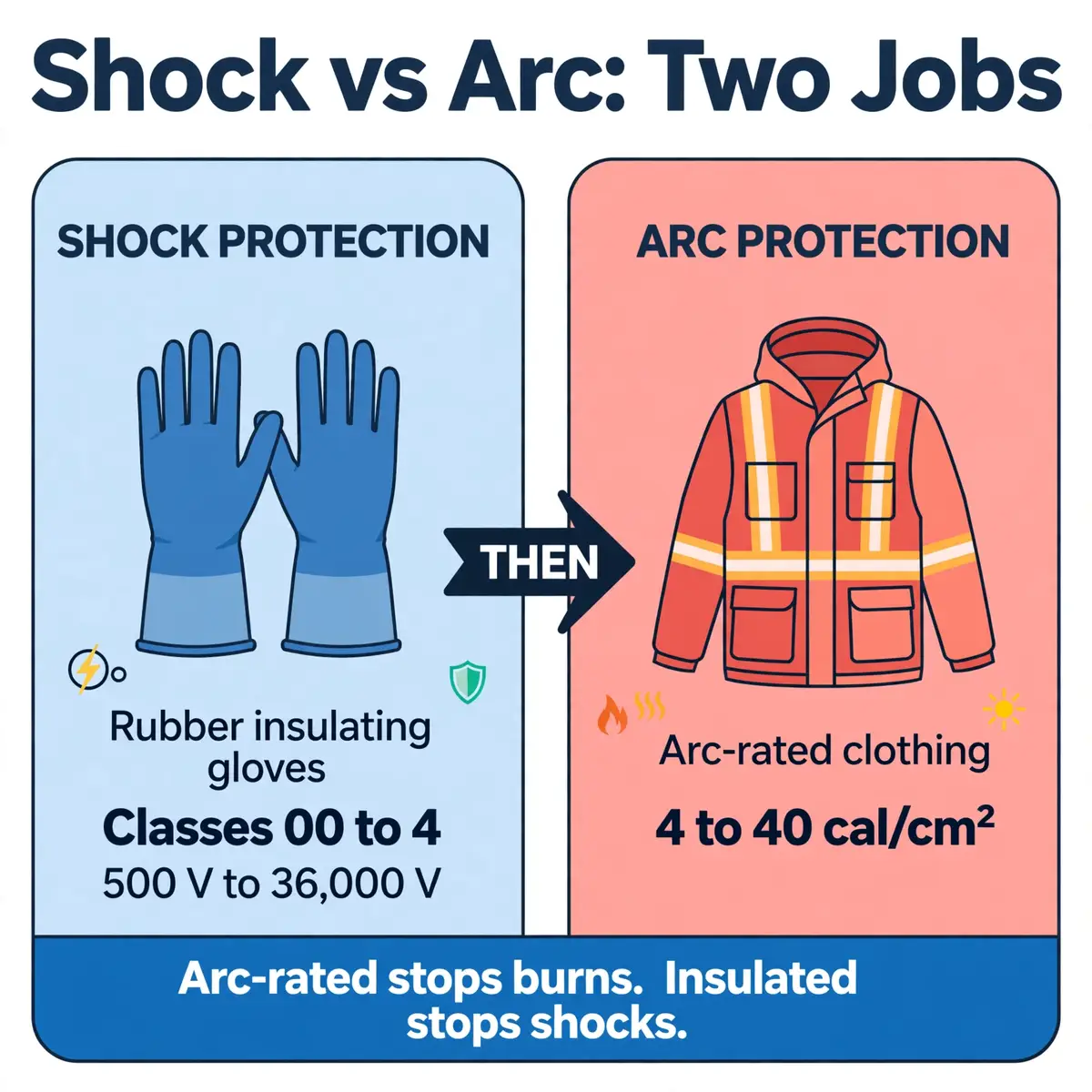
Shock PPE and arc flash PPE protect against two different hazards, and a worker on energized gear usually needs both at once. Shock is contact: current passing through the body. Arc flash is thermal: the heat and blast of a fault arcing through the air nearby. The protection for each is a separate set of equipment, selected separately, and one does not cover for the other.
Shock protection is rubber insulating gloves rated for the voltage, insulated tools and the approach boundaries that keep a worker far enough from energized parts. Arc flash protection is the arc-rated clothing, the hood or face shield, and the arc flash boundary. A worker racking a breaker hot needs the arc-rated suit for the flash and the rubber gloves for the shock, because both hazards are live at the same time and the suit does nothing to stop current through the hands.
AlertRubber insulating gloves are shock protection, not arc protection. Arc-rated gloves are arc protection, not a substitute for the rubber. Sort the hazard first, then the PPE for it.
Rubber Insulating Gloves: Classes 00 to 4
Rubber insulating gloves are the primary protection against shock when hands work near or on energized conductors. They are rated by voltage class, not by cal/cm². The classes run 00, 0, 1, 2, 3 and 4, from the lowest voltage up to the highest. Each class has a maximum AC use voltage that must not be exceeded. The class is picked for the voltage being worked, and confirmed against the specification rather than the colour or the box.
| Glove class | Maximum AC use voltage | Common use |
|---|---|---|
| Class 00 | 500 V | Low-voltage work |
| Class 0 | 1,000 V | Most general electrical work |
| Class 1 | 7,500 V | Medium voltage |
| Class 2 | 17,000 V | Medium voltage |
| Class 3 | 26,500 V | High voltage |
| Class 4 | 36,000 V | High voltage |
Rubber gloves are never worn bare. A leather protector goes over the rubber to take the abrasion, the puncture and the snag that would otherwise breach the insulating rubber, since a pinhole in the rubber is a path for current the worker cannot see. The rubber insulates, the leather guards the rubber. The one narrow exception is limited-use work needing high finger dexterity, where Class 00 gloves may be used without protectors up to 250 volts AC.
The Air Test Before Every Use
Before each day's use, the worker inspects the rubber gloves and air-tests them on the spot. Roll or twist the glove to trap air inside, then press and watch for the cuff to swell and hold, and listen and feel for a leak. A glove that loses air has a hole, and a hole is a shock path.
The air test catches the puncture the leather protector was supposed to prevent and did not. It takes seconds and it is done every time, not once a day. Gloves that fail the visual inspection or the air test come out of service at once, until they are cleaned and retested or replaced.
Retesting Every Six Months
Rubber insulating gloves are only protective if they are tested and in date, and the rubber degrades whether the gloves are used or not. Under OSHA's rule, gloves are electrically tested before they are first issued and every six months after that. They also go back for a test whenever their insulating value is suspect, after any repair, or after they have been used without leather protectors.
Gloves that were tested but never issued may not be placed into service unless the test was within the previous 12 months. The employer must certify that the equipment has been tested, by marking the information on the equipment or entering it in logs, and must provide paid time for workers to carry out the required testing and inspection. A glove past its test date is treated as failed until it is retested, no matter how good it looks.
Insulated Tools
Insulated tools are part of the shock protection on energized work. They are not the same as ordinary tools with a coated handle. A true insulated tool is rated and tested to a voltage, commonly marked for 1,000 V on the kind of low-voltage work where energized tasks happen. The insulation is built into the tool, not a comfort grip. They must meet ASTM F1505 or IEC 60900 and carry the double-triangle marking.
The point of the insulated tool is to remove one more shock path. A screwdriver that slips across two terminals is both a shock hazard and an arc source. An insulated tool reduces the chance that a slip turns into a fault. Inspect them like the gloves: a nick or a crack in the insulation is a failed tool, because the bare metal under the breach is a path for current. Wrapping a tool in tape does not make it an insulated tool.
Choosing the Right Ensemble for the Task
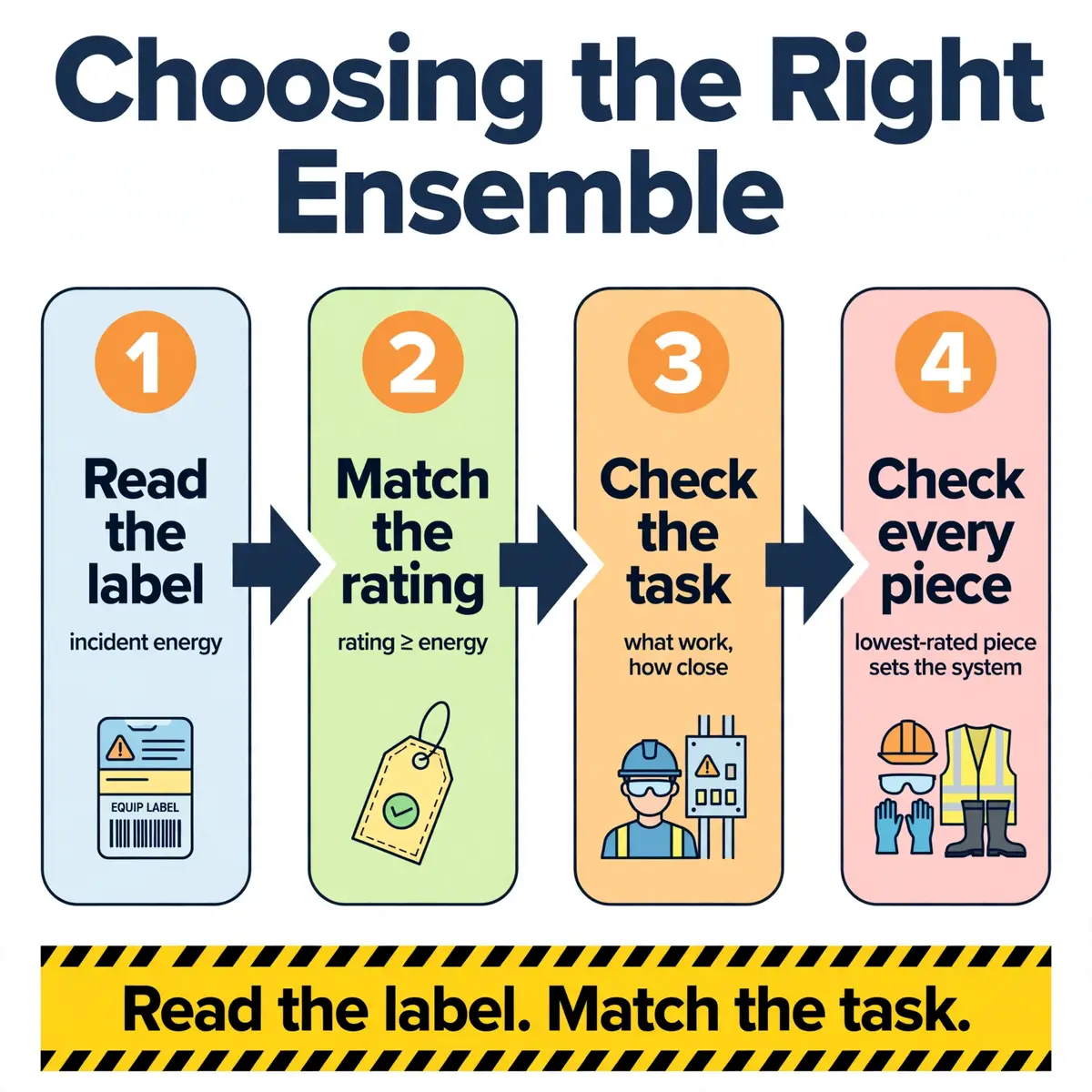
Selecting arc flash PPE starts before any garment is picked up. The first question is whether the work can be done dead. If the equipment can be de-energized, locked out and proven dead, no arc flash PPE is required for the electrical hazard at all. Only when energized work is justified and permitted does selection begin. It begins with a risk assessment that names the hazard, the incident energy and the boundaries.
NFPA 70E gives two methods for selecting the PPE. The central rule is that one method is used for a given piece of equipment, never both blended together. The method chosen decides what the worker wears, and mixing them produces a selection that is defensible under neither method.
The Incident Energy Method
The incident energy analysis method calculates the specific thermal energy, in cal/cm², that a worker could be exposed to at a defined working distance. An engineering study collects six inputs, then runs the IEEE 1584-2018 model:
- System voltage
- Available fault current
- Protective device type and clearing time
- Conductor gap
- Equipment configuration
- Working distance
The result lands on the equipment label. The worker picks PPE with an arc rating at or above that calculated value.
This is the more precise of the two methods. It is the one most sites with an arc flash study use. Its precision means workers may wear lighter, more comfortable PPE when calculations show lower incident energy. It may reveal that incident energy exceeds what standard PPE can protect against, which means the work must be de-energized instead.
The PPE Category Method
The PPE category method uses pre-defined lookup tables in NFPA 70E to assign a PPE category, 1 through 4, based on equipment type, voltage and the task being performed. It is simpler than the incident energy analysis. It has strict limitations: it can only be used when the equipment, voltage, fault current and clearing time all fall within the ranges the tables specify.
If any parameter is outside the listed range, or the equipment type is not listed at all, this method is invalid and an incident energy analysis is required instead. The table method also tends to be more conservative, because it cannot account for site-specific variables the way a full calculation does. It is an alternative method for facilities without a study, not a fallback for facilities that have not done one.
A Worked Example
A label reads 9.5 cal/cm² at the working distance. The worker needs a system rated at or above 9.5. In practice a 12 cal/cm² system is chosen. Every piece is rated to at least 12: shirt, pants, hood and gloves. A Category 2 outfit at its 8 cal/cm² minimum would not be enough, even though Category 2 is the tier a 9.5 cal hazard might be mistaken for.
That is the error the two methods invite. A cal value off a label must never be used to look up a PPE category from the table. A category must never be treated as a measured cal value for a different task. If there is a study, the worker selects to the cal number. If there is not, the worker uses the category tables within their stated limits.
Selection Checklist
Run through the checks in order, on every job, before anyone opens the gear:
- Confirm the work cannot be de-energized and the energized work is justified and permitted.
- Read the arc flash label on the specific gear for incident energy, arc flash boundary and approach boundaries.
- Choose one selection method — incident energy or PPE category — and stay in it for that equipment.
- Select PPE with an arc rating at or above the incident energy, or the right category, with margin to spare.
- Verify every piece in the line of fire clears the number, including the hood and the face window.
- Confirm the layer next to the skin is arc-rated or natural fibre, never a meltable synthetic.
- Match rubber insulating gloves to the voltage class, with leather protectors, and air-test them before use.
- Inspect all PPE for holes, contamination, cracks and worn closures, and pull anything that fails.
- Confirm sleeves down, collar and front closed, and no exposed skin in the line of fire.
Fit, Comfort and Heat Stress
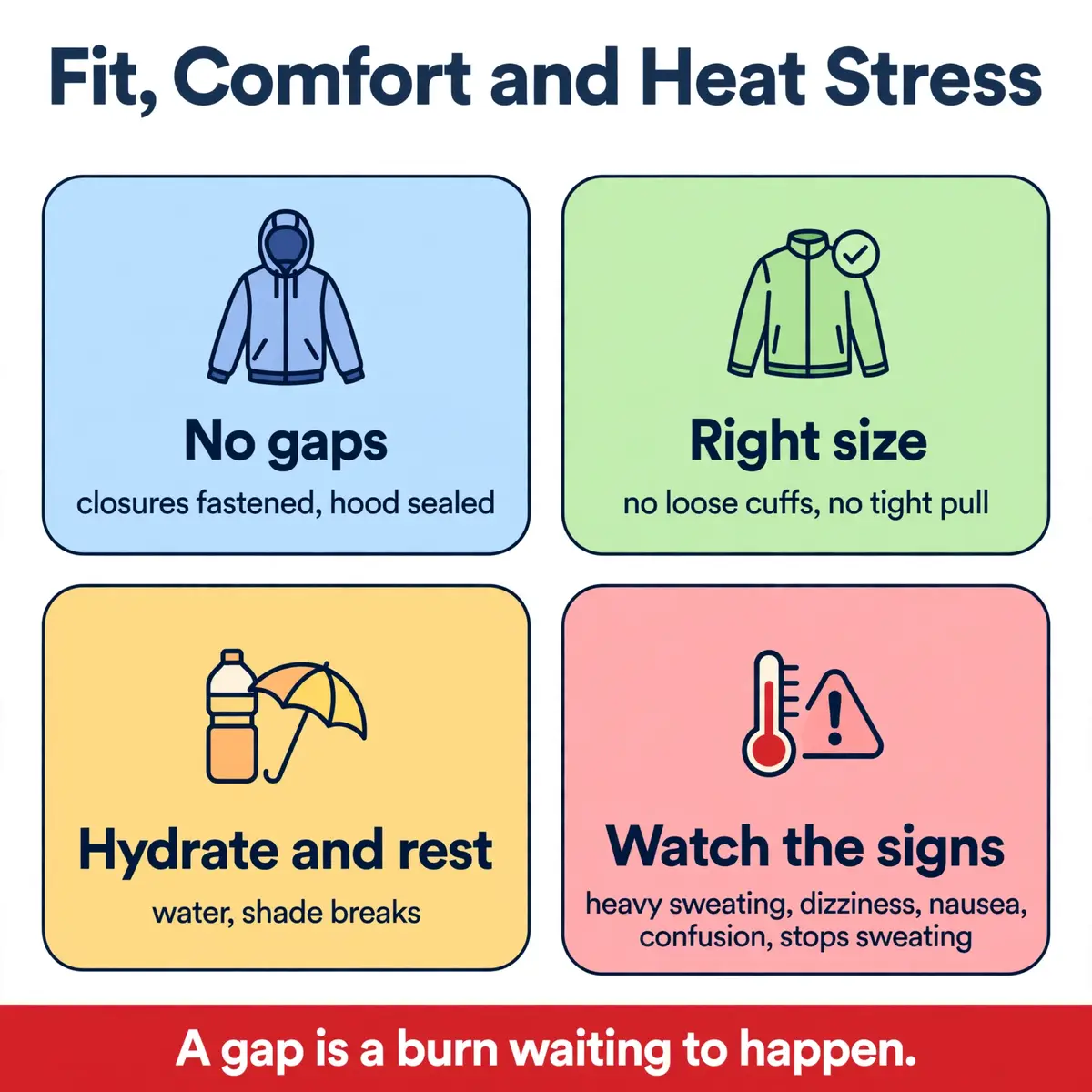
Fit is protection. An arc flash suit that leaves a wrist gap, a collar that will not close or a hood that sits wrong over the hard hat is rated on the tag and unrated on the body. Sleeves stay down, the front stays closed, and no skin shows in the line of fire. A suit bought a size too small pulls open at the shoulders and wrists. A suit bought too large bunches, snags and leaves folds the arc can reach under.
Comfort decides whether the gear is actually worn. A suit that is too hot, too heavy or too tight to work in gets worn open, worn half on, or left in the locker. That is why the selection matters as much as the rating: a lighter system that clears the number is safer in practice than a heavier one the worker fights all day. Heat is the cost of the protection, and it has to be planned for, not endured in silence.
Getting the Fit Right
Fit is checked the way the rating is checked: before the work starts, with the whole system on. The worker puts on the full ensemble and checks every closure and every gap before approaching the gear. The ensemble is the base layer, shirt and pants or coverall, suit, hood, hard hat, glasses, hearing protection and gloves.
- Sleeves down to the wrist, with the glove cuff overlapping the sleeve so no wrist shows.
- Collar and front fully closed, with the hood sealed around the hard hat and no neck exposed.
- Hood window clear and undamaged, with safety glasses on underneath it.
- Boots laced and trousers covering the ankle, with no gap between trouser and boot.
- Gloves the right size, so the worker can grip tools without the leather protectors slipping off the rubber.
Working in the Heat
Arc flash suits trap heat. A Category 4 suit over arc-rated base layers is heavy, sealed and insulating by design, and the worker inside it heats up fast. Heat exhaustion and heat stroke are real risks on this work. They are worse because the suit hides the early signs: the worker cannot see flushed skin. Sweat has nowhere to go.
Plan the work around the heat. Schedule the energized task for the cooler part of the day where possible, set work and rest periods before the job starts, keep drinking water within reach, and watch each other for the signs. The signs are heavy sweating, dizziness, nausea, confusion, or a worker who stops sweating altogether. Anyone showing those signs comes out of the suit and out of the heat at once, and a first aid kit and a trained first aider are part of the job setup, not an afterthought.
Care: Keeping Arc-Rated Clothing Rated
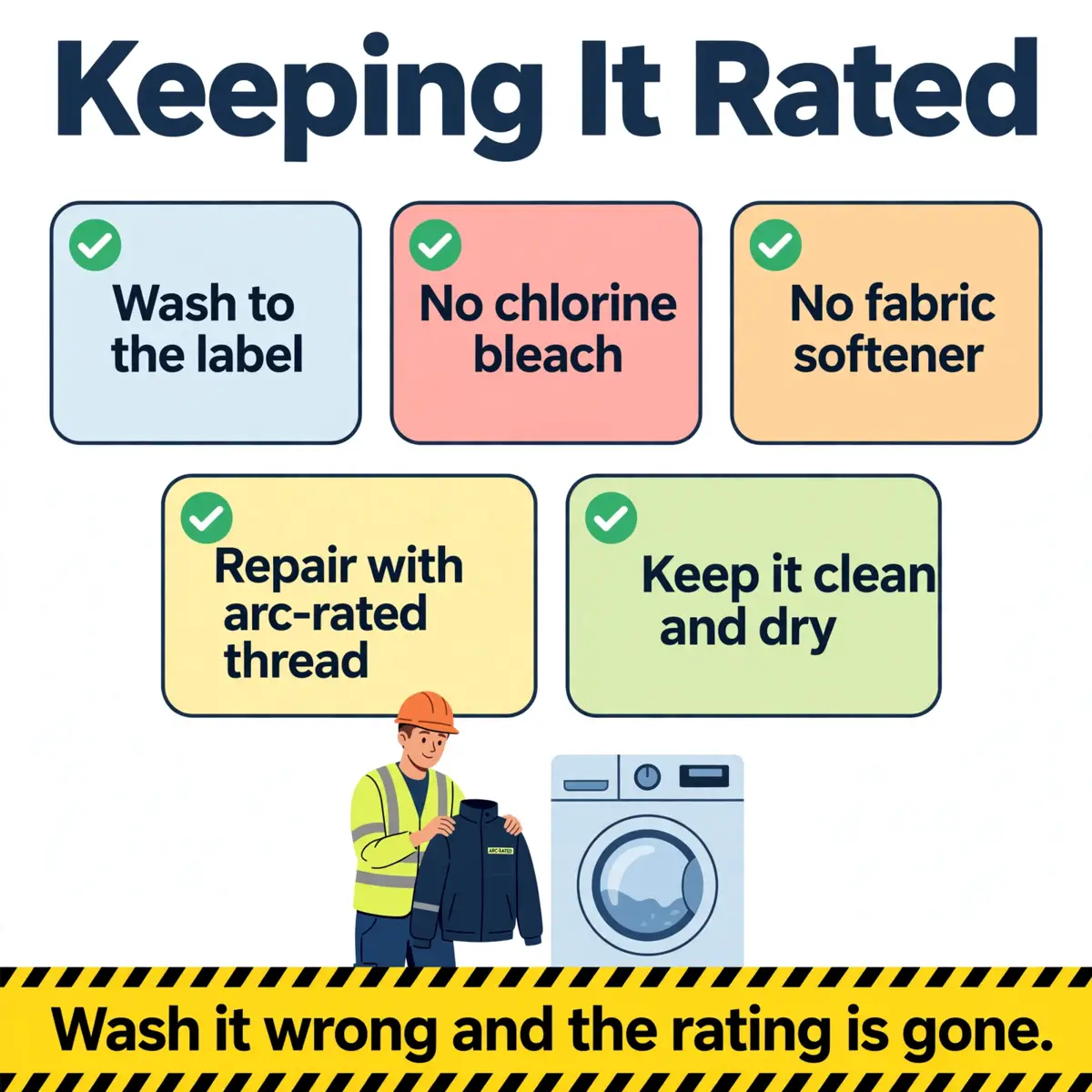
Arc-rated clothing keeps its rating only if it is cared for the way the maker specifies. A few laundry habits will quietly kill the rating without changing how the garment looks. A garment that looks fine can be unprotected. The rating lives in the fabric and its condition, and the care instructions on the label are part of the rating, not a suggestion.
Wash to the manufacturer's instructions, and keep industrial laundering to a provider that handles arc-rated apparel. Home washing is acceptable for many garments if the label allows it. The rules are the same either way: the wrong detergent or the wrong cycle can undo the protection the fabric was tested to.
WarningA 25 cal suit caked in hydraulic oil is not a 25 cal suit anymore. Flammable contamination burns, even on flame-resistant fabric.
What Kills a Rating in the Wash
Two household products are the classic rating-killers. Do not use chlorine bleach, which can degrade the arc-rated fibres. Do not use fabric softener, which leaves a flammable residue that can ignite. The opposite of what the garment is for. Both are easy mistakes, because both are normal in a household wash.
- No chlorine bleach and no fabric softener, on any arc-rated garment, ever.
- Follow the maker's washing temperature and drying instructions on the label.
- Use only the detergents the maker allows, and keep industrial laundering to a provider that handles arc-rated apparel.
- Do not use starch or other finishes unless the maker says they are safe for the fabric.
Contamination and Modification
Contamination is the other rating-killer. Arc-rated fabric that is soaked in grease, oil, solvents or other flammable material can ignite and burn even though the base fabric is flame-resistant, because the contaminant burns. A garment that cannot be cleaned of a flammable contaminant is done, regardless of its age.
The same goes for any field modification. Cutting a garment, adding non-rated patches or sewing on non-rated trim breaks the tested system and voids the rating. Repairs are done only with flame-resistant materials and thread, and only in the way the maker allows. There is no field repair that restores a tested rating, so a garment with a hole, a burn or contamination that will not wash out is replaced.
Inspection and Retirement
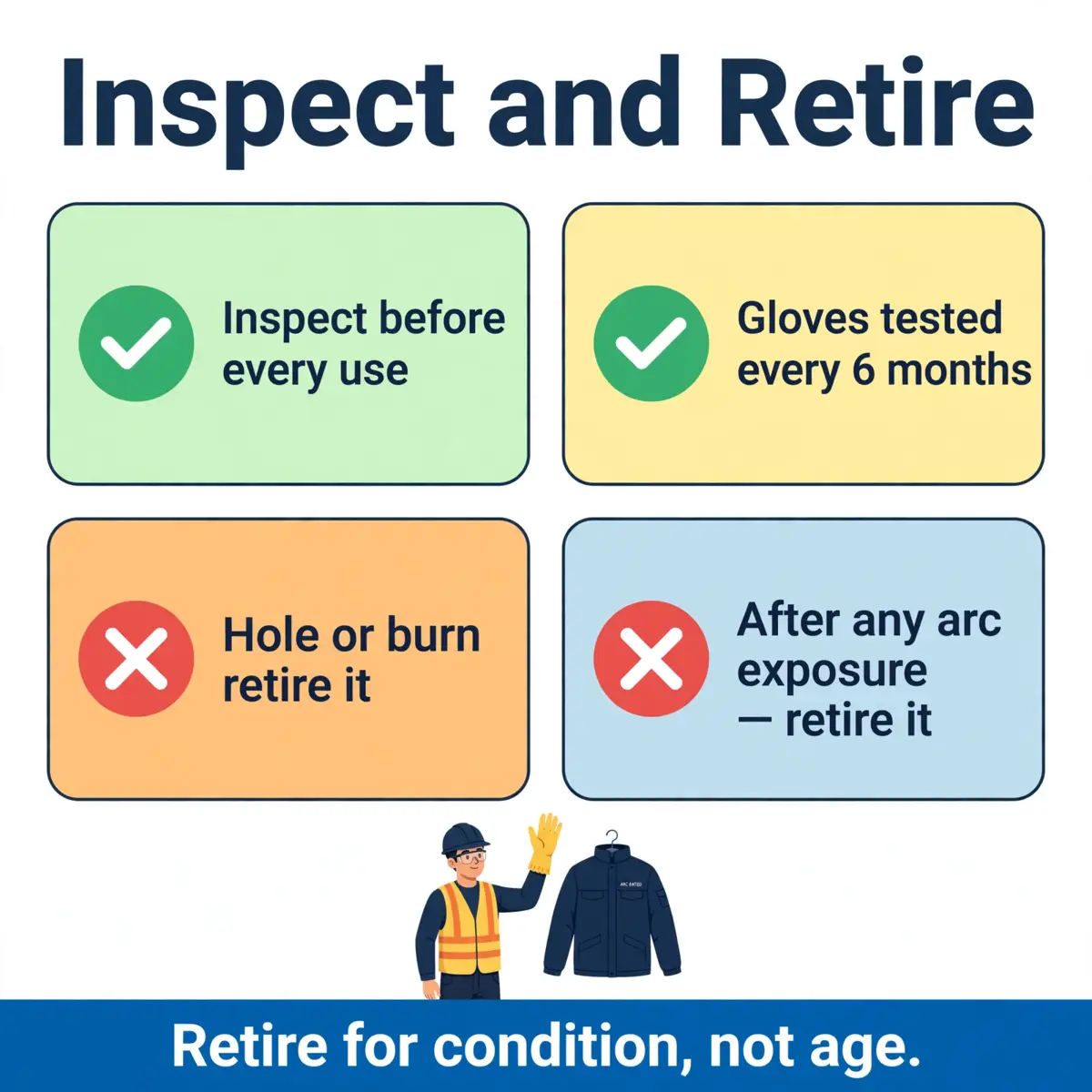
Arc-rated clothing and the rest of the PPE get inspected before use. The items that fail get pulled, not patched. The pattern across all of it is the same. Inspect every time, trust the date and the damage over how the gear looks, and replace rather than gamble. The whole point of the PPE is the day the arc goes off. That is not the day to find the hole.
Inspection is quick when it is routine. The worker looks the clothing over, checks the hood window, checks the gloves and the tools. Confirms the test dates are in date. A minute at the locker is cheaper than a burn that the rating would have prevented.
What to Look For
Look the clothing over for holes, worn or thin spots, tears, frayed seams, broken closures and contamination, because any of those breaks the protection at the spot it appears. A hole in an arc-rated sleeve is a hole the arc goes through. A closure that will not seal is a gap that stays open.
- Holes, tears, worn or thin spots, frayed seams and broken zips or closures on every garment.
- Flammable contamination — grease, oil or solvents — that will not wash out.
- Cracks, crazing and scratches on the face shield and hood window that obscure vision or weaken the window.
- Rubber glove test dates, and the air test result from before the job.
- Insulated tools for nicks or cracks in the insulation, and leather protectors for cuts or holes.
When to Retire It
No manufacturer prints an expiration date on an arc flash suit or garment. The flame resistance of the fabric is guaranteed for the life of the garment by several makers. The arc rating does not wash out when the garment is laundered the right way. A suit is retired for condition, not age.
- Any exposure to an arc, after which the garment has done its work.
- A hole, tear or burn, or a repair made with non-flame-resistant thread or patches.
- Flammable contamination that will not wash out, or fabric that is torn, thinned or faded.
- A hood window that is scratched, hazed or cracked, or a broken zipper or closure.
- Rubber gloves past their six-month test date, or that fail the air test, until they are retested or replaced.
Gloves and Tools Get Their Own Checks
Rubber gloves carry their own retest cycle on top of the visual check, with the periodic dielectric test in the lab and the before-use air test in the field. Track the issue date and the test date, because the calendar is what disqualifies a glove long before any visible damage does. A glove past its test date is out of service until it is retested.
Insulated tools get the same discipline. Check the rating marking, look for nicks and cracks in the insulation, and pull any tool whose insulation is breached. A tool that has been dropped, crushed or used as a pry bar is inspected before it goes back into the kit, not after it fails on the job.
What the Law Requires
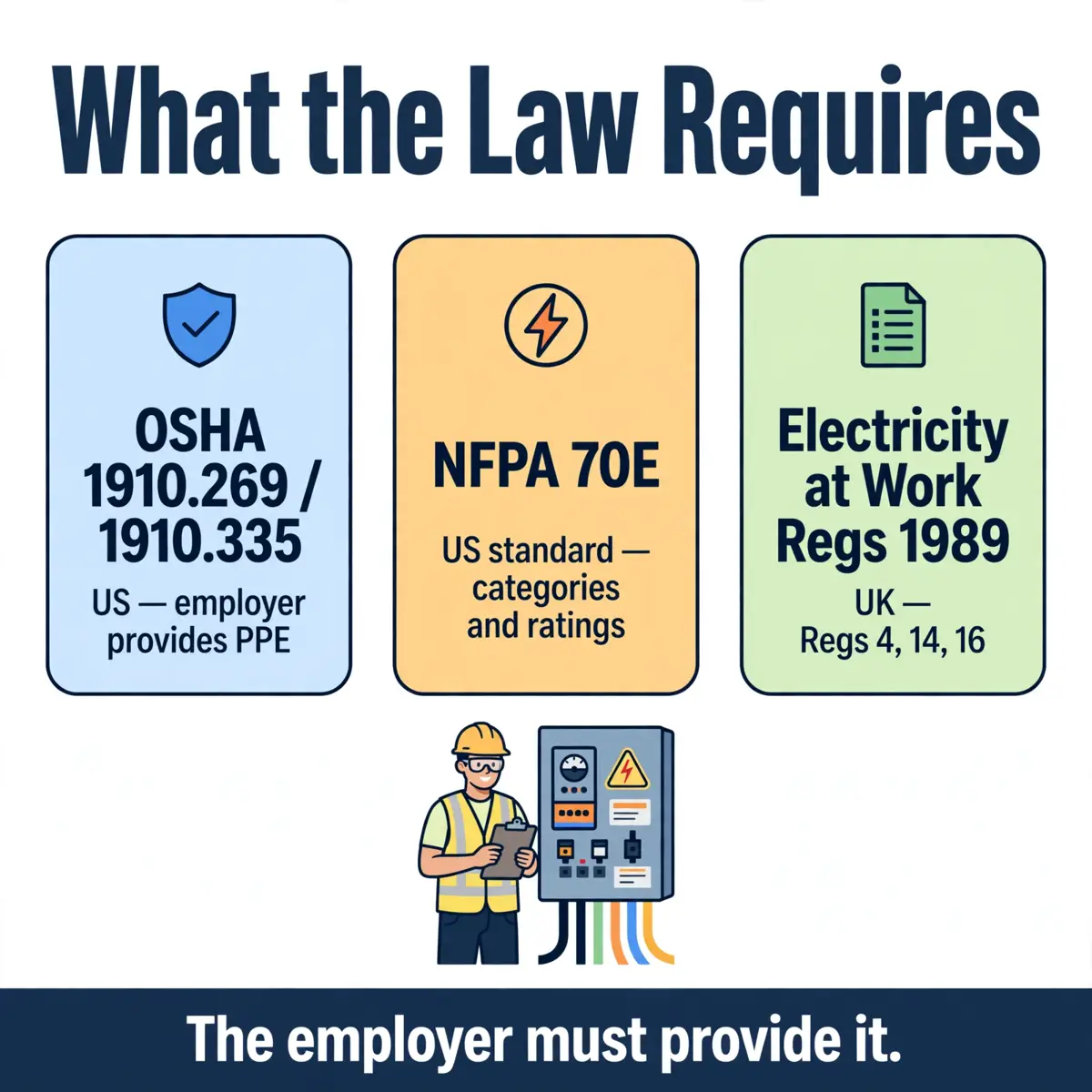
OSHA writes the duty and NFPA 70E supplies the method. The law says the employer must assess the hazard, estimate the energy and provide the protection. The consensus standard says how to do each of those things, and the ASTM and IEC standards say what the gear itself must be. A US search market does not establish US jurisdiction. The rules below are attributed to the place they belong to.
NFPA 70E is a consensus standard, not a law. OSHA enforces the duty through its own regulations, and it recognizes NFPA 70E as a way to meet that duty. The current edition of NFPA 70E is the 2027 edition, in effect since 6 May 2026. It adds a requirement for an additional person to be present when a worker is at risk of injury from justified energized work.
United States
In general industry, OSHA's rule at 29 CFR 1910.335 requires employees working where there are potential electrical hazards to be provided with. To use, electrical protective equipment appropriate for the specific parts of the body to be protected and for the work performed. The same rule requires nonconductive head protection where there is a danger of head injury from electric shock or burns, eye or face protection where there is danger of injury from electric arcs or flashes. Insulated tools where tools might contact exposed energized parts.
For electric power work, 29 CFR 1910.269(l)(8) is the specific rule. The employer must assess the workplace for flame and electric arc hazards, make a reasonable estimate of the incident heat energy for each exposed employee. Ensure the employee wears clothing and equipment with an arc rating at or above the estimate whenever the estimate exceeds 2.0 cal/cm². The rule also prohibits clothing that could melt onto the skin or ignite and continue to burn. It sets the head and face thresholds described earlier in the kit section.
Electrical protective equipment itself is governed by 29 CFR 1910.137, which covers design, in-service care and use, and the testing intervals for rubber insulating equipment. The general PPE rule at 29 CFR 1910.132 requires the employer to assess the hazards of each task, select the PPE that controls them. Provide the required PPE at no cost to the employee. OSHA training requirements and the PPE requirements employers must meet are covered separately on this site.
Great Britain
In Great Britain, the legal duties come from the Electricity at Work Regulations 1989. Regulation 4(1) requires all systems to be of such construction as to prevent danger, so far as is reasonably practicable. Regulation 4(4) requires any protective equipment provided under the Regulations to be suitable for the use it is provided for, maintained in a condition suitable for that use, and properly used.
Regulation 14 is the live-working rule. No person may work on or near a live conductor that may give rise to danger unless it is unreasonable in all the circumstances to make the conductor dead, it is reasonable to work live, and suitable precautions are taken.
Regulation 16 requires the person to be competent, or supervised to the degree the work needs. HSE states that around 1,000 workplace electrical incidents are reported each year, with around 25 people a year dying from their injuries. The Personal Protective Equipment at Work Regulations 1992 require the employer to provide suitable PPE where risks cannot be controlled another way.
Europe and the Rest of the World
In Europe, arc-rated clothing is certified to EN 61482-2, with the open arc test of EN 61482-1-1 giving an ELIM, ATPV or EBT value, or the box test of EN 61482-1-2 giving Arc Protection Class 1 or 2. The European categories are not the same as the NFPA 70E PPE categories, so a garment bought to one system is not selected by the other's numbers. A buyer checks which system the site's risk assessment uses, and selects to that system's rating.
Canada uses CSA Z462, Workplace Electrical Safety, which mirrors NFPA 70E's approach with its own category tables. Wherever the work is done, the principle is the same: the rating on the garment must be at or above the energy the worker could face, the base layer must not melt. The work is done dead whenever that is reasonably possible. NFPA 70E is not legally binding in Great Britain or in Canada; the local regulations carry the duty.
Common Mistakes
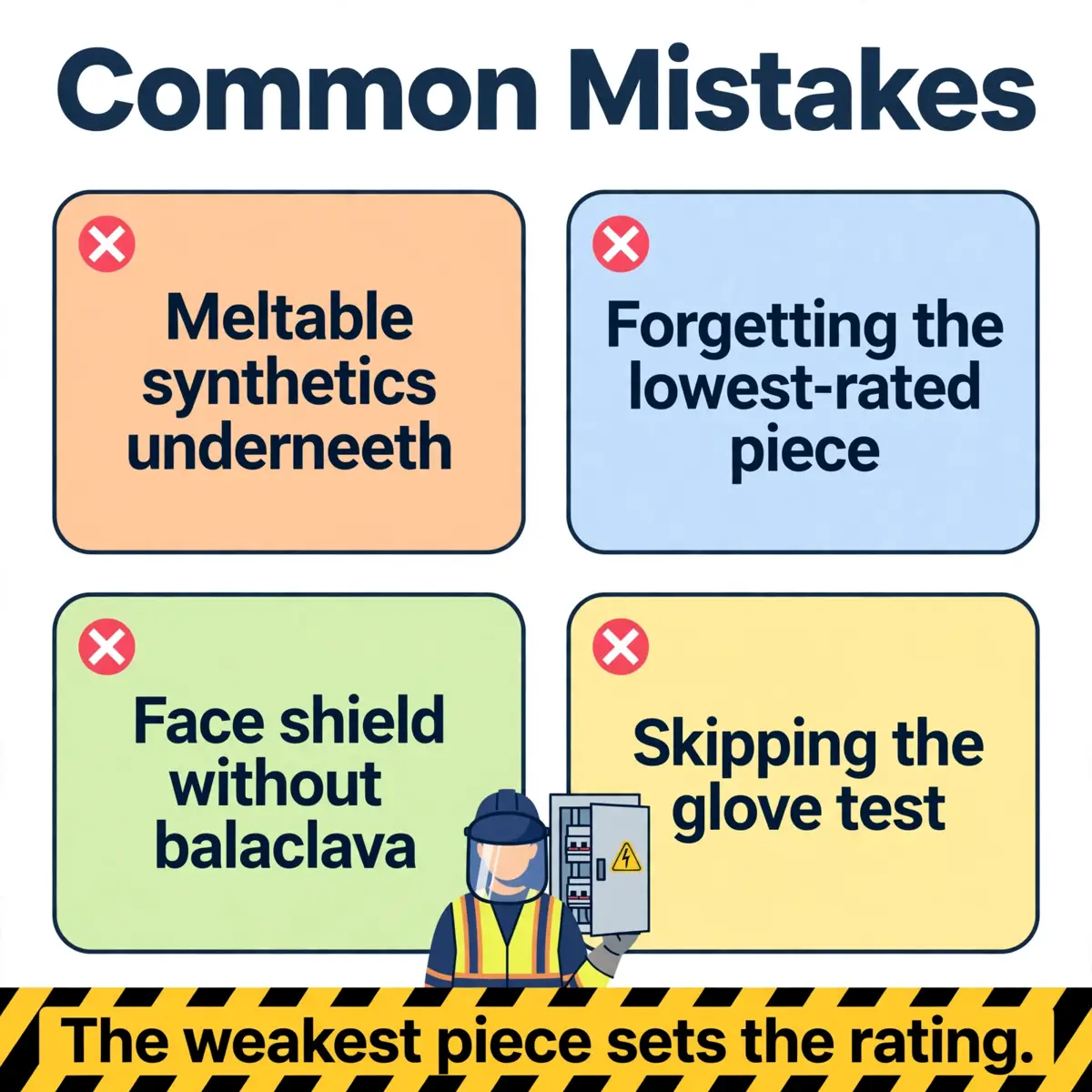
Most arc flash injuries do not come from a missing suit. They come from a suit that was almost right: the wrong rating, the wrong layer, the wrong gloves, or the right gear worn the wrong way. These are the mistakes that recur on real jobs, and each one has a simple check that prevents it.
- Wearing PPE rated below the incident energy. A 12 cal suit on a 25 cal bus is a worker who is dressed and exposed at the same time.
- Putting a meltable synthetic shirt next to the skin. Polyester or nylon under arc-rated clothing melts into a worse burn than the arc alone.
- Reading a cal value off a label and using it to pick a PPE category. The two selection methods must never be mixed on the same equipment.
- Treating rubber insulating gloves as arc protection. Rubber is for shock; arc-rated gloves are for heat. Energized work usually needs both.
- Working with rubber gloves past their test date. A glove past its six-month retest is treated as failed until it is retested.
- Reaching for the arc suit first. De-energize gear that could have been shut down and locked out instead of suiting up for it.
- Wearing a high-rated suit with a lower-rated hood. The head becomes the weak point, at the most exposed part of the worker.
- Keeping a contaminated or holed garment in service. Flammable contamination and holes break the rating at the spot they appear, and no field repair restores it.
Every one of these mistakes is visible before the work starts. The label, the tag, the base layer, the glove test date and the inspection take minutes. They are the difference between a suit that protects and a suit that only looks like it does.
Frequently Asked Questions
What Cal Rating PPE Do I Need for Arc Flash?
Read the incident energy in cal/cm² off the arc flash label on the specific piece of equipment, then select PPE with an arc rating at or above it, with margin to spare. A 9.5 cal label needs a system rated comfortably above 9.5 cal, such as a 12 cal system. If there is no study or label, use the NFPA 70E PPE category tables within their stated limits.
What is the Difference Between Atpv and Ebt?
ATPV, the arc thermal performance value, is the incident energy at which there is a 50 percent probability of a second-degree burn through the fabric. EBT, the energy breakopen threshold, is the energy at which the fabric breaks open. A fabric is assigned whichever value it reaches first in the ASTM F1959 test, and that is its arc rating.
Is Flame-Resistant Clothing the Same as Arc-Rated Clothing?
No. Flame-resistant clothing resists igniting and self-extinguishes when the flame source is removed. Arc-rated clothing is flame-resistant and has also been tested and assigned an arc rating in cal/cm². Every arc-rated garment is flame-resistant, but not every flame-resistant garment is arc-rated. For arc work the tag must show a cal/cm² rating and ASTM F1506 compliance.
What Should I Wear Under Arc Flash PPE?
The layer next to the skin must be arc-rated or an untreated natural fibre such as cotton, wool or silk. Meltable synthetics such as polyester, nylon, acetate, rayon and polypropylene are prohibited next to the skin under arc-rated clothing, because they melt under arc heat and stick to the skin. Plain cotton on its own is not arc-rated PPE.
How Often Do Rubber Insulating Gloves Need to Be Tested?
Rubber insulating gloves must be electrically tested before they are first issued and every six months after that, plus whenever their insulating value is suspect, after any repair, or after they have been used without leather protectors. Gloves tested but never issued may not be placed into service unless the test was within the previous 12 months. Before each day's use, the wearer inspects the gloves and air-tests them for leaks.
Can I Work on Equipment Above 40 cal/cm² with a Bigger Suit?
No. NFPA 70E's category tables stop at 40 cal/cm². The standard treats work above that level as a stop: the equipment must be de-energized. Suits rated 65, 100 or 140 cal/cm² are sold and are specified by the incident energy number on the label rather than by a category. Buying a bigger suit is not a substitute for the de-energize-first rule.
Does Arc Flash PPE Expire?
No manufacturer prints an expiration date on an arc flash suit or garment. The arc rating does not wash out when the garment is laundered the right way. A suit is retired for condition, not age. Retire it after any exposure to an arc. Retire it too when it has a hole, a burn, flammable contamination that will not wash out, or a broken closure. Rubber gloves are different — they are retired by the calendar, with a six-month retest.
Do I Need Arc Flash Gear for 480 V Work?
Voltage is not the number that decides it; incident energy is. A 480 V motor control centre can have an incident energy of a few cal/cm² or well above 40, depending on the available fault current and the clearing time of the upstream protection. Two 480 V panels in the same plant can carry different categories, which is why the label on the specific gear is read before the work starts.
Sources
- NFPA — NFPA 70E, Standard for Electrical Safety in the Workplace (2027 edition)
- OSHA — 29 CFR 1910.269, Electric power generation, transmission, and distribution (e-CFR text)
- OSHA — 29 CFR 1910.335, Safeguards for personnel protection (e-CFR text)
- OSHA — 29 CFR 1910.137, Electrical protective equipment (e-CFR text)
- OSHA — Fact Sheet: Electrical Protective Equipment Requirements (FS-3875, November 2016)
- OSHA — Interpretation letter: Heat energy estimates for arc-rated protective clothing and faceshields (2 October 2015)
- OSHA — Interpretation letter: Electrical protective equipment, testing intervals for rubber insulating gloves (19 August 2020)
- Tyndale USA — How It's Tested, Episode 4: ASTM F1506, the Big Two Tests for Arc Protection
- Tyndale USA — How It's Tested, Episode 7: ASTM F1959, the Arc Rating Test
- Sioen — EN 61482-2: Protective clothing against the thermal hazards of an electric arc
- Legislation.gov.uk — The Electricity at Work Regulations 1989, Regulation 14 (work on or near live conductors)
- HSE — HSG85, Electricity at work: Safe working practices (3rd edition, 2013)